
Results for

Market news – Week 1, October 2022
Last week, rising interest rates, extreme volatility in the currency and bond markets, and concerns about a recession fueled the uncertainty that plagued traders in recent weeks.
Last week, rising interest rates, extreme volatility in the currency and bond markets, and concerns about a recession fueled the uncertainty that plagued traders in recent weeks.
Forex

The EUR/USD pair began last week on the back foot, dropping to just under $0.9540 before reversing course mid-week to make significant gains. It finished the week at around $0.9800.
Rising energy prices prompted another surge in European inflation, with the eurozone announcing that its key inflation index grew at an annual rate of 10% in September, up from 9.1% in August.
A possible concern of the European Central Bank (ECB) is that an increase in borrowing rates in Europe might harm debt-ridden nations. However, the ECB is expected to raise its main refinancing rate on Thursday, 27 October, with a 0.75% increase to keep up with the US central bank.
The EUR/USD may have responded to US inflation statistics, which indicated that consumer prices remain high. The United States consumer expenditure data also increased, indicating that the American people continue to be purchasers even as inflation rises.
By the end of the week, GBP/USD had also reversed course and surged from $1.068 at the start of the week to roughly $1.168.
The UK government's aim to reduce taxes while encouraging economic progress has failed. After markets deemed the government's new economic policy unsuitable, the Bank of England (BOE) was compelled to interfere.The BOE indicated that it would temporarily purchase long-term UK government bonds (gilts) to restore market functioning. This instant reaction boosted the British pound.
This week, S&P Global will publish the final September Manufacturing Purchasing Managers' Index estimates for the EU and the US. The EU will release its respective August Retail Sales figures, while the US will end the week by releasing the September non-farm payrolls report. The country is predicted to have gained 250K new jobs this month, while the unemployment rate is expected to remain unchanged at 3.7%.
Because there will be no high-impact data releases from the UK this week, traders will pay careful attention to political headlines and movements in the UK gilt market.
Level up your trading strategy with the latest market news and trade CFDs on your Deriv X account.
Commodities
Last week saw an upward trend in gold prices, with it starting the week at $1,643 and ending at around $1,663. The gain in XAU/USD was attributed to the drop in global bond rates.
The BoE’s announcement to temporarily purchase long-term government bonds resulted in the 10-year US T-bond yield falling by more than 5% as the 10-year UK gilt yield fell by 10%, allowing the inversely-correlated gold to gain positive momentum.
This week, market players will carefully watch global bond markets. The UK gilt market appears to have steadied following the BoE's intervention. But traders may lose confidence rapidly if the UK government fails to address worries about the economy being pushed into an unsustainable debt path.
On the US side, non-farm payrolls (NFP) are due this week, and traders may perceive weaker-than-expected NFP growth as an excuse to sell the US dollar, opening the door for positive activity in XAU/USD ahead of the weekend. On the other hand, traders may aim to raise their long positions in the US dollar if the NFP rises quicker than expected.
Meanwhile, oil was on track for its first weekly increase in 5 weeks as traders anticipate this week's Organization of the Petroleum Exporting Countries (OPEC+) meeting, which might result in a production cutback plan to compensate for a weakening global economy.
Experts expect a reduction in output since increasing interest rates and worries of a worldwide economic recession have impacted oil prices.
Cryptocurrencies
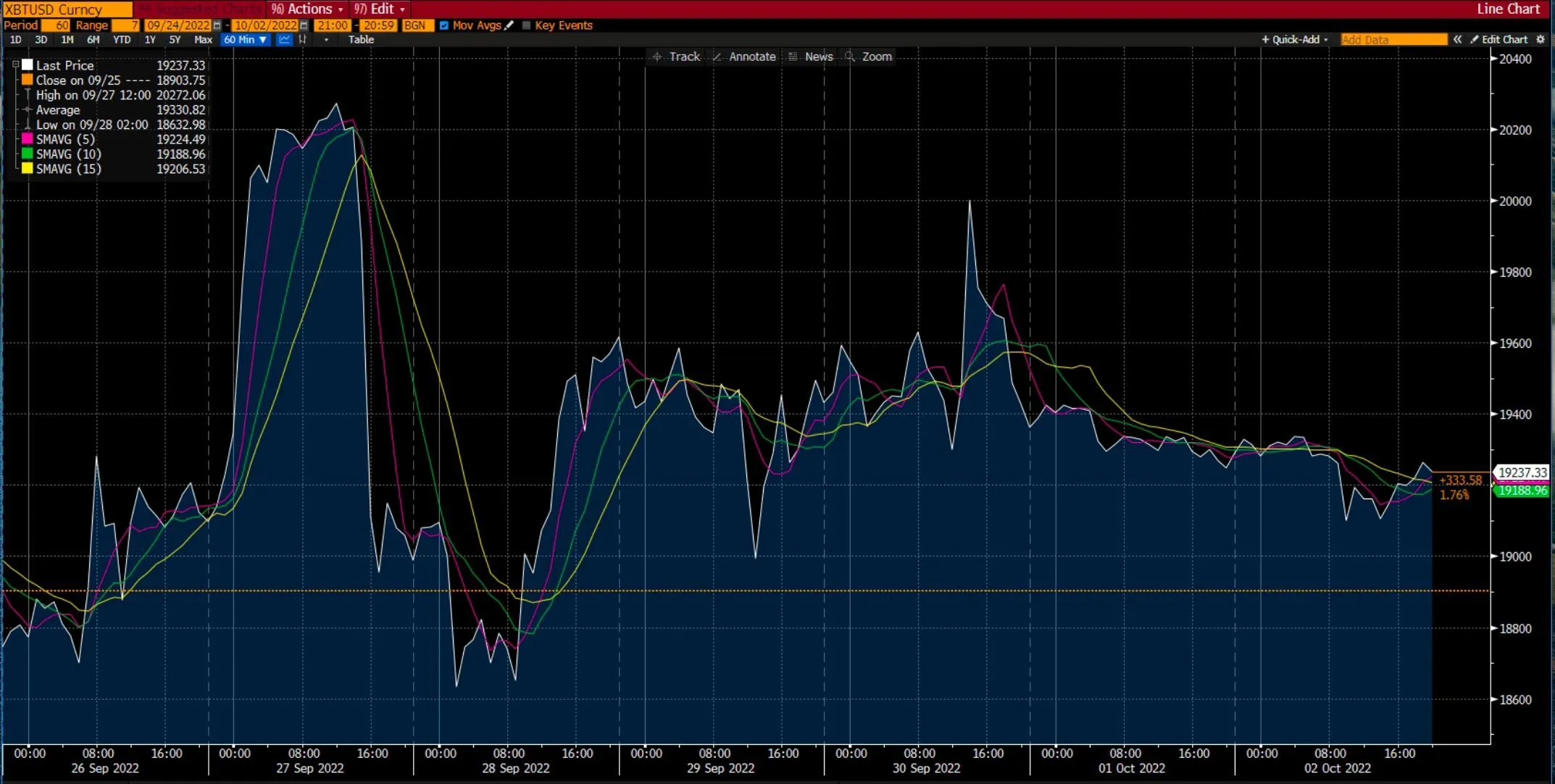
Over the last week, cryptocurrency values remained relatively unchanged, with the leading tokens posting small increases and losses.
As of Sunday, 2 October 2022, Bitcoin was trading around $19,230 after reaching its high on Friday, surpassing the $20,000 mark. Ethereum, on the other hand, was trading just around the $1,300 mark.
The highlight of last week was Elon Musk's texts, which were revealed ahead of his deposition. In these texts he suggested transferring Twitter (TWTR) to the blockchain, paying for it, integrating Dogecoin, and partnering with Sam Bankman-Fried of cryptocurrency exchange FTX, who was eager to throw $5 billion into the Twitter offer.
In other news, a funding round of $80 million has been raised by Bitcoin payments company Strike. Strike plans to introduce new products and establish partnerships to expand its customer base to include large financial institutions and businesses.
Take advantage of market opportunities by sharpening your trading strategy and trading the financial markets with options and multipliers on Deriv Trader.
US stock markets

*Net change and net change (%) are based on the weekly closing price change from Friday to Friday.
Stocks fell for the third week in a row due to turmoil in the UK financial markets and signals that the Federal Reserve (Fed) still has a long way to go in its attempts to contain inflation.
Even as the Fed tries to control inflation, a monthly inflation index used by the Fed to measure price movements has risen faster than expected.
According to the Personal Consumption Expenditures price index, excluding food and energy, consumer prices grew by 4.9% year on year (YoY) in August, up from 4.7% in the previous month.
In other news, Nike's earnings fell by 12.8% on Friday, 30 September 2022, after reporting a massive inventory growth (+44% YoY) in fiscal quarter 1 and warned of sustained gross margin pressure in fiscal quarter 2.
Energy (+1.8%) was the only sector to complete the week with a gain.
The monthly US labour market data for September is coming out this week on Friday, 7 October 2022. The economy added 315,000 new jobs in August, down from 526,000 in July, while the unemployment rate increased from 3.5% to 3.7%.
Now that you’re up-to-date on how the financial markets performed last week, you can improve your strategy and trade CFDs on Deriv MT5.

How to read stock market indices
Find out how you can read stock market indices to assess the performance of stock markets they represent.
This post was originally published by Deriv on 22 September 2022
A stock market index (or stock market indices if there is more than one) is a group of stocks used to measure the performance of a sector, stock market, or economy. A stock index usually consists of a set number of the top stocks of a particular exchange.
As a trader, understanding how to measure stock market indices is essential as it helps you assess the performance of a particular stock market, and through that, you can predict the pattern of stock market prices.
How are indexes weighted?
The most common way to read an index is to note the changes in its values over time.
In general, the value of a stock market index is based on the value of the individual stocks that make up that index. Because these prices change often, each stock market index is unique, and no two are entirely alike.
With different stocks and varying calculations, it is worth noting that every new stock market index has different starting values and should not be measured against each other.
In perspective, if one index goes up 300 points daily while the other goes up only 50, you may think the first index performed better than the second. However, if the first index was initially 50,000 while the second index started at 500, the second index had done better in percentage.
To analyse stock market indices, you should focus on the percentage of rise and fall instead of its point value, as a higher percentage gain means a more significant profit, while a higher percentage loss signifies a more considerable loss.
Note that most stock market indices do not measure the performance of the entire market but only show the general health of the sector, industry or economy they represent. Therefore, you can find out how each stock contributes to the index by understanding which stocks make up that particular index and how they are weighted.
Types of weighted index
There are 3 types of weighted indices, and they are categorised according to how the stocks influence the overall market index.
- Market capitalisation-weighted indices
- Equal weighted indices
- Price weighted indices
To properly read stock market indices, you’d need to know how much weight each stock would have on the index. There are separate ways of reading and analysing different weighted indices. This part will explore how each weighted index could be read.
Market capitalisation-weighted indices
Being the most common index weighting, market capitalisation-weighted indices consider stocks with a larger market capitalisation to have more influence and a more prominent weightage on the overall market index. These indices represent what a trader would earn if they purchased stocks of every company in the index.
Let’s look at an example index consisting of Company A, Company B, and Company C. Let’s say these companies have 7,500, 2,000, and 500 stocks, respectively, each priced at USD10, USD100, and USD500. In this example, Company A would have a lower market capitalisation at USD75,000, followed by Company B at USD200,000, leaving Company C with the highest market capitalisation at USD250,000.
If Company C’s stocks rise, it would have more of an impact on the value and percentage of the index compared to Company A having the same rise in stock prices. In the same way, if Company C’s stocks plummet, the value of this index will be more affected than if there were a massive decline in Company A’s stocks.
Equal weighted indices
As their name suggests, equal-weighted indices are affected equally by every company they consist of.
To find the value of this index, calculate the stock prices of each of these companies’ stocks by multiplying by the weight each company carries (calculated according to the number of companies in the index) and summing up to get the index value.

Looking back at the example above, there are 3 companies, meaning each would share one-third of the weight, or 33.3%, of each. Following this formula, the index value would be USD203.13.
Price weighted indices
Like market capitalisation-weighted indices, the value of price-weighted indices depends on the price of each stock. The difference is that with these indices, the price of each stock determines the percentage of influence it has on the index (with market capitalisation-weighted indices, the number of stocks the company has also influences the index).
Let’s look at the weightage of each company from the example above if they were price-weighted.

Based on the calculations above, the stocks in Company C would have more influence on the value of the index than those in Companies A and B.
Therefore, if there is a minor spike in Company C’s stock prices, it would have a more substantial effect on the overall stock index than a similar spike in Company A’s or B’s. On the other hand, a minor dip in Company C’s stock prices might have a similar effect on the index as a major dip in Company A’s stock prices.
Put this knowledge to the test by trading stock indices risk-free with our free demo account. You get 10,000 USD in virtual funds that can be reset if you run out. When you’re ready to trade, you can switch to a real account and trade your favourite indices on our platforms. Deriv MT5 offers CFD trading, while Deriv Bot and Deriv Trader allow you to trade options.

Market news – Week 2, September 2022
After a three-week losing streak, many markets saw gains last week as traders focused on Federal Reserve rate hikes, inflation, and the implications for the economy in the coming months.
After a three-week losing streak, many markets saw gains last week as traders focused on Federal Reserve rate hikes, inflation, and the implications for the economy in the coming months.
Forex
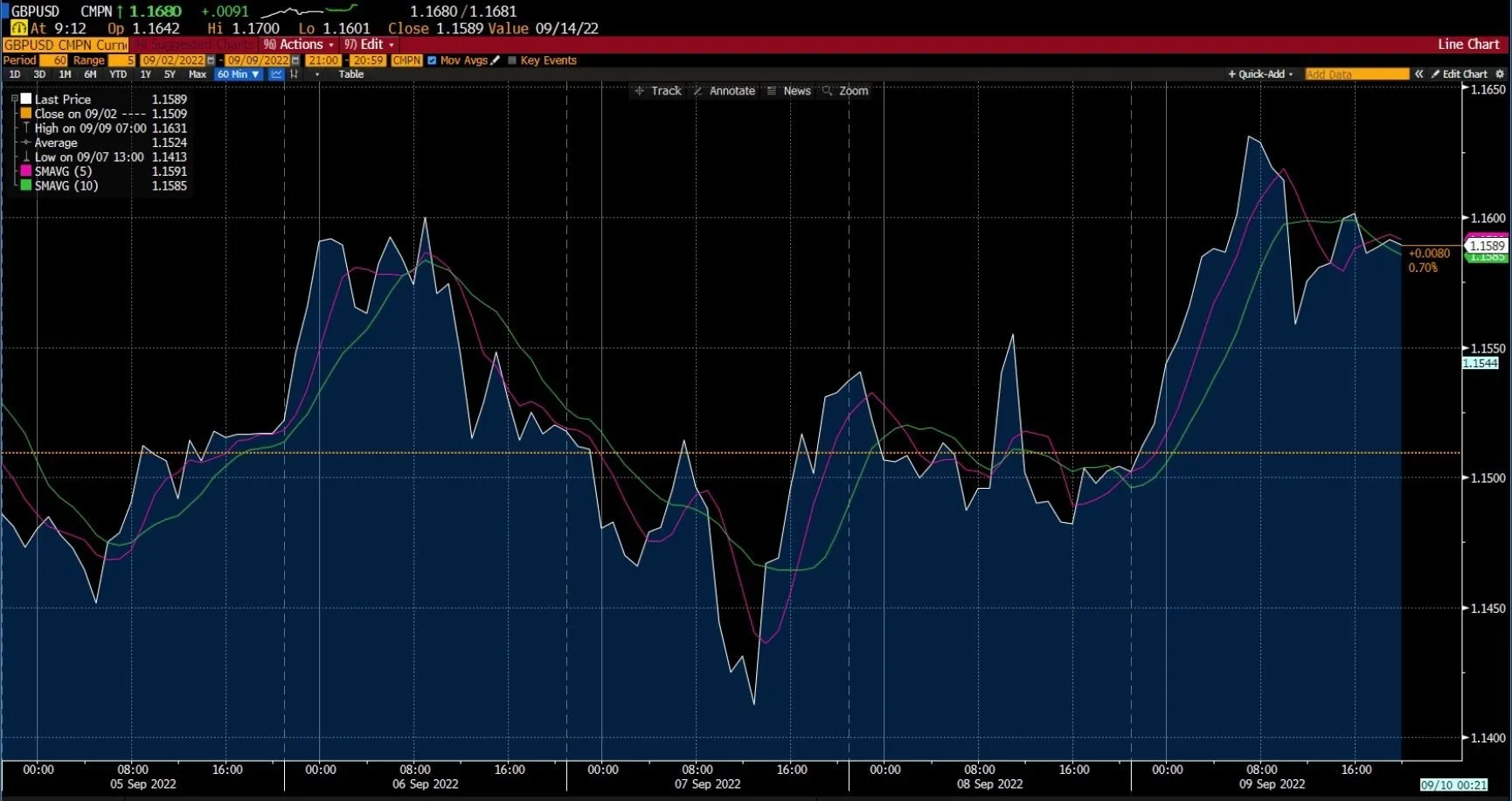
As the weekend approached, EUR/USD traded at $1.0047, up from $0.9932 at the start of the week.
This rise can be attributed to European and American authorities prioritising inflation control over growth stimulation. As expected, the European Central Bank (ECB) raised rates by 75 basis points. Additionally, the ECB pledged to keep raising rates as long as inflation remains high. Meanwhile, Fed Chairman Jerome Powell delivered an aggressive statement stating that the Central Bank must act strongly until inflation is reduced to 2%.
Following these events, German Bund rates reached their highest level in almost a decade. Rates on US Treasury bonds rose too, but they stayed below their weekly highs, preventing the US dollar's price from rising.
Meanwhile, GBP/USD ended a three-week losing skid and staged a remarkable recovery from four-decade lows of $1.1405. The markets' expectation that Britain's new Prime Minister, Liz Truss, will unveil a new economic package to address the energy crisis contributed to the pound's recovery from multi-decade lows.
This week, in addition to the Gross Domestic Product figures for the UK, the focus would be on the inflation metrics for the euro, British pound, and US dollar.
Level up your trading strategy with the latest market news and trade CFDs on your Deriv X Financial account.
Commodities
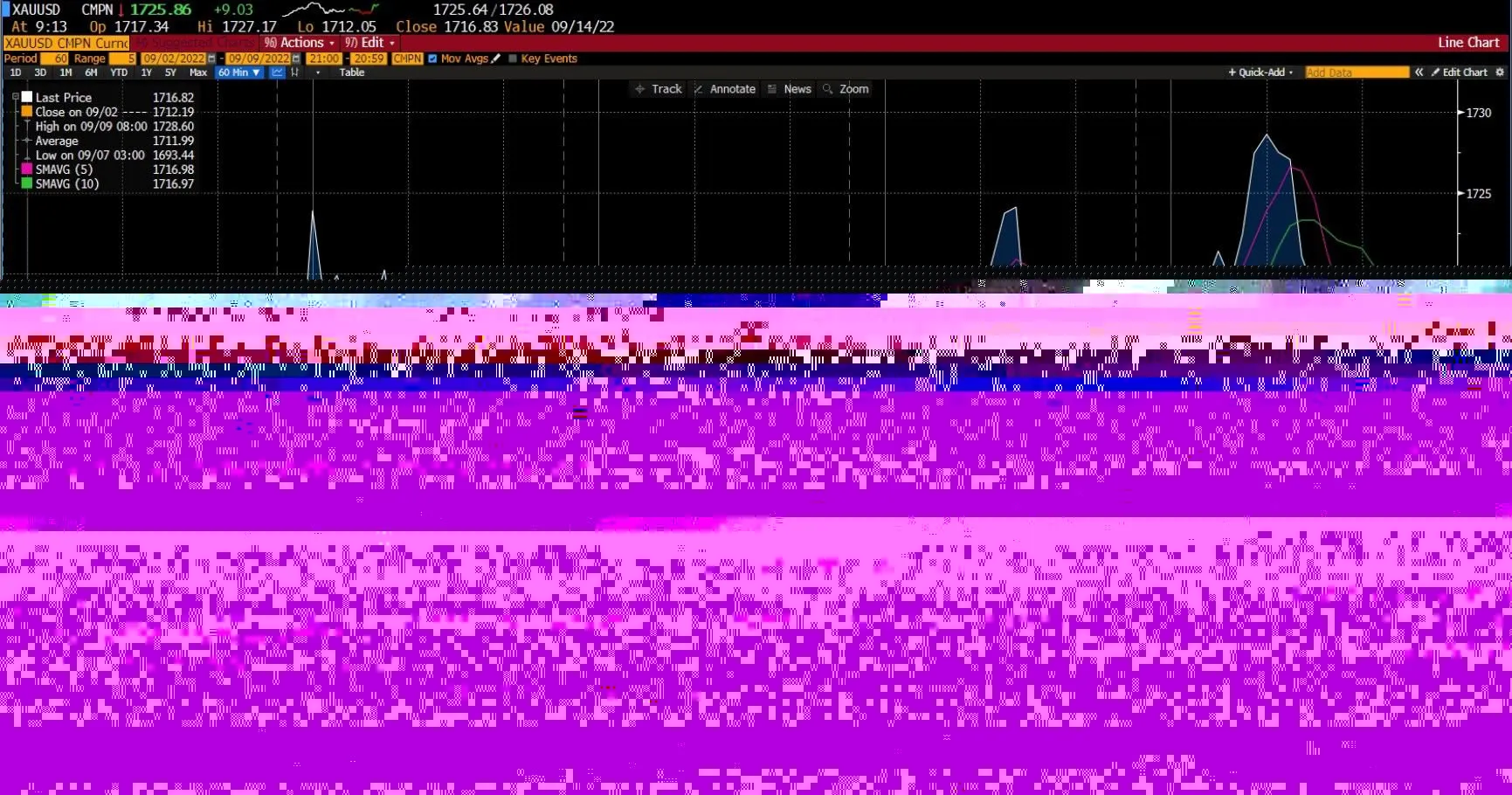
Gold began the week at $1,713.52 and had been trading in an Ascending Triangle pattern with an upward-sloping trendline drawn from Wednesday's low of $1,694.31.
With the US dollar under intense selling pressure on the first half of Friday 9 September 2022, gold extended its upward correction, reaching a ten-day high of approximately $1,730. However, the yellow metal failed to maintain its positive momentum. It barely changed below $1,720 in response to expectations that the Federal Reserve would continue raising interest rates and ended the week without a convincing move in either direction.
Meanwhile, WTI finished the week virtually unchanged in the last 7 days – closing at around $86 per barrel. At the start of the week, WTI and Brent fell to lows not seen since the beginning of the year.
This week, the spotlight will be on the release of inflation numbers in the US, which might cause a strong reaction. A drop in inflation expectations should hit the US dollar, whilst an unexpected rise might help the currency to gain strength and weigh on XAU/USD.
Cryptocurrencies
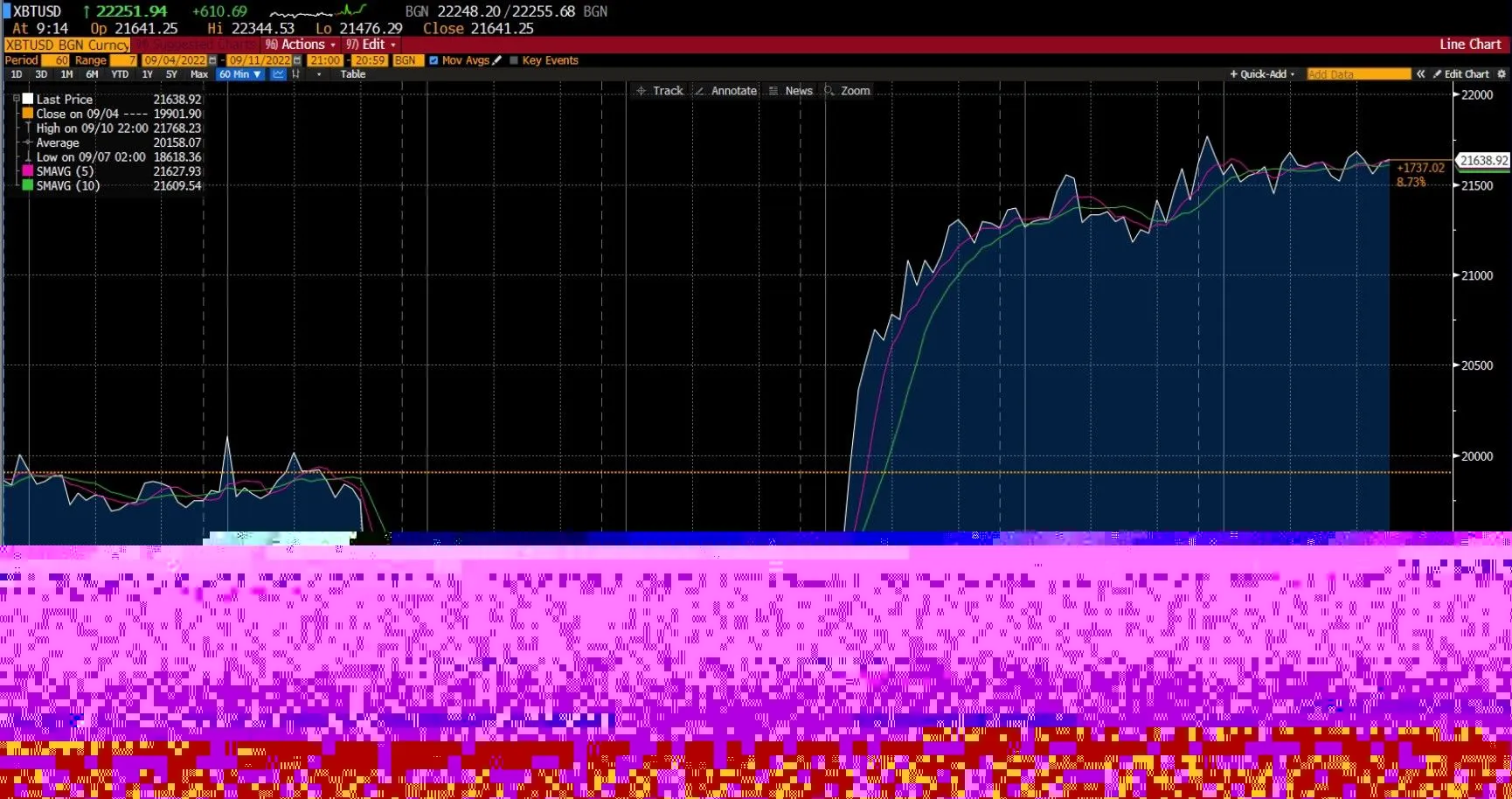
Cryptocurrencies experienced a volatile week. The global crypto market capitalisation fell below $1 trillion on Wednesday, 7 September 2022. Bitcoin was at the epicentre of market volatility, with its prices fluctuating between $18,000 and $21,000.
Bitcoin dropped by over 6% during the first half of the week. By mid-week, the most popular digital token was trading slightly below the $18,750 level and was close to testing the 2022 lows.
However, there was a big change in trend on Friday, 9 September 2022, when the largest cryptocurrency by market value rallied more than 10% to reach the $21,000 level, as seen in the chart. This was Bitcoin's most significant daily gain in 6 months.
At the end of the week, Bitcoin was trading at $21,638.92. The global cryptocurrency market capitalisation climbed back to cross the $1 trillion threshold, touching $1.06 trillion. In addition, the total crypto trading volume slightly increased to $72.92 billion.
Other cryptocurrencies, namely Ethereum, Litecoin, and Dogecoin, saw gains of 9%, 4%, and 2%, respectively, during the week.
The Ethereum merge is expected to take place this week and is likely to impact trading decisions.
Take advantage of market opportunities by sharpening your trading strategy and trading the financial markets with options and multipliers on Deriv Trader.
US stock markets
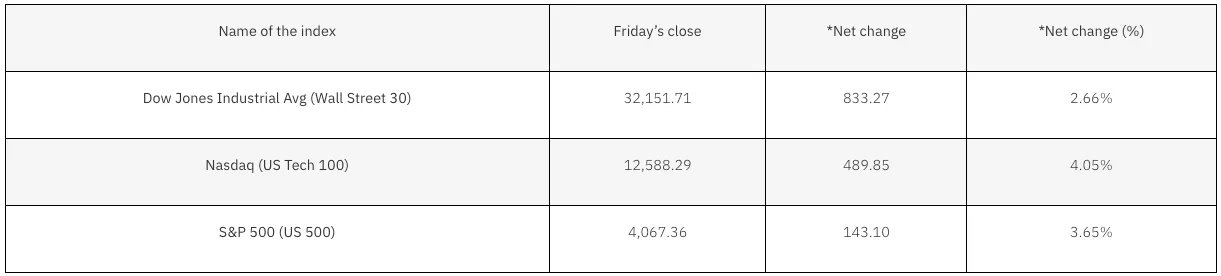
*Net change and net change (%) are based on the weekly closing price change from Friday to Friday.
The major averages ended a three-week losing streak on Friday, 9 September 2022, after rallying for three straight days. In the past week, the Dow gained by 2.66%, the S&P 500 rose by 3.65%, and the Nasdaq increased by 4.05%.
Stocks rallied after the Wednesday afternoon release of the Fed's "Beige Book", which summarises economic reports from its branch banks. The report indicated moderate price increases in 9 of its 12 districts. The report also highlighted some declines in the prices of steel, lumber, and copper.
Traders have become more confident that the market has reached a temporary bottom after it surrendered about half its summer rally.
Plus, the markets showed resilience to come out on top, despite Wall Street anticipating a 0.75 percentage point rate hike after Fed Chair Jerome Powell reaffirmed his commitment to bring inflation down.
We can expect an eventful week of economic reports, with the Consumer Price Index (CPI) providing the latest update on consumer inflation on Tuesday, 13 September 2022. The Producer Price Index (PPI) will follow on Wednesday, 14 September 2022.
Now that you’re up-to-date on how the financial markets performed last week, you can improve your strategy and trade CFDs on Deriv MT5.

Market news – Week 4, September 2022
Bears dominated the financial markets for the second week in a row. Inflation numbers from the previous week paved the way for the interest rate hikes that caused the markets to lose.
Bears dominated the financial markets for the second week in a row. Inflation numbers from the previous week paved the way for the interest rate hikes that caused the markets to lose.
Forex

The EUR/USD pair fell to $0.9689, down by approximately 3.35% for the week.
As expected and in reaction to higher-than-expected inflation in August, global policymakers raised rates dramatically to try to contain it and bring it down to more manageable levels. Despite the dangers such choices pose to economic development, the US Federal Reserve (the Fed) increased interest rates by 75bps.
Rising tensions between the European Union (EU) and Russia also dealt another blow to the EUR/USD pair. The war's intensification exacerbates Europe's energy problem as winter approaches, increasing the likelihood of a longer and worse recession.
Meanwhile, in the EU, market participants raised their expectations for a 50bps rise from the European Central Bank (ECB) in October, with a 75bps hike possibly on the table.
In other news, GBP/USD has fallen for two successive weeks now. The rate rise decisions by the Fed and the Bank of England highlighted the expanding policy divergence, while the Bank of England (BOE) disappointed the markets by raising interest rates by just 50bps instead of 75bps. This contributed to the pair's weekly loss of almost 400 pips.
This week will focus on the speeches from ECB President Christine Lagarde and Fed Chairman Jerome Powell. In terms of macroeconomic news, the GDP figures for the United States and the United Kingdom (Q2), as well as the Eurozone CPI, are due soon.
Level up your trading strategy with the latest market news and trade CFDs on your Deriv X account.
Commodities
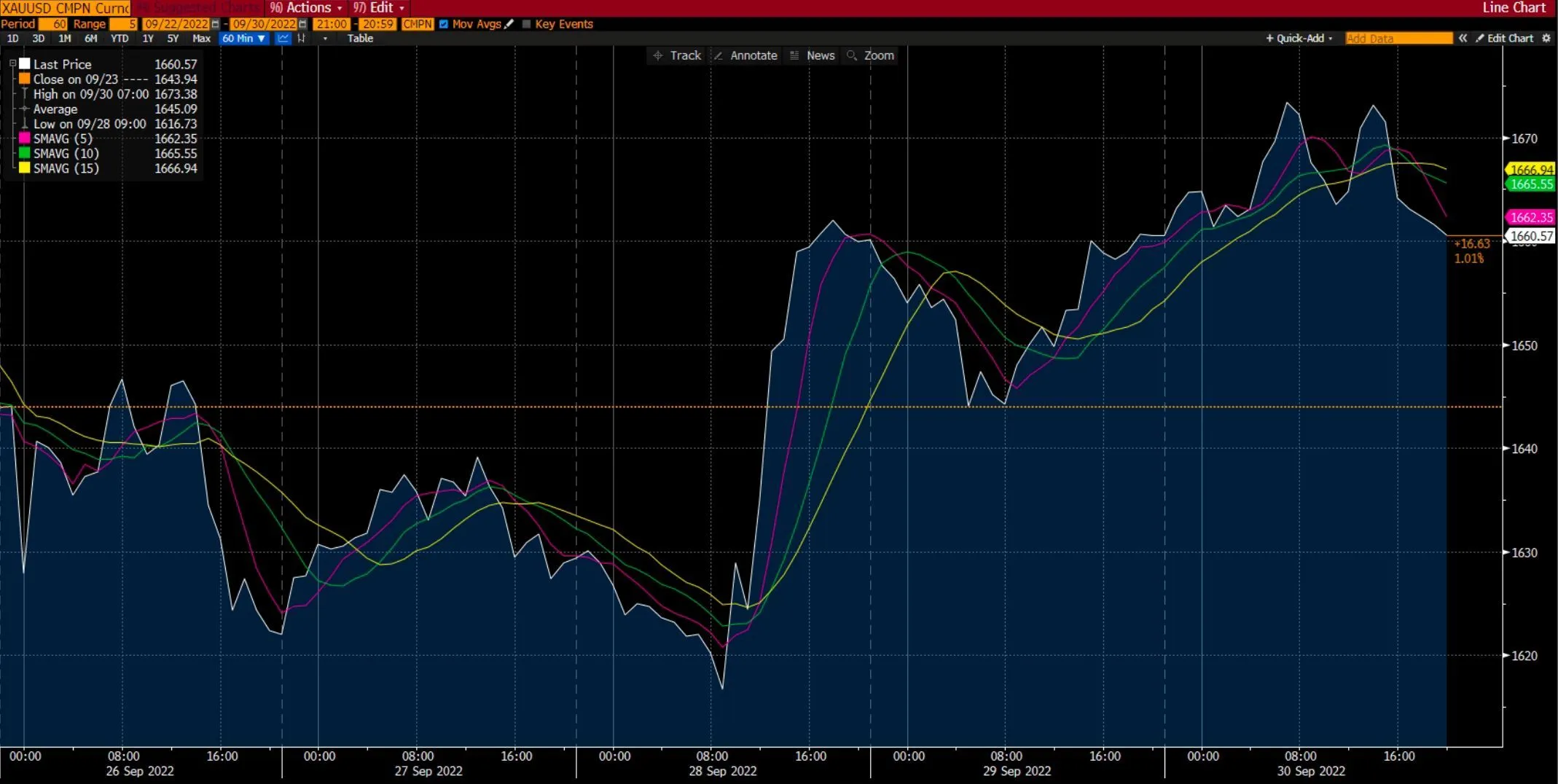
After rallying and remaining resilient for most of the week despite volatile market action, gold suffered hefty losses on Friday, losing nearly 2% on the week.
Gold's attractiveness has been dampened by rising US Treasury rates, particularly on the interest-rate sensitive short end. Given that the US interest rates have been climbing for months, the current situation is not unique.
As predicted, the Fed raised interest rates by 75bps, offering a lift to US Treasury bond rates and forcing gold prices further down.
Oil fell for the longest period in a row as central banks worldwide stepped up their fight against inflation at the expense of economic development.
Falling for the fourth consecutive week, WTI fell below $80 per barrel on Friday for the first time since January. Concerns about the global economy are causing crude to post its first quarterly loss in more than two years.
Investors will also be watching the Fed speech this week. Because the dollar is highly overbought, any upbeat words about the inflation outlook or comments that may be seen as less hawkish than Fed Chair Powell's announcement could pave the way for a major dollar drop and help gold recoup some of its losses.
Cryptocurrencies
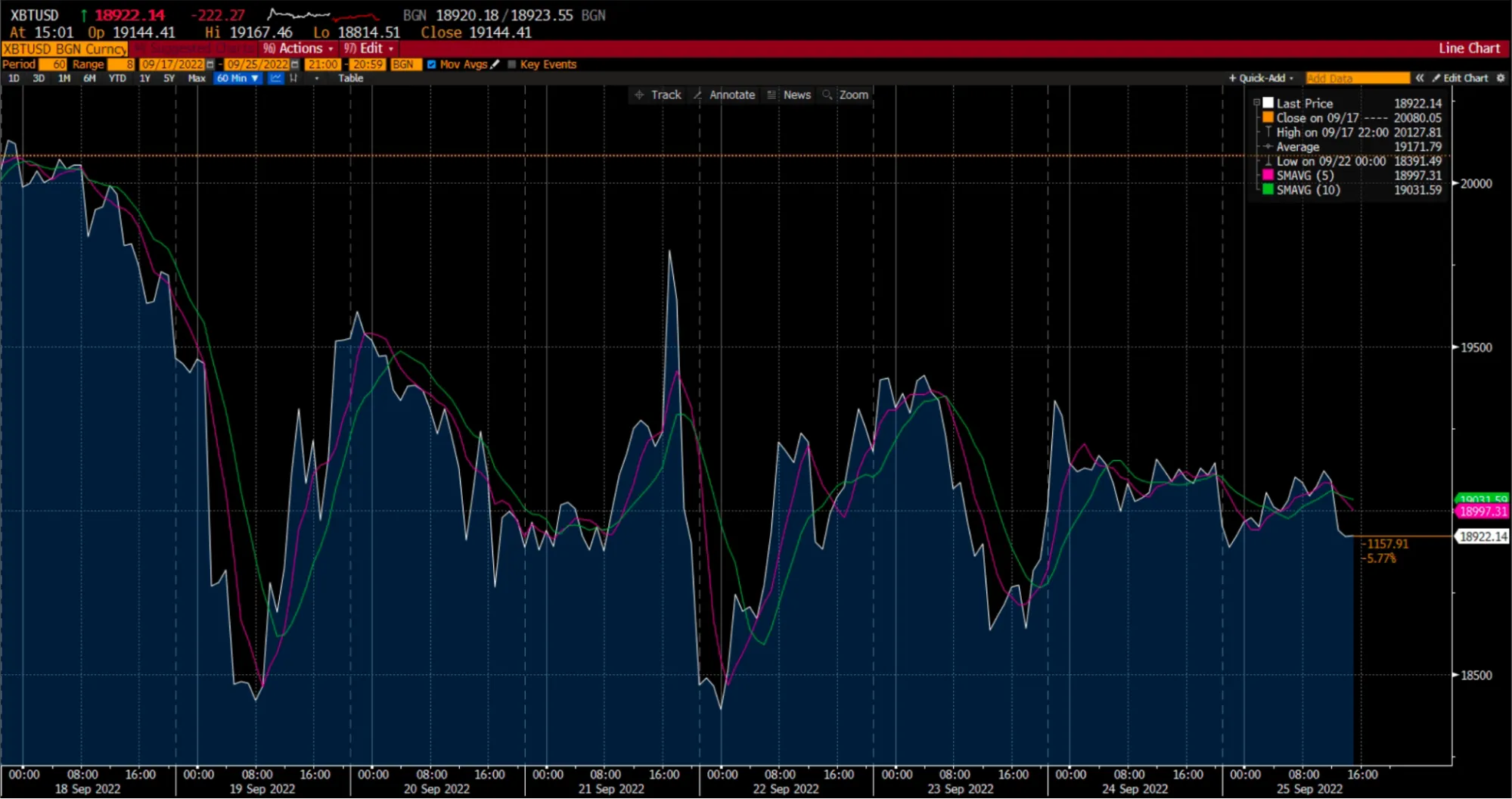
Cryptocurrency prices fell on Friday after a hectic week that featured an interest rate rise and regulatory measures. The White House presented its cryptocurrency regulatory framework – this includes the US Securities and Exchange Commission (SEC) claiming authority over Ethereum and the Internal Revenue Service now pursuing crypto tax evaders.
After rising above $19,400 earlier in the day, Bitcoin fell to roughly $18,800 after the market closed on Friday. Meanwhile, Ethereum dropped below $1,300, losing nearly 12% in the previous seven days. One of the major factors that contributed to this drop was the Ethereum switch to a proof-of-stake network, which may lead to future regulations on ETH.
In other news, Warren Buffett has criticised cryptocurrencies, claiming they have no fundamental value. This criticism has kept Berkshire Hathaway (BRKB) away from digital banking, crypto businesses, and non-traditional financial firms. However, new SEC filings by Buffett indicate that he may be opening up to some of these more risky assets, at least indirectly.
Take advantage of market opportunities by sharpening your trading strategy and trading the financial markets with options and multipliers on Deriv Trader.
US stock markets
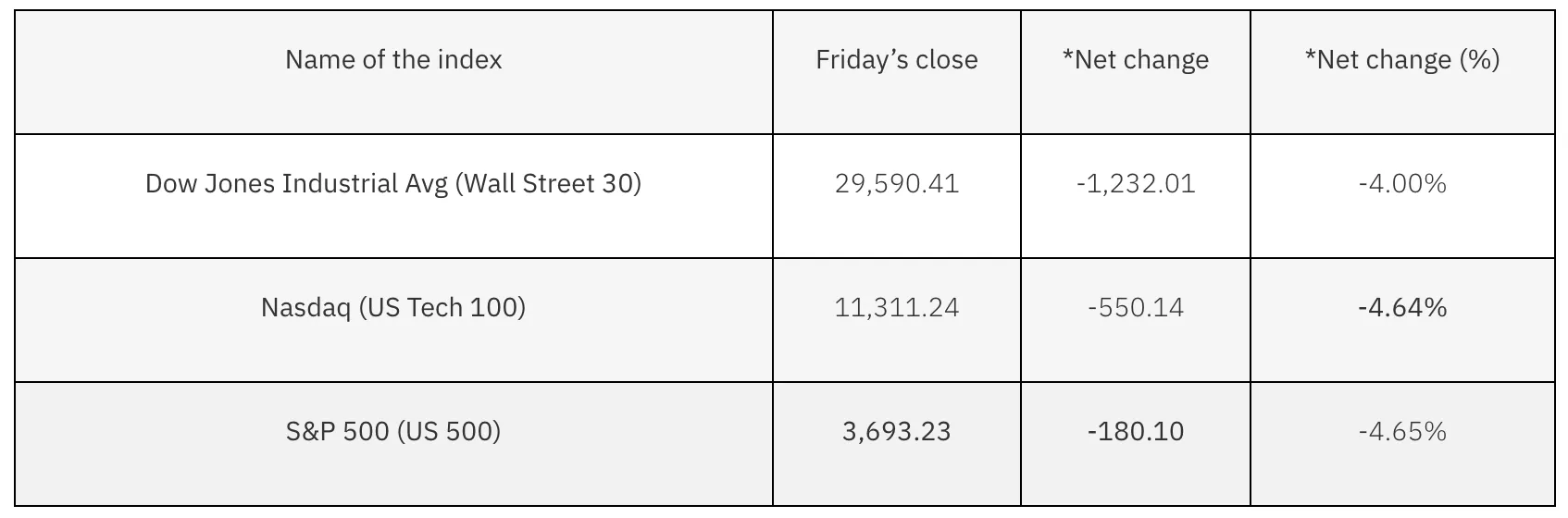
*Net change and net change (%) are based on the weekly closing price change from Friday to Friday.
Last week, the Fed was fully in control of the markets, with the stock market reeling and interest rates rising as investors absorbed the likelihood of more aggressive rate rises ahead. As part of the Fed's effort to bring down excessive inflation, it raised its policy rate by 75bps and boosted its forecast for future rises.
The 10-year US Treasury bond yield increased for the ninth week in a row, reaching roughly 3.69% on Friday up from around 3.45% from the previous week.
Dow Jones was down by 4%, Nasdaq fell by 4.64%, and S&P 500 was down by 4.65%.
Stocks rose more than around 17% from mid-June to mid-August, owing to a growing consensus belief that the Fed would refrain from raising interest rates in the short term. While the CPI did drop to 8.3% year-on-year in August, the report disappointed on a month-over-month basis, with inflation rising 0.1%, presumably supporting the Fed's more hawkish language last week.
Concerns about rising interest rates and the greater likelihood of a recession drove equities into a bear market in June, and the resurgence of those concerns has pushed stocks back to midsummer lows.
Now that you’re up-to-date on how the financial markets performed last week, you can improve your strategy and trade CFDs on Deriv MT5.

Market news – Week 3, October 2022
Last week, the financial markets displayed a welcome resilience despite inflation data adding to traders' concerns about future interest rate hikes.
Last week, the financial markets displayed a welcome resilience despite inflation data adding to traders' concerns about future interest rate hikes.
Forex
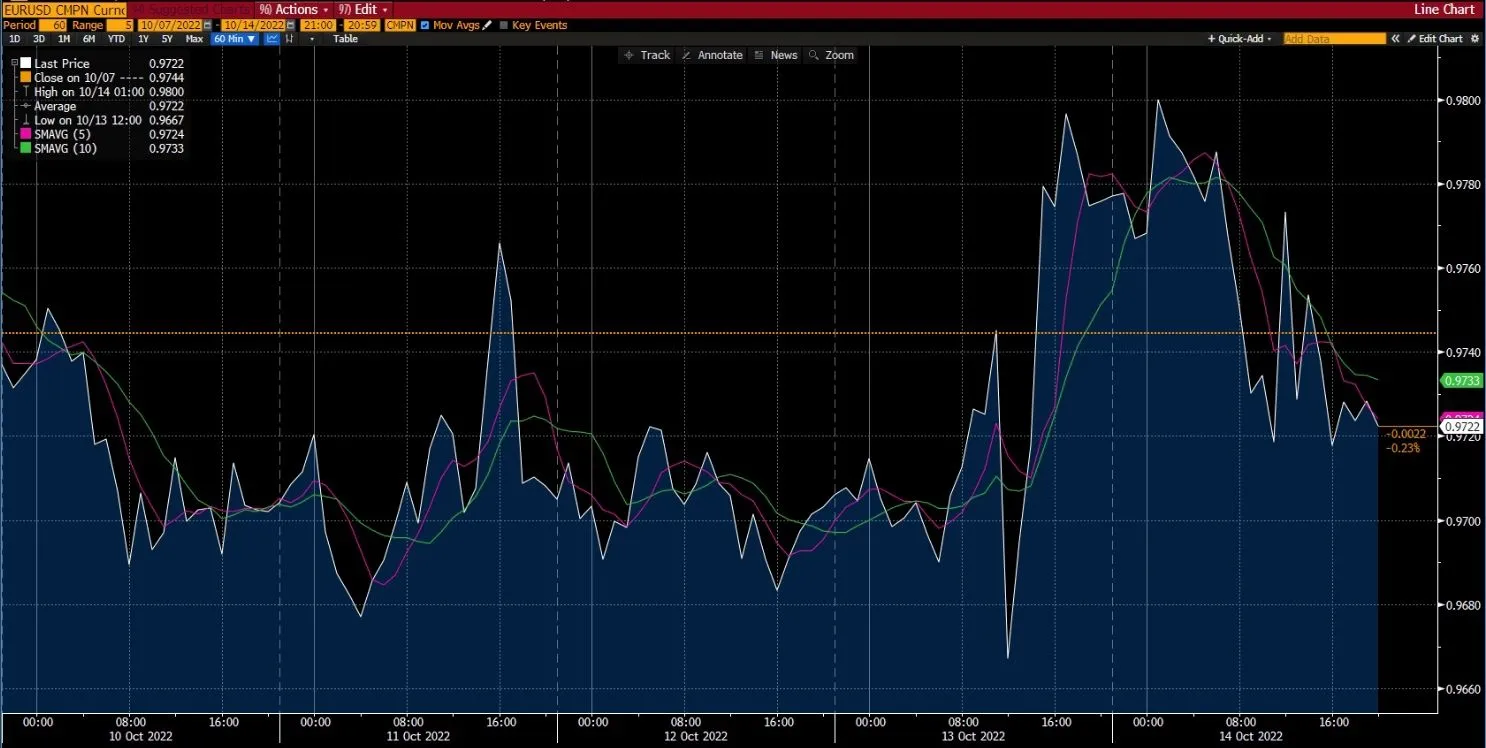
Last week, EUR/USD stayed flat and traded around $0.9721. Despite easing for a third straight month, the US Consumer Price Index (CPI) for September fell short of market expectations of 8.1% as the figure hit the 8.2% mark on a year-on-year (YoY) basis. However, core inflation increased to a record high of 6.6% YoY.
Furthermore, in the European Union, Germany confirmed that annual inflation rose by 10.9% in September 2022. Two rate hikes have been delivered by the European Central Bank (ECB), totalling 125bps – this is well below the Federal Reserve's 300bps (Fed). However, more rate hikes may occur at the Fed and ECB's next 2 monetary policy meetings, which are due before the end of the year.
GBP/USD, on the other hand, recovered from the previous week’s decline and was trading around $1.1183 for the week. The reason for it going up was mainly attributed to the Bank of England (BoE) gaining support for its recent bond-buying programme aimed at addressing a financial stability concern.
In this week's economic news, the EU releases its final Consumer Price Index for September 2022.
Level up your trading strategy with the latest market news and trade CFDs on your Deriv X account.
Commodities
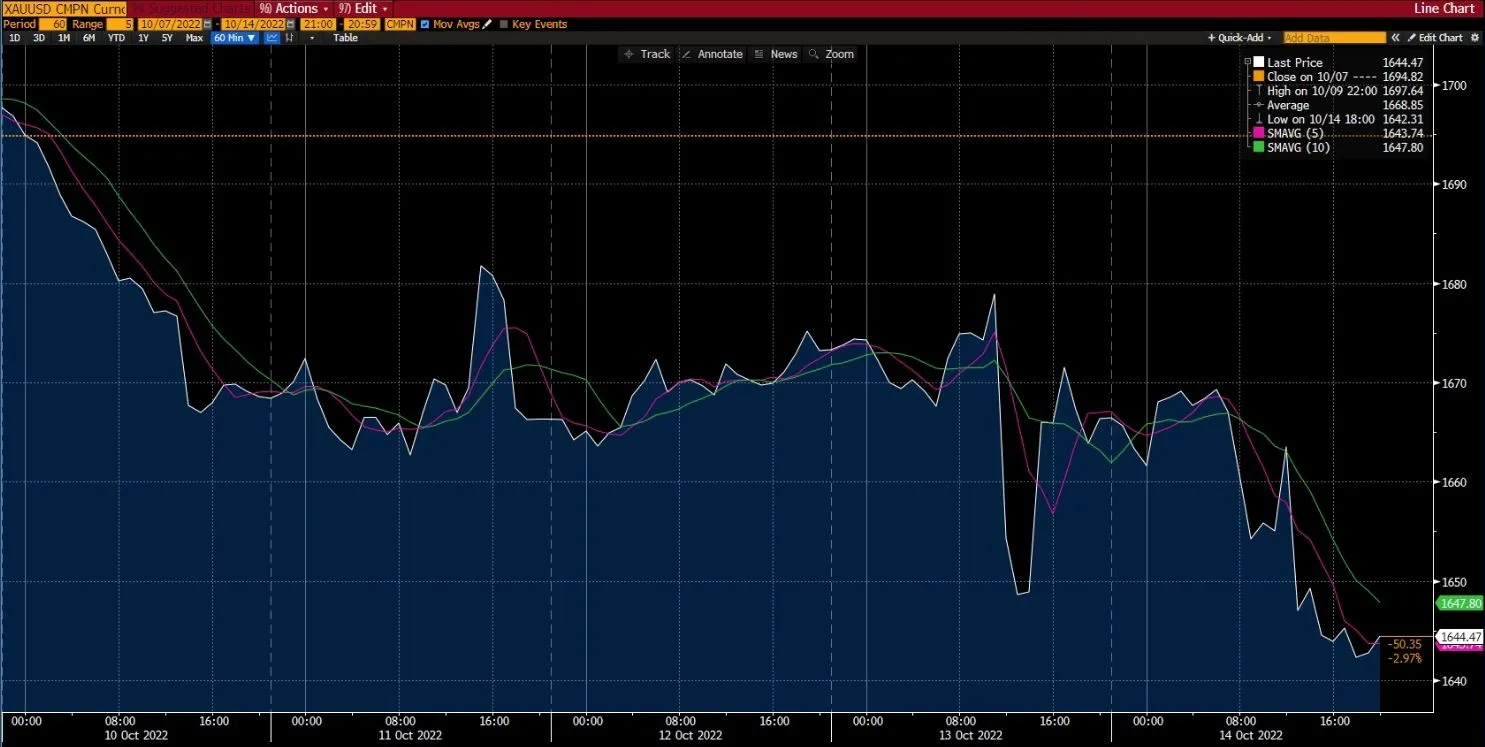
XAU/USD broke its two-week winning streak and experienced its worst week in nearly 2 months. The yellow metal dropped by more than 2% for the week. Consumer prices in the US increased more than expected in September, providing the Fed with ammunition to raise rates again.
Meanwhile, a strong US dollar impacted silver 8 days in a row, which has fueled hopes that the Fed will announce a fourth consecutive 75bps rate hike in November. The CPI figures also confirm that inflation pressures remain consistent, enabling the Fed to keep raising interest rates.
Moreover, following a set of downbeat macroeconomic data, traders are becoming more wary of the greenback as a safe haven.
Oil dropped by more than 3% on Friday, 14 October 2022. Despite the production cutbacks offered by the Organization of the Petroleum Exporting Countries (OPEC+) to reduce supply and increase oil prices, the value of oil dropped due to concerns about a worldwide recession and sluggish oil demand, notably in China.
Cryptocurrencies
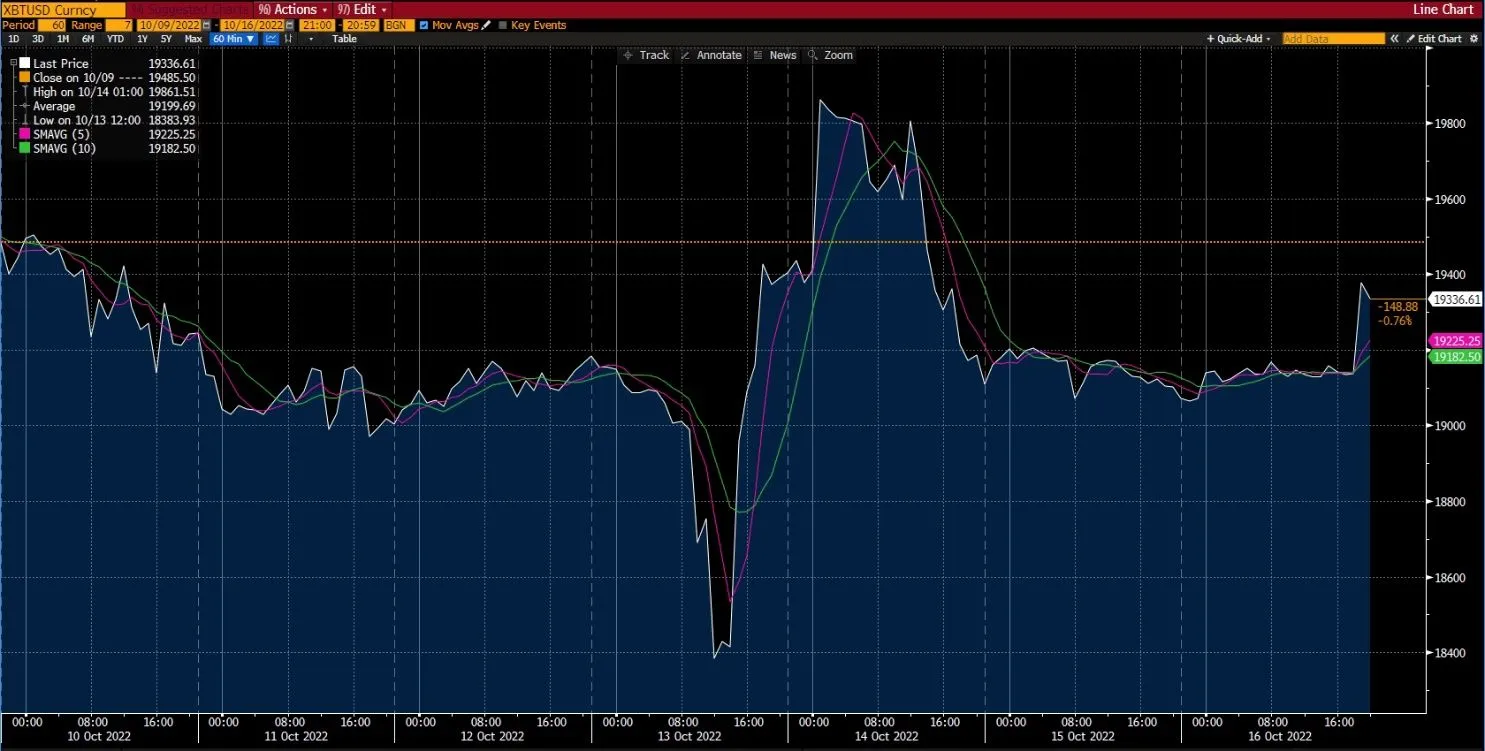
The global cryptocurrency market experienced slight volatility as traders' sentiments shifted during the week. Currently, the total cryptocurrency market capitalisation is near $900 billion.
On Thursday, 13 October 2022, Bitcoin plummeted from $19,100 to a multi-week low of $18,400 due to the latest US inflation numbers release. The cryptocurrency then bounced back and climbed to reach almost $20,000 for the first time in over a week, resulting in increased market volatility. At Sunday's close, the largest cryptocurrency in the world by market capitalisation was trading at $19,336.61.
Ethereum, on the other hand, was trading sideways and initially couldn't breach its resistance level at the $1,300 level. However, it successfully surpassed that mark towards the end of the week, and was trading at $1,310 at the time of writing.
Take advantage of market opportunities by sharpening your trading strategy and trading the financial markets with options and multipliers on Deriv Trader.
US stock markets
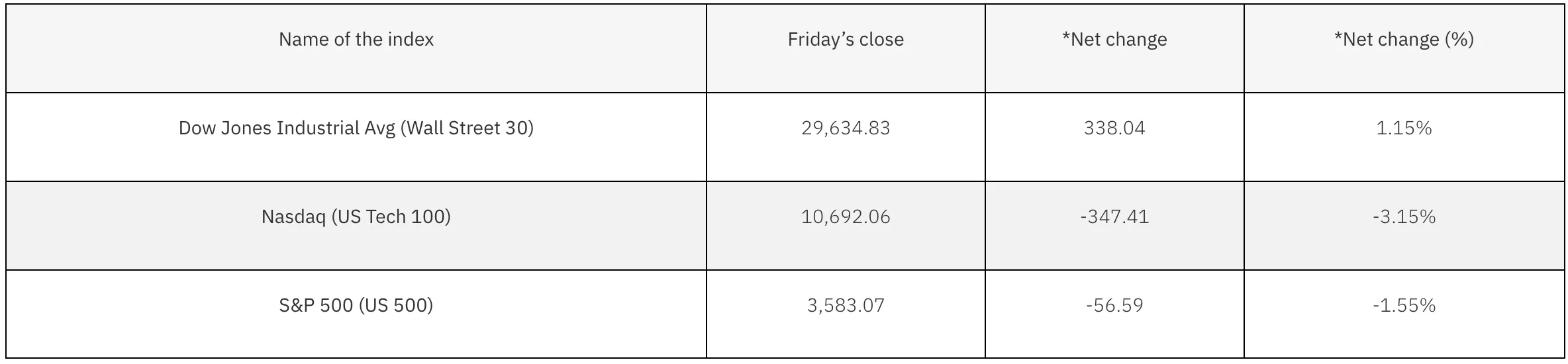
*Net change and net change (%) are based on the weekly closing price change from Friday to Friday.
Most major indices were down as third-quarter earnings season began, and traders analysed inflation data and its implications for the Fed's policy. Concerns about the impact of aggressive rate hikes, the escalating war between Russia and Ukraine, and China increasing its COVID-19 measures all contributed to the price decline.
Sectors like consumer staples and healthcare rallied, while consumer discretionary and communication services shares underperformed, with Amazon, Tesla, and Meta Platforms leading the decline.
Despite the Fed raising interest rates 5 times this year, the CPI for September released on Thursday, 13 October 2022, revealed that major inflationary factors aren't slowing down. The annual CPI rate in September dipped to 8.2% from 8.3% the previous month. Core inflation, excluding volatile food and energy costs, climbed to a higher-than-expected 6.6%, the highest increase in 4 decades.
At the start of this year, the International Monetary Fund predicted a 3.8% global economic growth in 2023. However, it has reduced its growth forecast to 2.7%, warning of the possibility of recessions in many nations if policymakers fail to handle inflation concerns properly.
Now that you’re up-to-date on how the financial markets performed last week, you can improve your strategy and trade CFDs on Deriv MT5.

Market news – Week 4, October 2022
Even though volatility remains elevated, the financial markets’ performance in the last week offered a glimmer of hope.
Even though volatility remains elevated, the financial markets’ performance in the last week offered a glimmer of hope.
Forex
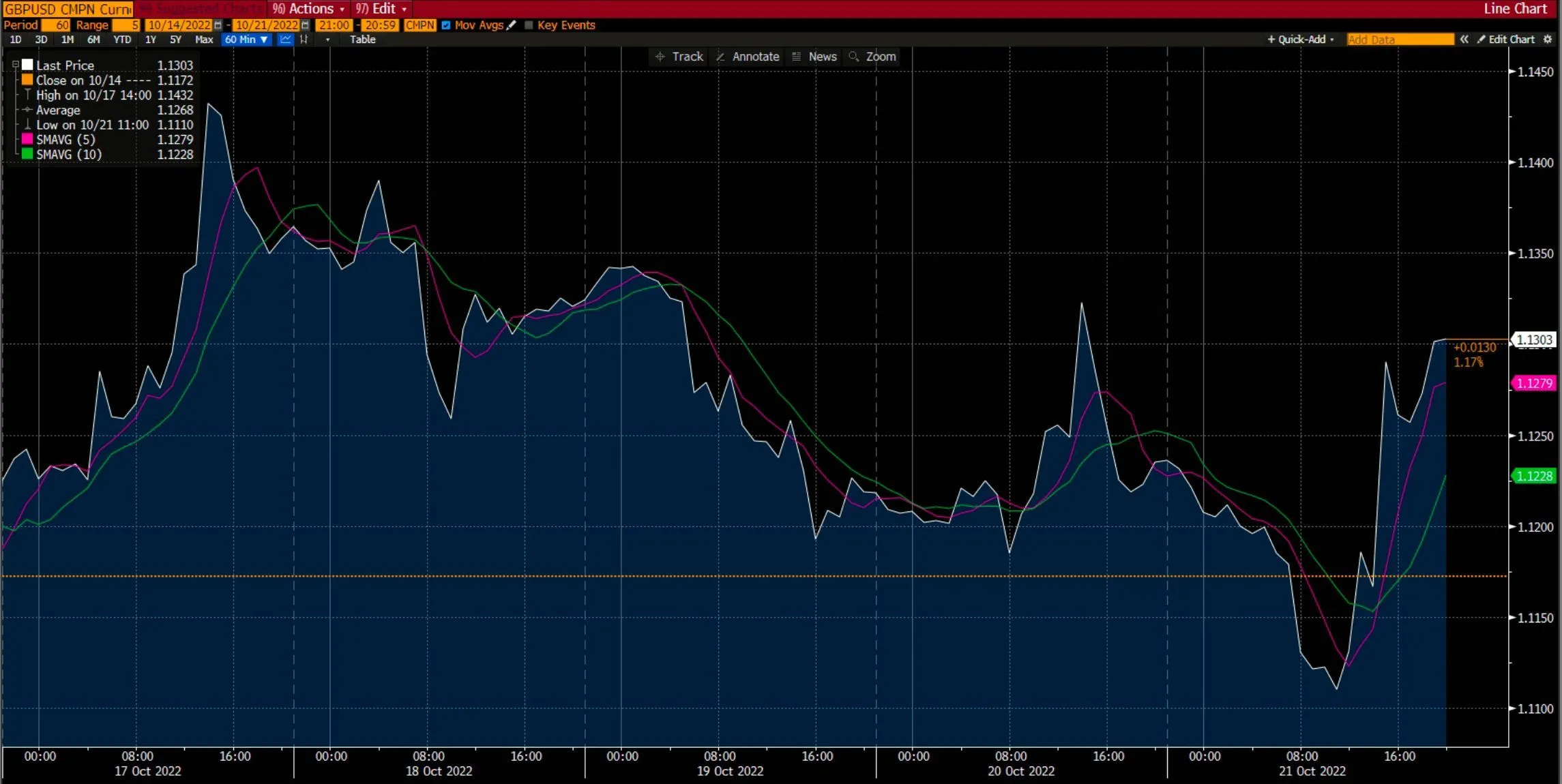
For the week, the GBP/USD defended its weekly gains despite the UK political debacle.
There was some calm among GBP buyers following Liz Truss's resignation, who resigned after a turbulent and unprecedented tenure in which her economic policies roiled financial markets. However, the calmness didn’t last long because of the political uncertainty that surfaced immediately after Truss's resignation. Although the pair rose for the week, its upside was capped by this factor and by surging US Treasury yields.
Additionally, the euro gained 1.4% against the US dollar over 5 days since late May. Federal Reserve members spoke less hawkishly on Friday, 21 October 2022, which may have contributed to the improvement in EUR/USD.
Lastly, USD/JPY surpassed the ¥150 mark for the first time since 1990. However, it did not last long as it fell back to around the ¥146 mark. The sharp drop was a clear signal to traders that the Ministry of Finance intervened to buy the Japanese yen to prevent further currency depreciation.
Level up your trading strategy with the latest market news and trade CFDs on your Deriv X account.
Commodities
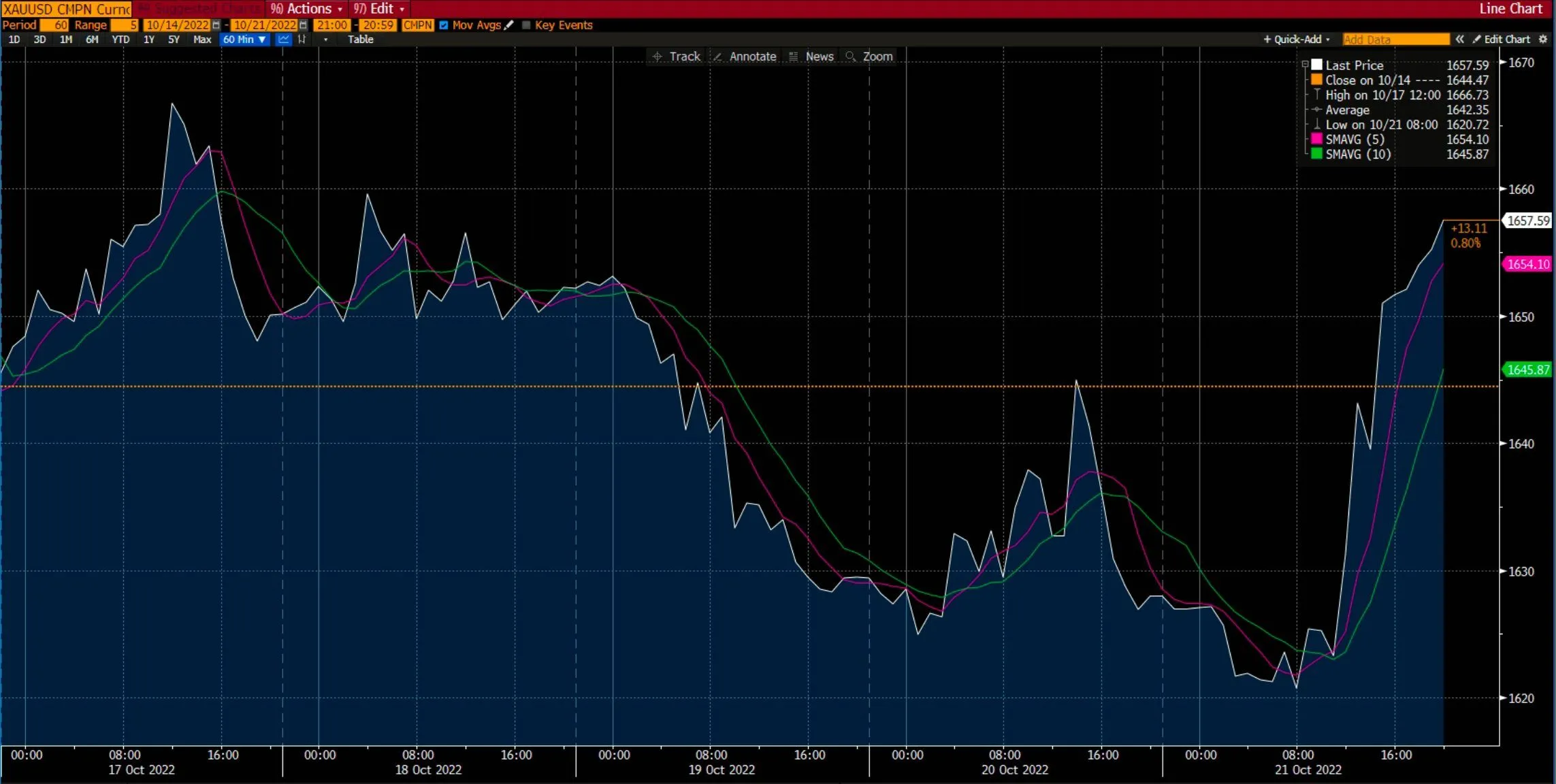
There was a good chance that gold would lose for the second week in a row. However, on Friday, 21 October 2022, it bounced back based on speculation about possible Fed actions. It was pretty much a flat week for gold, with the yellow metal seeing a rise of around 0.5% for the week.
Meanwhile, silver rose quite significantly and finally breached the $18 mark, trading close to $19.40.
After a volatile week, oil prices rose following concerns over a global slowdown. Despite slowdown concerns and aggressive measures taken by central banks to tame inflation, oil has lost a third of its value since early June. As the Organization of Petroleum Exporting Countries (OPEC+) cuts output and the European Union implements sanctions on Russian flows, the market will likely face a supply uncertainty period in the next few months.
Furthermore, Xi Jinping announced on Sunday, 23 October 2022, that China would maintain its Covid Zero policy, which entails mass vaccinations and lockdowns. So now, the future of Chinese oil demand is uncertain.
Cryptocurrencies
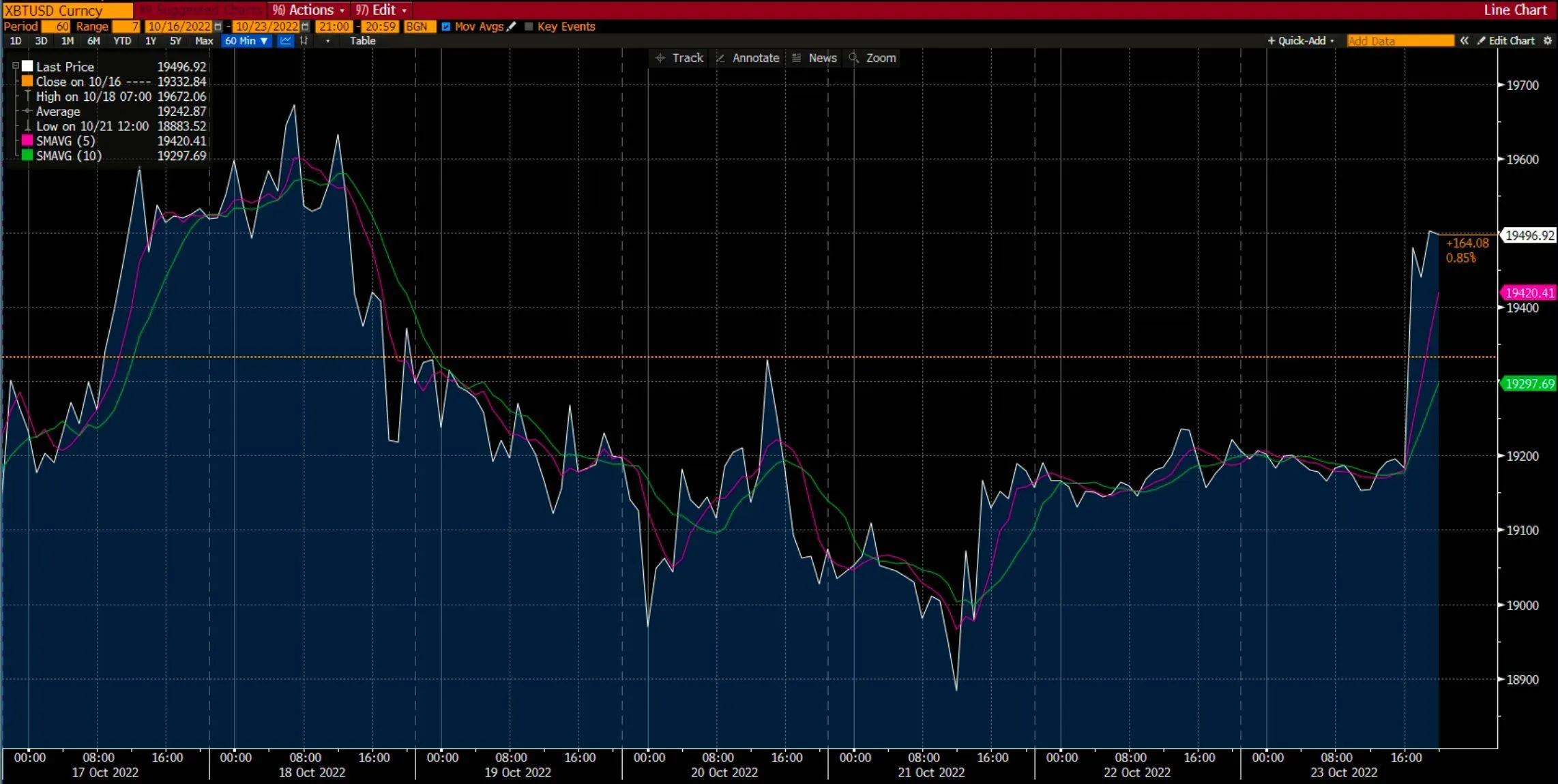
Cryptocurrency values remained relatively unchanged as the market experienced another flat week. The total crypto market capitalisation is hovering around the $920 billion mark.
Bitcoin, the world's largest cryptocurrency by market capitalisation, is currently trading at around $19,500.
In the meantime, Ethereum recovered from the previous week's losses to trade at $1,330 once again. However, on Thursday, 20 October 2022, its value fell to $1,282.14.
Popular blockchain oracle network, Chainlink, announced that its services were adopted by major blockchains such as Ethereum, Polygon, Avalanche, and BNB Chain. Despite traders' accumulation of LINK (Chainlink’s native cryptocurrency), its price has been relatively stable over the past month.
In other news, BNY Mellon, America's oldest bank and the world's largest custodian bank, launched a cryptocurrency custody service in response to increased customer demand. The digital service allows clients, traditional funds' managers, and institutional investors to hold Ether and Bitcoin with the same security offered on standard assets.
Take advantage of market opportunities by sharpening your trading strategy and trading the financial markets with options and multipliers on Deriv Trader.
US stock markets
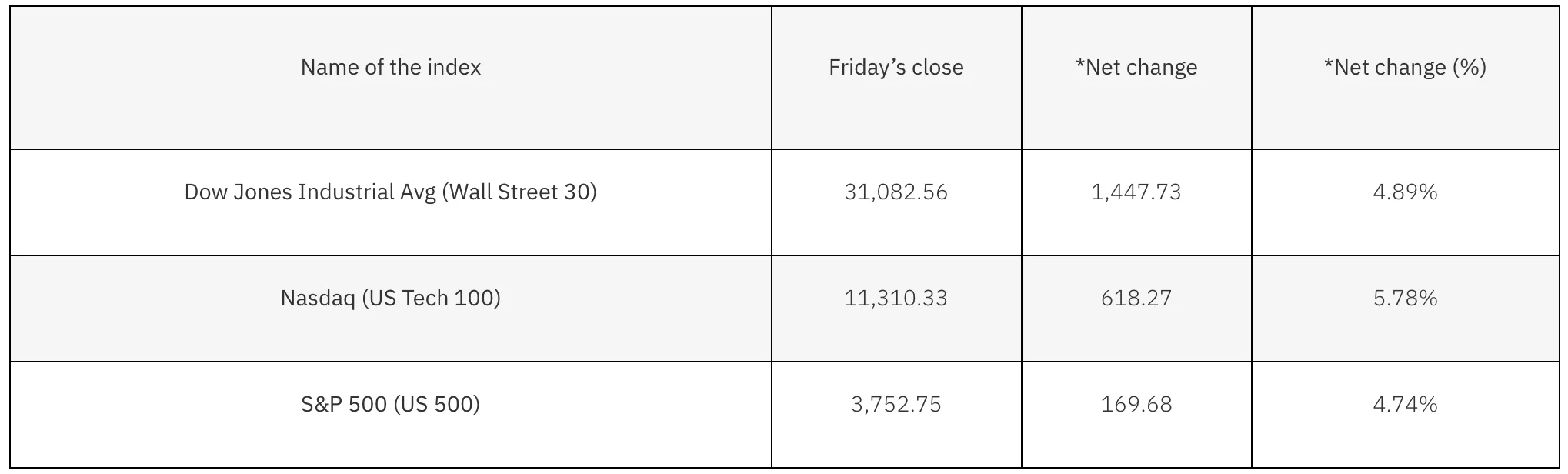
*Net change and net change (%) are based on the weekly closing price change from Friday to Friday.
As the week ended, the indices increased by more than 4%, their largest Friday-to-Friday percentage increase since June.
During the recent earnings season, traders scrutinised the newest financial statements from corporations, looking for indications of stress from high inflation, rising borrowing prices, and adverse economic conditions.
Meanwhile, advertisers continued to reduce marketing spending due to macroeconomic difficulties. Shares of Facebook-owned Meta and Twitter fell by 1.2% and 4.9%, respectively.
Housing data also showed significant deterioration. The impact of increasing interest rates has been most sharply felt in interest-rate-sensitive sectors of the economy, with housing being perhaps the most affected.
Traders were heartened on Friday, 21 October 2022, by rumours that the Federal Reserve was starting to moderate interest rate hikes. Following a volatile week of trading, stocks concluded the week on a bullish note.
Now that you’re up-to-date on how the financial markets performed last week, you can improve your strategy and trade CFDs on Deriv MT5.

Market news – Week 2, October 2022
Global financial markets lost most of their early-week gains by the end of the week as a strong US employment report took centre stage.
Global financial markets lost most of their early-week gains by the end of the week as a strong US employment report took centre stage.
Forex
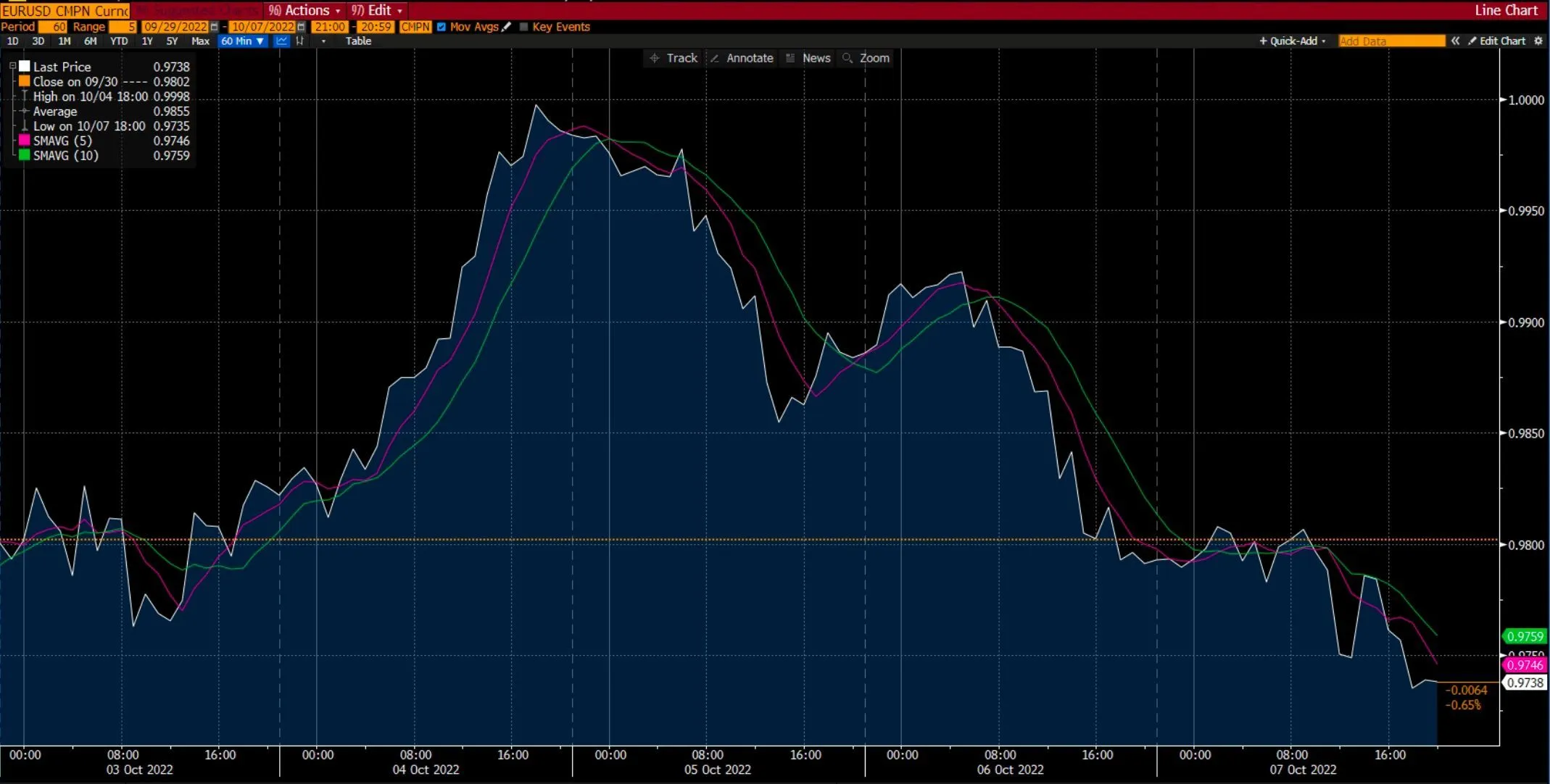
Despite its initial advance, EUR/USD failed spectacularly at parity, ending the week at just under $0.9750, resulting in a slight weekly loss.
Traders believed that the growing likelihood of a worldwide recession would push central banks to decrease the pace of quantitative tightening sooner than later. However, the positive mood didn't last long, and the pair began losing strength after more sanctions were imposed on Russia as a result of the illegal annexation of Donetsk, Luhansk, Kherson, and Zaporizhzhia.
On the other hand, the US Federal Reserve (Fed) continued with its hawkish approach. There were 263 thousand new jobs added in September, which was better than expected, but the numbers were lower than the previous month. The unemployment rate fell unexpectedly to 3.5%, while the Labor Force Participation Rate decreased to 62.3% from 62.4% in August. After a row of discouraging US employment reports, September’s report came as a welcome relief.
Meanwhile, the pound fell on Friday, 7 October 2022 after stronger-than-expected nonfarm payroll data retraced most of its weekly gains. The fragile state of UK fiscal policy measures has added pressure on the GBP. The currency continues with its bearish trend even as the UK government attempts to stabilise bond markets after Chancellor Kwasi Kwarteng announced a tax cut.
In other currency news, the Australian dollar fell as the Reserve Bank of Australia (RBA) stumbled in the fight against unpredictable inflation. In light of continued pricing pressures nationally and abroad, their raise of 25 bps to 2.60% last week was viewed as dovish.
This week's focus is all on inflation, with the September US Consumer Price Index (CPI) set to be released. The annual inflation is expected to rise by 8.1% this year, slightly better than the previous 8.3%. Furthermore, the US Federal Reserve will publish the minutes of its most recent meeting.
The UK labour market data will be released this week, and the Bank of England's comments will set the tone for the GBP/USD pair ahead of the UK monthly GDP.
Level up your trading strategy with the latest market news and trade CFDs on your Deriv X account.
Commodities
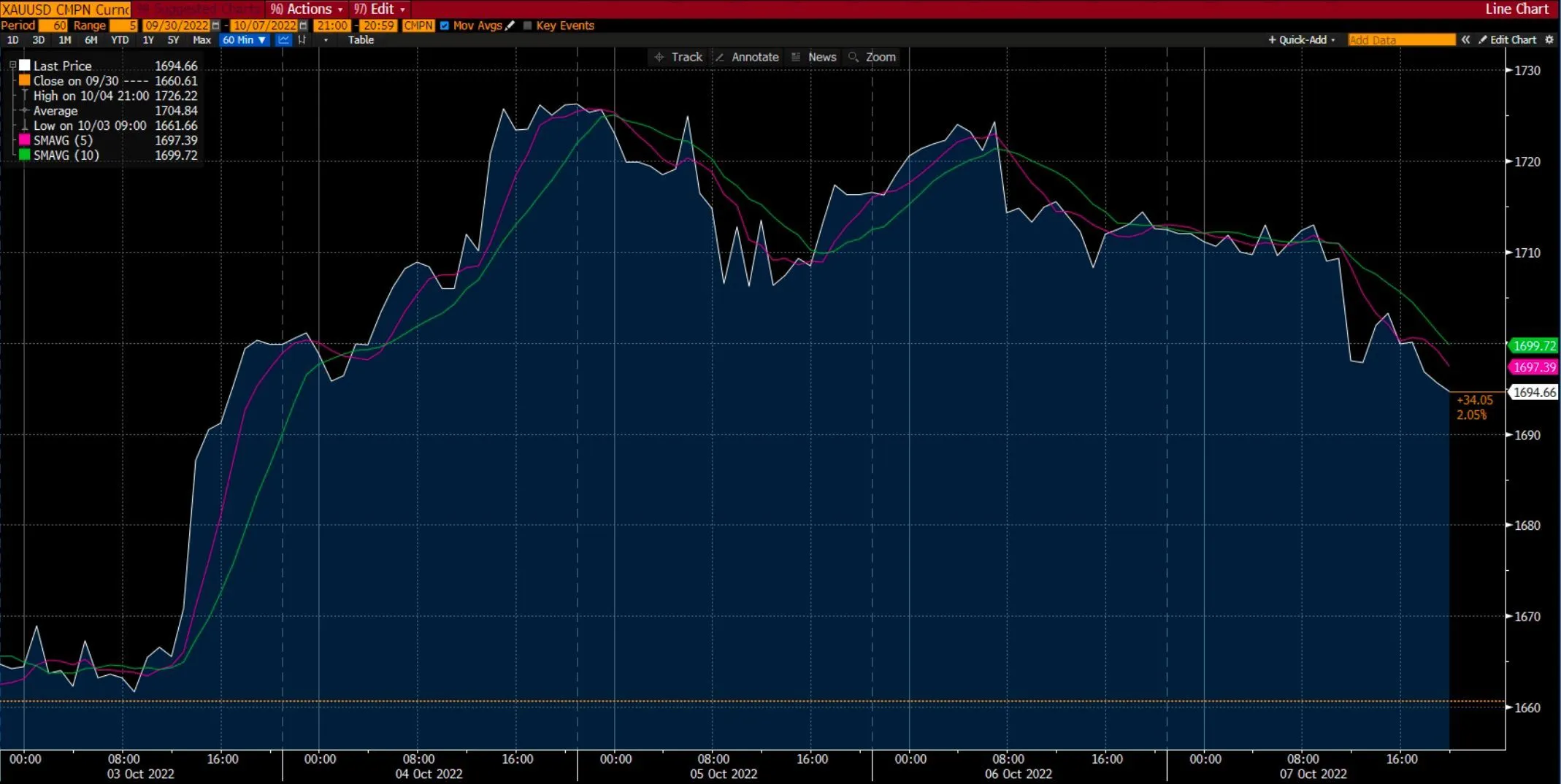
In the first part of last week, gold gained, but most of its gains had been lost by the end of the week.
Gold gained traction as the market mood improved, making it difficult for the greenback to find demand. Furthermore, a nearly 5% drop in the benchmark 10-year US Treasury bond yield on Monday, 3 October 2022, lifted XAU/USD by more than 2% – its biggest one-day gain since March 2022.
However, the US dollar recovered its strength as the days passed, thanks to higher-than-expected non-farm payrolls in September and a decrease in unemployment rates from 3.7% to 3.5%. In response to the job report, the 10-year Treasury bond rose by around 4%, causing gold to return to $1,700 ahead of the weekend.
On the other hand, oil prices gained the most since early March due to a weak supply outlook that offset lingering macroeconomic concerns. Even though demand fears remain front and centre in equity markets, supply fears appear to be driving this week's market action.
A combination of the Organization of the Petroleum Exporting Countries (OPEC+) cuts and the impending European sanctions on Russian crude is likely to leave the market vulnerable at the end of the year. Plus, Russia reiterated last week that it would not sell oil to countries adopting a US-led price cap, adding to the supply uncertainty.
According to forecasts, the consumer price index (CPI) will increase by 8.1% year-over-year (YoY) in September, down from its August reading of 8.3%. The annual Core CPI excludes volatile food and energy costs and is expected to rise from 6.3% to 6.5% this year.
Cryptocurrencies
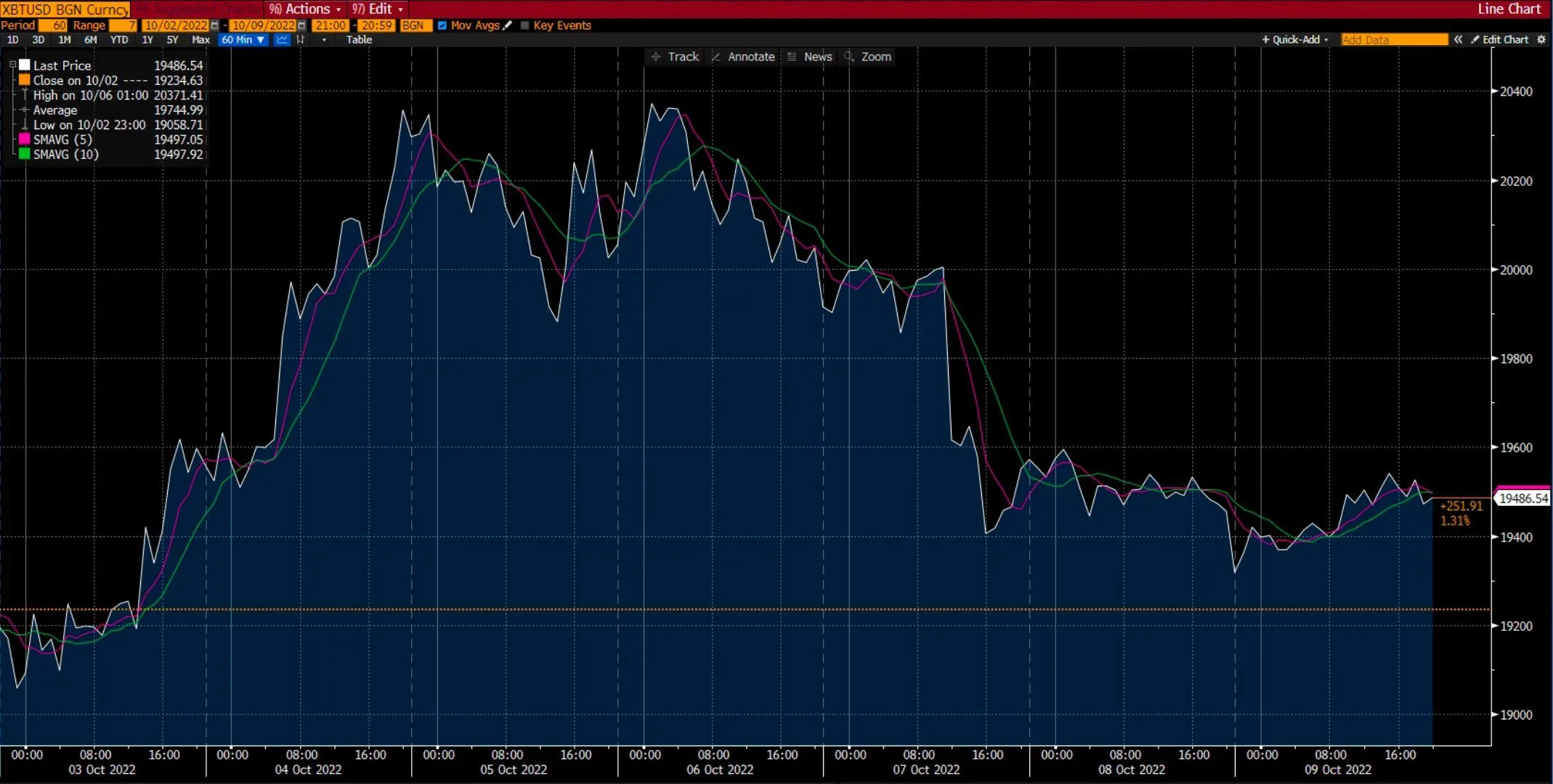
Major cryptocurrencies experienced yet another flat week.
On Tuesday, 4 October 2022, Bitcoin traded above the $20,000 level. However, due to a lack of trading activity, it failed to hold above that mark.
That being said, Bitcoin’s market dominance has increased by 2% in the last month. Based on the chart, Bitcoin is trading at $19,486.54 and has gained 1.31% over the past 7 days.
Meanwhile, Ethereum failed to show any significant movement in either direction and inched up by 0.3% in the last week. The second-largest cryptocurrency could not find a new support level and kept hovering in the $1,300 range all week. Macroeconomic factors seem to have perforated the ‘merge shield’ as Ethereum, too, feels the heat of the rising interest rates and inflation.
Moving away from Bitcoin and Ethereum, the rest of the major cryptocurrencies traded sideways as traders moved away from riskier assets.
Take advantage of market opportunities by sharpening your trading strategy and trading the financial markets with options and multipliers on Deriv Trader.
US stock markets

*Net change and net change (%) are based on the weekly closing price change from Friday to Friday.
Most of the gains that stock indices saw throughout the week were wiped out because certain data showed that the economy was not slowing enough for Federal Reserve policymakers to be satisfied. Oil prices surged following a pact by major producers to reduce global output, making energy the standout performer of the S&P 500 Index.
Stocks slumped on Friday, 7 October 2022, after a strong monthly employment report fueled anticipation that the US Federal Reserve will hike interest rates by 75 bps at its next meeting. Signs of labour market strength heightened inflation worries. The US Labor Department reported on Friday, 7 October 2022 that the economy added 263K jobs in September, and the unemployment rate fell to a multiyear low of 3.5%.
While last week's labour market trends were crucial, the September inflation number due on Thursday, 13 October 2022, will likely affirm or derail the quarter's promising start. A lower-than-expected CPI might support the idea that the inflation peak has passed, but an increase could prompt further rate rises.
Another indicator to watch will be the third-quarter results season, which will provide insight into corporate profitability.
Now that you’re up-to-date on how the financial markets performed last week, you can improve your strategy and trade CFDs on Deriv MT5.
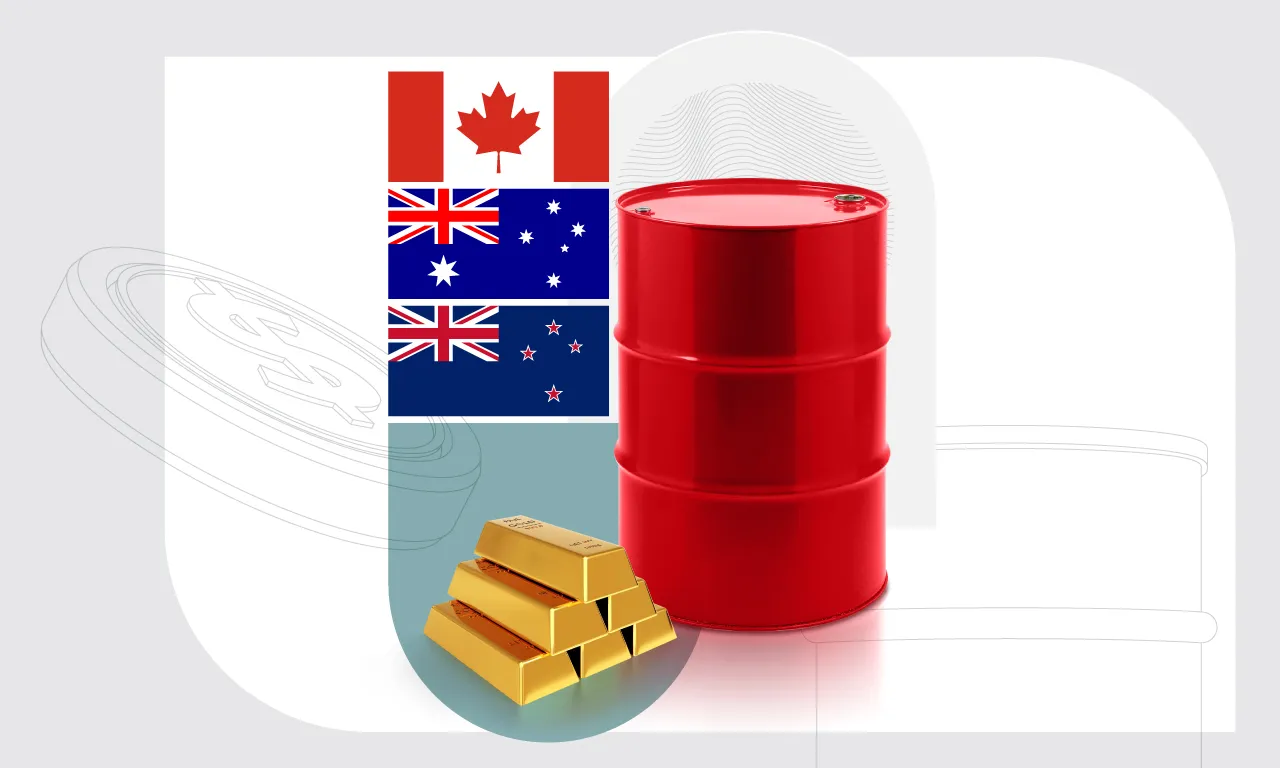
How can you trade commodity currency pairs in forex trading?
If your trade strategy involves trading in commodities, read our blog to learn why you should also start trading commodity currency pairs.
Commodity-linked currencies often mirror shifts in global markets, but the relationships are fluid rather than fixed. Traders who follow a drift-aware, event-driven approach aim to understand how changing commodity prices, macroeconomic conditions, and policy expectations combine to shape movements in pairs such as AUD/USD, USD/CAD, and NZD/USD.
This article explains how to trade these pairs effectively using a structured, lens-based framework that balances technical execution with contextual awareness.
Quick summary
- Commodity links (oil→CAD, metals/gold→AUD, dairy→NZD) are real but change with time—use them as context, not fixed rules.
- Apply a Three-lens Model: Commodity trend/catalyst, USD backdrop, and domestic policy/data.
- Trade only on confluence; plan around events; scale size to correlation stability; confirm divergence moves before entry.
- Define invalidation in advance for inventories, auctions, and central-bank days.
- As with all forex trading, these approaches involve market risk and no outcome is guaranteed.
What does forex trading with commodity currency pairs look like day to day?
A session starts with a prepared calendar and linked charts: oil or metals on one screen, the related FX pair on another, and the dollar index or yields nearby. Watchlists track EIA inventories, OPEC+ meetings, RBA/BoC/RBNZ decisions, China PMIs, and GDT auctions. Alerts trigger at price levels or event times.
During the day, seek confluence.
“In commodity FX, the first signal is rarely the best signal. The edge comes from waiting for the story and the structure to align.” — Deriv Analyst Team
Example for beginners
If crude oil rises steadily for several days while Canada posts stronger-than-expected employment data, USD/CAD often drifts lower. A beginner-focused approach is to wait for a clearer chart structure, such as a break and retest, which can help impose discipline on the trade setup, while recognising that market outcomes remain uncertain and price can still move against the position.
If crude prints a third draw, yields soften, and Canada data hold firm, expect USD/CAD to lean lower, but wait for structure (break and retest) before entry. Size the trade according to how stable the week’s commodity–FX link looks. If signals conflict, say oil rises but the dollar strengthens, reduce size or shift to a cross where the tension is smaller.
Execution should be structured and disciplined. Stage orders where you can exit fast if wrong. Stops sit beyond invalidation levels, not arbitrary pips; exits scale out at prior swing points. Post-trade, a short journal entry notes catalyst, lens scores, and result, which is useful for spotting early regime shifts.
What are commodity currency pairs in forex trading, and which pairs like USD/CAD, AUD/USD, and NZD/USD qualify?
Commodity currency pairs are those where one side belongs to a major commodity-exporting economy. The key trio—AUD/USD, USD/CAD, and NZD/USD—earn that label because metals/gold, oil, and dairy shape their export earnings and, through that, growth, inflation, and interest-rate expectations.
When export prices rise sustainably, national income improves and policy expectations firm, supporting the currency. The reverse holds when prices fall. The link is conditional and regime-dependent—USD direction and domestic policy often override commodity impulses short term.
A practical workflow blends clean commodity and FX data, an event calendar, and a checklist to confirm confluence instead of reacting to a single headline.
“Most correlations are conditional. Treat every commodity–currency link as a regime that must be revalidated, not assumed.” — IMF Research Note
Example for beginners
If iron-ore prices rise overnight and China’s PMI comes in above 50, a trader checks whether AUD/USD is forming higher lows. If the chart supports the macro backdrop, the trader can plan a small, structured long position.
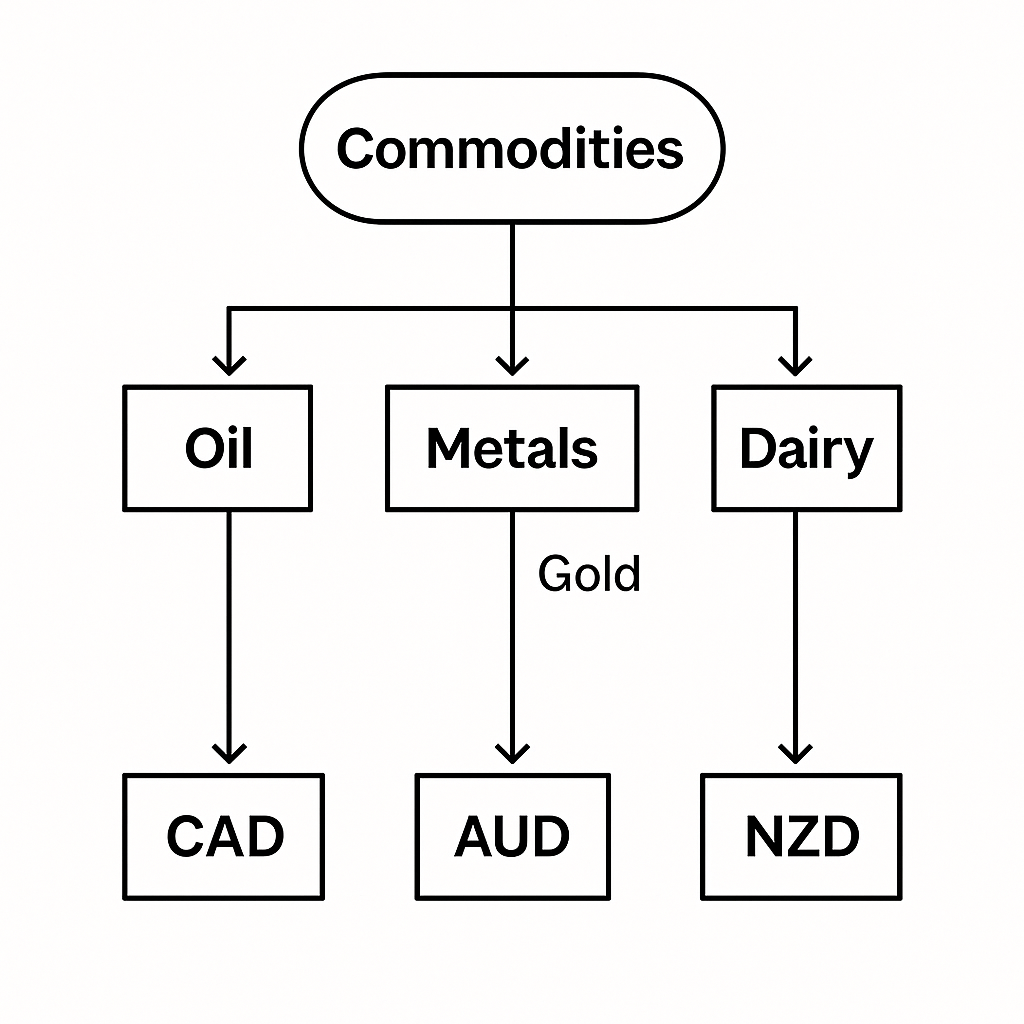
Why do commodity-linked currencies move with commodities, and how does correlation strategy change?
The commodity→FX channel runs through income and policy transmission. Price shocks alter margins, taxes, and spending; these affect growth and inflation, which steer rate paths and bond yields; FX discounts the new outlook.
Correlations drift as regimes shift—OPEC+ actions, mining investment, weather, and inventories all play a role. The USD mechanically lifts or weighs on commodities, while local policy and risk appetite can amplify or offset the effect. Producer hedging sometimes hides the pass-through in spot FX.
Use rolling correlation statistics to identify regimes, not to time entries.
Example for beginners
When dairy prices have been rising for several weeks but NZD/USD hasn’t moved much, it may signal a lag. Instead of entering early, beginners can wait for the pair to break above a repeated resistance level before considering a trade.
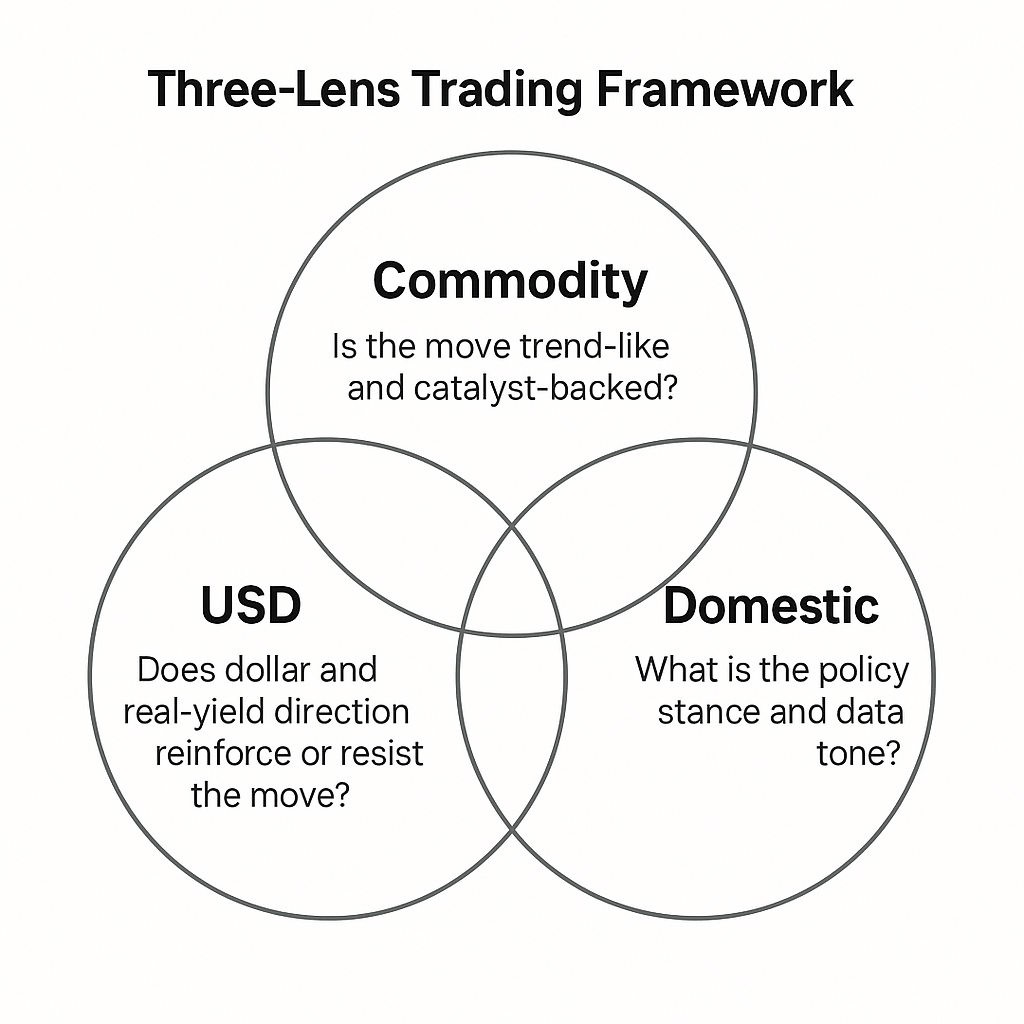
Before committing risk, read the tape through three lenses:
- Commodity lens: Is the move trend-like and catalyst-backed (multi-week draws, credible demand shifts)?
- USD lens: Does dollar and real-yield direction reinforce or resist the move?
- Domestic lens: What is the policy stance and data tone (RBA/BoC/RBNZ; CPI, labour, activity)?
Trade only when at least two lenses align, and consider normal position size when all three lenses support the view, while keeping in mind that alignment does not remove the inherent risks present in all market conditions.
Senior FX Strategist at ANZ elaborates:
“Alignment across lenses reduces false positives dramatically. When all three agree, conviction and size can increase safely.”
How should you approach USD/CAD, AUD/USD, and NZD/USD when forex trading commodity currency pairs?
USD/CAD — oil-sensitive, not oil-dominated
Canada’s crude exports make CAD responsive when oil moves for genuine reasons: persistent EIA draws, OPEC+ restraint, or credible supply shocks. Still, U.S. yields and risk sentiment shape day-to-day swings.
In some market conditions, selling USD/CAD rallies near established resistance may offer clearer structure than chasing breakouts, although this still involves market risk and does not guarantee improved outcomes. When oil is firm but the USD rises on risk-off or strong U.S. data, expect range conditions: trade smaller or focus on CAD crosses.
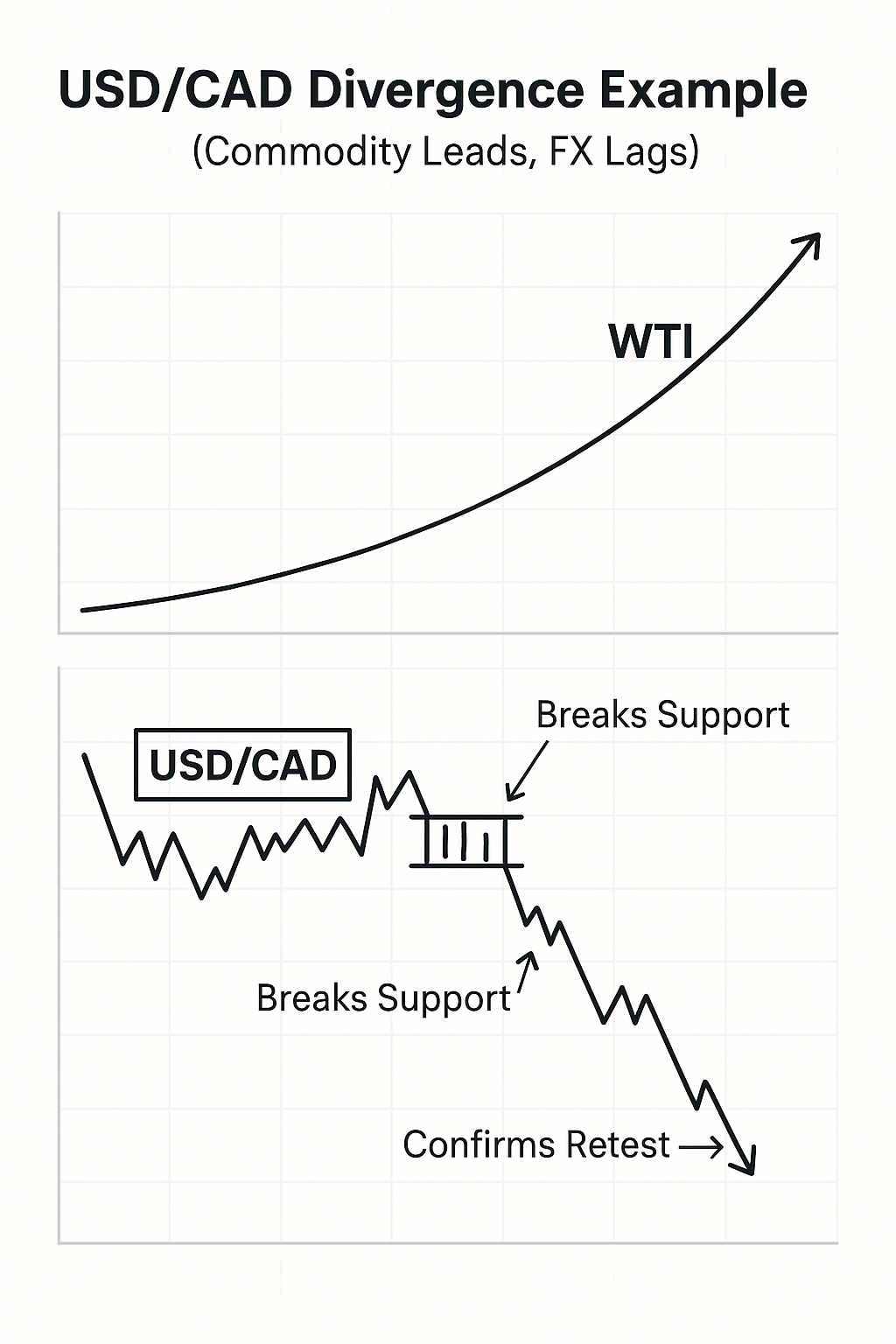
A classic divergence appears when WTI rallies yet USD/CAD stalls below range; the cleaner entry comes on the first retest of broken support from beneath, with stops beyond the invalidation swing. The main spoiler is a sudden USD surge—always keep hard stops and avoid averaging into headlines.
AUD/USD — metals, China, and policy nuance
Australia’s export basket links AUD to iron ore, coal, and gold, while China’s data transmit demand shocks. The cleanest rallies pair firm metals with a softer USD and an RBA that is at least neutral to hawkish.
Pullbacks toward recent value (prior range highs or moving averages) can provide patient entries. If metals are strong but China PMIs are mixed, or the RBA sounds cautious, treat longs as tactical.
A practical sequence: China PMI returns above 50, gold breaks out as real yields fall, and AUD/USD clears a multi-week range. Waiting for the pullback that holds that level offers better risk–reward than buying the first break. Flip bias quickly if the USD turns higher on surprise data or a soft Australia CPI undercuts RBA expectations.
NZD/USD — dairy, weather, and regional beta
Dairy’s weight in exports means GDT results can sway income expectations and policy outlook. NZD also inherits AUD’s regional beta.
A favourable backdrop blends rising GDT prints, firm RBNZ rhetoric, and a neutral-to-weaker USD; in that case, lean long on dips with AUD/NZD strength confirmation. Underperformance shows when dairy softens or RBNZ turns dovish despite global risk-on.
A typical catch-up trade follows two or more strong auctions while NZD/USD stays capped; once U.S. data push the dollar lower and price holds above resistance, the first higher-low above breakout offers clearer levels for placing stops and managing exposure.
Remember, NZD weakens fast in global risk-off. Respect that asymmetry when sizing.
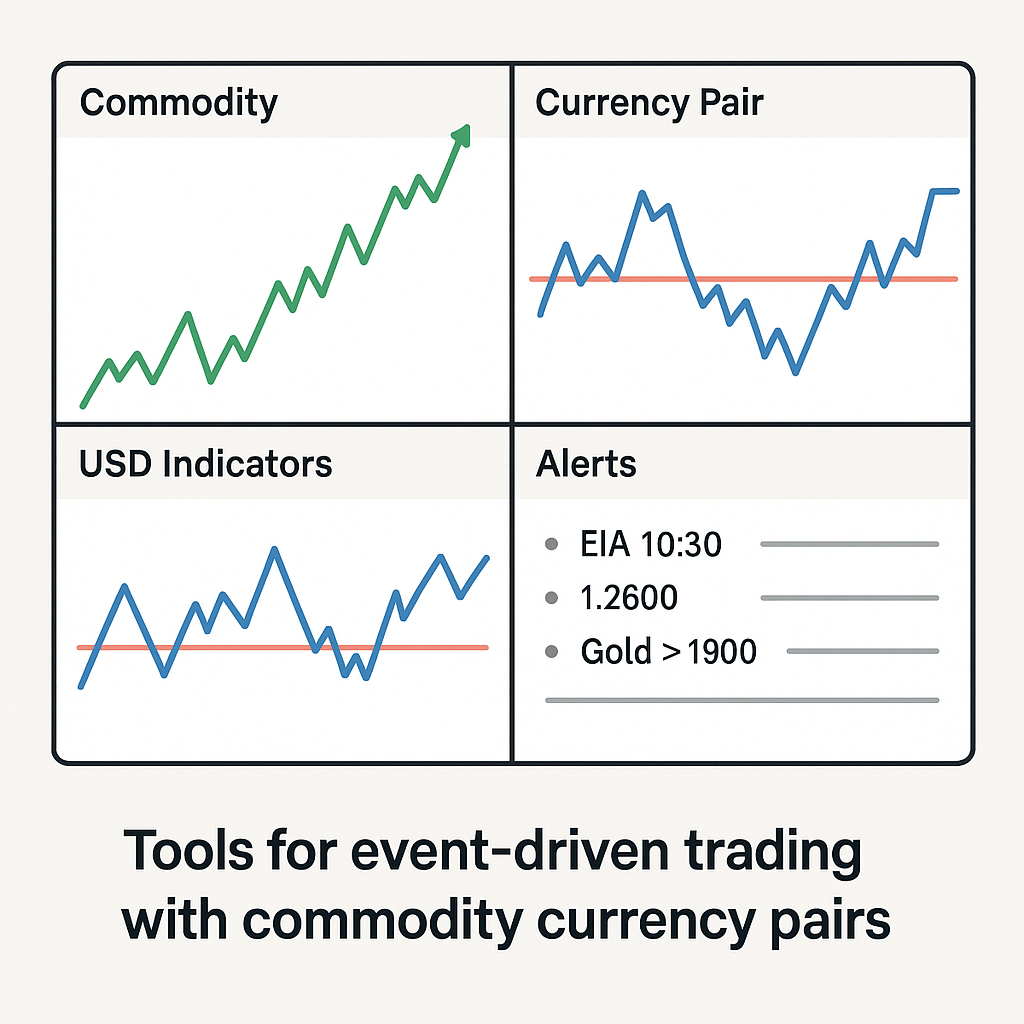
What tools support event-driven trading and risk management for commodity currency pairs?
Linked layouts let you view the commodity and its currency side by side. When oil jumps, you immediately see whether USD/CAD reacts.
Pre-built watchlists group catalysts by pair—EIA and OPEC+ for USD/CAD; RBA, Australia CPI, and China PMIs for AUD/USD; GDT and RBNZ events for NZD/USD—so no release surprises you.
Layer alerts:
- One for economic event times
- One for price levels
- One for conditions (for example, “gold above last week’s high while DXY is down”).
Templates and checklists help consistency: score each lens, define invalidation, and write the if/then before placing the order. Position-sizing tools convert risk into lot size so you know exposure precisely.
Session awareness also matters: AUD/NZD react more in Asia hours; USD/CAD in North American flows. After each trade, journal catalyst, lens score, and result—these notes reveal when regimes shift.
How can a correlation strategy and risk management framework guide trades in commodity currency pairs?
Score each lens +1 / 0 / –1.
- Commodity lens: trend-like and catalyst-backed?
- USD lens: dollar and yield direction supportive?
- Domestic lens: policy stance aligned?
Commit risk only when the total score ≥ +2. If lower, wait or switch to a relative-value trade that reduces the conflicting lens.
Translate the score into a plan:
- Define trigger (for example, “retest of broken support holds”).
- Mark invalidation (where thesis fails).
- Set initial target (nearest swing extreme).
- Plan stop-trailing logic.
Account for calendar risk between entry and exit—trim or hedge around key prints.
How does event-driven trading shape entries, sizing, and exits in commodity currency pairs?
For trend-following, let price break structure, then buy/sell the retest with stops beyond invalidation and staged exits at prior extremes.
For mean reversion, fade only true extensions against a neutral macro score and demand reversal evidence (for example, a failed auction).
A divergence setup—commodity leads, FX lags—works only when FX structure confirms; never rely on correlation alone.
Sizing adapts to regime:
- Normal position size may be used when all three lenses align, provided the trader remains aware that alignment does not eliminate the potential for adverse price movements.
- Smaller size when one pillar wobbles.
- Use higher timeframes and shorter holds when confidence is low.
Convert the weekly watchlist into if/then statements:
- If EIA prints a third draw and DXY is down → look to sell USD/CAD on a one-hour break-retest.
- If China PMIs beat and gold is firm while RBA leans hawkish → buy AUD/USD pullbacks.
- If GDT surprises higher and RBNZ is firm while USD softens → stalk NZD/USD dips that hold new support.
Journal lens scores and outcomes to identify whether you’re in a commodity-, USD-, or policy-led regime.
“Consistent journalling is what turns experience into edge. Patterns emerge long before price makes them obvious.” — Deriv Trading Coach

Market news – Week 1, December 2022
Oil prices continued to slip after reduced demands from China, as the country attempts to contain Covid-19 outbreaks. Meanwhile, major cryptocurrencies showed signs of recovery after the bear run triggered by the collapse of FTX — a leading cryptocurrency exchange.
Oil prices continued to slip after reduced demands from China, as the country attempts to contain Covid-19 outbreaks. Meanwhile, major cryptocurrencies showed signs of recovery after the bear run triggered by the collapse of FTX — a leading cryptocurrency exchange.
Forex
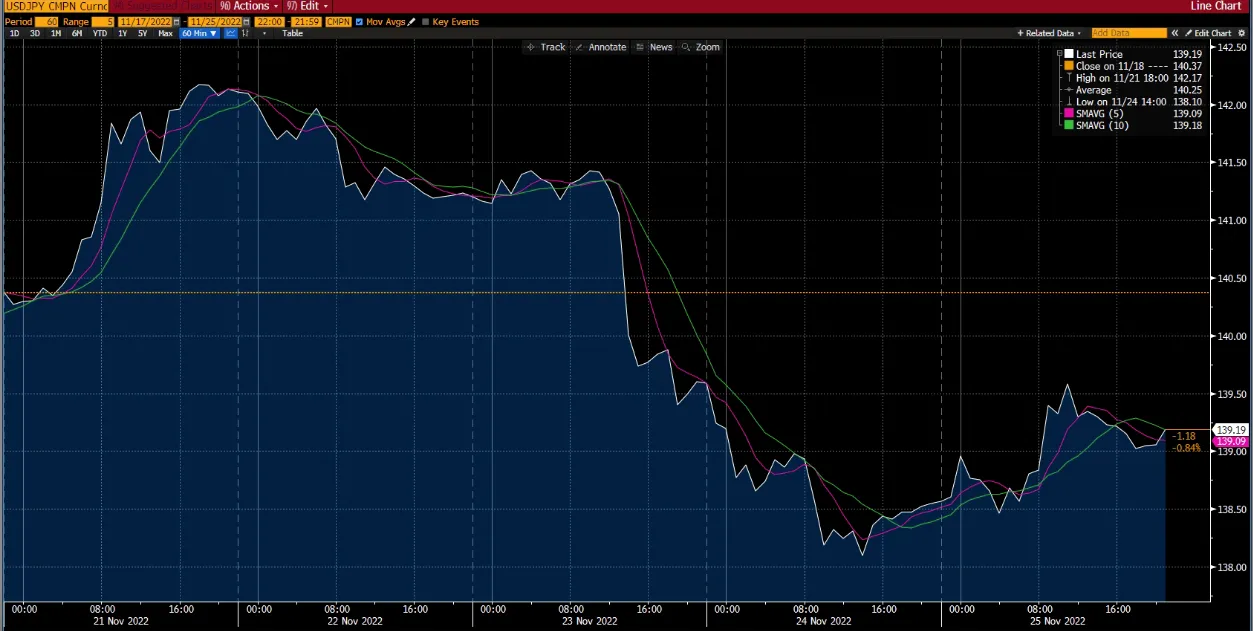
The euro outpaced the US dollar over the week. This is because the US dollar fell in value following the release of the Federal Open Market Committee’s (FOMC) 23 November meeting minutes, which indicated that rate hikes might pause in the near term. Furthermore, the committee believes that the monetary policy is nearing a "sufficiently restrictive" level.
The pound sterling's multi-week comeback continues, aided in part by a lower US dollar. It has now recovered all the losses it suffered as a result of the tax policy moves of the Liz Truss government.
Due to the lessened volatility in the United States as a result of the Thanksgiving break, the Japanese yen closed the week on a high note. The USD has been under pressure since the release of the FOMC minutes, which underlined the US Federal Reserve’s policy of slowing its interest rate hikes.
The Personal Consumption Expenditures (PCE) price index — which captures inflation across a wide range of consumer expenses and reflects changes in consumer behavior — and November's non-farm payrolls (NFP) statistics are due this week. Plus, the US Fed is currently altering its pace carefully as tightening pushes its way into the economy with delays. Still, rosy data may easily make the Fed maintain its current course.
Level up your trading strategy with the latest market news and trade CFDs on your Deriv X account.
Commodities
Oil prices fell for the third week in a row as investors worry about decreasing demand in China, where Covid restrictions are being reinstated due to an increase in the number of infections.
Oil was further depressed as European officials were unable to agree upon a price cap for Russian oil despite debating a level deemed more generous. The lack of agreement means that the Kremlin wouldn’t be adversely affected when it comes to limiting its exports and production, which could negatively affect oil prices.
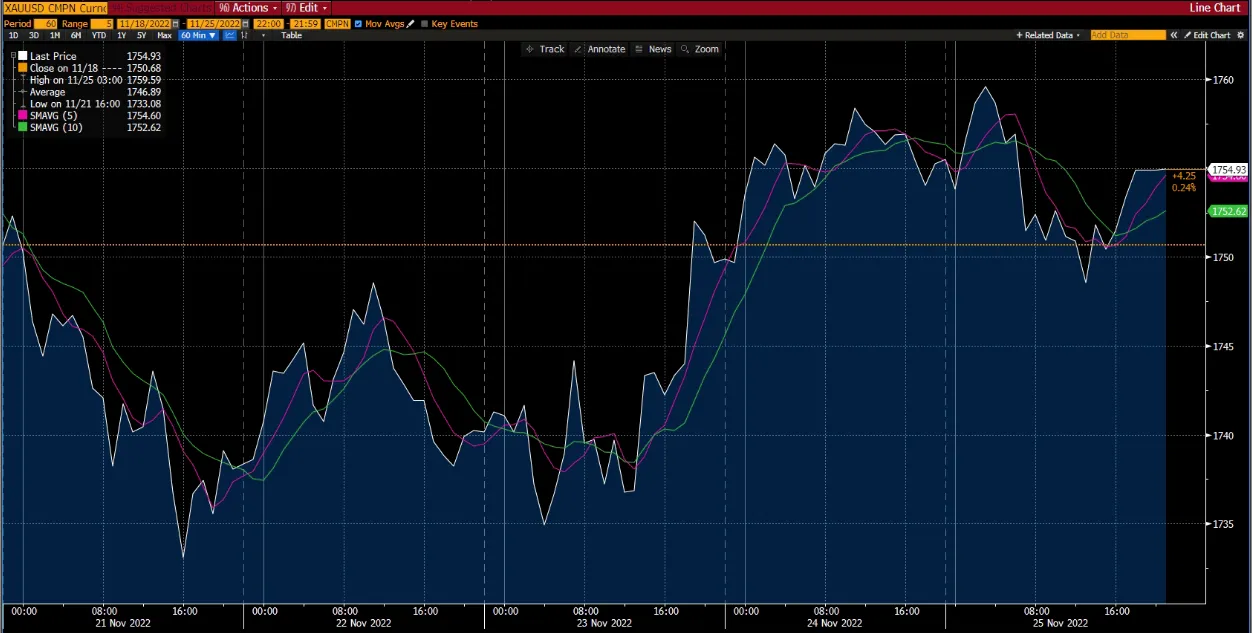
Meanwhile, gold gained traction after the previous week's downward correction, helped by renewed US dollar weakness and declining US Treasury bond yields.
This week's focus will be on coronavirus news from China. If it continues to tighten restrictions, gold and oil may fall.
Non-farm payrolls (NFP) are predicted to decline by 30,000 after growing by 261,000 in October. A dismal performance is expected to weigh heavily on the US dollar, opening the door for a bullish XAU/USD. A positive NFP surprise, on the other hand, should have an opposite effect on financial markets, which may cause gold prices to fall.
Cryptocurrencies
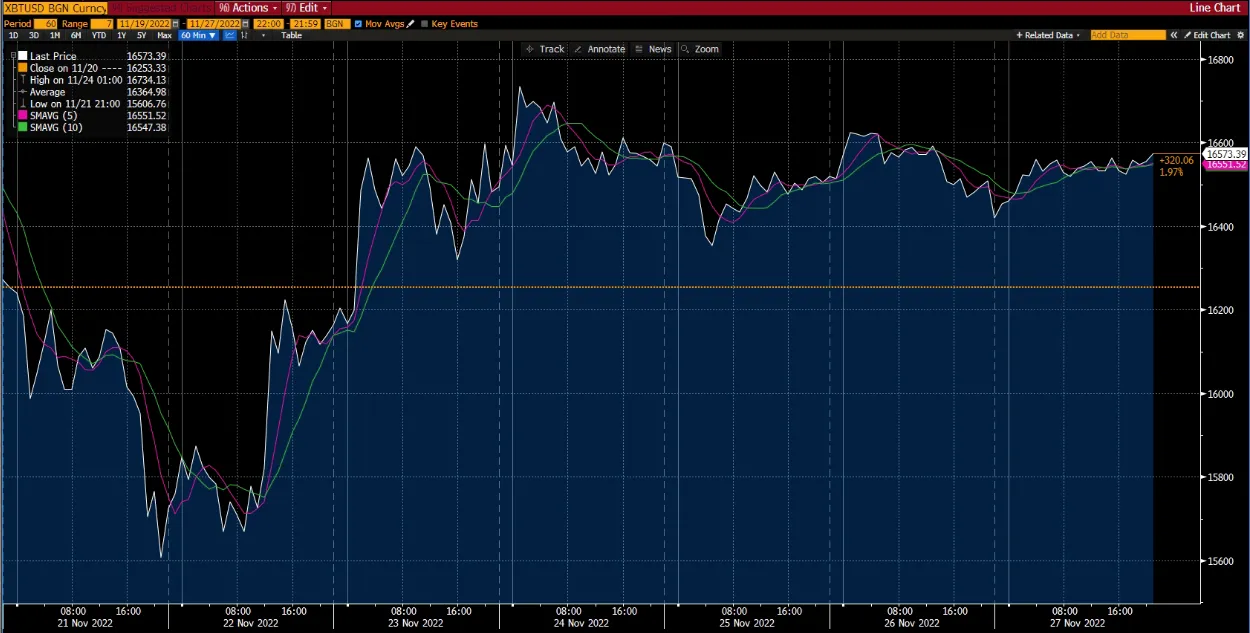
Cryptocurrency values remained relatively stable over the past week, with major tokens posting small increases as well as losses. The global crypto market capitalisation stands at USD 820 billion at the time of writing; it had slipped below USD 800 billion last week.
Bitcoin, the world’s largest digital currency, has increased in value by 4% over the last week, and is currently trading at around USD 16,420. Meanwhile, Ethereum is currently trading at USD 1,193 after reaching a high of USD 1,205 on Saturday.
As opposed to the trends in other major digital currencies, meme-inspired cryptocurrency Dogecoin (DOGE) surged 35% over the last week. The short-lived price surge was fueled by Elon Musk’s confirmation that he intends to integrate payments into Twitter 2.0. Musk has frequently used his Twitter account to express views on Dogecoin.
Meanwhile, Binance — the world’s largest cryptocurrency exchange — has established a new website to elucidate its Proof of Reserves System (PoR) in order to prove that it holds client assets in full as a digital currency keeper. Explaining PoR, Binance in a blog post stated, “[T]his means that we are showing evidence and proof that Binance has funds that cover all of our users assets 1:1, as well as some reserves.” It added: “When a user deposits one Bitcoin, Binance's reserves increase by at least one Bitcoin to ensure client funds are fully backed.”
The move comes in the wake of the collapse of its crypto exchange rival FTX, which had a significant portion of its assets backed by its own FTT coin. This revelation, when brought to light, precipitated FTX’s collapse. Binance's move will assure investors of their crypto investments and will likely stabilize digital currencies.
Take advantage of market opportunities by sharpening your trading strategy and trading the financial markets with options and multipliers on Deriv Trader.
US stock markets

*Net change and net change (%) are based on the weekly closing price change from Friday to Friday.
The holiday-shortened trading week was closely speculated on by traders as they watched the rising Covid-19 cases in China and the Black Friday sales numbers. Overall, stocks gained momentum after last week’s downward turn.
However, on Friday, 25 November 2022, Nasdaq felt the pressure from Apple Inc., which fell around 2% after news of reduced iPhone shipments broke out. The fall in supply was a direct result of the rising Covid-related worker unrest in China.
Last week, the Dow Jones Industrial Average rose 152.97 points, or 0.45%, to 34,347; the S&P 500 lost 1.14 points, or -0.03%, to 4,026.12; and the Nasdaq dropped 82.69 points, or -0.70, to 11,576.
This week, traders face a deluge of economic releases as Wall Street prepares for the US Fed’s final interest rate decision for the year in December. The economic calendar in the coming days will be marked by the release of several reports, including the monthly employment report, housing market report, gross domestic product (GDP) data, and Consumer Confidence Report (CCR), among others.
On the inflation front, traders would be keen on the PCE price index, which is due on Thursday.
Now that you’re up-to-date on how the financial markets performed last week, you can improve your strategy and trade CFDs on Deriv MT5.
Sorry, we couldn’t find any results matching .
Search tips:
- Check your spelling and try again
- Try another keyword