
Results for

How to set up optional parameters to enhance your Deriv Bot strategy
Creating a basic trading strategy gives you a fully functional trading bot. Once you set up your mandatory blocks and throw in a few advanced parameters, your Deriv Bot can perform trades on your behalf automatically.
Creating a basic trading strategy gives you a fully functional trading bot. Once you set up your mandatory blocks and throw in a few advanced parameters, your Deriv Bot can perform trades on your behalf automatically.
But there is more to it. You can enhance your strategy by setting up the optional Sell conditions block and including additional instructions to the mandatory Restart trading conditions block.
Quick tip
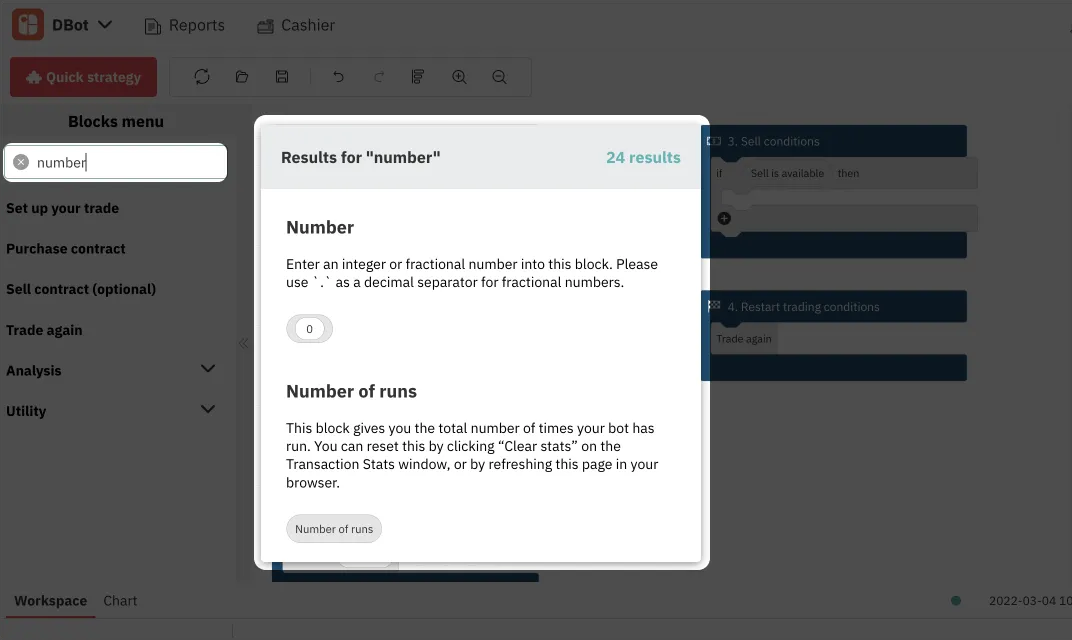
Before we jump into the details of how you can do it, here is a quick tip to make your Deriv Bot journey much easier: use the search bar to find the blocks you need.
The search bar is located in the top left corner and can save you a lot of time if you don’t remember the exact location of each block in the menu. Just type in its name, and pick it from the search results.
Set up the optional Sell conditions block
You may remember that we already mentioned the Sell conditions block briefly when we were going through the process of setting up mandatory blocks. This block lets you sell your contract before it expires.
There are two main reasons to sell your contract before its expiration:
- To secure your profit: if your trade is winning, and you don’t want to risk losing your profit if the price starts moving against your prediction.
- To cut your loss: if your trade is losing, and you want to protect yourself from losing more if the price keeps moving against your prediction.
In a way, this feature is similar to take profit and stop loss, as it allows you to secure potential profits and cut potential losses. But unlike take profit and stop loss on Deriv Bot, which can only be applied once a contract is closed, the Sell conditions block can sell your contract while your trade is still running.
Bear in mind that not all contracts can be sold — it depends on various factors — such as asset’s type or the trade duration (for example, tick contracts can’t be sold). Once a contract is purchased, you’ll see the ‘Sell’ button in your trade summary on the right if you can sell the contract or the ‘Resale not offered’ message if you can’t.
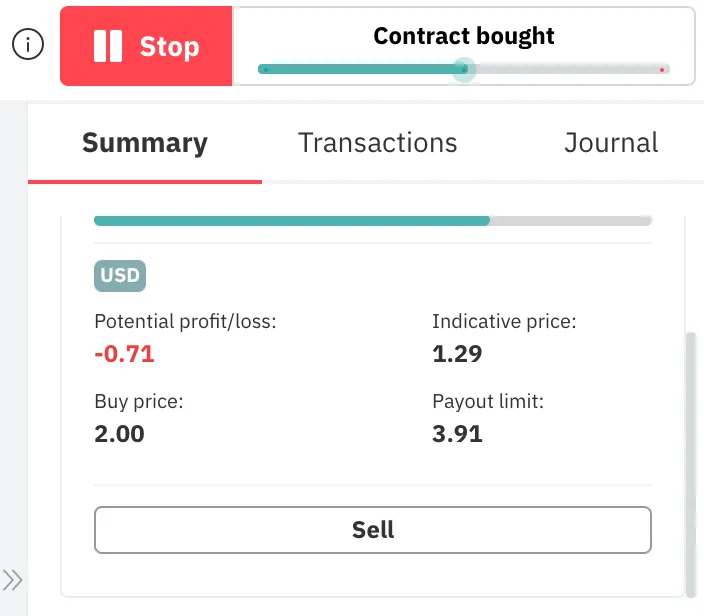
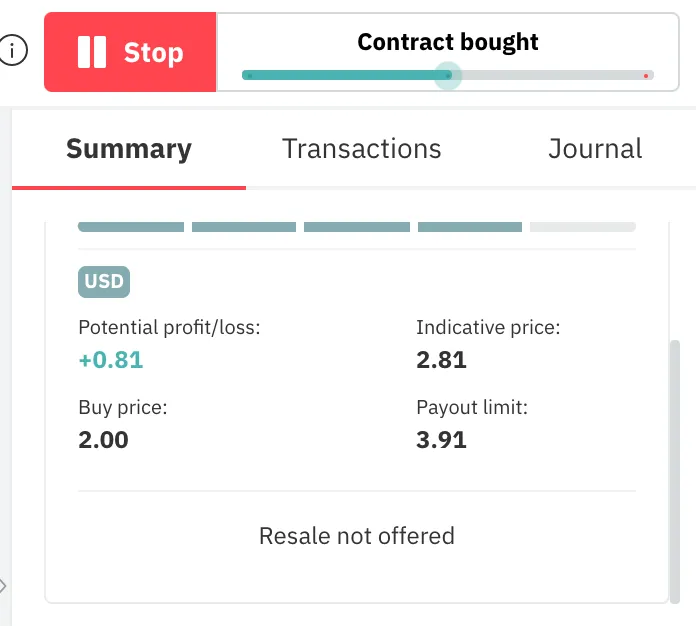
Here is how you instruct Deriv Bot to sell your contract:
1. Click the Analysis tab, then the Contract subtab, and select the Sell profit/loss block. This block calculates how much profit or loss you could make after selling your contract.
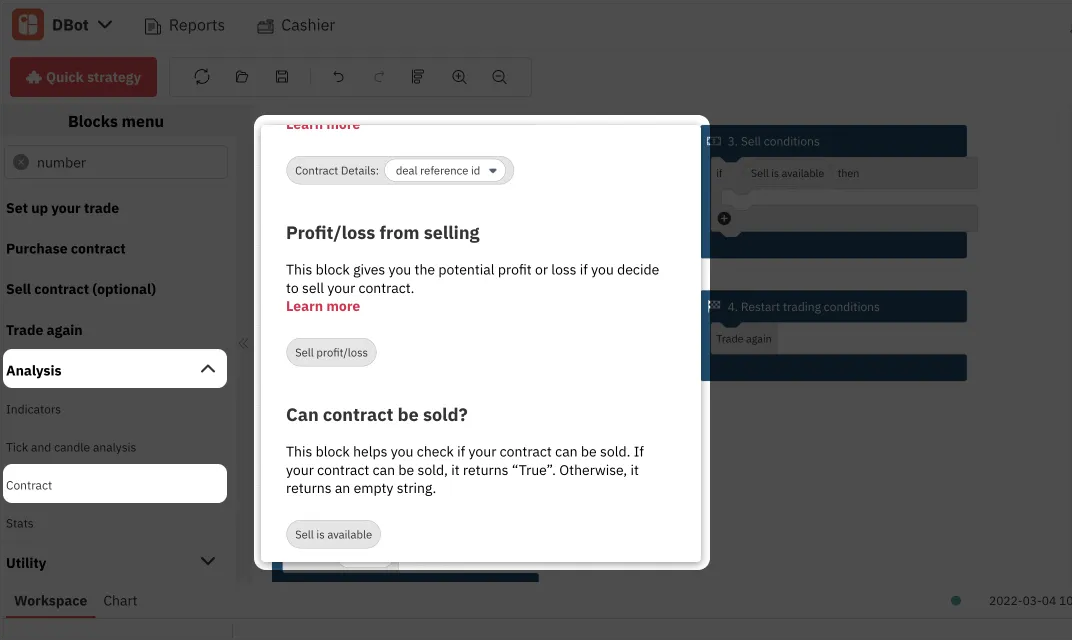
2. Set up the following instructions to tell your bot to sell the contract at a market price if such an option is available, and only if the profit is more than 1 USD.
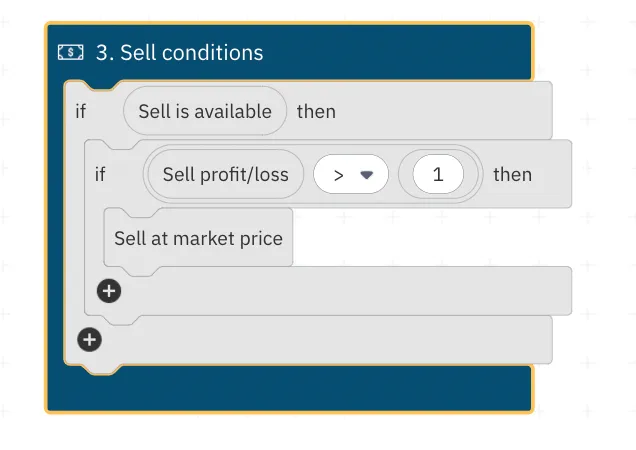
You can adjust the number anytime to match your own strategy. Alternatively, you can replace the number with the ‘Stake amount’ variable, which will instruct your bot to sell your contract if the profit from the sale is higher than your stake.
Set up take profit and stop loss
Unlike other platforms, where a contract is closed upon reaching take profit or stop loss level, Deriv Bot can compare results of every trade with take profit/stop loss amounts and then decides whether to continue or stop trading. To teach your bot how to make this comparison, you need to set the following instructions:
- Create ‘Trade result’, ‘Stop loss’, and ‘Take profit’ variables.
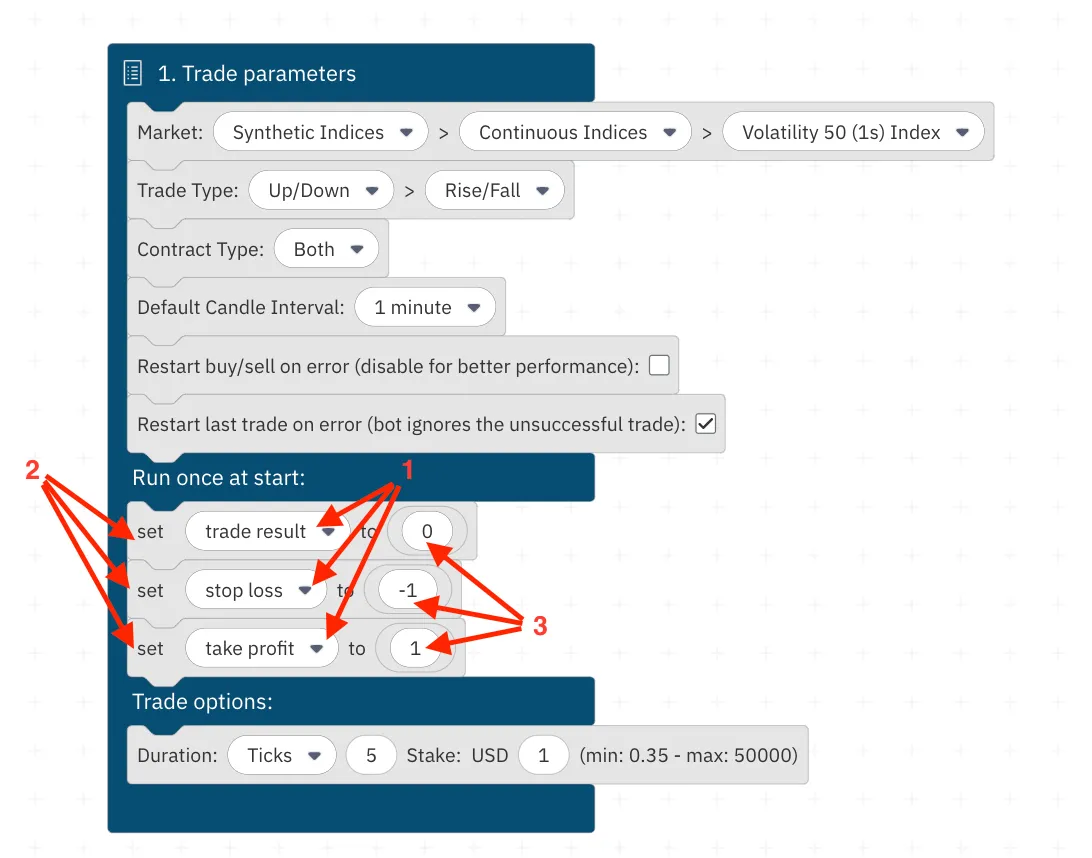
- Place 3 ‘Set’ blocks into the ‘Run once at start’ section of the ‘Trade parameters’ mandatory block, and select one of the variables you have just created in each one of them.
- Assign values to your new variables: 0 for the ‘Trade result’ and your preferred amounts for ‘Stop loss’ and ‘Take profit’.
- Set up the following parameters using the same 3 variables, along with ‘Change’, ‘Contract details’, ‘Conditional’, and ‘Compare’ blocks.
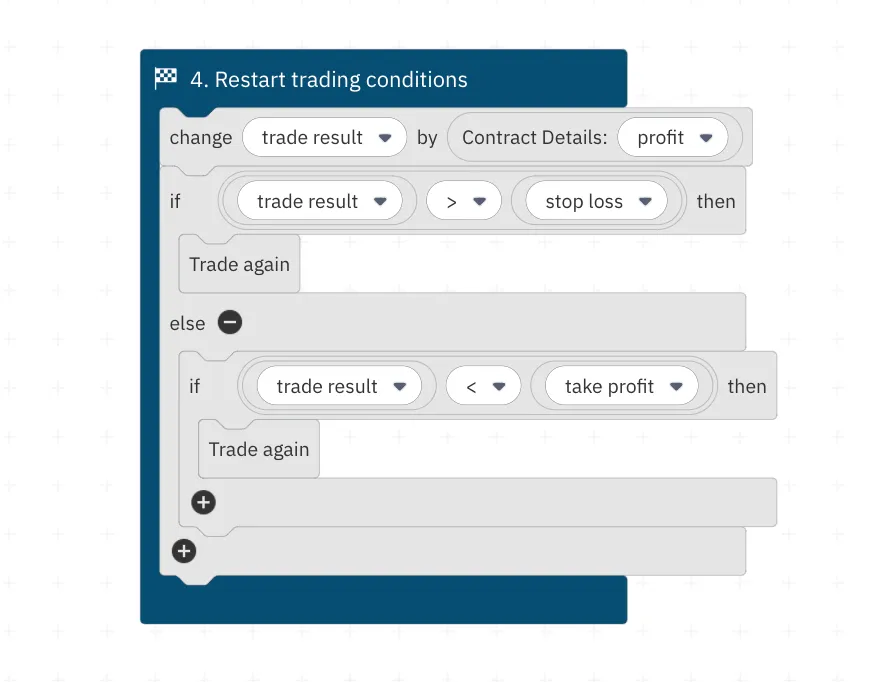
These instructions will tell your bot to compare the results of each trade against the stop loss and take profit amounts you set up. The bot will stop trading if your trade result exceeds your take profit level or surpasses your stop loss level. Otherwise, it will continue opening trades.
Once you have all these parameters set and the mandatory parameters, your trading bot will be able to perform a full cycle strategy – buy a contract, sell it, and continue or stop trading.
But you can improve your bot even further and teach it how to analyse markets and determine the best time to buy a contract. Let’s move on to our How to use technical analysis with Deriv’s trading bot to find out more.
Meanwhile, you can always practice setting up your strategy with your risk-free demo account pre-loaded with virtual currency – practice makes perfect!

Debunking forex trading myths
Not everything you hear about forex trading is real! We've debunked a few myths you should know before you start trading.
This post was originally published by Deriv on 4 August 2022.
You've probably heard many things about forex trading — some good, some bad. But not everything you hear or read about this financial market may be true. In this blog post, we'll debunk the most common myths to help you decide if this market would be a good option for you to trade.
Myth 1: You need a lot of capital to trade forex.
Fact: Most forex brokers, including Deriv, allow you to start trading the forex market with minimal capital.
In the past, the foreign exchange market was only accessible to major international banks and financial institutions with large capital. Nowadays, anyone can trade forex thanks to modern electronic trading and a fast internet connection.
On Deriv, you can trade forex with minimal capital. What’s even better is that you can create a free demo account that’s credited with virtual funds to sharpen your trading skills risk-free before trading with real money.
Myth 2: Currency trading is the same as gambling.
Fact: Forex trading is based on probability, whereas gambling is a game of chance.
In forex trading, you study how the market moves through technical charts and fundamental analysis and, from that, make an informed decision on how an individual currency is likely to perform in the future. Like other markets, you predict the best time to buy or sell it to make a profit.
In gambling, the outcome depends on pure luck. As a gambler, you play against the house, which always has the upper hand as it sets higher odds for losing than winning positions. Some gamblers may sometimes win the jackpot, but many fail, so the odds are heavier in the house's favour. Forex trading is free from this flaw.
Myth 3: There is manipulation in the forex market.
Fact: Thanks to the highly liquid nature and huge transaction volume of the forex market, it is almost impossible to manipulate forex currency rates.
This is one of the most notorious misconceptions about forex. Although governments and large banks control currencies, it doesn't necessarily mean they manipulate currency trading in the market.
Instead, the forex market is almost impossible to manipulate due to a few factors, including the sheer volume of daily transactions that happen in the market, totalling over 6 trillion US dollars in 2023. Additionally, as forex is a global marketplace, macroeconomic events, as well as the unpredictable nature of the traders who trade forex, heavily influence currency prices, making it a highly volatile and liquid financial market.
Myth 4: You can't beat seasoned traders.
Fact: You can. Just remember not to take them on at their own game.
Seasoned traders may have more capital and superior technology, but that doesn't mean you are any less of a trader. It's all about finding and establishing your niche, which will separate you from them.
Professional traders have their own trading strategies that work for them — some hold significant positions, while others focus on intra-day trades. The key is to find a trading niche that is underexploited by other traders. This will give you an opportunity to gain an edge and potentially make more profits.
Myth 5: It's easy to trade forex currency pairs.
Fact: Generally, trading is not easy, which applies to all markets, including forex.
A high level of risk is involved, especially when you trade with leverage. The higher the leverage, the higher the risk level.
Though it's possible to experience significant losses when trading with high leverage, you can use risk management features to minimise these losses. With a Deriv account, you can trade forex with CFDs, options, and multipliers. CFDs allow you to limit your potential loss by using stop loss and take profit orders. Some types of options let you earn a predetermined payout if the market moves in favour of your prediction. With multipliers, you can protect your stake with automatic stop out.
Tapping into the forex market is a strategic way to diversify your trading portfolio. To be able to do this successfully, you have to stick to the facts and not be influenced by myths — do your research and keep up with the market reports to make the best possible trading decisions.

Market news – Week 4, July 2022
Despite Bitcoin's gain for last week, Ethereum was named the best performer. Find out how other markets performed in this week’s report.
As financial markets embraced an improved global risk sentiment, several assets saw gains. However, traders are waiting for the Gross Domestic Product (GDP) results scheduled to be released this week, and the real question is – will markets be able to hold on to their gains if recession sets in?
Forex

EUR/USD ended the week at around $1.0213 while recovering from its multi-year low of $0.9951 in mid-July. The pair rose mainly due to Wall Street having an excellent week and falling US government bond yields weighing on the greenback.
Meanwhile, the Federal Reserve's 'blackout' period allowed GBP/USD to recover after falling to $1.1760 – its lowest level since March 2020. Reduced bets on a 100bps rate hike combined with less hawkish commentary by Fed policymakers led to a broad correction in the US dollar. Also, the rising chances of the Bank of England raising rates by 50bps in August provided an ideal environment for GBP/USD to recover. However, the chart above shows that uncertainty about UK politics limited the currency pair's rebound, causing the pair to end its week at around $1.200.
This week is dominated by risks associated with events happening in the US, the most important of which is the Fed policy decision. Furthermore, the UK calendar doesn't include any high-level macro news. As a result, political events in the United Kingdom will continue to be important for GBP traders.
Level up your trading strategy with the latest market news and trade CFDs on your Deriv X Financial account.
Commodities

Gold had an excellent start to the week and recovered from its 11-month low of $1,698 before the European Central Bank increased interest rates for the first time since 2011. This dragged the metal back to below the $1,690 mark on Thursday, 21 July 2022.
Furthermore, the minutes of the Reserve Bank of Australia policy meeting, released on Tuesday, 19 July 2022, also indicated that future interest rate hikes would be necessary to bring inflation back to the target level. As a result, gold prices were further impacted.
At Friday’s close, the precious metal was trading at the $1,727.75 mark, nearly bisecting its SMA 5 and SMA 10, which were at $1,726.18 and $1,728.17, respectively.
On the other hand, the resumption of Russian gas supply via the Nord Stream 1 pipeline is improving market confidence and easing concerns about a potential recession. This improvement has caused oil prices to drop heavily despite the risk-on mood amid fears of more output and less demand.
In addition, China has issued lockdowns due to its increased Covid-19 cases. Therefore, restrictions on the movement of men and materials as well as layoffs in manufacturing activities may lead to a serious decline in aggregate demand. This would significantly impact oil prices.
Cryptocurrencies

Although the crypto winter is far from over, the cryptocurrency market felt some warmth last week, with none of the leading crypto coins suffering significant losses. In fact, Bitcoin climbed to the $24,000 level on Wednesday, 20 July 2022, its highest since mid-June.
However, the bears returned, causing Bitcoin to return to the sub-$23,000 range towards the end of the week. At the time of writing, its price is at the $22,748.19 mark, marginally leading its SMA 5 and SMA 10 at $22,731.87 and $22,701.03, respectively.
Ethereum outperformed Bitcoin in terms of market growth and grazed the $1,600 level before returning to the mid-$1,500 level towards the end of last week. The growth can be attributed to the announcement of Ethereum Merge, the network upgrade, which seemed to have caused the rally.
Meanwhile, other cryptocurrencies such as Avalanche, Solana and Doge saw 23%, 9%, and 6% growth during the last week.
Latin American countries of Paraguay and Colombia have joined the crypto bandwagon, making announcements and releasing statements that indicate cryptocurrency regulation.
In other crypto-related news, electric car manufacturer Tesla sold 75% of its Bitcoin holdings last week, valued at nearly $936 million.
Maximise market opportunities by sharpening your trading strategy and trading the financial markets with options and multipliers on DTrader.
US stock markets

*Net change and net change (%) are based on the weekly closing price change from Friday to Friday.
The 3 major averages posted substantial gains this week as US equity markets rebounded due to better-than-expected corporate earnings. The Dow saw a 1.95% rise, the S&P 500 experienced a 2.55% gain, and the Nasdaq climbed by 3.45%.
According to several second-quarter earnings reports, corporate profits and outlooks showed some resilience despite a slowing economy. About 21% of S&P 500 companies have reported earnings so far. Of those, nearly 70% have beaten the expectations of analysts.
This week will be highly eventful for the financial markets, with many significant companies like Microsoft, Google, Facebook, Apple, and Amazon reporting their earnings. The Federal Open Market Committee (FOMC) statement and Federal Funds Rate are scheduled to be released on Tuesday, 26 July 2022. At the same time, the nation's central bank is expected to hike its benchmark federal funds rate by 75 basis points. Furthermore, GDP results for the quarter will be released on Wednesday, 27 July 2022, which will attract a lot of attention.
In theory, a recession is identified when the GDP of an economy falls for 2 successive quarters. It will be interesting to see how the Fed works its way out if the results are unfavourable. We are in for a volatile week.
Now that you’re up-to-date on how the financial markets performed last week, you can improve your strategy and trade CFDs on Deriv MT5 Financial and Financial STP accounts.

Market news – Week 4, August 2022
A variety of new data released last week provided insight into the sentiments of the consumer. Despite high inflation, supply constraints, and Federal Reserve (Fed) rate hikes, household finances have remained a source of optimism.
A variety of new data released last week provided insight into the sentiments of the consumer. Despite high inflation, supply constraints, and Federal Reserve (Fed) rate hikes, household finances have remained a source of optimism.
Forex
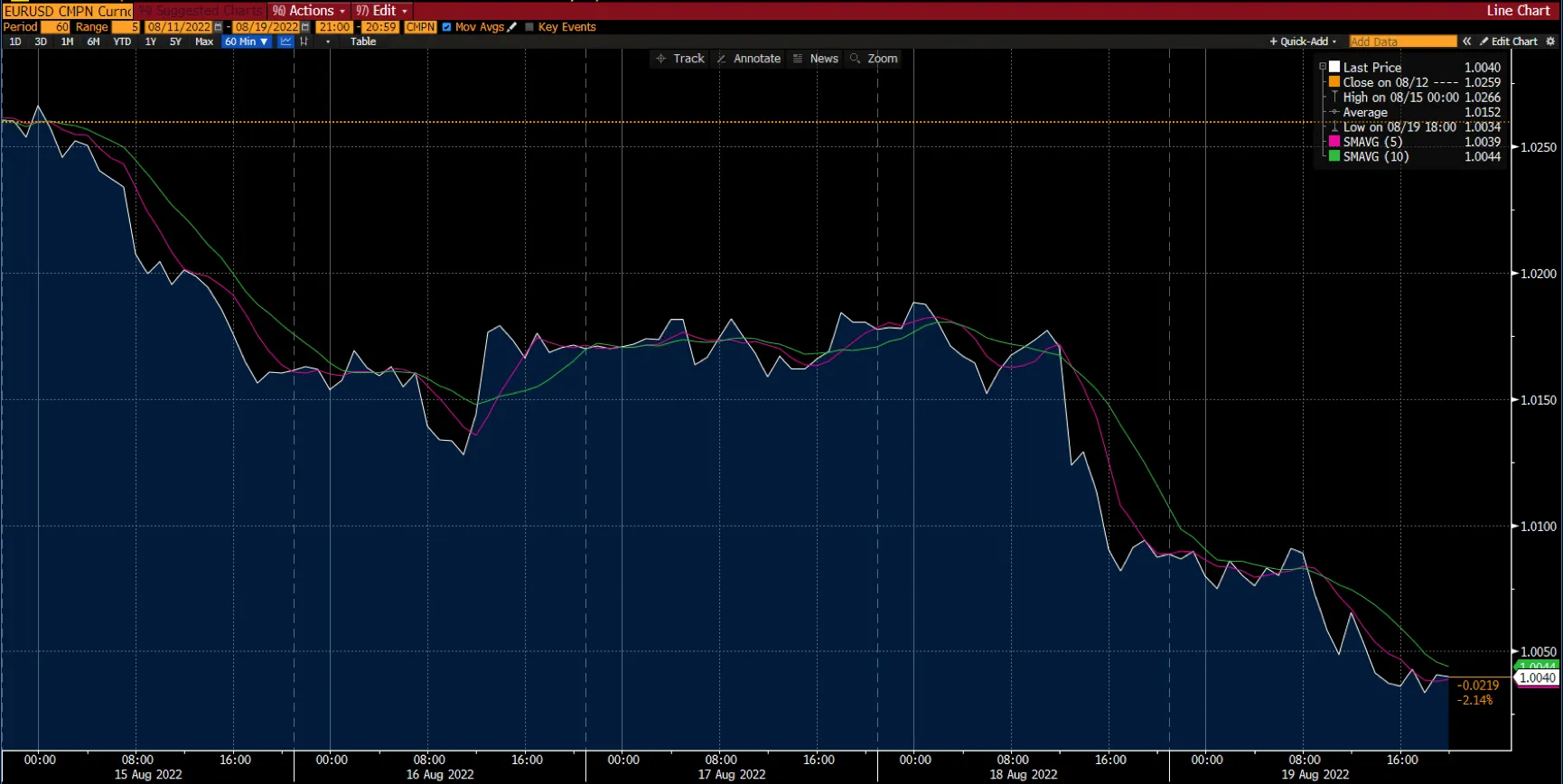
Last week, EUR/USD traded back to near parity, settling at weekly lows of $1.004. Amidst risk-off flows, the US dollar gained a solid footing. Later, as recent economic data indicated a strong performance, a healthy job market, and strong retail sales, the US dollar benefited further from signs that the US may be able to avoid a steeper economic downturn. However, US policymakers are still planning to continue raising interest rates to cool inflation and are looking to push rates beyond neutral.
As a result of a broad-based US dollar recovery, GBP/USD fell to its lowest level in a month – near $1.18. The pair lost over 300 pips in a massive sell-off caused by recession fears and reevaluation of the Fed's rate hike plan.
Meanwhile, USD/JPY rose to its highest level since July 27, settling at around ¥137 due to several factors revolving around Fed officials, all indicating that the US central bank remains on track to tighten its monetary policy further. However, the Bank of Japan has repeatedly maintained its ultra-easy policy settings, resulting in a significant divergence in monetary policy.
Level up your trading strategy with the latest market news and trade CFDs on your Deriv X Financial account.
Commodities

Last week, gold prices showed a downward trend and ended the week at around $1,747. The rising US Treasury bond yield, hawkish Fed comments, and the rise in the US dollar's prices weighed down gold's performance. The pair struggled to recover and ended up losing more than 2% on a weekly basis.
This week will be important for gold, focusing on Federal Open Market Committee (FOMC) Chairman Jerome Powell's speech. If Powell fights against the market's expectation of the Fed becoming dovish in the second half of 2023, the US dollar should be able to excel and will drive gold further down. On the other hand, if the chairman suggests a 50bps rate hike in September rather than a 75 bps increase, US T-bond rates might plummet and may pave the way for a strong rally in gold.
Meanwhile, oil dipped for the week due to a strong US dollar and fears that an economic slowdown will limit demand. Moreover, the strength of the US dollar, which hit a five-week high, also limited crude's gains by driving up the cost of oil for customers using other currencies.
Cryptocurrencies
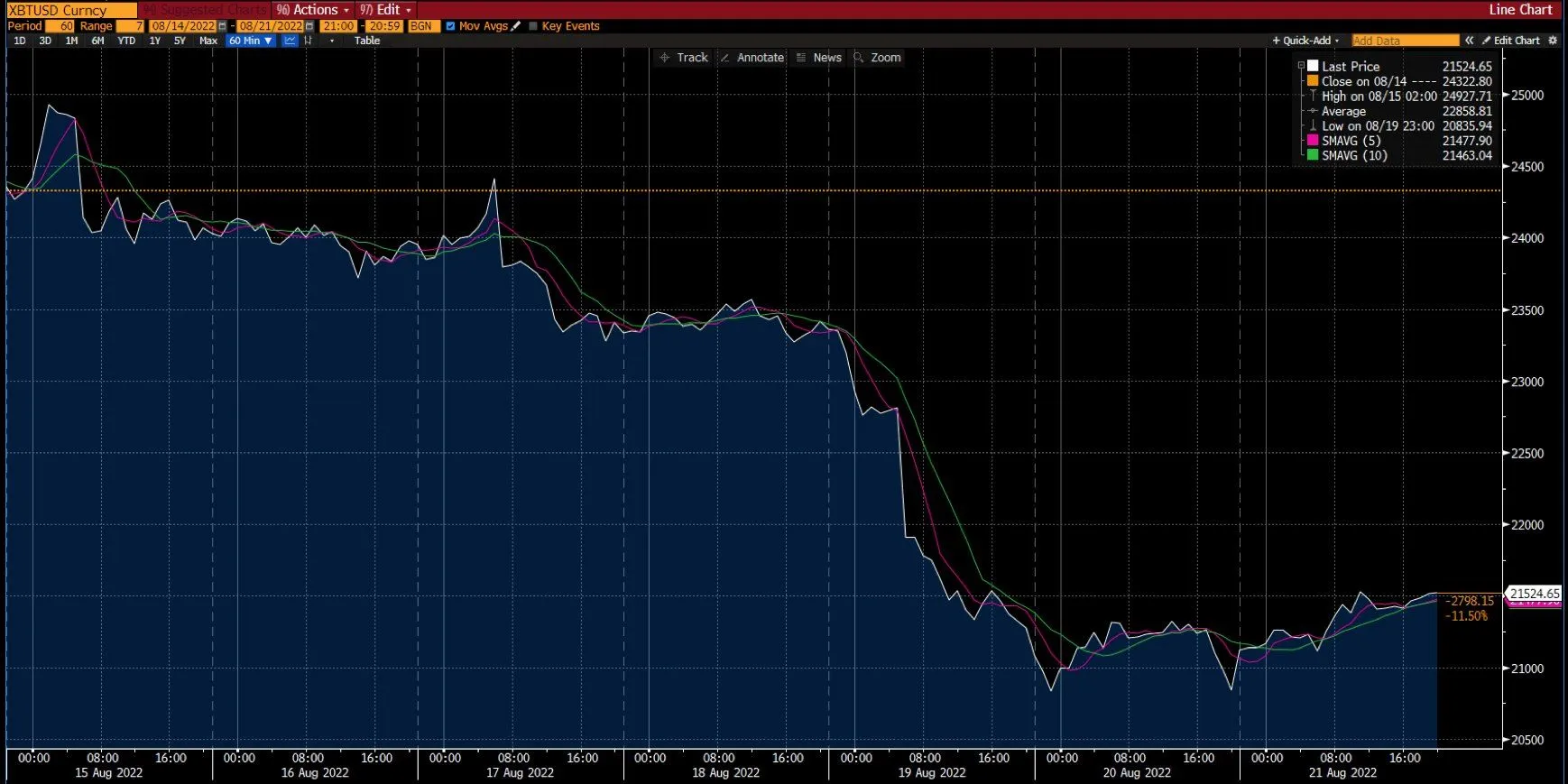
It was a tough week for the cryptocurrency ecosystem. Most major cryptocurrencies depreciated due to heavyweights like Bitcoin and Ethereum posting double-digit percentage losses by the weekend.
Bitcoin started the week above the $24,000 level. However, it fell below a bullish trendline following the release of minutes from the latest FOMC meeting. These minutes revealed that US central bankers are unlikely to lessen their current monetary hawkishness. This resulted in Bitcoin spiralling downward after reaching a two-month high above $25,000. It ended the week at $20,988, down by 13.7% from last week's closing price, continuing its recent losing streak.
Similarly, Ethereum fell below a bullish trendline. It started the week above the $1,900 level and ended it at a $1,600 level. Ethereum's price showed weakness after the recent spike in buying pressure failed to sustain despite the anticipation of its upcoming merge upgrade.
Maximise market opportunities by sharpening your trading strategy and trading the financial markets with options and multipliers on Deriv Trader.
US stock markets
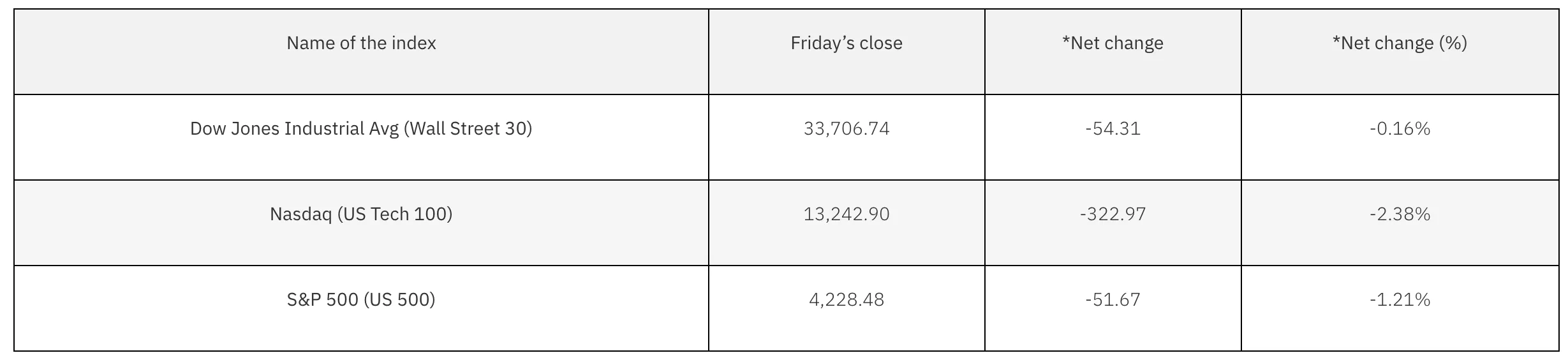
*Net change and net change (%) are based on the weekly closing price change from Friday to Friday.
It was a week of losses for all 3 major indices. The Dow Jones fell by 0.16%, the S&P 500 fell by 1.21%, and the Nasdaq declined by 2.38%.
Friday's losses ended a four-week winning streak for the US equity markets, forcing major benchmarks into negative territory for the week. The biggest losers were Amazon, Apple, and Microsoft.
Despite signs of cooling inflation, Fed policymakers reaffirmed their commitment to tighten their monetary policy, driving stock markets lower. The Federal Reserve chairman's comments on interest rate hikes are causing traders to focus on how aggressively the Fed could raise them to combat inflation.
Since March, the Fed has raised its benchmark overnight interest rate by 225 basis points to reduce inflation.
Several companies are scheduled to report their earnings this week, including Zoom Video Communications, NVIDIA, and Salesforce. Furthermore, Federal Reserve policymakers will discuss a vital part of the US economy's struggles at the Jackson Hole Economic Symposium on Thursday, 25 August 2022.
Now that you’re up-to-date on how the financial markets performed last week, you can improve your strategy and trade CFDs on Deriv MT5 Financial and Financial STP accounts.

Benefits of forex trading
Why trade forex? Learn about key benefits of forex trading and why you should start trading in the biggest financial markets.
This post was originally published by Deriv on July 28, 2022
The forex market is not only the biggest financial market in the world but also one of the most accessible markets to trade on. This marketplace is made up of buyers and sellers from all over the world participating in forex live trading and offers opportunities suitable for both beginner and experienced traders.
If you have been thinking about adding forex to your trading portfolio, read on to find out why you should.
Trade 24/5
The forex market is open round the clock on weekdays, giving you even more opportunities to trade international currency pairs and take advantage of their price movements. Thanks to the business hours of forex exchanges across international time zones, at least one region is operating at any point during the week.
The four major global exchanges that start and end the trading day are Sydney, Tokyo, London, and New York — with these exchanges, forex trading starts at 9:00 pm (GMT) on Sunday and ends at 9:00 pm (GMT) on Friday.
Gain exposure to global economic markets
When you trade forex, you’re able to gain international exposure to different global markets depending on the currency pair or basket you trade.
Forex currency pairs are categorised into major, minor, micro, and exotic pairs and are made up of currencies from all over the world. These three categories have different liquidity levels that represent how actively traded the currency pairs are.
You can also trade currency basket indices. These indices measure the value of one currency against a basket of five other equally weighted global currencies, increasing your exposure to even more global markets at the same time.
Trade a highly liquid market
Liquidity refers to how quickly an asset can be bought and sold. When a market is highly liquid, it basically means that there are lots of buyers and sellers trading at any point, leading to a higher trading volume and lower transaction costs as traders seek to complete transactions easily and quickly.
The forex market is one of the most liquid in the world (in 2019, the market was averaging over 6 trillion USD traded daily). With the large number of active trades happening every day and low costs, it becomes easier for traders to enter the forex market and start trading.
Profit from both rising and falling prices
On Deriv, you can trade forex via options, CFDs (contract for differences), and multipliers, which all allow you to potentially profit from rising as well as falling prices. With these trade types, you’ll be predicting the price movements of currency pairs or baskets, and if the price moves according to your prediction, you’ll earn a profit.
Options trades are timed, so you’ll be predicting market movements within a specific time period. On the other hand, CFD trades can stay open for as long as you want to take advantage of market movements (as long as you have sufficient funds in your account to cover potential losses in case the market moves against you). With multipliers, you’ll get to multiply your potential profits without losing more than your stake.
Start trading with low capital requirement
Thanks to the highly liquid nature of the forex market and low transaction costs, you can open a forex trade even with relatively low capital. On Deriv, all you need is a 5 USD deposit into your account, and you can start trading forex on any of Deriv’s platforms.
Make the most of high leverage
On Deriv, you can trade major, minor, and exotic currency pairs with high leverage. Trading forex with leverage gives you more market exposure by allowing you to trade more than your capital allows. This means you get to open a trade worth more than your stake. For example, with a leverage of 1:10 and a stake of 100 USD, you’ll get to open a trade worth 1,000 USD.
The profit or loss you make at the end of your trade is based on the trade’s full value, so trading with leverage allows you to maximise your capital and increase your potential profits. However, note that this also means potential losses are increased.
Take advantage of tight forex spreads
A spread is the difference between the bid and ask prices and represents the cost to open a CFD trade. These are determined by the broker and are calculated in pips, which are small price movements of an asset.
Deriv offers one of the tightest competitive forex spreads in the industry. In a highly liquid market like forex, with a large trading volume and transactions are completed quickly, the tighter the spread, the faster you will likely gain back your capital and take greater advantage of the price changes.
- - -
Find out more about options trading and CFD trading on Deriv before you get started. Or use a free demo account now to start exploring the forex market risk-free. This demo account is pre-loaded with 10,000 USD of virtual currency, and it’ll give you a chance to experience these benefits before you start trading with real money.

Market news – Week 3, September 2022
The financial markets saw a sharp change in trend from the previous week as inflation took centre stage. Overall, the financial markets traded in the red due to the Federal Reserve’s actions and new economic data in the US.
The financial markets saw a sharp change in trend from the previous week as inflation took centre stage. Overall, the financial markets traded in the red due to the Federal Reserve’s actions and new economic data in the US.
Forex
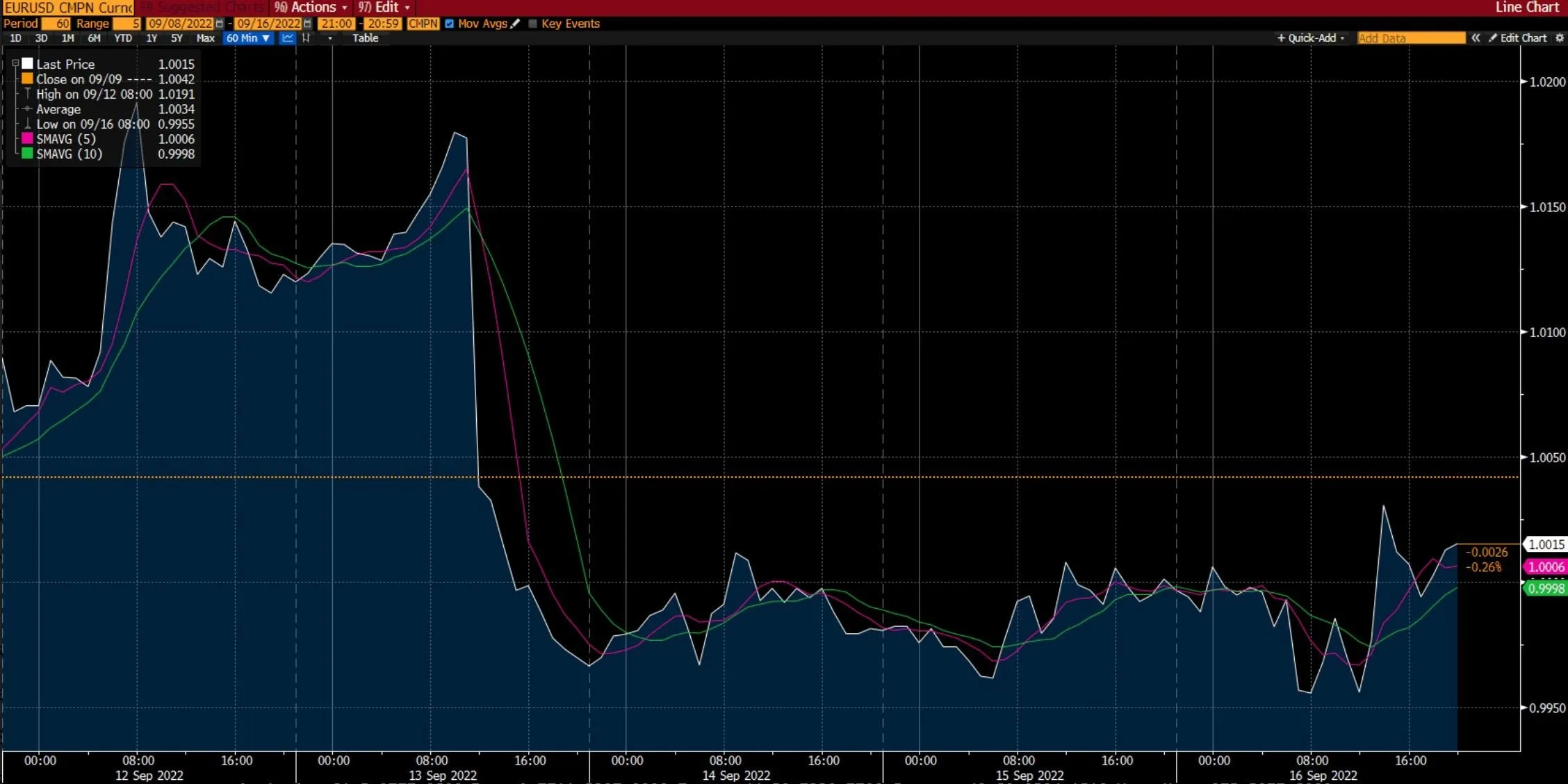
Fed Chairman Jerome Powell's aggressive tone was rejected by traders, who expected inflation to be moderate and the Fed’s policy to tighten following September's rate hike. The price rises, however, are relentless. August's Core Consumer Price Index (CPI) increased by 0.6% (MoM), above forecasts. Other CPI measures also rose, resulting in expectations of a 100 basis points rate hike.
The EUR/USD fell and only made tiny recoveries in response to poor US data, such as disappointing retail sales estimates. In nominal terms, inflation is outpacing consumption.
With respect to the monetary policy, European Central Bank (ECB) officials overwhelmingly endorsed a substantial rate increase in October. This contrasts with ECB President Christine Lagarde's more nuanced stance following the recent rate decision.
Even though the euro is fighting hard, the US dollar seems to be holding on tight.
The GBP/USD failed to maintain its bounce, falling roughly by 200 pips. The pair finished the week in the negative, trading below $1.1500. The decline in the pair's prices could be due to disappointing retail sales in the UK. Sales volumes in the retail sector declined by 1.6% in August, continuing with the summer of 2021 trend.
This week will be important for the markets as the Fed and Bank of England decide on interest rate hikes.
Level up your trading strategy with the latest market news and trade CFDs on your Deriv X Financial account.
Commodities

Gold started the week at around $1,720. As the US dollar continued to rise, gold dropped to its lowest level since April 2020 and finished the week at a notably lower price of $1,675, just under 3% from its price at the start of the week.
That being said, the expectation of a significant rate hike by the Fed on Wednesday, 21 September 2022, appeared to be a crucial factor exerting downward pressure on gold on the final day of the week.
Meanwhile, silver prices began trading at around $18 and ended at approximately $20. Despite growing concerns that the US central bank's tightening might cause a recession, US economic statistics showed that consumer sentiment continued to improve, driving up this precious metal's price.
WTI prices hovered around $85 due to fears of a long-term decline in global energy demand. Because of the same reasons mentioned above, oil prices have fallen by around a quarter in the last 3 months.
The World Bank and the International Monetary Fund warned of an imminent global economic downturn in late 2022/23, weighing on morale. Furthermore, the strong US inflation data released earlier last week boosted the US dollar, which hurt the market (because oil is traded in US dollars, making it costlier for overseas customers).
Cryptocurrencies
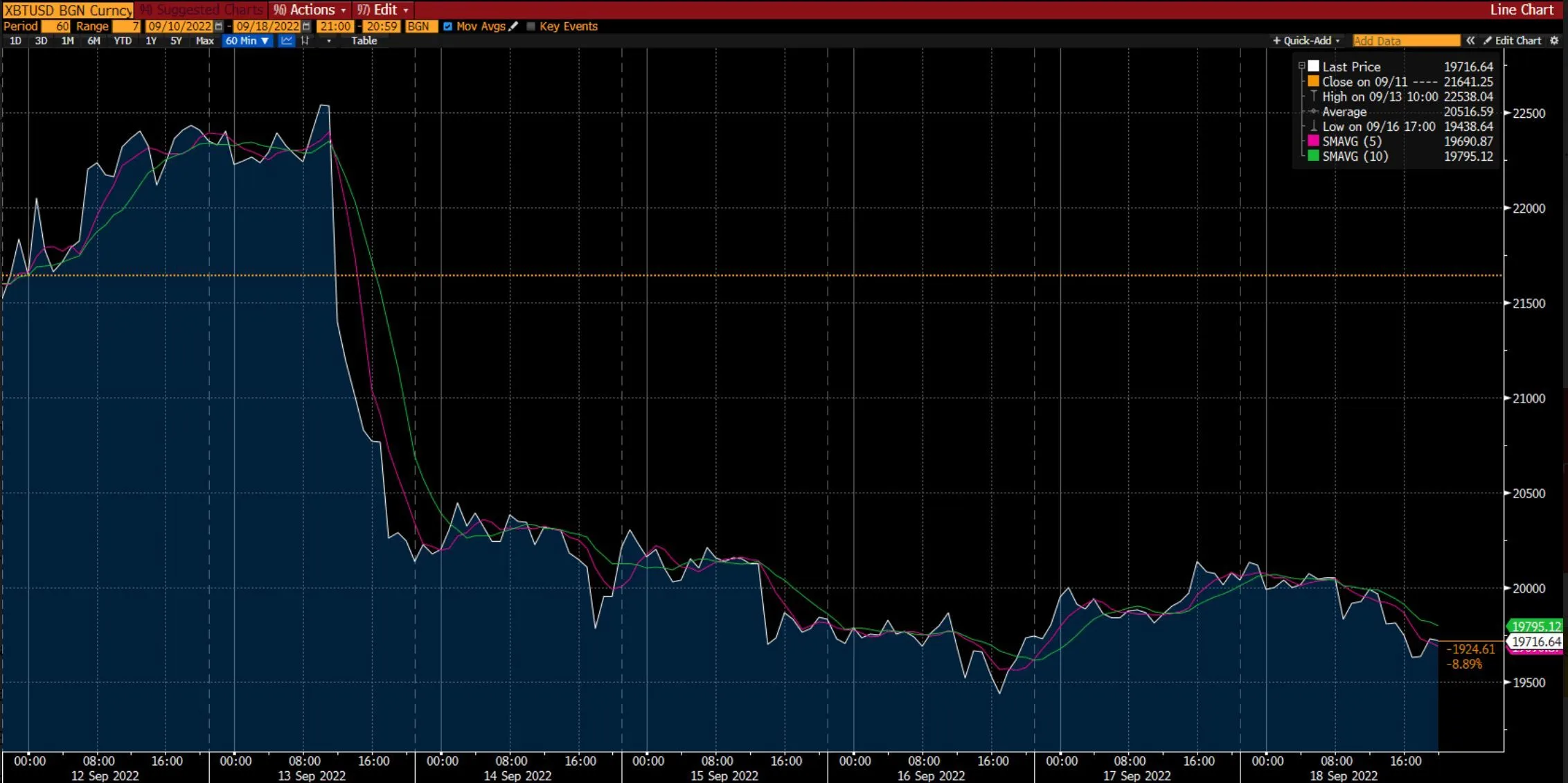
The global cryptocurrency market crashed last week, with all the major cryptocurrencies trading in the red. The previous week's uptrend was short-lived as the global market capitalisation returned to the sub-$1 trillion level, and the trading volume stood at the mid-$60 billion mark.
Bitcoin, as usual, was in the eye of the storm. On Tuesday, 13 September 2022, the largest cryptocurrency in the world by market capitalisation dropped from the $22,500 level to the $20,400 level, sending the crypto market into a frenzy. The coin experienced further losses during the week and is trading at $19,716.64 at the time of writing.
Bitcoin's market value stood at around $370 billion, and the trade volume was approximately $30 billion. The token has slumped by 12.5% in the last 6 days.
Meanwhile, the Merge effect seems to have worn off as Ethereum followed Bitcoin's footsteps, dropping below the $1,400 level for the first time since mid-July.
Bitcoin’s decline and Ethereum's price drop after the Merge have also been reflected in other altcoins, such as Litecoin and Dogecoin, which dropped by 15% and 11%, respectively.
In other news, President Joe Biden outlined the plans for cryptocurrency regulation as the government realises the importance of digital assets in fostering innovation and supporting the country's technological advancement.
Take advantage of market opportunities by sharpening your trading strategy and trading the financial markets with options and multipliers on Deriv Trader.
US stock markets
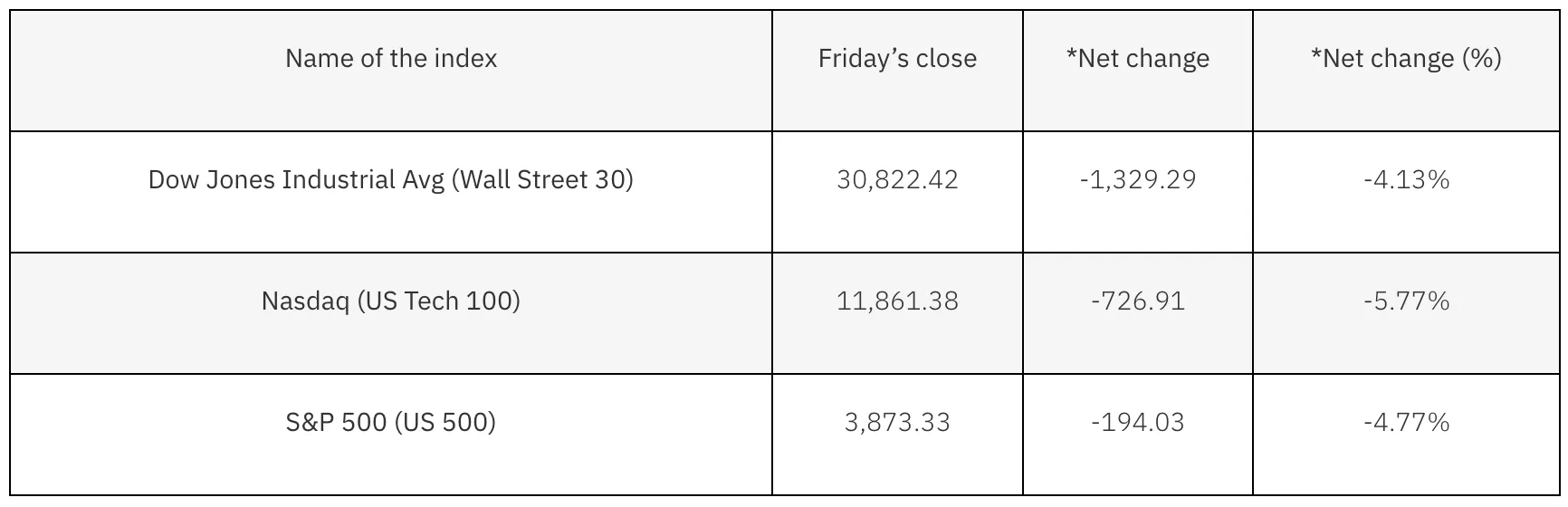
*Net change and net change (%) are based on the weekly closing price change from Friday to Friday.
The stock market fell sharply as inflation fears intensified, and short-term bond yields reached levels last seen in 2007. The S&P 500 index fell by around 4.77%, its biggest weekly decline since June. Furthermore, growth stocks fared the worst, with the technology-heavy Nasdaq 100 falling by nearly 5.77% and the Dow Jones Industrial Average falling by approximately 4.13%.
Within the S&P 500 index, shares of communication services and information technology fell as Google parent Alphabet and Facebook parent Meta Platforms hit new 52-week lows. The industrial and materials sectors also suffered.
According to the consumer price index (CPI) data released on Tuesday, 13 September 2022, which exceeded expectations, traders began losing faith in the notion that "peak inflation" had passed. The prices increased by 8.3%, higher than consensus predictions of a gain of around 8.1%. However, the increase in core inflation (excluding food and energy) was alarming. It reached 6.3%, its highest level since March and higher than the estimate of 6.1%.
This week's focus will be on the Federal Open Market Committee (FOMC) meeting, as the Fed has emphasised lowering inflation over ensuring strong economic demand.
Now that you’re up-to-date on how the financial markets performed last week, you can improve your strategy and trade CFDs on Deriv MT5.

Market news – Week 5, August 2022
The Jackson Hole speech indicated that it is too early for the Fed Reserve (Fed) to declare victory against inflation. The markets reacted to that news, and what a reaction it was!
The Jackson Hole speech indicated that it is too early for the Fed Reserve (Fed) to declare victory against inflation. The markets reacted to that news, and what a reaction it was!
Forex
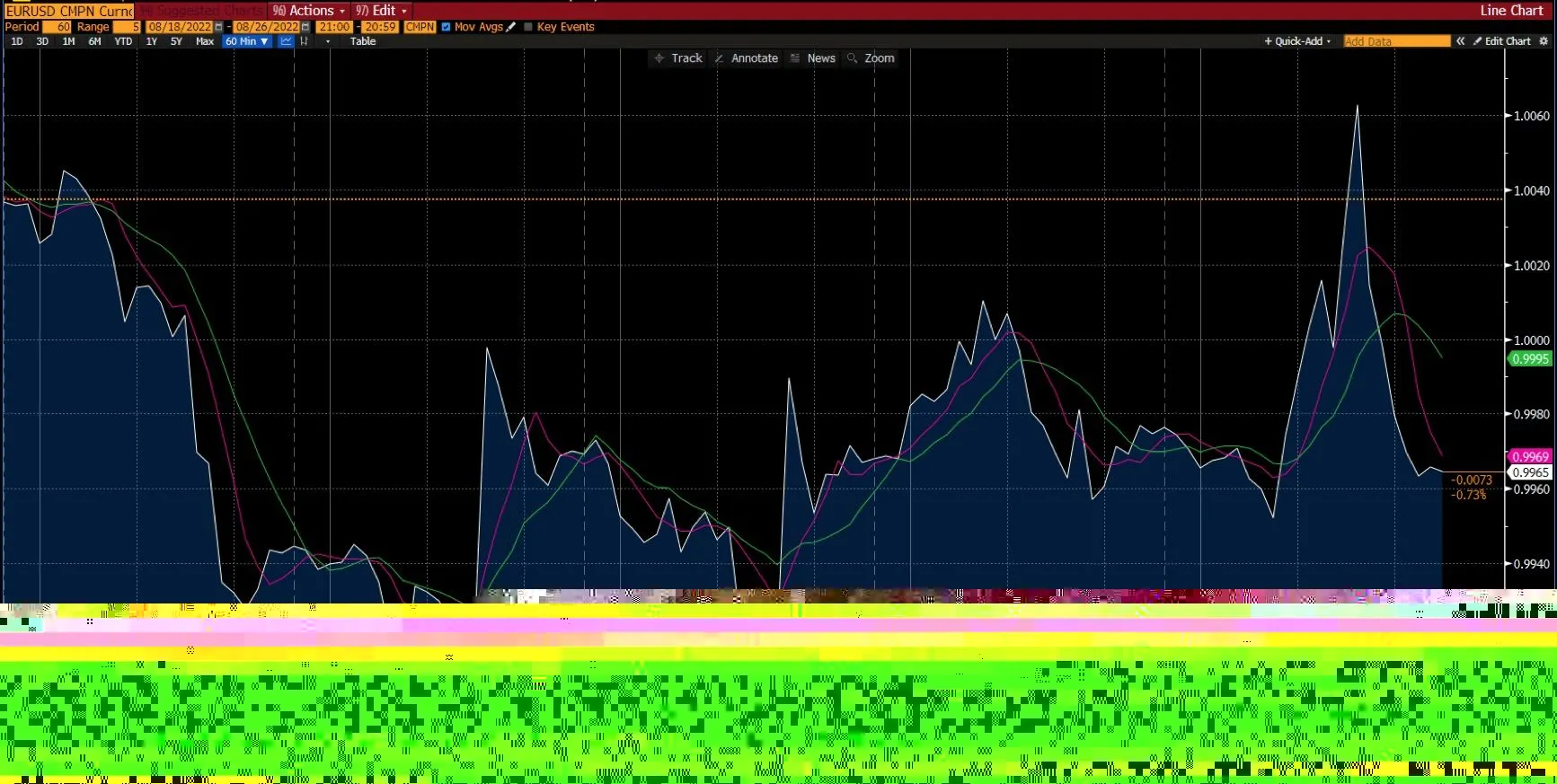
Last week, EUR/USD plummeted to its lowest level since 2002, reaching $0.9901. But the pair recovered to close the week at $0.9965.
Russia's refusal to give up on its energy supplies has worsened the energy situation in Europe, posing a threat of shortage for the upcoming winter. Prices are rising, and inflation is rapidly increasing, causing the pair to fall below parity.
On the other hand, Fed Chairman, Jerome Powell, said that the Fed remains committed to price stability. According to the Fed, "reducing inflation is likely to require a sustained period of below-trend growth" and a restrictive policy stance for "some time".
Powell's remarks caused the greenback to decline and EUR/USD to rise marginally, thereby increasing the chance of a 75 bps rate rise in September. While the US dollar rose at the start of the week, it lost momentum as the central bank indicated that its primary objective was to control inflation, regardless of the economic consequences.
Meanwhile, GBP/USD continued to fall just below the $1,800 mark. According to the British energy regulator, energy costs in the UK may increase by 80% to £3,549 per year from the beginning of October, which is a concern that will contribute to the UK's economic downturn.
This week, the focus will be on the non-farm payroll figures, which are critical to the September Fed rate hike decision.
Level up your trading strategy with the latest market news and trade CFDs on your Deriv X Financial account.
Commodities
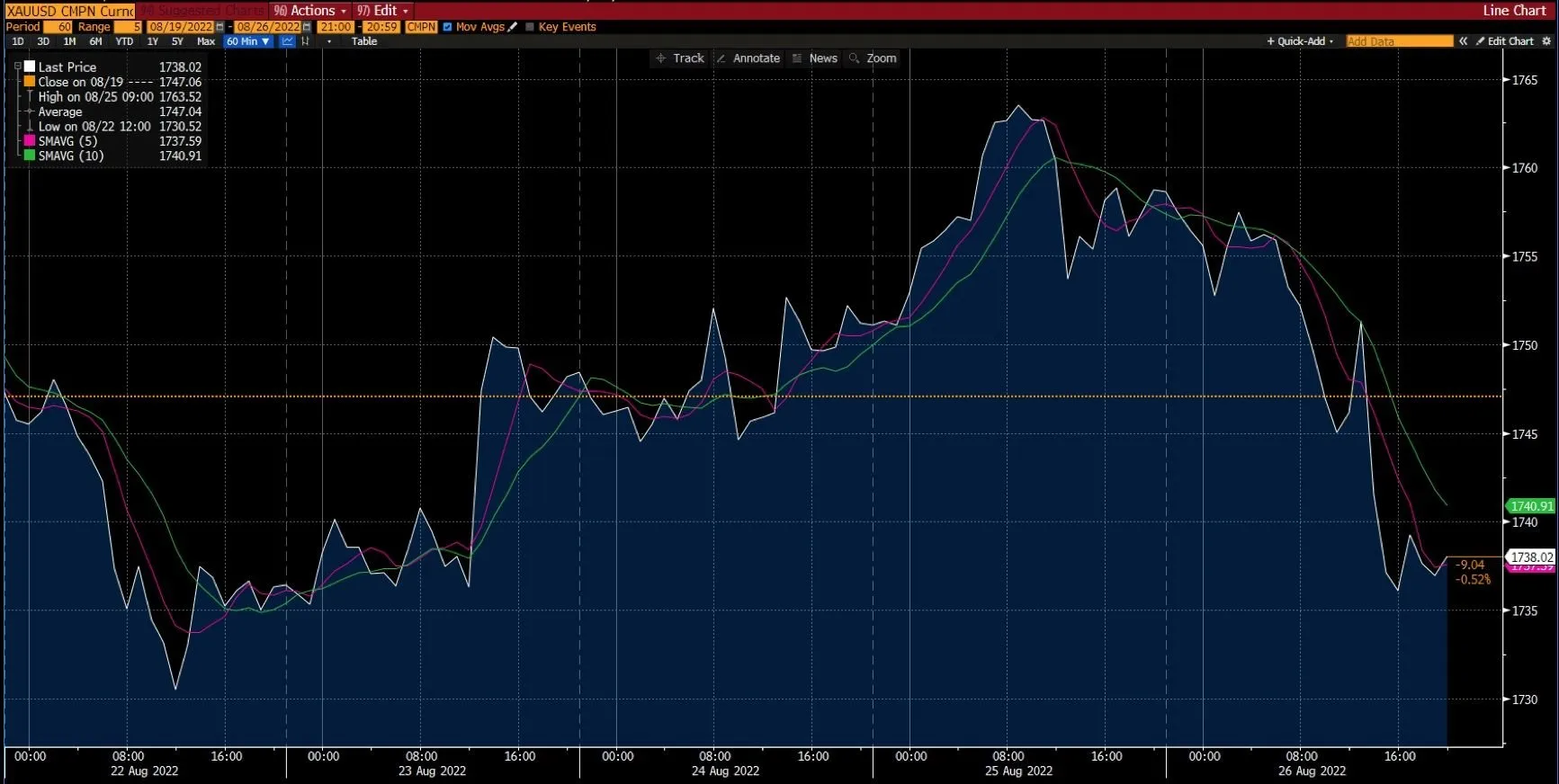
Last week, gold fluctuated between gains and losses before ending the week below $1,740.
Gold prices were reasonably calm despite the Fed's Economic Policy Symposium, which caused volatility across the markets. However, the yellow metal suffered losses as a result of the second quarter GDP declining less than expected and traders shifting to stocks instead of safe havens such as gold.
Furthermore, the rise in yellow metal prices was restrained by the rise in sovereign bond yields and after Fed Chairman Jerome Powell warned that rate increases would continue over the following months.
On the other hand, oil rallied this week mainly due to Saudi Arabia's warning about supply limitations. Prices have risen since Saudi Arabia's oil minister suggested reducing production by the OPEC+ (Organization of the Petroleum Exporting Countries Plus). Meanwhile, Fed Chairman Jerome Powell indicated that the US central bank is likely to continue raising interest rates to battle inflation. Energy consumption is often viewed negatively when rates are higher.
This week's main focus will be on the non-farm payroll and unemployment rate statistics, which traders will closely follow to gauge the US economy.
Cryptocurrencies
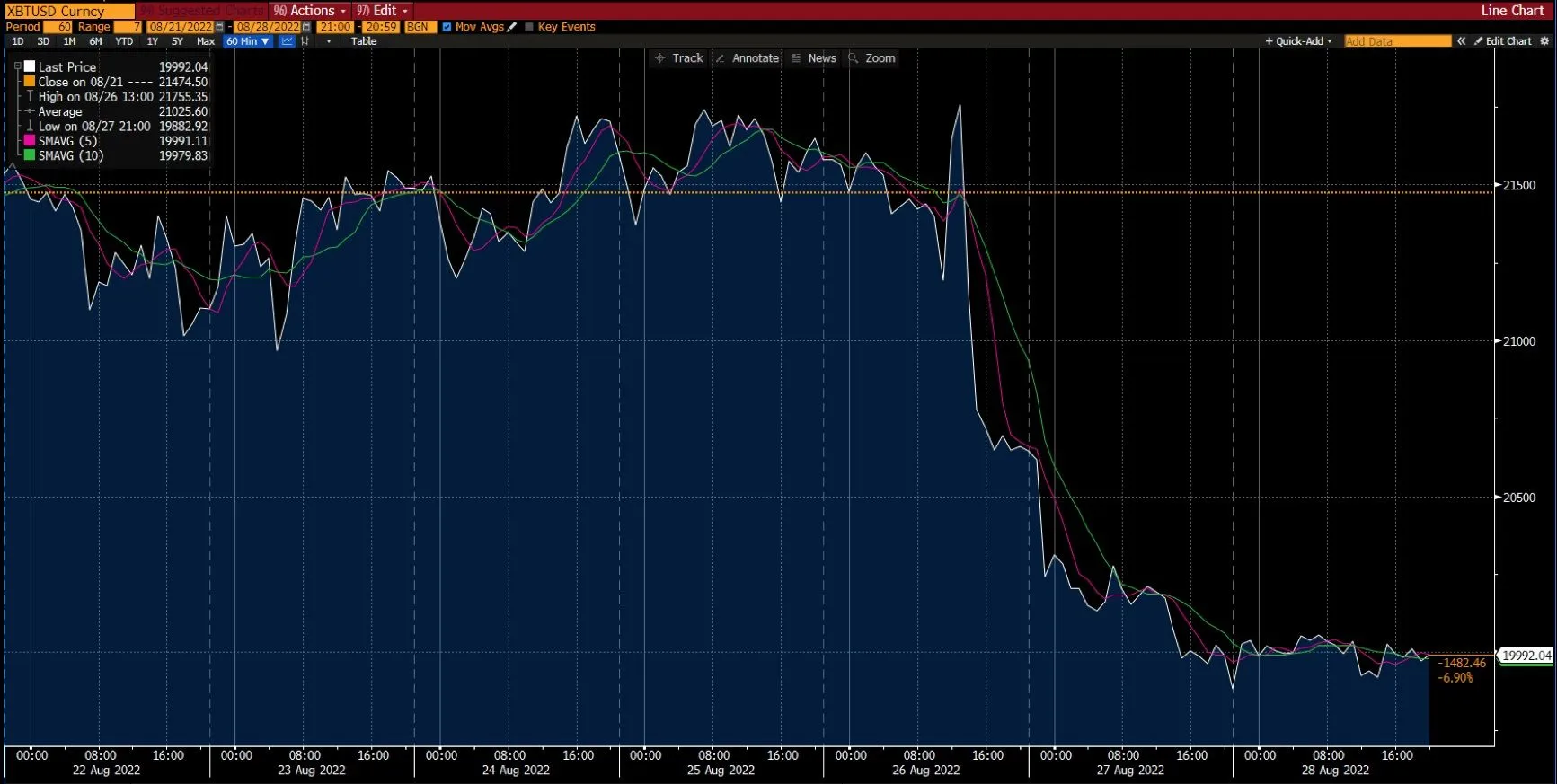
The cryptocurrency market had an anticlimactic week due to a significant drop in the prices of major cryptocurrencies. Following a period of stabilisation, the market suffered a substantial drop, much to traders' surprise.
Bitcoin was trading at around the mid-$21,000 level for most of the week. However, over the weekend, Bitcoin was at the forefront of all the occurrences as the coin plummeted below the $20,000 mark for the first time since mid-July. This significant drop may have occurred due to concerns about the Fed's rate-hike path post the Jackson Hole speech.
Earlier this month, the $20,000 level acted as a support level for Bitcoin, and the cryptocurrency even went on to surpass the $25,000 mark. However, at the time of writing, Bitcoin dropped below that support level and is trading at $19,992.04.
Other major cryptocurrencies followed Bitcoin's footsteps as the market experienced a wider retreat. Ethereum dropped below the $1,435 mark – its lowest since the last week of July.
Among other cryptocurrencies, Dogecoin fell to $0.06, Cardano to $0.42, and Solana to $30.15, each getting a taste of the bearish movement.
Take advantage of market opportunities by sharpening your trading strategy and trading the financial markets with options and multipliers on Deriv Trader.
US stock markets
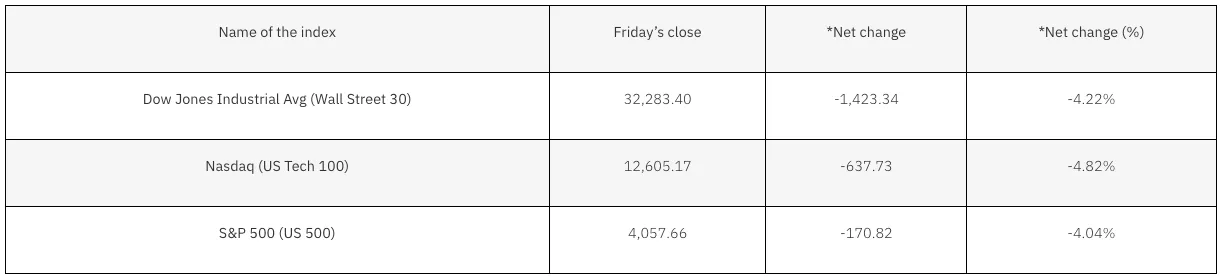
*Net change and net change (%) are based on the weekly closing price change from Friday to Friday.
For the second week in a row, the major averages declined. Stocks collapsed on Friday, 26 August 2022, after Fed Chairman Jerome Powell said the central bank would not back off from its fight against rapid inflation.
For the week, the Dow tumbled by 4.22%, the S&P 500 dropped by 4.04%, and the Nasdaq fell by 4.82%.
The Federal Reserve's Chairman Jerome Powell was more hawkish than anticipated in his speech on Friday, which weighed down on the stock market. With Powell's continued stance against inflation, traders have been considering the implications of higher interest rates being kept in place for longer.
The core index, which excludes food and energy, is at 4.6%, which is currently more than double the Fed's 2% target.
This week, traders are looking forward to Friday, 2 September 2022, as the Bureau of Labor Statistics (BLS) will release its monthly report on non-farm payrolls.
Now that you’re up-to-date on how the financial markets performed last week, you can improve your strategy and trade CFDs on Deriv MT5 Financial and Financial STP accounts.
.webp)
How to protect your online trading account
In this digital era, cybercrimes are widespread and easily committed. According to cybercrime statistics, an average of 2,244 cybercrimes happen daily. Hackers and scammers use social engineering to manipulate and exploit the emotions of unsuspecting victims into sharing confidential data about themselves. These data breaches could cause significant losses to the victims. In this blog post, we will explain the different types of social engineering and how to protect yourself against them.
In this digital era, cybercrimes are widespread and easily committed. According to cybercrime statistics, an average of 2,244 cybercrimes happen daily. Hackers and scammers use social engineering to manipulate and exploit the emotions of unsuspecting victims into sharing confidential data about themselves. These data breaches could cause significant losses to the victims. In this blog post, we will explain the different types of social engineering and how to protect yourself against them.
Phishing
Phishing is an attack where scammers pose as legitimate individuals or businesses to collect personal information from unsuspecting users. Users usually receive genuine-looking emails that lead them to a fake website, where they are tricked into revealing sensitive information such as their passwords or bank details.The following are the various types of phishing:
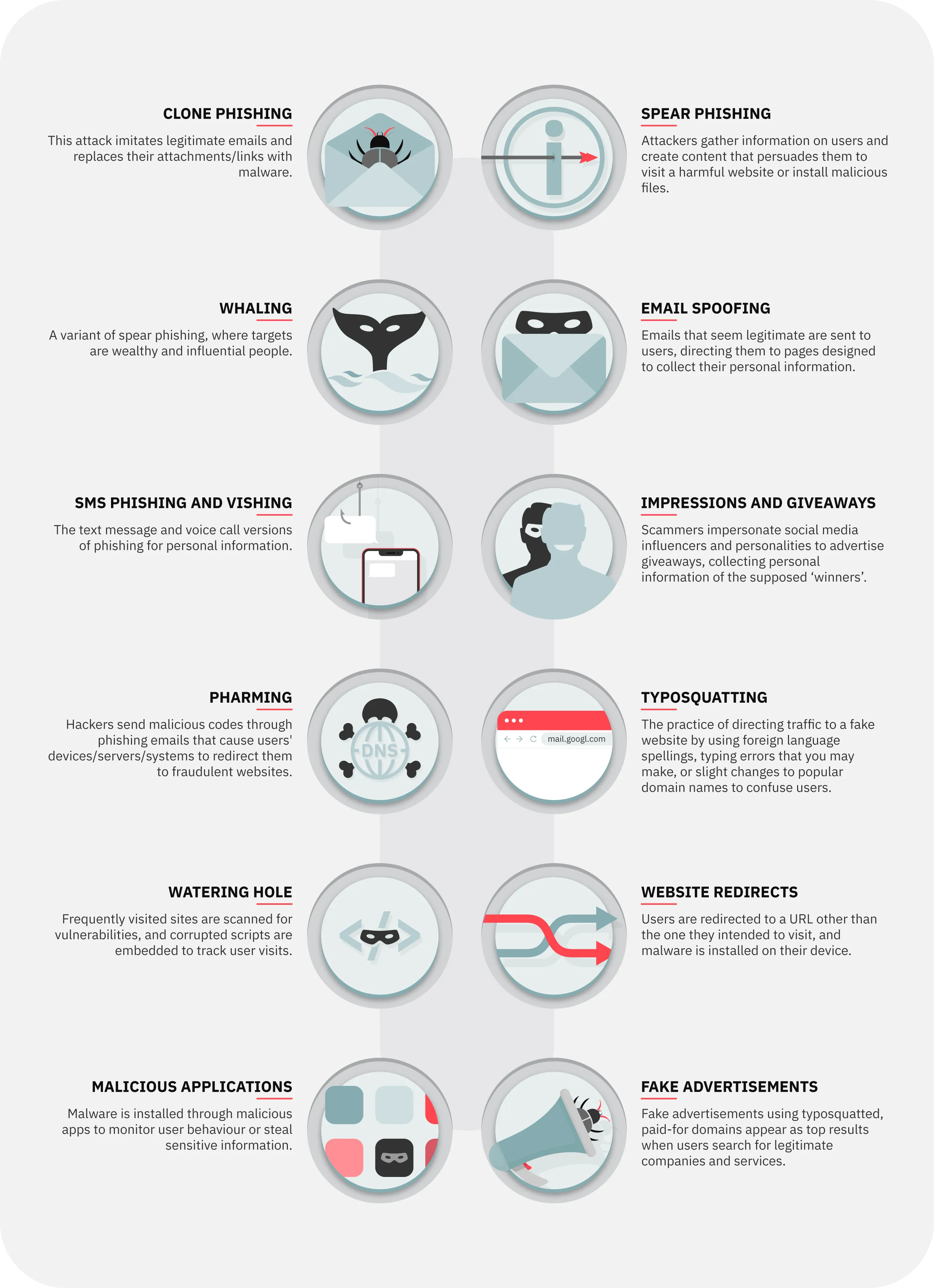
Keylogging
Keystroke logging or keylogging is the act of secretly recording keystrokes on a keyboard. Often, a keylogger tool is used by scammers to capture the keystrokes – either using a programme (software) or a physical device (hardware) – and the data collected would be used for illegal activities.
Types of keyloggers
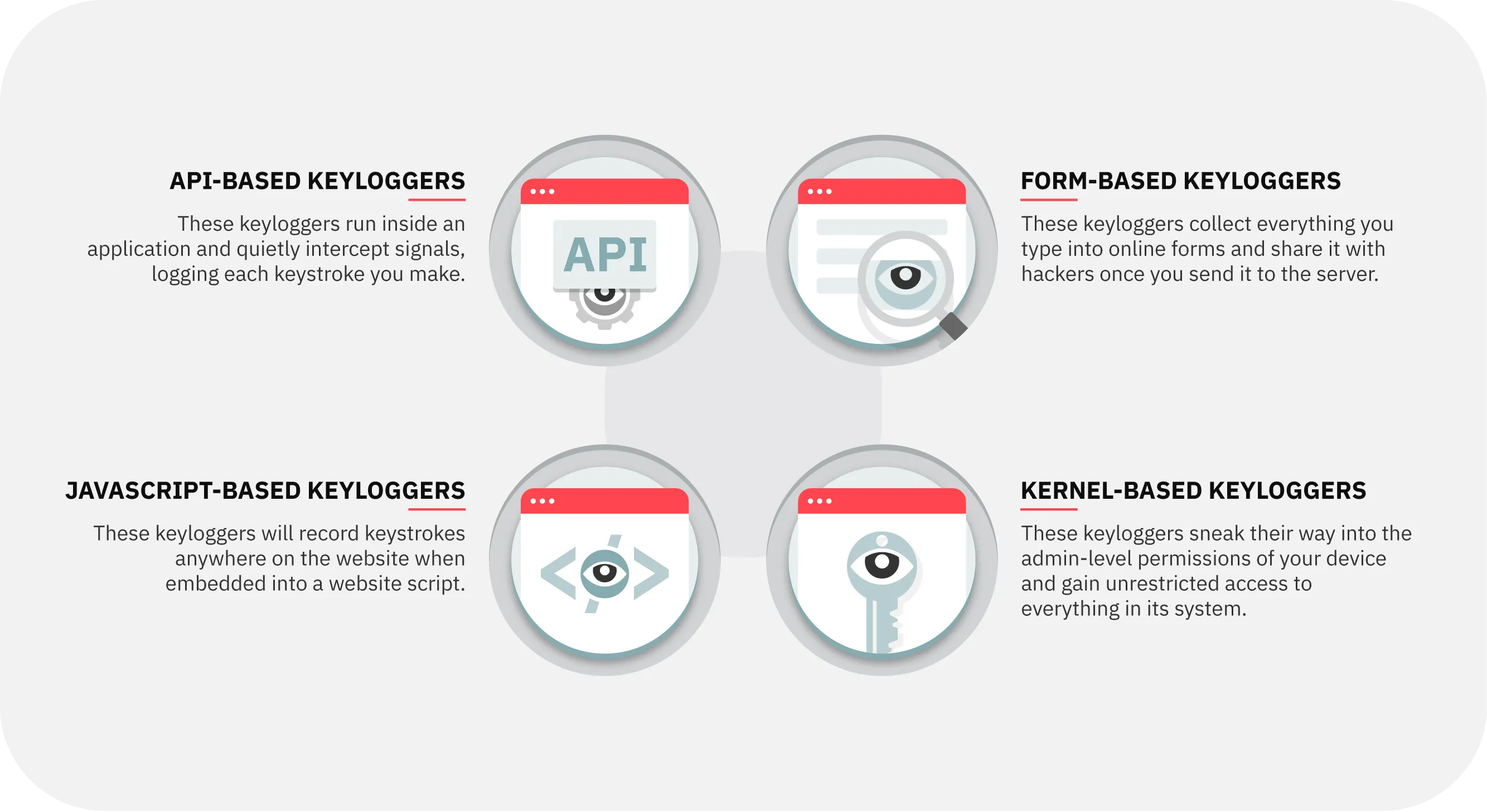
Software keyloggers are apps and computer programmes that are secretly installed onto your device by a hacker through phishing attacks or remote downloading. In addition to tracking keyboard activity, some software keyloggers can also capture screenshots and information copied to your clipboard. These keyloggers can be detected and removed by antivirus software. Here are a few examples of software keyloggers:
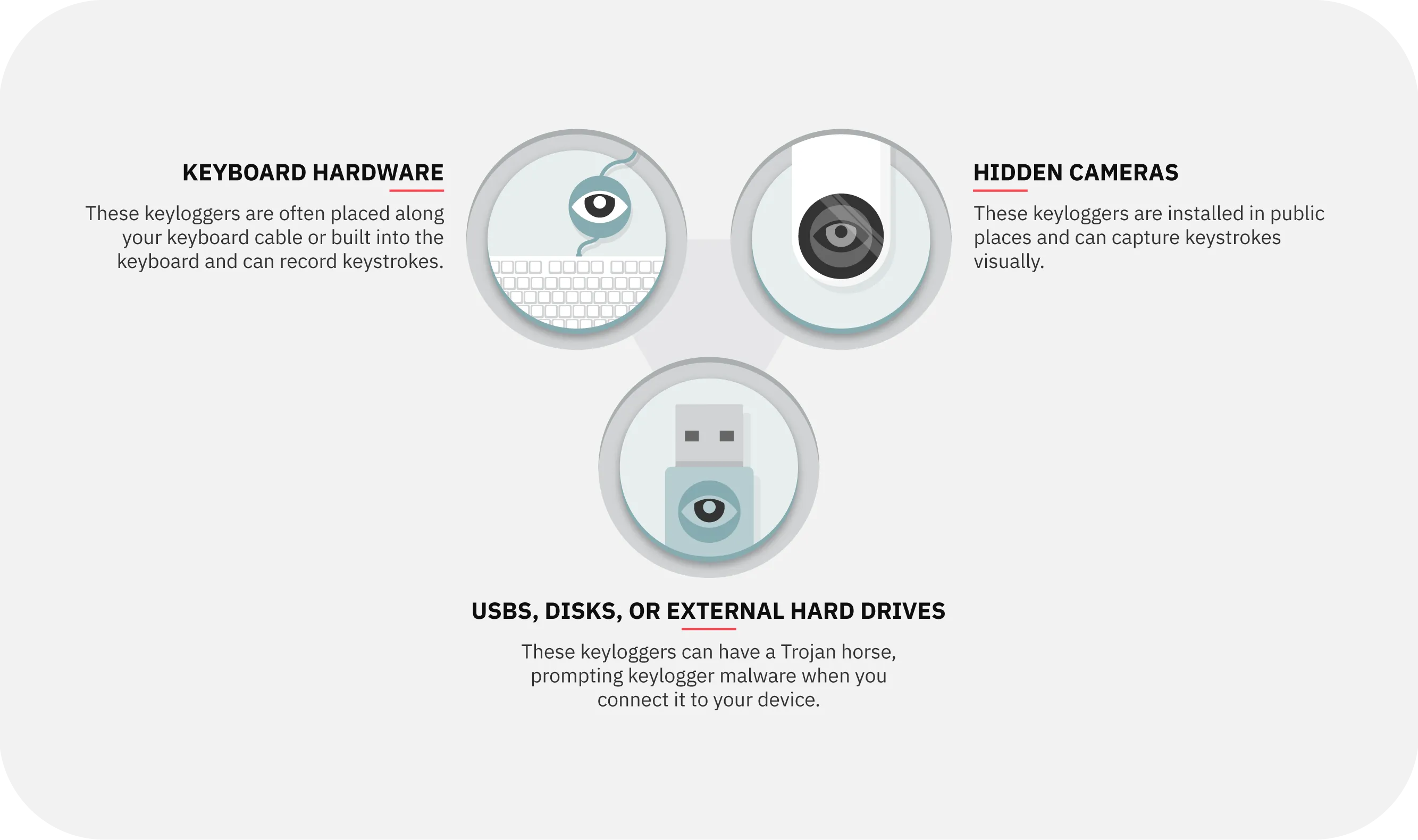
Hardware keyloggers are usually hidden in plain sight as they are built into or connected to your device. Unlike software keyloggers, antivirus software would not be able to detect these keyloggers. Here are a few examples of hardware keyloggers:
Man-in-the-middle attack
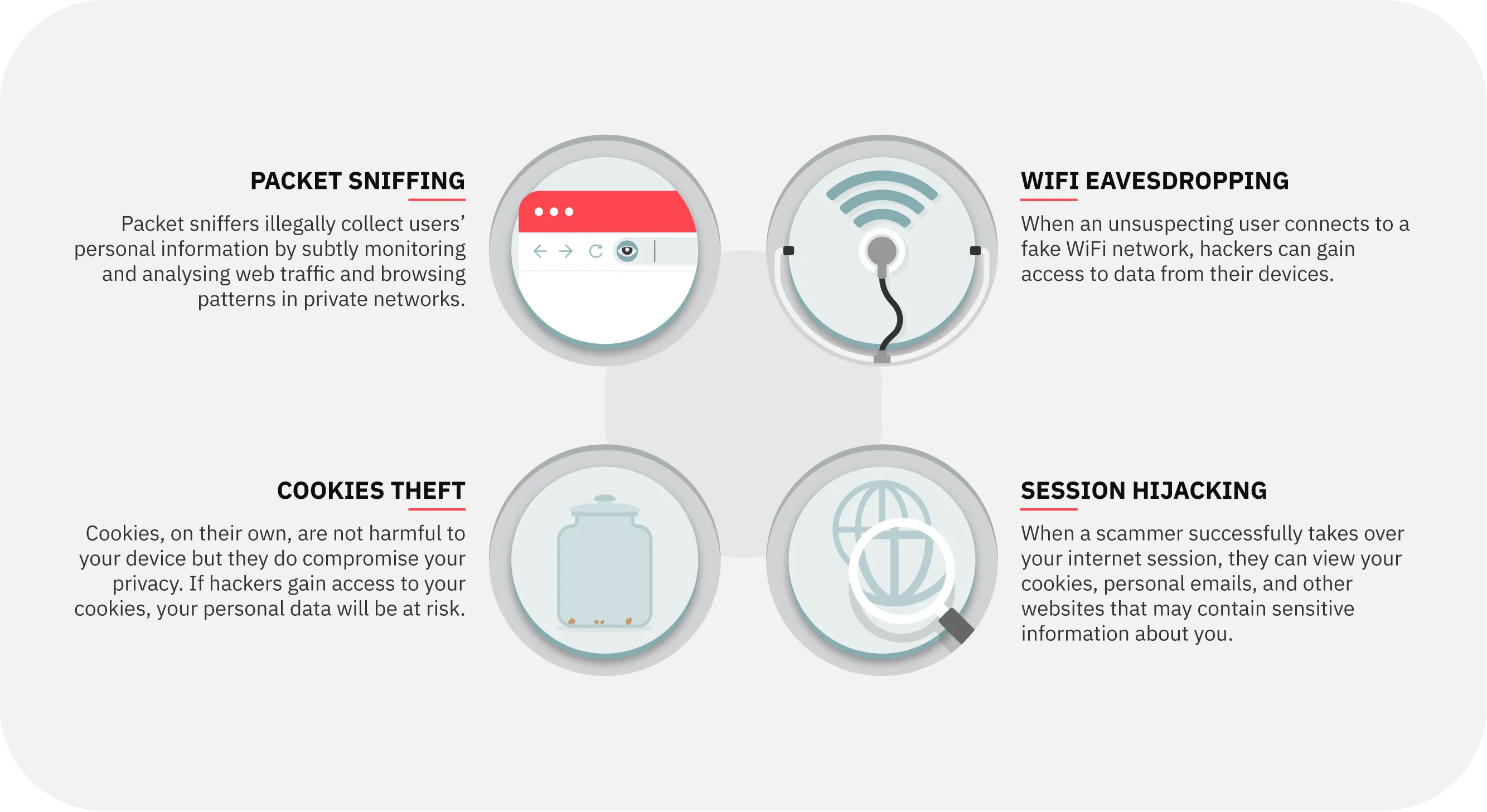
While having free public WiFi wherever you go does seem convenient, it comes with risks. Public WiFis are susceptible to Man-in-the-middle (MitM) attacks.MitM attacks happen when a malicious third party pretends to be a legitimate middleman and intercepts communications between two parties. When a user decides to browse a certain website, the third party would interfere and send the user to a fraudulent site instead. Here are a few examples of MitM attacks:
Scareware
As implied by its name, scareware is malware that intends to scare users. By creating fake warnings, scammers intimidate users into installing malicious software or visiting websites that will corrupt their devices. This message is an example of scareware:

Baiting
Have you ever received a random email for the delivery of an order you never made? If you have, a scammer may have attempted to bait you. Scammers who use this method of social engineering depend on feelings of curiosity or greed to trick users.

Be wary of random or unfamiliar websites offering free downloads of ebooks, music or movies, which only require you to create an account. The details you share are exactly what scammers want. The files you download could also contain malware that collects personal information.Baiting can also happen in physical form. If you see a USB device or an external hard drive unattended somewhere, ignore it. Scammers leave infected devices lying around as bait to corrupt the devices they are plugged into.
6 tips to secure your Deriv account
Now that you’re familiar with various social engineering attacks, here are some helpful suggestions to protect your Deriv account from hackers.
1. Don’t click on random links.
Be sure that the URL begins with HTTPS and not HTTP, and always pay attention to the spelling, characters, and other irregularities that can be found in the URL. If you find that our official website doesn’t begin with HTTPS, or that Deriv is spelt incorrectly, don’t enter your personal information. If you receive an email from a familiar organisation requesting you to confirm your login details on another website, try accessing the website without clicking on the link provided. Don’t click on links that redirect you to an external website.
2. Double-check message contents.
Thoroughly examine the emails and messages you receive to confirm if the tone and content match those of the sender. Additionally, observe whether there are spelling and grammatical errors in the message. Most legitimate businesses carefully craft their messages before sending them to you (yes, that includes us!). Notice something fishy? Copy the content of the email and look it up on a search engine to check if it’s a popular phishing scam, or get in touch with the sender through a phone call or alternate email address. Deriv will only contact you through [email protected] or [email protected]. So if you receive an email from us which did not come from these email addresses, contact us via live chat and report the email.
3. Shield yourself.
Make sure your operating systems and antivirus software are regularly updated. Our website and apps are constantly upgrading and improving, so keep your device up-to-date and consistently update your apps. We also recommend using a Virtual Private Network (VPN) to encrypt your connection when trading with us, especially if you’re accessing sensitive information.
4. Turn off auto-connect settings.
You can avoid MitM attacks by ensuring your devices don’t automatically connect to WiFi and Bluetooth networks. Better yet, turn your network settings off unless you need to use them. We discourage connecting to public WiFi as hackers could create fake WiFi networks with names of legitimate individuals or businesses nearby. To ensure you are connecting to a real, secure, and reliable public WiFi network, double-check the WiFi credentials.
5. Set a strong password.
Your password should be unique, containing a mixture of numbers, symbols, and uppercase and lowercase letters. Exclude personal information such as your name or birthdate. Change your password regularly and try not to use the same password for multiple accounts. Password managers can help store your passwords and recommend stronger passwords. Additionally, enable 2FA using your mobile device or email. Accounts that require a password and 2FA tend to be more secure than those only requiring passwords.
6. Be aware of your surroundings.
Never leave your belongings unattended. To avoid keyloggers from being implanted or infecting your device, always ensure your gadgets are within view and look out for odd electronics that seem out of place. Don’t let your curiosity get the best of you if you find stray USB devices or external hard drives. You don’t want to invite malware into your device yourself, do you?Don’t fall victim to social engineering! Make sure your Deriv account is secure by following these tips.

Market news – Week 1, September 2022
Previously, Federal Reserve Chairman Jerome Powell told traders at Jackson Hole that the Fed is committed to hiking interest rates and fighting inflation until it "gets the job done". Last week, financial markets appeared to take that warning seriously.
Previously, Federal Reserve Chairman Jerome Powell told traders at Jackson Hole that the Fed is committed to hiking interest rates and fighting inflation until it "gets the job done". Last week, financial markets appeared to take that warning seriously.
Forex
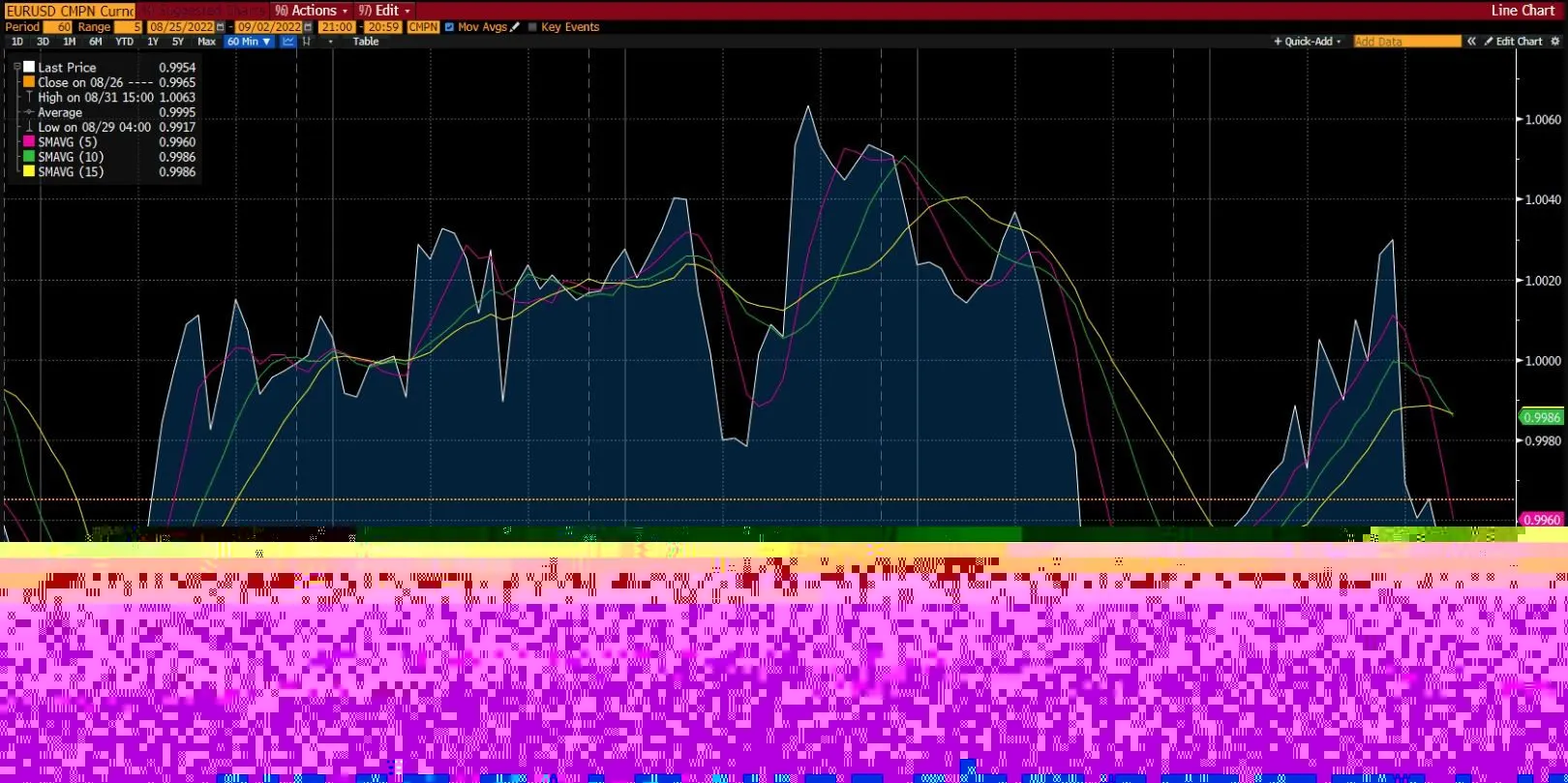
For the second consecutive week, the EUR/USD pair oscillated near parity, volatile but unable to find direction, and ended the week at $0.9954. Despite sluggish growth, US macroeconomic indicators indicate economic progress is continuing, easing some of the Federal Reserve's burden. Even though the Fed acknowledged that its macroeconomic policy negatively affects household and business expenses, it reaffirmed its commitment to taming inflation.
According to EU policymakers, the European Central Bank (ECB) is likely to tighten the monetary policy more aggressively, leading traders to increase the odds of an ECB rate hike to 75 basis points in September. This news led to a spike in government bond rates, while bond prices fell throughout Europe.
Meanwhile, on the GBP/USD front, the bleak UK economic picture continued to weigh on the native currency along with the escalating energy and cost-of-living crises.
This week, ECB officials will hold their monetary policy meeting, and traders will finally learn whether the ECB has leaned towards managing inflation or protecting fragile growth. Also, something to look forward to would be the US Federal Reserve Chair Jerome Powell's remarks.
Level up your trading strategy with the latest market news and trade CFDs on your Deriv X Financial account.
Commodities
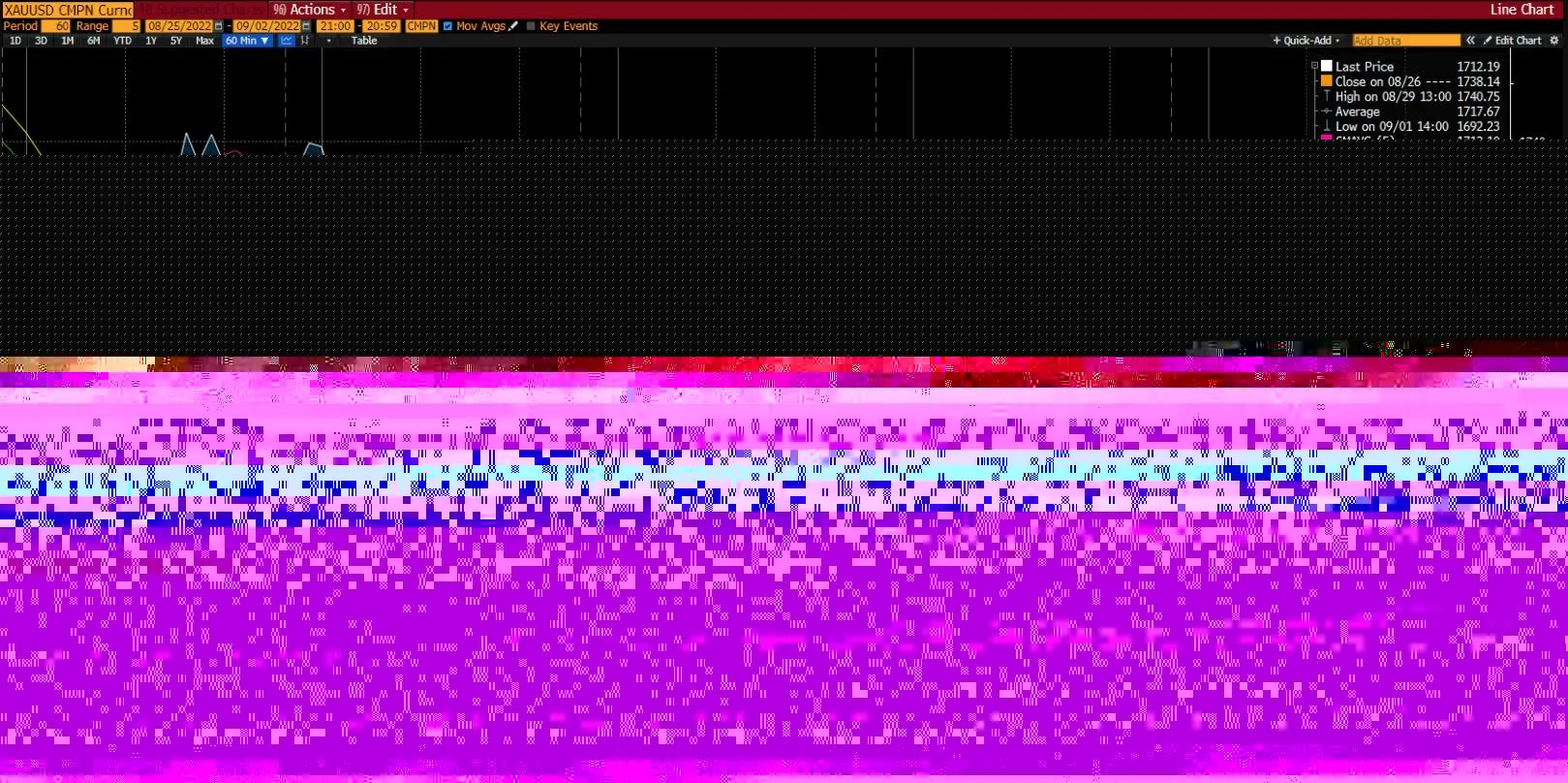
Despite closing the week in red, gold found some relief on Friday, 2 September 2022. The yellow metal recovered most of its previous day's losses but replicated its lowest level in the last 2 months. The spot prices reached new daily highs on Friday to close the week above the $1,700 level.
The dollar-denominated commodity found some strength due to 2 factors. First, the US dollar dropped from a two-decade high ahead of the closely watched US jobs report. Second, the mild drop in US Treasury bond yields after the release of the non-farm payrolls report further helped support its growth.
Gold crossed just above its resistance level of $1,710 at the end of the week, making this price the new support level. With the next Fed Reserve's rate decision less than 3 weeks away, traders await the outcome as the US dollar will be impacted, exerting upward or downward pressure on gold.
Meanwhile, silver prices reversed from their lowest prices since July 2020 to reach $18.00 ahead of the US non-farm payroll results, snapping out of a five-day downtrend. Traders are on edge for any surprises that could renew the US dollar run-up and hurt the XAG/USD.
Cryptocurrencies

A tough week for the cryptocurrency market ended with major coins in the red. Following the Fed Chair's hawkish comments, traders seem to consider how rising borrowing rates will affect riskier assets.
Last week, Bitcoin prices kept hovering around the $20,000 level, with somewhat volatile jumps and dips that resemble an (ECG) electrocardiogram result. The average Bitcoin price last week was $20,001.72, which indicates that there was almost equal movement above and below the mean level.
Having said that, at the time of writing, Bitcoin was trading at $19,905.52 and had stayed below the $20,000 mark throughout the weekend.
Meanwhile, other cryptocurrencies continued to be in turmoil. Litecoin, Dogecoin, Cardano, and Dash have all experienced continued losses in the past month, except for a spike in mid-August.
Ethereum was the stand-out performer last week and is trading slightly below the $1,600 level. Its continued surge can be attributed to the anticipation of an upgrade to its blockchain software.
Take advantage of market opportunities by sharpening your trading strategy and trading the financial markets with options and multipliers on Deriv Trader.
US stock markets
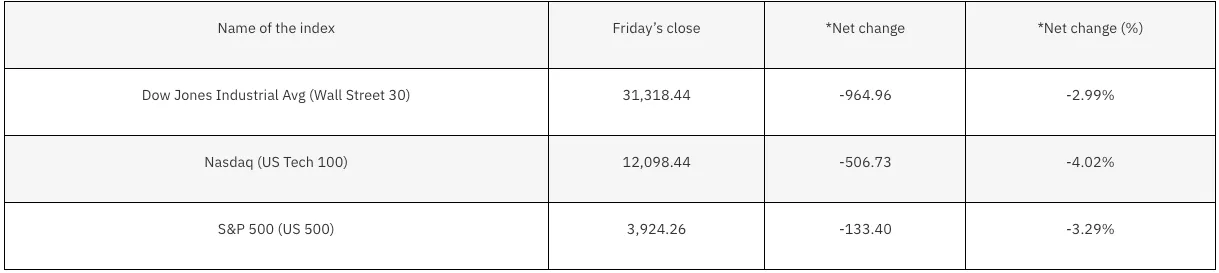
*Net change and net change (%) are based on the weekly closing price change from Friday to Friday.
Equity markets fell despite a remarkably stable jobs report on Friday, 2 September 2022. The Dow declined by 3% for the week, while the Nasdaq fell by over 4%. S&P 500 prices fell by 3.3% for the week and 8.3% over the last 3 weeks.
Based on the Bureau of Labor Statistics’ non-farm payrolls report published on Friday, 2 September 2022, the US economy added 315,000 jobs in August. The figure was just above the Dow Jones’ consensus estimate of 295,000, and the unemployment rate rose to 3.7%, slightly above their expectations of 3.5%.
While many traders said the jobs report was encouraging, the data also made them wary of the Fed's outlook for the future. Traders remain concerned about the path of rate increases, and many fear aggressive rate tightening by the central bank may lead to a recession.
This week, Apple will be hosting its annual product launch event on Wednesday, 7 September 2022, followed by Fed Chair Powell's remarks regarding the future monetary policy on Thursday, 8 September 2022.
Now that you’re up-to-date on how the financial markets performed last week, you can improve your strategy and trade CFDs on Deriv MT5 Financial and Financial STP accounts.
Sorry, we couldn’t find any results matching .
Search tips:
- Check your spelling and try again
- Try another keyword