
Results for

Market news – Week 4, June 2022
Cryptocurrencies experienced one of their worst weeks in history thanks to the Fed’s announcement to raise interest rates. However, other markets also experienced setbacks due to this announcement.
Cryptocurrencies experienced one of their worst weeks in history thanks to the Fed’s announcement to raise interest rates. However, other markets also experienced setbacks due to this announcement.
Forex

Although the core inflation result for May 2022 came in as expected and strengthened the Euro, the currency does not seem to be reversing its long-term plunge. This further intensifies the inflationary pressure on the European Central Bank (ECB) as it battles the concern of a fading Euro. On the other hand, the continued strengthening of the US dollar has caused the EUR/USD pair to close the week in the negative territory.
As seen in the chart above, after starting the week on a downtrend and falling to $1.1971, the GBP/USD pair experienced a short-term rally on Thursday, 16 June 2022, and prices reached a three-day high of around $1.2381. Furthermore, the release of disappointing US macro data weakened the greenback and served as support to the declining GBP/USD pair.
Moreover, its slight recovery from two-year lows faltered due to the diverging monetary policy announcements by the Fed and Bank of England (BoE) towards the end of last week. As a result, the currency pair ended the week at $1.2227, slightly above the SMA 10 at $1.2220 and nearly bisecting at its SMA 5 and SMA 15 at $1.2211 and $1.2245, respectively. Now, all eyes are on the UK inflation report and the Fed Chairman’s testimony for fresh directional commands for the cable pair.
The Bank of Japan (BoJ) governor announced that the monetary policy could be eased further if needed. This triggered a JPY sell-off, which, combined with the US dollar rebound, explains the USD/JPY bullish run.
Level up your trading strategy with the latest market news and trade CFDs on your Deriv X Financial account.
Commodities
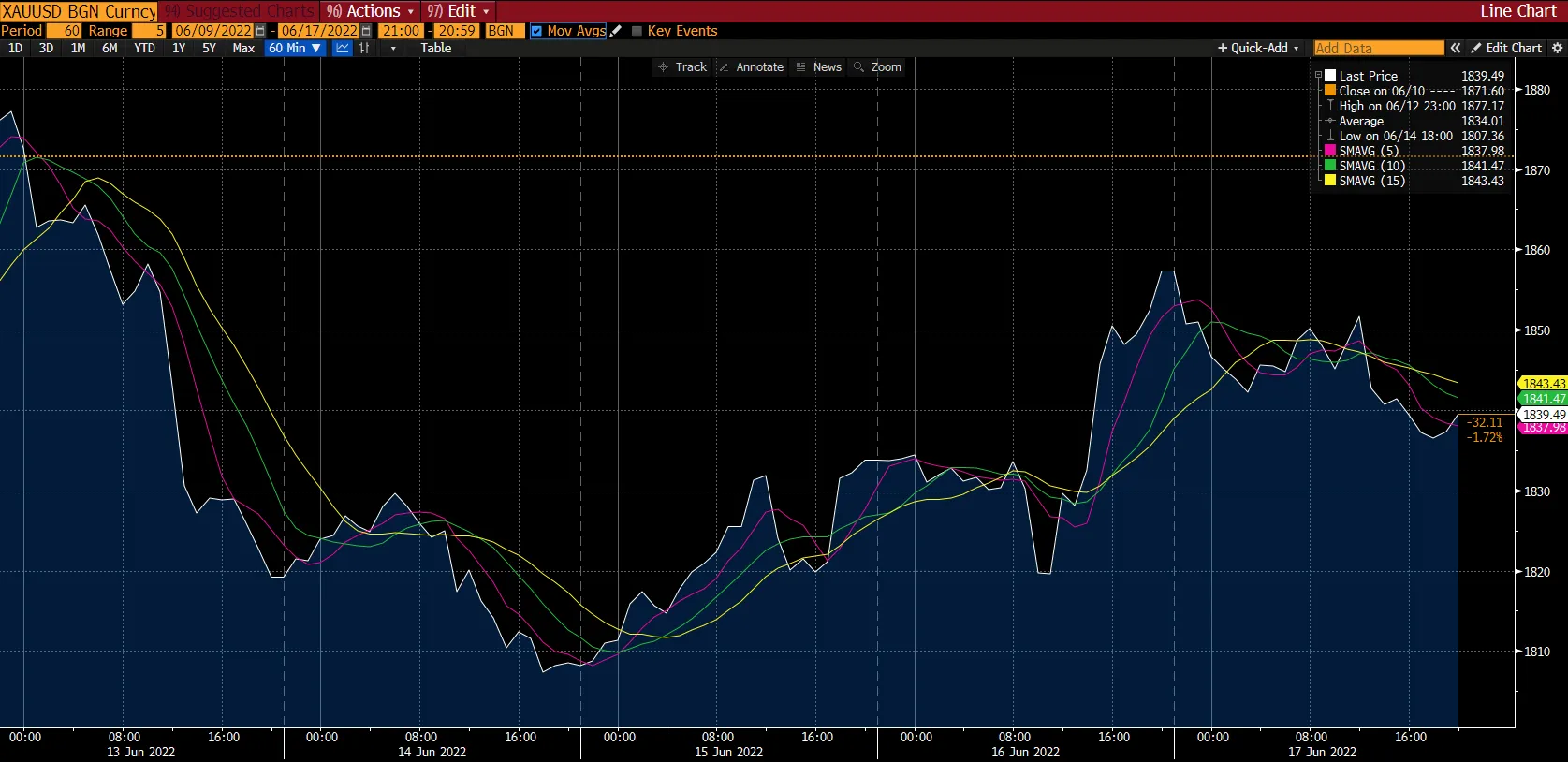
After starting the week above $1,870, gold prices plummeted below $1,810 on Tuesday, 14 June 2022, for the first time since traders began withdrawing from the market in February.
Gold is often regarded as an inflation hedge, but the opportunity cost of holding it is higher when the Fed raises short-term interest rates since the metal yields no interest.
Despite closing the week at $1,840 on Friday, 17 June 2022, gold closed at its lowest level in almost a month as a stronger US dollar and interest rate hikes from the Federal Reserve, Swiss National Bank, and Bank of England dented the safe-haven metal’s appeal.
As seen in the chart above, gold ended the week trading right above its support level of $1,837. The outlook for interest rate policies and inflation expectations shifts in the coming week will significantly impact the yellow metal.
Meanwhile, oil prices suddenly reversed from the long-term uptrend after climbing up to almost $125 a barrel earlier this month. On Friday, 17 June 2022, oil prices fell by 6% to a four-week low and ended the week at around $112 a barrel. This occurred due to the interest rate hike by major central banks that would slow down the global economy and limit energy demand.
Cryptocurrencies

The crypto market fell below $1 trillion for the first time since January 2021. With a loss of $300 billion in seven days, last week was one of the worst weeks in crypto history.
In the chart above, the price of Bitcoin continued to slump, dropping by 34% in the past 7 days and trading below the $20k mark. However, Bitcoin has clawed its way back to around the $20k mark on Sunday, 19 June 2022. This movement may indicate a swift turnaround after the recent successive declines since institutional traders may see a buying opportunity after Bitcoin reaches the rock-bottom level.
Meanwhile, Ethereum, in particular, performed poorly, going down by 40% over the same period and trading at around $1,000.
In part, macroeconomic factors were to blame for the downfall of the crypto market. Recently, cryptocurrencies have not been working as an inflation-proof asset as the performance of equity and bond markets has directly impacted Bitcoin. Inflation has been rising lately, causing central banks to raise interest rates, hitting risky assets.
Due to the extreme market conditions, several cryptocurrency-lending companies have halted their operations in withdrawals, transfers, and swaps requests. This has indirectly led to a sell-off from crypto traders as this raises concerns about the future of cryptocurrencies.
Maximise market opportunities by sharpening your trading strategy and trading the financial markets with options and multipliers on DTrader.
US stocks market
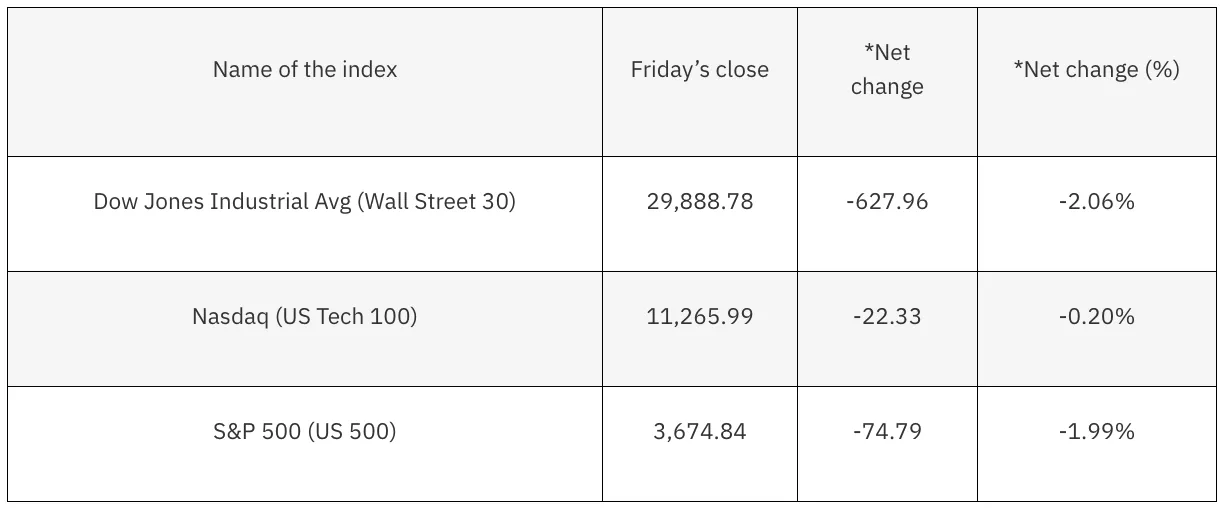
*Net change and net change (%) are based on the weekly closing price change from Monday to Friday.
All 3 major indices finished the week with sharp losses. This was the most significant decline for the S&P 500 since the pandemic hit markets in March 2020. Furthermore, the Dow faced its biggest drop for the week since October 2020. The market has now lost ten times in the last 11 weeks overall.
Since every company in the index was in the red at least once during the week, the S&P 500 is officially in a bear market.
On Wednesday, 15 June 2022, the Federal Reserve announced a 0.75% interest rate increase — the largest since 1994. Stocks were on the rise, however; after the announcement, the Dow dropped to levels not seen since January 2021. Furthermore, all 11 stock market sectors saw declines.
Amid growing recession fears, Home Depot, Intel, and JPMorgan hit new 52-week lows. Meanwhile, tech giants like Amazon, Apple, and Netflix sank by nearly 4%.
The Fed's comments on Friday, 17 June 2022, echoed their commitment to clamping down inflation after hiking rates by 75 basis points earlier in the week. Now, traders are looking forward to Powell's testimony later this week as the Fed appears to remain focused on returning inflation to its 2% target.
Now that you’re up-to-date on how the financial markets performed last week, you can improve your strategy and trade CFDs on Deriv MT5 Financial and Financial STP accounts.

Market news – Week 5, June 2022
Financial markets saw volatility, gains, and drops last week as traders' risk appetites were affected by various factors.
Financial markets saw volatility, gains, and drops last week as traders' risk appetites were affected by various factors.
Forex
Last week, EUR/USD saw a slight reversal in the long-term downtrend it was on from the beginning of June. At the start of last week, the currency pair saw an upward movement ever since it moved past the $1.0500 mark. Later, the EUR/USD pair saw a decent pullback on Thursday, 23 June 2022. However, this was short-lived as the bulls resumed their upward run, and the pair ended the week above the $1.0600 mark.
This trend change can be attributed to the weakening of the greenback over the past week. Despite the $1.0670 level acting as an upside cap to the pair, it is unlikely that the pair will break out of its slump soon. Furthermore, geopolitical concerns and the Federal Reserve-European Central Bank divergence will keep the upside in check.
Meanwhile, the GBP/USD downtrend flattened out last week, experiencing its first weekly gains of the month. The bulls stepped in to merely stop the falling pair, which mostly traded sideways throughout the week.
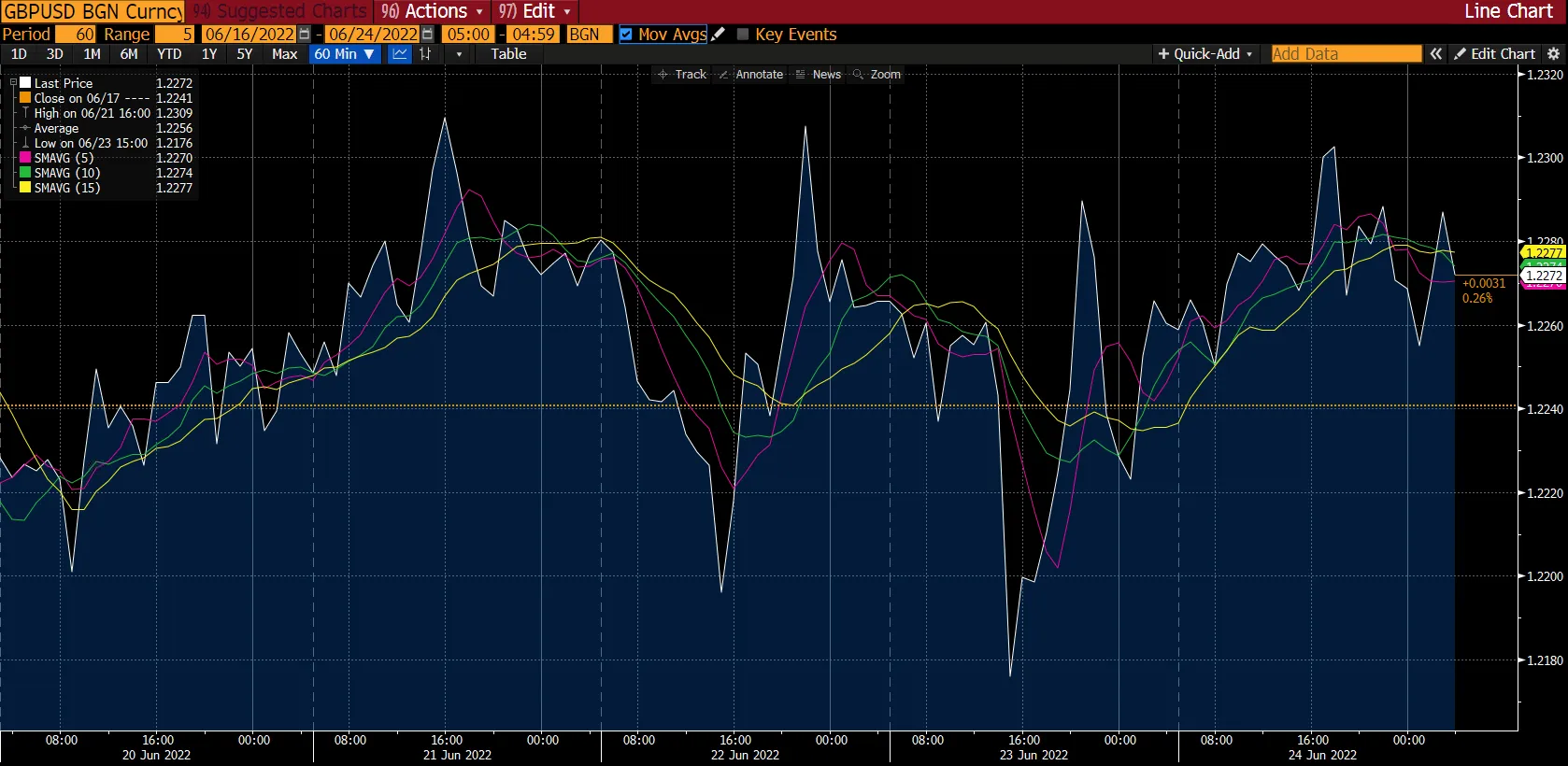
Due to the US dollar gaining strength, the cable pair mirrored the EUR/USD's movement with a sharp dip below $1.2200 on Thursday, 23 June 2022. Compared to the start of the week, the pair saw a marginal increase at Friday's close. As you can see from the chart, GBP/USD ended the week at $1.2272, bisecting the SMA 5 and SMA 10 at $1.2270 and $1.2274, respectively.
Level up your trading strategy with the latest market news and trade CFDs on your Deriv X Financial account.
Commodities

Gold started the week modestly flat at around $1,840. It then proceeded to find a floor due to the thinner liquidity condition brought on by the US holiday of Juneteenth. However, XAU/USD's upside remains capped, as traders seem wary of the Fed's aggressive monetary policy.
On Thursday, 23 June 2022, the yellow metal extended its losing streak into the fourth straight trading day. This drop is linked to the market's reassessment of Fed Chair Jerome Powell's testimony in the bi-annual Monetary Policy Report, where he managed to gain acceptance for his justification of the recent rate hike. However, his testimony apparently favoured the risk appetite and gold prices momentarily, resulting in an upward movement. Nevertheless, gold still ended with losses for the second consecutive week.
The second half of June hasn't been the best for WTI oil as it fell sharply on Wednesday, 22 June 2022. This fall resulted from US President Biden's push to bring down soaring fuel prices. The move, which includes pressure on major American energy companies to lower fuel prices as they have been reaping huge profits, calls for a temporary suspension of federal taxes on gasoline. However, WTI oil regained traction and rebounded on Friday, 24 June 2022. With OPEC (Organisation of the Petroleum Exporting Countries) member Libya closing nearly all production due to unrest, supply concerns were revived, leading to WTI oil's recovery.
Cryptocurrencies
Despite the total market value of all cryptocurrencies rising by $40 billion last week, it remained below the $1,000 billion threshold. Because of this weekly rise, June's deficit is now $373 billion.
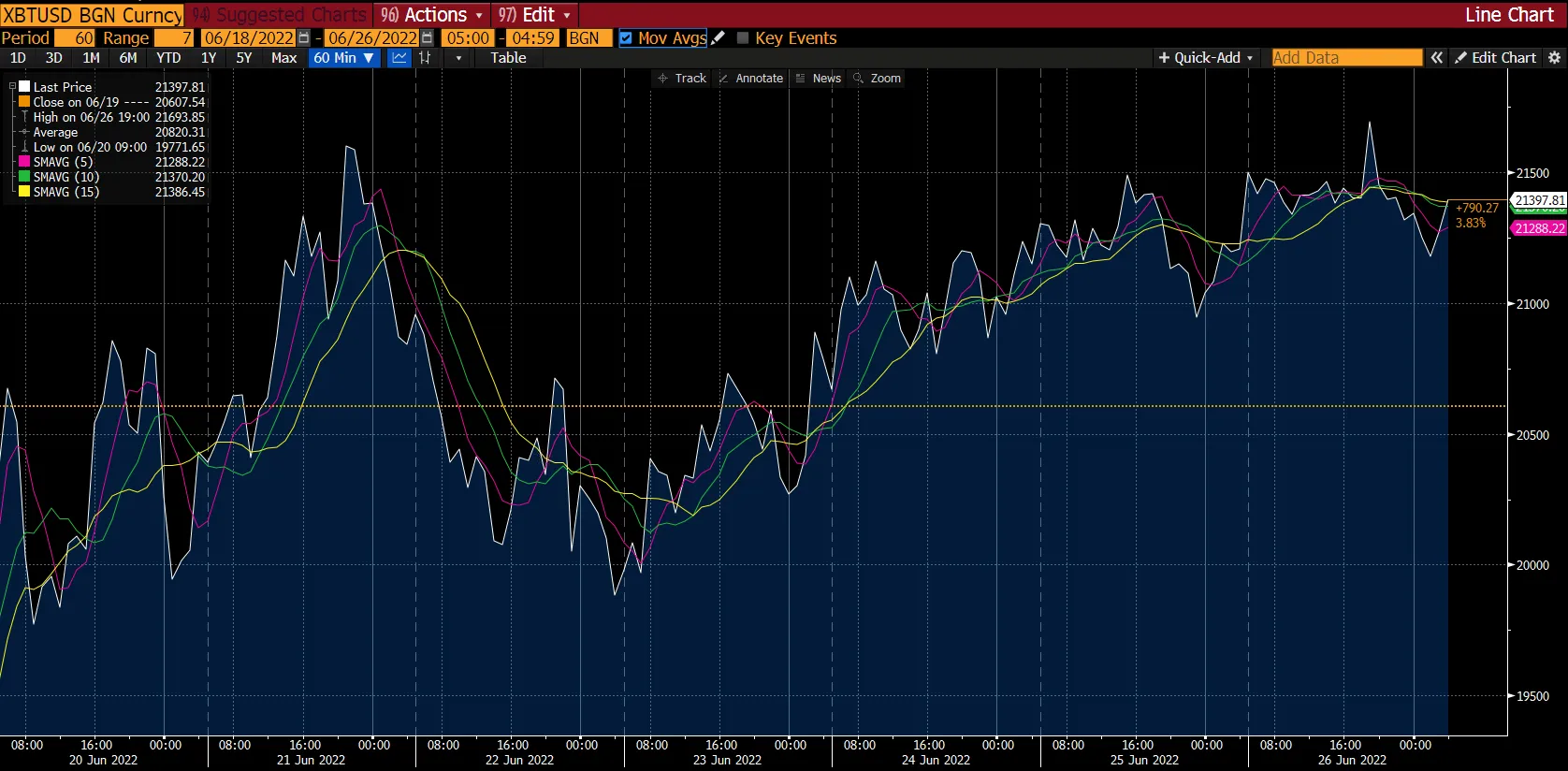
Following its downward drop, the price of Bitcoin stabilised once again over the $20,000 mark. As seen in the chart above, Bitcoin closed the week up by 2.33% at the $21,400 level. Since it ended the week trading at its resistance level, traders are waiting to see if this is the new support level.
Meanwhile, Ethereum, which fell as low as $880 on Saturday, 18 June 2022, increased by 5.8% on Sunday, 26 June 2022, to $1,280.
Recently, the market for digital assets has experienced extreme volatility as traders dumped riskier investments due to concerns that aggressive interest rate increases could lead to an economic downturn. Furthermore, traders reduced their stakes in cryptocurrencies after the price of Bitcoin fell last week to its lowest level since 2020.
In the coming week, significant US economic metrics and central bank discussions might put traders' appetites to the test. Among these events, G7 summit updates and remarks from Fed Chair Powell, European Central Bank's President Lagarde, and Bank of England Governor Bailey will be included.
Maximise market opportunities by sharpening your trading strategy and trading the financial markets with options and multipliers on DTrader.
US stocks market
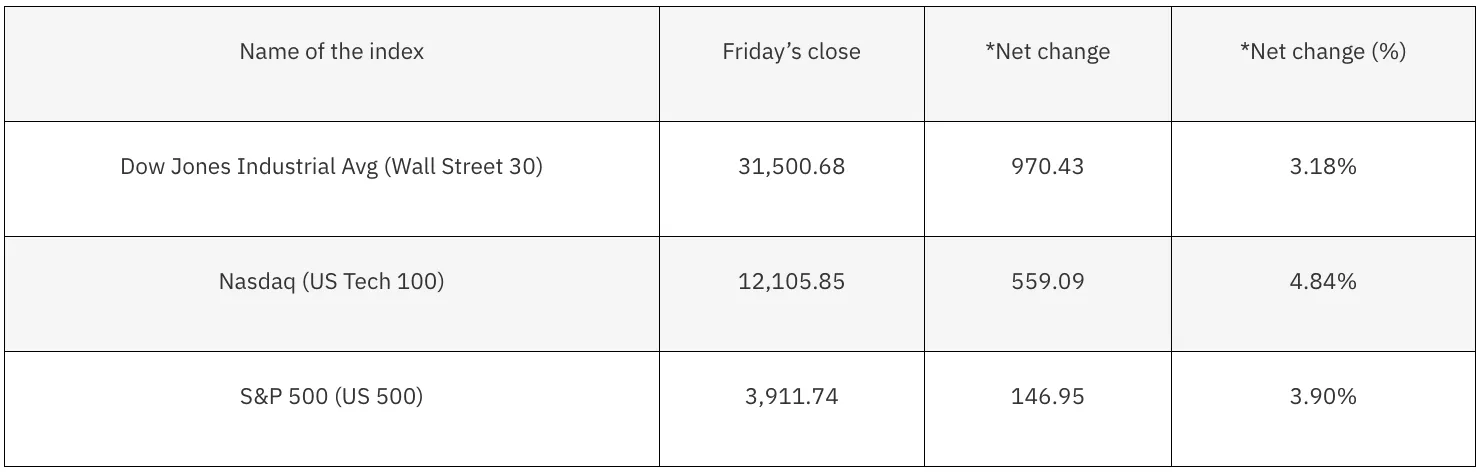
*Net change and net change (%) are based on the weekly closing price change from Monday to Friday.
As markets head towards the end of June, stocks completed a big comeback week. The S&P 500, the Nasdaq Composite, and The Dow closed over 3% higher than the previous week.
The stock market started picking up on Wednesday, 22 June 2022, as traders slightly stopped worrying about a recession. Despite last week's Federal Reserve announcement of a 0.75% rate hike – the most significant since 1994 – Fed Chairman Jerome Powell told Congress the Fed is "firmly committed" to bringing inflation down.
Moreover, last week's economic data indicated that the Federal Reserve's aggressive move toward monetary tightening was having the desired effect of slowing the economy and moderating inflation.
All 11 of the benchmark index's sectors rallied. Among them, FedEx was nearly up by 7.2%, eBay jumped by 6.3%, and Goldman Sachs Group's stock price surged by 5.8%.
The Federal Reserve also said that US banks could comfortably withstand a severe economic downturn based on their capital and assets. Based on comments from Powell, interest rates are expected to go up by another 0.50% or 0.75% at the next Fed meeting in July. So, traders are watching closely and look forward to Powell's speech scheduled for later this week.
Now that you’re up-to-date on how the financial markets performed last week, you can improve your strategy and trade CFDs on Deriv MT5 Financial and Financial STP accounts.

Keep your coins safe: Crypto exchange vs crypto wallet
Security is one of the most important aspects of crypto trading. However, if you trade crypto on Deriv, you don’t need to worry about it at all because you don’t buy the actual cryptocurrency. You open your trades with fiat money.
Security is one of the most important aspects of crypto trading. However, if you trade crypto on Deriv, you don’t need to worry about it at all because you don’t buy the actual cryptocurrency. You open your trades with fiat money. Whether you trade with CFDs, options or multipliers, you only predict the price movements of an asset and get a chance to earn a payout if your prediction is correct.
Now, if you choose to trade with crypto instead of fiat money, you will actually own a cryptocurrency, and that's when you need safe storage for it.
When it comes to fiat money, there are two options to keep large amounts of it safe: you either have it in cash or store it in a bank. Cryptocurrency can also be stored in 2 ways: using crypto exchanges and crypto wallets. Both are digital storage, of course, as cryptocurrencies don’t have a physical form.
However, here's an interesting note – neither crypto exchanges nor crypto wallets actually store cryptocurrency. They only provide secure access to it while the coins are stored on a blockchain. Just like when you use a credit or debit card – it’s not actual fiat money, just a piece of plastic, but it gives you access to the money you stored in a bank.
So, what's the equivalent of a card when it comes to cryptocurrency and accessing your crypto assets? It's your public and private keys.
What are private and public keys in the crypto world?
Public and private keys are strings of numbers, letters and other characters (similar to a password) that allow you to perform actions with your cryptocurrencies. A public key is similar to your bank account number – you can share it with other people, who can then transfer cryptocurrency to you. A private key is like your credit card PIN – not to be shared with anyone, as it gives access to your crypto.
The difference in private key management is exactly what differentiates crypto exchanges from crypto wallets.
What is a crypto exchange?
A cryptocurrency exchange is a service that allows you to buy and sell digital coins securely. An example of crypto exchanges on Deriv is fiat onramp services – Changelly, Xanpool, or Banxa. These service providers let you exchange fiat money for cryptocurrency. The purchased crypto is deposited right into your Deriv account and can be used for trading.
Well-known crypto exchanges, especially when they are officially affiliated with an established broker, are one of the safest options to buy, sell, and trade crypto. However, when it comes to storing large amounts, experts advise against keeping your digital coins at crypto exchanges and broker accounts for an extended period of time due to security concerns. Crypto hacks, although rarely successful, usually target exchanges as they are places where a high concentration of cryptocurrency data flows through. If that happens, you have limited control over the safety of your crypto assets and have to rely on the exchange’s service providers entirely to keep them protected.
The main reason for the limited control over your own crypto assets lies in private key access. Most cryptocurrency exchanges do not provide it – the key belongs to an exchange exclusively. This type of storage is called custodial.
If you want to have full control over your crypto assets, a good way of keeping them safe is to transfer any crypto you don’t use for trading to a secure crypto wallet.
What is a crypto wallet?
A cryptocurrency wallet is a software (programme) or hardware (device) that lets you store your digital coins safely.
Software wallets are also called hot wallets and store your private keys in a programme connected to the internet. Just like almost any software nowadays, it can be accessed via a desktop app, mobile app or web browser. One of the most important features to look for when selecting a software wallet is two-factor authentication (2FA), as it strengthens security and provides ease of use.
A lot of hot crypto wallets are non-custodial, which means they give access to the private keys and the responsibility of its safekeeping to the owner. This type of crypto storage is usually considered much safer than custodial crypto exchanges, as long as wallets’ owners take proper care of them and backup their keys. However, it’s important to keep in mind that some hot wallets are custodial too, and do not provide access to a private key.
Hardware wallets, also known as cold wallets, store crypto access offline and are usually no larger than a USB flash drive. This type of wallet is considered a safer option because the device is only connected to the internet when you need to use your crypto, making it much harder to hack. The important security measure, in this case, is just keeping the device safe.
Until very recently, the third type – a paper wallet, used to be considered the most secure way to protect crypto assets. A paper wallet literally means keeping your private key written or printed on a piece of paper. However, since there is a high risk of misplacing or damaging it, this type of wallet is gradually losing its popularity.
Both cold and paper wallet types are completely non-custodial.
Choosing one type of crypto storage over another is purely a matter of personal preference. But do remember that it is crucial to do your research and ensure that the service provider is well-trusted and not fraudulent.
Meanwhile, while reviewing your options, why don't you create a demo account to practise your trading skills risk-free? Once you feel confident, you can switch to trading with crypto to potentially make more crypto without buying it.

Factors that influence stock market prices
Ever wondered what affects stock market prices? Learn about the factors that drive stock prices and make informed decisions when trading.
This post was originally published by Deriv on June 23, 2022
The stock market is a volatile and unpredictable place where prices are constantly fluctuating. Understanding the factors that play a part in determining price movements is crucial as it can help you take more calculated risks when you trade in the stock market. Here are a few key factors that influence stock market prices.
Supply and demand
One of the main factors that influence stock prices is supply and demand. When the supply and demand do not balance each other out, the price of stocks fluctuates. The general rule is that when demand is higher than supply, the prices rise; if supply is higher than demand, the prices drop.
For instance, when there is more demand for Apple stock but not enough stock to meet this demand, the price goes up, and if there are many Apple stocks available on the market but not a lot of demand for them, the prices fall.
Market sentiment
The prices of stocks also depend on the human factor, particularly human psychology. People tend to be driven by their emotions, which can also be true when it comes to stock market trading.
Traders can be influenced by rumours swirling around the stock market. If there are talks about a certain company making less profit than expected, traders may steer clear of the company and sell off their stocks. Similarly, if there is news about the company expecting massive profits, the surge of confidence could influence traders to buy more stocks in hopes that the stock prices would continue going up in the future.
Another example of market sentiment that could affect stock prices is affected by major geopolitical events. Traders often keep up with current affairs, and when there is tension, such as a boycott of a certain company and its products, they could anticipate a dip in profits. Shareholders in the company may then be inclined to sell some or all of their holdings, which could, in turn, cause the stock price to decline.
Fundamentals of the company
A company's fundamentals, such as its performance, are also essential in understanding the stock market and its prices. A trader's expectations and analysis of the changes in the company largely shape their trading habits, which in turn affects stock prices.
For instance, if there is an internal shift in a certain company, like a change in the board of directors, traders could look into the previous performance of the new board of directors and analyse whether the new management can bring more success to the company. If they expect the company to suffer losses under the new management, they may avoid trading stocks of that company. They might even sell their stocks at a slightly lower price to avoid big losses in the future. If most traders feel the same way, following the supply and demand principle and stock market timings, the price of the company’s stocks could fall because of surplus supply.
When a change happens in a company, such as rebranding, traders might think it would profit the company in the foreseeable future. Because of that, they could buy more stocks of this company with the expectation that the price will continue to rise, increasing their earnings.
Some traders may have a more accurate prediction of the stock market by relying on research analysts and making their observations based on stock market reports. You can read more about topics such as fundamental analysis to help you take more calculated risks.
Keep in mind that with Deriv, you don’t need to own an asset to trade it, which means you can potentially profit from both rising and falling prices. With your new knowledge of stock market basics, you can set clear expectations, create a good strategy, and practise with our free demo account pre-loaded with 10,000 USD of virtual money. When you’re ready, you can start trading with real money.

Useful tips on how to trade online
We outline useful tips on how you can learn to trade based on how experienced traders trade. From the ebook ‘7 traits of successful financial traders'.
This post was originally published by Deriv on July 7, 2022.
Every trader goes through their own trading journey, some admittedly more successful than others. In the ebook by veteran trader and self-made millionaire Vince Stanzione '7 traits of successful financial traders' explains how successful traders plan their trading strategy and how you can learn to trade from their examples.
Cut your losses
Trading comes down to psychology — everyone wants to win; no one wants to lose.
When faced with an unprofitable trade, experienced traders don’t let it run and hope the market will improve eventually. They know it’s a bad idea to keep an unprofitable trade open and let it accumulate losses, which will also make it harder to gain any profit. They know when to cut their losses
The following table explains why cutting your losses is crucial. It shows the returns needed to break even for unprofitable trades. For example, if your trade has already lost 5%, you’ll need the position to move in your favour by 5.3% to break even.

Plan your exit strategy
Beginner traders tend to focus on when to open a trade but pay little attention to closing it. According to Stanzione, deciding when to exit a trade is even more critical than deciding when to enter it.
Your exit rule to take a profit or loss should be determined before you start trading, and you should stick to it. It shouldn’t be some afterthought that you consider while your trade is running. Your psychological responses can change once you open a trade, and your emotions can influence your decisions. So, it’s important to have an exit strategy and follow it.
Diversify
A tip often repeated in trading for beginners is to diversify your portfolio. While you should diversify by trading on various markets and assets, you can also add diversity to your strategy by trading on the different directions of price movements to lessen your risk.
With the availability of digital options and contracts for difference (CFDs), you can trade on markets that go up, down, and even sideways. You don’t need to only trade on markets or assets moving in one direction.
Follow the right trends
Experienced traders follow trends and profit from them. Trends can be up or down, but overall, traders gain more from an uptrend because a market can go up by an unlimited amount, whereas the most a market can go down is 100%.
In his ebook, Stanzione says that successful traders trade according to what they see rather than what they think will happen. They depend on the numbers to tell them what is happening — if the price of an asset rises from 60 to 65 to 70, it is going up — and they trade accordingly.
Master your emotions
After facing a few losses, new traders may doubt their trading strategy and start thinking about changing their approach. But if you keep changing your strategy, how will you know if it works?
Markets don’t usually perform as we would like them to. Plus, many external factors can affect your emotions and trading judgment. This is why you need to learn to recognise when you are getting emotional about your trades — whether it’s feeling unsure about your strategy or an attachment to your positions. Remember to follow your trading strategy, and don’t trade emotionally.
Keep it simple
Many new traders think they need lots of fancy software, multiple trading screens, and a rapid internet connection to trade successfully. But the truth is, while they may be helpful, these tools won’t help you financially succeed as a trader.
Keep things simple. Deriv gives traders access to a variety of trading platforms and various financial markets. Sure, you can check out extra trading plugins or systems for some extra help if you’re a new trader, but you don’t need to spend thousands of dollars on fancy software to become a successful trader.
Know what you can control
However smart we think we are when it comes to trading, we deal with unpredictable elements when we trade. What we know and can control should help us decide how much we can risk. Determining these is what you should be spending time on.
For example, how much risk you can allow yourself to have per trade. You can control this even though market prices fluctuate or an asset doesn’t perform as you had predicted. Build a plan to manage your trade finances, and follow through with it
Explore how to start trading and download the full version of the ebook '7 traits of successful financial traders', by Vince Stanzione, veteran trader and self-made millionaire. Or put these tips into practise by trading with a free Deriv demo account. With it, you can put these trading tips into practise by trading risk-free with virtual funds before upgrading to real money.
You may also like:
Why beginners need to have an online trading demo account
Trading for beginners: top 3 tips on how to be a smart trader

Why traders choose Deriv for commodities
Trade commodities on Deriv via CFDs and options to diversify and hedge inflation against global supply and demand trends.
Commodities trading on Deriv allows traders to participate in markets that move with global supply, demand, and economic trends. From energy products like oil and natural gas to metals such as gold, and agricultural commodities including cocoa and grains, Deriv provides access through CFDs and digital options.
This article combines the latest insights from Deriv’s educational and blog resources to explain why commodities trading matters, how it works on Deriv, and how traders can use its platforms responsibly and effectively.
Quick summary
- Commodities help diversify portfolios and hedge against inflation.
- Deriv provides CFDs and digital options that allow flexible participation in commodity price movements without owning the physical assets.
- CFDs suit traders who prefer active management; digital options fit those seeking defined risk and event-based trading.
- Traders benefit from high liquidity, transparent pricing, and diverse markets on Deriv.
- Understanding market context, risk, and platform tools builds long-term consistency.
Why trade commodities on Deriv?
Trading commodities gives retail traders access to markets that react directly to global events, making them ideal for those who follow macroeconomic and geopolitical news. According to Deriv, commodities offer four key benefits:
Commodities trading on Deriv provides:
- Diversification: Commodities often move differently from equities or currencies, helping reduce overall portfolio risk.
- Inflation hedge: Commodity prices tend to rise with inflation, preserving purchasing power.
- Global exposure: Traders can benefit from global supply–demand dynamics in oil, metals, and agriculture without needing physical ownership.
- Flexible access: Deriv’s platforms offer CFDs and options that allow both short- and long-term exposure with transparent cost structures.
In addition to these advantages, Deriv’s trading ecosystem is built for accessibility and learning. Traders benefit from a seamless environment across desktop and mobile platforms, 24/7 availability for selected synthetic assets, and robust educational tools such as Deriv Academy and regular webinars that cover market analysis, strategy building, and platform walkthroughs. This approach helps users develop both technical and fundamental literacy while practising responsible trading.
A Deriv market analyst gave their insights:
“Commodities remain one of the most direct ways for traders to engage with macro trends. Whether you’re hedging inflation or trading price cycles, Deriv’s platforms offer tools suited for both precision and flexibility.”
What makes CFDs trading a flexible option for commodities markets?
CFDs trading provides flexibility because it allows traders to profit from both rising and falling prices while controlling leverage and risk parameters.
CFDs (contracts for difference) let traders speculate on commodity price movements with leverage, enabling both long and short positions. On Deriv MT5 and Deriv cTrader, traders can:
- Set stop-loss and take-profit orders.
- Use partial closes and trailing stops to manage risk dynamically.
- Trade with small position sizes suitable for beginners.
At a glance: This section explains how CFDs give traders full control over trade management and flexible strategies that suit different time horizons.
Example: A trader expects gold to rise after strong central-bank demand data. They open a long CFD position with a tight stop below support and trail it as the price moves higher.
An IMF outlook in 2025 mentioned:
“Gold and oil continue to show resilience amid macroeconomic uncertainty, supported by central bank demand and energy policy shifts.”
Advantages of CFDs trading:
- Full trade management and flexibility.
- Ability to capture intraday and swing opportunities.
- Transparent cost structure with spreads and potential overnight swaps.
Deriv also integrates margin and leverage management tools designed to help traders monitor exposure and apply predefined risk controls. Traders can adjust leverage based on account type and market volatility, ensuring that potential losses remain proportionate to their strategy. The platform’s negative balance protection prevents account balances from going below zero, which helps limit losses to deposited funds.
How do digital options work in commodities trading?
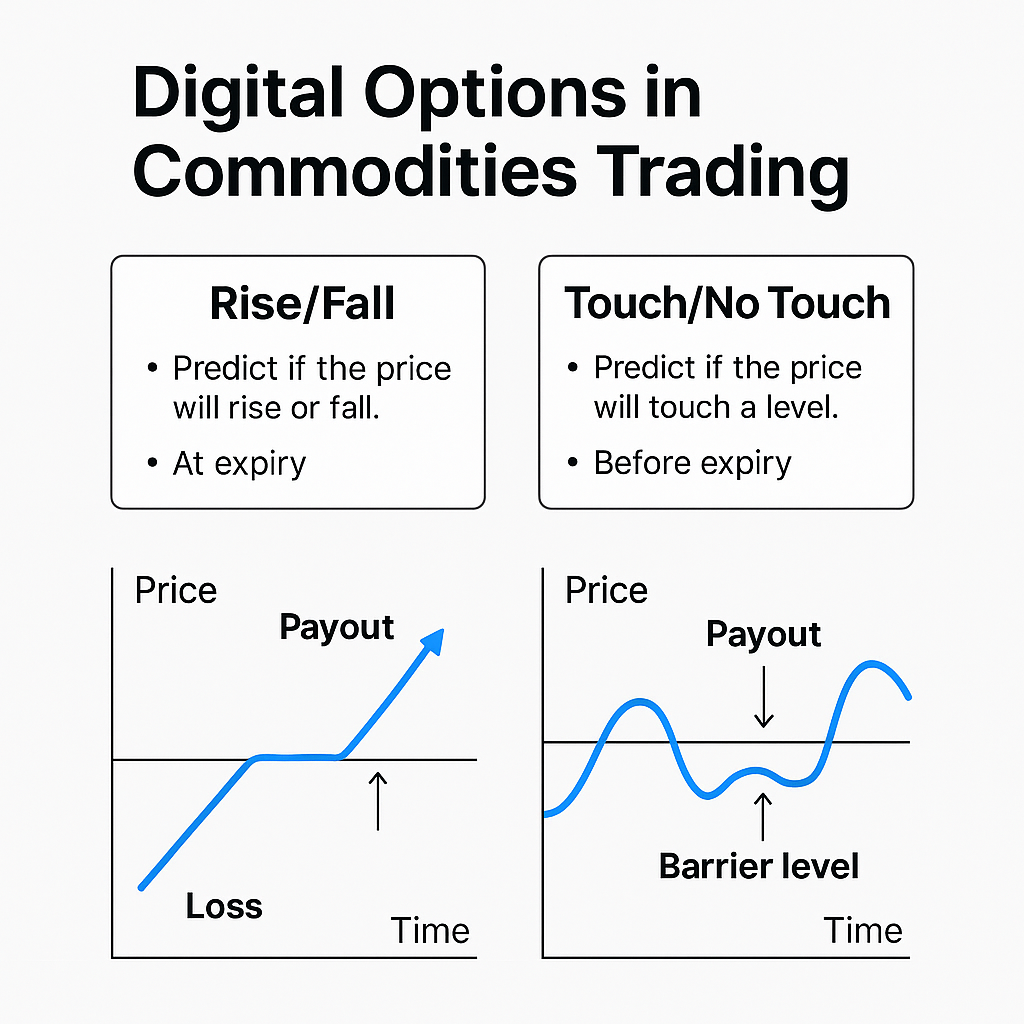
Digital options help traders structure short-term market participation by offering predefined risk parameters and fixed contract conditions.
Digital options on Deriv Trader, SmartTrader, and Deriv Bot allow traders to define direction, time frame, and risk before entering a position. Each contract has a known maximum loss (the stake) and a fixed potential payout.
Common trade types include:
- Rise/Fall: Predict whether the price will end higher or lower at expiry.
- Higher/Lower: Set a price barrier and forecast whether the market will finish above or below it.
- Touch/No Touch: Predict if the market will reach a certain level before expiry.
Why traders use digital options:
- Defined risk and reward.
- Simplicity. A more structured way to express short-term views or event-driven scenarios, particularly in volatile market conditions.
- Access through automation using Deriv Bot for consistent execution.
Example: A trader expects a short-term rise in UK Brent Oil crude after an OPEC+ announcement. They choose a Rise contract on SmartTrader with a 15-minute expiry and a fixed stake, ensuring controlled exposure.
A commodities analyst from Financial Times External reminds:
“Digital options let retail traders apply professional-style event strategies with limited downside. It’s a simple but powerful gateway into commodities.”
What global factors influence commodities markets and CFDs trading?
Global factors influence commodities markets and CFDs trading through supply–demand shifts, geopolitical events, economic policy changes, and seasonal variations.
Commodity prices are influenced by a blend of fundamentals, geopolitical factors, and seasonal trends:
- Supply and demand: Production cuts or surpluses drive price changes, particularly in oil and soft commodities.
- Geopolitical tensions: Conflicts and sanctions can disrupt supply chains, impacting energy and agricultural prices.
- Macroeconomic indicators: Interest rates, inflation, and currency movements affect commodity demand and investment flows.
- Weather patterns: Agricultural commodities like cocoa and grains react strongly to droughts, floods, or disease.
- Technology and energy transitions: The shift toward renewable energy affects demand for fossil fuels and metals used in green infrastructure.
As of 2025, OPEC+ reportedly continues to shape the energy landscape through strategic production adjustments, while the global shift toward renewable power influences long-term demand for oil and metals. Climate-related disruptions in cocoa and coffee supply have also caused significant price swings. Traders on Deriv can use in-platform tools, such as real-time market feeds and technical analysis indicators, to interpret and react to these developments.
Because supply–demand data updates weekly, traders can also use digital options for short-term plays around energy reports, while CFDs are more suitable when trends develop over several sessions.
A Deriv market analyst elaborates:
“Traders who align their CFD or options exposure with key macro events—like OPEC+ decisions or EIA reports—tend to achieve more consistent performance.”

How can traders improve risk management in trading commodities?
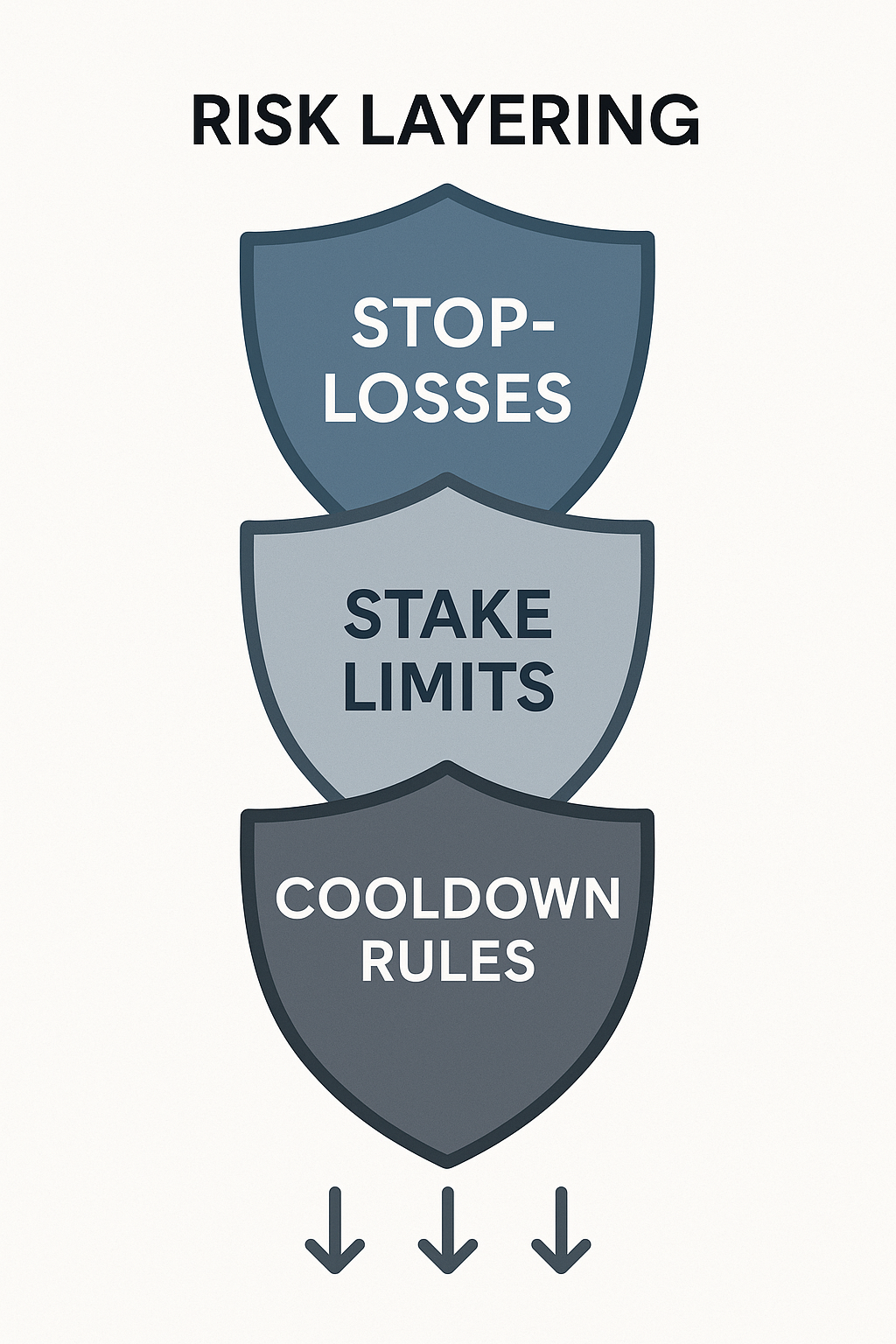
Traders can improve risk management in trading commodities by setting clear exposure limits, diversifying across markets, and automating stop-losses and take-profits.
Deriv emphasises responsible trading through proper risk management and platform tools.
While risk management tools can help structure exposure, they do not remove market risk. Commodity prices can move sharply due to unexpected geopolitical developments, economic data releases, or supply disruptions. Traders should treat stop-losses, stake limits, and diversification as protective measures rather than guarantees, and reassess risk continuously as market conditions change.
Key practices include:
- Set risk limits: Define a percentage of capital to risk per trade (1–2% typical for CFDs; 0.5–1% for options).
- Avoid correlation risk: Limit simultaneous trades in highly related commodities (e.g., WTI and Brent).
- Use stop-losses and take-profits: Automate exits to prevent emotional decision-making.
- Check contract details: Review spreads, trading hours, and swap rates before entering CFDs.
- Prefer options for events: During high volatility, digital options can cap risk better than leveraged trades.
Example: Before a major EIA report, a trader might select a No Touch option to limit exposure to large intraday swings.
Which beginner trading strategies work best for commodities trading?
Beginner trading strategies work best when they focus on one or two commodities, use small risk percentages, and combine both technical and fundamental insights.
- Start narrow: Focus on one or two commodities, such as gold or oil, to understand price drivers.
- Use demo accounts: Practise with virtual funds before trading live.
- Combine technical and fundamental views: Align chart signals with macro events (e.g., EIA reports or central-bank meetings).
- Track and review: Keep a trading journal to analyse performance and refine strategies.
- Stay informed: Follow credible sources, such as EIA, OPEC, and IMF updates.
Common beginner mistakes include overleveraging, trading without a defined plan, and ignoring global news. New traders often react emotionally to price swings or try to recover losses quickly. Deriv’s demo accounts and educational materials can help prevent these pitfalls by promoting structured learning in a simulated environment before trading with real funds.
Context line: This approach helps traders develop habits that lead to better decision-making and consistency over time.
Key takeaways
Commodities trading on Deriv combines accessibility, flexibility, and transparency. CFDs provide full trade control and multi-day management, while digital options offer simplicity and defined risk. By understanding global factors, practising sound risk management, and using Deriv’s platform tools effectively, traders can build a disciplined, sustainable approach to the commodities markets.
A member of Deriv education team comments:
“Traders who pair sound risk controls with market awareness often find commodities a rewarding way to diversify their trading strategy.”

Market news – Week 1, August 2022
Financial markets experienced a triple whammy of data last week, which included the July Federal Reserve’s rate decision, the second-quarter’s Gross Domestic Product (GDP) reading, and the better-than-expected earnings results of the large-cap tech giants.
Financial markets experienced a triple whammy of data last week, which included the July Federal Reserve’s rate decision, the second-quarter’s Gross Domestic Product (GDP) reading, and the better-than-expected earnings results of the large-cap tech giants.
Forex

EUR/USD finished last week at around the $1.0220 mark. While it lost ground for the second month in a row, it is still much higher than its multi-decade low of $0.9951 in mid-July. Besides usual recession fears, the US Federal Reserve's latest monetary policy decision also propelled the pair forward.
While the US dollar continued to weaken globally, GBP/USD gained for the second consecutive week. A combination of tepid optimism failing to boost the US dollar and better-than-expected preliminary UK S&P Global Purchasing Managers' Index reports prompted some to predict a 50 basis point Bank of England rate hike in August, which further strengthened the pair. A less hawkish Fed outcome, coupled with slowing economic activity, supported the majors' uptrend after the world's most powerful central bank abandoned forward guidance. As expected, the Fed raised its key policy rates by 75 basis points to 2.25% – 2.50%.
The macroeconomic data is quite light for this week. However, the focus will be on the Bank of England's interest rate decision and the US Non-farm Payrolls scheduled on Thursday, 4 August 2022 and Friday, 5 August 2022, respectively.
Level up your trading strategy with the latest market news and trade CFDs on your Deriv X Financial account.
Commodities
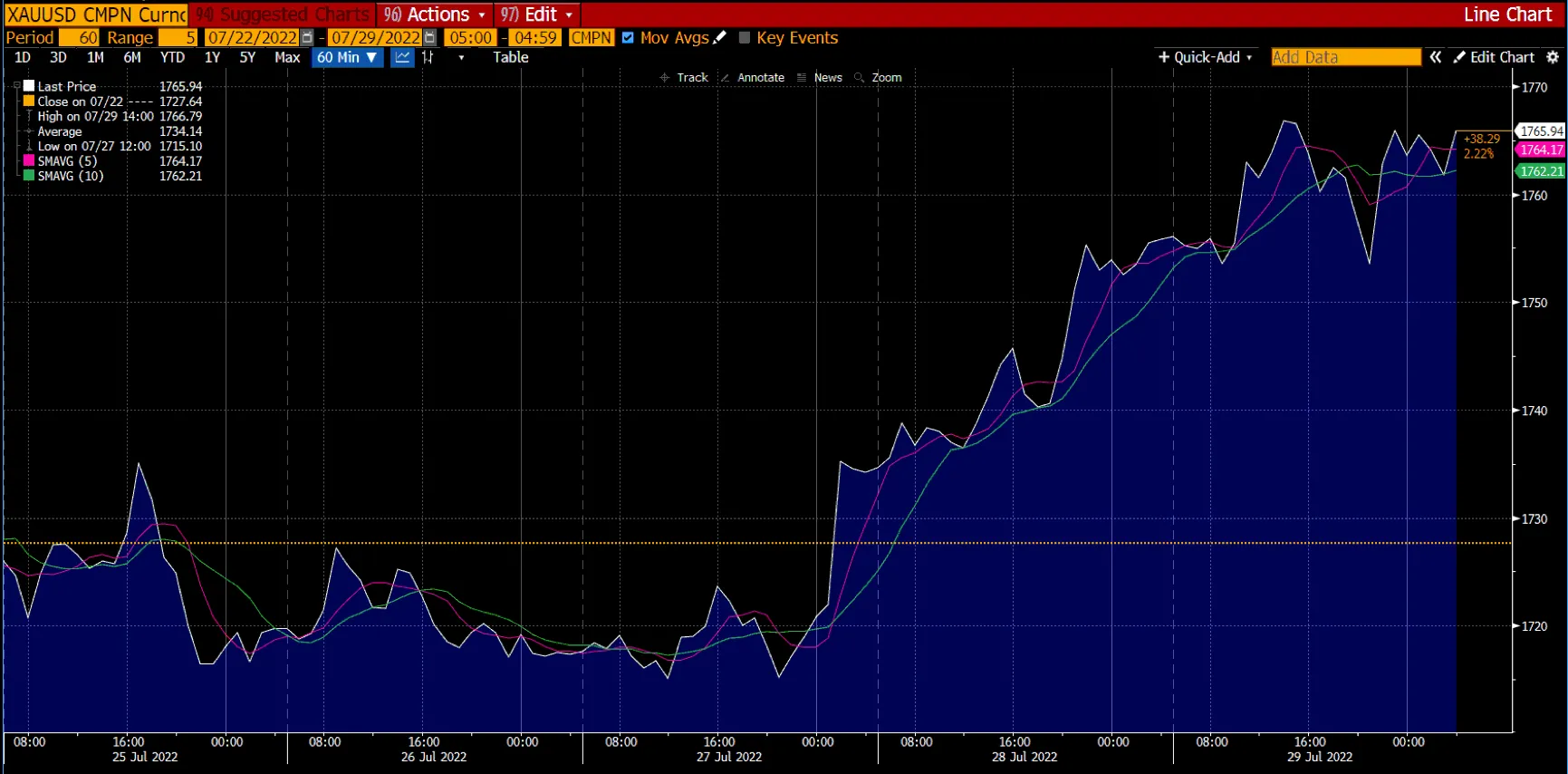
Last week, gold saw its biggest weekly gain since early March. As seen in the chart above, the yellow metal's prices went up by 2.2%, closing the week at around $1,765.94.
Speculation that the Federal Reserve may delay the pace of interest rate hikes as the US economy weakens led to gold's big jump. Additionally, the recent decline in the US Treasury yields and better stock market prices seemed to put pressure on the US dollar, which benefited the price of gold.
The gold market was tested by a few macroeconomic factors, such as the US ISM Manufacturing, Non-Manufacturing Purchasing Managers' Index (PMI), and the US Non-farm Payrolls (NFP).
Meanwhile, oil prices rose for the week but fell short of their highs due to traders focusing on this week's OPEC+ meeting, which is expected to disappoint US expectations for a supply increase.
Cryptocurrencies
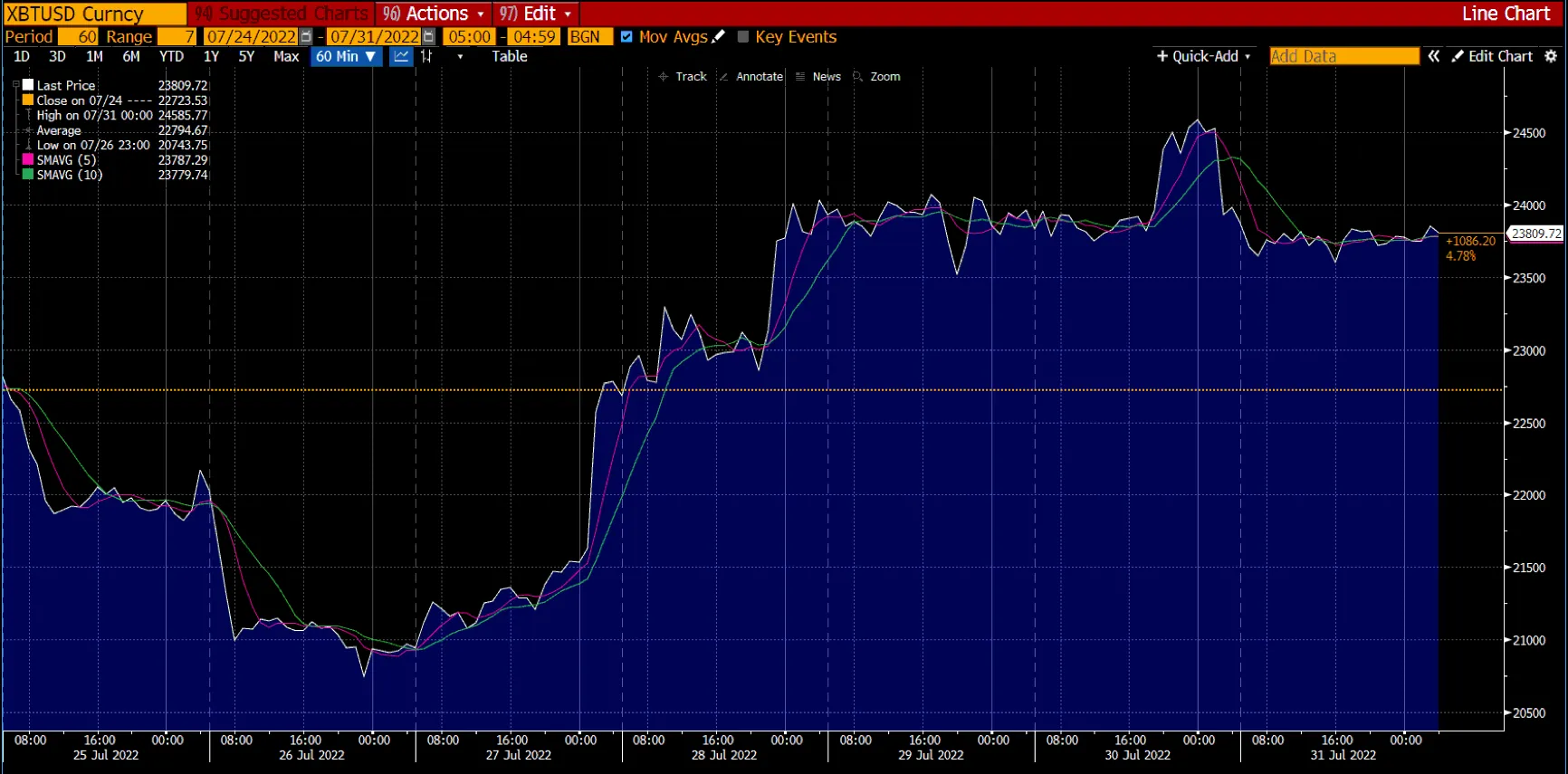
The cryptocurrency market saw some sustained positive action for the second consecutive week, with leading coins making significant gains. Overall, the market held its ground regardless of the Fed announcing another interest rate hike.
Despite the stronger-than-expected contraction in the US GDP, Bitcoin surged past $24,000 for the first time since mid-June.
On Saturday, 30 July 2022, the largest cryptocurrency by market capitalisation breached the $24,500 mark before receding to the sub-$24,000 range. At the time of writing, Bitcoin’s price is at $23,809.72, on course to converge with its SMA 5 and SMA 10 at $23,787.9 and $23,779.74, respectively.
Meanwhile, Ethereum experienced an even greater rally and continued to be the top performer, gaining by over 16%.
Among the top 20 cryptocurrencies, the prices of Cardano, Polkadot, Polygon, and Uniswap rose by 11%, 20%, 14%, and 30%, respectively.
On Friday, 29 July 2022, the global cryptocurrency market capitalisation rose sharply to touch $1.10 trillion, and the total trading volume was at $107.69 billion.
The overall consumer sentiment in the market is getting better. As a result, major retailers are taking notice of changing consumer behaviour. Despite it sounding unbelievable, almost 75% of retailers from various industries across the US are expected to accept cryptocurrency or stablecoin payments soon.
Maximise market opportunities by sharpening your trading strategy and trading the financial markets with options and multipliers on DTrader.
US stock markets
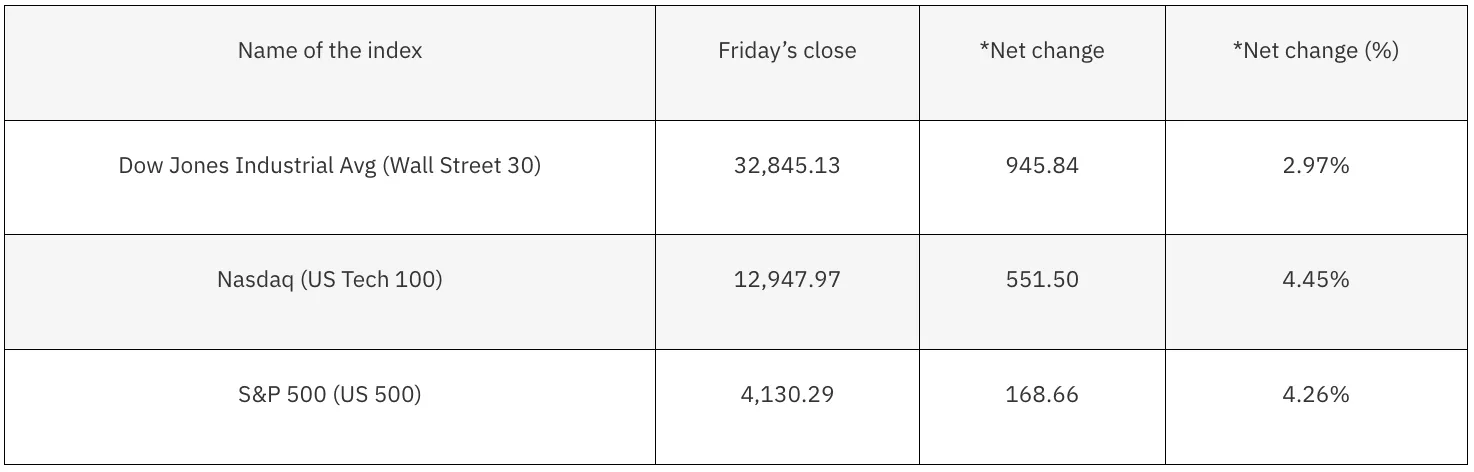
*Net change and net change (%) are based on the weekly closing price change from Friday to Friday.
Stocks surged on Friday, 29 July 2022, posting solid weekly gains and their best monthly performance since 2020. The Dow Jones gained by 2.97%, while the S&P 500 climbed by 4.26%, and the Nasdaq rose by 4.45%.
For the month, the tech-driven Nasdaq gained by 12.35%, making July its best month ever. The main reason for this was the strong earnings from Apple and Amazon, which rose by 3.3% and 10.4%, respectively, on Friday, 29 July 2022. This month also saw the Dow climb by 6.7% and the S&P 500 rise by 9.1%.
Although the Federal Reserve increased rates by 75 basis points earlier in the week and the second quarter Gross Domestic Product reported a decline, the markets were up. This optimism was because the Fed announced an expected slowdown in the pace of its interest rate hikes (as signs emerged that inflation is cooling down), and more than half of S&P 500 companies posted better-than-expected earnings.
This week, the government will release several vital reports on jobs that could affect the Fed’s next policy moves.
Now that you’re up-to-date on how the financial markets performed last week, you can improve your strategy and trade CFDs on Deriv MT5 Financial and Financial STP accounts.

Market news – Week 2, July 2022
The holiday-shortened trading week was impacted by the most recent Federal Reserve (Fed) meeting and several economic data, raising concerns among traders about the potential steps to combat inflation.
The holiday-shortened trading week was impacted by the most recent Federal Reserve (Fed) meeting and several economic data, raising concerns among traders about the potential steps to combat inflation.
Forex
EUR/USD fell to a 20-year low on Friday, 8 July 2022, before finishing the week at around $1.019. This fall was a result of financial markets being gripped by panic as recession fears persisted and inflationary pressures rose, further intensified by Russia's energy crisis.
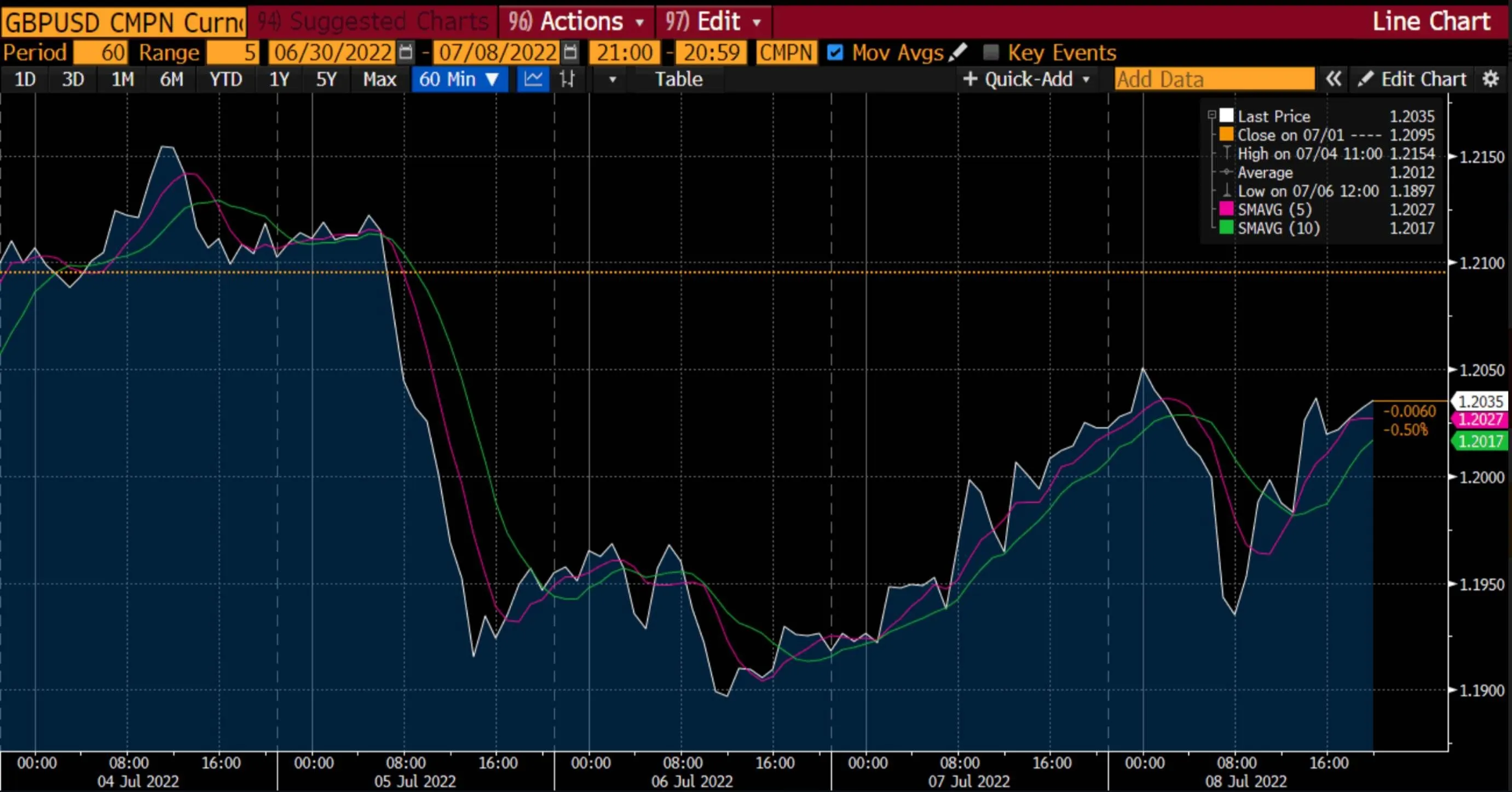
For the second consecutive week, the British pound declined against the US dollar, bringing prices to their lowest since March 2020. Boris Johnson was at the centre of a political storm that contributed to the pair's weakness, which was also influenced by recession fears and Brexit concerns. The resignation of Mr Johnson on Thursday, 7 July 2022, removed some political uncertainty, allowing prices to recover before the weekend. The chart above shows that the pair was priced just above the 5 and 10 SMA's, ending its week at around $1.2035.
Although the USD/JPY pair continued to rise, it did not break through its 24-year high of ¥137.00. The US June payrolls eased recession fears, causing the USD/JPY to rise. Furthermore, the inaction of the Bank of Japan (BoJ) towards its ultra-loose monetary policy and Shinzo Abe's assassination have hindered the yen's value and weakened the Japanese economy.
This week will be important for currencies since the US and the UK will release June inflation figures and UK GDP data.
Level up your trading strategy with the latest market news and trade CFDs on your Deriv X Financial account.
Commodities
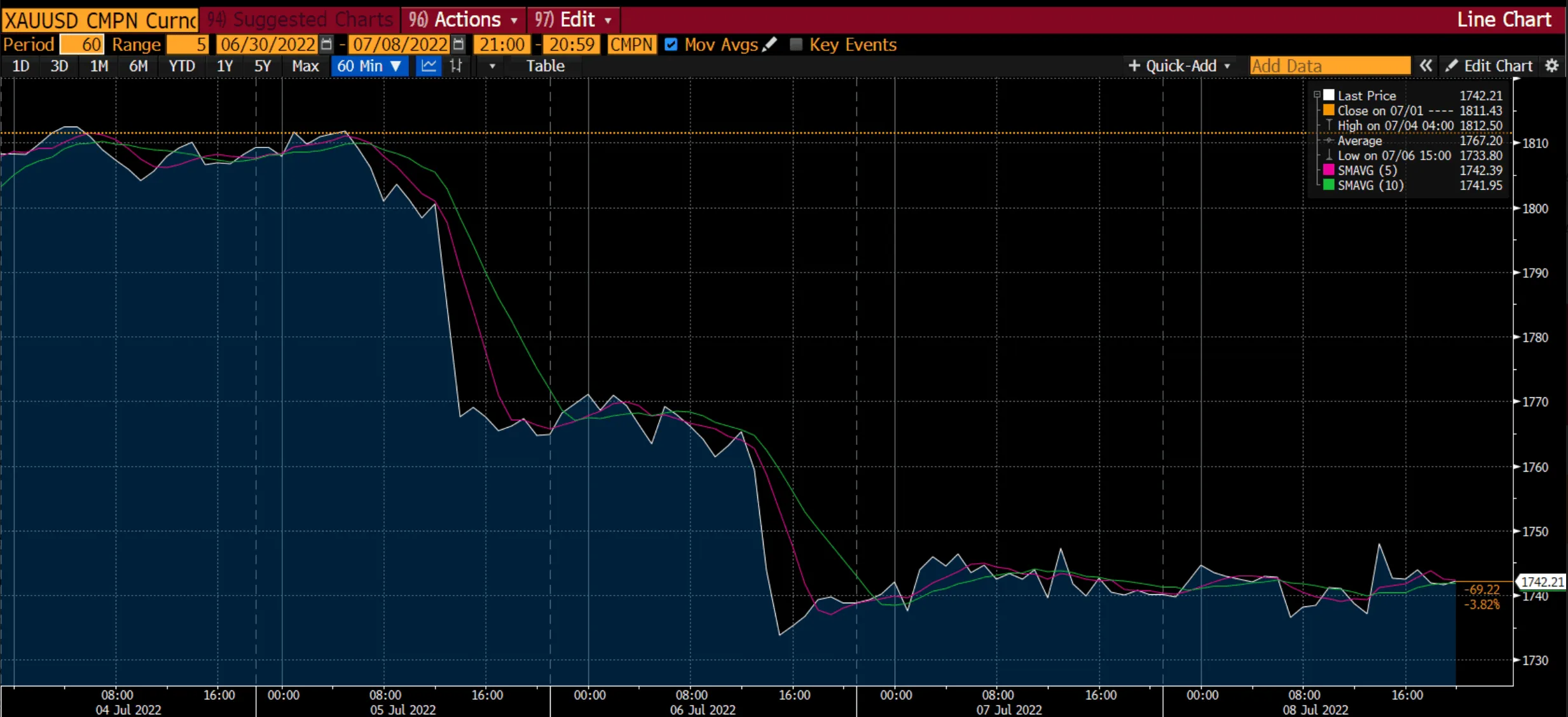
The yellow metal started the week around $1,810 and plunged to the $1,740 level – its lowest since September 2021. Fears of a global recession seemed to have affected traders' confidence, causing gold prices to fall. Moreover, the Federal Reserve's constant talk of raising interest rates to curb soaring inflation was a significant deterrent. In fact, Fed Chair Jerome Powell stated that the US central bank remains committed to bringing inflation under control and that the US economy is prepared to withstand tighter policy.
On Friday, 8 July 2022, gold went up by 0.40% due to a weaker US dollar and a mixed sentiment. However, it was down by 3.53% for the week. The chart shows the drastic drop and highlights that gold ended the week between a thin resistance and support level.
Meanwhile, oil prices rose by 2% on Friday, 8 July 2022, as the market remained concerned about whether the jobs sector is strong and the possibility of the Fed raising rates aggressively. However, oil posted a weekly decline of roughly 3.4% in what was a volatile week for commodities in general. Furthermore, worries over a potential recession pulled prices down for the week and led to oil prices touching their 12-week low mid-week.
Cryptocurrencies
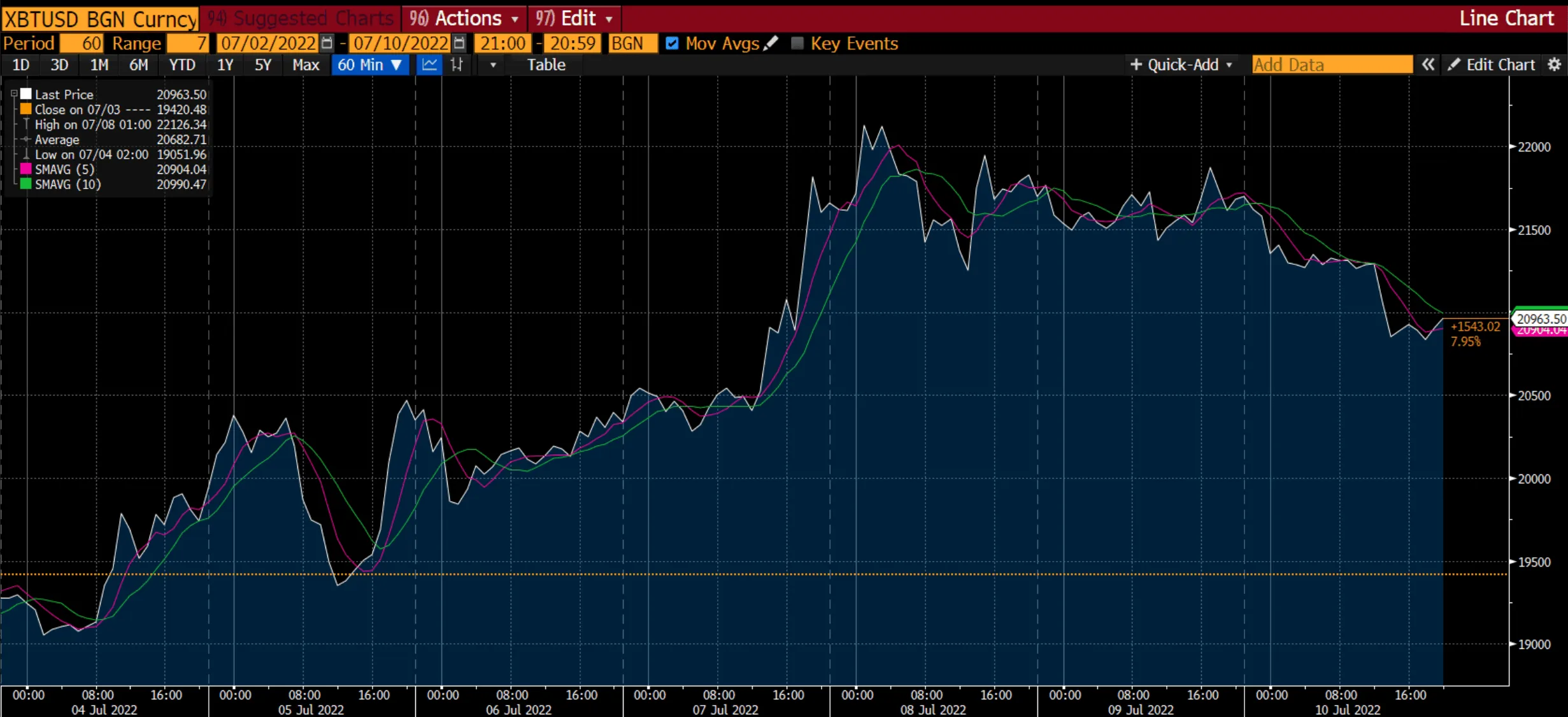
Last week, most of the top cryptocurrencies (by market capitalisation) increased in value, making it a great week for traders.
With both traditional and crypto markets reacting positively to the United States Federal Reserve's reassurance that recession fears are exaggerated, Bitcoin reclaimed the $22,000 level for the first time since mid-June. As seen in the chart above, the price went above the $22,000 mark on Friday, 8 July 2022 and maintained its upward momentum since the start of the week.
Ethereum, the second-largest cryptocurrency by market cap, also increased by around 9% in the last 7 days. Meanwhile, Polygon surged upwards by 19%, Avalanche climbed by over 10%, and Solana increased by nearly 7% for the week.
Furthermore, Dogecoin (DOGE) rose after Elon Musk's The Boring Company, a construction and infrastructure company, announced that it would accept DOGE as a payment currency. DOGE has surpassed Polkadot to become the tenth-largest cryptocurrency, with a market cap of around $9.37 billion. Over the last 7 days, the cryptocurrency has gained by approximately 7%.
Maximise market opportunities by sharpening your trading strategy and trading the financial markets with options and multipliers on Deriv Trader.
US Stocks market
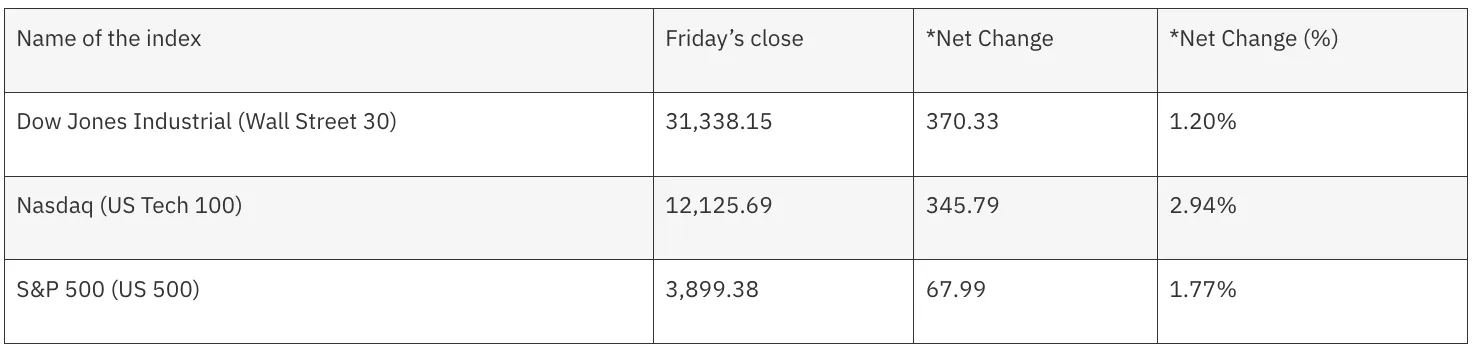
*Net change and net change % are based on the weekly closing price change from Monday to Friday.
All 3 major averages finished the week in green. The stock market recovered much of the previous week's losses, hoping that the Federal Reserve would control inflation without causing the economy to slump.
Nasdaq rose for 5 consecutive days for the first time this year. Furthermore, last week's gains lifted the S&P 500 Index out of bear market territory, and it is now down by only 19.1% from its peak in January. Meanwhile, Friday's payrolls report from the Labor Department revealed that employers added 3,72,000 nonfarm jobs in June, exceeding consensus expectations of around 2,70,000. Although the jobs report was positive for the economy, many traders expect the Federal Reserve to fight inflation with rate hikes in the coming months aggressively.
However, Twitter lost more than 5% on Friday, 8 July 2022, and ranked among the worst performers in the S&P 500 due to reports that Elon Musk might withdraw his takeover offer.
The corporate earnings season will start next week, with JPMorgan Chase, Morgan Stanley, Wells Fargo, and Citigroup set to report their second-quarter earnings. Moreover, June's Consumer Price Index (CPI) will also be a key focus for traders and will be available this Wednesday, 13 July 2022.
Now that you’re up-to-date on how the financial markets performed last week, you can improve your strategy and trade CFDs on Deriv MT5 Financial and Financial STP accounts.

Stock market indices 101
In a nutshell, a stock market index is a group of stocks that are combined by sector, industry, or economy. Some indices are made of top-ranked companies in the market, while others may consist of handpicked companies from a particular stock market category.
In a nutshell, a stock market index is a group of stocks that are combined by sector, industry, or economy. Some indices are made of top-ranked companies in the market, while others may consist of handpicked companies from a particular stock market category.
By compiling stock information of companies, stock indices allow you to get insights into the overall trend of price movements, market sentiment and general financial health of a market.
Let’s take a glimpse at how they work.
How are stock market indices calculated?
A stock index price indicates the average price of stocks in it.
There are various considerations when selecting which stocks will be included in a particular stock index. This could include the size of the company, its market capitalisation, or even its industry.
Once the companies are selected, the next step is to determine how much weight each of them will have in the index, as the weight of each stock may influence the index value.
Here are the most popular ways indices are weighted:
Market-capitalisation-weighted indices
In this index type, stocks with a larger market capitalisation carry more weight. A company's market capitalisation can be calculated by multiplying its current stock price by the number of outstanding stocks. For instance, if a company has 1 million stocks selling at USD30, this company’s stocks would have a market capitalisation of USD30 million. This company would have much more weight compared to a company with a market cap of USD1 million.
In this case, the price of the index will change drastically as the price of the stock with a higher market cap changes. On the other hand, if a company with a low market cap experiences any change, it would have minimal effect on the stock index.
This is the most common index weighting, and most major stock indices use it to calculate their value.
Equal-weighted indices
An equal-weighted index is where stocks are weighed against each other equally, regardless of their price, market capitalisation, or any other factor. This means that every company’s performance affects the index equally. Thus, to find the index's price made of 100 stocks, you’d need to add up all their prices and divide the sum by 100.
Price-weighted indices
The weight of each company in a price-weighted index is determined by its current stock price. Regardless of their size, companies with more expensive stocks would have a heavier weight in the index than those with a lower price. For instance, if the stock index consists of four stocks worth USD10, USD20, USD30 and USD40, the stocks would make up 10%, 20%, 30%, and 40% of the total index, respectively.
It’s important to note that each index can have multiple variations. For example, the S&P 500 index, tracking the performance of 500 large companies in the US, is usually market-capitalisation-weighted, but there is also an equal-weighted version of it.
How do stock market indices help traders?
Stock indices mainly function as economic indicators or market barometers that measure financial health. The average value of stocks in a specific country’s stock market shows how well its economy is doing.
By observing these indices, you get a sense of how the overall market is doing without monitoring individual stocks, and you can evaluate the performance of the market by comparing the current price of an index to its previous price. This allows traders to analyse market trends and understand market sentiment.
Not only that, traders can also opt to trade on these indices.
Popular stock market indices on Deriv
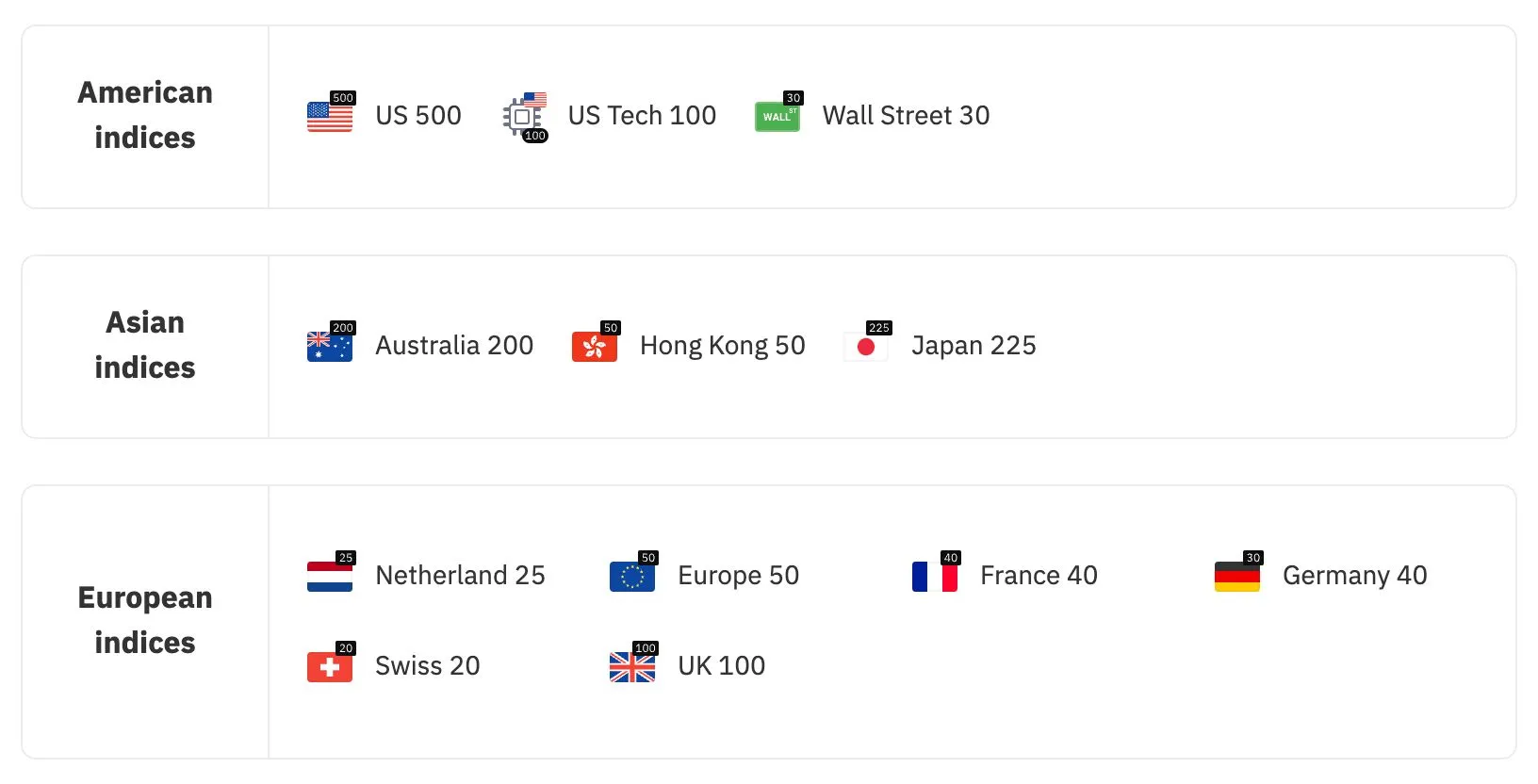
On Deriv, you can trade on popular stock indices with CFDs and options by predicting the indices’ market movement and without buying the underlying stocks. We offer a handful of popular indices that can be traded on our platforms: American indices, Asian indices, and European indices.
American indices
US 500 is the index of the 500 leading publicly-traded companies in the United States, US Tech 100 features the major technology and non-financial companies, and Wall Street 30 measures the stock movement of the top 30 companies in the United States that conduct industrial activities.
Asian indices
Australia 200 provides the index of the country’s 200 most significant companies, while Japan 225 tracks the stock movement of the top 225 publicly-traded companies in Japan. Hong Kong 50 observes the performance of the 50 largest companies in Hong Kong.
European indices
Europe 50 index looks at the 50 biggest companies in the Eurozone (European Union countries that use the Euro as their currency). France 40 gauges the French stock market movement by considering its 40 best companies. Germany 40 comprises 40 of the country's top performers while Netherlands 25 evaluates the top 25 Dutch companies.
UK 100 analyses the top 100 publicly-traded companies in the United Kingdom. Spain 35 tracks the 35 most prominent Spanish companies, whereas Swiss 20 provides the index of Switzerland's top 20 companies.
Stock market indices available for CFD trading on the Deriv MT5 platform:
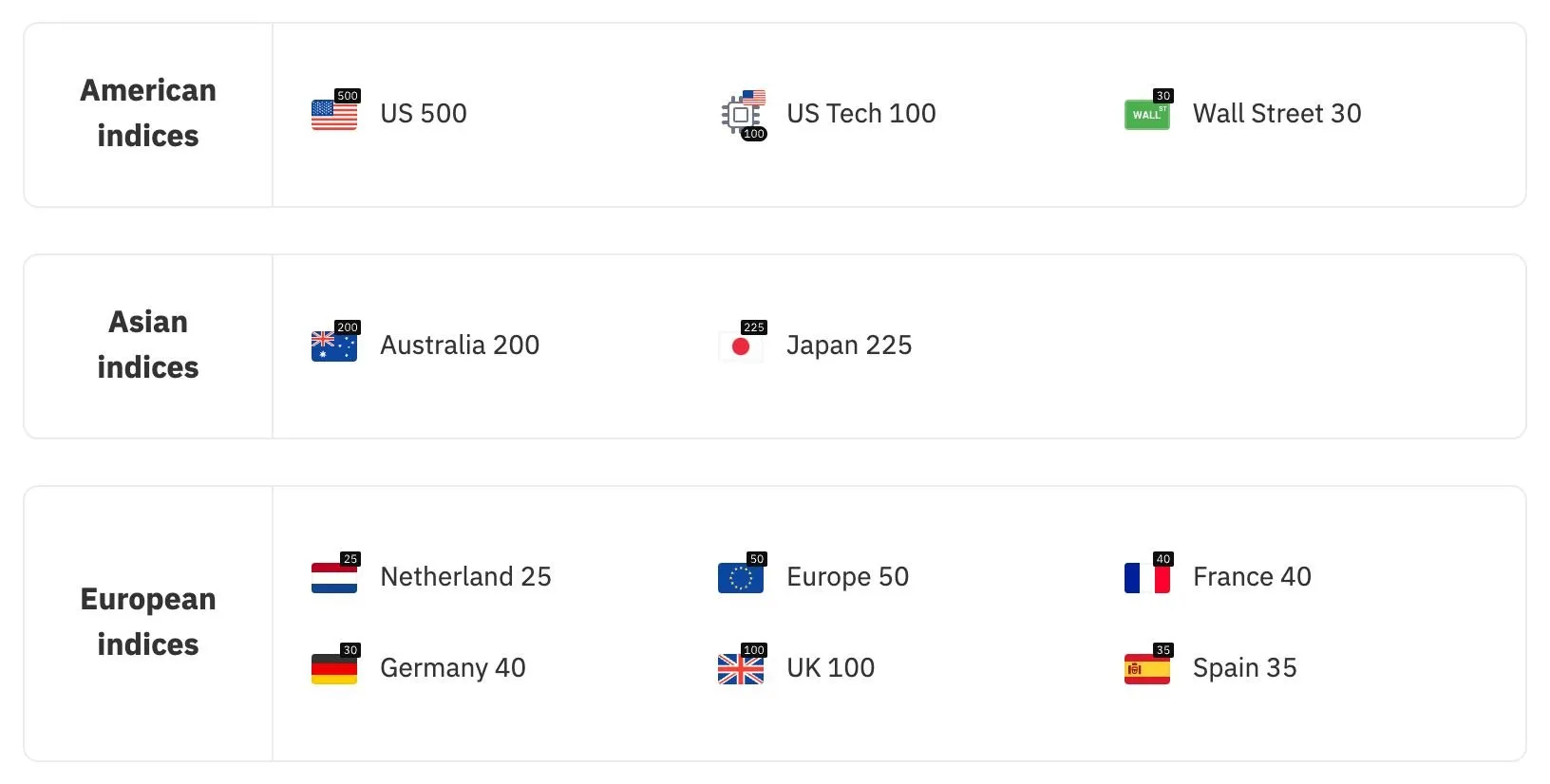
DBot and DTrader offer options trading on the following stock indices:
Practise trading on your favourite stock indices with our free demo account, which comes with 10,000 USD virtual funds that can be reset when you run out. Once you’re ready, you can begin your stock indices trading journey with us.
Sorry, we couldn’t find any results matching .
Search tips:
- Check your spelling and try again
- Try another keyword