
Results for

Weekly market report – 10 Jan 2022
Markets started the year on a sour note as the S&P fell over 2%, Nasdaq was down by around 5%, and Dow Jones was nearly negative, around the 0.9% mark. Growth sectors such as the technology and the discretionary sectors did not perform up to par, while value sectors such as energies and financial services sectors held up for the week. Furthermore, Mega cap technology stocks like Netflix, Microsoft, and Alphabet were down between 6% to 10% last week.
US Indices
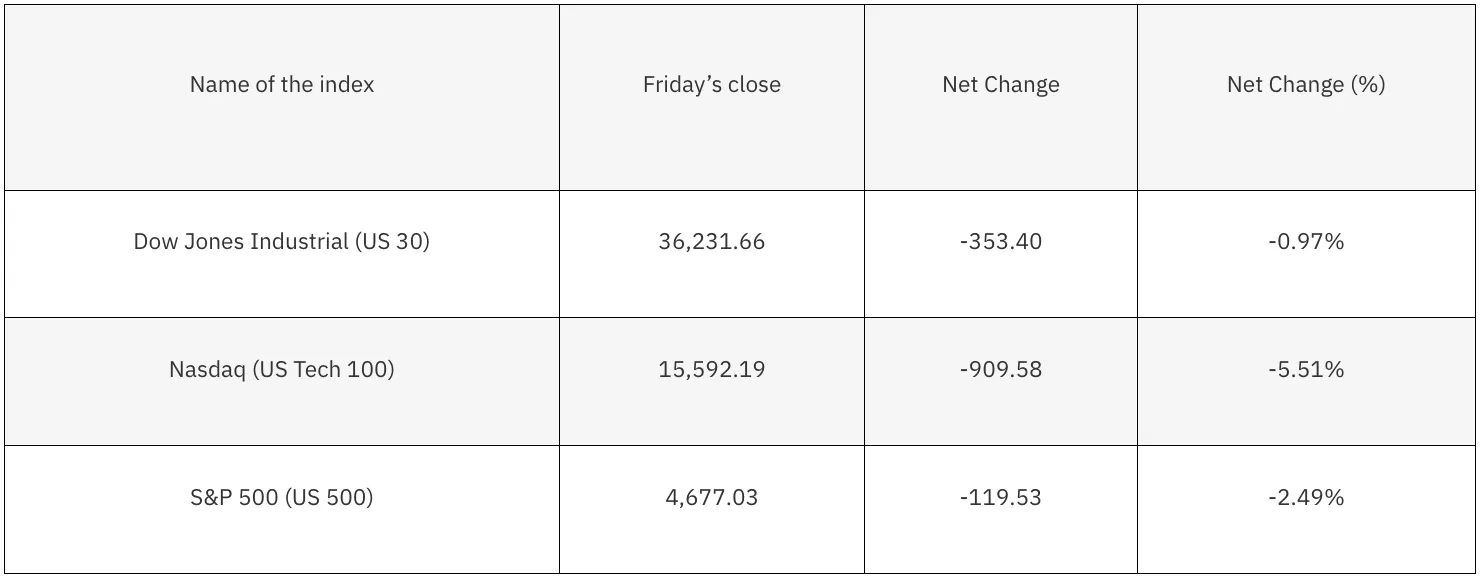
Markets started the year on a sour note as the S&P fell over 2%, Nasdaq was down by around 5%, and Dow Jones was nearly negative, around the 0.9% mark. Growth sectors such as the technology and the discretionary sectors did not perform up to par, while value sectors such as energies and financial services sectors held up for the week. Furthermore, Mega cap technology stocks like Netflix, Microsoft, and Alphabet were down between 6% to 10% last week.
This happened mainly due to the rise in Treasury yields, which was driven by the hawkish comments released from the FOMC meeting on Wednesday, 5 January 2022, suggesting a more positive outlook for further rate hikes and asset tapering. As a result, the 10-year Treasury yield went up from 1.34% last December to around 1.80% last week.
The economic data released last week was mixed with the Institute for Supply Management (ISM) data for both manufacturing and service sectors missing its mark. The Non-Farm payrolls fell short of its expected target of 400,000 newly created jobs. Meanwhile, the average hourly earnings rose to 0.6% in December, beating the estimate of 0.4%. This contradictory data suggested that many Americans preferred self-employment, given that 4.5 million people quit their jobs in November 2021.
Highlights for this week include Fed Chairman Jerome Powell's nomination hearing before the Senate Committee on Banking, Housing, and Urban Affairs, in which he will be expected to offer more information about his hawkish comments last week. In addition to this, the Consumer Price Index (CPI) and Producer Price Index reports are scheduled for the week. Economists expect another hot month for both the readings, whereas few believe that inflation may have peaked, with November's CPI reading being the highest since 1982. Traders will also continue to keep an eye on the yields as Tech and Growth stocks are most sensitive to the rising yields.
Forex
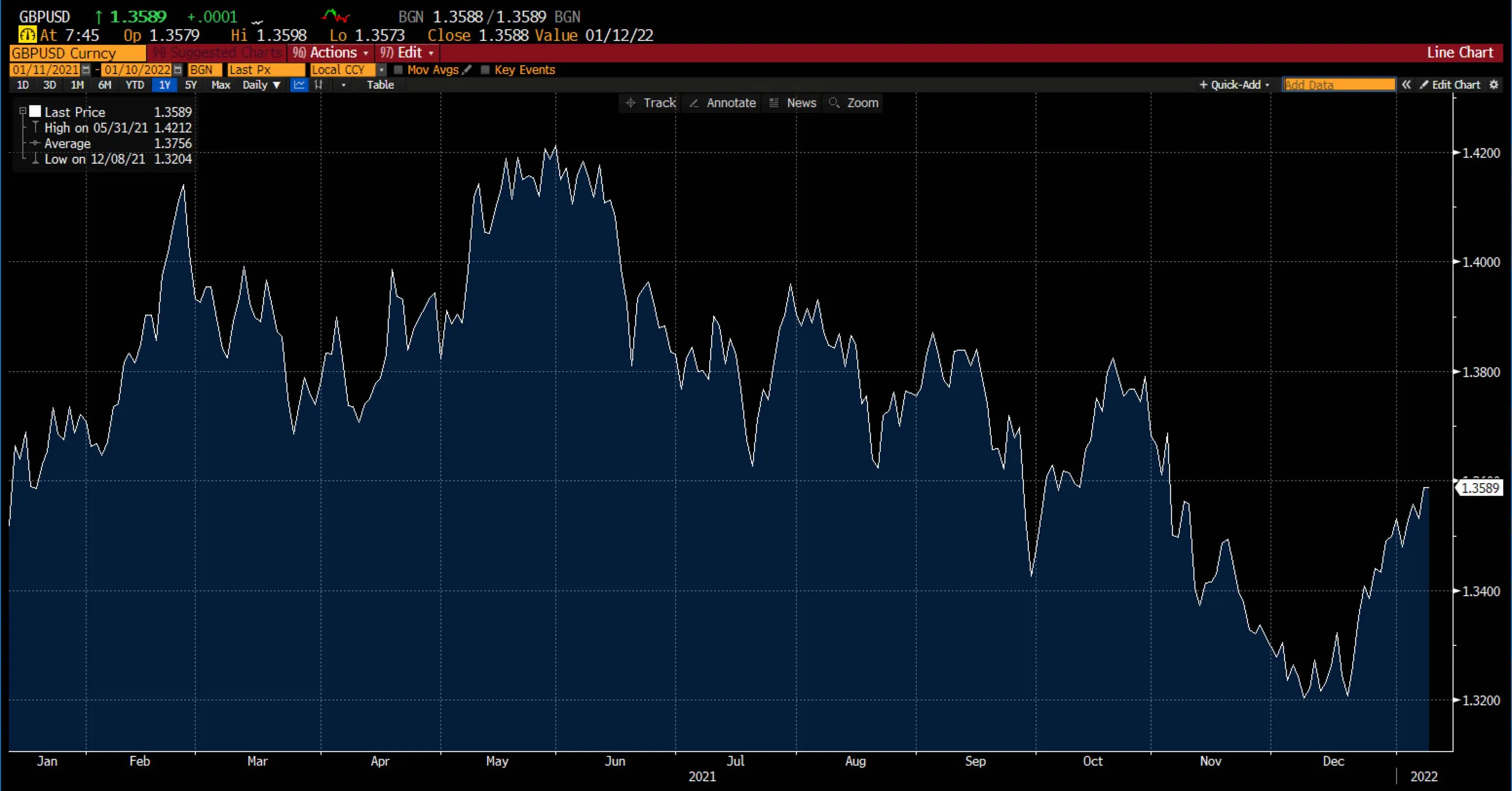
In the Forex market, the US Dollar had a disappointing start to the year. Alongside, the Dollar Index added +0.07%, but most gains were erased following the middling December jobs report. Additionally, EUR/USD rates finished lower by -0.20%, while USD/JPY rates added +0.33%. In comparison, GBP/USD rose +0.39% despite trends.
Friday, 7 January 2022 saw the US dollar lose ground against the Euro due to the disappointing December jobs report. The single currency soared, and the greenback weakened after the US Labor Department said non-farm payrolls rose by 199,000 last month, well short of the 400,000 estimate.
Despite the poor overall report, the unemployment rate fell to 3.9% against expectations of 4.1%, and wages rose by 0.6%. These statistics increased expectations that the Federal Reserve will begin raising interest rates at its March meeting.
The Euro strengthened against the US dollar despite showing barely any reaction to data showing Eurozone inflation rose to 5% in December. Several Eurozone policymakers have said they expect inflation to slow in 2022 gradually, and this year's rate hike may or may not be necessary.
After news broke last week that the UK will impose no more restrictions to combat Omicron, the Pound gained against many rivals, especially the US dollar. However, the week ahead is shaping up to be quite busy on the economic front. With Omicron peaking in London and the Federal Reserve's urge to tighten the monetary policy still rising, these two forces will likely remain in play for the major currency pair. Technically speaking, GBP/USD is currently trading at 61.8% of the retracement level of 1.35800 and below its resistance level of 78.6% of 1.36900. The upcoming week features the all-important US inflation and retail sales data and the UK's GDP data.
Commodities
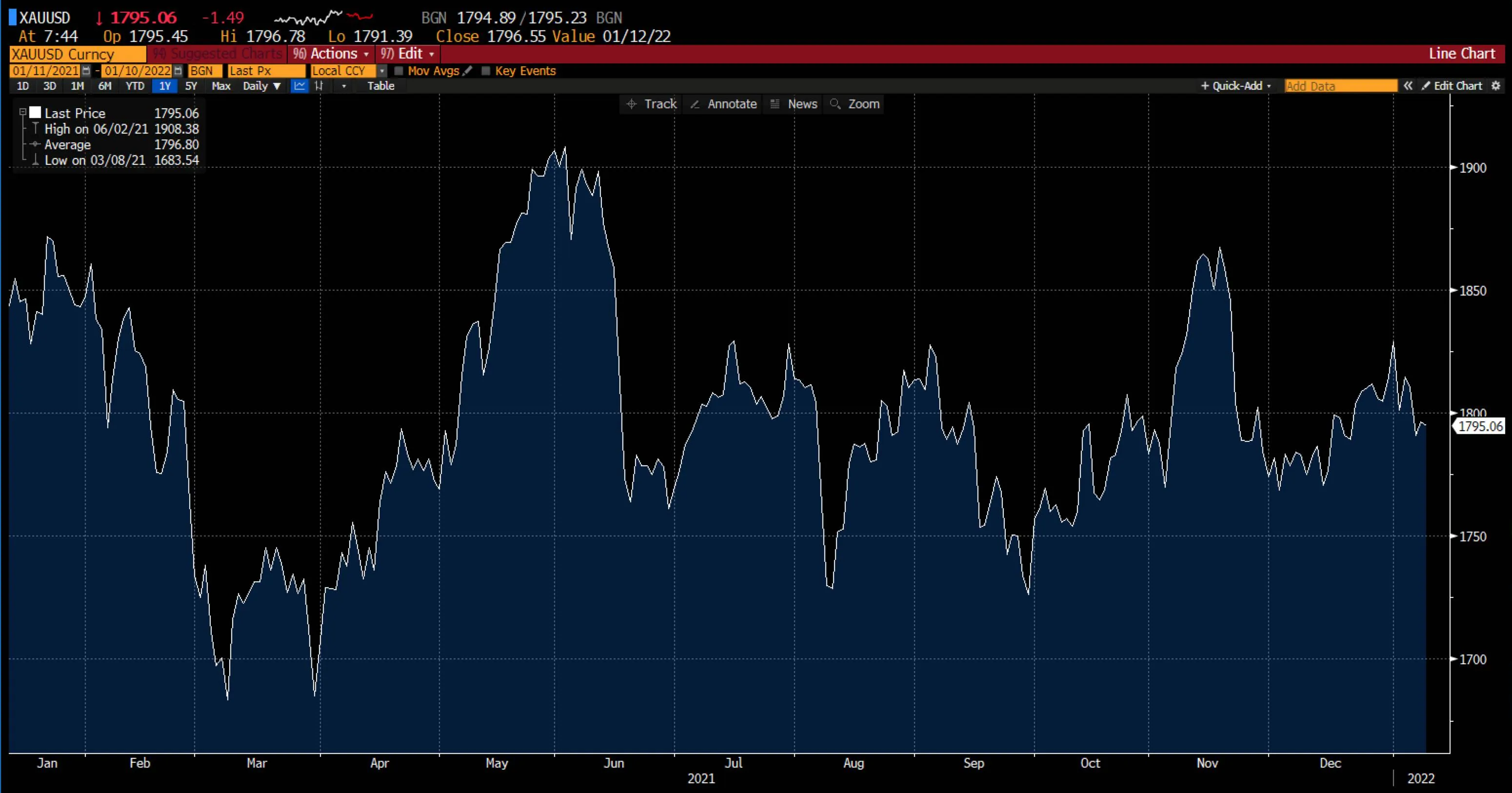
Last week, gold prices pushed through volatile waters against the US dollar. On Thursday, 6 January 2022, the yellow metal entered a freefall to reach lows of around $1,790, translating to a 2% dip from the previous 24-hours. Gold entered Friday’s trading set for a 1.7% weekly loss, but prices mildly recovered in the week's final trading session. The metal ticked up around 0.4% by Friday, 7 January 2022, mid-day, trading close to $1,797 per ounce.
An overall shaky week for the bullion came amid signals from the Federal Reserve to hike interest rates faster than expected and disappointing US jobs growth data. With the US moving closer to full employment, gold's reaction highlights its particular sensitivity to inflationary risks and interest rate advances.
Additionally, spot silver and platinum also edged up last week. Silver advanced by 1.1% at around $22.40 per ounce, whilst palladium climbed by over 3% to $1,933 per ounce. Meanwhile, platinum fell by 0.6% to trade around $959 per ounce.
In a bullish week for the oil markets, Brent crude jumped to $80 per barrel last Tuesday, 4 January 2022, its highest level since November 2021. Prices advanced as OPEC+ maintained its plan to increase its output by 400,000 barrels per day in February 2022, indicating optimism for future global demand.
Cryptocurrencies
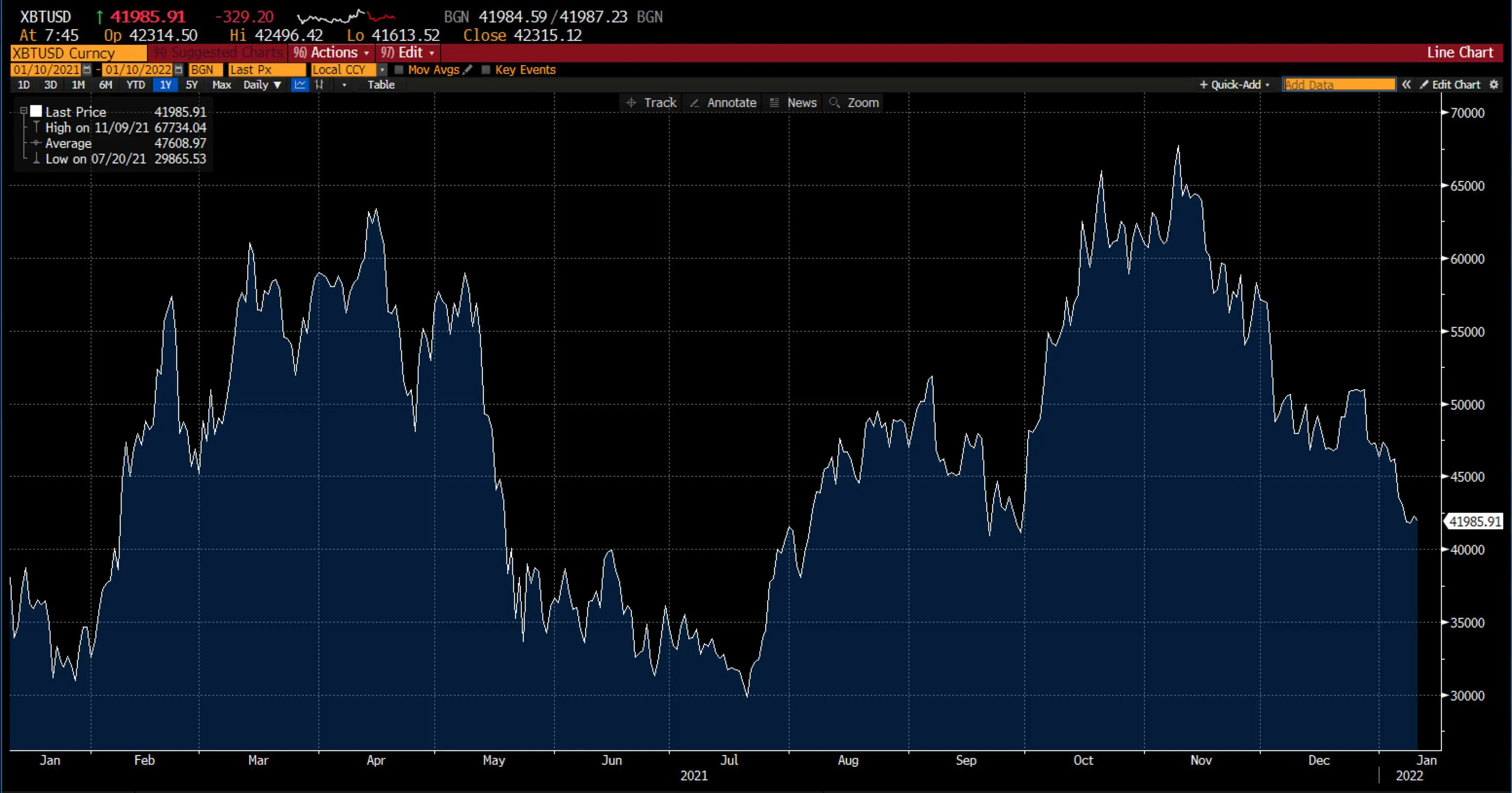
It was a heavy week for the crypto markets, as Bitcoin's value plummeted to a 3-month low over worries about tightening monetary policy in the United States and an internet outage in Kazakhstan, the world's second-largest mining hub.
As of late afternoon on Friday, 7 January 2022, Bitcoin's price was trading near the low of $41,360 after falling below the $42,000 mark. Bitcoin began its bearish run early last week upon hints from the Federal Reserve that policymakers were ready to aggressively dial back the stimulus aid that kept the economy afloat during the pandemic's peak.
A hawkish attitude by monetary policymakers led to a global sell-off in equity markets, which spread over to cryptocurrencies. Even though supporters often describe Bitcoin as uncorrelated with traditional financial markets, experts have noted growing patterns between the price movements of bitcoin and stocks. The world's largest cryptocurrency could test the waters around the $38,600 level, where its first support level lies at the 23.6% retracement level. If Bitcoin bulls rally, upside resistance is visible around $44,400 at the 38.2% retracement level.
Altcoins also followed the price drop of the market leader, with Ethereum and Solana continuing to slide. This decline resulted in both coins shedding between 6-8% during Friday's sell-off.
Trade the financial markets with options and multipliers on DTrader or CFDs on Deriv X Financial account and Deriv MT5 Financial and Financial STP accounts.

Weekly market report – 17 Jan 2022
It was a bumpy ride for the US indices last week. The S&P 500, the Nasdaq 100 and the Dow Jones were down for the week by -0.16%, -0.02% and -0.44% respectively.
US Indices
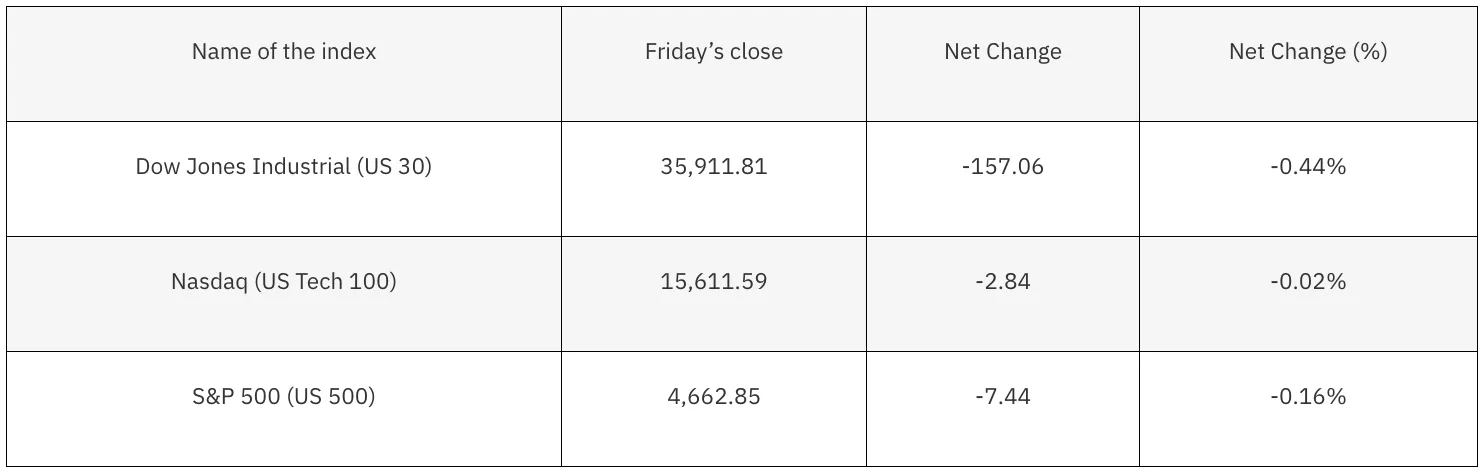
It was a bumpy ride for the US indices last week. The S&P 500, the Nasdaq 100 and the Dow Jones were down for the week by -0.16%, -0.02% and -0.44% respectively.
Stocks jittered as traders monitored a disappointing set of bank earnings along with a larger-than-expected fall in US retail sales. First, JPMorgan Chase (JPM) dived 6.6% after the firm posted underwhelming 4th quarter revenues and absorbed the additional costs of rising compensation expenses. Similarly, Citigroup (C) shares reversed after experiencing a similar miss on trading revenues during the 4th quarter.
The risk-averse sentiment also increased due to disappointing data releases such as the December retail sales in the US, which fell by 1.9% MoM, marking its most significant drop since February 2021.
Furthermore, traders are also worried about ongoing price pressure across the US economy. The latest print from the Bureau of Labor Statistics showed that consumer prices rose at a 7% YoY in December, marking its hottest spike in 4 decades.
Those figures came after the last policy meeting of 2021, in which the Federal Reserve appeared more inclined to raise interest rates in March 2022 to combat rising prices. JP Morgan CEO Jamie Dimon now expects up to 6 or 7 incoming interest rate hikes this year, doubling down on his earlier bet of only 3 or 4.
But, last week also saw winners like Netflix shares (NFLX) climb more than 1% to help boost the Nasdaq on Friday, 14 January 2022. This rise came following the company’s announcement to raise prices for US and Canadian consumers.
Market experts anticipate the 1st quarter of 2022 to be volatile for tech and growth stocks. “The 1st quarter should be rising yields, rising rates, an outperformance of cyclicals, and we think that the long duration growth names are going to have a challenging quarter”, Alicia Levine, the head of equity at BNY Mellon Wealth Management, remarked.
Forex
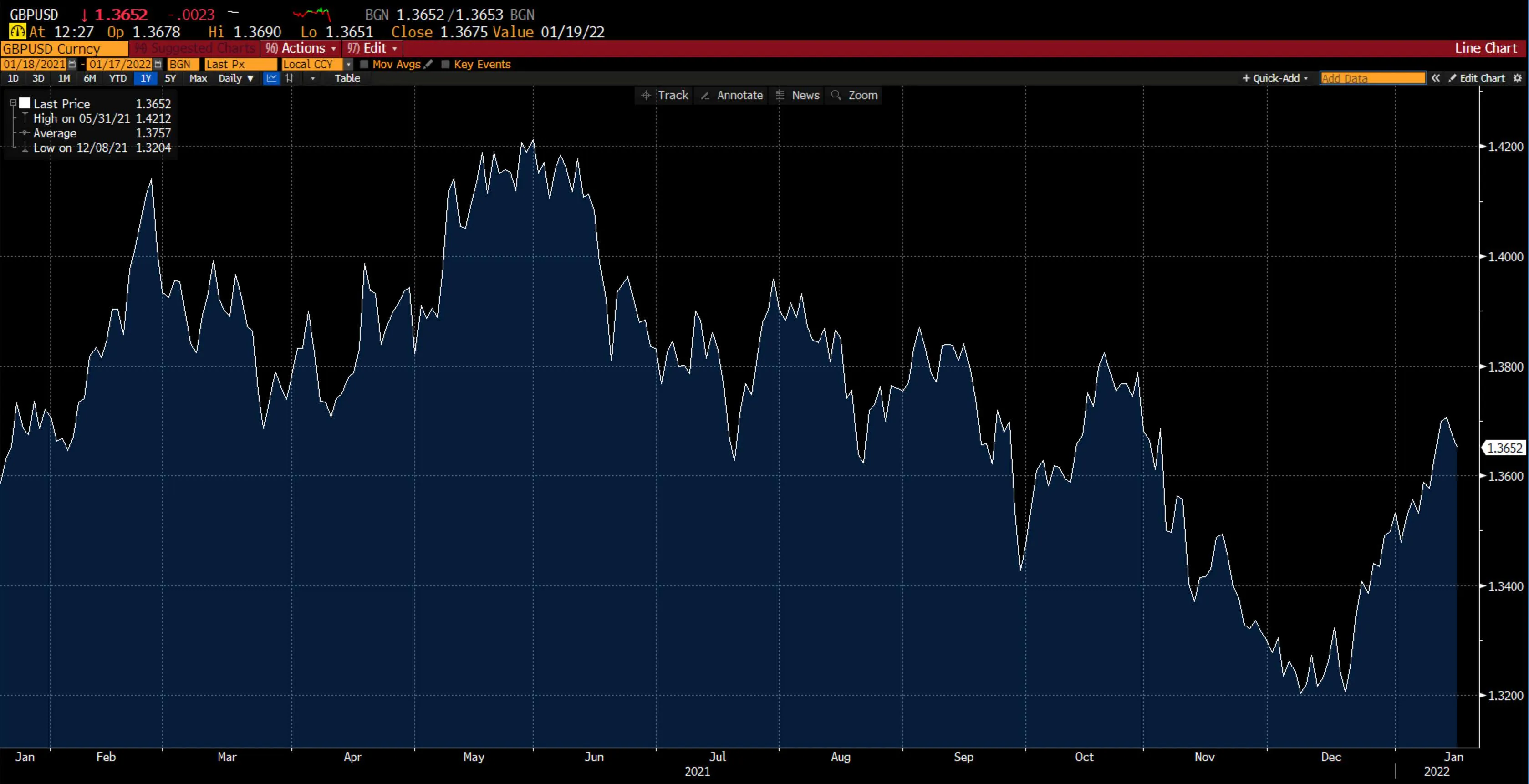
On Friday, 14 January 2022, the dollar snapped out of its three-day losing streak as traders avoided riskier currencies amid fears that the US Federal Reserve's tightening policies were already included in asset prices.
The greenback was pressured, even though Fed Chair Jerome Powell said the US economy is ready for tightening monetary policy, and inflation data showed the largest annual rise in nearly 4 decades.
Despite being 0.3% higher on Friday, 14 January 2022, the US dollar index closed the week about 0.6% lower, showing its worst performance since early September.
Meanwhile, despite several solid macroeconomic releases, the British Pound struggled to hold onto the $1.3700 level against the US dollar during the New York session. The US dollar Index rose by approximately 0.25% in the last hour, sitting at $95.05. This rise was spurred by the rise in yields on US 10-year Treasury bonds, up to 1.75%, a three basis point gain.
Currently, GBP/USD is trading at $1.36800, which lies between 61.8% retracement support at $1.36300 and 78.6% retracement resistance at $1.37500.
In relation to the Japanese yen, the US currency fell 0.02% to more than a three-week low of ¥114.150. The safe-haven Japanese currency has benefited from the recent souring of risk sentiment in global financial markets. Plus, policymakers at the Bank of Japan are also debating when they can start telegraphing an eventual rate hike, which could happen before inflation reaches the bank's target of 2%.
Technically speaking, USD/JPY is currently trading at the ¥114.300 level, right below its 50% retracement level of ¥114.450.
Commodities
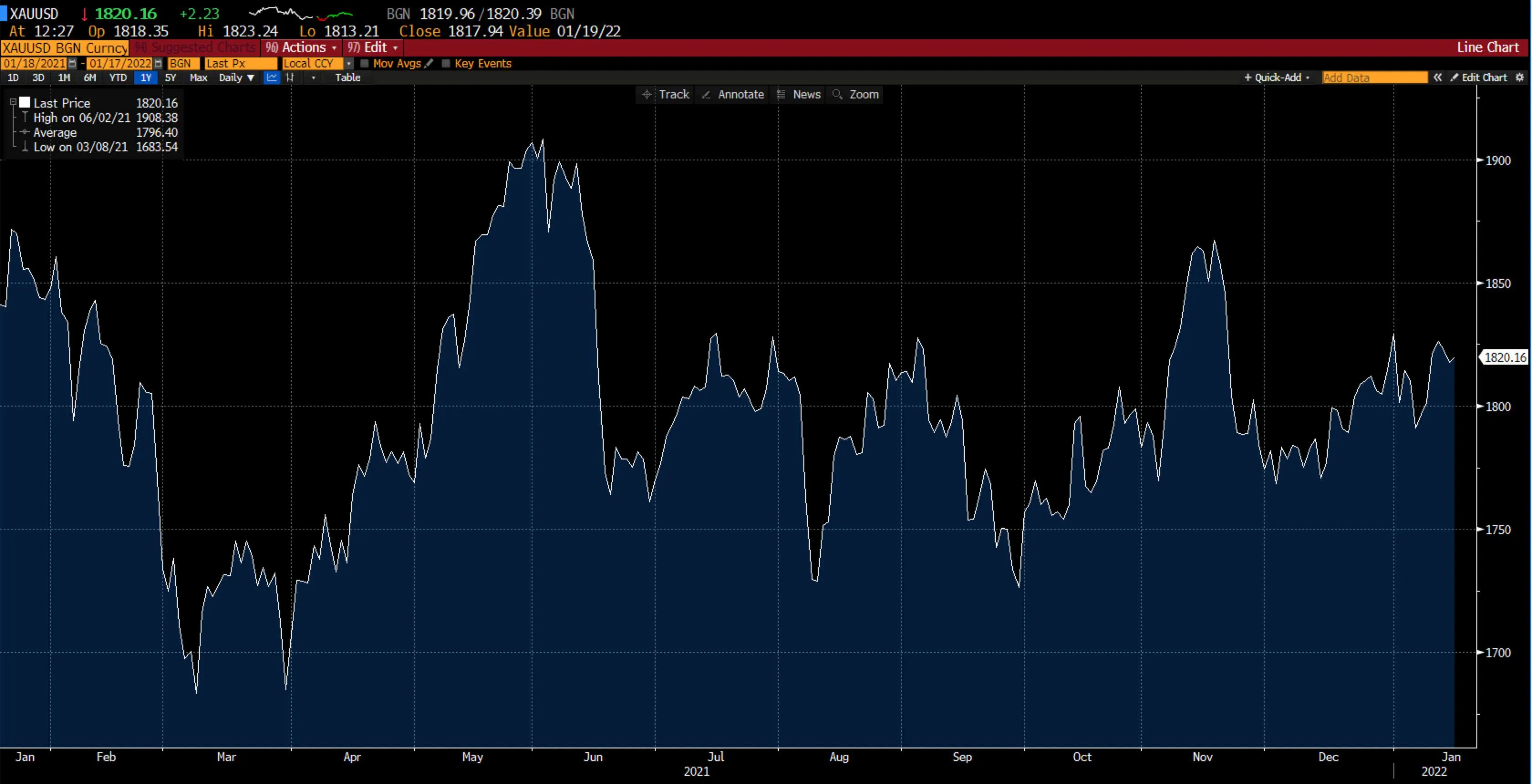
Last week, gold ended on a high note mainly due to the 10-year US Treasury yield, which dropped from 1.8% to 1.7%, helping gold maintain its bullish momentum. Another contributing factor was the Consumer Price Index, published on Wednesday, 12 January 2022, which rose by 7% YoY in December. Overall, gold started its week at around $1,800 and ended at around $1,817.
Technically, gold is trading near its resistance, around $1,835 at the 61.8% retracement level. If it does breach the resistance, the new resistance would be at around the $1,890 mark at the 78.6% retracement level.
This week will not feature any high-tier data; however, traders will closely observe the bond yield. If the 10-year US Treasury yield falls below 1.7% and stays there, the US dollar will face new selling pressure, and gold could rise. Conversely, a break above 1.8% would put pressure on gold.
Oil has continued its bullish momentum as the US dollar weakened and headed towards its most significant weekly fall in 4 months. Generally, a weaker US dollar makes the price of commodities more affordable for traders in other currencies.
However, oil prices reached a multi-year high, with demand outweighing supply and signs that the Omicron variant is not as disruptive as anticipated. WTI rose by around 6% last week, whereas Brent rose by about 5% last week. Meanwhile, China aims to release oil reserves during the Lunar New Year holidays as a strategic plan alongside the United States to curb the global prices of oil.
Cryptocurrencies

This week, Bitcoin's price has turned around after losing 20% in the last two weeks due to fears of an interest rate hike and a spike in Omicron cases. It is currently trading at $43,100, up by 3% in the last 7 days.
The daily chart shows that Bitcoin is trading around its resistance of $44,000 at the 38.2% retracement level, whereas the support level lies around the $39,000 mark at the 23.6% retracement level.
Several top altcoins gained over 15% this week, including Polygon (MATIC) and Polkadot (DOT). However, the price of Dogecoin soared over 17% after Elon Musk announced that the cryptocurrency could be used to purchase Tesla products.
The store, which offers a broad range of manufactured and branded Tesla products like quad bikes for children, portable wireless chargers, men and women clothing, and accessories, has seen some of its products sold out since integrating DOGE payments.
In the last days of 2021, traders began to visualize the potential of Dogecoin after Elon Musk's tweet in December, where he first announced an upcoming pilot test of Doge as a payment option for Tesla.
Furthermore, Solana's scalability, low transaction fees, and ease of use have been affirmed by Bank of America (BoA) strategists. In a note released last week, the company describes Solana as the 'Visa of the digital asset ecosystem.'
Trade the financial markets with options and multipliers on DTrader or CFDs on Deriv X Financial account and Deriv MT5 Financial and Financial STP accounts.

What are stocks, how and where to trade them
If you've been eyeing the financial markets for a while now, you've probably come across the terms 'stock,' 'stock market,' and 'stock trading.’
If you've been eyeing the financial markets for a while now, you've probably come across the terms 'stock,' 'stock market,' and 'stock trading.’ Financial markets include any marketplace where securities are traded, and the stock market is just one type of financial market. It's where stock trading — the buying and selling of shares in a particular company — takes place.As a first step to understanding how the stock market and stock trading work, let's first answer the question, 'What are stocks?'
Defining stocks
A stock, also known as equity, is a type of investment that represents a share or partial ownership of a company. If you buy stocks in a corporation, you become a shareholder, and you get a dividend of the corporation’s profits based on the amount of stock you own. Dividends may be paid in cash or in more stock.Corporations sell stocks to raise capital for operating their businesses. A stock market exchange is where these public corporations sell their stocks. Stocks are generally expected to appreciate in value over time, especially if the company has shown continuous growth and stability. This is the main reason why investors buy stocks — to build their wealth. Whenever a company's stock value rises, stockholders can sell the stock they previously purchased, at a profit. And, essentially, this is how stock trading works.
The stock market
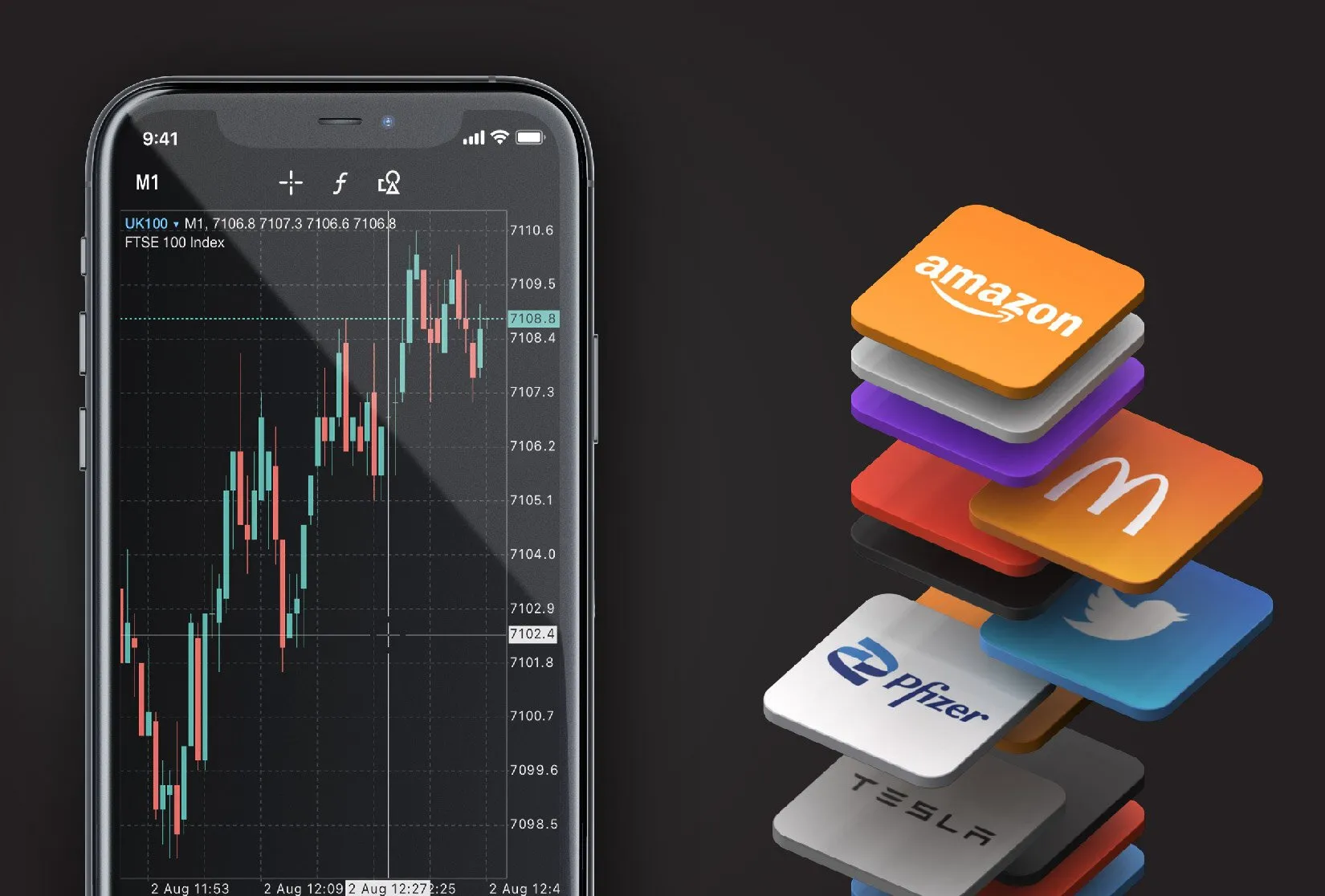
Stock trading takes place in the stock market. The stock market acts as a commercial hub for purchases of stocks and mutual funds. It’s open to everyone, which means you get to be among other people who invest in the stock market. How it operates is pretty straightforward — it lets buyers and sellers negotiate prices and make trades.The stock market works through a network of exchanges like Nasdaq and the New York Stock Exchange, for example. It is in these exchanges that companies list shares of their stocks that can be bought. The value of each stock is highly dependent on its supply and demand. As the laws of supply and demand dictate, if there are more buyers (demand) than sellers (supply) for a specific stock, the value of that stock will go up. If more sellers are active in the market than buyers, the stock’s value will decrease. With the dependence on supply and demand, it’s logical to conclude that the stock market is highly volatile. As with any volatile market, trading on the stock market has its risks. One way to work around the risks is to spend time researching which stocks to trade in and when to trade them.
Trading CFDs on stocks
As a result of the market's volatility, trading in the stock market comes with risks that can make you hesitant to start. If you want to learn the ropes without jumping in head-first, you can try trading CFDs on stocks first.With CFD trading, you can trade on the price movement of any financial market without actually owning the underlying asset. Traders predict whether a particular asset's price will rise or fall. If you think the asset price will go up, you can buy a CFD and gain a profit from the rise. This is called ‘going long’. If you think the price of an underlying asset will go down, you can sell a CFD and profit from the fall. This is called ‘going short’.The more the market moves in your favour, the more profit you make. But, it’s also possible that your predictions may move against you, which would result in potential loss.
Where to trade CFDs on stocks
On Deriv, you have the option to choose from two reliable platforms where you can trade CFDs on stocks — Deriv X, and Deriv MT5 (DMT5).
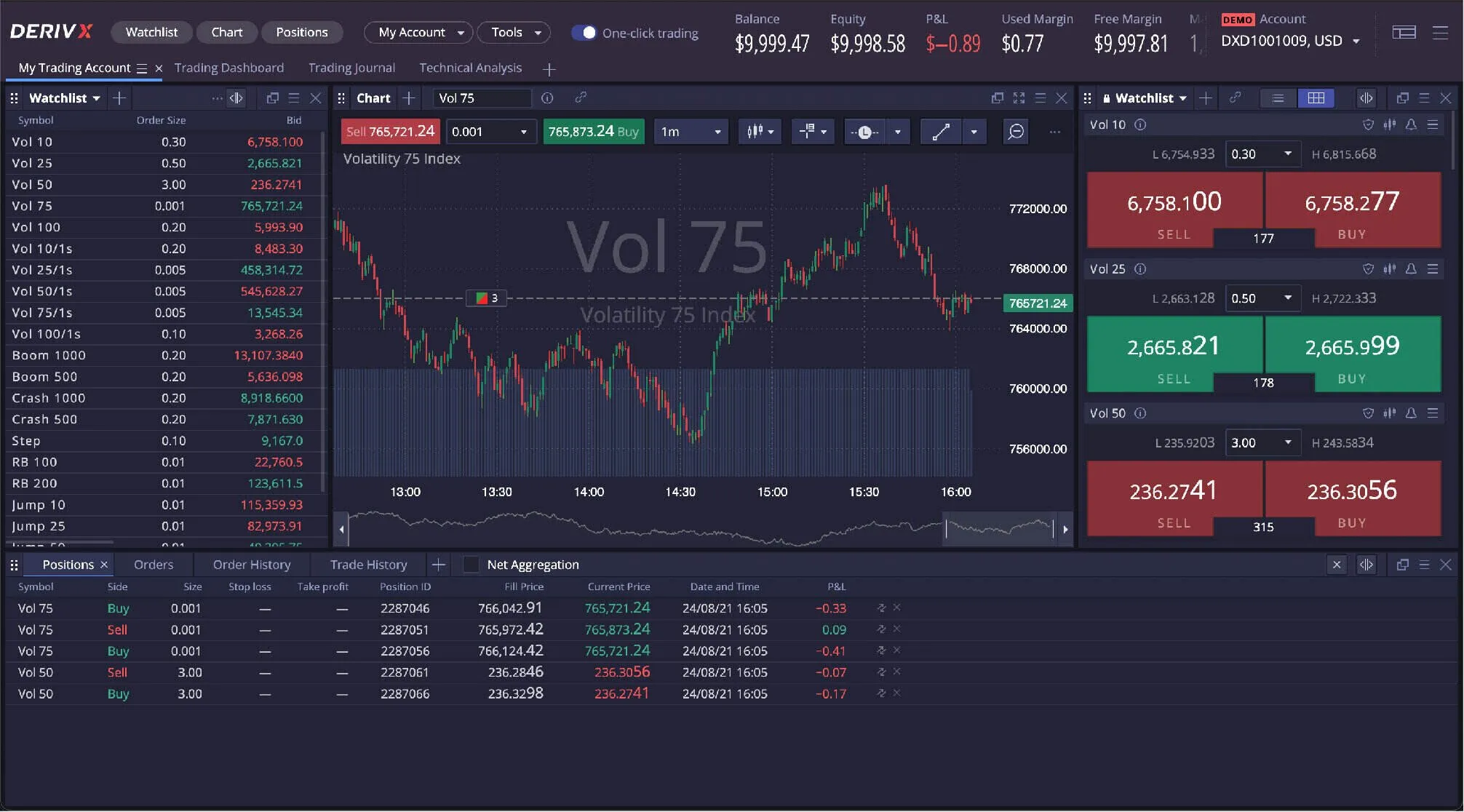
Deriv X is a multi-asset trading platform that offers CFDs on stocks and other assets, including forex, commodities, cryptocurrencies, and synthetic indices. It provides a versatile trading environment that you can customise to suit your preference. You can drag and drop widgets, create your layouts, and its intuitive tools and feature-rich charts let you get the info you need at your fingertips.
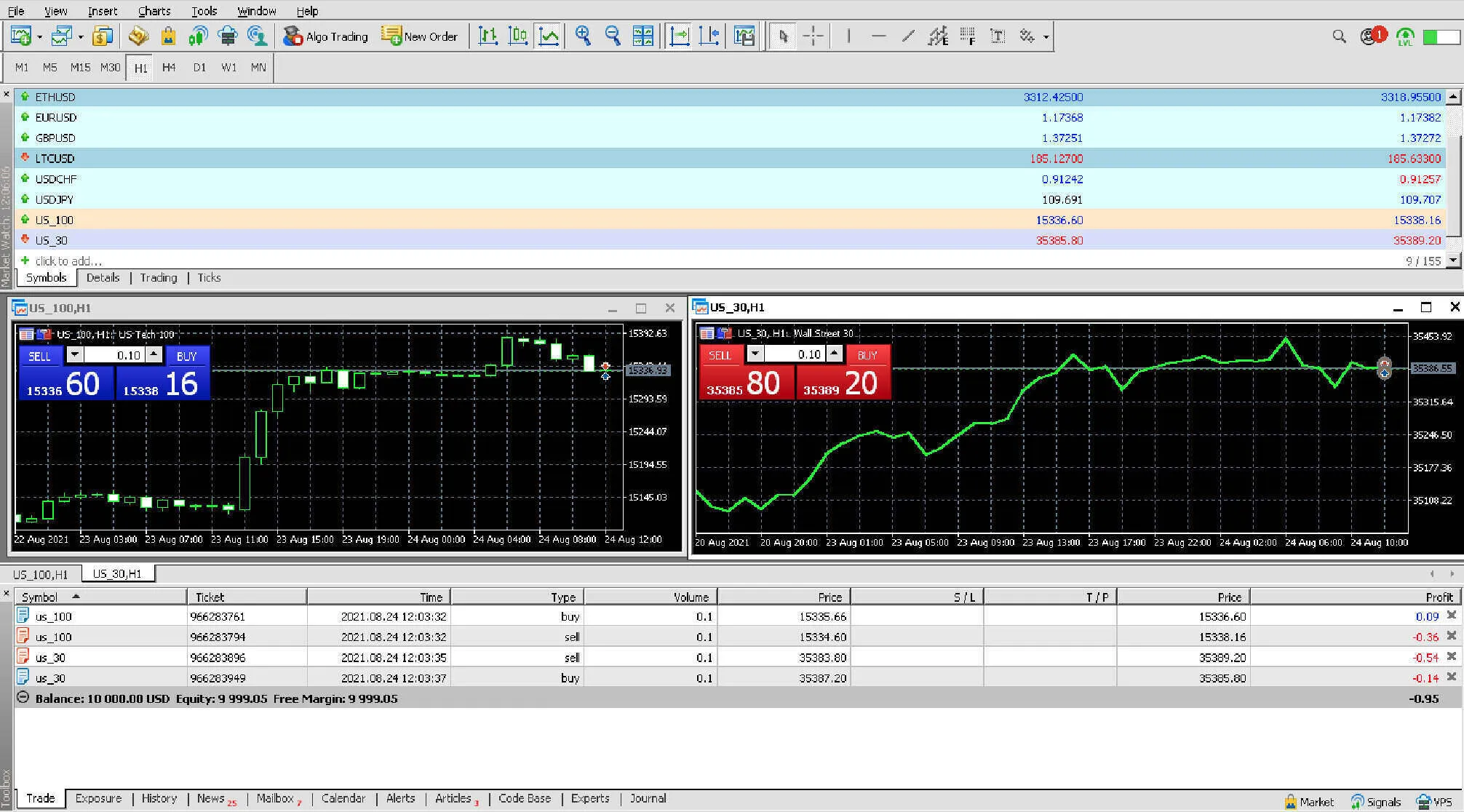
Deriv MT5 is an all-in-one CFD trading platform where you can access innovative trade types such as margin trading. It’s considered the most popular trading platform to date as it boasts advanced financial trading functions and superior technical and fundamental analysis tools. What makes DMT5 stand out more than other trading platforms is that it allows you to trade automatically by using robots and trading signals.DMT5 and Deriv X are both multi-asset platforms, letting you trade not only CFDs on stocks, but other instruments as well. You get to enjoy high leverage and low spreads to increase your potential gains when the market moves in your favour.Practise your trading skills and strategies with a free Deriv demo account. The demo account comes preloaded with 10,000 USD virtual money so that you can trade risk-free.
.webp)
Weekly market report – 24 Jan 2022
Last week, the US Dollar Index gained approximately 0.40%, with the DXY trading at 95.60 ahead of Friday’s close. Despite this advance, the index remains within the range seen in January, and now the focus turns to next week's Federal Reserve interest rate announcement, and the broader rally for 2021 is at stake.
Forex
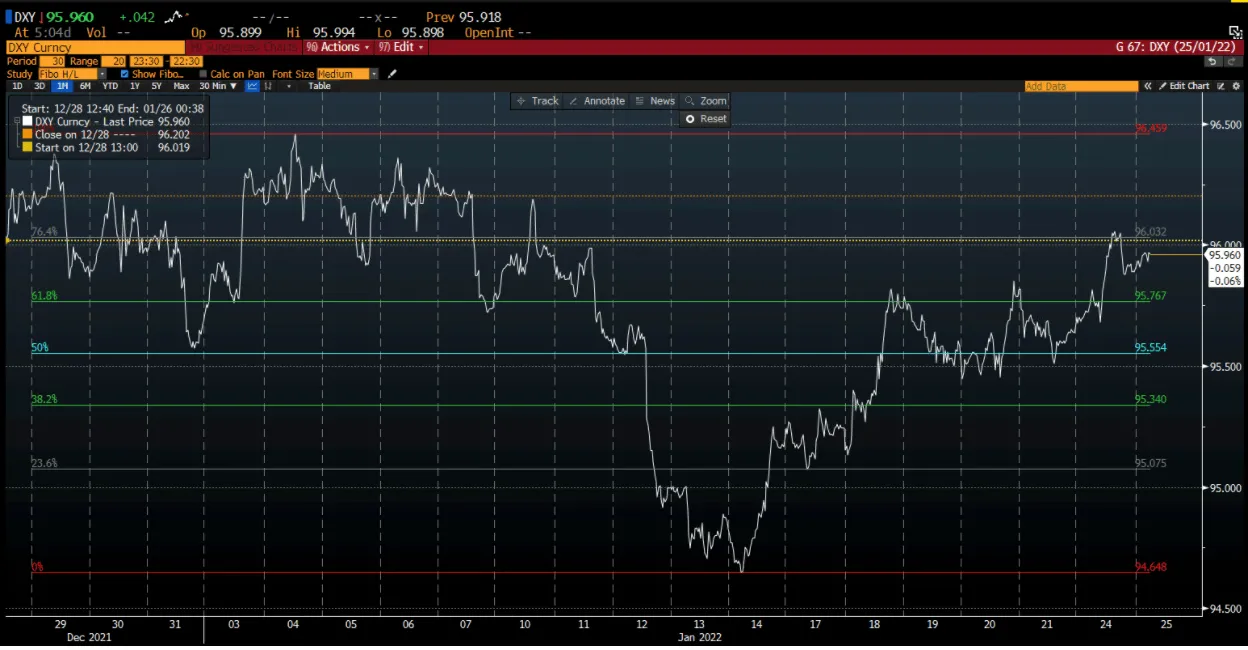
Last week, the US Dollar Index gained approximately 0.40%, with the DXY trading at 95.60 ahead of Friday’s close. Despite this advance, the index remains within the range seen in January, and now the focus turns to next week's Federal Reserve interest rate announcement, and the broader rally for 2021 is at stake.
Here’s how our top pairs responded to this gain:
- USD/JPY is approaching its monthly low of ¥113.38 amid the decline in global equity markets. Meanwhile, the Federal Reserve's interest rate decision could change the outlook for the currency in the near future as it prepares for a normalised monetary policy. The US monetary policy decisions may support USD/JPY since the Federal Reserve is likely to raise interest rates over the next few months, while also explaining its exit strategy.
- After recent gains, EUR/USD seems to have returned to its comfort zone – just a few pips above the $1.1300 mark. On Tuesday, 18 January 2022, the pair fell the most as US traders returned to their desks and pushed government bond yields to a level not seen since February 2020.
- Having won four weeks in a row, GBP/USD lost nearly 1% last week following Friday's disappointing retail sales data that caused the British pound to continue losing interest. The US dollar struggled against falling US Treasury bond yields, however, risk-averse market conditions weighed on the pound ahead of the weekend.
- The GBP/JPY pair maintained its downwards trend, falling to a three-week low around the ¥154.45 level during the Asian session. This is the seventh day of a negative move, mainly fueled by reviving demand for the safe-haven Japanese yen.
Falling US Treasury bond yields made it difficult for the greenback to outperform its rivals ahead of the weekend. However, the Federal Open Market Committee’s (FOMC) rate decision is scheduled for Wednesday, 26 January 2022. Traders are hoping for clearer hints about upcoming rate hikes, and are pricing in a first-rate hike for March 2022 along with at least 3 hikes through the year.
Commodities
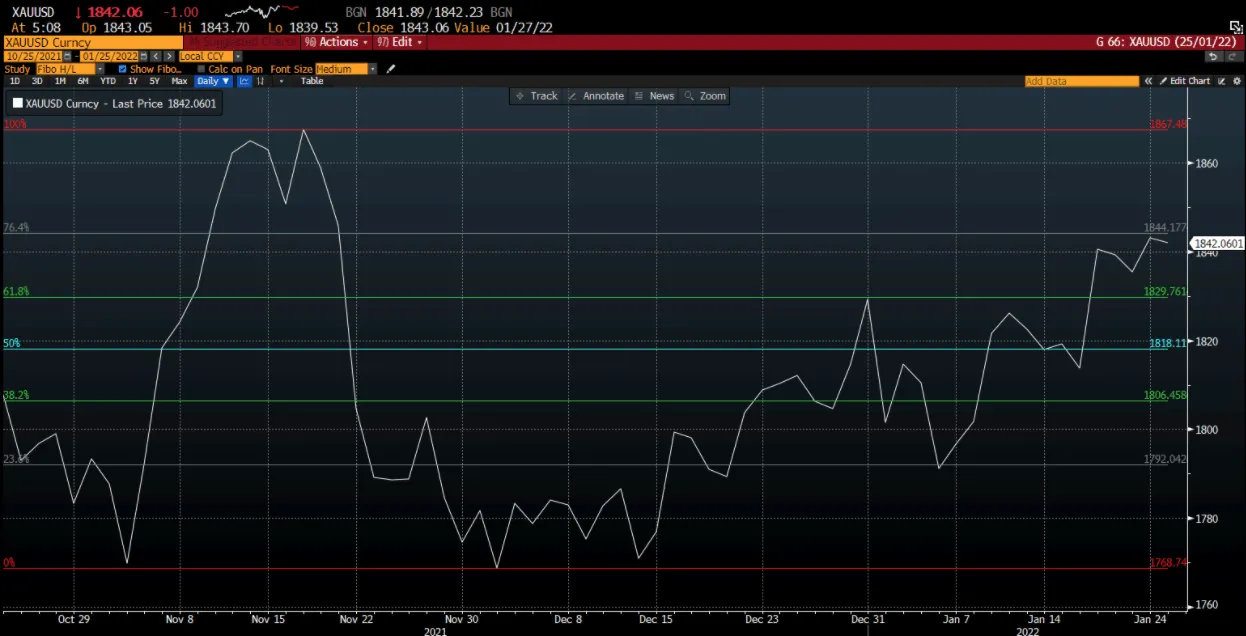
Gold and silver reached two-month highs on Thursday, 20 January 2022, driven by inflation fears and tightening Russia-Ukraine tensions. By Thursday afternoon, spot gold was trading at $1,841 per ounce. Aside from gold, silver rose 2.1% to $24.63 per ounce last week, whilst platinum and palladium extended gains from their previous rallies.
Currently, gold's primary support level is $1,765 at a retracement of 23.6%. The yellow metal is continuing with its upward momentum and has already broken through its first major resistance around $1,824. Meanwhile, its new resistance level sits at $1,765 at the 50% retracement level.
"With all indicators pointing to inflation continuing to be problematic and crude oil prices remaining high, gold prices could hit $2,000 an ounce this year," said Jim Wyckoff, Senior Market Analyst at Kitco News.
With the US dollar index levelling off and inflation still the centre of discussion, gold is seeing an unexpected rally as traders flock towards safe-haven assets whilst crypto and high-risk tech take the hit. At the moment, other precious metals are reaping the benefits of the current risk-averse market sentiment.
Cryptocurrencies

Last week, the cryptocurrency market suffered heavy losses as the US stock market declined sharply. Wall Street suffered a poor performance last Thursday, 20 January 2022, which led to a sell-off that wiped out almost $150 billion from the crypto market. With the Federal Reserve also indicating plans to reduce its balance sheet and raise interest rates, traders seemingly responded by shedding their positions in riskier assets. Cryptocurrencies, reputed for their high risk-high volatility, were included in the list.
Bitcoin fell by 15% on the week and was trading around the $36,000 mark by late Friday afternoon. The world's leading cryptocurrency was trading down almost 50% from its previous record high of $69,000 last November. Meanwhile, Ethereum dropped by more than 20%, trading close to $2,500.
Currently trading around $35,500, Bitcoin may find support around its first support level of $30,750 at 38.2% retracement. On the upside, Bitcoin's primary resistance level lies at $37,250 at 50% retracement. If this level is broken, its secondary resistance level of $43,700 would be activated.
Bitcoin's overall growth can be attributed to its use as a hedge against inflation caused by the US government's $2 trillion Covid stimulus package. However, with inflation now at its highest yearly pace in 4 decades, analysts believe that the risks of a more hawkish Federal Reserve will weigh down on Bitcoin's growth during this period.
It's important to note that regulators are also clamping down on cryptocurrencies, with China banning all crypto-related activities and US policymakers implementing restrictions on certain market aspects. Naturally, this poses an even larger threat to the long-term growth of decentralised digital currencies.
US Indices
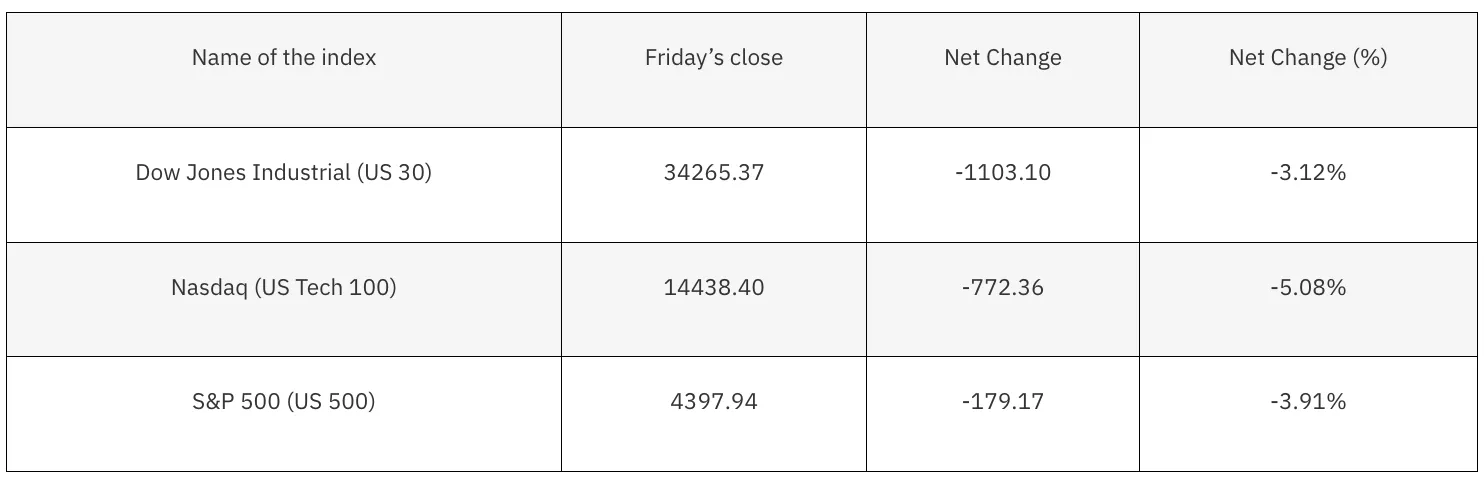
US Indices have continued to slump 3 weeks in a row due to fears of rising interest rates and their impact on growth sectors.
Since the interest rate environment has changed, the stock market leaders have been shifting as the weak performance of the technology sector has caused the indices to fall. This led to traders shifting from high-risk stocks to defensive stocks.
Another contributing factor is the 10-year Treasury yield, which reached its highest level since 2019 on Wednesday, 19 January 2022, only to fall the following day due to the weaker-than-expected jobless claims report. The stock market has been shaken recently as interest rates have risen by more than 0.5% since early December, even though the rates are still relatively low by historical standards.
Additionally, short-term volatility in the US stock market jumped more than 50% for the week and, on Friday, 21 January 2022, hit its highest level since peaking in early December following the presence of the Omicron variant of Covid-19. Last week also saw the CBOE Volatility Index, also known as the VIX, rise from around 19 to almost 29 – these readings indicate increased volatility and uncertainty.
This week, the focus is on the Federal Reserve, where the members could reveal how many rate hikes they plan to make to control inflation this year.
Trade the financial markets with options and multipliers on DTrader or CFDs on Deriv X Financial account and Deriv MT5 Financial and Financial STP accounts.

Weekly market report – 31 Jan 2022
Last week, the US dollar extended its winning streak, posting the most significant weekly gain in roughly 7 months.
Forex
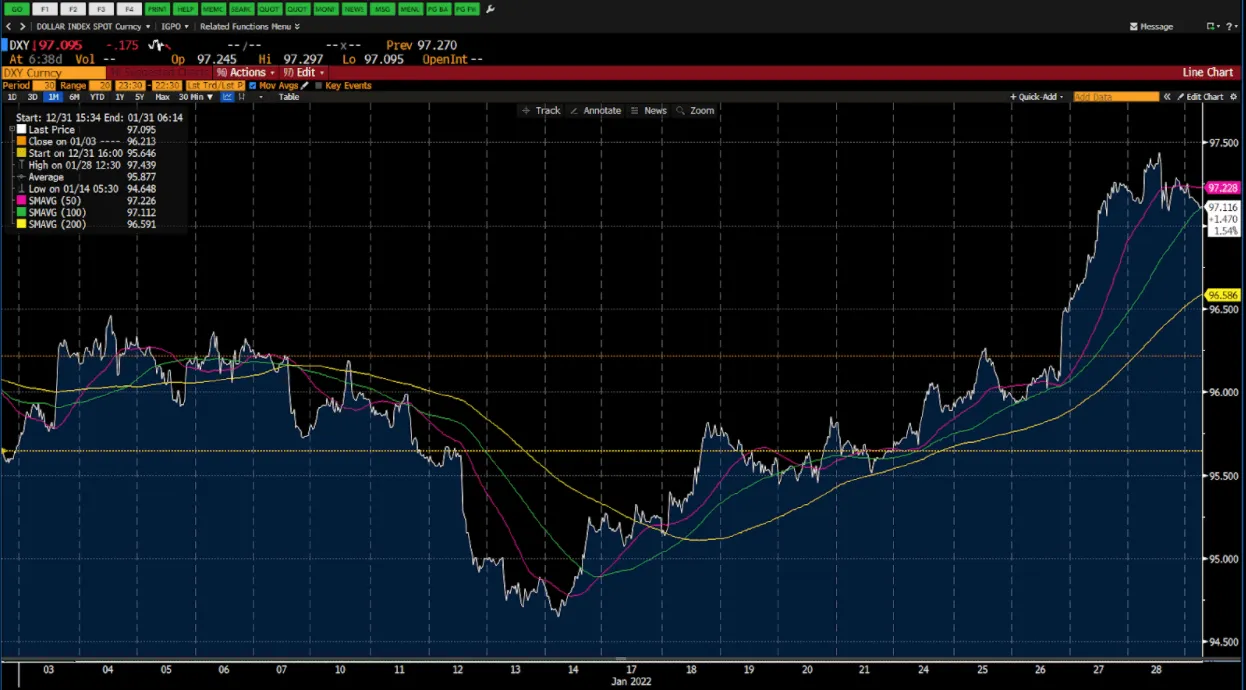
Last week, the US dollar extended its winning streak, posting the most significant weekly gain in roughly 7 months. For the first time since July 2020, the Dollar Index (DXY) surpassed $97 by more than 1.7% as the Federal Reserve announced it would raise rates faster in the months ahead. Technically speaking, the monthly chart shows multiple support levels of 200 and 100 SMAs around $96.6 and $97.1, respectively, and a 50 SMA resistance level at around $97.2.
How did the other pairs react?
- The EUR/USD pair was trading near $1.11 and slumped to its weakest level since May 2020 after the Federal Reserve confirmed its hawkish view.
- GBP/USD was barely around $1.3400 due to mixed US data and the endorsement of the rate hikes made by the Federal Reserve. Additionally, political uncertainty surrounding Prime Minister Boris Johnson has also weighed on the British Pound.
- USD/JPY had an upward bias before it slid ahead of the weekend due to the US 10-year Treasury yield fall by 8 basis points from 1.85% to 1.77%. As of the weekend, it is currently trading around ¥115.22. As for the Japanese data, the core inflation rate stood at -0.7% - more than twice December's (-0.3%).
- On Friday, the GBP/JPY pair traded within a narrow range of ¥154.00 - ¥155.00ish, staying just above the low it reached earlier in the week. The pair started the week nearly 0.75% down but now trades in the ¥154.2 area with roughly 0.15% weekly gains.
This week's focus will be the upcoming Non-farm Payroll (Jan) and Unemployment Rate (Jan) scheduled for Friday, 4 February 2022. The report is expected to show that 238k new jobs were created in the month, whereas the unemployment rate should remain at around 3.9%.
Commodities
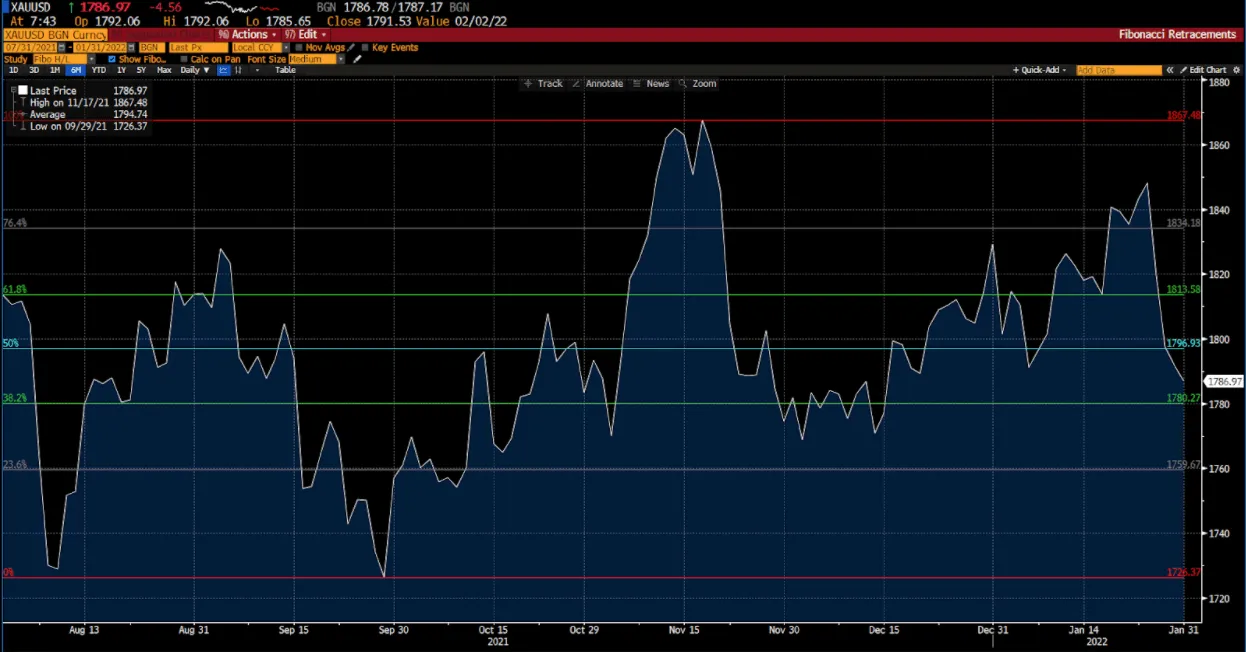
Within 3 days, gold lost all of its gains since the start of the year, as the US Federal Reserve affirmed its hawkish stance. On Wednesday, 26 January 2022, the Fed announced that its policy settings would remain unchanged and that the quantitative easing program would end as scheduled in early March. However, during the Federal Open Market Committee press conference, Chairman Jerome Powell's comments on the policy outlook sparked a rally in the USD and sent XAU/USD down sharply.
Although the XAU/USD pair reached its highest level since November on Wednesday, 26 January 2022, at $1,853, it lost more than 3% from that level to end the week below $1,800. As far as technical analysis is concerned, gold is trading below the 50% retracement level near $1796.93. The metal's next support level will be near the 38.2% retracement level at around $1780.27.
Meanwhile, silver had its worst week of the year, dropping for 6 consecutive days, closing at approximately $22.39. Overall, silver accumulated losses of around 7.90% for the week – its highest since November 2021.
Cryptocurrencies
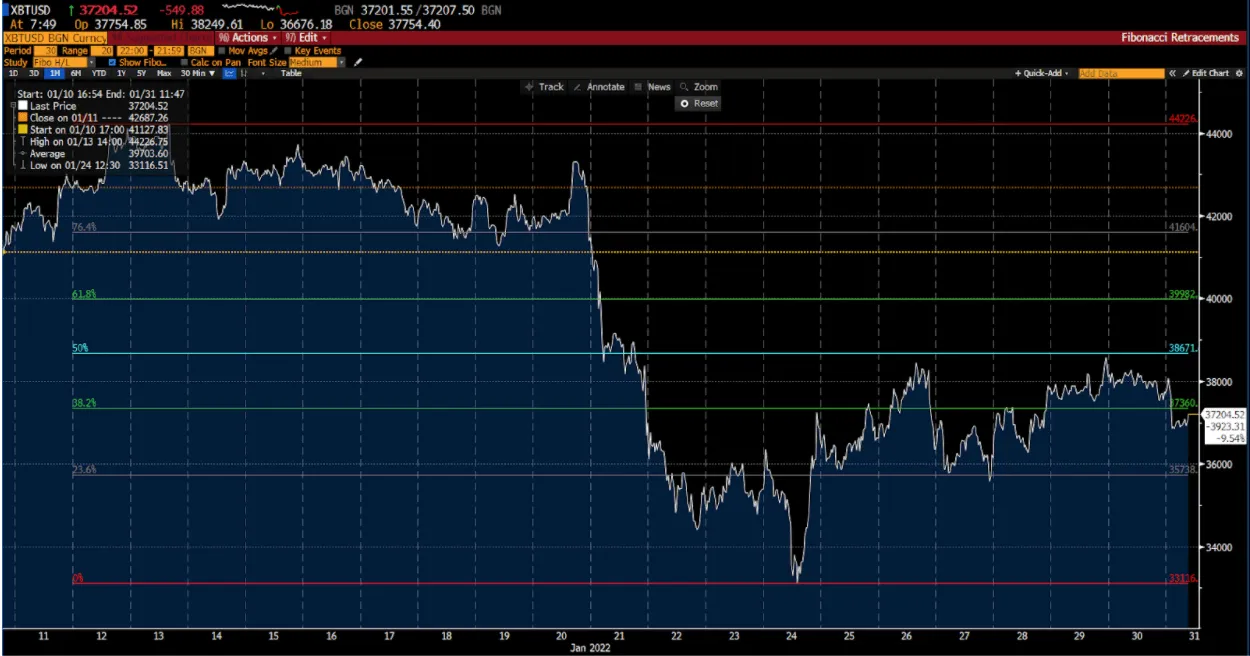
The cryptocurrency market plunged, with Bitcoin trading under $38,000. Compared to its all-time high of $69,000 hit in November, Bitcoin has fallen by nearly 20% since the start of 2022.
In recent weeks, the prices of cryptocurrencies have been under severe pressure. Traders have been worried about the ripple effect of expected Federal Reserve interest rate increases that have caused digital tokens and stocks to fall together since the beginning of the year. Last week, the Fed held interest rates near zero, aiming to increase rates to combat inflation.
Furthermore, on Thursday, 27 January 2022, the US Securities and Exchange Commission denied a proposal to list and trade shares of Fidelity's Wise Origin Bitcoin Trust. When making its decision, the SEC cited trader protection and public interest concerns. Since last year, traders have been able to buy shares of an ETF that tracks Bitcoin futures contracts. However, a spot Bitcoin ETF would track the price of Bitcoin rather than the price of Bitcoin futures, and the SEC isn't quite ready for that yet.
Currently, Bitcoin is trading at $37,200, right under its 38.2% retracement level of $37,400. If it breaches this level, the new resistance at 50% retracement level will be $38,700.
Meanwhile, Ethereum's has been in a slump since its price dropped below $3,000 on 20 January 2022. Currently, the price is trading at $2,500, but on Monday, 24 January 2022, it fell below $2,200 – its lowest level since July 2021.
On the other hand, Dogecoin (DOGE) has climbed to ninth place by market capitalisation even though its price has slid more than 4% in the past 24 hours. The top meme cryptocurrency has managed to topple the embattled Terra (LUNA) token, which is down by another 10% amid a brutal sell-off.
US Indices
.webp)
On Friday, 28 January 2022, equity markets surged to reverse previous mid-week losses as traders witnessed another volatile week. The Dow Jones Industrial Average gained 1.05%, while the S&P 500 index ended a three-week losing streak by gaining 0.49%. However, the Nasdaq 100 ended with barely a change of -0.38% for the week.
Based on Thursday's closing prices, the S&P 500 was on track to post a weekly loss of about 1.90%. As January comes to a close, the S&P 500 is paced for its worst monthly performance since March 2020, trading down by 7%. Furthermore, the Dow Jones could also witness its worst month since October 2020.
The latest economic data was the focus on Friday, 28 January 2022. In December, the Personal Consumption Expenditures (PCE) index rose by 5.8% year-over-year – the highest level since 1982. Out of this 5.8%, the core PCE, which excludes more volatile food and energy prices, rose at a 4.9% annual rate. Over the past month, all 3 major indices have fallen as traders consider the consequences of the Federal Reserve's more hawkish monetary policy tilt. With traders digesting the Federal Reserve's pivot to tighter policy, the CBOE Volatility Index, used as the market's fear gauge, shot up to a yearly high of above 30.
In addition to this, Apple (AAPL) posted record earnings and better-than-expected profits, tech stocks led Friday's rally. Meanwhile, Microsoft (MSFT) surpassed earnings expectations by posting revenues of $51.73bn versus forecasts of $50.88bn.
Fed Chairman Jerome Powell stated earlier this week that interest rates would be raised in March above near-zero levels. However, other questions remain unanswered, such as how quickly the Fed aims to raise interest rates and when it will begin reducing its $9 trillion balance sheet and tightening financial conditions.
Trade the financial markets with options and multipliers on Deriv Trader or CFDs on Deriv X Financial account and Deriv MT5 Financial and Financial STP accounts.

Weekly market report – 07 Feb 2022
With seven-year-high oil prices and 4 consecutive days of declines for the US Dollar Index, markets have entered February on a turbulent note. Learn more here.
Forex
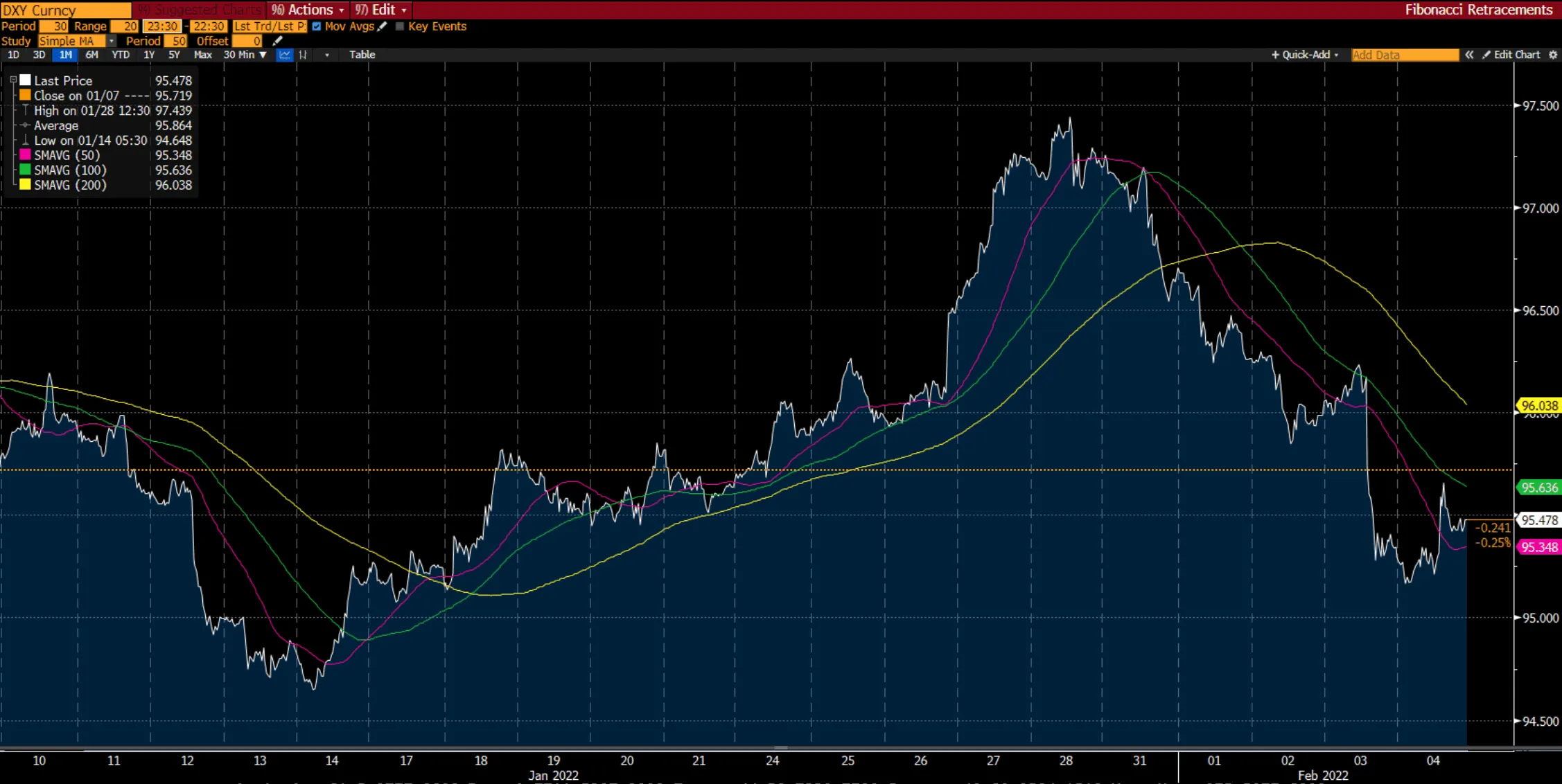
Last week, the US Dollar Index fell for 4 consecutive days, finally giving up its gains of the previous 2 weeks. However, it bounced back on Friday, 4 February 2022, following data showing the world's largest economy created far more jobs than expected. The same data suggests the Federal Reserve may raise interest rates by a larger amount at its March policy meeting. Despite its bounce back, the US Dollar Index was still down by 1.09% (close over close) for the week. As per the monthly charts, the US Dollar Index ended its week at around $95.48 and showed a 50 SMA support level at $95.34 and multiple resistance levels of 100 SMA and 200 SMA around $95.63 and $96.03, respectively.
How did the other pairs react?
- The EUR/USD pair had its best week since March 2020, gaining around 350 pips to reach a new 2022 high of $1.148, and is now trading at around $1.144. Following the European Central Bank's monetary policy meeting, the shared currency rose as President Christine Lagarde startled market participants with her hawkish tone, despite the delivery of a modestly dovish statement.
In contrast, US data for the week showed a -301k change in ADP Employment compared to the 207k that was forecasted, while Non-Farm Payrolls added 467k jobs, which was 3 times more than predicted. The unemployment rate increased to 4%; however, the participation rate increased to 62.2%, indicating a healthy recovery in the employment sector.
- The GBP/USD has had a mixed week due to the Bank of England's (BoE) varying signals and Non-Farm Payrolls. As expected, the BoE announced a 25 basis point rate hike, but 4 of the 9 members opted for a 50 basis point increase instead. As a result of this close call, Sterling rose, despite November's unexpected no-hike decision.
On the other hand, speculation about double the hike in rates also roiled the US dollar. Federal Reserve officials downplayed the possibility of a 50 basis point hike in borrowing costs when the bank meets in March, as opposed to comments made by Fed Chairman Jerome Powell, who hinted at the potential of such a move. This same message was repeated by 6 authorities, putting pressure on the US dollar.
- Following the release of the US employment report, which showed better-than-expected numbers, the USD/JPY jumped from ¥114.90 to ¥115.38. The pair reached its highest level since Monday, 31 January 2022, and is currently trading above ¥115.00, indicating that its bullish momentum is still intact.
This week ahead will be quiet on macroeconomic data, while the United States will disclose the final estimate of the January Consumer Price Index.
Commodities

Following a significant drop in the previous week, gold recovered in the first half of the week as the US dollar struggled to find demand. On Thursday, 3 February 2022, rising US Treasury bond yields restrained gold's upside, while a strong US January jobs report couldn't help the pair gain bullish momentum. Gold ended the week at around $1,808. The RSI for 14 days on a 6-month chart is about 48 and is near the 200 SMA of $1,806 and above the 100 SMA of $1,797.
As traders anticipate the release of the US January Consumer Price Index (CPI) this week, gold is expected to be inversely correlated with the benchmark 10-year US Treasury bond yield. In particular, the January Consumer Price Index could influence expectations for a 50 basis point (bps) Fed rate hike in March.
Oil prices soared for the first time since 2014, surpassing the $90 per barrel mark, which drove the prices to seven-year highs and posted a seventh successive week of gains. WTI was up by 4.72% (close over close) for the week.
Oil prices continued to rise due to factors such as a temperature drop caused by the winter storm that hit the US recently and geopolitical tensions between the US, Ukraine, and Russia. Recent statistics indicated Iraqi output in January was considerably below its allowed quota under the previous OPEC+ arrangement. Furthermore, market commentators suggested Kazakhstan wants to keep more of its supply at home to cut domestic prices and ease civil tensions.
Cryptocurrencies
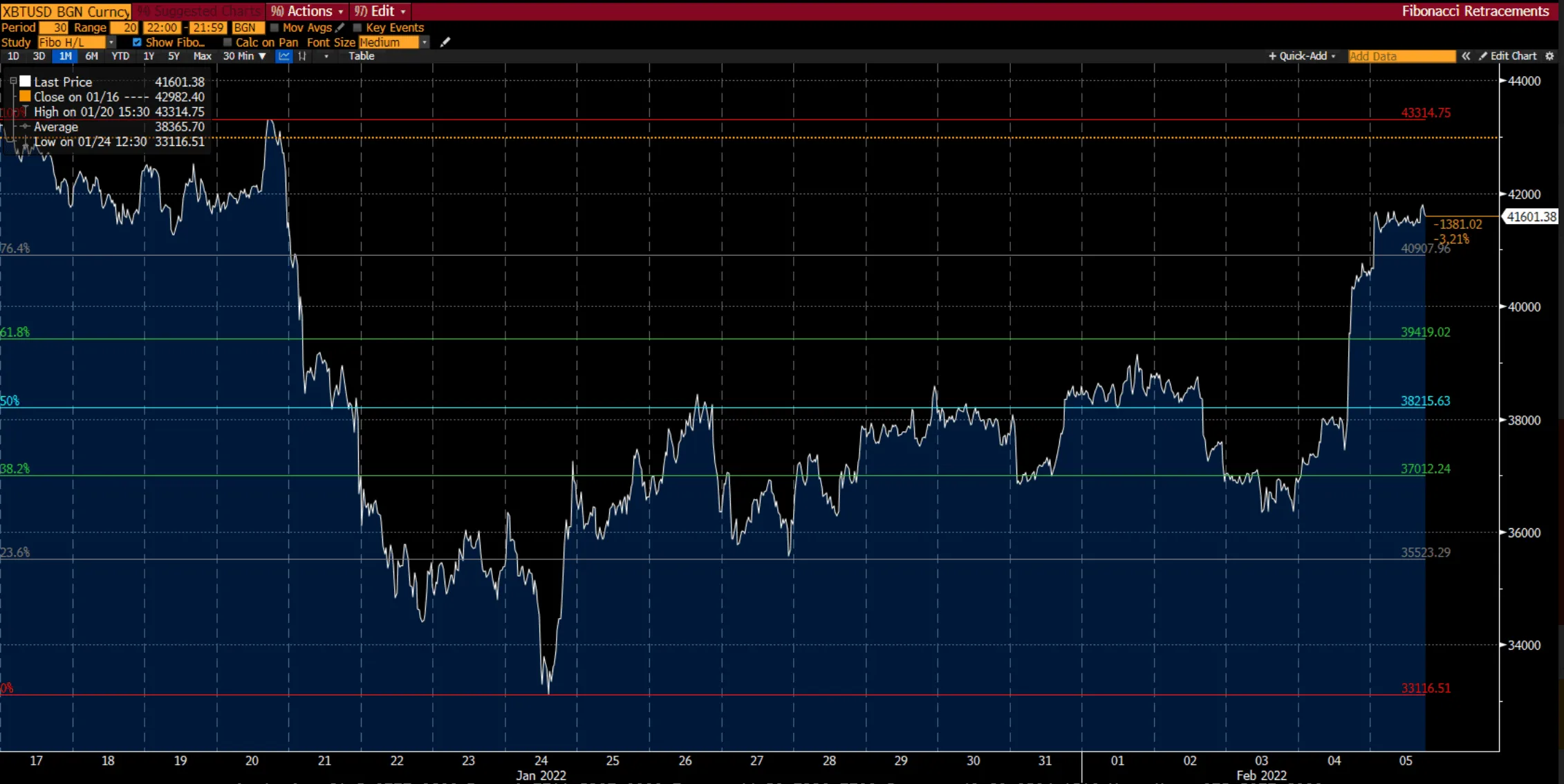
Following a turbulent week across global markets, Bitcoin rose the most in 4 months as traders showed signs of renewed risk appetite. The largest cryptocurrency by market capitalisation, which hadn’t risen above $40,000 for more than 2 weeks, increased by 10%. Technically speaking, Bitcoin is currently trading at around $41,600, above the 76.4% retracement level at $40,900, followed by the next support level of the 61.8% retracement level at around $39,400.
Furthermore, the price of Ether rose by 12%. Even SOL, the native currency of the Solana blockchain, posted similar gains. After hours of being lost to what some call the largest DeFi hack, the crypto was restored and increased by roughly 12%. Following suit, Polkadot rose 15.3%, bringing its seven-day gain to 20%, Terra was up 11.53% at the same period, and BNB, XRP, and Cardano all climbed 9-12%.
In terms of market capitalisation, Dogecoin was up by 5.5%, while Avalanche was up by 14.5%. As of Friday, 4 February 2022, the worldwide crypto market capitalisation totalled $1.64 trillion, while the overall cryptocurrency market volume increased by nearly 63% to reach $106.29 billion.
US Indices
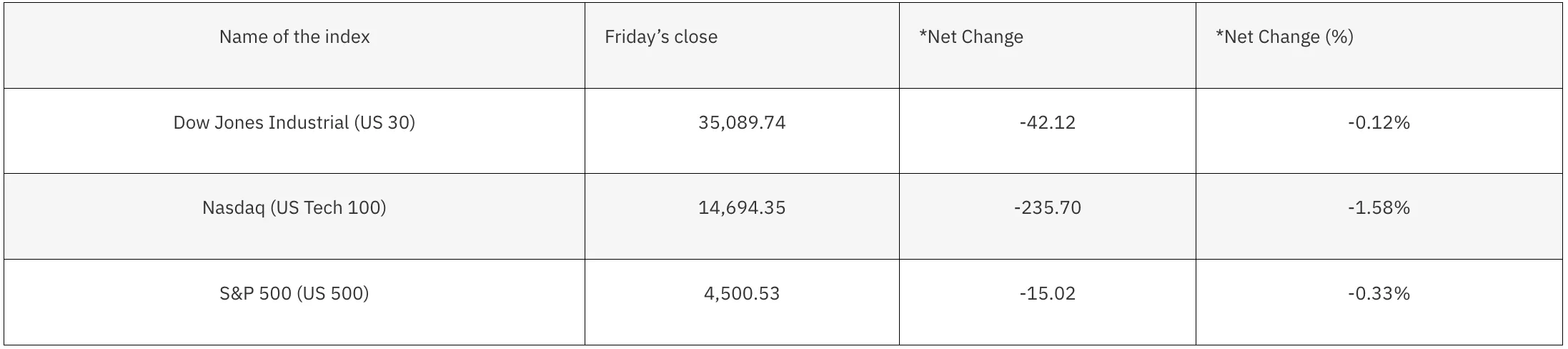
*Net change and net change % are based on the weekly closing price change from Monday to Friday.
It's been a volatile week for the US Indices, with the markets being driven mainly by employment numbers, earnings reports, and the possibility of higher interest rates in the near future.
Regarding earnings reports, Facebook's stock price went down by around 26% and wiped out about $232 billion of its market capitalisation. On the other hand, Amazon's report was better than expected, as it was mostly driven by its web services division which helped the indexes jump back the next day.
In addition to this, the strong jobs report on Friday, 4 February 2022 weighed on government bond prices, sending the 10-year US Treasury yield above 1.93% – the highest level since December 2019, before the start of the pandemic. Other countries' yields rose as expectations of monetary policy tightening increased.
The focus for this week would be the Consumer Price Index (CPI) data, which is scheduled for Thursday, 10 February 2022. According to last month's CPI, prices increased by 7.0% for the 12 months ending in December – the highest level since 1982. The rate was 5.5% when the volatile food and energy categories were excluded. In comparison, the forecast for this week's CPI data is expected to be around 7.3% and excluding food and energy, it is forecasted to be approximately 5.9%.
Trade the financial markets with options and multipliers on DTrader or CFDs on Deriv X Financial account and Deriv MT5 Financial and Financial STP accounts.

How to convert fiat to crypto and start trading
Buying crypto to fund your Deriv cryptocurrency account is now more streamlined, with clear steps from conversion to deposit.
Buying crypto to fund your Deriv cryptocurrency account is now more streamlined, with clear steps from conversion to deposit. This practical, wallet-ready guide walks you through every stage: from converting your fiat currency to crypto via onramp services, to logging in, funding your account, and getting your account ready for trading.
Quick summary
- Deriv’s fiat onramp services provide a structured and compliant way to convert local currency into cryptocurrency directly within the Deriv ecosystem.
- Funding a Deriv cryptocurrency account can be completed within minutes, depending on provider and blockchain conditions, giving traders timely access to their account balance.
- Deriv works with regulated fiat-onramp providers, each offering different verification flows and regional coverage depending on your location
- Built‑in verification, transparent conversion rates, and regulated partners support secure and traceable transactions throughout the process.
- Integrated onramps improve account management efficiency by reducing external transfers and consolidating funding steps in one platform.
Why do you need crypto in your Deriv account?
Cryptocurrency markets move quickly, and opportunities can appear at any time. To make sure you can respond promptly to market changes, you need crypto funds available in your Deriv cryptocurrency account. Whether you’re new to trading or an experienced investor, understanding how to buy and deposit crypto efficiently helps you manage your account more effectively.
A Deriv cryptocurrency account works as your digital wallet. It allows you to deposit, trade, and withdraw using digital currencies such as Bitcoin (BTC), Litecoin (LTC), Ethereum (ETH), Tether (USDT), and USD Coin (USDC). Having funds in your crypto account means you can start trading without waiting for traditional bank processing times.
Additionally, maintaining crypto in your account gives you flexibility to respond to sudden price changes. For instance, when Bitcoin or Ethereum experiences rapid movement, you’ll be ready to open positions without administrative delays.
What is a fiat onramp, and why does it matter?
A fiat onramp is a service that allows you to convert your local currency (GBP, EUR, USD, etc.) into cryptocurrency directly through Deriv’s trading platform. It eliminates the need for third-party exchanges or separate wallets, making your first crypto purchase more direct, with clear steps and built‑in security protocols.
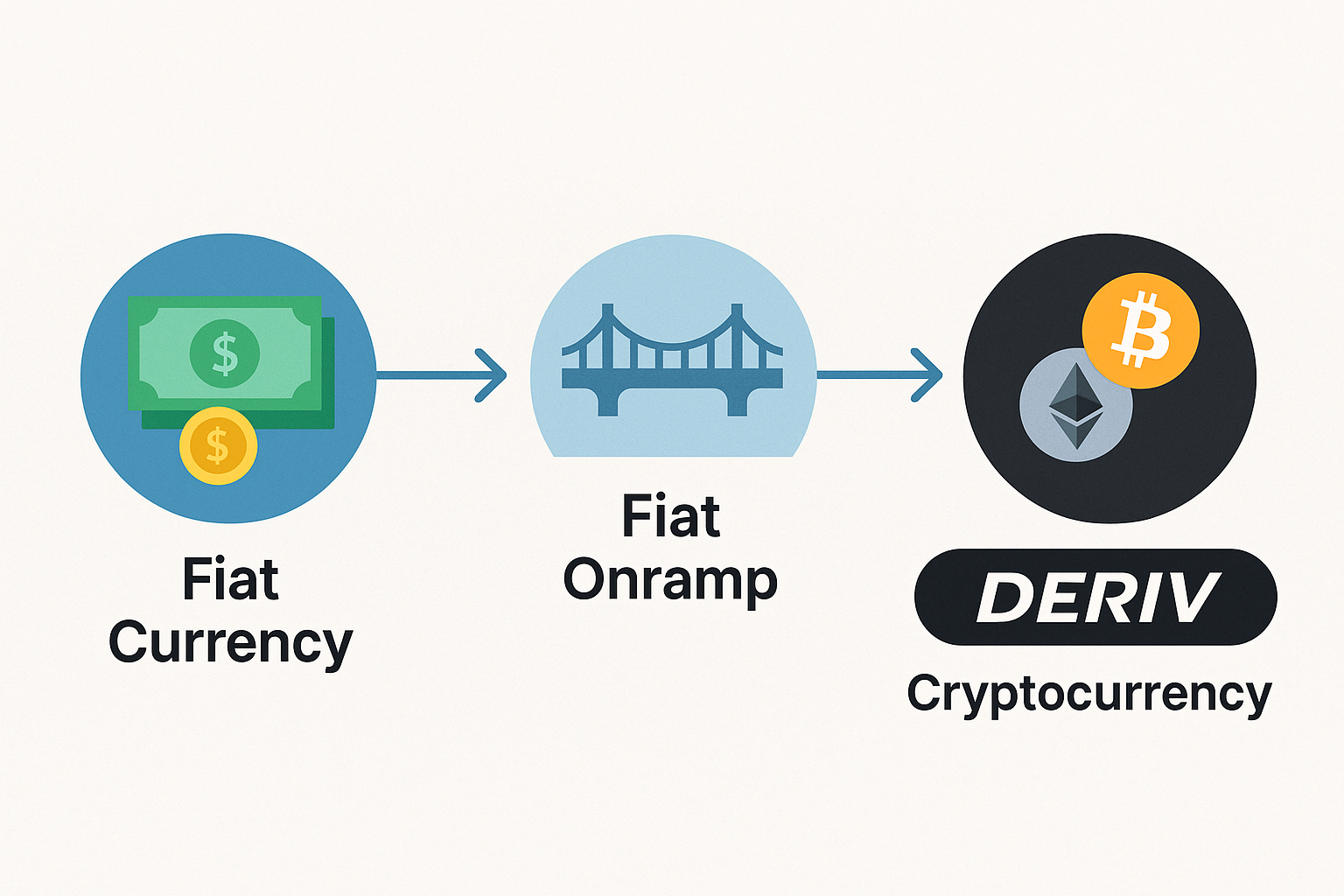
Here’s how it supports your transactions:
- Speed: Buy crypto in minutes, depending on provider and blockchain conditions.
- Security: All partners comply with Know Your Customer (KYC) and Anti-Money Laundering (AML) regulations.
- Convenience: No need for external wallets or additional platforms.
Aggelos Armenatzoglou, Senior Manager of Dealing Team at Deriv, elaborates:
“Fast access to crypto markets depends on efficient fiat-to-crypto gateways. A smooth onramp reduces friction and helps traders capture opportunities in volatile markets.”
Deriv works with regulated fiat-onramp providers, each offering different verification flows and regional coverage depending on your location.
Fiat onramps also provide transparency by showing conversion rates before you confirm a transaction. This helps you plan and manage your funds with greater clarity.
How do fiat onramps compare to traditional crypto exchanges?
Traditional cryptocurrency exchanges and fiat onramps both enable users to purchase digital currencies, but they differ in structure, process, and the number of steps involved. Understanding these differences can help you decide which approach fits your situation without suggesting that one method performs better than the other.
When using a traditional exchange, users typically create a separate account, complete an onboarding procedure, and set up an external cryptocurrency wallet. Most exchanges require several verification stages, and funding the exchange account may involve additional bank transfers or payment approvals. Once the cryptocurrency is purchased, users often need to transfer it manually to their preferred trading platform, which introduces extra steps and additional confirmation times.
“Different funding paths serve different user preferences. Traditional exchanges offer broader asset management options, while onramp services are designed to reduce the number of platforms involved in completing a purchase.” — Seeyan Padinjaraveettil, Marketing Tech Lead at Deriv
Fiat onramps operate in a more integrated way. Instead of managing separate platforms, users can convert local currency into cryptocurrency directly through Deriv’s partner services. The purchase and deposit occur within a single workflow, and the cryptocurrency is sent to the user’s Deriv account once the transaction is confirmed. This reduces the number of external transfers required and keeps the process contained within one ecosystem.
Both methods follow regulatory and security requirements, and the choice ultimately depends on factors such as preferred payment methods, regional availability, and whether the user already has an external crypto wallet they wish to use.
What should you prepare before using a fiat onramp?
Before starting a fiat-onramp transaction, it can be helpful to prepare the information and documents you may need during the process. Most providers require personal details such as your full name, date of birth, and country of residence to meet regulatory obligations.
Some may request a government-issued ID and, in certain cases, proof of address, depending on regional requirements. Ensuring these documents are valid and consistent with your Deriv account details can reduce the likelihood of verification delays.
Preparing your preferred payment method in advance, such as a bank card or supported digital payment service, can also make the process smoother when you begin your transaction.
How can you buy crypto and fund your Deriv account?
Follow these steps to fund your Deriv cryptocurrency account:
- Log in to your Deriv account
Visit app.deriv.com and switch to your cryptocurrency account.
- Open the Cashier section
Select Cashier from the left-hand menu.
- Select Fiat onramp
Choose Fiat onramp from the deposit options.
- Pick your preferred provider
Select your available fiat-onramp provider and follow the prompts based on your region and payment method.
- Follow the provider’s instructions
Complete verification and payment on the provider’s secure page.
- Complete your transaction
After payment, you’ll return to Deriv automatically. Your crypto will appear in your account once the deposit is confirmed.
Available fiat-onramp options may differ by region. Each provider offers its own verification steps, payment methods, and processing times. Users can select the option that aligns with their location and preferred payment method.
What should you watch out for when using fiat onramps?
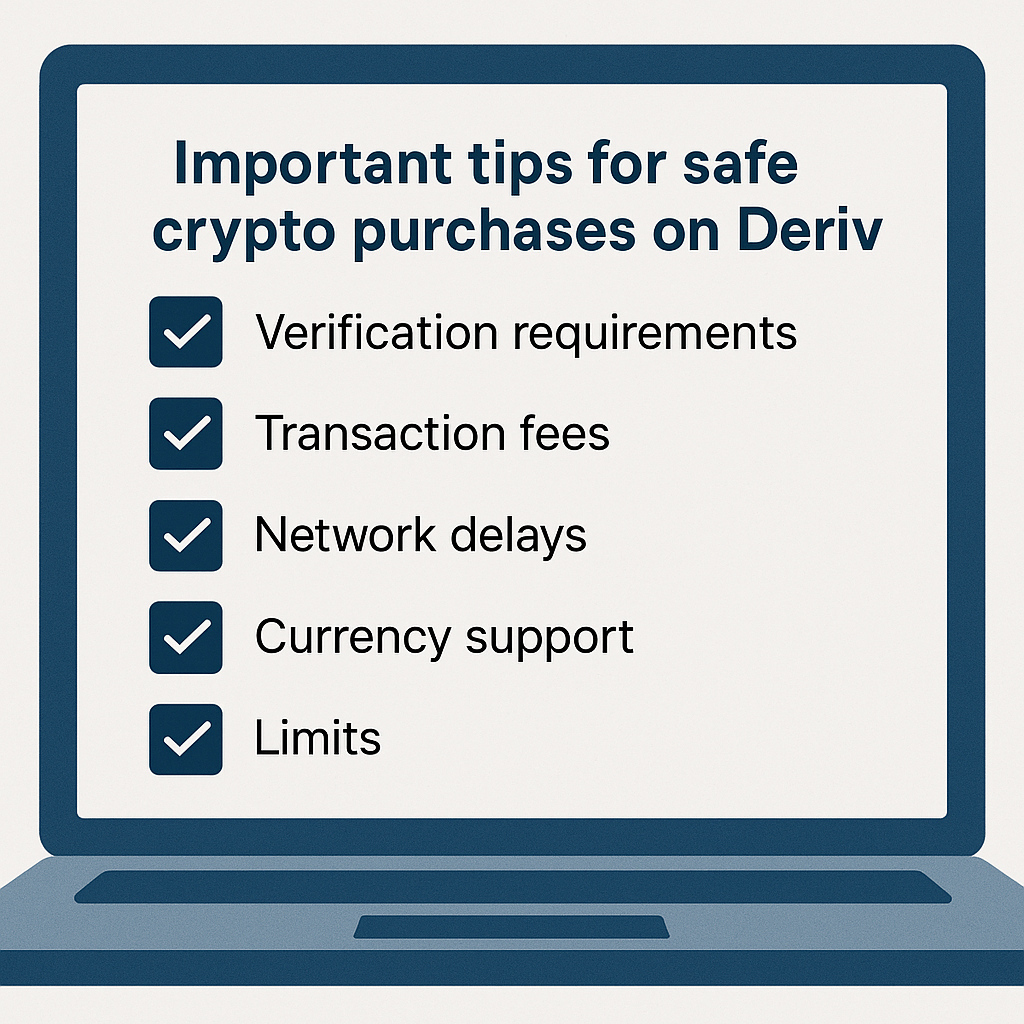
Although fiat onramps streamline the crypto-purchase process, keep the following considerations in mind:
- Verification requirements: You may need to upload identification documents for compliance.
- Transaction fees: Providers have their own service fees and conversion charges.
- Network delays: Blockchain congestion can influence processing times.
- Currency support: Availability varies by region and provider.
- Purchase limits: Minimum/maximum amounts differ across services.
Aleksandr Antonkin, Deriv Senior Manager of Specialised Dealer, reminds:
“Always double-check transaction limits and processing times. Network congestion can extend settlement windows during high-volume periods.”
Additionally, keep an eye on exchange rate fluctuations. Crypto prices shift frequently, so the final amount received may vary slightly.
What should you watch out for when using fiat onramps?
Once a transaction is submitted through a fiat-onramp provider, users can typically track its progress through the provider’s status page or email notifications. Most services display indicators such as “payment received,” “verification in progress,” or “crypto released to network.” When the cryptocurrency is sent to the blockchain, a transaction ID is usually provided, which can be used to check confirmation progress on publicly available blockchain explorers. Tracking these stages helps set realistic expectations about timing, especially when network activity is high. This visibility also makes it easier to share information with support teams if you need assistance.
How can you troubleshoot common onramp issues?
Even with reliable services, you may occasionally face small issues. Understanding how to troubleshoot them helps you resolve delays where possible.
- Verification problems: Ensure your documents are valid and match your account details.
- Delayed deposits: Check the transaction status on the onramp provider’s page or in your email confirmation.
- Payment errors: Confirm your bank allows international crypto-related transactions.
- Incorrect currency selection: Make sure the fiat and crypto types match your Deriv account settings.
If needed, contact Deriv’s 24/7 support team, who can coordinate with providers to trace your transaction.
How do you use a fiat-onramp to buy crypto on Deriv?
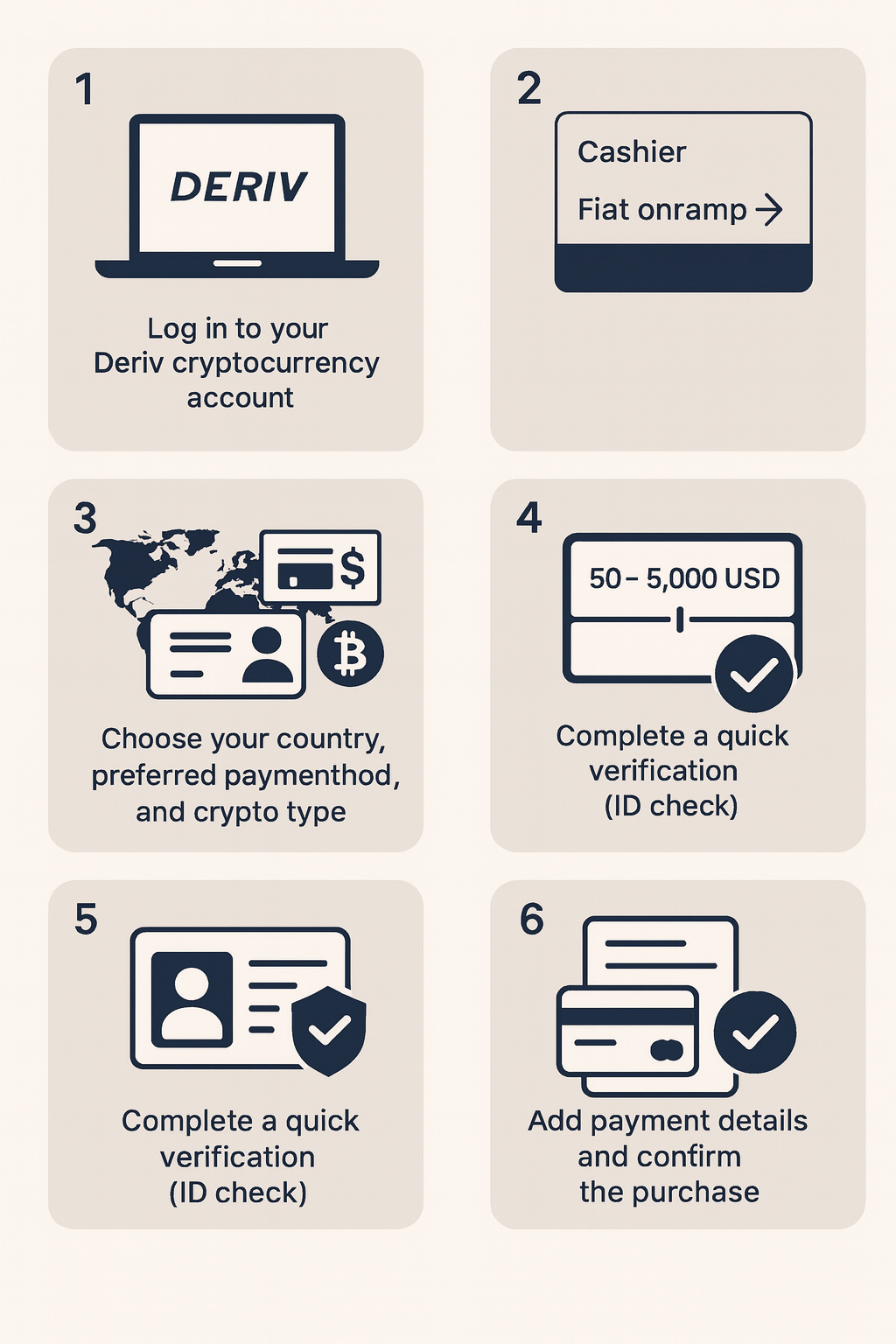
Here’s an example of the process:
- Log in to your Deriv cryptocurrency account.
- Go to Cashier → Fiat onramp → your available payment method.
- Choose your country, payment method, and crypto type.
- Enter the amount you want to buy (between 50 USD and 5,000 USD).
- Complete verification.
- Add your payment details and submit your purchase.
- Your crypto will appear once the deposit is confirmed.
What are the main benefits of using Deriv’s fiat onramps?
- Faster funding compared to external exchanges (depending on provider and blockchain conditions).
- All‑in‑one experience: Deposit directly into your Deriv account.
- Global accessibility: Available in many regions.
- Transparent rates: View conversions before confirming.
- Regulated partners: All onramps follow KYC and AML standards.
Using fiat onramps also enhances portfolio flexibility, allowing you to diversify across assets quickly, depending on processing times.
What are the key takeaways?
Funding your Deriv cryptocurrency account is now a more streamlined process. With regulated onramp providers, users can convert fiat to crypto and deposit it directly into their Deriv account.
By following this guide, you’ll have everything you need to convert fiat to crypto and prepare your account for trading on Deriv platforms.

Weekly market report – 14 Feb 2022
Last week, the DXY Index was up by +0.71% (close over close). This rise followed the US inflation rate data for January (CPI), which came in at 7.5% and reports that Russia is preparing to invade Ukraine.
Forex
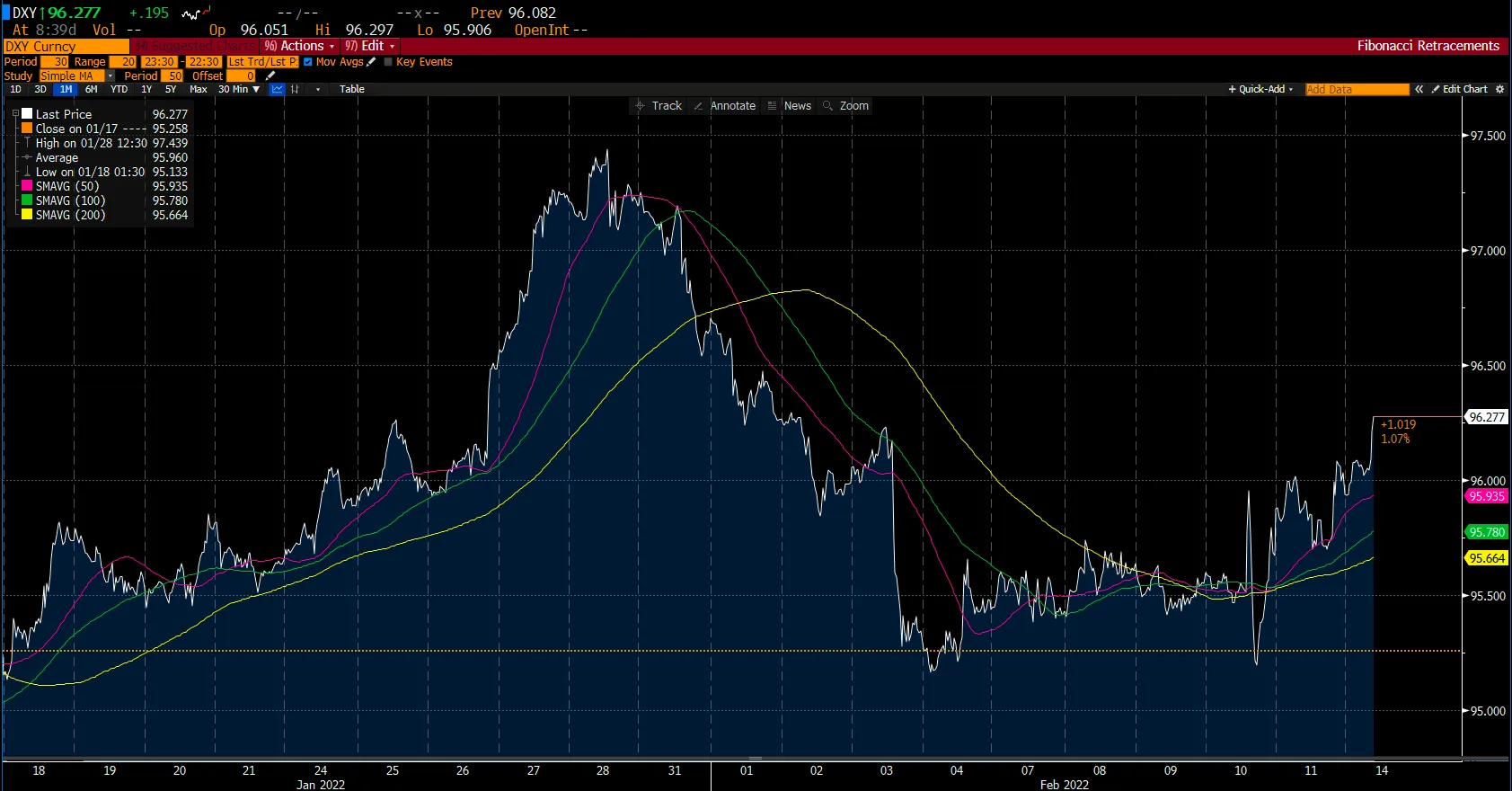
Last week, the DXY Index was up by +0.71% (close over close). This rise followed the US inflation rate data for January (CPI), which came in at 7.5% and reports that Russia is preparing to invade Ukraine. With this rise and movements in other safe-haven assets like US Treasuries and the Japanese yen, the market may be becoming increasingly concerned about a potential invasion. At the time of writing, the dollar index is trading around $92.2 and, as per the monthly charts, has multiple support levels at 50 SMA, 100 SMA and 200 SMA around $95.93, $97.78 and $95.66, respectively.
How did the other pairs react?
- The Euro depreciated, putting EUR/USD prices in jeopardy due to Russia and Ukraine's geopolitical uncertainties. A strong US inflation report, in which the CPI hit a new 40-year high in January, pushed the EUR/USD even lower. Therefore, the likelihood of a 50-basis-point rate hike by the Federal Reserve at its March meeting has risen dramatically.
- USD/JPY surged to just a point below its five-year high. With the release of the January inflation report, Treasury yields rose sharply, sending stocks tumbling and driving the USD/JPY to ¥116.34. In the United States, interest rates have resurfaced as a major factor. Furthermore, Japan's economic data was disappointing, with Labor Cash Earnings and Household Spending falling short of their respective predictions of 0.1% and 0.3% in December.
- The GBP/USD pair managed to keep most of its gains from the previous week. As US inflation touched a new 40-year high, the spotlight switched back to the Federal Reserve's (Fed) tightening stance. Meanwhile, the UK economy has weathered the Omicron storm. However, due to Brexit concerns and failed attempts by the European Union (EU) and the United Kingdom (UK) to relaunch the negotiations on post-Brexit commercial relations in Northern Ireland (NI), GBP bulls have been cautious. This sentiment caused the pair to trade in the range of $1.3485 – $1.3645, despite improving fundamentals.
This week, the focus will be on the January Retail Sales – predicted to be at 1.8% MoM, the January Producer Price Index – expected to be at 0.5% MoM, and the Federal Open Market Committee (FOMC) meeting.
Commodities
Oil prices rose for the eighth consecutive week as tensions between Russia and Ukraine raised concerns about limited global supplies. The global benchmark, WTI crude, rose just shy of $95 a barrel on Friday 11 February 2022, before paring gains.
Russia's potential invasion of Ukraine poses a geopolitical risk that could disrupt global oil supplies and prompt US regulatory sanctions. In recent weeks, oil prices have risen due to speculation that demand will outpace supply as the global economy continues its recovery from the pandemic.
"The oil market is incredibly tight. Prices continue to surge and are now reaching levels that are uncomfortable for consumers across the world", said Toril Bosoni, head of IEA's oil markets division, on Friday 11 February 2022.
In the metals market, gold ended last week at its highest level in 3 months after breaking through $1,850 – a crucial resistance level. In Friday's late session, the yellow metal caught demand as US involvement in the Russia-Ukraine crisis deepened. While the news induced selling pressures within the equity markets, gold prices were up more than 1% on the day and around 2.1% on the week.
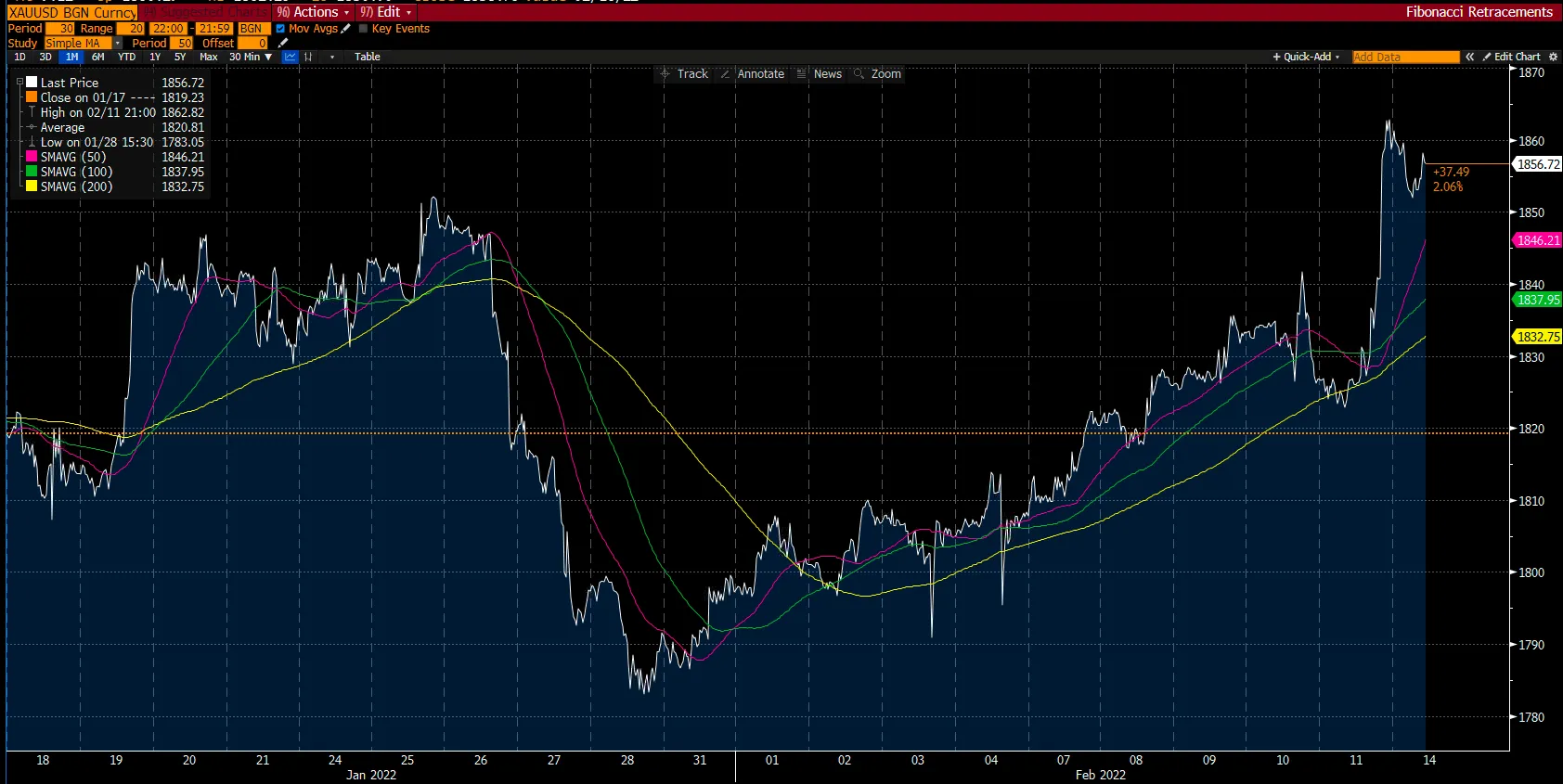
Gold is currently trading at around $1,856 levels, well above its corresponding 50, 100 and 200-day moving averages. The latest geopolitical uncertainty, along with equity market instability and rising inflationary pressures across the US and Europe, is likely to ensure its place in traders' portfolios for the foreseeable future.
Cryptocurrency
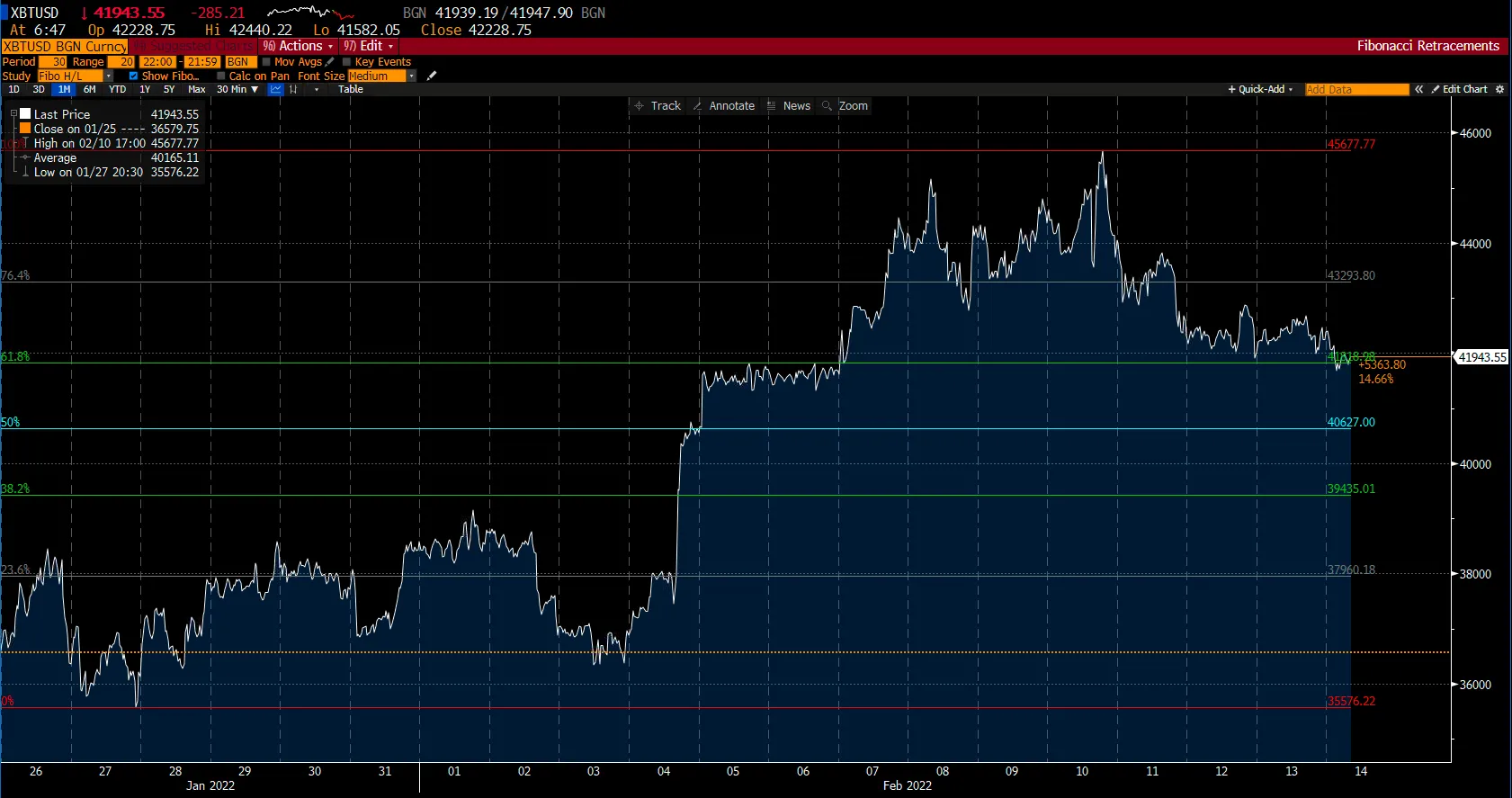
Thursday, 10 February 2022, saw the price of Bitcoin fall slightly amid a more severe financial pullback in the US. On Friday, 11 February 2022, US president Biden urged all Americans to leave Ukraine immediately, warning "an invasion could begin at any time". Furthermore, Russian and Ukrainian geopolitical risks contributed to the crypto dip and retreat to safe-haven assets.
Bitcoin surrendered most of its gains from the week's opening as the yield on the 10-year Treasury rose to over 2% for the first time since 2019. The world’s largest cryptocurrency fell by almost 1.30% to around $44,100 levels.
In recent months Bitcoin has been trading noticeably similar to tech stocks. Last week, increasing inflation pressures pushed the 10-year benchmark higher, which negatively affected high-growth tech stocks and Bitcoin. This was because institutional traders are now interested in Bitcoin and trading it as a risk asset. As a result, the world's largest cryptocurrency has been trading negatively along with tech stocks, which started the new year on a sharp decline.
Technically, Bitcoin is trading dangerously close to its first major support level of $41,943 at the 61.8% retracement level. If it slips through this level, the new primary support would be $40,627 at 50% retracement. Meanwhile, an upwards movement for Bitcoin would introduce $43,293 as its next resistance level at 76.4% retracement.
Most altcoins followed Bitcoin's plunge, as Ethereum dropped by 4% on Friday, 11 February 2022, while Solana plummeted by 7%.
Analysts expect Bitcoin, the world's largest cryptocurrency, to remain under pressure for the next few months. "In last spring's drawdown, it took about 6 months for Bitcoin to recover. A similar timeline in the current drawdown would put a recovery date sometime in May", wrote Bitcoin holding company NYDIG last week.
US Indices
.webp)
*Net change and net change % are based on the weekly closing price change from Monday to Friday.
The major US market indices fell again this week, continuing with their poor start to the year. Due to increased concerns about inflation, monetary tightening, and the geopolitical turmoil in Ukraine, stocks rose on Tuesday and Wednesday before falling on Thursday and Friday.
The 10-year US Treasury yield rose above 2% for the first time since mid-2019 for the third week in a row due to inflation fears. This rise caused rate-sensitive sectors, such as growth companies, to suffer as more aggressive Fed tightening expectations increased.
Stock and bond prices plummeted after the government reported 7.5% inflation in January – the highest since 1982. It was more than the 7.0% increase in December and much higher than the 1.8% annual average of inflation in 2019. Furthermore, warnings from the US officials that a Russian invasion of Ukraine is possible may also have contributed to the late-week sell-off.
The US government will release a report on Wednesday, 16 February 2022, that will reveal whether US retail sales recovered in January following the surfacing of the Omicron variant during the peak of the holiday shopping season. Finally, the FOMC will publish the latest meeting minutes on the same day.
Trade the financial markets with options and multipliers on Deriv Trader or CFDs on Deriv X Financial account and Deriv MT5 Financial and Financial STP accounts.

What is forex live trading?
Find out what forex live trading is, how currency pairs trading works, and how to begin trading foreign currency online.
This post was originally published by Deriv on 3 Feb 2022.
Forex live trading is short-term and fast-paced online trading on the foreign currency exchange market. This market is commonly known as forex or FX, and it is the world’s biggest and most popular financial market.
Although forex trading happens mostly online, you’ve most likely made an offline forex transaction a few times in your life too. For example, when you travel to another country, say the United States, you need to convert your home country’s currency into USD. When you do this, the exchange rate between the two currencies determines the USD amount you get for your local currency. The forex rate fluctuates continuously and is based on the supply and demand of the currencies.
In simple terms, forex trading means buying one currency and selling another at the same time; this is why you always see them quoted in pairs. For example, EUR/USD and GBP/USD. The first currency in the pair is the one you buy, and the second is the one you sell.
Which forex currencies can I trade on Deriv?
Online forex trading, just like the offline version of it, involves trading on currency pairs.
There are three main types of currency pairs:
- Major pairs — the world’s most widely traded currencies paired, e.g. GBP/USD or EUR/GBP
- Minor pairs — less liquid currency pairs, e.g. NZD/USD or AUD/CAD
- Exotic pairs — one major currency paired with an emerging economy’s currency, e.g. EUR/HKD
Deriv also offers trading on micro forex pairs, which are currency pairs traded in smaller sizes than the standard pairs, e.g EUR/USD or USD/JPY.
For the full list of forex currency pairs you can trade on Deriv, head to the forex page.
How to get started trading in the forex market?
There are multiple ways to start forex live trading. For example, on Deriv, you can trade currency pairs with digital options or CFDs. But whichever trading type you choose, there are some universal tips that will help you make the beginning of your forex trading journey a little easier:
Familiarise yourself with forex lingo
- Base currency: The currency you are holding. If you’re from France, that currency would be euro. In the EUR/USD pair, EUR is the base currency, and it shows how many US dollars you can buy with one euro.
- Quote currency: The currency used as a reference to measure the value of the base currency. In the EUR/USD pair, USD is the quote currency.
- Bid price: The bid price is what the broker is willing to pay for the base currency.
- Ask price: The ask price is the rate at which a broker will sell the quote currency. It is always higher than the bid price.
- Spread: The difference between the ask price and the bid price; Ask price – Bid price = Spread. If you are buying the currency, you’ll pay the ask price, and if you are selling it, you’ll receive the bid price.
Analyse the market
From major political events, elections, and an increase in government debt to something as unexpected as natural disasters, many factors may affect how the forex market moves. That’s why it is crucial to keep an eye on market-related news and significant events that might affect currency price movements. Good analytical skills and in-depth knowledge about market conditions will help you to make the best possible trading decisions.
Choose the right broker
Do some research and read reviews in order to select the forex broker that best suits your needs. Here are some considerations that you can pay attention to. Your broker:
- Offers demo accounts where you can practise trading risk-free.
- Has a wide suite of available forex pairs and other trading products to help you diversify your portfolio.
- Gives you easy and round-the-clock access to their customer support team to provide you with quality assistance whenever you need it.
- Offers a wide selection of deposit and withdrawal options in your country of residence to make sure you can fund your account and make withdrawals effortlessly.
- Has the required licences and complies with the necessary regulations in your country of residence.
Practise, practise, practise with a forex demo account
Make use of your demo account! The idea behind demo accounts is not only to offer you an opportunity to familiarise yourself with online trading platforms. Having a demo account to trade on forex also allows you to test your trading skills and strategies with virtual money without risking your hard-earned capital. Once you feel confident in your understanding of the market and the broker’s trading platform, you can start trading with real money.
Need more info before diving in? Download the free “How to trade the forex market” ebook, written by veteran trader, Vince Stanzione. It is filled with trading strategies and tips to help you get started on forex trading.
Sorry, we couldn’t find any results matching .
Search tips:
- Check your spelling and try again
- Try another keyword