
Results for

Weekly market report – 06 Dec 2021
The US Indices experienced a volatile week. Fears over the Omicron variant and the Federal Reserve's willingness to tighten monetary policy contributed to all 3 indices continuing their downward trend. This caused the CBOE volatility index to rise to a high of 35 intraday for the first time since January — readings above 30 indicate increased volatility and uncertainty.
US Indices

The US Indices experienced a volatile week. Fears over the Omicron variant and the Federal Reserve's willingness to tighten monetary policy contributed to all 3 indices continuing their downward trend. This caused the CBOE volatility index to rise to a high of 35 intraday for the first time since January — readings above 30 indicate increased volatility and uncertainty.
Concerns about the COVID variant and Federal Reserve policy also affected the fixed income market. Last week, the 10-year US Treasury Yield fell to 1.36% on Friday, 3 Dec 2021, vs 1.52% on Monday. US Federal Reserve Chairman Jerome Powell expressed concern about inflation and suggested that the Fed might be able to curb inflation by accelerating the pace of the asset tapering program.
Known for its stability during an economic crisis, the utilities sector was the best-performing sector for the week. On the other hand, the Communication Sector has been the worst-performing sector for the week, mainly because of President Biden's announcement to avoid a near-term lockdown.
This week, the focus will be on the Consumer Credit, the Core Consumer Price Index, and the Federal Budget.
Forex
The Swiss Franc and the Yen were the biggest winners in the currency markets, followed by the Dollar. Considered as safe-haven currencies, both the Swiss Franc and the Yen appreciated against global currencies and bond yields due to concerns about the spread of the Omicron variant which has led to restrictions around the world. Concerns about possible aggressive actions by the Federal Reserve to control inflation positively impacted the Dollar.
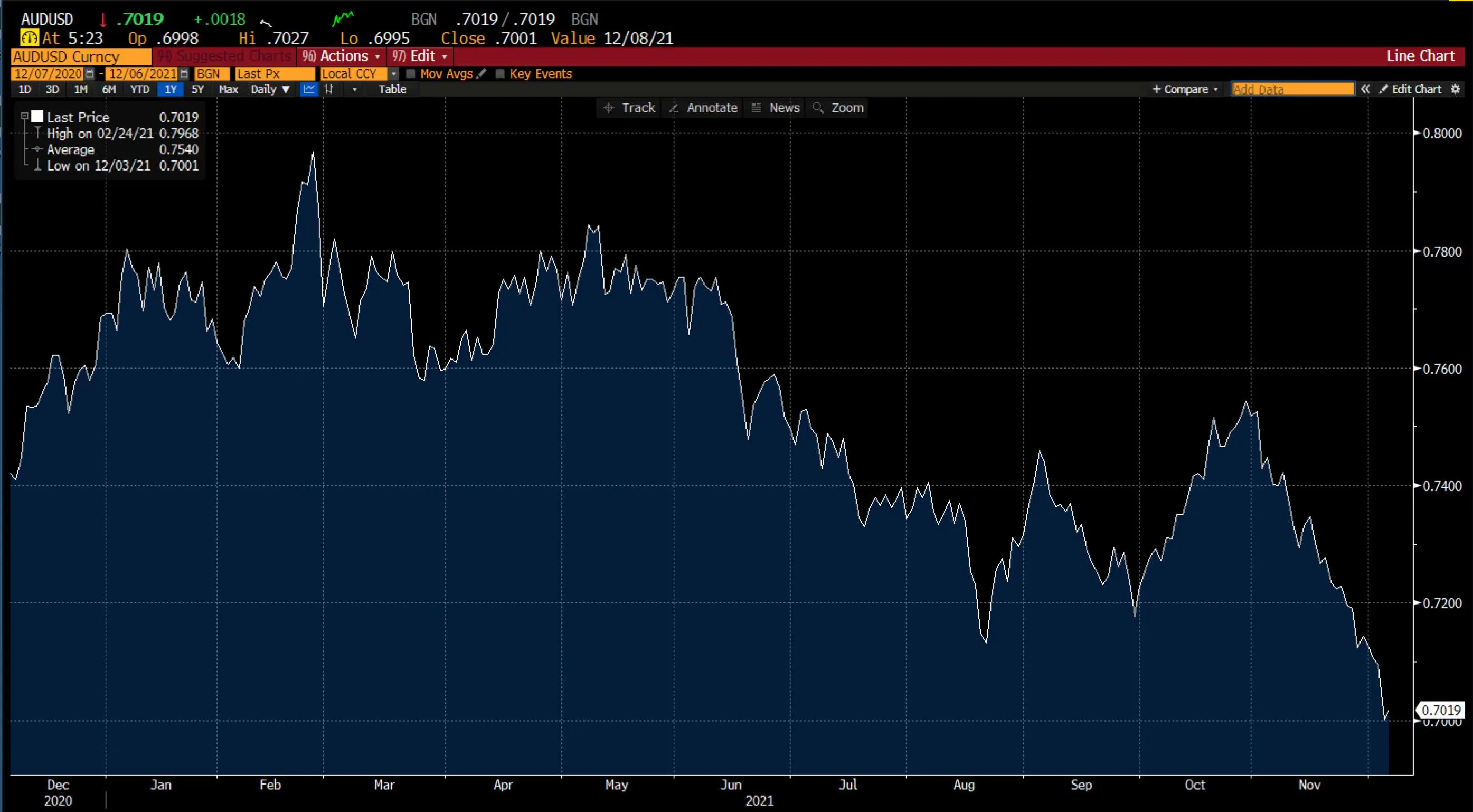
The Australian Dollar has continued to set new lows against the US Dollar, falling the most in 2 weeks since June 2021. Australia's economy finds itself at the front-end of the global supply chain, making the following developments around Omicron significant. Since the last RBA meeting, the AUD/USD has fallen from 0.7532 to 0.7000. The RBA will meet this week to discuss monetary policy. Given the significant movements in AUD/USD since the last RBA meeting, it is important to watch the RBA's interest rate decision on Tuesday, 7 Dec 2021, and commentary about the economic conditions driving their decision. AUD/USD broke its support at the 61.8% retracement level of $0.70500, making it the new resistance level — the new support level at 50% retracement is near $0.67500.
Following the release of a weaker-than-expected US jobs report, the dollar reversed gains to trade flat on the day. The report still contained positive revisions for previous months and solid details about the labour market. Despite the Omicron threat, markets quickly bounced back from disappointing jobs data after the Fed announced committing to its current level of tapering and asset purchases.
On the UK front, doubts have grown over the forecasted December interest rate set by the Bank of England after the rate setter noted that more information about Omicron might be beneficial before changing policy settings. If the Omicron strain threatens to slow consumption and production, policymakers do not want to risk hindering economic demand.
Commodities

As economic uncertainty increases, market watchers are turning to oil prices to gauge production and economic demand. This outlook shows weak economic prospects, with oil prices sliding for a sixth straight week- the longest stretch of weekly declines since 2018.
The price of WTI crude fell 0.63% to close at $66.26. The price of crude will first find support around $60.50 at the 61.8% retracement level, followed by the $55.50 range at the 50% retracement level. As of Friday's close, WTI crude was trading near its 50-day moving average. Despite the threats posed by the Omicron strain, OPEC is committing to its plan of slowly increasing oil output by 400 barrels a day in January. This decision is significant amid heightened concerns in the global oil markets and was a leading factor in last week's price declines.
In the metal markets, Gold ended the week flat at $1,783.18, a -0.03% change from last week's initial opening price. Friday's closing price positioned gold slightly above its first major support level of around $1,780 at the 38.2% retracement level. On the upside, resistance is found around the $1,800 mark at the 50% retracement level, followed by its second major support level of $1,820 at the 61.8% retracement level.
Despite ending flat on the week, Gold rose 1% against the dollar on Friday, 3 Dec 2021, benefiting from a flight to safety amidst Omicron uncertainty and a dip in US Treasury Yields.
Cryptocurrency
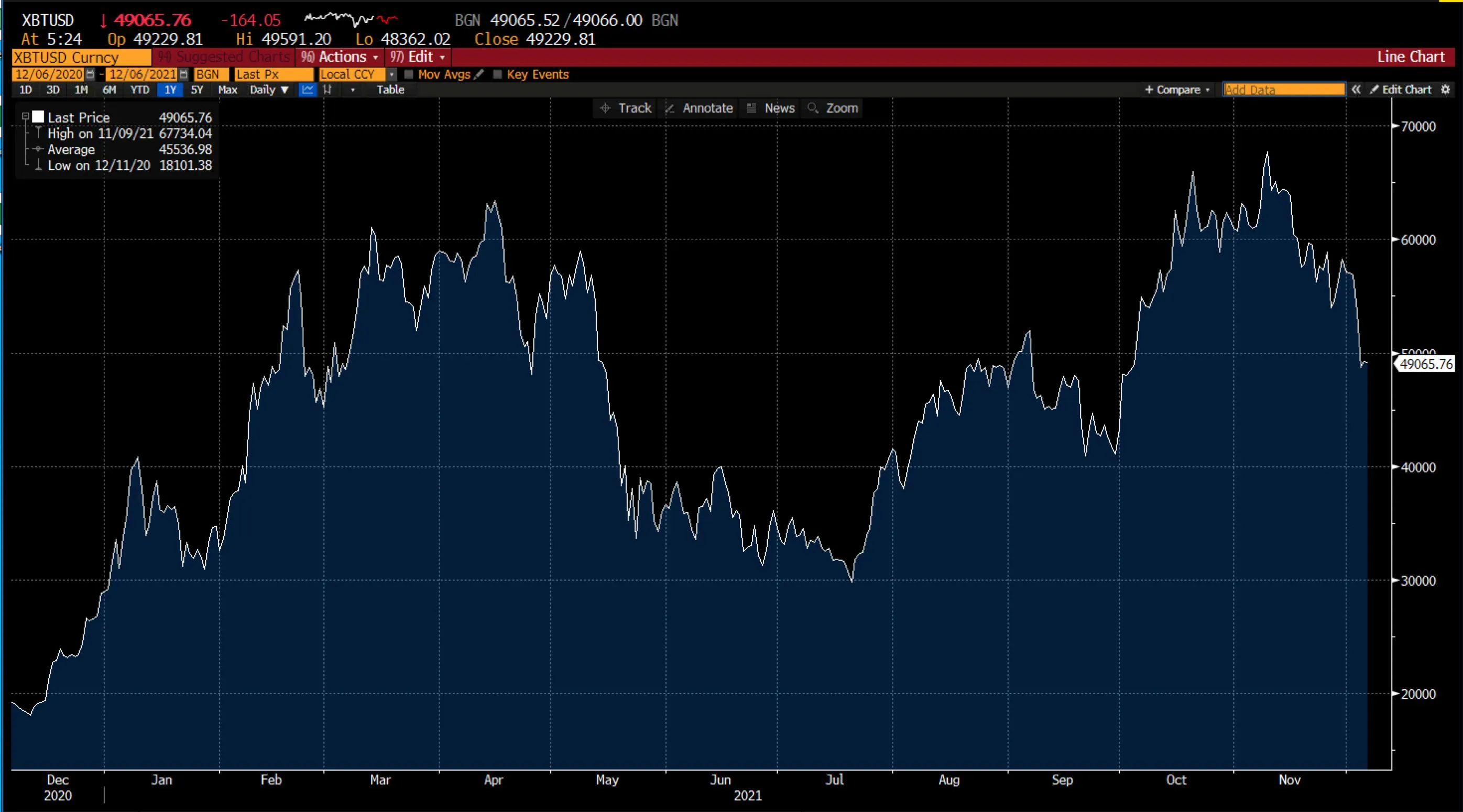
In a disastrous end to the week, Bitcoin prices fell sharply on Saturday, 4 Dec 2021, diving to a low near $43,000 before rebounding. In the 24 hours from Friday to Saturday, the world's most prominent cryptocurrency lost around $10,000, equaling over 17% of its value being wiped out. The price of Ethereum, the second-largest cryptocurrency, also took a hit. Ethereum dived as low as $3,400 on Saturday, 4 Dec 2021, to shed 15% in 24 hours during the market sell-off.
Market losses accelerated early Saturday morning, with no apparent reason for the drop being evident. Cryptocurrencies started falling as stocks pulled back on Friday, 3 Dec 2021, leading investors to flock towards the safety of bonds. Mounting sentiment in tech stocks may also have translated over to the crypto space as investors started offloading. The sell-off also occurred amidst an unsettling sentiment around the chatter of impending crypto regulations from international governments.
Now trailing towards recovery, Bitcoin is settling slightly below its first major resistance levels near $54,400 at 50% retracement. In the event of additional market turmoil, Bitcoin should receive support at around $50,900 at 38.2% retracement. A breach of this key level would see Bitcoin's next major support at the $46,600 mark at the 23.6% retracement level.
Trade US indices, forex, and commodities with options on DTrader and with CFDs on Deriv MT5 Financial and Financial STP accounts. Trade cryptocurrency with multipliers on DTrader and CFDs on Deriv MT5 Financial and Financial STP accounts.

Weekly market report – 20 Dec 2021
All 3 major US stock indices closed last week in the red, as the markets assessed the Federal Reserve’s newest signals to potentially raise interest rates multiple times next year.
US Indices
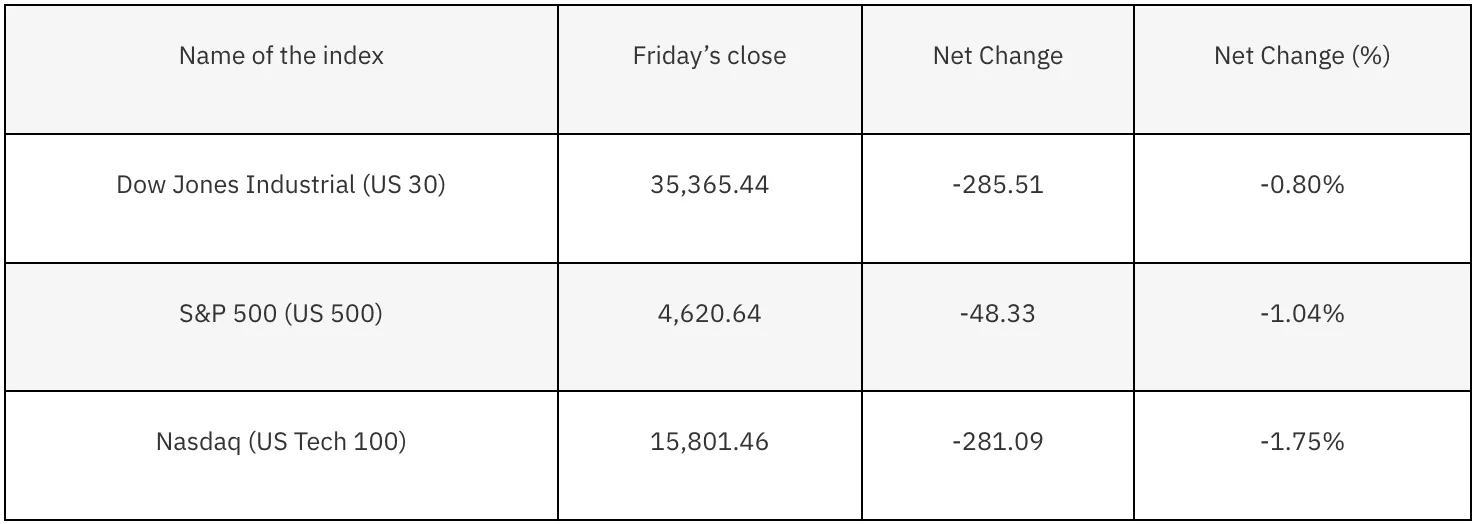
All 3 major US stock indices closed last week in the red, as the markets assessed the Federal Reserve’s newest signals to potentially raise interest rates multiple times next year.
In its final meeting of the year, Federal Reserve chairman Jerome Powell remarked hawkishly on the Fed’s monetary policy outlook, with forecasts from the Federal Open Market Committee (FOMC) projecting up to 3 interest rate hikes before the end of 2022.
“We’re in a position where we’re ending our taper by March, in two meetings, and we’ll be in a position to raise interest rates as and when we think it’s appropriate,” Powell remarked at the press conference.
Equity markets initially absorbed the news well, before rethinking their stance. The Dow Jones, S&P 500, and the Nasdaq Composite all rose sharply on Wednesday, 15 December 2021. Markets seemingly correlated a hawkish Fed stance with an optimistic, confident macroeconomic outlook — one that no longer needs the stabilizer wheels of low-interest rates to keep its economy from tipping.
However, mid-week gains from Wednesday’s rally were quickly wiped out during Thursday's session and again during Friday’s close. The Dow Jones ended the week down by 1.65%, whilst the S&P 500 dropped 89.66 basis points, ending the week 1.90% lower. The Nasdaq Composite drew up the heaviest hit, shedding 451.59 points to close the week trailing at -2.89%.
In an environment with increasing rates and reducing liquidity as the Federal Reserve accelerates its asset purchase taper, long-term growth and technology stocks are being pressured, as both are valued heavily on future earnings potential.
Contrary to this, cyclical stocks across the financial and energy sectors outperformed the rest of the market on Friday, 17 December 2021, as rising interest rates boosted growth in these sectors.
Forex

Last week, the US dollar gained as traders took flight from riskier currencies. Their decision was triggered by the central bankers' chatter of interest rate hikes and concerns about the rise in Omicron cases.
The US dollar index was up by around 0.6% during afternoon trading on Friday, 17 December 2021. After recovering its lost value from Thursday's Fed-induced market dive, the dollar ended the week 0.67% higher.
The euro and the British pound dropped by 0.6% and 0.8% respectively after booking gains the two previous days. In Friday's late session, the euro stood at $1.1247 and the pound at $1.3239.
Throughout last week, traders kept close tabs on the British pound's price movements. In response to a surprise interest rate hike from the Bank of England (BoE), the GBP/USD pair reached a mid-week high of $1.337 for the first time since late November. Since the beginning of the pandemic, the BoE is the first central bank to raise interest rates.
As crude oil prices dropped by 2% on fears that Omicron will reduce global demand, commodity-linked currencies, including the Australian and Canadian dollar, fell against the US dollar. Meanwhile, the Japanese yen traded flat against the US dollar.
Commodities
Oil prices fell for the week, as fears grew that a new restriction may depress fuel demand due to increased cases of Omicron. In the past week, Brent crude dropped by 2.6%, settling at $73.52 a barrel, and WTI fell by 1.3%, dropping to $70.86 a barrel.
The number of oil rigs in the United States increased during the week, raising concerns about potential oversupply. It is possible that OPEC+ could meet before their scheduled meeting on 4 January 2022 if changes in the demand outlook warrant a review of their plans to add 400,000 barrels per day of supply in January.
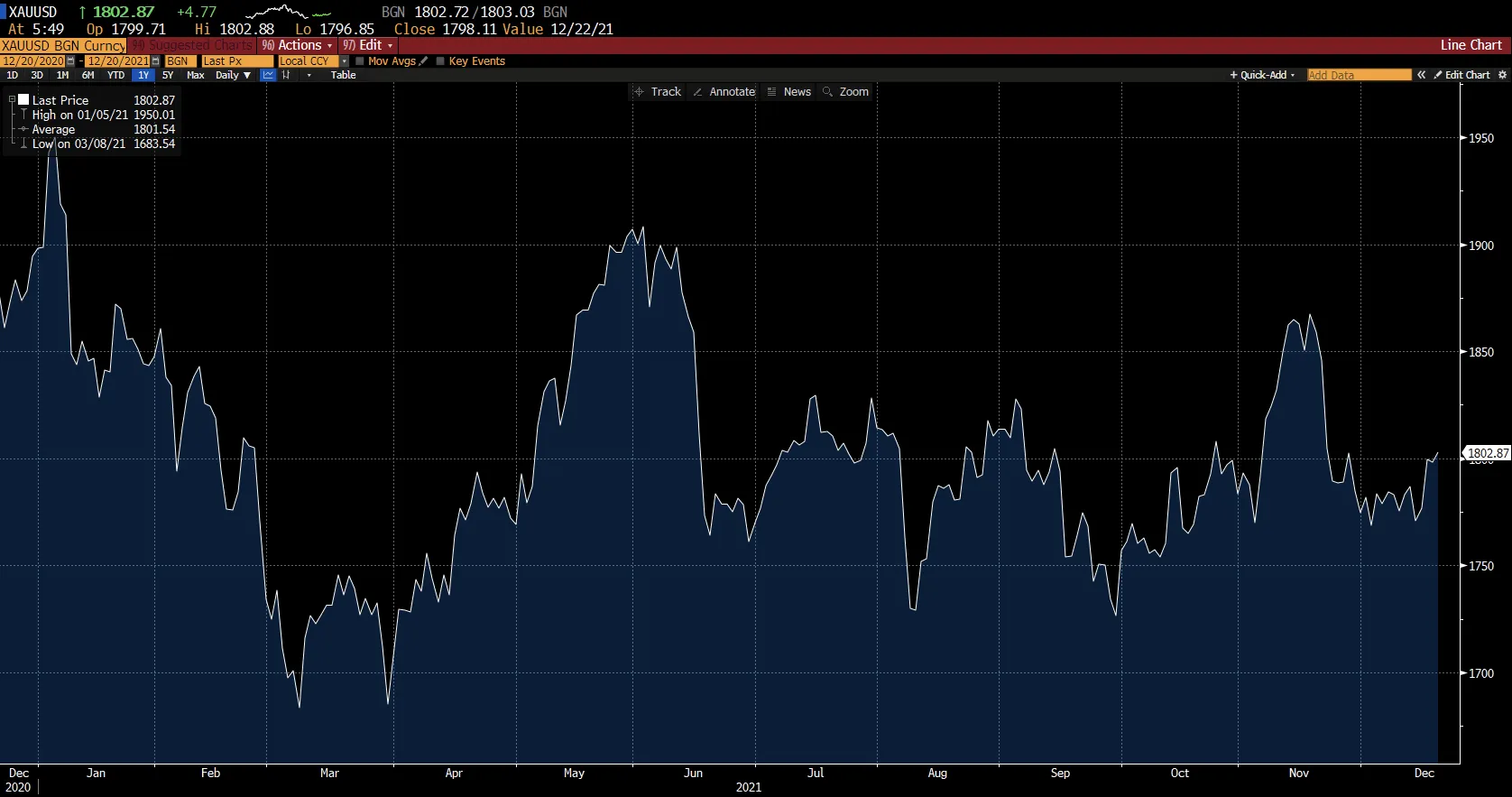
Concerns over the Omicron surge and rising inflation drove traders to safe-haven assets on Friday, 17 December 2021, causing gold to climb above $1,800 for the first time in 5 weeks. The Federal Reserve’s forecast of up to 3 rate hikes next year would typically weigh on gold as higher interest rates increase the opportunity cost of holding non-yielding bullion. However, gold gained despite inflows into the US dollar, which is also considered a store of value during uncertain times.
XAU/USD closed at $1,798 on Friday, 17 December 2021. The pair is currently trading right under its resistance at the 61.8% retracement level, near $1,801. If gold breaches the 61.8% retracement level, its new resistance will be at the 78% retracement level near $1,834.
It will be interesting to see how traders react to the upcoming festive session and US macroeconomic events for the week, such as the US GDP (Q3), Consumer Confidence and the Unemployment Claims.
Cryptocurrencies
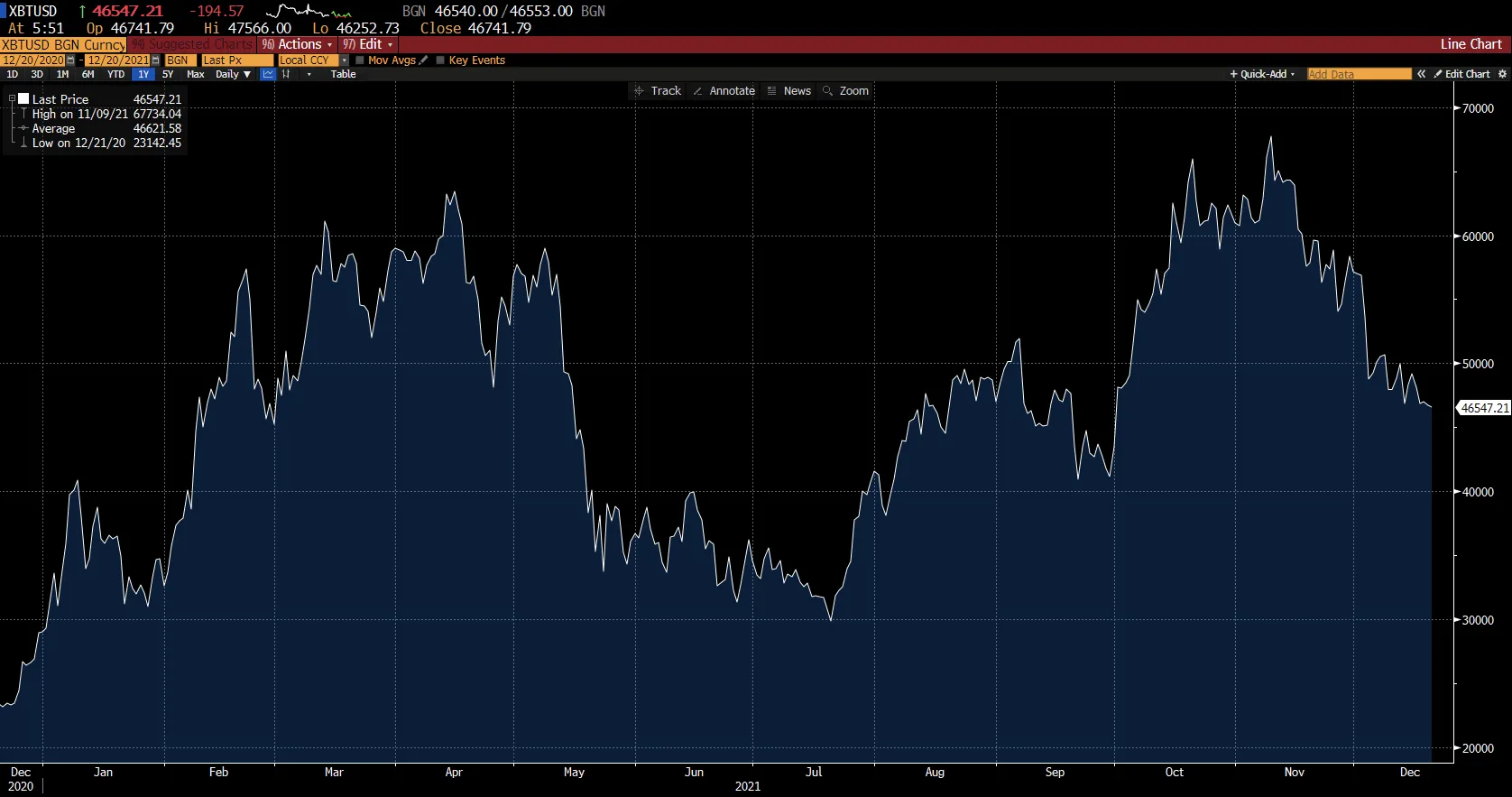
Crypto prices continue their downward trend as the central banks adopt an aggressive stance towards inflation. The price of Bitcoin (BTC), Ethereum (ETC), Binance Coin (BNB) and Cardano (ADA) fell between 3%-5% for the week. However, the market capitalisation is still well below the $2.3 trillion mark.
Bitcoin has declined for the fifth consecutive week. It has been hovering around the $50,000 mark for quite some time and has fallen well short of its peak in November, which was around $70,000.
Eswar Prasad, a senior professor on international trade policy at Cornell University, quoted that “Bitcoin itself may not last that much longer” because there are many alternatives to Bitcoin, some of which are more environmentally friendly.
On Friday, 17 December 2021, Bitcoin closed the week at around $46,850. A weekly chart shows it trading near $47,900, close to the 50% retracement level. According to the Simple Moving Average, the 21-week Moving Average is around $51,900, and the 50-week Moving Average is roughly $47,600, determining the near support and resistance levels.
Trade the financial markets with options and multipliers on DTrader or CFDs on Deriv X Financial account and Deriv MT5 Financial and Financial STP accounts.

Weekly market report – 27 Dec 2021
As markets head into their final trading days of the year, the three major US indices closed higher on Thursday, 23 December 2021, in what came as a pre-holiday Santa Claus rally.
US Indices

As markets head into their final trading days of the year, the three major US indices closed higher on Thursday, 23 December 2021, in what came as a pre-holiday Santa Claus rally.
The S&P 500 acquired some impressive gains, closing at an all-time high of $4,725 to end the week +1.58% higher, with 80% of the companies that make up the index gaining ground. Retailers and other companies that depend on consumer spending accounted for a large share of these gains. Among them, Tesla (TSLA) rose over 16% after CEO Elon Musk announced he was "almost done" selling 10% of his stake.
Meanwhile, the Dow Jones and Nasdaq Composite followed the trend, recovering losses from earlier in the week to close up +0.55% and +0.85%, respectively.
Healthcare and technology stocks also helped lift the market, whilst traders notably bid up shares in hotel operators and other travel-related companies. In particular, the share price of American Airlines (AAL) went up by 10.5%, while Delta Airlines (DAL) closed 9.8% higher.
The markets also rallied after positive health data regarding Omicron and related hospitalisations emerged, shrugging off concerns that the variant would stunt economic recovery. This fact, coupled with upbeat consumer confidence levels and the release of upwardly revised domestic GDP levels, placed all three major averages in the green after a shaky opening.
Another major boost for the markets came from the US Labor Department. The latest jobless claims report indicated 205,000 people filed for unemployment insurance last week, continuing its decline since the height of the pandemic. The department’s latest figures reflect a strong labour market, fueled by a significant demand for workers in the coming year.
Forex
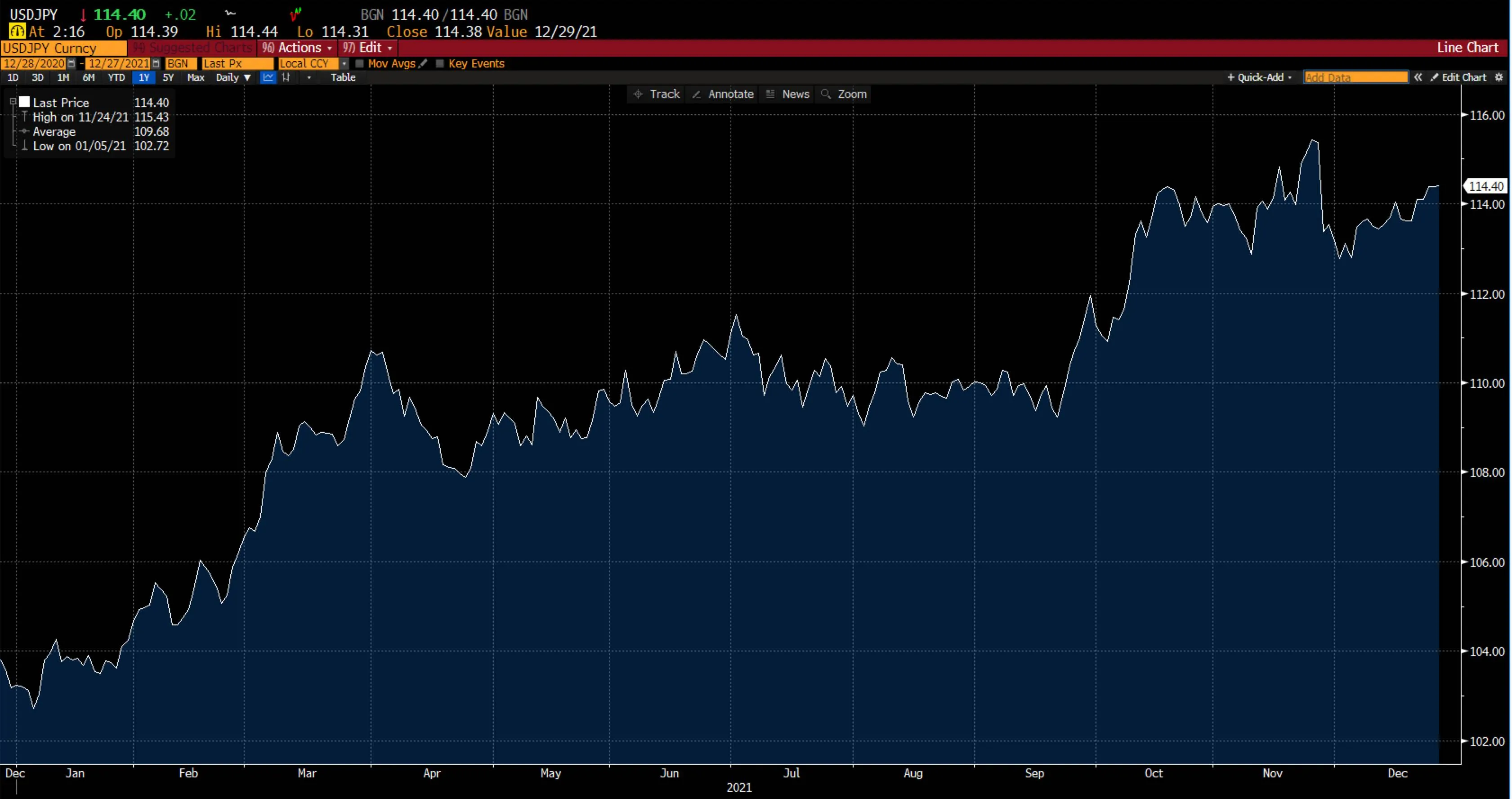
The US Personal Consumption Expenditures (PCEs) Price Index data published earlier this week showed the largest annual growth since 1982 with 5.7% YoY in November. This result helped the US dollar hold firm against its rivals.
The USD/JPY rates have been increasing in recent weeks, hitting a four-week high at the end of last week – the pair closed the week at $114.41. Given the upward trend, the 21-week Moving Average is around $112.00, and the 50-week Moving Average is roughly $110, determining the near support levels.
The key factor driving the pair higher is the Federal Reserve’s divergent monetary policy, which is likely to widen the spread between US government bond yields and Japanese government bond yields. Additionally, positive US economic data also supported the US dollar. With expectations of a tighter monetary policy by the Fed, the bullish momentum is expected to continue in the coming months, which will support the US dollar.
With trading action becoming subdued on Christmas Eve, EUR/USD appeared to have settled around mid-1.1300s on Friday, 24 December 2021. While the short-term bullish sentiment remains intact for the pair, thin trading conditions are likely to limit its movement for the remainder of the week.
GBP/USD gained for the fourth consecutive day after pulling back from over a month's low. Recent reports suggested that the current vaccines were more effective than first thought against the Omicron strain, easing worries about the increase in COVID-19 cases in the UK. According to a UK study, fewer hospitalisations were attributed to Omicron infections, boosting the British pound.
Further, subdued demand for the US dollar gave the GBP/USD pair a modest lift. Next year's hawkish Fed policy, which implies at least 3 rate hikes, should limit USD downside and limit gains for the pair.
However, the lack of relevant economic data and thin liquidity conditions at year-end discouraged traders from making aggressive bets.
Commodities
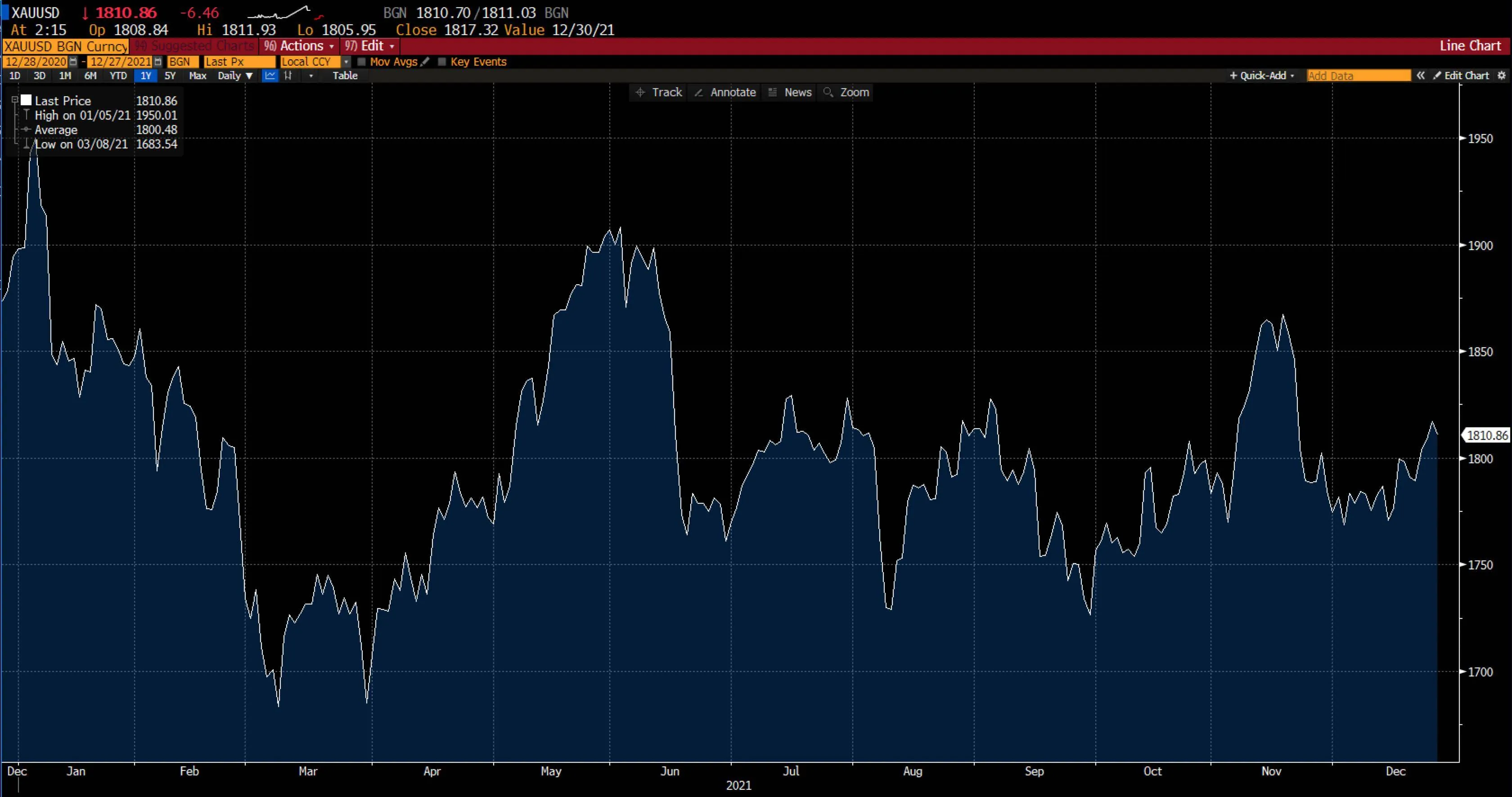
As a result of the weakening US dollar, gold rose for the last 2 days, remaining above the $1,800 mark for the second week in a row. However, it was unable to cross its monthly high. From a technical point of view, gold closed at $1,808.81 and is trading below the 61.8% retracement level, near $1,830.
That being said, traders exhibited a risk-on attitude by ignoring stronger US Treasury yields and drawing cues from favourable updates on the Omicron variant and the US stimulus. They are hoping that the latest COVID variant would not impede global development, giving Wall Street bulls the boost they need at this time of the year.
The price of oil climbed as well, with concerns about Omicron's impact on global economies easing and early data indicating that the virus caused milder disease. However, traders remained cautious about the increase in infected cases.
On Tuesday, 4 January 2022, OPEC + and its allies will decide whether to increase production by 400,000 barrels (BPD) per day in February.
Cryptocurrencies
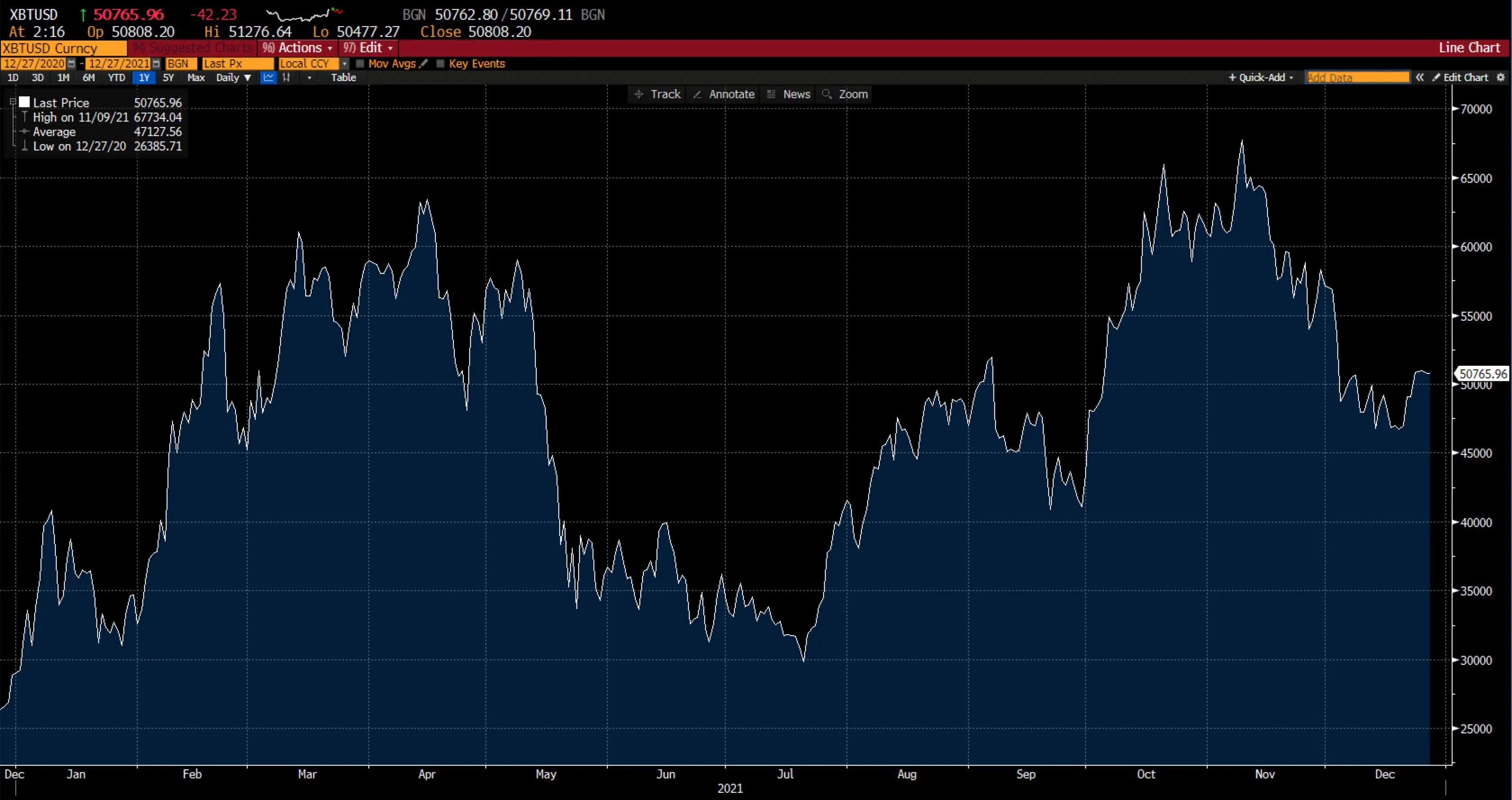
The holidays brought plenty of Christmas cheer for Bitcoin traders after the blockchain cryptocurrency entered the Christmas weekend, hitting a two-week high.
Despite trading volumes remaining low in the lead up to Christmas, the world's largest cryptocurrency broke the $50,000 mark for the first time since Friday, 12 December 2021. Last week Bitcoin was up by an impressive 8% on the week, reaching an intra-week high of $51,65.
As a market leader, Bitcoin influenced the performance of other cryptocurrencies with its upward momentum. Ether's price advanced above $4,100 on Thursday, 23 December 2021, climbing 4% by the week's end.
For the second most popular cryptocurrency in the world, 2021 has been an excellent year. In late December 2020, Ethereum was trading around the low $700 mark. As the end of December 2021 approaches, Ethereum has seen an approximate rise of 450% (year-to-date), as compared to Bitcoin, which sits at a relatively low performance of 80% (year-to-date).
Analysts attribute Ethereum's performance this year to its greater flexibility and integration potential with decentralised applications (dApp), decentralised finance (DeFi), and non-fungible tokens (NFT).
Trade the financial markets with options and multipliers on DTrader or CFDs on Deriv X Financial account and Deriv MT5 Financial and Financial STP accounts.

Year-end market holidays 2021 — what to expect
Since the year-end market holidays 2021 are rapidly approaching, you'll likely want to make sure you’re on top of your trades. Seasonality greatly impacts how financial markets perform.
Since the year-end market holidays 2021 are rapidly approaching, you'll likely want to make sure you’re on top of your trades. Seasonality greatly impacts how financial markets perform. Prior to the holidays, there is a seasonal market trend called pre-holiday effect, which is when the markets usually experience higher volatility than on regular trading days.
To help you prepare and refine your trading strategies during this time, here’s what you can expect this upcoming holiday season.
Stock market
During the holidays, stock prices fluctuate due to a number of contributing factors, including:
- the number of active traders
- the end of a financial quarter for companies (when they rebalance their portfolios based on which investments performed well or poorly)
- investors selling their unprofitable shares
With the expected rises and dips in price movements this time of the year, most traders rely on technical and fundamental analysis to study the seasonal stock trend of a particular asset to strategise better.
Stock exchanges holiday calendar
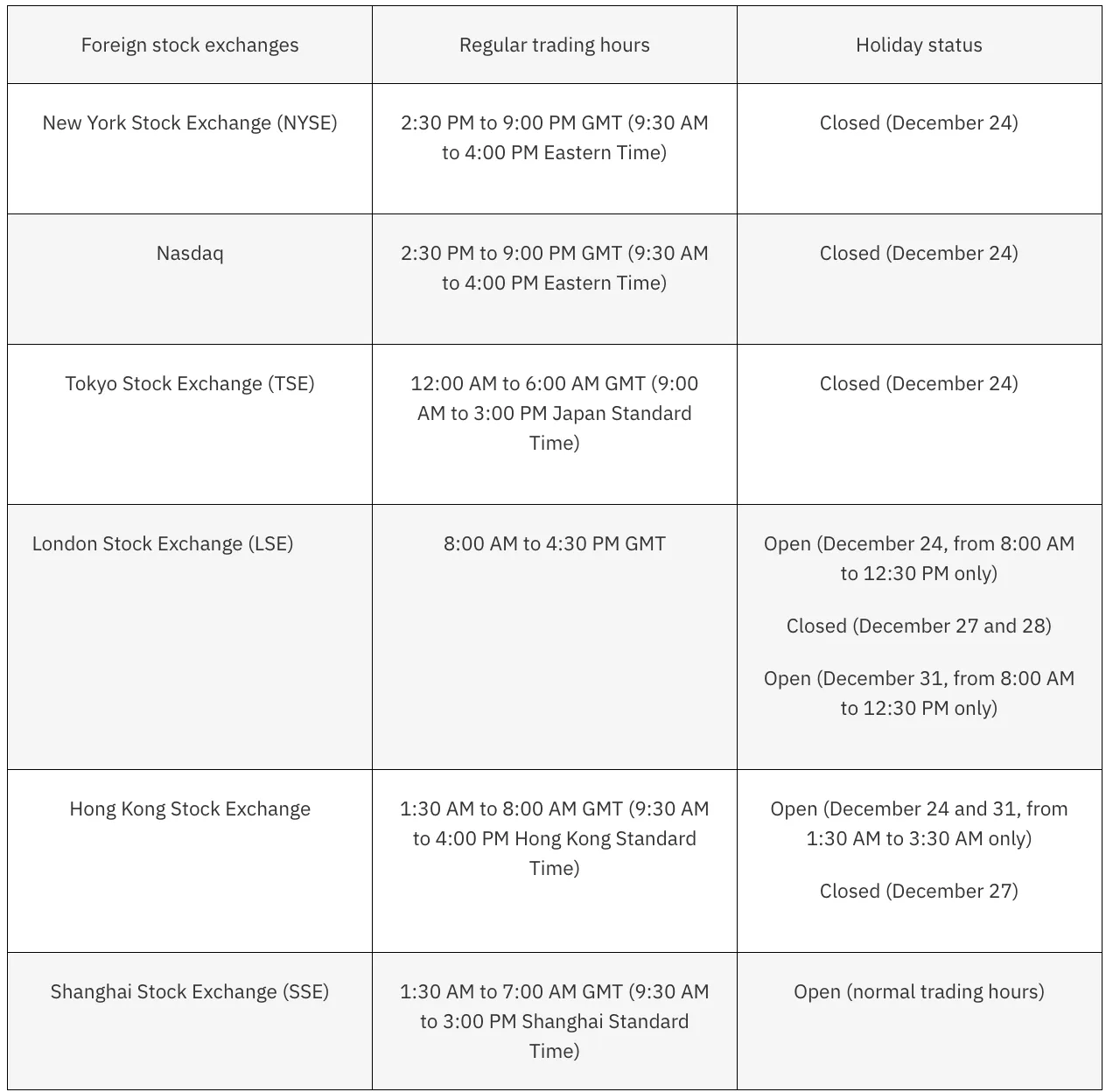
*Stocks and stock indices can be traded on Deriv MT5 (with CFDs) and Deriv Trader, Deriv Bot, and SmartTrader (with options).
Forex market
The forex market is the world's largest financial market, with over 6 trillion US dollars in daily trading volume. It’s dominated by financial companies, hedge funds (also known as offshore investment funds), and banks.
These key market players are absent during the holiday season, resulting in lower liquidity. Their absence also leads to heightened volatility with higher chances of false breakouts, which some traders find unrewarding as there’s less potential for gains.
In a decentralised market like forex, there is no way of knowing how prices will move, so trading under such unpredictable market conditions can be challenging. Most traders rely on both technical and fundamental analysis in studying its price movements.
When is the forex market closed?
The normal trading hours for the forex market are 10:00 PM to 9:00 PM GMT (5:00 PM to 4:00 PM Eastern Time), from Sunday to Friday. It's only officially closed on Christmas Day (December 25th) and New Year's Day (January 1st).
*Forex can be traded on Deriv MT5 and Deriv X (with CFDs) for 24 hours (with a 5-minute break at 22:00 GMT), Deriv Trader (with options and multipliers), and Deriv Bot and SmartTrader (with options).
Commodities
The holiday season generates a high demand for commodities — from natural resources to precious metals — resulting in bullish markets that most traders take advantage of. This rise in demand strengthens their prices, paving the way for more potential positive returns.
The commodities market’s trading hours are 3:00 PM to 5:30 AM GMT (9:00 AM to 11:30 PM Central Standard Time), from Monday to Friday (depending on the asset). This market is only officially closed on Christmas Day (December 25th).
*Commodities can be traded on Deriv MT5 and Deriv X (with CFDs; trading hours vary depending on the asset), and DTrader, DBot, and SmartTrader (with options).
Other markets
Cryptocurrencies and synthetic indices are the markets that never sleep. On Deriv, these markets are available to trade 24/7, even throughout the holiday seasons and on public holidays.
*Cryptocurrencies and synthetic indices can be traded on all Deriv platforms — Deriv MT5 and Deriv X (with CFDs), Deriv Trader (with options and multipliers), as well as and Deriv Bot and SmartTrader (with options but for synthetic indices only).
Important: Deriv remains operational throughout the holiday season. The schedules mentioned are for guidance only and are subject to change.
Deriv wishes you a festive season filled with love and warmth!

Weekly market report – 03 Jan 2022
Stocks ended the final trading session of 2021 on a downward note, but still capped off a record-setting year despite the continuing headwinds of the global pandemic.
US Indices
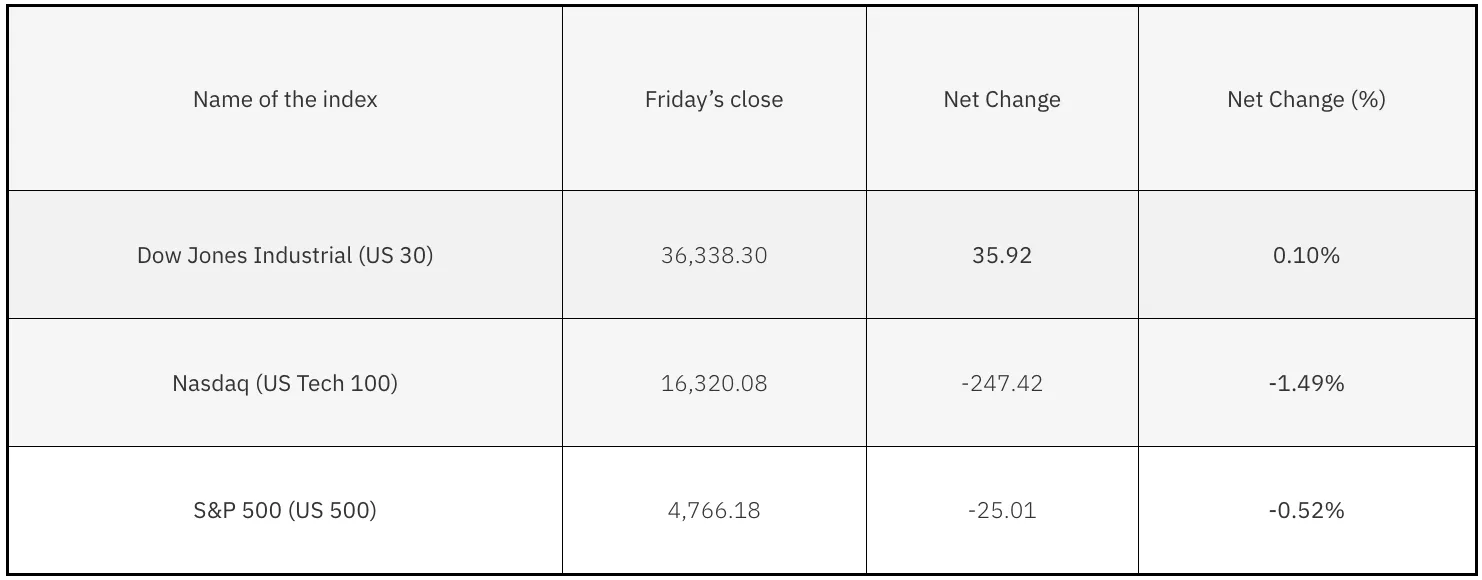
Stocks ended the final trading session of 2021 on a downward note, but still capped off a record-setting year despite the continuing headwinds of the global pandemic.
The S&P 500 was the stand-out index in 2021 — it posted a 26.9% gain for the year, or a total return of 28.7% including dividends. Meanwhile, the Dow Jones gained a comparatively lower rate of 18.7%, and the tech-powered Nasdaq Composite climbed 21.4%. The year 2021 marked the sixth historical year that the S&P 500 outperformed its two counterparts.
Home Depot (HD) and Nike (NKE) were amongst the top winners on the Dow Jones, each gaining more than 1%. On the downside, airline stocks experienced yet another turbulent week. American Airlines pulled back over 2.5%, whilst United Airlines dived 1.9%. Boeing (BA) led losses on the Dow, posting a 1.2% decline.
High-growth tech stocks also retreated as the 10-year US treasury yield rose above 1.5%. Meanwhile, investors continued to monitor developments related to the Omicron variant.
Despite ongoing inflationary pressures and warnings of an ‘overheating’ stock market, investors are still expecting a boost from the ‘January effect’, referring to a seasonal trend positing that the market’s best month tends to be the year’s first.
As Facebook parent Meta, Apple, Microsoft, and Google prepare to release new hardware products and software services in places that were previously a niche market for early adopters, the year 2022 is set to be the biggest year yet for the Metaverse. Leading tech companies are confident that devices that transport users to expanded or imaginary worlds will open up the biggest new market for software since Apple introduced the touchscreen smartphone in 2007.
Forex
The US Dollar Index (USDX), which measures the value of the US dollar in relation to a basket of currencies, fell on Friday during quiet holiday shopping. However, it did end 2021 with a gain of nearly 7% as the US investors are betting the Federal Reserve will raise rates sooner than most other major economies amid rising inflation brought about by Covid-19 stimulus initiatives.
The Canadian dollar, which performed around flat against the dollar in 2021, was the best performer, helped by expectations that the Bank of Canada would begin tightening its monetary policy as soon as January. The worst performer against the majors was the Japanese yen, which is down around 10% this year.
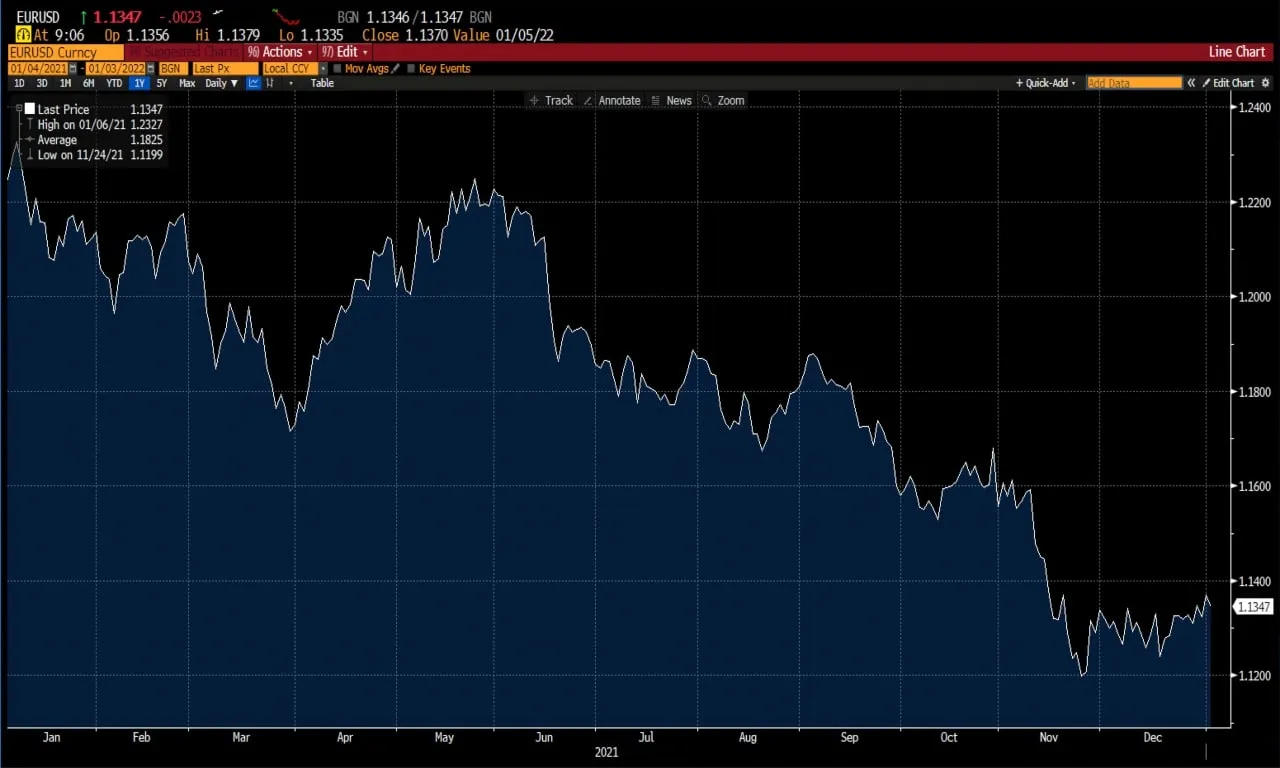
Despite the euro reaching a seven-week high of around a $1.1365 level against the US dollar on the last day of 2021, the EUR/USD registered a dull start to 2022, falling approximately 0.20% intraday around $1.1340. While mixed concerns ruled the day, the market's consolidation at the year's first sluggish session led to a slight correction of the quote.
Above all, the Fed's monetary policy divergence from the ECB's will be key to watch in the year 2022 as the Fed is likely moving faster than the ECB towards a tighter monetary policy, which could weigh on EUR/USD prices.
As a result, Wednesday’s Federal Open Market Committee (FOMC) Meeting Minutes and Friday’s US Nonfarm Payrolls (NFP) will be crucial for the pair traders.
The pair is currently trading above its support at the 23.6% retracement level of $1.13142 and below its resistance at the 38.2% retracement level of $1.13850.
Commodities
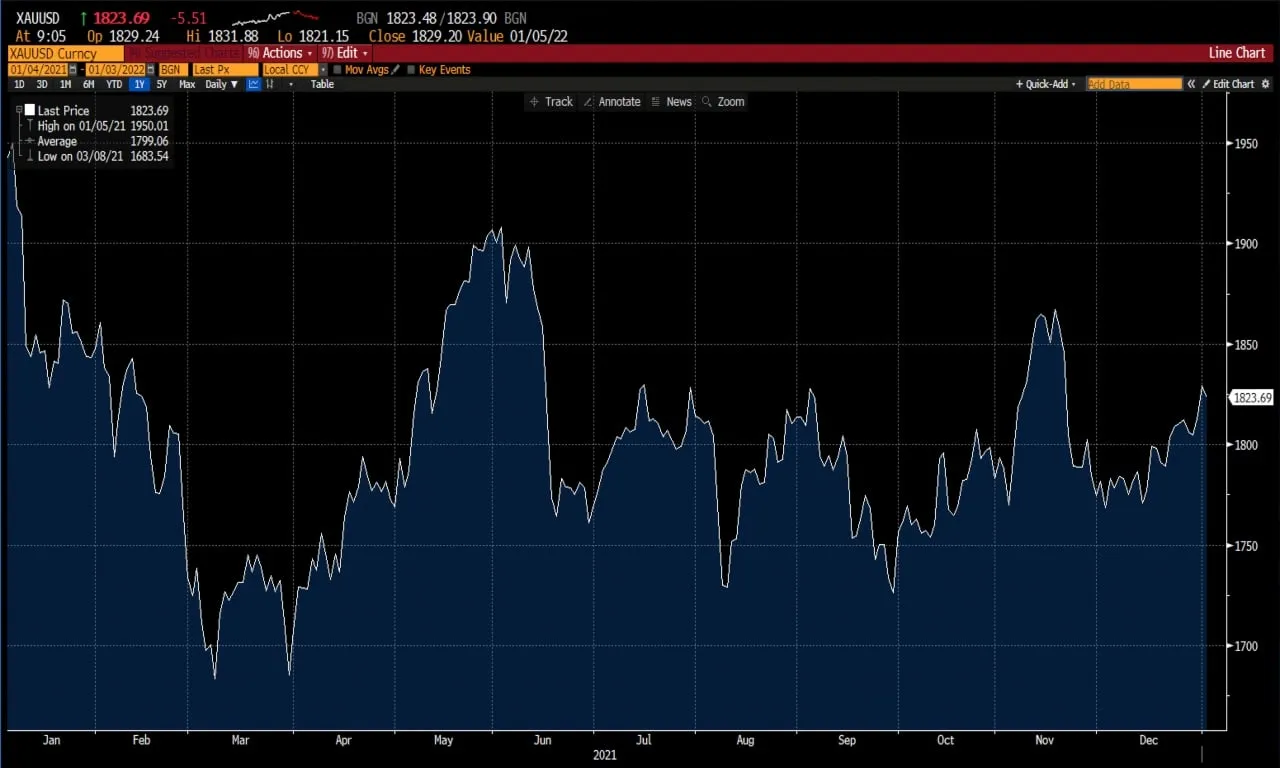
The year-end flows favoured gold against the US dollar (XAU/USD) for the week. This is due to the absence of major market moving news, negative reactions on the Wall Street indices, a pullback in the US dollar index, and the escalation of Omicron cases around the world. This new variant could trigger a continuous flight to safety in 2022, which will increase demand for risk-free government bonds and lower yields, alongside raising gold prices. Gold against the US dollar traded just under $1,830 and is trading close to the resistance level near $1,839 at 61.8% retracement level. The support level is around $1,765-$1,780 at 50% retracement level.
Gold against euro (XAU/EUR) reached new highs for the first time since December 26, with bids hovering around €1,608 in the early European morning on Friday. As a result, yellow metal prices in euro have risen for the second day in a row, continuing a significant increase seen on Thursday. In addition, the recent fall in EUR/USD amid Omicron concerns, the strength of US retail data, and the suspension of German 10-Year Treasury yields near the monthly highs could have contributed to the strength of the XAU/EUR. However, the record surge in daily French Covid infections and the 45% increase in monthly viral hospitalisations pose a challenge for XAU/EUR buyers.
In the energy markets, oil prices fell for the first time in eight days, with WTI crude falling $1.78 (2.3%) to $75.21 a barrel. Natural gas prices rose 46% in 2021, the highest year since 2016. OPEC + will hold a meeting on 4 January 2022, and will probably stick to their plan of adding 400,000 barrels per day of supply in February.
Cryptocurrencies

Bitcoin traded close to the $47,000 mark during the year-end holidays on lower volumes than usual. Opening on Monday above the $51,000 mark, the world’s largest crypto coin gave up steep losses during the week, shedding over 10% by Thursday to trade around lows of $46,250.
Bitcoin closed out December with a 19% drop, its largest monthly loss since May. The year 2021 has proven to be one of Bitcoin’s slowest with a yearly advance of 59%, the slowest since 2015 when it gained only 36%.
Ethereum in comparison gained around 380% in 2021, whilst Binance coin, the number three cryptocurrency by market capitalisation, soared over 1000% in value.
Looking into 2022, Arcane Research, a blockchain research firm made a number of predictions for the crypto market. Amongst them, Ethereum is expected to yet again outperform Bitcoin in 2022. According to Arcane Research, the expected surge in NFT sales volumes whose tokens mostly still run on the Ethereum blockchain will be a major driver.
Trade the financial markets with options and multipliers on DTrader or CFDs on Deriv X Financial account and Deriv MT5 Financial and Financial STP accounts.

Deriv's 2021 in a nutshell
As the world started recovering from the uncertainty the pandemic brought, Deriv stepped up to the challenge of adapting to the new reality.
Change is indeed challenging, but if that change is for the better, we stick with it simply because we know the result is for the greater good.
― Jean-Yves Sireau
Deriv CEO and founder
As the world started recovering from the uncertainty the pandemic brought, Deriv stepped up to the challenge of adapting to the new reality. We renewed our pledge to make trust and growth the core goals for our organisation. Looking back, 2021 led us to new initiatives, approaches, and launching new products. Everything we did this year contributed to Deriv's focus areas — our clients and business.
Clients
2021 saw the launch of Deriv Academy – a knowledge hub designed to equip our clients with blogs and videos to help them sharpen their trading skills and get the most out of our platforms and services. In the future, we are planning to include webinars, podcasts, and interactive features as well, providing our clients with access to multiple learning mediums.
Knowledge goes hand in hand with opportunity. Our native app, Deriv GO, was also released this year to help our clients seize trading opportunities even on the move. We launched Deriv Go on Google Play, HUAWEI App Gallery, and App Store, offering multipliers trading on forex, crypto, and our proprietary synthetic indices. The year 2022 will see us develop Deriv GO further, improving our clients' user experience and adding more trading features.
One of our other important launches in 2021 was Deriv X – a CFD trading platform offering a highly personalised trading environment on mobile, tablet, and desktop devices. With customisable layouts, advanced charts, watchlists, and real-time alerts, Deriv X helps traders seize market opportunities on forex, commodities, cryptocurrencies, and synthetic indices.
Alongside, we revamped Deriv API as a product, making it easier for our clients and partners to create highly-personalised trading platforms, apps, and payment websites for their use or to capitalise on them.
We also introduced tighter forex spreads, allowing our clients to take advantage of every opportunity. With up to 50% reduction in spreads on selected forex pairs, combined with high leverage, zero deposit and withdrawal fees, and zero commission, this offer has become one of the most competitive on the market.
Finally, to keep up with innovative technologies quickly becoming the new normal, we integrated project IDV into our documentation process. This initiative has been implemented to enhance our customer experience, making our clients' identity and document verification process easier and more seamless.
Business
Along with welcoming 1.5M users in 2021, we also welcomed a new approach to project management, adopting new technologies and expanding our team to organise and drive our key projects. Our commitment to embracing growth areas also led to the formation of new teams like Strategy & Project Management Office, Reputation Management, and Delivery Excellence in Risk Department in line with our vision to pursue excellence and efficiency.
We adopted a fresh approach to the Deriv Careers page, providing an overview of all the departments, their differences, and a description of what to expect in the application process. As we're always on the lookout for fresh talent, these updates helped us make sure the application journey is as seamless and informative as possible. Upholding the principle of transparency is something we prioritise in the way we do business and interact with clients, colleagues, and potential new hires.
To give extra inspiration to our new hires and potential candidates, we also enhanced our LinkedIn page by including the journey of growth and learning of several employees within our story. We are proud of the multicultural spirit in every one of our 700+ employees, where the fabric of various cultures, experiences, and academic backgrounds are woven together by the thread of learning and being distinguished.
But that's not all. Along with expanding our current offices, we also built new teams in Minsk, Paris, Guernsey, and London. With a total of 13 teams spread over 10 countries, we look forward to welcoming passionate and versatile people into the Deriv family.
All these projects enabled us to tap into the needs of our clients, ensuring we stand by our main mission — to make online trading accessible to everyone. It also served us as a guiding force for creating opportunities to strengthen ties with our partners, who are an extension of the business.
The challenges we've faced throughout the year set the stage for our strength to shine through. With 130+ trading assets and more than 100 transactions per second, our daily trading volume is more than 15 billion USD, however, we wouldn't be where we are today without your unwavering support. Even as we're chartering new waters, we're proud of where our resilience and your commitment has taken us today. As we stand on the brink of 2022, we celebrate the milestones of 2021, looking forward to new horizons with invigorated passion and vision.
That's a wrap from us. See you in 2022!
Sincerely,

%25252520(1).webp)
What is cryptocurrency? A beginner's guide
Wondering what’s the crypto buzz about? Find all the basics of cryptocurrency trading and tips in our blog: what is cryptocurrency, why is it secure, and how to choose one for trading.
This post was originally published by Deriv on 13 Jan 2022
Most of us are familiar with the digital currency concept without realising it. We pay without seeing a single coin or banknote when we use our bank cards to buy goods and services. So, the money we use daily is digital, in a way. Cryptocurrency is also a form of digital money, and it's becoming increasingly popular, capturing more and more headlines. However, it's an entirely different concept.
Before diving into trading, let's explore basic information about this new virtual currency.
What does cryptocurrency mean?
Cryptocurrency is a digital currency with no physical form and is entirely independent of the traditional banking system. It's an exciting technological breakthrough that has revolutionised how we use money. Having payments handled between people without any involvement of a third party (like banks) is entirely different from how we used to deal with money.
Cryptocurrency isn't issued by any government; it uses blockchain technology that keeps records of all transactions within a decentralised global network of computers. The data verifying these transactions is cryptographically encoded, which means one party transforms it into a code in a way that only the intended party can decode it and view, and that's where the "crypto" part comes from.
What is cryptocurrency mining?
Mining is a process of verifying cryptocurrency transactions. Miners encrypt every transaction and collect them together in groups that are called blocks. These blocks are later chained together, which is called the blockchain.
Once a block is thoroughly verified and added to the blockchain, it generates new coins. As a result, a miner is rewarded with newly generated coins and transaction fees that are paid for all the transactions in the block. It's a way of earning crypto without buying it and the most appealing reason to become a miner.
Is cryptocurrency safe?
The complexity of blockchain technology makes cryptocurrencies highly resistant to hacking.
First, it's decentralised – the data is shared with the entire network instead of being kept in one place, making it harder for hackers to find the source.
And most importantly, having all the transactions and internal information cryptographically secure makes it almost impossible to access or change the data.
Why trade crypto?
Now that we know how cryptocurrency works, let's find out how you can trade it. But first of all, why is crypto trading such a hot topic? More and more traders get involved in crypto trading daily for different reasons. It may be just a curiosity for some of them, but there are undeniable benefits to it, too:
- Round-the-clock trading.
- High volatility – prices change rapidly, giving traders a range of opportunities, not eliminating the risk.
- High liquidity makes it easy to convert the most popular cryptocurrencies into cash.
Let's see how you can take advantage of these benefits.
Where do beginners start with cryptocurrency trading?
The starting point depends on the type of trading you choose. The first option is to own the cryptocurrency you are going to trade. In this case, you need to exchange fiat money for the cryptocurrency of your choice on an exchange platform.
You also need to create a digital wallet to keep your cryptocurrency safe. It basically means just creating an account on a website or app. There are plenty of options available on the crypto market. It's always good to compare a few options to determine what works better for you.
Most of the wallets serve as exchange services, too, to make this process easier. It means you can buy, sell and hold your cryptocurrency in the same place.
The other way to trade cryptocurrency is to speculate on its price movement without buying it. This type of trading can be done with Multipliers digital options or CFDs. Check the Cryptocurrency Trading for Beginners blog to find out more about how you can trade crypto with these trade types.
Which cryptocurrency should you choose for trading?
As of February 2022, there are around 10,000 cryptocurrencies listed. Most cryptocurrency trading platforms offer quite a few options to choose from. The top 10 are measured by market capitalisation, according to CoinMarketCap.
1) Bitcoin ($827.9 billion)
2) Ethereum ($367.1 billion)
3) Tether ($78.6 billion)
4) Binance Coin ($70 billion)
5) USD coin ($52.6 billion)
6) Ripple ($39.3 billion)
7) Cardano ($35.9 billion)
8) Solana ($31.8 billion)
9) Avalanche ($23 billion)
10) Terra ($22 billion)
But what are other substantial differences between these virtual currencies, apart from the market capitalisation? In a nutshell, the main differences lie in technical characteristics. Here is an example of a brief comparison of the current three largest cryptocurrencies.

If you are new to cryptocurrency trading, starting with Bitcoin – the biggest and most well-known digital coin is a good idea. And once you get more comfortable, you can always expand and upgrade your trading strategy, adding other cryptocurrencies to your portfolio.
Is cryptocurrency the future of money?
It's hard to predict if cryptocurrencies are here to stay. Some consider them the future of all transactions and potentially the main form of currency in years to come, while others predict an inevitable crash. But regardless of the future outcome, you can ride the wave of its popularity and try to make some extra income while it lasts.
If you have more questions, in our next blog, we have prepared a few more examples of how you can benefit when you get in on the cryptocurrency action now.

Weekly market report – 13 Dec 2021
It was a good week for the US Indices. Fears related to the Omicron variant seemed to be abated with initial studies by BioNTech and Pfizer showing a booster shot would be effective against the virus.
US Indices
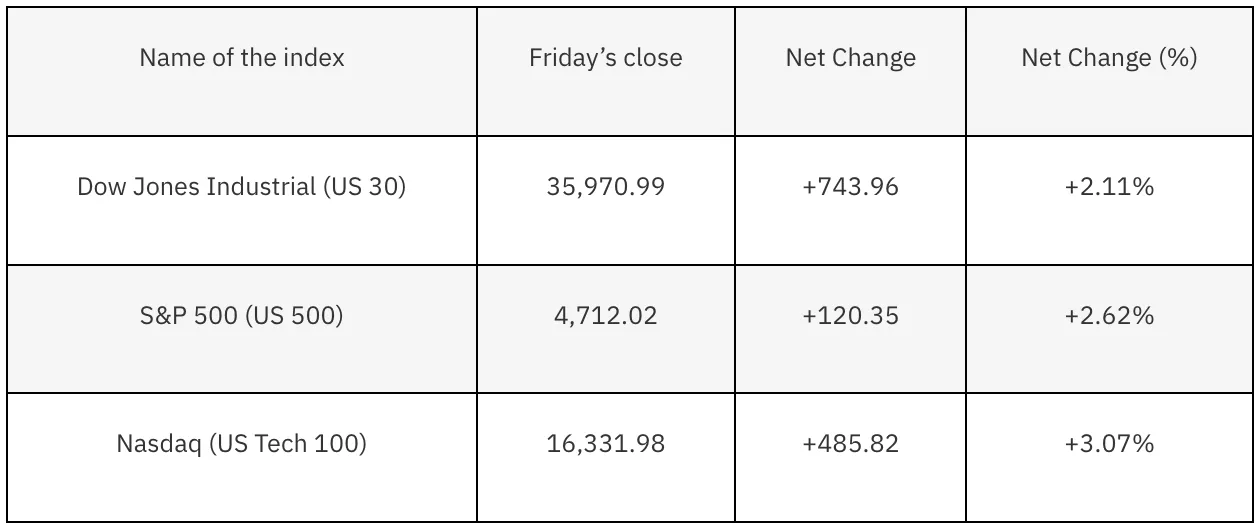
It was a good week for the US Indices. Fears related to the Omicron variant seemed to be abated with initial studies by BioNTech and Pfizer showing a booster shot would be effective against the virus. The S&P 500 and the Nasdaq Composite recorded their best weekly gain since February, whilst the Dow Jones recorded its best weekly gains since March. The US Large Cap growth stocks outperformed the value stocks, mainly driven by Information Technology stocks such as Apple (AAPL) and Cisco Systems Inc (CSCO).
The main highlights of last week included:
- The CPI report released on Friday, 10 Dec 2021 showed the inflation rate came in at 6.80%, the highest level since 1982. However, excluding the categories of food and energies, the inflation rate was at 4.90% — in line with expectations.
- The labour market has also shown signs of improvement, with the rate of unemployment below 4.20%. Prior to the release of the CPI report, the yield on the 10-year note was high but then flattened.
- The 10-year Treasury Yield was at 1.49%, up 1.34% from last Friday, 10 Dec 2021. However, it is far below the recent high of 1.68%. This data may reflect the fact that higher inflation could lead to a faster tightening of the monetary policy by the Fed.
This week, the focus is on the Federal Reserve meeting on Wednesday, 15 Dec 2021, as this is the last one for the year and based on comments from the Fed Chairman Jerome Powell, the Central Bank may speed up the taper of its $120 billion monthly bond purchases to tackle the surge in inflation. The Fed is expected to provide economic projections on growth, inflation and unemployment levels.
Forex
Investors bet that even if inflation rose higher than expected, the interest rate hike pace would remain the same in the wake of Friday's CPI report. The dollar lost ground after consumer prices rose approximately in line with expectations in November.
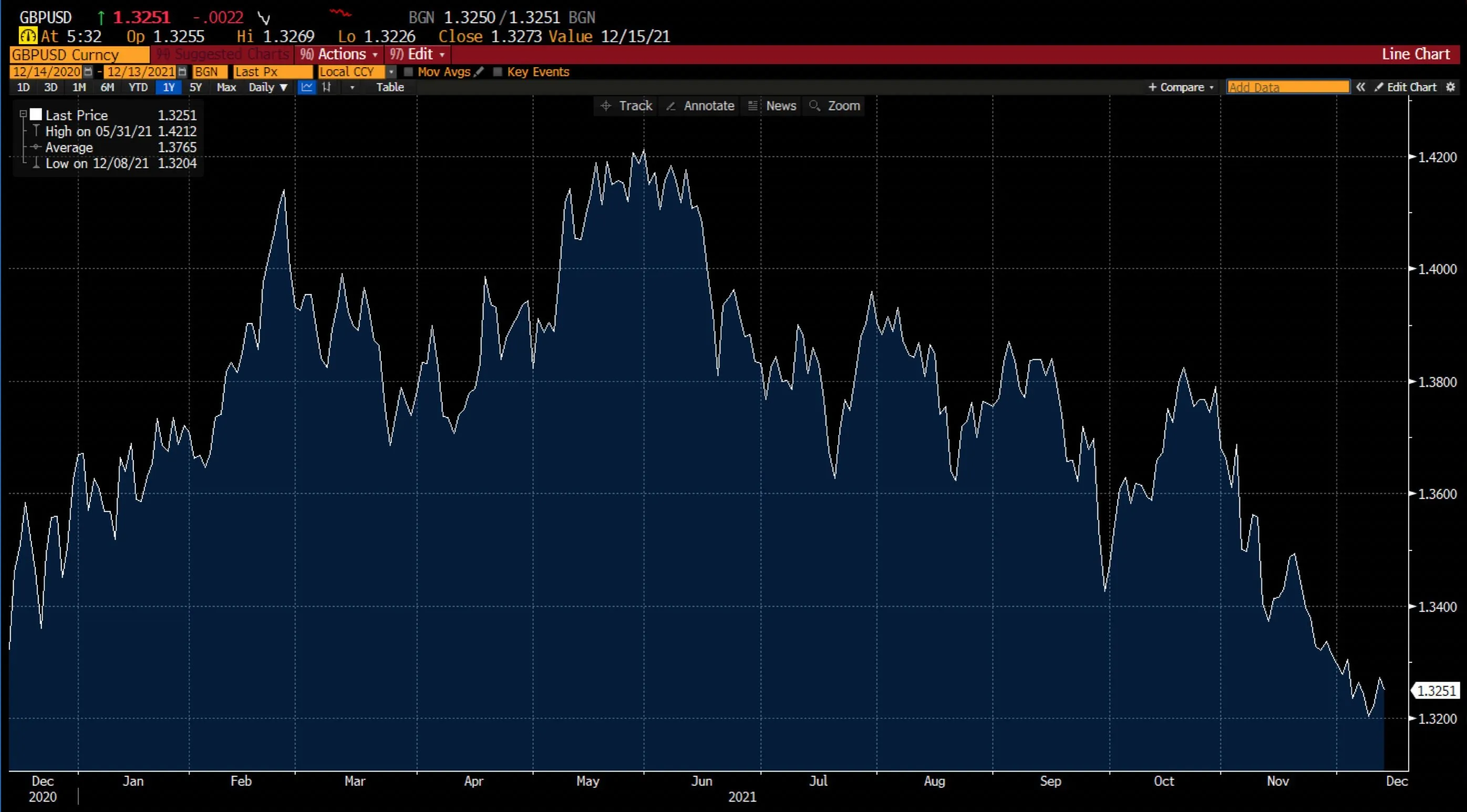
As the UK tightens its coronavirus restrictions once more, the pound is headed for its first yearly loss since 2018. Prime Minister Boris Johnson is encouraging people to work from home to prevent the spread of Omicron. This measure has stoked fears about the country's sputtering economy and forced traders to pare back their bets on an interest rate hike, which just weeks ago looked like a done deal.
A shift in sentiment has seen the pound retreat to the $1.33 level against the dollar. The GBP/USD is trading close to its support level near $1.31 at 61.8% retracement level, followed by the next support level near $1.28 at 50% retracement level.
It is, however, the Bank of England’s monetary policy decision that will get the most attention this week. Final policy decisions of the year are also to be made by the Federal Reserve and European Central Bank this week. While parts of Europe experience far stricter lockdowns, there is little doubt the European Central Bank will remain dovish.
Commodities
Oil markets let out a sigh of relief upon hearing that the Omicron strain may not hinder global demand as potently as originally feared. With recent demand remaining stagnant and global crude inventories well below their 5-year average, oil markets appear to be at a temporary sweet spot, with Brent Crude and WTI trading around the $75.00 per barrel and $72.00 per barrel mark, respectively.
Both Brent and WTI Crude benchmarks broadcast gains of around 8% last week, their largest weekly gains since late August. This occurred whilst several downside risks are still weighing on the horizon. Weak international air traffic and rising covid cases across Europe may still be looming in the eyes of investors, but soaring US inflation figures are adding to oil’s bullish sentiment, largely counteracting the above-mentioned risks.
Investors will keep an eye on whether WTI crude can break through its first major resistance level around $74.00 at the 78.6% retracement level. Looking downwards, its first major support level lies around the $65.00 level at 61% retracement, followed by its second support of approximately $59.00 per barrel at the 50% retracement level.
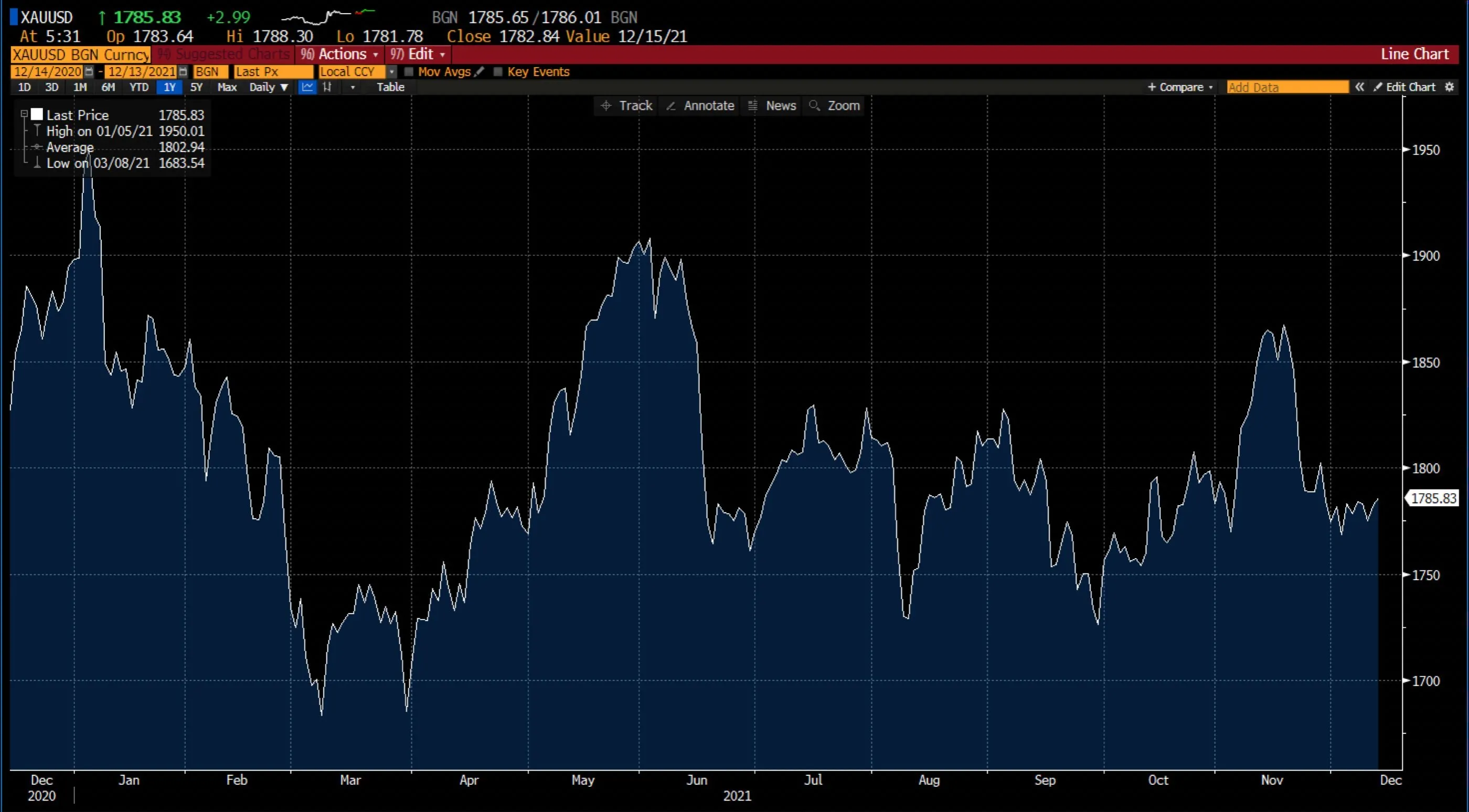
In the metal markets, gold prices gained momentum on Friday, 10 Dec 2021 although not enough to stop its fourth straight weekly fall. Investors kept to the sidelines ahead of November’s 40-year high Inflation figures that could influence the Fed’s next changes to monetary policy.
Gold gained 0.1% to hit $1,776.23 per ounce, whilst bullion prices dropped 0.4% as rising inflation and a strengthening labour market left investors inclined towards caution. Should the Federal Reserve decide to further accelerate the pace of its asset purchases in line with the interest rate hikes, it could impact the future price of gold.
Cryptocurrency
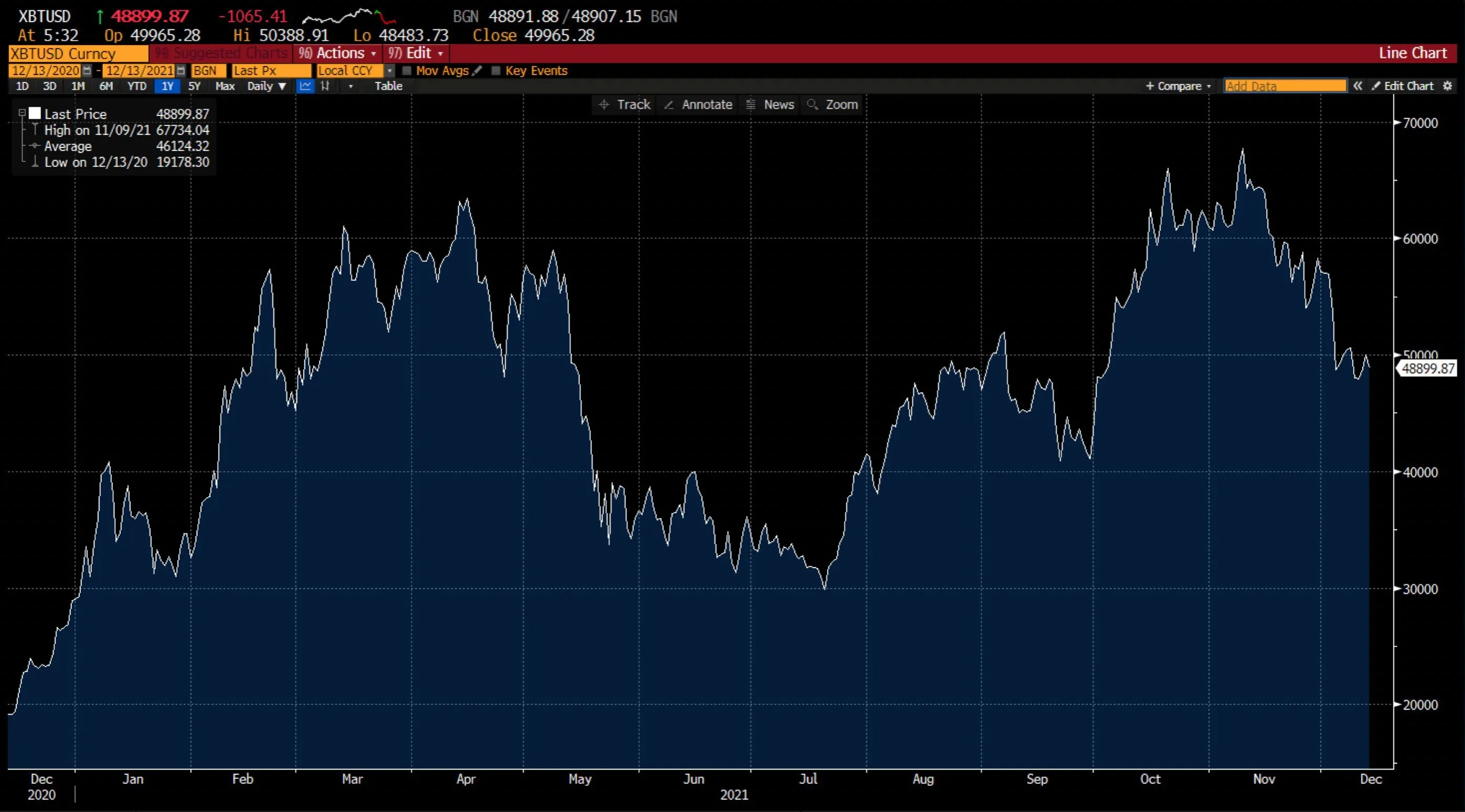
The crypto market continued to slump after last week’s minor crash, as investor sentiment hit its lowest levels since July 2021. Bitcoin (BTC), Ethereum (ETH), Solana, (SOL), Binance Coin (BNB) and Cardano (ADA) were all down between 1-5% on Friday, 10 Nov 2021 from the previous 24 hours. These combined losses wiped around $100 billion from the overall cryptocurrency market, pushing its total capitalisation back below $2.3 trillion.
Bitcoin’s disastrous declines over the first weekend of December extended to trading on Monday, 6 Dec 2021. After losing almost a fifth of its value at one point, Bitcoin absorbed a 5% fall to begin the trading week.
A volatile period for the world's largest cryptocurrency saw its value swing from gains to losses and back to gains on Friday after the release of key US inflation data showed consumer prices to be rising at their hottest rate in almost 40 years.
Bitcoin ended lower on Friday, down 0.82% to end the day around $47,200. Over the week, it was left stranded for its fourth consecutive weekly decline. In comparison to previous $100,000 year-end forecasts, or even a return of last month's record high of $69,000, the popular digital asset is struggling to play out the festive season as investors initially imagined.
However, over the weekend session with Saturday’s rally, Bitcoin was able to rebound, shooting through its first key resistance around $48,740, and placing its new resistance at the $53,460 mark at the 61.8% retracement level.
Trade US indices, forex, and commodities with options on DTrader and with CFDs on Deriv MT5 Financial and Financial STP accounts. Trade cryptocurrency with multipliers on DTrader and CFDs on Deriv MT5 Financial and Financial STP accounts.
.webp)
Synthetic Indices Deriv guide for smart trading
In 2025, Deriv strengthened its synthetic ecosystem by introducing fifteen indices available on both Deriv MT5 and Deriv cTrader.
Volatility lies at the heart of every trading decision — it defines how markets move and how traders manage risk and opportunity. On Deriv, volatility is represented through synthetic indices: mathematically generated markets designed to mirror real-world price behaviour without being influenced by economic data, news, or liquidity changes.
In 2025, Deriv strengthened its synthetic ecosystem by introducing fifteen indices available on both Deriv MT5 and Deriv cTrader. These one-second tick instruments deliver faster execution, more refined volatility control, and seamless automation via cBots and Expert Advisors (EAs). Together, they reinforce Deriv’s position as a leader in transparent, data-driven synthetic markets, built for traders who value precision and stability.
These indices promote consistency and flexibility. They allow traders to test, refine, and automate strategies in an always-on environment, ideal for algorithmic development, educational use, and strategy optimisation.
Quick summary
- Synthetic indices replicate market behaviour with fixed volatility levels (10%, 15%, 30%, 90%, 100%, 150%, and 250%).
- Crash/Boom indices represent event-based markets with probabilistic price spikes or drops.
- The new one-second series includes Volatility 15, 30, and 90 (1s), plus Boom 600, Crash 600, Boom 900, and Crash 900 — all available on Deriv MT5 and Deriv cTrader.
- The one-second series bridges traditional volatility concepts like the VIX with synthetic consistency, enabling traders to plan around predictable volatility regimes.
What are synthetic indices on Deriv and why do they matter?
Deriv’s synthetic indices are algorithm-based instruments that maintain statistically consistent volatility conditions, simulating real market dynamics in a controlled environment. These include Volatility, Range Break, Drift Switch, Step, and Crash/Boom indices.
Volatility indices represent constant volatility levels, while Crash/Boom indices introduce stochastic elements, generating price spikes or drops based on event probabilities. This structure enables traders to experience realistic market behaviour without external disruptions, perfect for strategy testing and automation.
They offer continuous data streams for studying market reactions, backtesting automated systems, and teaching volatility management in isolation from global events.
How do Deriv MT5 and Deriv cTrader support one-second volatility indices trading?
The 2025 expansion marks a major step in Deriv’s synthetic-trading evolution. According to Prakash Bhudia, Deriv’s Head of Product & Growth:
“The new indices “amplify opportunities by giving traders faster, cleaner access to volatility patterns without needing complex technical setups.”
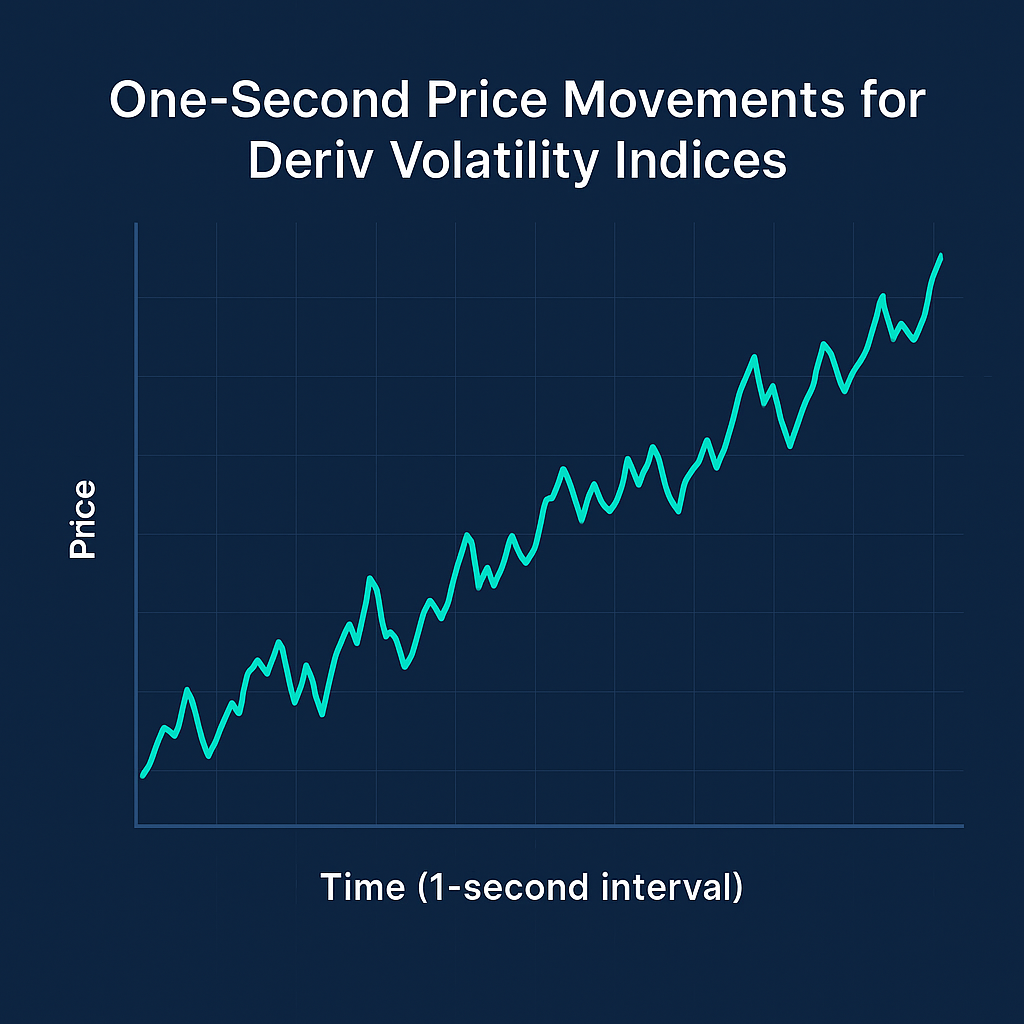
These developments make synthetic markets more practical for quantitative analysts, educators, and active traders exploring volatility systematically.
How do Crash Boom indices, Range Break, and Drift Switch differ?
The table below outlines each index family and its trading applications.
Notes: “σ” denotes volatility; event frequency = long-term average, not fixed timing.
Where to trade and what each platform offers
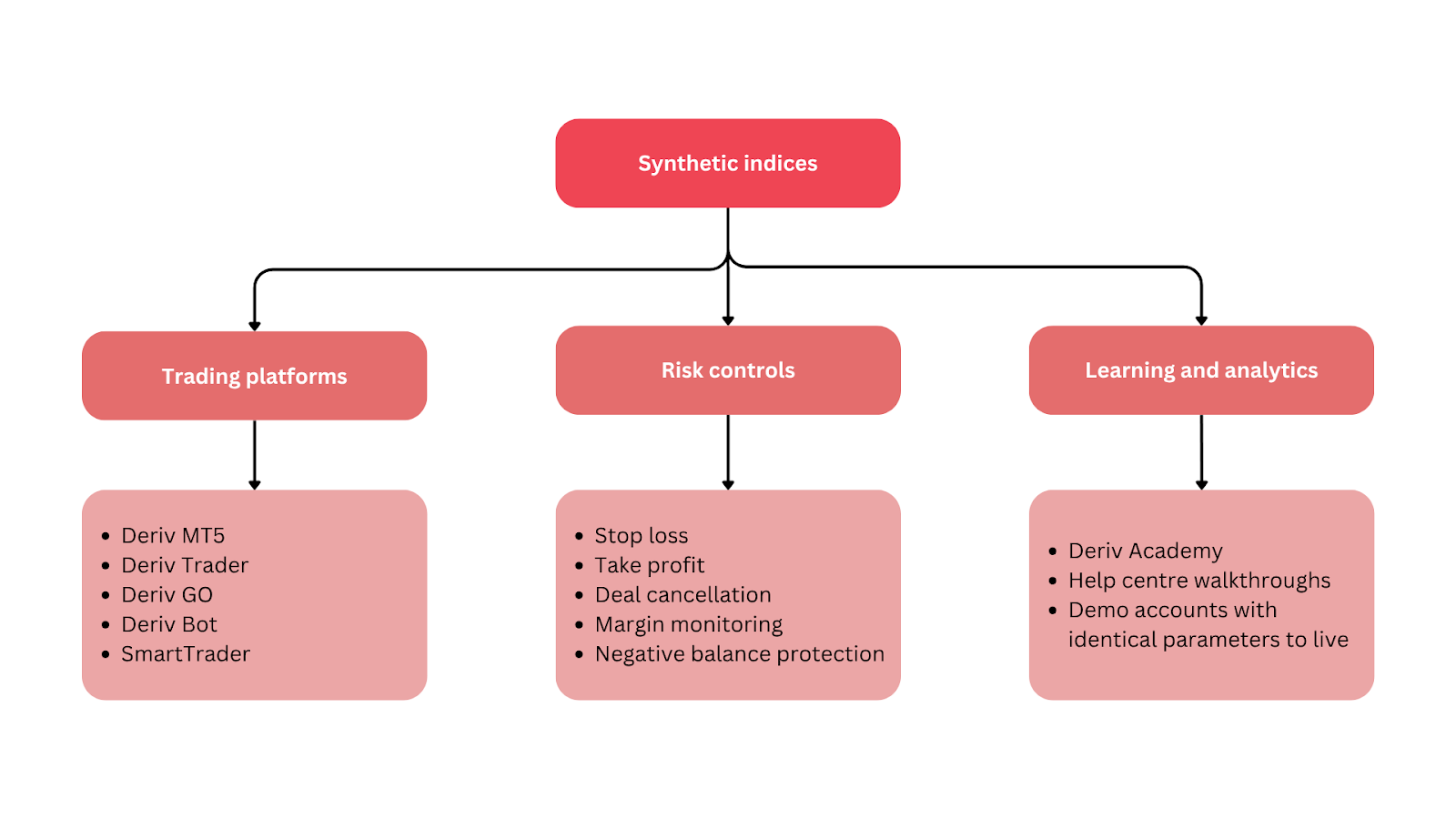
- Deriv cTrader — Advanced order types, Depth of Market, and cBots automation. Best for 1-second indices and Crash/Boom 600–900 series.
- Deriv MT5 — Multi-asset platform supporting EAs and hedging. Ideal for combining synthetic indices with forex, cryptocyrrencies, and derived assets in one account.
- Deriv Trader — Simplified interface for multipliers and options; offers fixed-risk control.
- Deriv GO — Mobile app for tracking trades and exposure.
- Deriv Bot — No-code automation builder for basic strategies.
Each platform integrates within Deriv’s ecosystem, enabling traders to develop and move strategies from demo to live seamlessly.
Which synthetic trading strategies suit each volatility environment?
Crash and Boom indices model sudden price moves — upward booms or downward crashes. Each tick carries a small chance of a major move:
- Crash 600 ≈ one large drop every 600 ticks on average.
- Boom 900 ≈ one major spike every 900 ticks on average.
This stochastic structure supports two main tactics:
- Breakout strategies — enter as the spike begins and trail the move.
- Fade strategies — trade in the opposite direction once volatility settles.
By studying spike frequency and size, traders can design realistic stops and manage drawdowns effectively.
Synthetic volatility and the VIX analogy
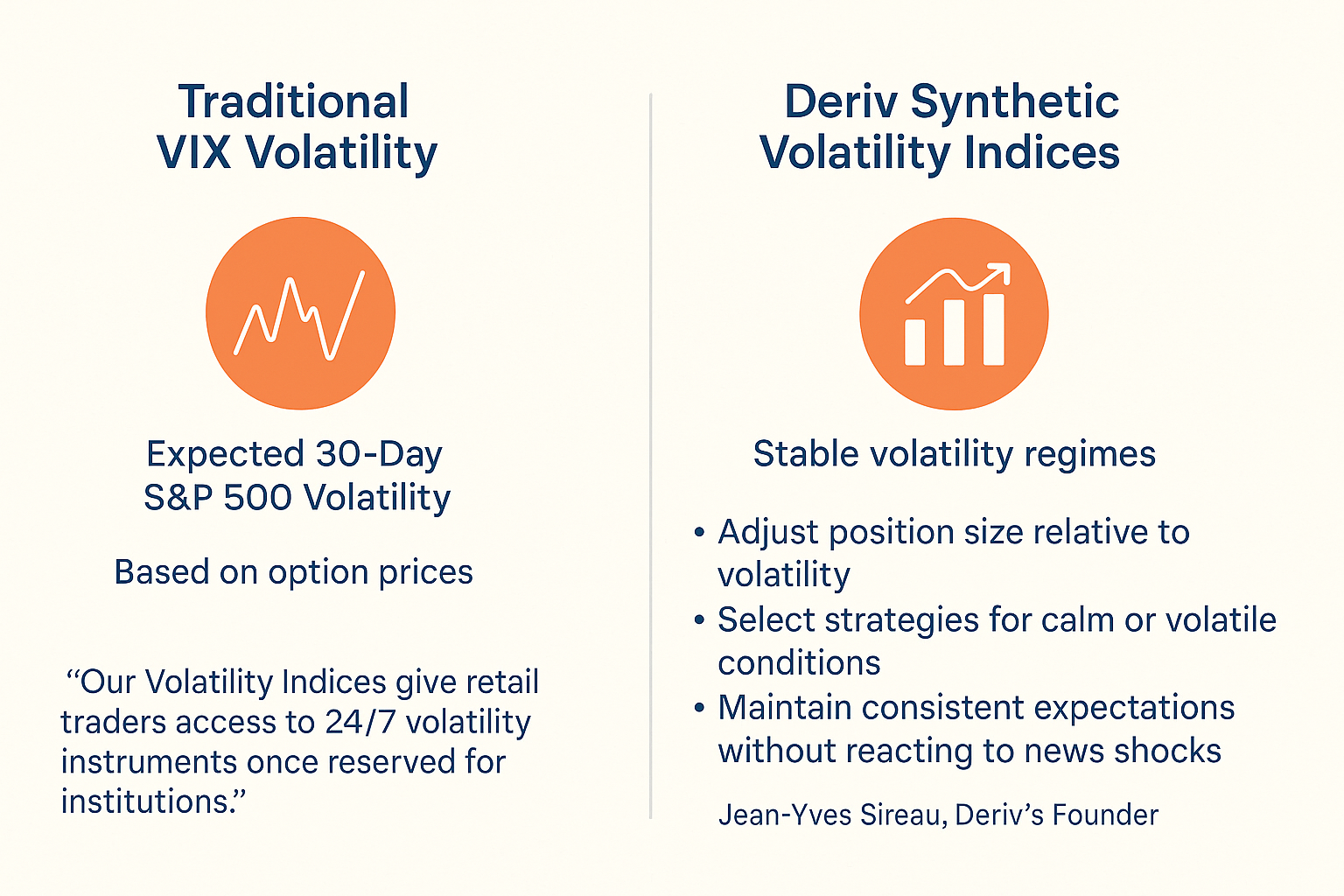
In traditional markets, the VIX measures expected 30-day S&P 500 volatility. Deriv’s synthetic indices play a similar analytical role — representing stable volatility regimes for planning and comparison. Unlike the VIX, Deriv’s indices are derived from cryptographically-secure algorithms rather than option prices.
This analogy helps traders:
- Adjust position size relative to volatility.
- Select strategies for calm or volatile conditions.
- Maintain consistent expectations without reacting to news shocks.
As Jean-Yves Sireau, Deriv’s Founder, notes:
“Our Volatility Indices give retail traders access to 24/7 volatility instruments once reserved for institutions.”
What are the best algorithmic trading tools for Deriv’s synthetic markets?
- Volatility 15 (1s) – Micro-scalping and mean reversion using MA, RSI, and Bollinger Bands with tight stops.
- Volatility 30 (1s) – Balanced setup for short-term momentum; combine MA crossovers with ATR-based stops.
- Volatility 90 (1s) – For breakout systems with wider stops; use time-based exits to reduce churn.
- Crash/Boom 600–900 – Event-driven tactics; trade breakouts or reversals with ATR trails and structured risk limits.
Rakshit Choudhary, Deriv’s CEO, elaborates:
“The company’s goal is to advance AI-first trading technology and empower traders with precision tools for the next decade.”
How Deriv’s ecosystem links its markets
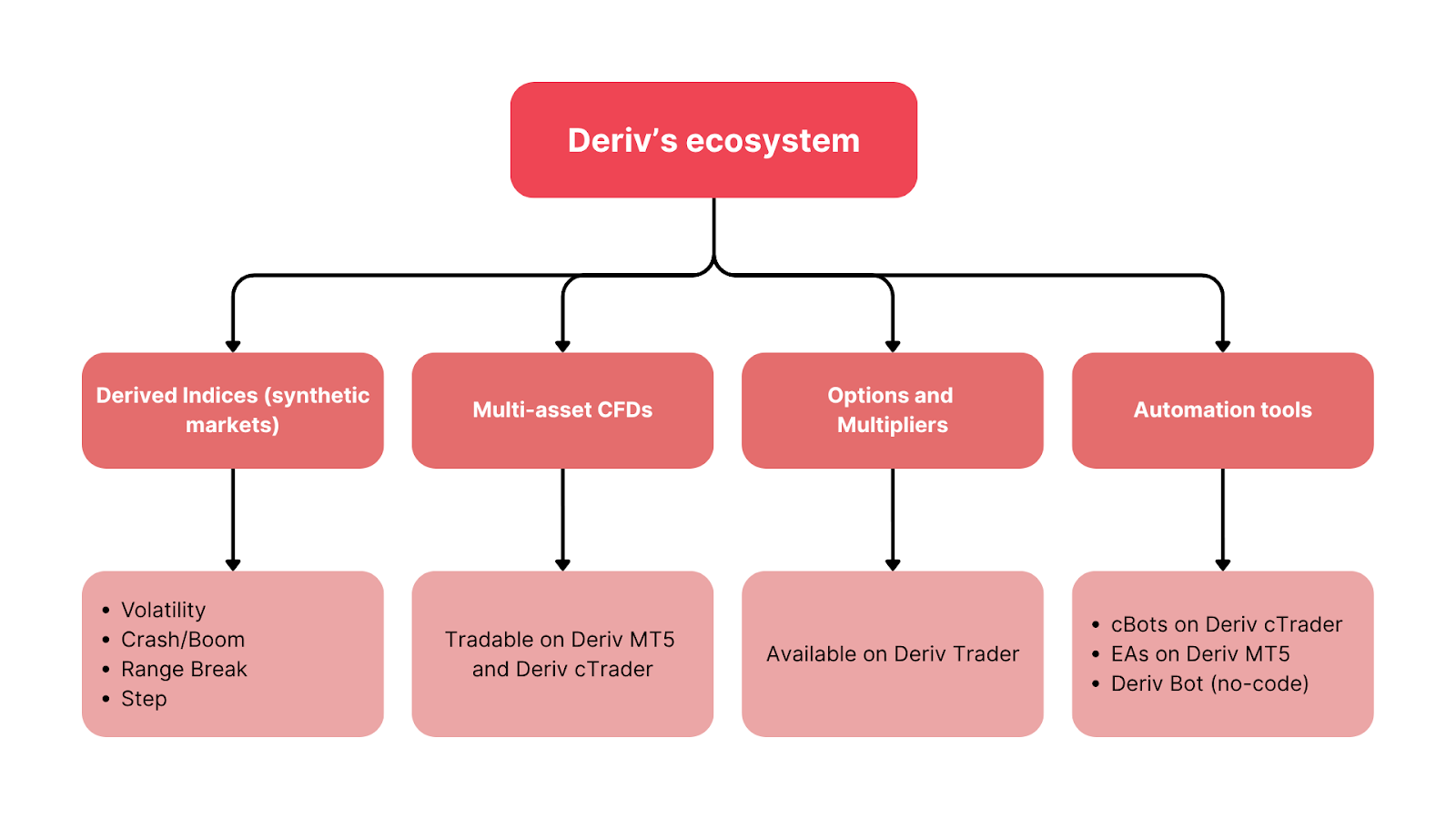
Deriv’s infrastructure connects all its markets and platforms, creating a unified environment for education, testing, and live execution. Deriv operates with cryptographically-secure random-number generation (RNG) and transparency standards to ensure fair synthetic market behavior.
Ecosystem overview:
- Derived indices – Volatility, Crash/Boom, Range Break, Step.
- Multi-asset CFDs – Tradable on Deriv MT5 and Deriv cTrader.
- Options & multipliers – Available on Deriv Trader.
- Automation tools – cBots, EAs, and Deriv Bot (no-code).
This network lets traders build, test, and scale strategies fluidly. Lessons from synthetics — on leverage, stop placement, and drawdown control — translate directly into other asset classes.
Sorry, we couldn’t find any results matching .
Search tips:
- Check your spelling and try again
- Try another keyword