
Results for
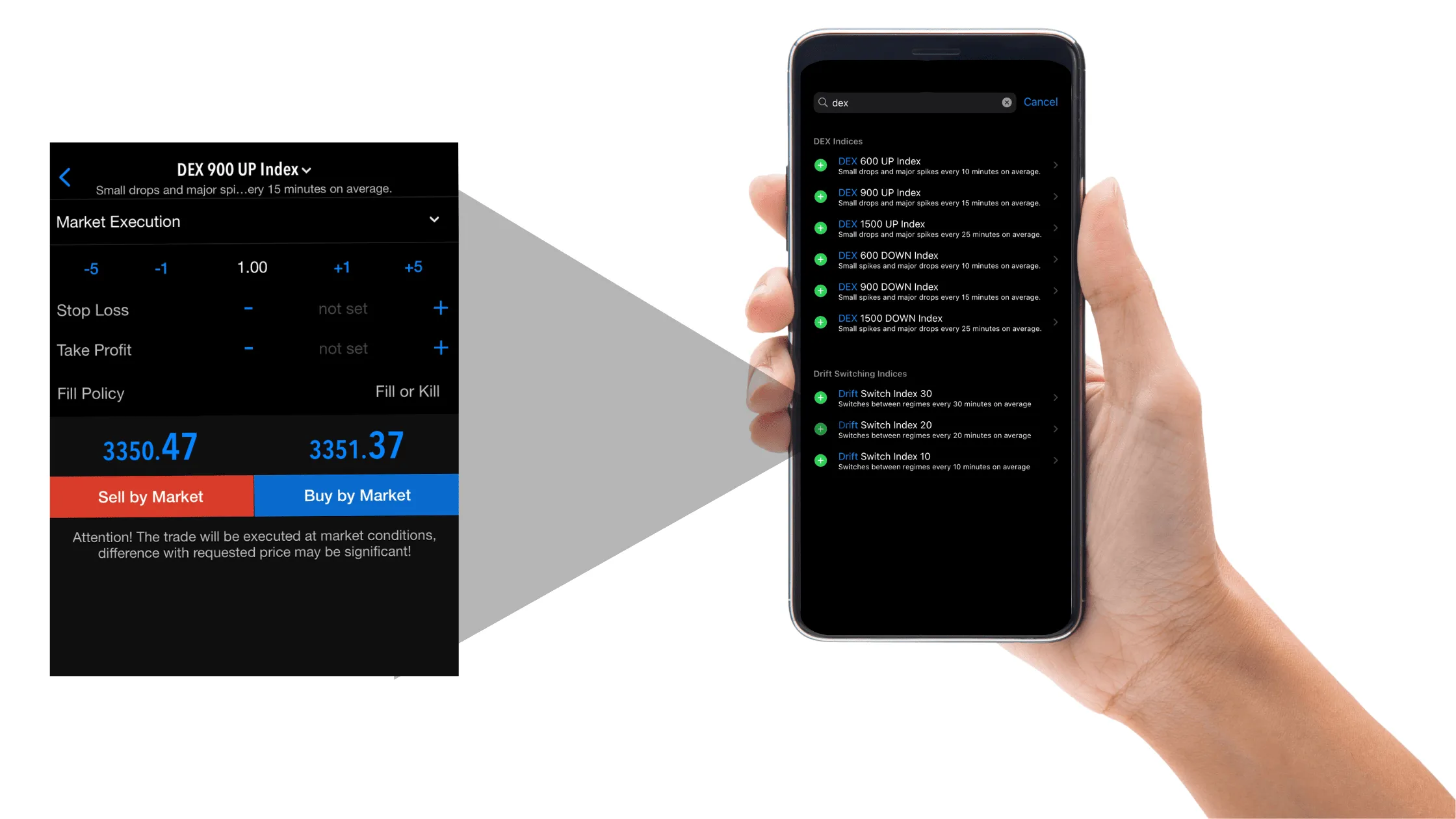
5 steps to trade DEX indices and DSI on Deriv MT5
Learn how to trade Double Exponential Jump Diffusion Index (DEX) & Drift Switch Indices (DSI) on Deriv MT5 in 5 steps.
Want to get started on Double Exponential Jump Diffusion Index (DEX) and Drift Switch Indices (DSI)? Trade it on Deriv MT5 in 5 easy steps.
1. Choose your index
Choose from 6 DEX and 3 DSI instruments to diversify your trading portfolio.

2. Add the index to your list
A higher Day % means a greater price jump (and potentially better asset performance) over the past 24 hours.

3. Tap on the symbol to trade
Chart, details, and statistics options are also available for further analysis.

4. Manage your trade
Customise your trade by setting your preferred parameters, such as stop loss, take profit, and fill policy.

5. Open your trade
Tap Sell or Buy by market to place your trade.

For more information on DEX indices and DSI, visit our website.

Inflation watch: Will gold be your refuge?
In this latest InFocus episode, we focus on what could change gold prices in times of high inflation, and how it can impact your trading strategies.
In this latest InFocus episode, we focus on what could change gold prices in times of high inflation, and how it can impact your trading strategies:
- US inflation and interest rate decisions
- US CPI report and gold prices
Stay informed with our weekly market analysis on InFocus, equipping you with critical insights to make informed decisions.

Bitcoin or Nvidia: Which asset is set to dominate the next decade?
A look at how Nvidia's 200% growth could pose a challenge to Bitcoin's dominance. Find out what lies ahead for these top-performing assets.
Putting bitcoin side-by-side with assets from other classes always seems like an unfair matchup, with Bitcoin dominating the gains column like it did in 2023 — compared to other assets.

However, Nvidia emerged as a worthy challenger, not only rivaling, but surpassing Bitcoin’s impressive gains with the asset going up more than 200% last year!
Nvidia Corp and BTC historical data analysis
Both assets have undergone significant transformation, stunning analysts with their before-and-after pictures. Just five years ago, Nvidia stock struggled to reach USD 54, while the company was forced to revise its earnings guidance downward from USD 2.7 billion to USD 2.2 billion. This decline was spurred by waning demand for gaming GPUs and turbulence in the cryptocurrency market for miners.
Nvidia CEO Jensen Huang voiced frustration over the sporadic and unpredictable nature of significant purchase orders. He described Q4 2018 as a “real punch in the gut”, employing terms like “unusually turbulent” and “disappointing quarter”— terms that are uncommon for him to use today.
Bitcoin also had its tribulations back in 2019. Beyond enduring a steep decline amid a harsh crypto winter, a widespread Chinese crackdown on all crypto businesses cast doubt on the legitimacy of the asset class, as per analysts’ observations at the time. Regulatory turmoil also ensued in the United States, with the IRS categorising Bitcoin as property and the Commodity Futures Trading Commission (CFTC) treating it as a commodity.
Moreover, the introduction of the first Bitcoin futures contracts on the Bakkt platform received a lackluster response, failing to bolster the asset price.
Bitcoin and Nvidia Corp performance today
In just five years, Nvidia has become one of the hottest properties in the investing scene, breaching the coveted USD 1 trillion market cap. The company’s Q4 2023 earnings report dominated news cycles, with Nvidia achieving a staggering USD 22.1 billion — a significant 22% increase from the previous quarter. The stock price also surged, reaching a new high above USD 800 per share. Some analysts are even calling Nvidia the “most important stock on earth.”

Fueled by the surge in generative AI, Nvidia has risen to the challenge by manufacturing best-in-class GPUs. Their H100 GPUs, the workhorses of generative AI, are in high demand, with thousands ordered despite the hefty USD 30,000 price tag. This rapid growth is a clear sign of Nvidia’s dominance in this critical area of AI development.
Bitcoin, on the other hand, has been on the rise since late last year and has picked up the pace since the turn of the year. This rally follows a significant downturn caused by the FTX collapse and legal troubles surrounding Binance co-founder, Changpeng Zhao. Bitcoin is now hovering near its all-time high of USD 68,900, with analysts predicting a decisive break above this level imminently.

Buoyed by the SEC giving the nod to Spot Bitcoin ETFs from top financial institutions, and the hot anticipation ahead of April’s halving event, some analysts expect bitcoin to touch highs of USD 100,000 in 2024.
With the before and after picture laid out, what could the next decade look like for both assets and which one could come out on top?
The bearish argument: Will Nvidia stock go down?
While the two may be jacked at the moment, there are analysts poking holes at the potential growth of the assets. Head of financial analysis at AJ Bell, Danni Hewson believes that investors should define their risk before going heavy into Nvidia stock.
“At the moment, it’s going from strength to strength - but, as with all companies showing this kind of stellar growth, there is a ceiling somewhere, and investors need to be careful that they in their minds know what that ceiling is for them.”
Others like Andrew Merricks, portfolio manager at IDAD funds, called for caution while selecting the stock - terming it a “bubble”.
“Nvidia has to be a bubble. It’s not sustainable. It can’t be. However, anything connected to AI is a good long-term investment.”
Bubble or not there are legitimate bearish concerns going forward, such as the ability of the company to keep up with orders — considering the supply side hiccups of mid-2023. Though Nvidia has made decent sales when it comes to its gaming and crypto-mining chips, its main money maker is the AI chip. There are also concerns about a possible dip in demand for AI chips, especially after the recent ban prohibiting the sale of US chips to China.
Bitcoin’s fast-paced growth may soon flatten according to some analysts who think that the price is at a strong resistance region and that the demand for bitcoin ETFs may slow down soon despite the record inflows observed at Blackrock.
The bullish argument: Will the uptrend continue?
Amidst predictions of a slowdown in AI chip demand down the line, Nvidia is proactively ramping up its innovation efforts to maintain its competitive edge. The company is gearing up to unveil consumer-centric graphics cards designed to facilitate AI applications on desktops and smartphones.
These upcoming cards are poised to streamline the customisation of generative AI, with the impending chipset expected to accelerate the creation of AI-generated videos by 1.5 times and images of 1.7 times. With such strategic initiatives underway, Wall Street analysts like Vijay Rakesh are optimistic about Nvidia’s revenue potential, projecting a staggering USD 300 billion in revenue by 2027.
Bitcoin analysts are painting an optimistic picture as the current bull-run cycle progresses. With the impending halving event on the horizon, analysts anticipate a scarcity mindset among buyers, who are expected to fervently add more Bitcoin to their portfolios.
Moreover, the recent record inflows into Blackrock’s Spot Bitcoin ETF, following substantial inflows of approximately USD 778 million worth of BTC into IBIT, further bolster confidence in Bitcoin’s upward trajectory. This influx of institutional capital underscores the growing acceptance and adoption of Bitcoin within traditional financial circles, fuelling expectations of continued price appreciation in the near term.
This is an indicator of increasing institutional interest as the spot ETFs become “a significant factor in bitcoin’s price discovery”, according to Vetle Lunde, a senior analyst at K33.
Anticipating the road ahead
These assets could be set for exponential growth over the next decade. As to which one could be worth more in 10 years, it will depend on each asset’s resilience during bear cycles and their reaction to market conditions along the way.
Bitcoin could keep pumping until it runs into more regulatory hiccups, as governments and central banks grapple with how to deal with it. Nvidia on the other hand, could feel the burn in case market conditions change for the worse, and the AI arms race leads to significant restrictions by important countries such as the United States and China.
As for now, you can get involved and speculate on the price of these two incredible assets with a Deriv MT5 account. It offers a list of technical indicators that can be employed to analyse prices. Log in now to take advantage of the indicators, or sign up for a free demo account. The demo account comes with virtual funds so you can practise analysing trends risk-free.
.webp)
Automated trading: The future is now
Automated trading has taken the world by storm. Learn about the future trends and how to take advantage of automated trading platforms.
Explore what’s in store for the future in automated trading. See how you can make the best of this fast-evolving aspect of online trading.
Automated trading, affectionately known as bot trading, has become very popular in the last decade as trading technology advances. The increasing complexity of financial markets has also played a significant role, attracting traders worldwide to jump on the automated bandwagon.
What is automated trading?
Automated trading uses software (a trading bot) to execute trades on your behalf. Automated trading systems can be programmed to follow any trading strategy and can be used to trade a variety of asset classes.
Some benefits of automated trading are:
- Convenience
Trading bots can trade 24/7, so you don't have to sit in front of your computer all day to trade. - Discipline
Trading bots can follow your trading strategies to the letter without the influence of emotions or biases. - Accuracy
Trading bots can execute trades faster and more accurately than humans.
If you’re thinking of getting into bot trading, read on as we explore what’s in store for the future.
5 game-changing future trends
- Increased use of artificial intelligence (AI) and machine learning (ML)
AI and ML are already being used to develop more sophisticated trading algorithms and to make better trading decisions. In the future, AI and ML are expected to play an even more significant role in automated trading as they become more powerful and accessible. - Greater automation of the trading workflow
Currently, many aspects of the trading workflow are still manual. In the future, more and more of these tasks are expected to be automated using AI and ML. This will free traders to focus on more strategic tasks, such as developing and refining trading strategies. - More personalised trading experiences
Bot trading platforms are becoming increasingly sophisticated and personalised. Traders can now tailor their trading bots to their needs and risk tolerance. In the future, trading bots are expected to become even more personalised as they use AI and ML to learn more about each trader's preferences. - Increased use of blockchain technology
Blockchain technology can revolutionise the way that financial markets operate. Using secure, decentralised ledger technology, self-executing contracts (smart contracts) can automate complex transactions. Thanks to blockchain technology, we can expect to see more secure and efficient automated trading systems in the near future. - The rise of social trading
Social trading platforms allow traders to connect with each other, share trading ideas and strategies, and even automatically copy the trades of successful traders. Social trading is expected to become more integrated with automated trading as traders use social trading to identify and follow successful trading strategies.
Hold on, it has risks, too
While automated trading offers many advantages, it’s not a magic bullet. Using trading bots has its risks. It’s essential to carefully evaluate any bot trading system before using it and to understand the risks involved.
Here are 3 important risks to consider:
- Technical failures
Automated trading systems rely on technology, and technology can fail. This could include hardware failures, software failures, or internet connectivity issues. If your trading bot fails, it could execute trades you did not intend to make or miss out on profitable trades. - Human error
Humans create automated trading algorithms, and humans make mistakes. While algorithmic trading is innovative, if there is a bug in your trading bot system, it could lead to losses. - Market volatility
Bot trading systems are designed to trade in various market conditions, but they are not perfect. If the market becomes too volatile, your trading bot may be unable to keep up, and you could lose money.
The future is bright
As AI and ML become more powerful and accessible, automated trading platforms are expected to become more bot trading more accessible to a broader range of traders and help traders make better trading decisions. We will also see more trading brokers offering exciting automated trading solutions in the next few years.
If you want to ride the wave of the future and get into bot trading, Deriv Bot is a great trading platform to start with. Explore automated trading on Deriv Bot risk-free with a demo account with virtual money.
.webp)
How CFD traders benefit from market news and sentiment
Discover how CFD traders can leverage market news and sentiment to gain a competitive edge. Learn more about the benefits of staying informed.
News and market sentiment play an essential role in CFD (Contract for Difference) trading. News events can affect the price of a CFD contract, and market sentiment can indicate how CFD traders feel about the market.
News events can be anything that affects the supply or demand for a commodity. For instance, a natural disaster can disrupt production, leading to a decrease in supply and an increase in price. A political event, such as a change in government, can also affect the price of a commodity.
Market sentiment is the collective opinion of traders about the future direction of the market, differentiated by bullish sentiment and bearish sentiment. If traders are bullish, they believe that the price of a CFD contract will go up. If traders are bearish, they think that the price of a CFD contract will go down.
Traders can use news and market sentiment to make informed trading decisions. By understanding the factors that are affecting the price of a CFD contract, traders can better predict how the market will move and make more profitable trades. Let’s explore this further.
KEY TAKEAWAYS
- Market news provides vital information, impact assessment, and risk management insights. Pay attention to major news events; they can have a significant impact on the financial markets. Risk management can help you protect your capital and minimize your losses.
- Market sentiment reflects the emotions and attitudes of traders and can indicate potential market directions. Monitoring market sentiment can help you make more informed trading decisions. Technical analysis can help you identify trends and patterns in market prices.
Market News
- Information Source: Market news serves as a primary source of information for traders. It includes a wide range of data, such as economic reports, corporate earnings announcements, geopolitical developments, and news related to specific assets or industries.
- Impact Assessment: Traders use market news to assess the potential impact of events and developments on asset prices. For example, positive earnings reports from a company can boost the stock's price, while negative economic data can lead to market declines. There are always estimated/expected results for economic data, and the market reaction is usually dependant on how the actual data figures differ from the expectations.
- Risk Management: News can signal potential risks or opportunities. Traders often use news to adjust their positions or implement risk management strategies. For instance, if there's news of political instability in an oil-producing region, traders may anticipate a rise in oil prices and adjust their CFD positions accordingly.
- Trading Signals: Some traders employ news-based trading strategies, where they actively react to news events by entering or exiting CFD positions. This approach is known as news trading and relies on quick execution and analysis of breaking news.
Market Sentiment
- Emotional Gauge: Market sentiment represents the collective emotions and attitudes of traders and investors. It can be bullish (positive) or bearish (negative) sentiment, reflecting market participants' overall outlook on a particular asset or the market as a whole.
- Indicator of Market Direction: Sentiment can often anticipate market direction. If there is overwhelmingly positive sentiment around a particular asset, it can drive prices higher, while negative sentiment can lead to price declines.
- Contrarian Indicators: Contrarian traders often go against prevailing sentiment. They believe that when sentiment reaches extreme levels (excessively bullish or bearish), it can signal a potential reversal in price. For instance, if the majority of traders are overly bullish on a stock, it may be a contrarian signal to consider shorting it.
- Sentiment Analysis Tools: Traders use various tools and indicators to gauge sentiment, including sentiment surveys, social media sentiment analysis, and options market sentiment indicators. These tools help traders assess the prevailing sentiment accurately.
Together, market news and sentiment help traders make informed decisions, identify trading opportunities, and manage risks effectively.
However, it's important to note that sentiment trading is just one part of a trader's toolkit. Market news and sentiment should be combined with technical and fundamental analysis, risk management strategies, and a thorough understanding of the CFD market to make well-rounded trading decisions.
On Deriv, you can trade CFDs on Deriv MT5 and Deriv X for CFDs.
Sign up for a free demo account to start exploring CFD trading. It comes preloaded with 10,000 USD virtual currency so that you can practise trading commodities online risk-free.
If you’d like to learn more about trading CFDs and calculating profits/losses, check out our CFD trading guide.

Smart contracts in blockchain: The end of contracts as we know them
Smart contracts are like a secure online record book. Learn how smart contracts work, their benefits and why they are the future of contracts.
Imagine a world where money is digital, secure and instantly transferable, all without the wild price swings of the crypto rollercoaster. Enter digital standards, like the ERC-20, that guide how digital coins are created. These standards form the backbone of the digital revolution, with stablecoins like USDC and USDT that are built on these standards offering ideal compatibility for smart contracts.
What are smart contracts and how do they work
A smart contract is a special computer program that lives on a blockchain (like a secure online record book). This program holds the terms of an agreement between two or more parties. Imagine a smart contract like a super organised to-do list stored on a secure, shared computer system called a blockchain. It outlines the steps everyone agrees to, like sending a payment or delivering a product. The smart contract then automatically checks off tasks as they're completed, making sure the deal happens without anyone needing to constantly monitor it.
Unlike traditional agreements where you need lawyers, regulators and other suits to ensure all terms have been adhered to, smart contracts authenticate deals through a network of nodes. These nodes verify and validate all aspects of the transaction, eliminating the need to constantly question each other's intentions. This is what they mean when they call it “trustless”.
Benefits of smart contracts
Smart contracts are the most talked about development in the blockchain world and are becoming increasingly popular in the financial world – and it's easy to tell why. When computer scientist Nick Szabo conceived the idea for smart contracts, he wanted to change the fickle nature of the contract game at the time.
Smart contracts eradicate the fickleness of traditional contracts in three main ways.
- They eliminate counterparty risk
Counterparty risk is possible in traditional centralised systems because the enforcer is a human - who can be biased or corrupt. Smart contracts are decentralised, automated, and immutable - making them perfect enforcers of solid agreements.
Smart contracts work like an escrow system. Basically an “if-then” system of managing transactions between parties. If one party's needs are met, then the transaction can be verified and completed.
Imagine a writer doing some work for a client’s website. The client can lock funds into a smart contract until the writer delivers work that meets the clients specifications. When the former is satisfied, funds can be immediately released to the writer. If the writer fails to satisfy the client, funds are sent back to the client and the contract is cancelled.
Smart contracts are useful in larger scale use cases too.
Smart contracts can revolutionise supply chains. A manufacturer could set up a smart contract that automatically triggers payments to suppliers the moment goods are scanned as received at a warehouse. Additionally, it could track the quality of goods and adjust payments accordingly. This system reduces transaction delays and increases trust in complex supply chains.
- They enhance record keeping
No more disputes about what was agreed in the past. No side arguments can be made under the guise of context either. This is because smart contracts record and secure the terms of the contract on the blockchain.
They do this through lines of code on the network that prevent malicious actors from altering any details. These records are immutable and timeless. Smart contracts have been embraced the most on the Ethereum network - with the ERC-20 being the anchor for smart contracts.
- They enhance security
Smart contracts offer enhanced security by leveraging the immutability of blockchain technology. Once deployed, the terms of a contract and its transaction history become nearly impossible to change. This tamper-resistance ensures that no single party can manipulate the agreement and provides a clear audit trail.
The decentralised nature of blockchains, where information is spread across a network of computers, provides another layer of security. There's no single point of failure, and consensus mechanisms ensure the network agrees on the validity of transactions.
Smart contracts: The future of blockchain
The potential benefits of smart contracts are still being fully realised. As adoption grows and use cases expand, we're likely to see them reshape industries from finance to healthcare to supply chain logistics. The future is decentralised, automated, and more secure – and smart contracts are paving the way.

S&P 500: Is the Boom sustainable?
In this latest InFocus, we explore how the US PMI & unemployment data influence market sentiments & the Fed’s interest rate decisions.
In this latest InFocus, we explore the major economic data that are poised to sway the S&P 500. We cover the following economic indicators:
- US manufacturing PMI data
- US non-manufacturing PMI data
- US unemployment rate
Stay informed with our weekly market analysis on InFocus.

Halving hype: Is Bitcoin at a pivotal moment?
In this latest InFocus, we analyse the upcoming Bitcoin halving event. Join experts in analysing Bitcoin's recent dip and its future trends.
In this latest InFocus, we analyse the upcoming Bitcoin halving event and the potential effects on the market. We cover the following:
- Bitcoin’s price correction
- Bitcoin’s historical trends
- Technical indicators
Stay informed with our weekly market analysis on InFocus.
.webp)
Will Japan’s rate pivot affect the yen?
What's next for the Yen currency? Join us as we examine the impact of the Bank of Japan's interest rate adjustments and policy shifts on the Yen.
In this latest InFocus, we explore the factors driving the Yen movements that could potentially impact your trades:
- Bank of Japan (BOJ) interest rate hike
- Bank of Japan (BOJ) yield curve control adjustments
Stay informed with our weekly market analysis on InFocus.
Sorry, we couldn’t find any results matching .
Search tips:
- Check your spelling and try again
- Try another keyword