
Results for

An introduction to Litecoin: The digital silver to Bitcoin’s gold
Learn about Litecoin’s history and performance, and find out how it can make your financial transactions more efficient and quicker.
Dubbed the “digital silver” to Bitcoin’s gold, Litecoin (LTC), serves as a faster and more lightweight alternative to Bitcoin, focusing on simpler transactions and aiming to be a viable option for everyday payments.
The origin story of Litecoin
When former Google engineer Charlie Lee envisioned Litecoin in 2011 as a complement to Bitcoin, he wanted a cryptocurrency that put speed and accessibility first, rather than focussing primarily on becoming a long-term store of value. He did not want to move away from the foundational code and principles of Bitcoin though — which are decentralisation and security.
What’s special about Litecoin?
While sharing its roots with Bitcoin, Litecoin sets itself apart through several strategic differences, which are viewed in the industry as buildups on the Bitcoin token. So, what distinguishes Litecoin from Bitcoin and other crypto coins you may want to buy
It offers faster transactions
Litecoin’s average block generation time is about 2.5 minutes — four times faster than Bitcoin’s 10-minute average. This accelerated block generation enables significantly quicker transaction confirmation times, making Litecoin more suitable for point-of-sale usage.
There’s an increased coin supply
In contrast to Bitcoin’s 21 million coin limit, Litecoin has a total supply cap of 84 million coins. This more abundant supply contributes to price stability and makes the coin more accessible to a broader user base. There is a bit of a twist here though – Bitcoin’s lower coin limit makes it more desirable because of basic forces of supply and demand, which creates a positive effect on price. There is also a gulf in value with Bitcoin’s market cap at USD 1.24 trillion compared to Litecoin’s USD 6 billion.
It works on a lighter mining algorithm
Litecoin employs Scrypt as its proof-of-work algorithm, while Bitcoin relies on SHA-256. Scrypt was initially designed to discourage the use of specialised mining hardware (ASICs), promoting a more decentralised mining landscape where everyday users could participate using regular computer equipment. This makes the network more accessible and easier to interact with.
Presents a sandbox for new upgrades
Litecoin’s close resemblance to Bitcoin’s core structure has made it a viable testing ground for launching upgrades and new features — before their potential rollout on the Bitcoin network. Experimenting on Litecoin allows developers to experience the real-world impact of updates in a lower-risk environment. Its faster block generation time also allows for a quicker validation of new protocols.
Everyday use cases of Litecoin
Beyond its role as a testbed, Litecoin has carved out a space for itself as a valuable cryptocurrency for everyday use.
Merchant payments
With its faster confirmations and low fees, Litecoin is an attractive option for merchants. Several businesses worldwide, both online and offline accept Litecoin as payment now.
Micropayments
The Lightning Network integrated with Litecoin makes it ideal for tiny, high-frequency transactions that would otherwise be impractical on Bitcoin’s main network due to fees and time constraints.
Cross-border remittances
Litecoin’s borderless and decentralised nature offers a cheaper and potentially faster alternative to traditional remittance channels, especially for smaller transactions.
Litecoin price trend in 2024 so far
The price of Litecoin has been dropping lately after a rally that started in late February 2024 and lasted throughout early March.

Analysts note a gradual but upward movement in the price of Litecoin, with the 50 SMA currently edging up, albeit at a slow pace, with the 200 SMA looking flat below it. The RSI is below the 60 mark in a neutral region suggesting balanced market sentiment.
The popularity of Litecoin is increasing every day with more and more users either depositing, withdrawing , or speculating on the cryptocurrency. You can get in on the action with a Deriv MT5 account. This popular CFD trading platform offers a list of technical indicators that can be employed to analyse prices. Log in now to take advantage of the indicators, or sign up for a free demo account. The demo account comes with virtual funds so you can practise analysing trends risk-free.
An important note
The cryptocurrency landscape is constantly evolving. While Litecoin currently excels in the use cases mentioned, innovations and competitors could reshape its role and value in the future.

Doubling down on the future: 3 thematic SPDR ETFs with strong growth potential in 2024 and beyond
Get your trading strategy geared up with these 3 SPDR ETFs that are likely to outperform in the near future. Learn more about them here!
Have you thought about weaving exchange-traded funds (ETFs) into your trading portfolio?
ETFs are a hot pick in the trading world, bundling a variety of underlying securities into one neat package. Take the traditional ETFs from State Street Global Advisors under the SPDR brand, for instance. They usually mirror the ups and downs of a broad market index like the S&P 500, offering you a slice of the action across multiple industries through just one transaction.
But it doesn’t stop there. SPDR also dishes out thematic ETFs that hone in on particular sectors, technologies, or social trends, taking the basic idea of an ETF and tailoring it to specific interests.
Diving deeper: What is a thematic ETF?
Thematic ETFs were introduced as a strategic option for traders seeking focused exposure to long-term trends and disruptive technologies. Unlike traditional ETFs that track broad market indices, thematic ETFs zero in on specific sectors or themes, such as robotics, clean energy, or e-commerce.
These ETFs first made their mark in the late 1990s and early 2000s, captivating traders with their potential for exceptional returns from transformative trends. By zeroing in on specific industries, trends, or themes – from technology and energy to emerging markets – thematic ETFs offer several key benefits, including:
- targeted exposure
- intra-theme diversification
- access to a wide array of securities within a similar theme.
Three sectors that are worth a look in 2024 are energy, financial services, and technology. Each of these sectors have high potential thematic ETFs under the SPDR banner that could make waves in 2024 and beyond.
Let’s examine three thematic ETFs relevant to these sectors to help you make more informed trading decisions.
The XLE ETF (Energy Select Sector SPDR Fund)
Since going live in 1998, the XLE has amassed a portfolio of close to USD 38 billion. This has made it the largest investment fund attempting to match the performance of the entire energy sector in the US equities market.
XLE ETF review
Its asset base includes some big names in the oil and gas, consumable fuels, and energy equipment service industries. Notable names in the sector include Exxon Mobil Corp (which account for 21.83% of the fund’s total assets) and Chevron Corp and Eog Resources Inc, which contribute significant percentages of the fund’s total assets.
The ETF has not exactly been on fire over the past year, having shed 3.82% of its value. It is also seen as high-risk, with a beta of 1.26 and a standard deviation of 29.22%. According to some analysts, this is because its holdings include some large cap companies whose shares can be volatile in a sector prone to uncertainty.
The oil and gas sector, however, is rebounding after a period of uncertainty, and the fund also has exposure to clean energy companies – a sector that is expected to grow in huge leaps over the next few years.
This ETF earns a ‘Strong Buy’ rating from Zacks, offering investors a low-cost, high-momentum option with strong potential returns in its asset class.
The XLF ETF (Financial Select Sector SPDR Fund)
Investing in the XLF ETF means taking a chance on the health of the financial sector of the S&P 500 – which includes banks, asset managers, and insurance firms. The ETF has a close to USD 37 billion in assets under management, and is the largest ETF attempting to track the broad financial sector in US equity markets.
XLF ETF review
The annual operating costs for the XLF are 0.10%, making it one of the least costly investing products in the sector, considering its annual trailing dividend yield stands at 1.57%. It also had a decent past year, with a return of around 12% in 2023.
Some of its top holdings include Warren Buffet’s Berkshire Hathaway Inc which holds 13.4% of total assets, followed by JPMorgan Chase and Visa Inc with 9.65% and 8.11% in total assets respectively.
According to some analysts, the banking sector’s future could partly be shaped by the regulatory environment around artificial intelligence (AI) and cryptocurrency. With a beta of 1.02 and a standard deviation of 20.15% for the trailing three-year period, the ETF is seen as a medium risk asset in a growing sector.
A 2022 Statista report indicated that the US financial sector was set to grow by about 11.46% annually between then and 2027 – meaning a revenue jump from USD 580.10 million in 2022, to about USD 1.08 billion by 2027.
The ETF has a Zacks ranking of 1 (strong buy) due to the asset’s expense ratio, momentum, and expected asset class return, among other factors – making it a decent option for traders.
The XLK (Technology Select Sector SPDR Fund)
The XLK ETF gives traders exposure to the broader sector of the US technology market – with assets in IT, electronics, semiconductor, and software companies in the mix. It is the largest ETF attempting to match the broader US technology equities market, amassing an asset portfolio of USD 67 billion.
XLK ETF review
Its annual operating costs stand at 0.10% against a trailing dividend yield of 0.71%, which makes the cost quite reasonable and one of the lowest in the sector. The XLK has a beta of 1.14 and a standard deviation of 24.42%, and is categorised as medium risk in a sector that has been highly volatile at times.
Trading on this ETF means taking a chance on some of the hottest blue chip brands of our time, with companies like Salesforce Inc, Nvidia Corp, and Apple Inc among its top holdings. Microsoft Corp accounts for 23% of its holdings, with Apple Inc and Nvidia Corp accounting for 18.15% and 7.44% respectively. Other top holdings include Broadcom at 5.37% and Salesforce Inc at 2.96%.
With the tech industry making a comeback after a post-pandemic slump, some analysts are predicting a protracted period of gains as the AI arms race heats up. Its favourable expense ratio, positive momentum, and promising expected asset class return, among other factors, underscore the asset’s impressive Zacks ranking of 1 (Strong Buy).”
How to trade the best thematic ETFs in 2024
All three ETFs are available on Deriv. You can get involved by speculating on the price of these ETFs with a Deriv MT5 account. It offers a list of technical indicators that can be employed to analyse ETF prices. Log in now to take advantage of the indicators, or sign up for a free demo account. The demo account comes with USD 10,000 in virtual funds so you can practise analysing trends risk-free.

Bitcoin halving 2024 countdown: How miner moves could impact BTC prices
The bitcoin-halving countdown has begun! Read more about it and how miner moves will play a crucial role in a potential impact on BTC prices.
Bitcoin’s built-in scarcity mechanism, known as the “halving,” is a highly anticipated event in the cryptocurrency world. As part of Bitcoin’s 4-year cycle, the rewards miners receive for securing the network are slashed in half. With the next halving approaching on 19 April, eyes are turning toward a crucial factor: the miners themselves.
How will their response to this change impact Bitcoin’s price?
The Halving Effect: Potential for a bitcoin price surge
Bitcoin halving events are highly anticipated due to their historical correlation with dramatic price surges. After each halving, BTC prices have skyrocketed
- First Halving (2012): BTC leaped from around USD 12 pre-halving to over USD 1,200 afterward.
- Second Halving (2016): Bitcoin surged from around USD 650 to almost USD 19,000.
- Third halving (2020): Bitcoin surged from USD 9,000 to an all-time high of USD 67,549 before correcting to the USD 20,000 range where it remained for a while before its latest bull run.

A quick glance at this chart might suggest a direct link between halvings and subsequent surges, but it’s important to remember that correlation does not equal causation. Other significant factors, such as market sentiment, regulatory changes, and broader economic conditions, play a crucial role in shaping BTC’s price trajectory.
These factors often receive heightened attention during halving seasons, influencing market behaviour. This time around, miner activity could have a noticeable say on the price trajectory, adding another layer of complexity to the dynamics of the Bitcoin market.
The market is paying attention to this and has noticed recent tech upgrades by miners ahead of the halving. Some of the miners that went shopping for new tech include Cleanspark, who agreed to buy three mining facilities in Mississippi that will cost USD 19.8 million in cash, and RIOT, who are spending USD 100 million on the latest generation of MicroBT mining rigs.
The huge spending outlays are due to the sudden reduction in block rewards, which put miners under pressure to remain profitable. To survive, miners frequently adapt their strategies by upgrading to more powerful hardware to increase the efficiency of their mining, finding more affordable energy sources, and seeking ways to diversify their revenue streams beyond solely relying on block rewards.
Effect of halving on Bitcoin price
The halving isn’t just about miners scrambling to stay afloat; it could also set off a chain reaction that impacts the fundamental value proposition of Bitcoin itself. This potential chain reaction could revolve around supply and demand dynamics, mining difficulty, and ultimately, investor confidence.
Let’s delve into how the halving can influence the price of Bitcoin through these key factors:
Supply and demand dynamics
- The sell side pressure scenario
With more powerful hardware and a higher hash rate, the potential for miners to generate more Bitcoin increases. This could lead to a greater supply of Bitcoin entering the market, which can potentially put downward pressure on prices – assuming all other factors remain equal.

- The buy side pressure scenario
Conversely, if miners face difficulties (high electricity costs, inefficient hardware), it can reduce their output. This could lead to a slowdown in new Bitcoin creation, tightening supply and potentially having an upward effect on price.

Mining difficulty and scarcity
Aside from directly influencing supply and demand, mining difficulty plays a crucial role in Bitcoin price dynamics. As miners upgrade their hardware and compete for block rewards, solving blocks becomes increasingly difficult. This slows the rate of new Bitcoin entering circulation. While the absolute number of Bitcoin available may not change drastically, this increased difficulty reinforces the perception of Bitcoin’s scarcity, potentially boosting investor sentiment and leading to bullish price action.
Network security and investor confidence
A robust and secure network is essential for maintaining investor confidence, and this is where increased computing power (measured in hashrates) plays a vital role. As the Bitcoin network’s hashrate rises, it becomes exponentially more difficult and costly to attack, enhancing its resilience against hacks and manipulation. This bolstered security fosters trust among investors, potentially attracting new participants to the market and ultimately driving up demand for Bitcoin.
Conclusion
Large-scale miner upgrades can affect Bitcoin’s price in complex ways. While it could lead to short-term volatility and increased selling pressure, these upgrades often represent a bullish signal for the long-term trajectory of Bitcoin. Traders should closely monitor the hash rate, news about miner activity, and overall market sentiment to make informed decisions amidst the ever-evolving landscape of Bitcoin mining
Log in to your Deriv account to trade on Bitcoin prices ahead of the halving event. Or sign up for a free demo account, which comes with virtual funds, so you can practise your trading strategies risk-free.

Tech earnings alert: Are you prepared?
How will Q1 earnings for Netflix, Meta, & Microsoft be crucial for traders amid inflation & market volatility? Get insights in this week’s InFocus.
In this latest InFocus episode, we examine the impact of Q1 earnings from Netflix, Meta, and Microsoft on market dynamics. Discover how it can affect your trading strategies:
- US inflation and interest rate decisions
- Market shifts and tech stock performance
Stay informed with our weekly market analysis on InFocus, equipping you with critical insights to make informed decisions.
.webp)
Admin fees on Deriv MT5 Swap-Free accounts
We’ve introduced admin charges for Deriv MT5 swap-free accounts. Learn how the new fees are calculated.
Starting 29 April 2024, a new administration fee will be introduced for positions held overnight for swap-free accounts on Deriv MT5. Let’s break down the details and explore how to manage them.
How the fee is calculated
This fee is calculated based on the volume of your trades and varies depending on the instrument type.
The calculation formula is:
Admin fee = Fee in USD x Volume in lots
For example, if you hold 2 lots of BTC/USD overnight on your Swap-Free account, your admin fee on the first night after the grace period is over would be (USD 38 x 2 lots) = USD 76.
You can refer to the PDF document for a complete list of admin fees.
Key aspects of Deriv MT5 Swap-Free account’s admin fee
- Grace period: You won't be charged a fee for holding a position overnight for the first five days on derived instruments and the first fifteen days on financial instruments.
- Daily charge: The fee is applied daily after the grace period until the closure of your position.
- Partial closures: If you have multiple open positions, closing one will not reset fees for the others. Partial closures will be reflected in an adjusted fee.
- No closing fee: No fees will be charged when you close a position.
- Transparent charging: For clarity, the administration fee will be charged directly to your account.
Need more information?
Refer to Deriv’s updated terms and conditions for comprehensive details.
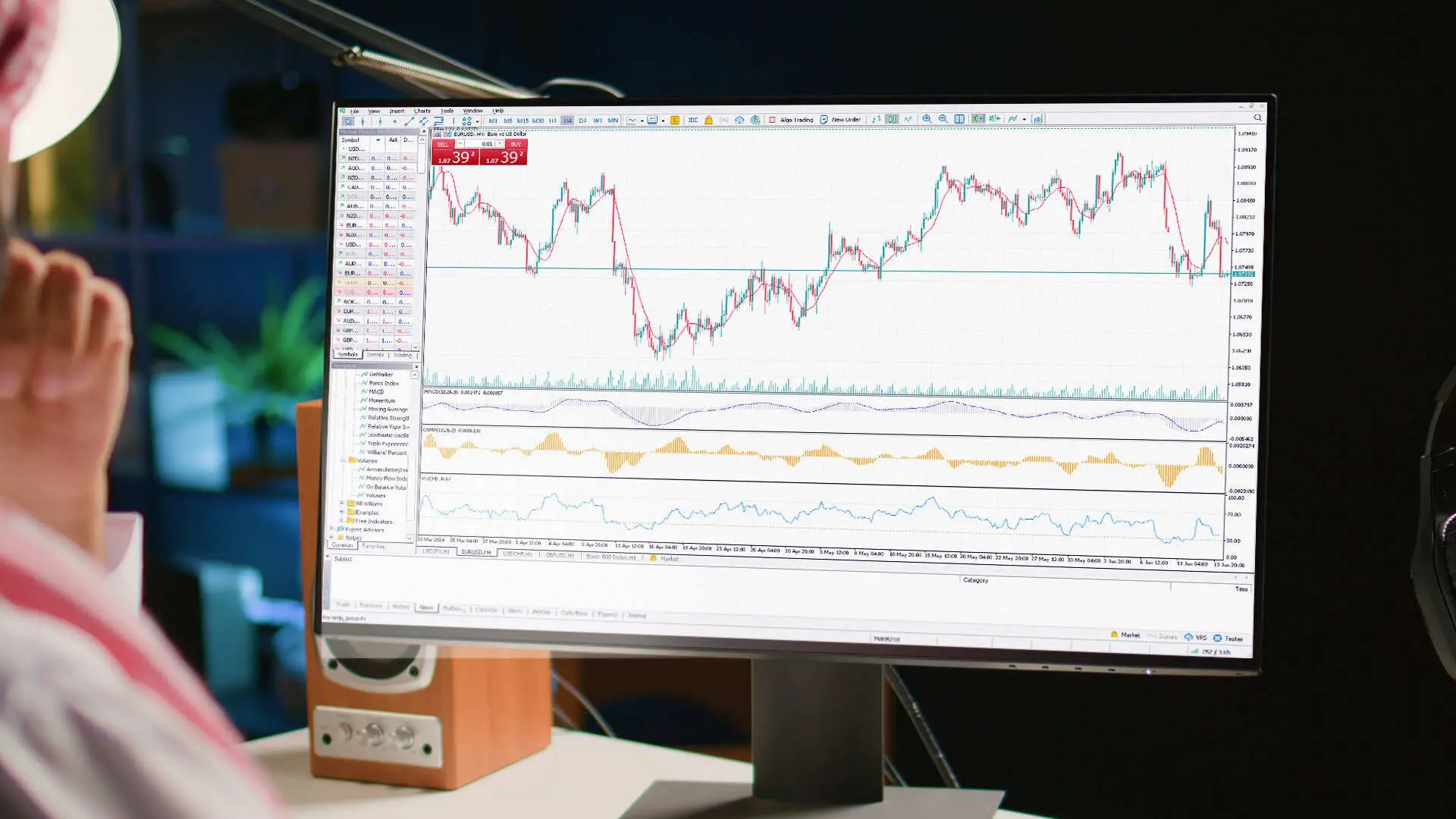
Your guide to Deriv MT5 – the world-famous CFD trading platform
All you need to know about the main features and functionality of Deriv MT5 – the world’s most famous CFD trading platform.
This post was originally published by Deriv on June 16, 2022.
Deriv MetaTrader 5 (MT5) is one of the most popular CFD trading platforms, built to cater to the needs of modern traders seeking comprehensive market access and sophisticated trading tools. It's packed with advanced features and resources for analysing markets and making quick trades, making it great for both new and experienced traders.
In this blog, we’ll walk you through the main features of Deriv MT5, along with a step-by-step guide on how to use it.
Markets available on Deriv MT5
The Deriv MT5 platform offers CFD trading on multiple markets and assets, depending on the account type you choose.
There are 3 account types available on Deriv MT5, each offering a demo and a real version:
.webp)
Please note that in the EU region, Derived FX and basket indices aren't offered. You can trade on the above assets with 1 CFD account.
How to use Deriv MT5
You can access the Deriv MT5 platform on:
- Web terminal (in your web browser)
- Desktop app
- Mobile app
For any of these options, you will need to sign up for a Deriv account first and then create a Deriv MT5 account on Trader’s Hub.
If you would like to use Deriv MT5 on your desktop or mobile, you’ll need to download the app first and then connect it to the Deriv server. This is a one-time action required upon your first account log-in.
To connect to the Deriv server on the web terminal:
- Log in to your Deriv account.
- Select a Deriv MT5 account type on Trader’s Hub.

3. Click Open on MetaTrader 5 web.
4. You will be redirected to the Deriv MT5 web terminal along with this pop-up box. Enter your Deriv MT5 login credentials under the Connect to account tab.
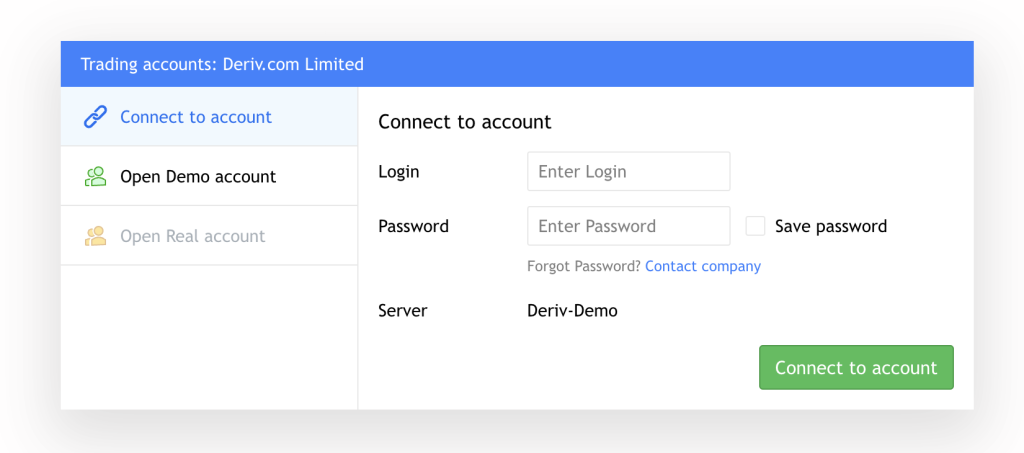
5. Click the Connect to account button to start trading.
6. To add a symbol, type the name on the right-hand search bar.

To connect to the Deriv server on your MT5 desktop app:
- Click the File tab in the top left corner.
- Click Open an account.
- Select Deriv.com Limited. Please note that your server depends on your account jurisdiction.
- Choose Connect with an existing trade account.
- Enter your Deriv MT5 credentials and click finish.
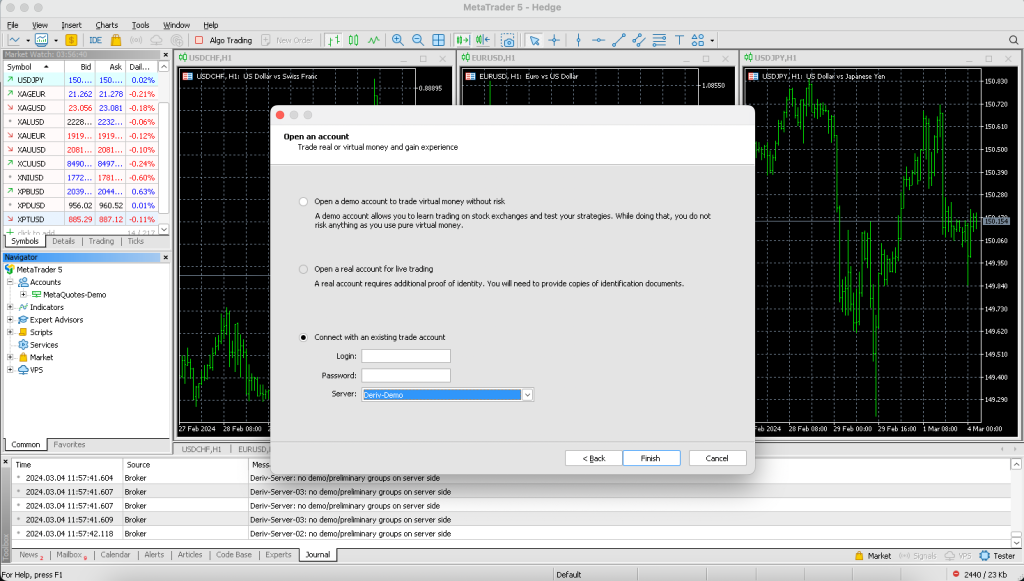
6. To add a symbol, tap the + click to add on the left-hand search bar.
To connect to the Deriv server on your MT5 mobile app:
- Tap on the left-hand corner and hit the Get started button.
- Select New account on iOS or tap + on Android devices.
- Search Deriv and select the Deriv broker which is listed on Trader’s Hub.
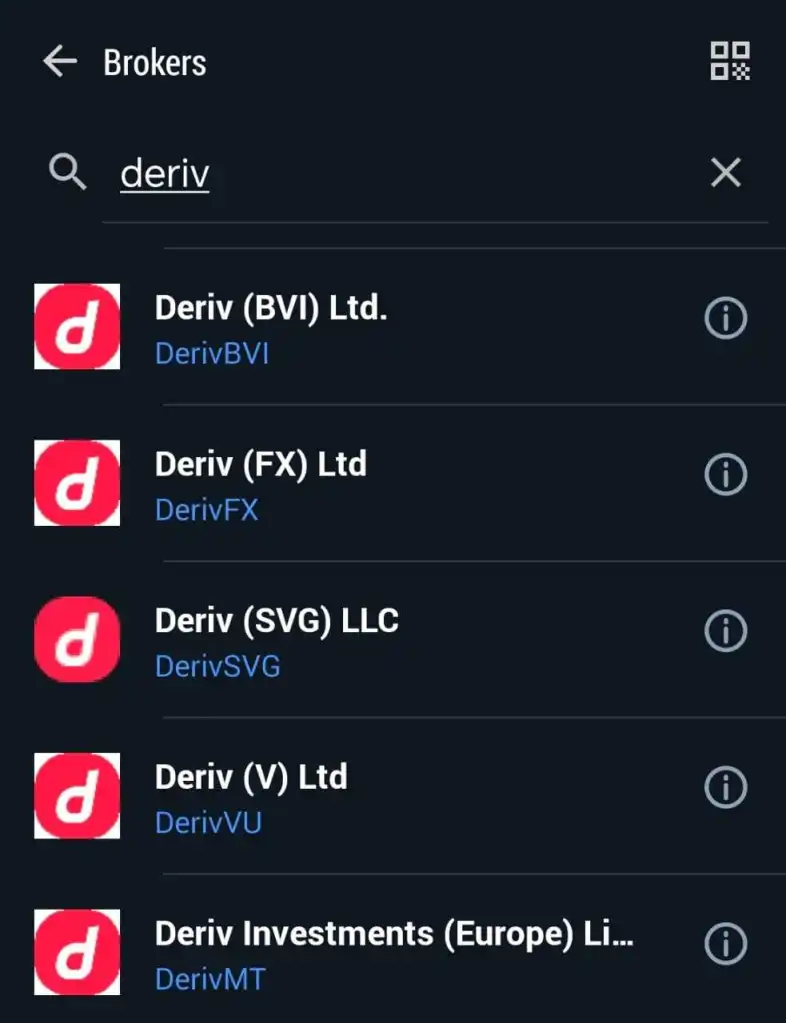
You can find the name of your Deriv broker on Trader’s Hub.
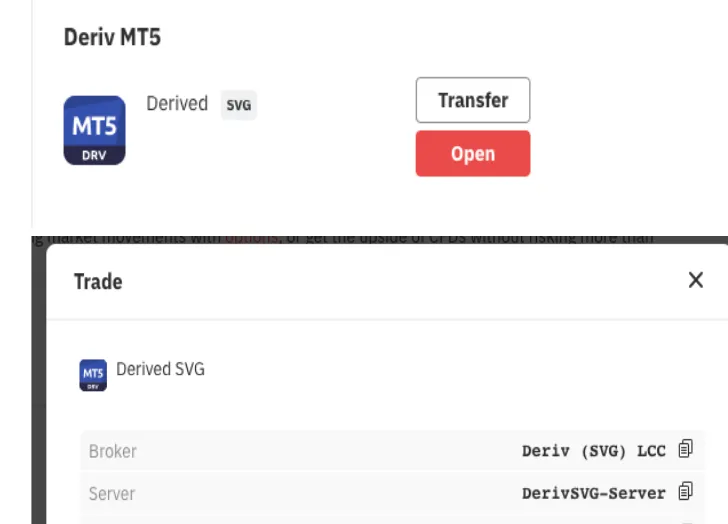
For example, if SVG is mentioned for your account, you must select Deriv (SVG) LLC from the list of companies.
4. Select your server name. This should match the Deriv company you selected in the previous step.
For your demo account, there is only 1 available server (Deriv-Demo), but for your real account, the server differs according to the account you have. You can check your server on Trader’s Hub.
5. Enter your Deriv MT5 credentials to start trading.
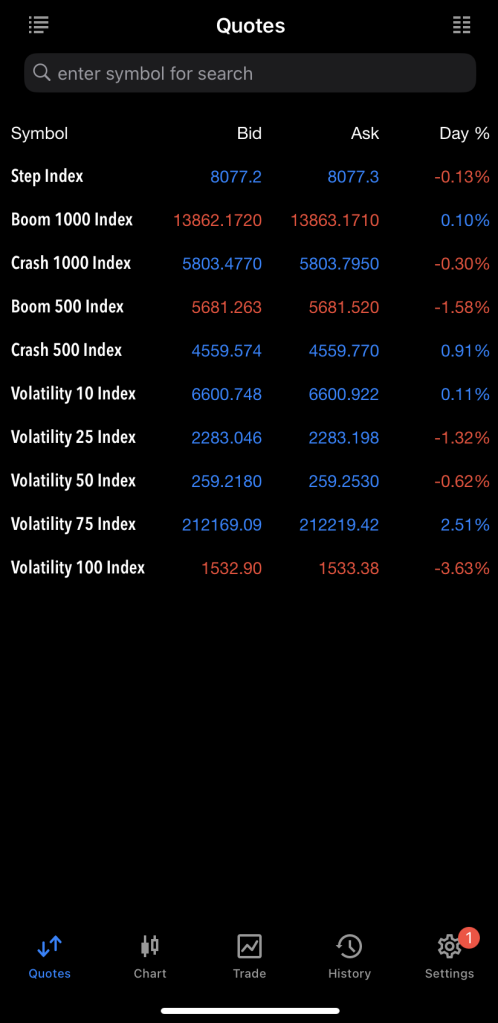
6. To add a symbol, type the name on the top search bar.
Main features of the Deriv MT5 platform
When you connect to your MT5 account, you’ll see an interface with a comprehensive toolbar and workspace.
As the Deriv MT5 desktop app offers the most extensive functionality, we’ll use this as an example in our guide.

You can customise the toolbar, which includes a list of all available trading assets (referred to as symbols), different chart types, and drawing tools, by right-clicking on any icon and selecting Customise.
The workspace is divided into panels that have different capabilities:
- Market watch: Located at the top left, this panel provides access to all trading assets and their live quotes. Right-click an asset and choose the Specification tab to reveal more details like margin rate, contract size, and trade timings.
- Navigator: This panel on the left side is a shortcut to your accounts and additional resources, like technical indicators, expert advisors, and more. Please note that it’s not available on the web terminal.
- Chart panel: At the centre of the workspace, you can display up to four different asset charts at a time or focus on one in full view. You can customise each chart’s appearance, colour schemes and displayed information under the Properties tab.
- Trading panel: Found at the bottom, this panel helps manage your trades, showing open and running trades under the Trade tab, closed trades in the History tab, and notifications in the Journal tab. It also features News and Calendar tabs for fundamental analysis to fine-tune your trading strategy.
These are the main features of the Deriv MT5 platform regularly used by traders. However, there are many more functions to explore. Set up a free demo account with 10,000 USD of virtual money to practice trading on the Deriv MT5 platforms risk-free!
For more insights on the platform’s benefits, read our blog on Why the trading world loves the MT5 platform.

Meta vs Microsoft earnings call: What to expect as AI rivalry intensifies
Meta and Microsoft earnings reports are right around the corner. Before the release, let’s take a look at their AI strategies and expert predictions.
The battle for AI supremacy rages on as Meta and Microsoft prepare to release their Q1 2024 earnings reports. With Meta’s report slated for April 24 and Microsoft’s on the 25th, the reports will reveal their financial health and potentially offer some clarity about their future plans. This article dives into their strategies, recent developments, and analyst predictions ahead of the earnings call.
Meta and Microsoft’s AI approaches in brief
While both companies recognise the boundless potential of AI, they have taken different paths in leveraging the technology – mirroring their unique business models.
Meta is zeroing in on the here-and-now of its social platforms. AI is the engine that personalises news feeds, combats misinformation, and, in the future, might make avatars more life-like within the metaverse.
For Microsoft, AI serves as a broader technological accelerator. It’s embedded in Azure’s infrastructure, powering tools tailored for businesses to build and deploy AI solutions at scale.
Billions pumped into AI
In a January 18th Instagram reel, Meta CEO Mark Zuckerberg outlined the company’s strategic roadmap for AI development, emphasising the need for a “massive compute infrastructure.” This ambitious plan involves acquiring 350,000 Nvidia H100 graphics cards at an estimated price of USD 25,000 per card. This represents a significant investment of approximately USD 9 billion directed solely towards bolstering its graphics processing capabilities.
Aside from building their chip arsenal, Meta is also reportedly ready to spend big on talent. A report from The Information says that Zuckerberg is sending personally written emails to AI researchers as he seeks to woo them to join Meta.
Microsoft, on the other hand, has acquired several AI startups, chief among them being Figure Robotics, a California based Robotics AI company – in a USD 675 million funding round. Just last week, Microsoft invested USD 1.5 billion into Abu Dhabi-based AI firm G42 in a deal that will see G42 run its AI applications and services on Microsoft Azure. The partnership will also see cutting-edge AI solutions delivered to a broad range of clients including global public sectors and large enterprises. It may also set the stage for increased interest in AI investment companies.
Meta’s Q1 earnings report expectations
Analysts expect that Meta’s Q1 earnings will reflect the success of these integrations. There will likely be particular interest in assessing how its AI-driven advertising technologies have performed, given the broader economic challenges and the digital ad market’s volatility.
Meta posted a strong Q4 revenue beat, delivering USD 40.1 billion against analyst predictions of USD 39 billion. Adjusted earnings per share also came in at USD 5.33, exceeding expectations. The Zacks Consensus Estimate for Q1 earnings is at USD 36.15 billion with an expected earnings per share of USD 4.29.
Analysts such as Piper Sandler’s Thomas Champion are optimistic about Meta’s prospects this year, predicting a 25% year-over-year increase in first-quarter revenue, while also increasing his price target for Meta shares to $600 from $525.

Analysts note that short-term technical indicators suggest a period of consolidation for Meta. The 50-day SMA is gradually approaching the 10-day SMA, while the RSI trends toward the 50 level. They infer that if upcoming reports exceed expectations, the stock could potentially rise to around $540.
Microsoft’s Q3 earnings report expectations
Market analysts predict that Microsoft’s earnings will showcase significant growth in its cloud sector, driven by the widespread adoption of Azure AI services. The performance of its AI enhancements in Office 365 and Dynamics 365 is also anticipated to be a key contributor to its revenue streams.
The Zacks Consensus Estimate predicts revenues of USD 60.63 billion for Q3 with earnings per share estimates of USD 2.81. The company’s share price is up 13% this year and is currently sitting at the USD 421 mark. Buyers have bounced back recently after being knocked back in the last week of March.
Analysts point out that the widening Bollinger Bands suggest rising volatility. They also note that with the SMA hinting at bullish signals and the RSI approaching oversold levels, a further upward trend might be on the way.

The upcoming earnings reports will thus not only reflect current financial health but could also offer insights into how effective each company’s AI strategy is in capturing new opportunities and defending market position. More importantly the reports could help traders make strategic moves while trading these assets.
As for now, you can get involved and speculate on the price of these two incredible assets with a Deriv MT5 account. It offers a list of technical indicators that can be employed to analyse prices. Log in now to take advantage of the indicators, or sign up for a free demo account. The demo account comes with virtual funds so you can practise analysing trends risk-free.
.webp)
How to identify and report phishing scams
Don’t fall for phishing tricks! Learn how to recognise red flags, report suspicious activity, and keep your online accounts safe.
Imagine you’re scrolling through your Instagram feed and you suddenly get a message in your DMs. It’s from an account you don’t follow, and it seems to be run by your favourite company’s brand ambassadors. In their message, they promise to send you some products for free if you click on an attached link.
Do you click on the link or not?
In this digital age, protecting your online identity and accounts is very important as scammers are becoming increasingly deceptive with their phishing attempts.
Phishing is a cyberattack where scammers try to trick you into revealing sensitive information like your passwords and bank details. They pose as real companies and create fake emails, social media profiles, and numbers to get you to take actions that compromise your safety. One wrong click can expose your data to scammers.
Read on to learn how to spot and report phishing scams to enhance your online security.
Emails
Spotting phishing emails can be tricky. Watch out for these warning signs of a scam email:
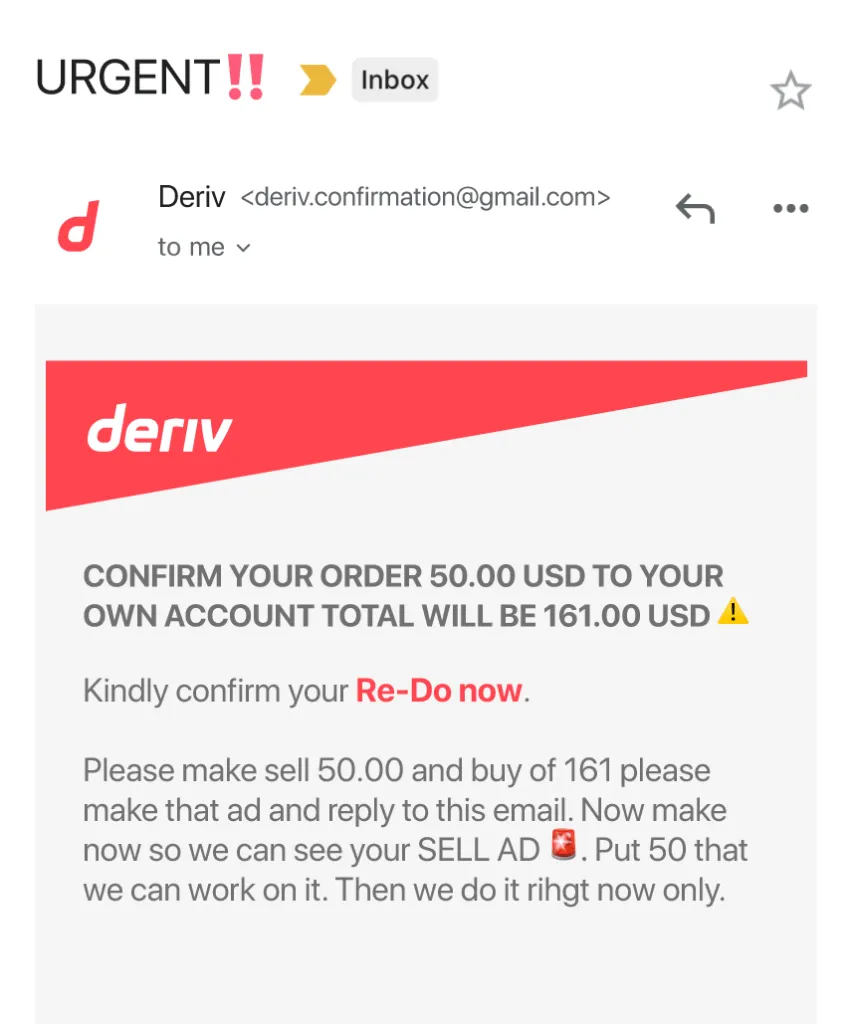
Common red flags of a phishing email:
- Unfamiliar sender’s email address. Deriv sends emails with the address ending in @deriv.com.
- Spelling and grammatical errors.
- They ask you to click suspicious links and attachments.
- Promises of easy money and huge profits.
- Requests to take immediate action like transferring your money to a bank account.
Less common red flags of a phishing email:
- Overly polite or formal language: Phishing emails sometimes use overly polite or formal language to create a false sense of professionalism and trust.
- Odd requests for information: Scam emails may ask for odd information, such as your mother's maiden name, childhood pet's name, or your childhood town’s name. These are common security questions which, if the scammer has the answers, can be used to reset your password and gain access to your account.
- Unexpected email signature changes: If you notice an abrupt change in the sender's email signature, like a different name or contact details, this is most likely a phishing email.
- Shortened URLs: Scammers often use URL shortening services to hide malicious links. The URL is shortened so the link doesn’t display the website if you hover your cursor over it.
If you get an email from someone pretending to be Deriv, please report it to us via live chat. Contact us if you have concerns, and we’ll confirm if we need anything from you.
Social media accounts
Now when it comes to fake social media profiles, we have to be more vigilant online. Look out for these warning signs to ensure you won’t become the next victim of a scam:

Common red flags of a fake social media profile:
- Frequent spelling and grammar errors.
- Misspelling of the account name.
- A high following-to-follow ratio.
- Emoji-loaded offers that sound too good to be true.
- Few or no friends/followers.
Less common red flags of a fake social media profile:
- Too many posts in a short time: Scam accounts may post numerous images or stories in a short period to gain attention and followers fast.
- Promotion of fake products: Scammers often advertise counterfeit or random products, that is not related to the company.
- Strange friend/follow requests: Scammers often create fake profiles and send you friend /follow requests. These accounts typically have few friends, minimal personal information, and no mutual connections.
- Request for payment: Scammers may ask you to make payments or transfer money outside of the platform. Please note that if Deriv needs any personal information, the request will be made via our official email or live chat.
.webp)
If you come across a fake social media account, tap on the 3 dots on the profile and click Report to flag the account as fraudulent. This process will take less than a minute and helps the platform take appropriate action.
After reporting the fake profile, please provide screenshots of their account to our Customer Support team via live chat so we can take additional measures.
Messaging app
On top of the fake social media profiles, scammers also create fake messaging accounts on WhatsApp to directly target a user. Make sure to check these signs of a scam messaging account and know how to report them effectively.

Common red flags of a scam messaging account:
- Spelling and grammatical errors in the message.
- Calls to click on links or download apps.
- Promises of huge profits and easy money.
- Urgent requests for personal data like your password and bank details.
Less common red flags of a scam messaging account:
- Excessive use of bots: Scammers may employ bots to engage you with automated messages or links to fraudulent websites. If a conversation feels too scripted or unnatural, it could be a scam.
- Fake customer support: Some scammers pose as customer support agents and offer assistance with issues you didn't request help for.
- Suspicious forwarded messages: If someone you don't know well forwards you messages or files without context, it could be an attempt to spread scams or viruses.
- Impersonation of trusted contacts: Scammers may impersonate your trusted contacts by using similar profile pictures and usernames.
If you come across a fake profile on a messaging app, tap on the account’s profile and click Report to flag the account as fraudulent. This process will take less than a minute and helps the platform take appropriate action.
After reporting the fake profile, please provide screenshots of their account to our Customer Support team via live chat so we can take additional measures.
Best practices to avoid phishing in general
Now that you can recognise and take action against phishing attempts, always remember the 5 Don'ts when engaging with emails and online accounts:
- Don’t instantly click on links or download files.
- Don’t share your personal information.
- Don’t act immediately if you’re being pressured to.
- Don't be afraid to contact our Customer Support via live chat if you have doubts or concerns.
- Don’t answer suspicious emails, calls, and messages.
Stay connected with us for the latest updates on our global accounts:
- Facebook: @derivdotcom
- Instagram: @deriv_official
- Twitter: @Derivdotcom
- LinkedIn: @derivdotcom
- YouTube: @deriv
- WhatsApp for clients: +971 523261628 | WhatsApp channel
- WhatsApp for partners: +971 521462917 | WhatsApp channel
For EU-specific updates:
Need help? Contact our WhatsApp support: +356 9957 8341.
For more safety tips, check out our How to protect your online trading account blog post or our How to avoid trading scams blog post.

Deriv gets Gold accreditation by Investors in People
Deriv gets gold accreditation by Investors in People. Find out the criteria, process and journey of one of Deriv's biggest achievement in 2023.
Deriv, one of the leaders in the fintech industry, achieved We invest in people, gold accreditation. This is the first industry accolade received in 2023, one of its many goals this year.
Being awarded gold is a triumph and something only 17% of organisations that Investors in People (IIP) assess achieve. This accreditation is for 3 years. IIP celebrates companies that finetune their management style to demonstrate trust, motivate employees to improve skills and knowledge, and remain agile to change.
For Deriv, the gold accreditation acknowledges the leadership approach, people practices, and culture of trust that the broker has strived to build in all its offices. Survey results reveal 80% of employees agree on solid people practices. They appreciate the empowering work culture which inspires them to be on their ‘A’ game and work their best.
The insights captured also indicate Deriv provides career advancement opportunities and cares about putting people first. Employees participate in innovation and transformation through a shift from small to big thinking about their work scopes, the business, and the industry.
.jpeg)
The shortlisting companies relies on three principles:
Leading: How much trust is there between employees and the leadership team? Do leaders live up to their values and inspire the right culture?
Supporting: Are the right structures in place so employees can do their job well? Are employees rewarded for doing well? And supported properly if they’re struggling?
Improving: Are there plenty of opportunities for employees to grow and develop? Is the company ready for any changes the future might bring?
The process:
- IIP representative talks to the company, its employees, and what is the motive for achieving accreditation.
- IIP sends out a survey to employees to see how they feel about working in the company and how well they are supported.
- IIP conducts one-on-one interviews with employees and attends meetings to gain insight into the workplace.
- The key findings are published in a report revealing the company’s failure or success in achieving the accreditation. The report also includes recommendations from IIP on the next steps for the company.
- IIP creates an action plan for what changes the company should make over the accreditation period.
The accreditation positions Deriv in 1st ranking in the finance and insurance activities sector and 3rd ranking globally in the technology/IT sector. Rankings are for organisations with employee strength of 250–4,999.

Commenting on the award, Seema Hallon, Head of People Management, said:
“This is a proud achievement for us! At Deriv, we try our best to create a work environment that encourages every team member to take ownership of their jobs and ‘up their game’ to bring out the best contribution to their roles. Our culture of trust, driven by our values, is based on open conversations, active involvement, agile working and fun together. We are excited to be on this journey of excellence with IIP and hope to be in the Platinum category soon!”
Deriv has ambitious growth plans for 2023. It is looking for skilled professionals to expand its dynamic, diverse, and fast-paced workplace. Join us in our journey, view our open positions.
About Deriv
Over the last 23 years, Deriv’s mission has been to make online trading accessible to anyone, anywhere. Deriv’s product offering includes intuitive trading platforms, over 200 tradable assets (in markets such as forex, stocks, and cryptocurrencies), unique trade types, and more. With more than 1,200 employees in 20 global offices spread across 16 countries, Deriv strives to provide the best work environment, which includes positive work culture, timely addressing of employee concerns, celebrating achievements, and conducting initiatives to boost their morale.
PRESS CONTACT
Aleksandra Zuzic
[email protected]
Photos accompanying this announcement are available at
https://www.globenewswire.com/NewsRoom/AttachmentNg/c7747671-2e51-4da5-8bdc-e8ccab8ef6b2
https://www.globenewswire.com/NewsRoom/AttachmentNg/cd0a9ee9-744f-4eb2-a533-d19989a1f090
https://www.globenewswire.com/NewsRoom/AttachmentNg/44084c93-ef28-4ce4-a375-c0296647ba71
Sorry, we couldn’t find any results matching .
Search tips:
- Check your spelling and try again
- Try another keyword