
Results for

How to read forex charts
Find out how to read forex charts, and get to know the features of candlestick charts, bar charts, and line charts.
When you trade in the forex market, you’ll need to know a few things, including how to read forex pairs and forex chart patterns.
Forex pairs display the exchange rate between two currencies, indicating how much of the second currency is required to buy one unit of the first currency.

To begin your journey as a forex trader, you’ll need to learn how to read the price charts of currency pairs.
What is a forex chart?
A forex chart is a visual representation of the exchange rate of a currency pair. Each point represents a currency pair’s price movement over a time period, and is used to identify trends and patterns. On Deriv MT5, there are three ways you can view a forex chart — with a candlestick chart, a bar chart, and a line chart.

What is a candlestick chart?
A candlestick chart utilises candlesticks, which graphically depict price movements in financial markets by illustrating the opening, closing, high, and low prices within a designated time frame.
Candlesticks have three main components:
- The body, representing the price range between the opening and closing prices.
- The wicks or shadows, showing the highest and lowest prices reached.
- The colour, indicating whether the sentiment of the candles are bullish (closing price is higher than opening price, often green or white) or bearish (opening price is higher than closing price, often red or black).
Candlestick charts are the most popular for forex trading because they provide more information than line or bar charts. This gives more insight into price action and more complex trend analysis.

What is a bar chart?
A bar chart, also known as a HLOC (high, low, open, close) chart, employs vertical bars to represent the trading activity within a designated time frame. Unlike candlestick charts, bar charts lack filled bodies, aiding traders who primarily focus on price movements.
The bars have distinct features:
- The top of the vertical line represents the highest price reached. It indicates the peak price that traders were willing to pay.
- The bottom of the vertical line represents the lowest price reached. It shows the lowest point at which traders were willing to sell.
- A short horizontal line extending to the left of the vertical line indicates the opening price. It signifies the price at which the market started trading during that period.
- Another short horizontal line extending to the right of the vertical line indicates the closing price. It shows the price at which the market concluded trading during that period.
- The line's colour is indicative of the price's movement: green or white for an upward shift (closing price is higher than opening price), and red or black for a decline (opening price is higher than closing price).
Bar charts are easier to interpret than candlesticks for beginner traders, as they have less visual clutter, making them valuable for simpler trend analysis.

What is a line chart?
A line chart connects the closing prices of a forex pair in a continuous line for a specified timeframe. It filters out the price fluctuations that occur during the opening, highest, and lowest points of trading. As a result, line charts are particularly useful for identifying medium- to long-term trends and patterns.
An extension of the line chart is called a mountain (or area) chart. Mountain charts are essentially the same, but there is shade in the space below the line and, hence, put less emphasis on individual data points.

Line charts are the simplest way to visualise price movement over time. They can be advantageous for identifying macro trends, smoothing noise, and incorporating volumes or moving averages. They can also be used alongside candlestick or bar charts.
Conclusion
Once you have understood how to read forex charts, the next step is learning about technical indicators, fundamental analysis, and risk management strategies. This will aid you in identifying trends, support and resistance levels, as well as candlestick and chart patterns. Beginner traders may choose to start with a demo account to practise your analysis without real money. Open a risk-free demo account with Deriv and check out the different types of charts today.

Market news – Week 4, April 2023
Last week, weaker-than-expected Consumer Price Index data caused the US dollar to stumble and gold prices to shoot up. Read more in our report.
On the back of a weak Consumer Price Index (CPI) report (released on Wednesday, 12 April), the US dollar stumbled and launched gold prices up overnight.
Forex

The EUR/USD pair closed the week at 1.0994 USD, dropping slightly after a high in the middle of the week thanks to a weakening US dollar from cooler-than-expected Consumer Price Index (CPI) data and the Federal Open Market Committee (FOMC) meeting minutes.
On Wednesday, 12 April, the highly anticipated March CPI data was released, revealing a 0.1% month-on-month increase. The same day, the minutes of the FOMC March’s meeting forecasted a mild recession as well as a chance that there will be one more rate hike in May. The US dollar took a hit, and touched an eight-week low.
Meanwhile, the GBP/USD pair closed the week at 1.2415 USD after small gains throughout the week, and the Japanese yen weakened to just over 132 USD.
This week, eyes will be on the Initial Jobless Claims report that will be released on Thursday, 20 April.
Commodities

Gold prices closed the week at 2,004.22 USD per ounce after a week of movements affected by the performance of the US dollar.
The precious yellow metal started the week by falling more than 1.0% from the previous week. However, its prices saw an overnight jump mid-week and touched a high of 2,046.79 USD per ounce. A weakened US dollar contributed to the jump, as the dollar fell after the release of below-expected US CPI data and the FOMC March meeting minutes (which showed policymakers raising the interest rate by 25 bps).
Silver also saw a 12-month peak after the release of those data. On the other hand, oil prices closed the week sideways, as they were unable to maintain momentum after last week’s jump following the unexpected output cut announcement by the Organization of the Petroleum Exporting Countries (OPEC+).
Cryptocurrencies

The cryptocurrency markets were trading higher this week, adding to their steady gains as investors raised bets that the US Federal Reserve will soon end its aggressive monetary tightening campaign. The global cryptocurrency market capitalisation currently stands at 1.27 trillion USD.
Bitcoin maintained its consolidation around the 30,000 USD level after reaching a peak of 30,506 USD on Friday, 14 April — its highest point since June 2022. It is currently trading at 30,326.60 USD at the time of writing.
Meanwhile, Ethereum achieved a new 11-month high of 2,120.56 USD on Sunday, 16 April, driving fresh enthusiasm among investors following the successful Shanghai upgrade.
In other news, recent developments suggest that international cooperation for worldwide cryptocurrency regulations may be on the horizon. At the G20 summit, India, which holds the presidency of the group in 2023, proposed a common regulatory framework for cryptocurrencies. Its aim was to address the associated risks while still allowing innovation and growth in the sector.
US stocks

*Net change and net change (%) are based on the weekly closing price change from Friday to Friday.
US stocks experienced mid-week fluctuations when the FOMC March meeting minutes revealed concern over the banking industry’s liquidity crisis, following a lower-than-expected inflation report which hinted at another policy rate hike in May. Both were released on Wednesday, 12 April.
However, all three major US stock indices recovered marginally to close the week in the green. The Dow Jones rose 0.89%, followed by the S&P 500 rising by 0.69%, and Nasdaq with a 0.22% increase.
Last week, major players JPMorgan Chase, Wells Fargo, and Citigroup kicked off earnings season, with reports that exceeded estimates, possibly contributed by fears of the stability of smaller banks reeling from the collapse of Silicon Valley Bank and New York-based Signature Bank last month.
This week, the first-quarter earnings season is in full swing.
Now that you’re up-to-date on how the financial markets performed last week, you can improve your strategy and trade CFDs on Deriv MT5 or Deriv X, or with options and multipliers on Deriv Trader.

Market news – Week 1, February 2023
The US dollar registered modest gains over the euro as data released over the last week revealed cooling in inflation and subdued consumer spending.
The US dollar registered modest gains over the euro as data released over the last week revealed cooling in inflation and subdued consumer spending.
Forex
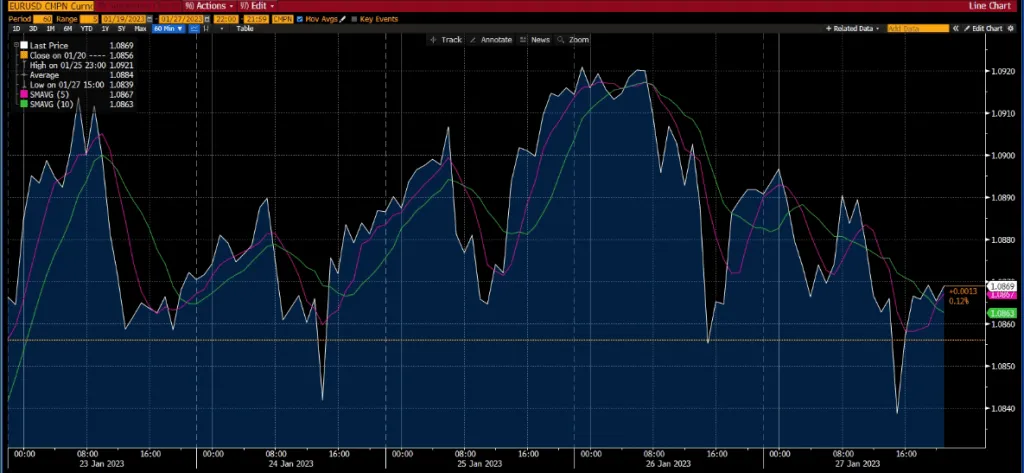
The US dollar arrested its slide against the euro, registering modest gains last week as reports showed cooling inflation and a fall in consumer spending. The EUR/USD pair closed the week at 1.0869 USD. Consumer spending was down 0.2% in December, while the Personal Consumer Expenditure (PCE) index rose 0.1% in November, according to the data released by the Commerce Department.
The GBP/USD pair was down for the week as the British pound sterling slipped 0.12% over the week to end at 1.2397 USD over fears of policy tightening measures by the Bank of England (BoE).
This week, attention will be on a slew of central bank policy decisions with the US Federal Reserve, the European Central Bank (ECB), and the BoE slated to make policy rate decisions. It is widely expected that the US Fed will go with a quarter basis point rate hike as it attempts to battle inflation in a tough economic environment. The Fed’s interest rate decision will be announced on Wednesday, 1 February, while those of the ECB and the BoE are scheduled for a Thursday, 2 February, announcement.
Meanwhile, consumer confidence data will be released on Tuesday, 31 January. The Institute of Supply Management’s (ISM) Manufacturing Purchasing Managers Index (PMI) data is slated for a Wednesday, 1 February, release. Meanwhile, the non-farm payrolls (NFP) data, unemployment rate and non-manufacturing Purchasing Managers Index (PMI) are due to be released on Friday, 3 February.
Level up your trading strategy with the latest market news and trade CFDs on your Deriv X account.
Commodities
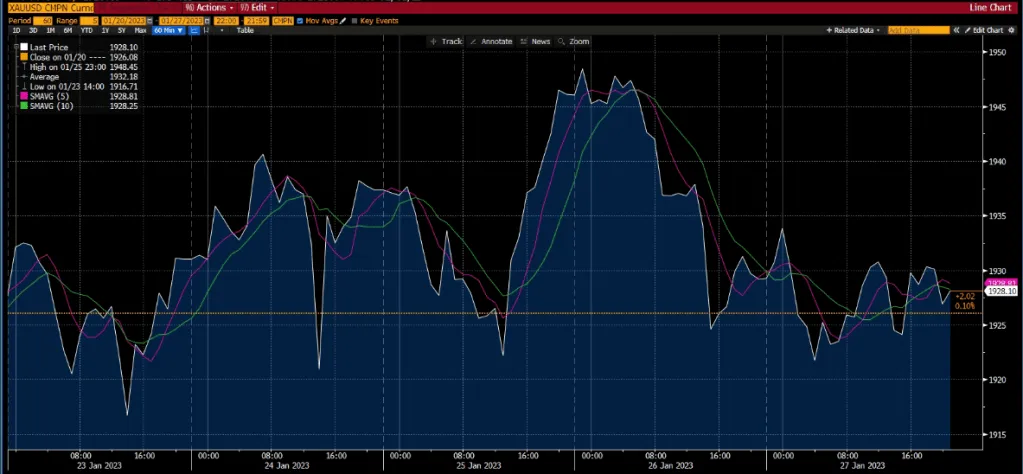
Gold prices rose for a sixth straight week to end last week at 1,928.10 USD an ounce. Its gains were capped by a strong dollar and a rise in US treasury bond yields.
The yellow metal’s price movement in the coming weeks will be dictated by the policy rate decisions by the various central banks in action this week, as well as the January employment numbers and the Purchasing Managers’ Index data in the US.
Meanwhile, oil prices started the week strongly before hitting the brakes as the week came to a close. Prices of the commodity were curtailed by better-than-expected US economic growth data and hopes of increasing demands from China as Covid fears have subsided over the last few weeks. Furthermore, the oil markets came under pressure due to strong Russian supply despite an EU ban and the Group of 7’s — commonly known as G7 — price cap that was imposed on the country over its war with Ukraine.
Ministers of the OPEC+ grouping — which comprise the Organization of the Petroleum Exporting Countries, or OPEC, and its allies led by Russia — are scheduled to gather on Wednesday, 1 February. Their decisions will drive the fate of oil prices in the coming weeks.
Cryptocurrencies
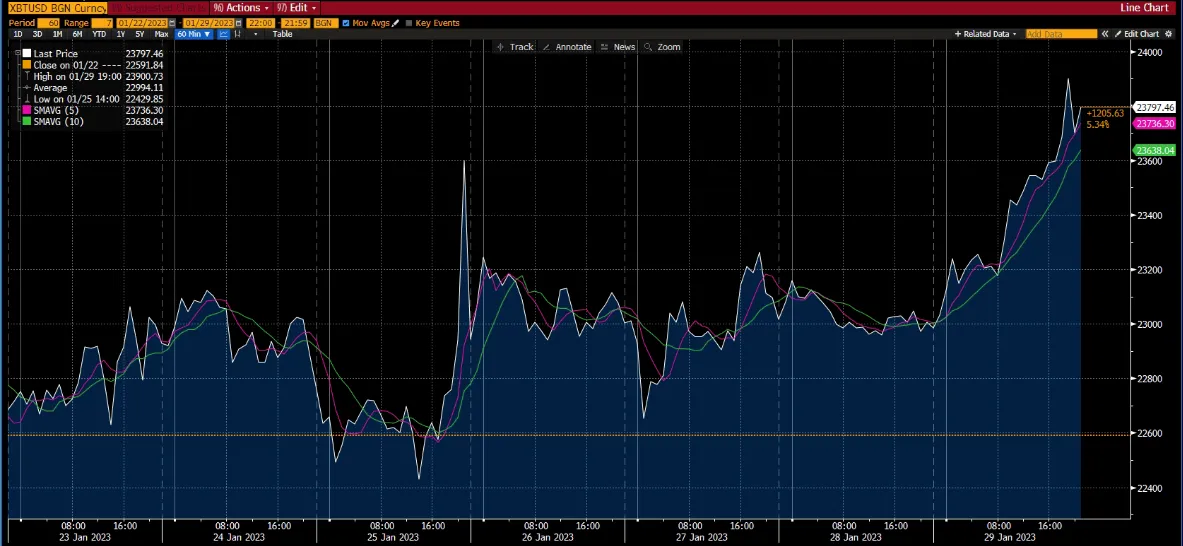
With four consecutive weeks of gains registered by major cryptocurrencies, the winter for digital assets — which followed the November 2022 collapse of the cryptocurrency exchange platform Futures Exchange (commonly known as FTX) — seems to be over. The global cryptocurrency market capitalisation stood above the 1 trillion USD mark for a seventh consecutive day on Sunday, 29 January, making this the longest streak since August 2022.
Bitcoin, the world’s largest cryptocurrency by market capitalisation, was trading at 23,783.90 USD at the time of writing. Meanwhile, Ethereum — the second-most popular digital asset — was trading at 1,648.33 USD as of Sunday, January 29.
The decisions at the US Federal Open Market Committee (FOMC) meeting on Wednesday, 1 February, can cause a significant shift in price levels of major cryptocurrencies, which could lead to volatility in the market.
In a development that could lead to regulation in the cryptocurrency space, thereby likely tempering the large-scale volatility seen in the digital assets, the White House published a blog titled “The Administration’s Roadmap to Mitigate Cryptocurrencies Risks” last Friday, January 27. It calls for the US Congress and other authorities to step up their efforts to regulate the cryptocurrency industry in the United States.
Take advantage of market opportunities by sharpening your trading strategy and trading the financial markets with options and multipliers on Deriv Trader.
US stocks

*Net change and net change (%) are based on the weekly closing price change from Friday to Friday.
Nasdaq registered its fourth straight week of growth, rising 4.71% over the week. The index remains on course to register its strongest monthly performance since July 2022. Meanwhile, Dow Jones and S&P 500 overcame their downturn to end the last week with a 1.81% and 2.47% rise, respectively. Their performance was in line with the favourable PCE data and cooling in inflation.
With 143 of the S&P 500 companies having reported their fourth-quarter earnings results, 67.8% of the firms have outperformed Wall Street expectations, which is below the 76% rate seen over the last four quarters.
US Federal Reserve Chairman Jerome Powel has indicated a continuing battle against inflation. As a result, the markets are anticipating another rate hike, albeit limited to 25 basis points this week.
Along with the Fed meeting and January employment data, a number of high profile earnings reports will be released next week, including those from Apple, Amazon, Google-parent Alphabet, and Facebook-parent Meta Platforms.
Now that you’re up-to-date on how the financial markets performed last week, you can improve your strategy and trade CFDs on Deriv MT5.

Market news – Week 2, April 2023
The US stock market surged for a third consecutive week as all 3 major indices — the S&P 500, Nasdaq, and Dow Jones — registered over 3% gains each.
The US stock market surged for a third consecutive week as all 3 major indices — the S&P 500, Nasdaq, and Dow Jones — registered over 3% gains each.
Forex
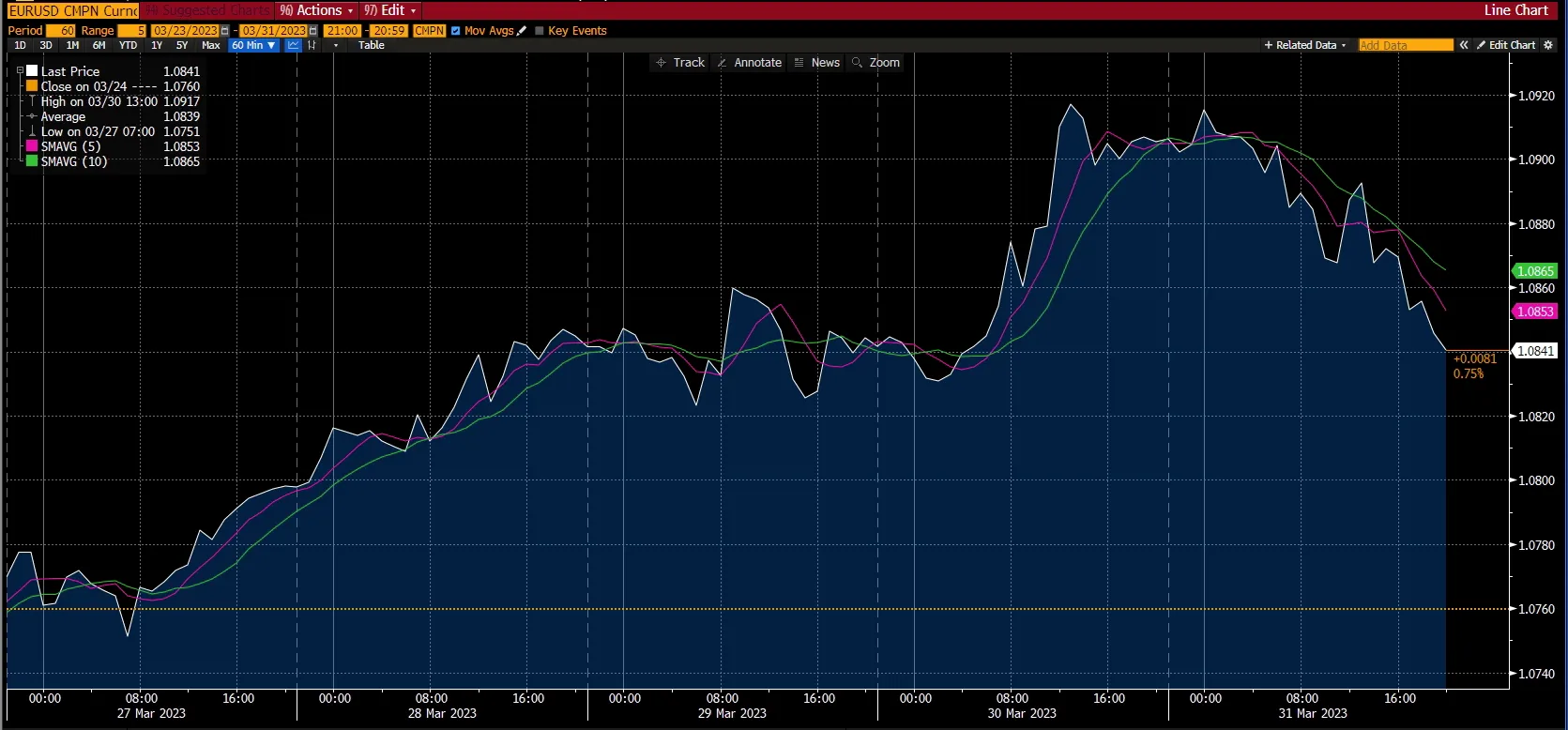
Continuing its upward movement, the EUR/USD pair closed the week at 1.0841 USD, despite some buoyancy observed in the USD as a result of favourable inflation data released on Friday, 31 March. The USD started the week under pressure due to the ongoing financial turmoil in the US banking system, but made a recovery as fears eased due to upbeat data releases.
The Core Personal Consumption Expenditures (PCE) Price Index — which is the US Federal Reserve’s (Fed) preferred gauge of inflation — was at 0.3% from January to February, down sharply from 0.6% in the previous monthly update. The inflation data has raised hopes of the Fed pausing its recent spate of interest rate hikes.
The British pound sterling outperformed the dollar for a third consecutive week and consolidated above the 1.2300 USD mark. It eventually closed the week at 1.2335 USD. Meanwhile, the USD/JPY pair retreated from its 2-week high and slid below 133.00 USD.
On the events front, the Institute of Supply Management (ISM) Manufacturing Purchasing Managers Index (PMI) data is scheduled for a Monday, 3 April, release, while the ISM Non-Manufacturing Index numbers will be out on Wednesday, 5 April. The all-important non-farm payrolls (NFP) data for March will be released on Friday, 7 April.
Level up your trading strategy with the latest market news and trade CFDs on your Deriv X account.
Commodities
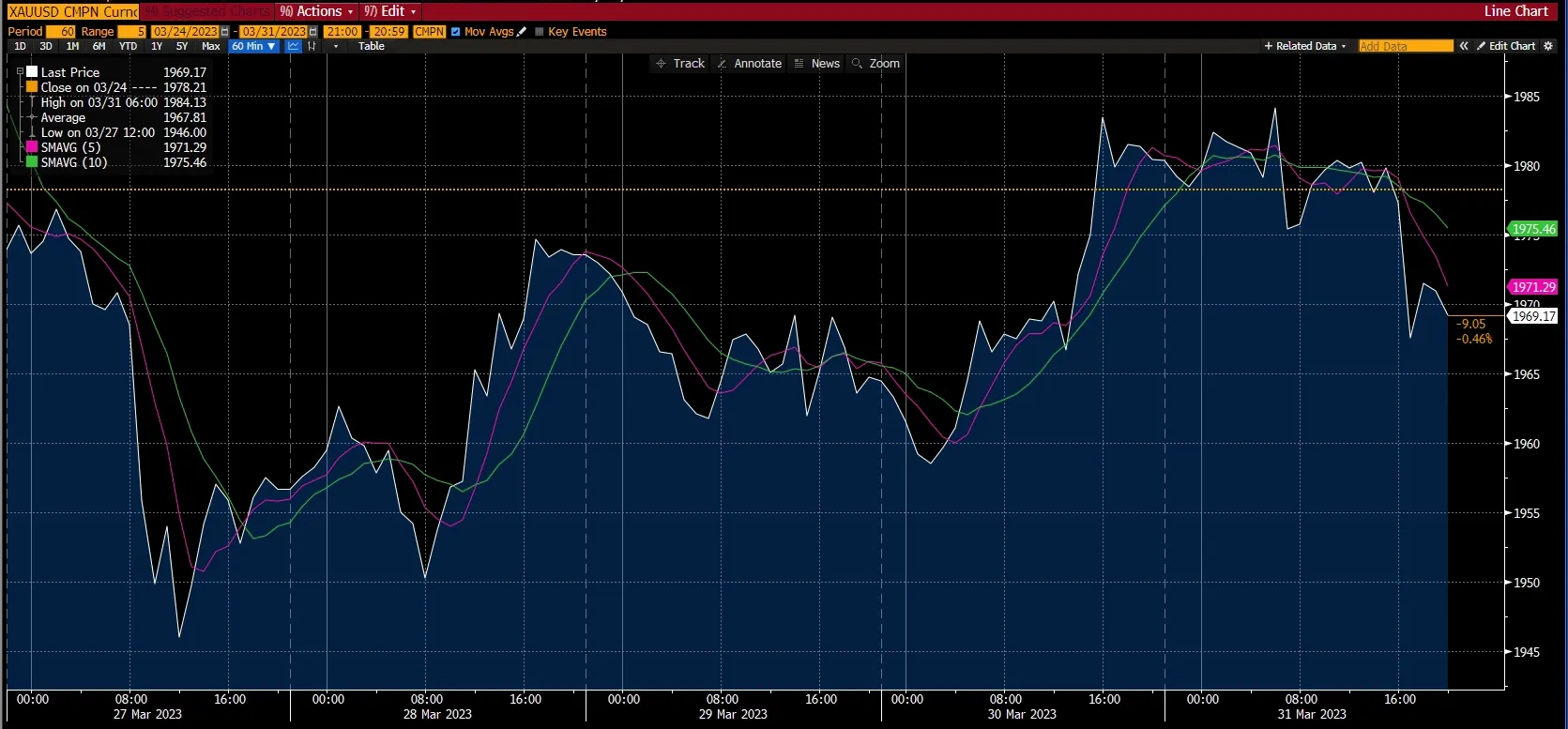
Gold prices remained within touching distance of the 2,000 USD mark, but couldn’t break through it and eventually closed the week at 1,969.17 USD — lower than the week prior.
The prices of the yellow metal have enjoyed a resurgence as investors flocked to the safety of gold over worries about the potential fallout from the failure of several banks in the United States and the problems at Credit Suisse in Switzerland. Those fears have now eased. The record fall in treasury yields also boosted demand for the precious commodity. However, the yields bounced back towards the end of last week, with the 10-year US Treasury yield up to 3.49% on Friday, 31 March — rising from 3.38% at the end of the week prior.
Oil prices marked a second consecutive week of gains, with prices up by over a dollar on Friday, 31 March. This comes on the back of factors including supply tightening in some parts of the world and easing of inflation in the United States.
Reduced supply of crude from the Kurdistan region of Iraq contributed to the gains, as well as the Organization of the Petroleum Exporting Countries (OPEC) appearing on course to stick to its Monday, 27 March, decision to cut production. Oil prices were also impacted by reduced inflation in the US, as this raised the prospect of the Fed halting its interest rate hikes. These developments point towards further surge in oil prices.
Cryptocurrencies

The cryptocurrency market appeared unaffected by the slew of regulatory enforcements being championed and administered over the last few weeks. Binance attracted regulatory action in the US, while cryptocurrency exchange firm Beaxy.com ceased operations after being charged by the Securities and Exchange Commission on Wednesday, 29 March.
Though the prices of digital assets have recovered since the start of 2023, trading volumes and liquidity in the market have dried up when measured over the past year. Even as an eye-catching upsurge in Bitcoin this year made it the best-performing asset in the first quarter, a widening US regulatory crackdown and the collapse of a few cryptocurrency-friendly banks have tempered investor enthusiasm.
Bitcoin, the world’s largest cryptocurrency, was trading at 28,202.50 USD at the time of writing. Meanwhile, Ethereum — the second-largest digital currency by market capitalisation — was trading at 1,795.37 USD. The size of the global cryptocurrencies market marginally increased from 1.15 trillion USD to 1.18 trillion USD during the week.
Meanwhile, in a latest episode of crackdown on the industry, the world’s biggest crypto exchange Binance and its CEO and founder Changpeng Zhao (commonly known as CZ) were sued by the US Commodity Futures Trading Commission (CFTC) on Monday, 27 March, claiming willful evasion of US law and allegedly breaching derivatives rules.
Take advantage of market opportunities by sharpening your trading strategy and trading the financial markets with options and multipliers on Deriv Trader.
US stocks

*Net change and net change (%) are based on the weekly closing price change from Friday to Friday.
The resurgence in the US stock market continued for another week as all 3 major stock indices registered gains over 3% each. The S&P 500 rose the highest at 3.48% followed by Nasdaq at 3.25%. The Dow Jones was up by 3.2%.
Over the course of the first quarter of 2023, Nasdaq registered the biggest gains at 17% on the back of the strong performance by technology stocks — which constitute a large part of the index. In comparison, the S&P 500 — which saw a historic high in January — was up 0.75%. The Dow Jones was up by 0.9% for the quarter.
The stock performance has remained unhampered by the banking crisis that has gripped the United States over the last few weeks (however, those tensions have since eased). Experts predict that stocks will eventually take a hit if persisting fears of recession materialise.
The non-farm payrolls (NFP) data — which will be out on Friday, 7 April — will reveal the extent of the strength of the US labour market and will be a key gauge of the state of the American economy.
Now that you’re up-to-date on how the financial markets performed last week, you can improve your strategy and trade CFDs on Deriv MT5.

Market recap: Week of 1–8 Sep 2023
Stay informed with our weekly market recap from 1st to 8th September, 2023. Get insights on the latest trends and developments in the financial world.
The European Central Bank dilemma
CNBC: A potential rate hike in September to address persistent inflation vs. concerns of economic downturn. ECB's policy stance hinges on a delicate balance between price growth and a weakening economic outlook. Mario Centeno emphasizes the need for caution due to subdued eurozone growth and existing measures. Notably, novel labour market flexibility could impact inflation contribution positively.
European Central Bank’s policy rates
As reported by Breaking News Networks: In a recent seminar, Christine Lagarde, President of the European Central Bank (ECB), emphasised the ECB's record pace of policy rate increases, totalling 425 basis points over the past year, as an expression of the institution's commitment to achieving a timely return of inflation to its 2% medium-term target. The upcoming ECB meeting on September 14 will be a pivotal moment, where officials will assess whether the recent economic slowdown justifies a potential pause in the ongoing cycle of tightening. Euro-zone inflation figures for August indicated a slowdown, dropping to 5.3% from 5.5% the previous month. However, concerns about a deepening contraction in private-sector activity have raised questions about the economic outlook. Currently, money markets assign roughly a one-in-four chance of the ECB raising rates by a quarter-point to 4% in the upcoming meeting. Stay tuned for further developments in ECB policy.
Cebr forecasts more rate hike increases
The Guardian report: Thinktank Cebr forecasts more rate hike increases and anticipates 28,000 insolvencies in the coming year. Approximately 7,000 business failures are expected per quarter in 2024 due to financial strain and economic challenges. Notably, insolvencies in Q2 2023 were 50% higher than the pre-pandemic levels in Q2 2019. Bank of England's interest rate has seen 14 increases since the end of 2021, rising from 0.1% to 5.25%.
Bank of England and UK inflation
Former BOE rate-setter Michael Saunders suggests the Bank of England may be finished with tackling UK inflation, citing economic cooling and loosening labour market signs. Birmingham City Council issues a Section 114 notice due to financial challenges.
Inflation expected to decline?
Inflation is expected to decline significantly by year-end, says Andrew Bailey, The Bank of England Governor, hinting at nearing peak interest rates. He sees rates 'much nearer to the top of the cycle' after 14 consecutive hikes. Bailey: 'Indicators signal a continued fall in inflation, marked by year-end.' Wage growth data key for rate policy.
Bank of Canada maintains rates
Reuters: The Bank of Canada maintains the overnight rate at 5% amidst weaker economic growth. Q2 2023 saw a 0.2% contraction due to reduced consumption, housing activity, and wildfires' impact. Household credit growth slowed due to higher rates. Domestic demand grew 1%, backed by gov't spending and business investment. Labour market tightness easing, with 4-5% wage growth. Concerns about inflation persist; policy rates may rise if necessary.
UK lenders’ rates
The Guardian reports: UK lenders started cutting their rates in the latter half of July, following news that UK inflation had fallen more than anticipated in June. This reduction prompted speculation that the Bank of England might not raise interest rates as aggressively as previously expected. HSBC and NatWest have taken steps to reduce mortgage rates, and this move is expected to be followed by other major UK lenders. NatWest, in particular, has unveiled reductions of up to 0.35 percentage points on selected fixed-rate deals. For instance, a five-year fixed-rate deal designed for homebuyers with a 5% deposit, currently priced at 6.39%, will see its rate decrease to 6.04% at NatWest.
White House Urges Short-Term Funding Solution
Reuters: Congress seeks to prevent shutdown with a stopgap measure, allowing time for a broader spending agreement. Funding challenges highlight vital cash-starved programs, like nutritional aid for low-income families. The looming Sept. 30 deadline sparks concern over the potential shutdown as the government faces financial crunch. Past shutdowns reveal economic repercussions, including reduced productivity and Gross Domestic Product (GDP) impact. Shutdowns bring economic insecurity for federal workers, emphasizing complex consequences.
Australia’s hopes of benefiting from China uncertain
According to The Guardian, Australia's hopes of benefiting from China's recovery face uncertainty as concerns rise on China's Stalled Growth and Property Crisis. Challenges loom as foreign investment slows alongside the property crisis with Evergrande and Country Garden. Youth unemployment, though suspended from the data series, raises concerns. A potential Chinese downturn could impact Australia's economy through reduced exports and investment. Rising unemployment and fiscal implications may follow. Veteran mining analyst Peter Strachan highlights immediate effects on exports and commodity prices. The Australian dollar is closely tied to iron ore prices.
Oil caps
CNN: Saudi Arabia aims for $81 per barrel to balance the budget, while Russia reduces exports to support Ukraine's conflict despite EU efforts to cap Russian oil prices. Most Russian oil is still trading above the cap.
Gold investment
According to JPMorgan analysts, gold investment has surged due to central bank purchases, pushing non-bank allocations to 2012 highs. High compared to history. Central bank’s demand may hold the key, but Q2 2023 shows normalization. Now, the outcome of gold prices hinges on this development.
Federal Reserve
Federal Reserve Bank of New York President John Williams acknowledges their current monetary policy is "pretty clear we're restrictive," but it's an open question whether they need to further curb economic activity to rein in inflation to 2%. Dallas Fed President Lorie Logan suggests they may skip a rate increase at the next meeting, but more tightening may be necessary for timely inflation control. Chicago Fed President Austan Goolsbee hints at a pause in rate hikes, focusing on how long rates will stay high to reach the 2% inflation target.

Market news – Week 4, March 2023
Oil prices endured a grim week — sliding a remarkable 13% — as turmoil gripped the Western banking system.
Oil prices endured a grim week — sliding a remarkable 13% — as turmoil gripped the Western banking system.
Forex
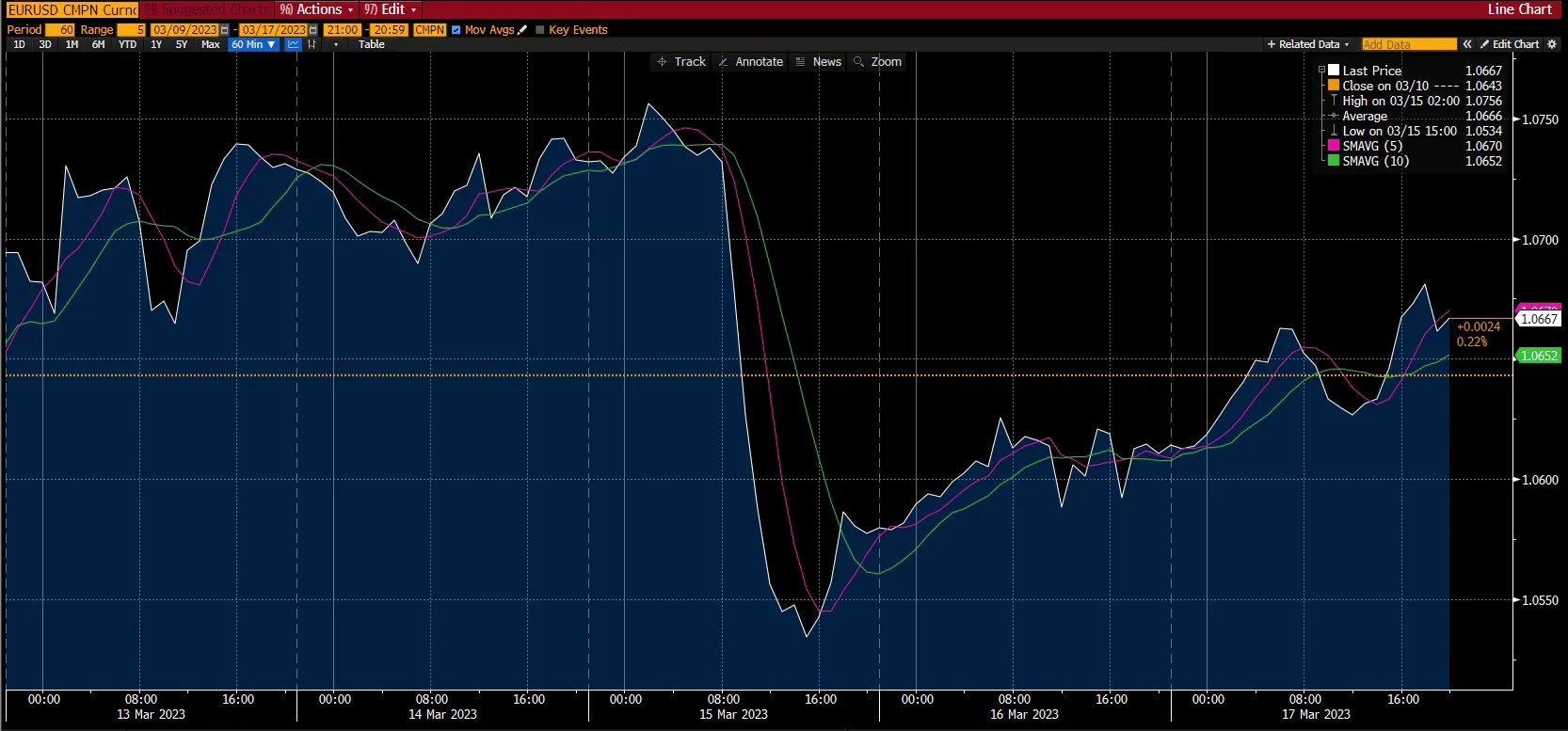
The EUR/USD pair slid heavily on Wednesday, 15 March, before gaining some ground and closing the week at 1.0667 USD. The banking crisis across the US and Europe — with the collapse of Silicon Valley Bank and Signature Bank in the US, and ongoing troubles at Credit Suisse in Switzerland — cast a shadow over the financial markets throughout the week.
The European Central Bank announced a 50 basis point hike on Thursday, 16 March, which led to a fall in yield in the US and German yields. The US Federal Reserve (Fed) will announce its own policy rate decision later this week.
Meanwhile, the GBP/USD pair closed the week at 1.2179 USD to mark significant gains, having closed the week prior at 1.2033 USD. The USD/JPY pair dropped below the 132 USD mark after the slide in US treasury bond yields on Friday, 18 March.
On the events front, all eyes will be on the US Federal Reserve’s interest rate decision which will be announced on Wednesday, March 22. Although a 25 basis point is the most likely outcome of the Federal Open Market Committee (FOMC) meeting, the ongoing banking turmoil has some observers suggesting that the Fed may keep rates unchanged. Also, Initial Jobless Claims data as well as the New Home Sales numbers will be released a day later on Thursday, 23 March.
Level up your trading strategy with the latest market news and trade CFDs on your Deriv X account.
Commodities
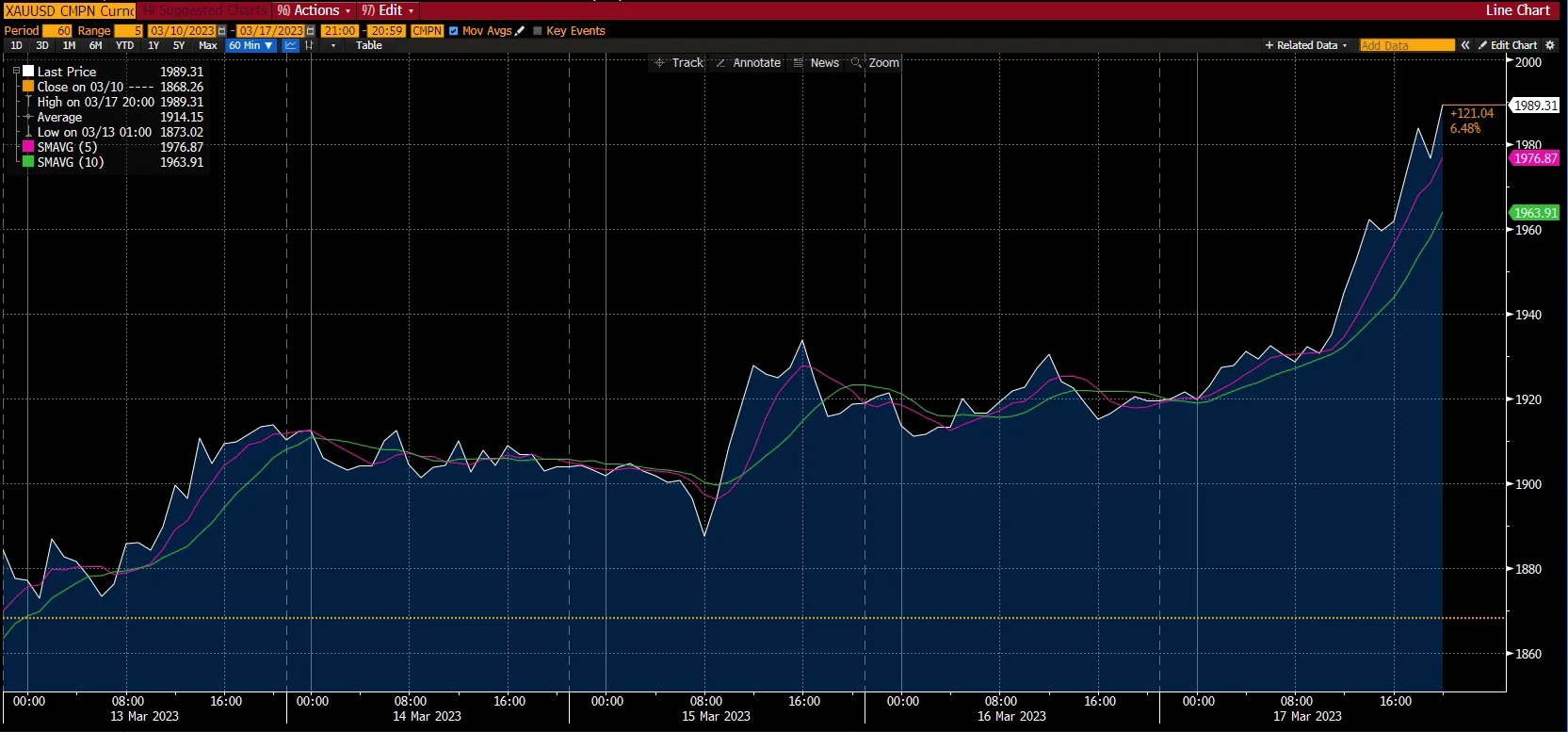
Gold prices registered major gains, rising more than 100 USD during the week as they approached the 2,000 USD mark. The prices of the yellow metal reached an 11-month high of 1,988.33 USD on Friday, 17 March. Gold prices are benefiting from risk aversion and the reversal in bond yields.
The February inflation data, which showed a decline, has raised hopes of a cautious approach from the US Federal Reserve, especially with the crisis in the banking sector. Its decision on policy rate hikes will have a significant impact on the price of the precious metal in the near term.
Meanwhile, oil prices endured a torrid week as they slumped to their lowest level in 15 months. Their prices collapsed a remarkable 13% for the week in the wake of the instability in the banking sector which has raised fears of an impending recession. A slowdown in economic growth will negatively impact the prices of the commodity.
Oil prices are expected to remain under downward pressure until the banking crisis gripping the West remains unresolved. Meanwhile, crude oil inventories — which measure the weekly change in the quantity of crude oil held by firms in the US — will be announced on Wednesday, 22 March.
Cryptocurrencies
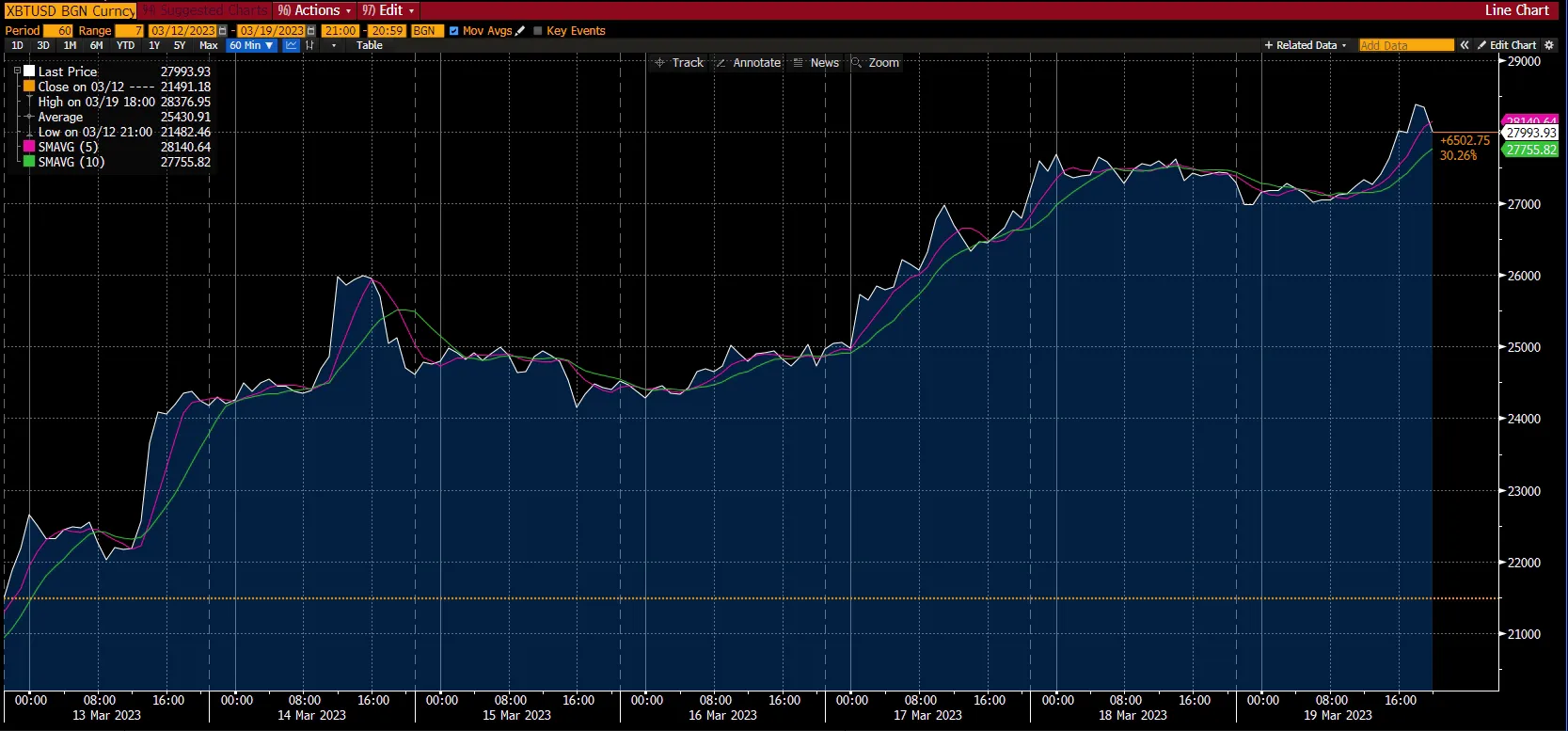
The global cryptocurrency market continued to display a bullish sentiment and reached a cumulative worth of 1.18 trillion USD on Sunday, 19 March. The ongoing financial crisis in the United States, particularly the upheaval in the banking industry, has prompted investors to turn to cryptocurrency as an alternative, boosting prices.
The current banking sector crisis, the impact of inflation in the US, and renewed hopes for a dovish Federal Reserve has Bitcoin reaching levels not seen since June last year. At the time of writing, the leading cryptocurrency was trading at 27,985 USD, marking a 16% boost in its value over the past 7 days. Similarly, Ethereum, the second-largest digital currency by market capitalisation, also drew strong interest, with its value increasing a remarkable 24.75% over the week to reach 1,783.82 USD.
In a significant development towards the mainstreaming of cryptocurrencies, one of Australia’s largest banks, National Australia Bank (NAB), has broken the blockchain barrier by becoming the first major financial institution to complete an intra-bank cross-border transaction on the Ethereum blockchain using its own NAB-issued stablecoin.
Take advantage of market opportunities by sharpening your trading strategy and trading the financial markets with options and multipliers on Deriv Trader.
US stocks

*Net change and net change (%) are based on the weekly closing price change from Friday to Friday.
US stocks bounced back from their recent slump which followed the collapse of Silicon Valley Bank and Signature Bank. Nasdaq was the biggest gainer with a 5.83% rise over the course of the week, while S&P was up 1.43%. Meanwhile, Dow Jones was down a meagre 0.15%. The gains, in what has been a grim week for the financial markets, was driven by a historic plunge in bond yields.
Some US government bond yields registered their biggest drop in decades as investors hope that the US Fed will halt its recent pace of policy rate hikes in a bid to prevent a potential fallout in the wake of collapse of regional banks. The bankruptcy of the two banks and issues at Swiss lender, Credit Suisse, have raised fears of a contagion that could herald a 2008-like recession which followed the collapse of Lehman Brothers.
The US Fed is now fighting the twin problem of keeping the inflation in check while maintaining financial market stability. The course of the Fed’s direction will become clear in their Wednesday, March 22, meeting — analysts predict a 25 basis point hike in the near-term and rate cuts later in the year.
Meanwhile, in a bid to stem the problems at Credit Suisse, the Swiss authorities have persuaded UBS Group to buy its rival in a landmark deal that carries a 3.23 billion USD price tag for UBS, which will also assume the 5.4 billion USD of Credit Suisse’s losses. The deal is expected to be completed by the end of 2023. Following the announcement of the deal on Sunday, 19 March, the US Federal Reserve, European Central Bank, and other major central banks issued statements to reassure markets.
Now that you’re up-to-date on how the financial markets performed last week, you can improve your strategy and trade CFDs on Deriv MT5.

Market news – Week 1, April 2023
In a week when the US Federal Reserve as well as the Bank of England announced policy rate hikes of 25 basis points each, the EUR/USD pair closed with gains.
In a week when the US Federal Reserve as well as the Bank of England announced policy rate hikes of 25 basis points each, the EUR/USD pair closed with gains.
Forex
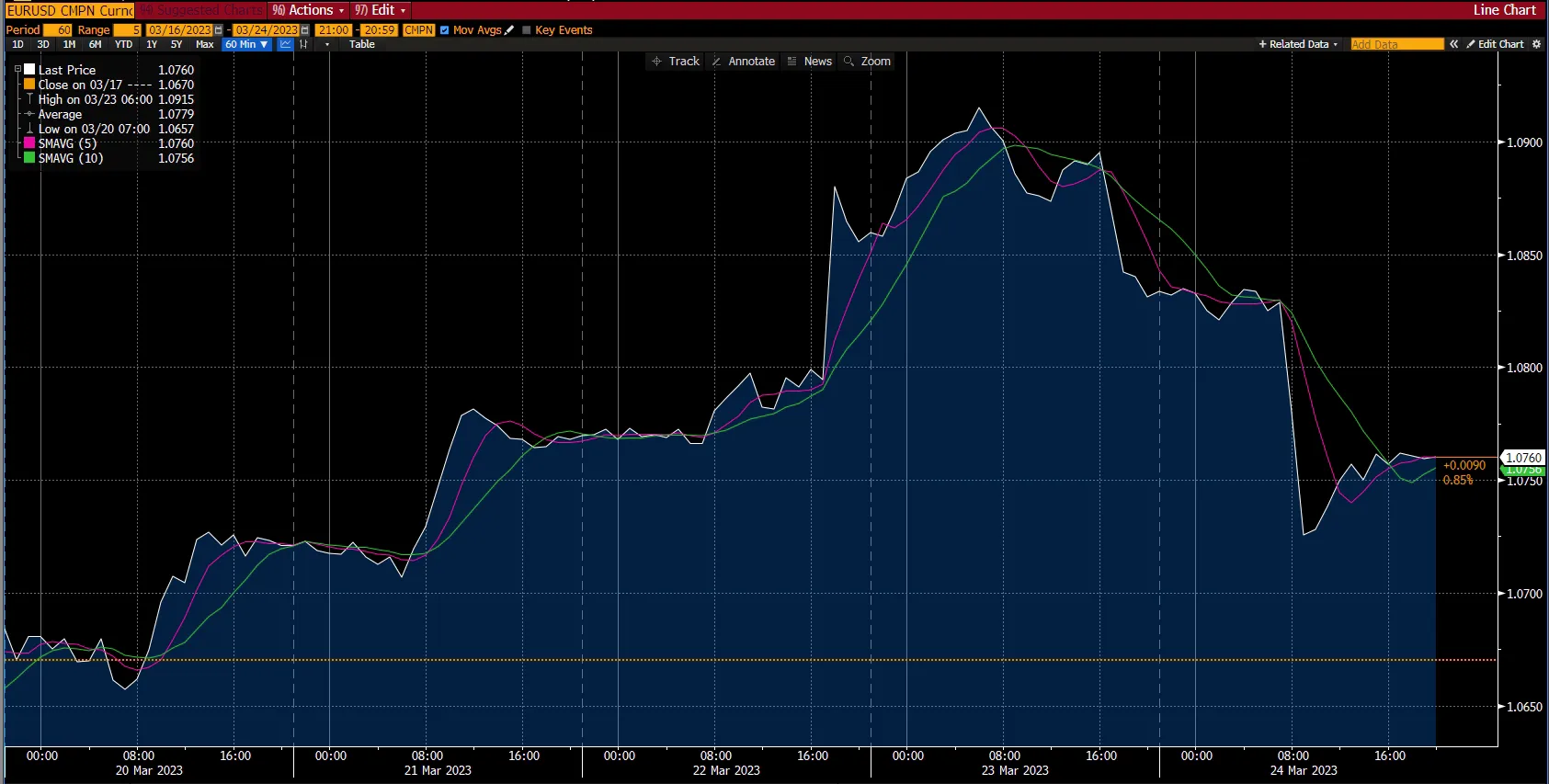
The EUR/USD pair was on the up, closing the week at 1.0760 USD. The euro gained — it went as high as 1.0900 USD on Thursday, 23 March — despite the banking crisis threatening to grip the Eurozone following the troubles at Credit Suisse, which is now set to be acquired by its rival UBS Group.
In its much-awaited Federal Open Market Committee (FOMC) meeting, the US Federal Reserve’s (Fed) policy rate decision was along the expected lines as it raised the rate by 25 basis points. The Fed is walking a tightrope, attempting to keep inflation in check while seeking to prevent contagion effects arising from the collapse of Silicon Valley Bank and Signature Bank.
The Fed wasn’t the only central bank to raise key rates last week as similar action followed in the United Kingdom, Switzerland, and Norway. The action in the UK came after inflation rose to 10.4% annual rate in February, prompting the Bank of England to lift its key rate by 25 basis points.
On the events front, it will be another crucial week in the United States as the Core Personal Consumption Expenditure (PCE) Price Index data — which is the Fed’s preferred gauge for inflation — will be released on Friday, 31 March. But before that, the fourth-quarter gross domestic product (GDP) data will be out on Thursday, 30 March.
Level up your trading strategy with the latest market news and trade CFDs on your Deriv X account.
Commodities
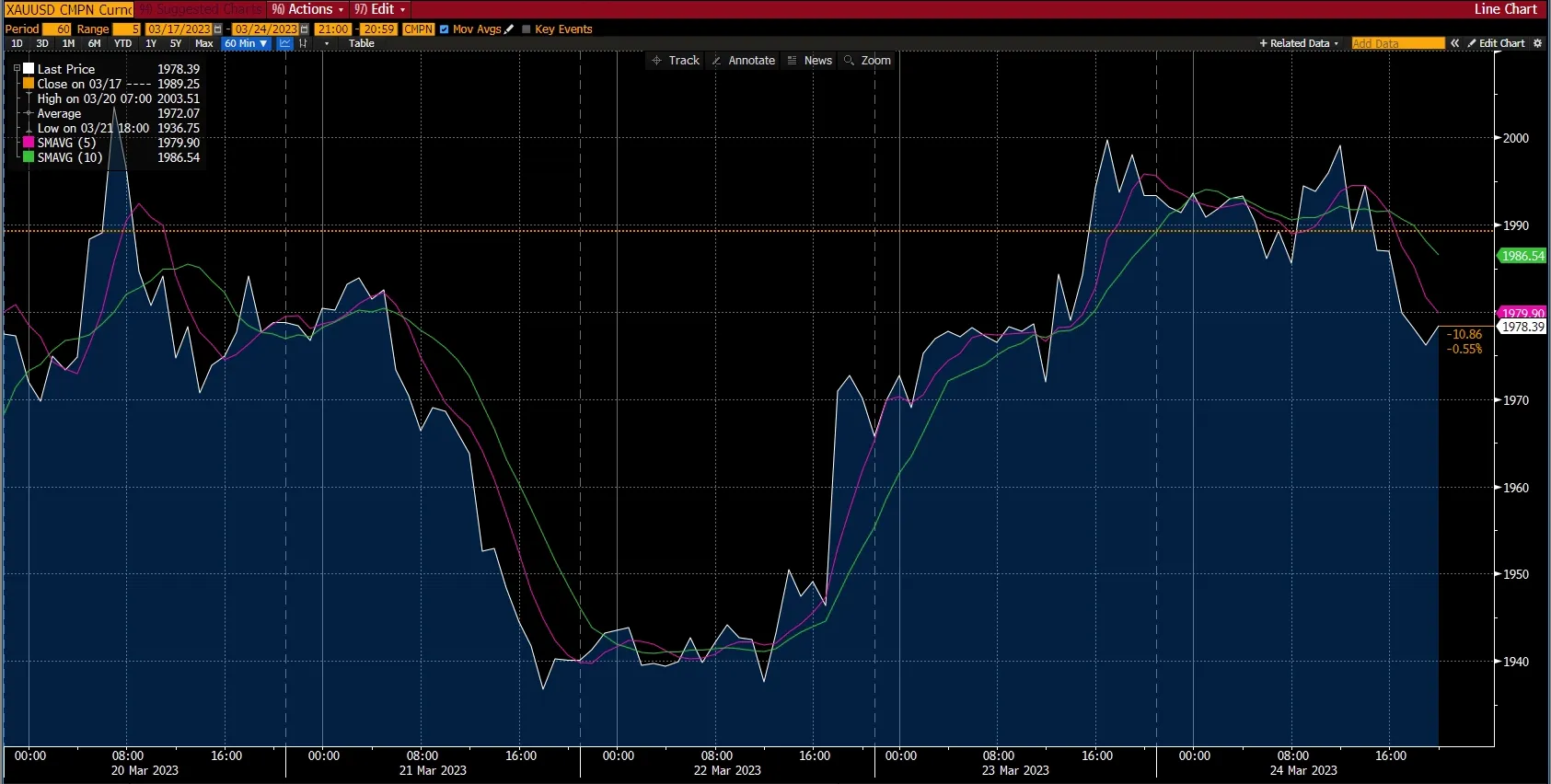
Gold prices enjoyed another surge last week. Having moved within a touching distance of the 2,000 USD level in the week prior, gold prices eclipsed the threshold, reaching 2,003.51 USD — their highest level since August 2020 — on Monday, 20 March. However, they eventually settled at 1,978.39 USD.
The crisis in the banking system in the West has coincided with the rise in prices of the precious metal. They have gone up nearly 9% since March 8.
After enduring a torrid week before last week when they lost a whopping 13% and slipped to their lowest level in 15 months, oil prices made modest gains as the banking crisis in the United States and Europe eased slightly. Brent futures rose 2.8% for the week, while US crude futures were up 3.8%. Crude prices were hampered by the US’s admission that refilling the country's Strategic Petroleum Reserve (SPR) may take several years.
However, oil prices were supported by strong demand expectations from China — the world’s biggest importer of crude. Meanwhile, Russia’s plan to cut oil production between March and June will not be as high as expected. The latest update on Russian production will ease supply worries and likely help stabilise the prices of the commodity.
Cryptocurrencies
The Group of 7 (G-7) countries and the European Union (EU) are seeking to promote tougher regulations of the cryptocurrency sector and aiming to increase business transparency and consumer protections, amid lingering concerns about potential risks to the global financial system posed by digital assets.
Their plan follows the November 2022 collapse of the major cryptocurrency exchange Futures Exchange (commonly known as FTX), which has laid bare the poor governance of the industry and sent shockwaves through financial markets worldwide. The global cryptocurrency market capitalisation stood at 1.16 trillion USD on Sunday, 26 March.
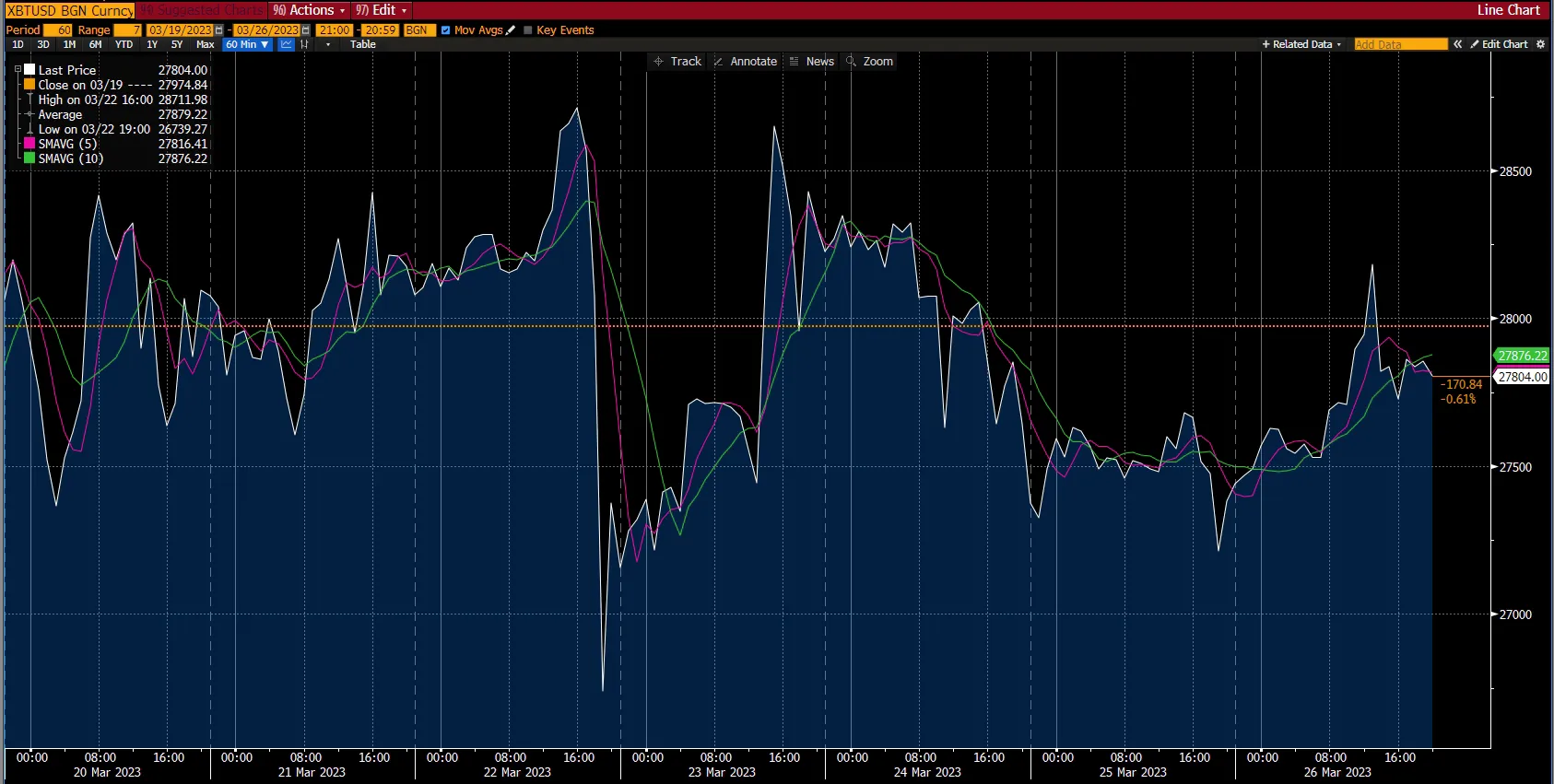
Bitcoin, the world’s leading cryptocurrency, started the new week by consolidating above the 27,000 USD support level. The currency was trading at 28,008 USD at the time of writing. Meanwhile Ethereum, the second-largest digital currency by market capitalisation, was trading at 1,776 USD.
In a development that would raise the spectre of regulations in the cryptocurrency space, Do Kwon, a South Korean national who co-founded Terraform Labs and developed the TerraUSD and Luna currencies, has been arrested and charged with fraud after his Terra-Luna stablecoin and crypto project lost an estimated 40 billion USD last year.
Take advantage of market opportunities by sharpening your trading strategy and trading the financial markets with options and multipliers on Deriv Trader.
US stocks

*Net change and net change (%) are based on the weekly closing price change from Friday to Friday.
The instability in the banking sector kept the US stock indices in check as they settled for modest gains following volatile movement over the course of the week. The Nasdaq was the biggest gainer at 1.97%, followed by the S&P 500 index at 1.38%. The Dow Jones rose by 1.18%.
The crisis following the collapse of Silicon Valley Bank in early March has seen investors flock for the shares of the top 5 companies by market value. Apple, Microsoft, Google-parent Alphabet, Amazon, and Nvidia have all risen between 4.5% and 12% since March 8. According to analysts, these stocks have gained as investors sought stronger and more viable companies in the wake of the ongoing turbulence in the banking sector.
The strength in the mega-cap stocks has corresponded with weakness in small-caps as the benchmark for the latter underperformed the former for a fifth successive week. It is in line with analyst expectations since they assert that the strength in mega-caps covers up weakness elsewhere.
This week will be crucial in terms of data releases. The Conference Board (CB) Consumer Confidence data — which measures the level of consumer confidence in the US economy — is due for a Tuesday, 28 March release. Meanwhile, the fourth-quarter GDP numbers in the US will be released on Thursday, 30 March.
Now that you’re up-to-date on how the financial markets performed last week, you can improve your strategy and trade CFDs on Deriv MT5.

Market news – Week 3, April 2023
Despite facing a multitude of challenges (including bankruptcies, fraud, and failures), the cryptocurrency world rallied and saw increases in overall value in the past month, including another rise over the weekend.
Despite facing a multitude of challenges (including bankruptcies, fraud, and failures), the cryptocurrency world rallied and saw increases in overall value in the past month, including another rise over the weekend.
Forex
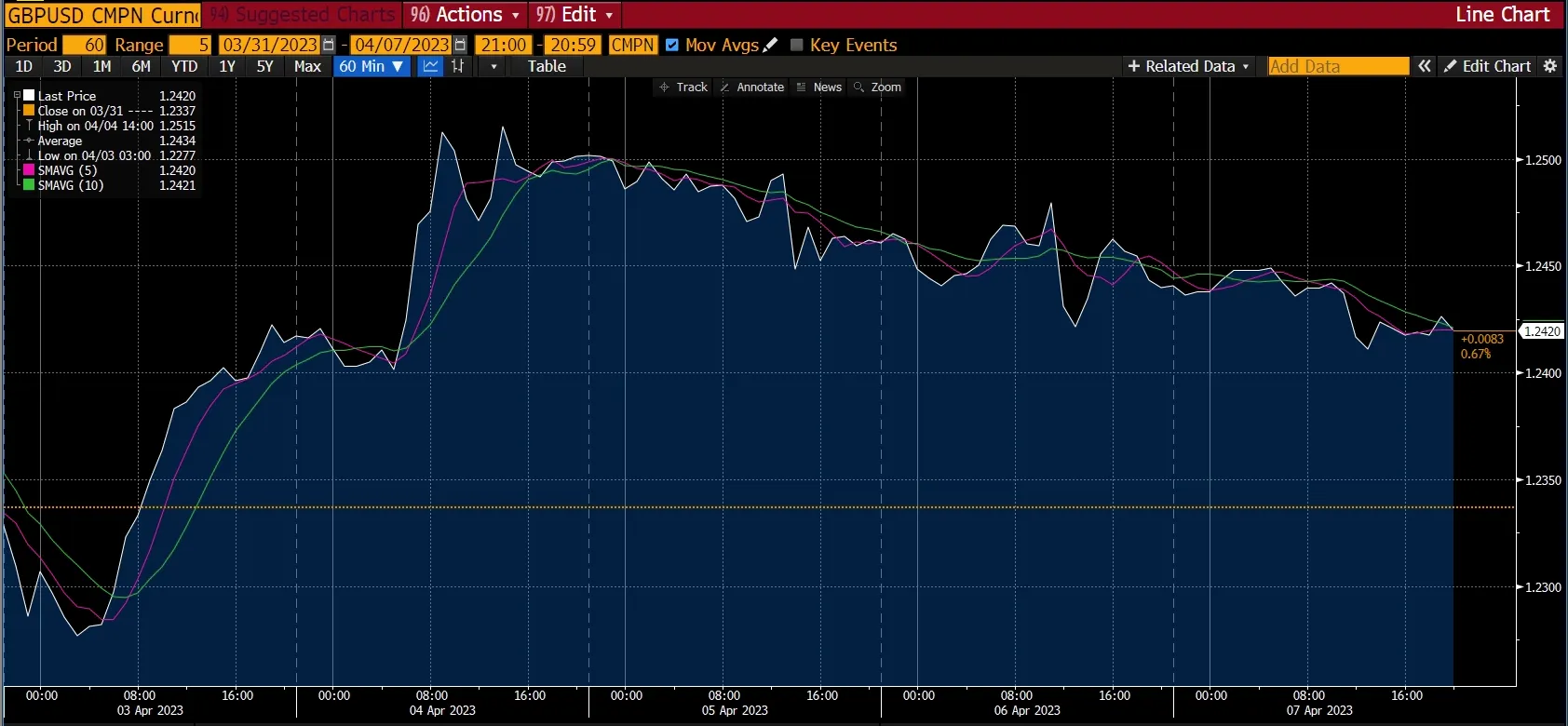
The GBP/USD pair rose early in the week, with the British pound gaining on the back of initial US dollar weakness. However, the US dollar grew in strength modestly throughout the week, leading to the pound closing at 1.2420 USD as it struggled to keep its momentum.
The non-farm payrolls (NFP) data — which was released on Friday, 7 April — showed that the US economy added 236,000 jobs in March and the unemployment rate came down to 3.5% from 3.6%. The numbers boosted the strength of the dollar as it recorded small gains. The employment data suggests another likely 25 basis point hike by the US Federal Reserve.
Moreover, the Institute of Supply Management (ISM) manufacturing data released on Monday, 3 April, showed a nearly 3-year-low at 46.3, below expectations of 47.5, reversing the uptick experienced in February. There, however, still remains multiple factors affecting the risk appetite of traders: ongoing US-China tensions, crisis in the banking sector, and recession fears.
Meanwhile, EUR/USD also rose and reached a 9-week high early in the week thanks to a strengthening euro, before falling and closing the week at 1.0907 USD. And the Japanese yen ended March flat against the US dollar with the yen’s Quarter 1 gains being wiped out.
This week will see the release of the Core Consumer Price Index (CPI) data on Wednesday, 12 April, along with the meeting minutes of the Federal Open Market Committee (FOMC) on the same day. And on Thursday, 13 April, the data from the Initial Jobless Claims and the Producer Price Index (PPI) will be released.
Commodities
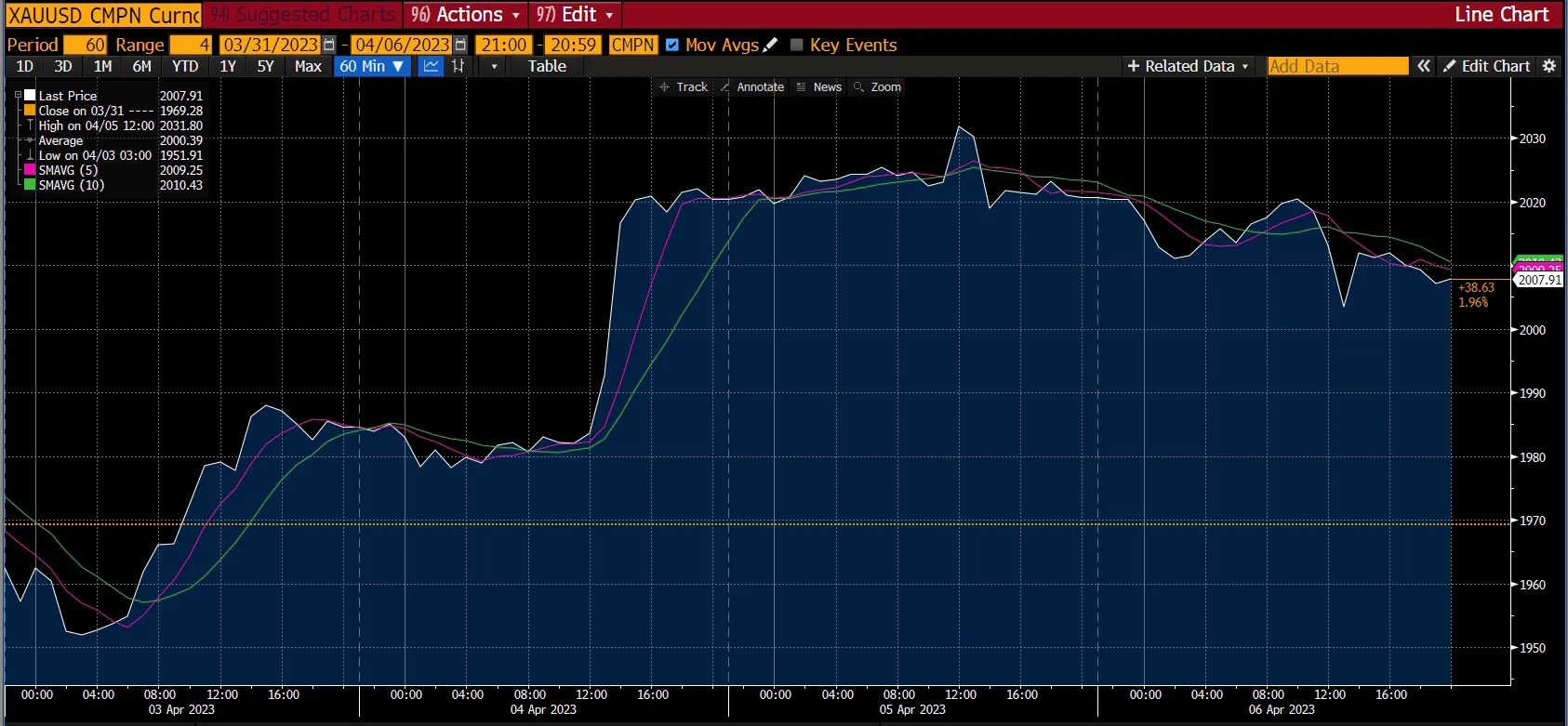
Although starting the week struggling and under pressure, gold prices reached a 13-month high mid-week, rising above 2,025 USD per ounce, as the US dollar weakened in the previous week. After the rally, prices wavered with small gains and losses as traders watched the market for new catalysts. Gold ended the week at almost 2,008 USD.
Lately, disappointing macroeconomic data like March’s ISM manufacturing and services Purchasing Managers’ Index (PMI) have strengthened views that the US could face a recession soon, which in turn is likely to affect the prices of the yellow metal.
Crude oil prices were at a 2-month high on Monday, 3 April. It soared over 5%, after a surprise OPEC (Organisation of the Petroleum Exporting Countries) announcement over the weekend that there will be an output cut of 1.1 million barrels per day. This cut was announced as a response to recent wild fluctuations in the market and in an effort to stabilise energy markets.
Crude prices managed to hold on to their gains for most of the week, before dipping at the close after the release of important data in the US.
With the Federal Reserve (Fed) maintaining its hawkish stance, concerns about a looming recession, and China still to reach its pre-pandemic economic activity levels, market perceptions on global growth prospects continue to fluctuate.
Cryptocurrencies
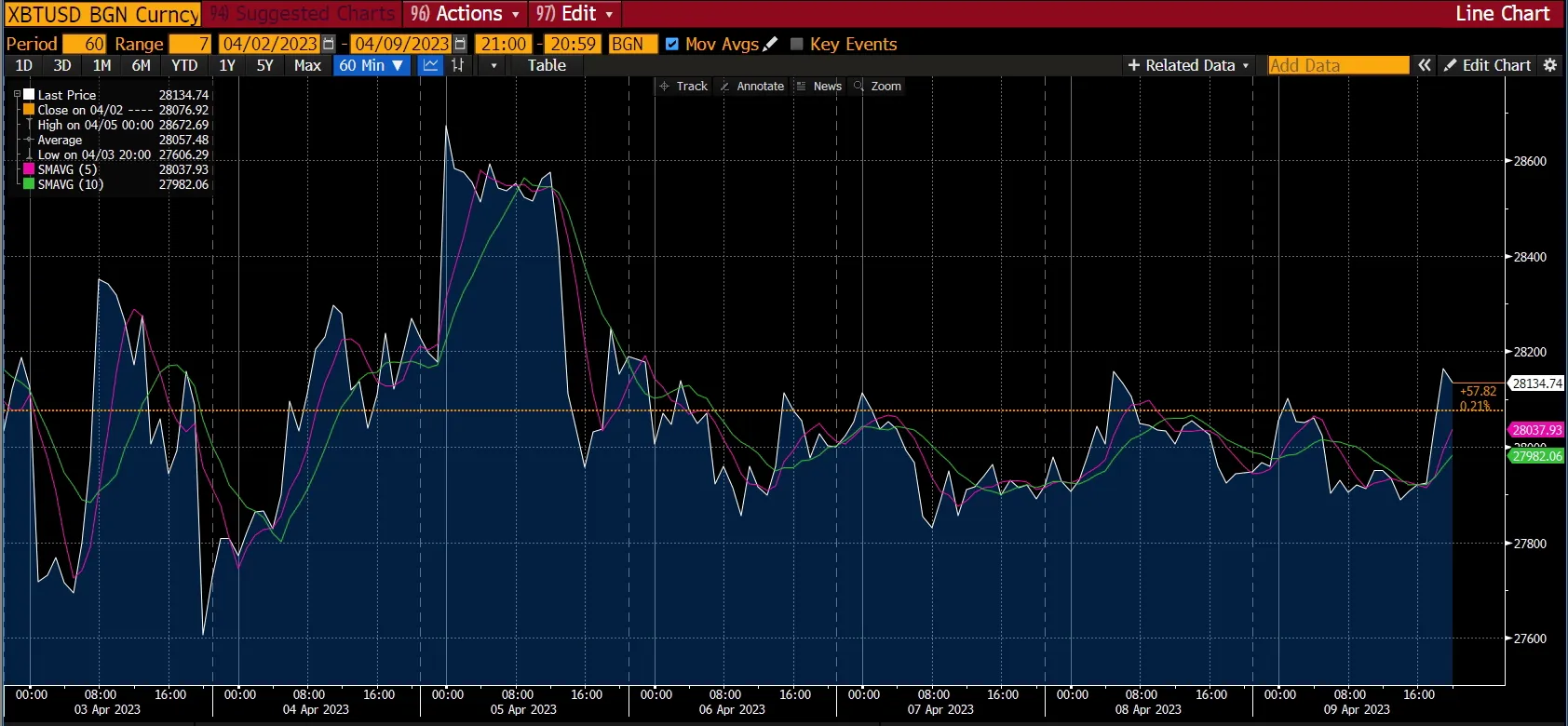
Last year, the world of digital tokens was impacted by a number of significant events. Despite the continuing setbacks since the collapse of Futures Exchange (or FTX) last November, the overall value of several cryptocurrencies rose in the past month in the aftermath of concerns about the health of the banking sector.
Last weekend, the prices of most cryptocurrencies rose as the market reacted to the non-farm payrolls report (released on Friday, 7 April), which showed an addition of 236,000 jobs to the US economy last month. The global cryptocurrency market capitalisation stood at 1.19 trillion USD on Sunday, 9 April
Despite Bitcoin’s rally this year drawing attention, the leading digital coin has seemingly halted its advance at 28,000 USD, a key trading point around which it has been meandering over the last two weeks. The world’s largest cryptocurrency has hit a proverbial wall at that level, moving slightly above or below it in what analysts are calling range-bound trading. It was trading at 28,343.20 USD on Sunday, 9 April.
Meanwhile Ethereum, the second-largest digital currency by market capitalisation, was trading at 1,859.57 USD at the time of writing.In other news, crypto enthusiasts turned their attention to other tokens such as Dogecoin, which surged as much as 30% last week after Twitter briefly changed its logo from the popular blue bird to the doge meme.
US stocks

*Net change and net change (%) are based on the weekly closing price change from Friday to Friday.
Consecutive weaker-than-expected data releases throughout the course of last week plus concerns over the Fed’s rapid interest rate hikes have rekindled fears of an upcoming recession, and caused US stocks to slip mid-week.
The Nasdaq and the S&P 500 ended the week on minor losses, while the Dow Jones gained slightly over the course of the week. The indices were boosted by a rally in Google-parent Alphabet shares which climbed 3.8% and Microsoft that rose 2.6%.
These slips in reaction to recession fears are a change in sentiment over recent months, when weak data was celebrated on the assumption that the Fed’s rate hikes were working and that the central bank would subsequently ease up on its rate hike spree. The US inflation report (which will be released on 12 April) will be closely monitored to assess predictions for the short-term trajectory of interest rates.
Another upcoming highlight is the March-quarter earnings season, which will be kicked off by major banks such as JP Morgan Chase and Citigroup on Friday, 14 April. This highly-anticipated season will likely indicate the health of the financial industry.
Now that you’re up-to-date on how the financial markets performed last week, you can improve your strategy and trade CFDs on Deriv MT5 or Deriv X, or with options and multipliers on Deriv Trader.

What is mining?
In this video, we go through the basics of what cryptocurrency mining is and how it works.
Take a deep dive into the world of cryptocurrency mining with our in-depth video that explains what crypto miners do and how blockchain works.
Sorry, we couldn’t find any results matching .
Search tips:
- Check your spelling and try again
- Try another keyword