
Results for

Market recap: Week of 9-13 Oct 2023
Stay informed with our weekly market recap from 9th to 13th October, 2023. Get insights on the latest trends and developments in the financial world.
US interest rates
Yahoo: Marko Kolanovic of JPMorgan foresees a potential 20% sell-off in S&P 500 amid rising interest rates.
Amid growing concerns, cash investments in money markets and short-term Treasuries are emerging as key protective strategies.
Bank of America's Michael Hartnett suggests a potential 20% downside but acknowledges near-term equity upside.
Bonds may become the top-performing asset class as recession risks become more apparent.
Bank of Japan
Reuters: Bank of Japan data dispels notion of mysterious Yen spike as intervention.
Friday's money market projection shows a 1.09 trillion yen net receipt, aligning closely with brokerages' estimates, suggesting minimal intervention.
Experts remain cautious but lean towards no significant intervention.
Central banks
Gold Council: Central banks continue to show strong interest in gold, with their gold reserves rising for the third consecutive month. In August alone, they added 77t to global official reserves, a 38% increase from July.
Over the past three months, their net buying totalled 219t, surpassing net sales from earlier in the year (96t).
European inflation
CNBC: European Central Bank VP de Guindos: Inflation to continue downward, watchful eye on oil prices.
OPEC raises long-term oil demand projections, diverging from IEA. OPEC predicts 116 million barrels per day by 2045, while IEA sees 'beginning of the end' for fossil fuels.
Rate hiking cycle
The Wall Street Journal: The sustained rise in long-term Treasury yields could bring the Federal Reserve's rate hiking cycle to an anticlimactic end. If long-term rates stay high and inflation cools, top central bank officials may halt short-term interest rate hikes. Dallas Fed President Lorie Logan noted that elevated long-term rates may reduce the need for raising the Fed funds rate.
Meanwhile, the Bank of England expressed concerns about overvalued financial assets, particularly in U.S. tech stocks and dollar-denominated corporate bonds.
Property markets
Business Times: The Bank of England highlights concerns over potentially overvalued risky assets. Some of the landlords are able to pass on costs to tenants because there have not been significant signs of landlords selling up so far. The BOE is closely monitoring the property market in Hong Kong and mainland China, examining potential spillovers to UK financial stability.
In China, monthly new floor space sales have dropped by nearly half compared to 2021 levels, and real estate investment fell almost a fifth in August compared to the same month in the previous year.
Inflation and growth
Yahoo Finance: Pimco sees a potential era of 'extremely attractive' fixed-income returns due to soaring yields and recession risk, says Pacific Investment Management Co. Bright outlook for high-quality bonds over the next 6-12 months with cooling inflation and growth concerns.
Japan's central bank, however, may raise rates as others cut them, potentially boosting Japanese yields - Pimco report.
Germany economy
The Associated Press: Germany's government and the IMF have both lowered their economic growth expectations, citing challenges in various sectors and structural issues.
The country's strong manufacturing sector faces energy challenges and a reduced demand from trade partners.
Yen volatility
Reuters: A senior Japanese finance ministry official said that the Group of Seven (G7) statement reaffirmed the group’s shared understanding that excess currency volatility is problematic.
In August, when questioned by reporters regarding the yen's recent decline approaching the significant 150 level on 12 Oct 2023, an ex-Bank of Japan official predicted no yen intervention until the breach of 150 threshold.
US Consumer Price Index
Reuters & CNBC: The latest US Consumer Price Index report reveals a 0.4% monthly increase and a 3.7% year-on-year rise, exceeding Dow Jones estimates of 0.3% and 3.6%.
Headline inflation surged by 0.6% in August. The core CPI also showed a 0.3% monthly increase and a 4.1% 12-month rise.
These unexpected numbers are driving up Eurozone government bond yields, fueling speculation that the Federal Reserve may consider interest rate hikes by year-end.
.webp)
What are ETFs? Your guide to exchange-traded funds
Get a better understanding of exchange-traded funds (ETFs), the different types, and pros and cons of trading ETFs. The most common questions asked by novice traders are...
The most common questions asked by novice traders are: What are ETFs? What do ETFs stand for?
ETFs, or exchange-traded funds, are a type of investment fund and exchange-traded products traded on a stock exchange. These versatile financial instruments offer flexibility and diversification to any trading strategy, making them popular among traders.
Here's what we'll cover in this blog post:
ETFs: What are they
Imagine a buffet where an array of dishes is available without you having to order each dish separately to try it. ETFs work similarly, offering a diverse spread of assets bundled into a single trading vehicle.
When you trade ETFs, you're essentially choosing a mix of assets, such as stocks, bonds, or commodities, without the hassle of owning each individually. These instruments are traded on stock exchanges, ensuring you can buy and sell them during market hours.
💡Pro tip:

Types of ETFs
There are various types of ETFs, with each having different underlying assets. ETFs come in multiple forms to suit different trading strategies and risk appetites. They may contain stocks, bonds, commodities, and indices. Some of the most popular categories include:
Stocks ETFs
Stock ETFs, also known as equity ETFs, invest in stocks, either tracking a specific set of stocks, a stock market index, or a particular sector within the stock market. ETFs can receive dividends from their underlying assets, such as stocks or bonds. When these assets pay dividends, the ETF typically collects and distributes them to its shareholders. When it has been a good period for the assets, the ETF market price tends to increase.
For example, the ARK Innovation ETF provides exposure to domestic and foreign stocks of companies that depend on or benefit from developments in artificial intelligence, automation, DNA technologies, energy storage, fintech, and robotics.
💡Pro tip:

Bond ETFs
When trading bond ETFs, traders are exposed to a portfolio of bonds that are segmented according to their type, issuer, and maturity, among other factors. For example, the iShares iBoxx$ High Yield Corporate Bond ETF tracks an index of high-yield bonds of US dollar-denominated companies.
Bond ETFs can vary in risk and return depending on the types of bonds they hold. Some other examples include government bonds, corporate bonds, municipal bonds, international ETF bonds, and other fixed-income securities.
Commodity ETFs
These ETFs track the prices of commodities like gold, oil, or agricultural products. Commodity ETFs allow traders to speculate on commodity price movements without physically owning or storing the commodities. They offer accessibility and cost-efficiency, while direct commodities trading provides ownership and precise exposure to your chosen asset.
For instance, the SPDR Gold Shares ETF tracks the price of gold bars in the over-the-counter (OTC) market.
💡Pro tip:

Index ETFs
These are the most prevalent types of ETFs and are engineered to mirror the performance of a particular stock market index. For example, the SPDR Dow Jones Industrial Average ETF Trust tracks the Dow Jones Industrial Average index. Traders can gain exposure to specific sectors or to the entire market with index ETFs. Index ETFs are known for their cost-effectiveness, which makes them an attractive option for traders.
What sets index ETFs apart from stocks ETFs is that the latter primarily invest in individual company stocks, while index ETFs track the performance of various indices, including but not limited to stocks.
💡Pro tip:

Pros and cons of trading ETFs
Selecting the optimal asset to trade is like choosing a new car. You want an option that has good value, is reliable, and suits your needs.
Let's take a closer look at some of the advantages of ETFs and why you should trade them.
- Diversification
ETFs offer a simple way to diversify across a wide range of assets rather than just a single asset. This can reduce the overall risk of your trading portfolio.
- Liquidity
Liquidity refers to how easily an asset can be bought or sold without affecting its price significantly. ETFs can be bought or sold throughout the trading day, providing flexibility to you.
- Transparency
You can easily see what assets ETFs hold, helping you make informed trading decisions. ETFs are required to disclose their holdings regularly. This means traders can easily see which stocks or bonds are in the fund's portfolio and track their individual performances and the performance of the ETFs.
💡 Pro tip:

While ETFs offer many benefits, there are a few things to keep in mind:
- Risk management
Even though ETFs provide diversification, they are not immune to market volatility and risk. Make sure to evaluate the risk associated with the underlying assets. Stay informed about current market conditions and news related to the sectors or asset classes covered by the ETF.
💡Pro tip:

- Price discrepancies
The current market value of an ETF may not consistently mirror the precise value of its underlying assets. As ETFs are traded on an exchange, traders are subject to market dynamics during trading. This means that prices may potentially deviate from the net asset value (NAV), which is usually the basis for an ETF’s trading price.
- Commissions and fees
While many online brokerages offer commission-free ETF trading, there may still be other fees, such as expense ratios, bid-ask spreads, and account maintenance fees. Understanding the fee structure of your chosen ETFs and the brokerage platform is essential before you start trading.
ETFs offer diversification, transparency, and liquidity, making them a valuable tool for traders to get on trading. Whether you're a beginner or an experienced trader, ETFs can play a significant role in your trading strategy, helping you build a well-balanced and diversified portfolio. However, like any other market, it's essential to do your research and consider your trading goals and risk tolerance before trading ETFs.
💡Pro tip:

It is always a good idea to create a demo account to start practising. Take the opportunity to explore the ETFs on Deriv MT5 or Deriv X, where you can gain experience and insights into how ETFs work.
%252520(1)%252520(1).webp)
New stablecoin added to Deriv for secure trading
Discover the latest addition to Deriv Cashier - Tether on Tron - a reliable stablecoin, ensuring utmost security for your trading endeavors.
We’re happy to announce an exciting new addition to Deriv Cashier – Tether (USDT) on the TRON network (TRC20). This new stablecoin is pegged to the US Dollar and opens up a secure way to deposit, withdraw, and trade on Deriv. You can now trade on Deriv without worrying about the volatility typically associated with crypto assets.
The addition of TRC20 USDT (tUSDT in Deriv) is an exciting step forward in expanding the capabilities of Deriv Cashier and giving you more tools and opportunities to trade the way you want.
The TRON network brings the advantages of low network fees (the fee required to conduct transactions or execute contracts on the blockchain network), rapid processing times, and robust security to the table. With tUSDT added to Deriv's Cashier, we are providing our users with a top-tier option for deposits and withdrawals within their Deriv accounts.

Read on to learn more about how to start depositing and withdrawing the tUSDT token on Deriv today.
Tether pegged to USD
The integration of tUSDT brings wider utility to the TRON ecosystem while giving Deriv traders a trusted stablecoin to trade with. Tether aims to provide dollar-pegged stability, reducing volatility risk compared to coins like Bitcoin. This makes tUSDT an ideal fund for trading on Deriv, allowing potential profits and losses to be denominated in a stable fiat-linked asset.

Here's how you can start using tUSDT:
--> Log in to your Deriv real account.
--> Open Cashier and go to Deposits.
--> Choose "Deposit cryptocurrencies" and make sure to select Tether TRC20 (tUSDT).
--> Click on Continue to see your wallet address* listed as a string of letters and numbers under the QR code.
*The address is generated by Deriv for you to send tUSDT from an external crypto wallet. As always, accurately copying the full address is critical to avoid loss of funds.
With tUSDT's arrival, Deriv continues expanding its roster of supported blockchain assets. Our platform aims to provide a complete suite of secure cryptocurrency funding options tailored to the needs of online traders worldwide. With tUSDT’s stability, affordability, speed, and security, it presents an excellent option for trading with cryptocurrency on Deriv.
We’re excited to open up this new capability to our users and look forward to seeing you take advantage of tUSDT!
.webp)
Market recap: Week of 2-6 Oct 2023
Stay informed with our weekly market recap from 2nd to 6th October, 2023. Get insights on the latest trends and developments in the financial world.
Rising insurance costs for EVs
The Guardian: Electric vehicle owners face soaring insurance costs as premiums for EVs surged by 72% in the past year, according to Confused.com. While car insurance prices have increased by 52.9% overall in the last 12 months, EV owners are hit harder, with claims costs 25% higher and longer repair times. These rising costs raise concerns for drivers making the switch to electric for environmental reasons.
Bank of Japan
Reuters: Bank of Japan Governor Kazuo Ueda highlights the distance to go before exiting ultra-loose monetary policy, citing potential impacts on BOJ's profits when interest rates rise. While interest rate payments to financial institutions could increase, higher-yielding bonds may boost interest income.However, the full extent of these effects remains uncertain. Rising interest rates and their impact on central bank profits are exemplified by the U.S. Fed's recent losses, surpassing $100 billion in September 2023. The primary goal of monetary policy, price stability, remains a priority for central banks despite financial considerations.
U.S. interest rates
CNN: Fed's Mester suggests possible rate hike, JPMorgan's Dimon anticipates further increases. Differing views on U.S. monetary policy: Mester hints at one more hike this year, while Dimon sees potential for a 1.5% rate rise to 7%.
Oil market
Yahoo Finance: Citi's Ed Morse: OPEC+ cuts fueled a prolonged oil bull run, but 4Q'23 may bring lower prices with more downside in 2024. Production rising outside OPEC+, including the US, Brazil, Canada, and Guyana, while Venezuelan and Iranian exports have increased.
Reserve Bank of Australia
The Guardian: Reserve Bank of Australia (RBA) keeps cash rate steady at 4.1% for 4th month. New governor Michele Bullock warns of potential future rate hikes. Focus on global economy, household spending, inflation, and labour market. Household consumption outlook uncertain due to financial squeeze and housing price dynamics.
Treasury yield
Barron’s: Stocks plunge as Dow Jones Industrial Average erases year's gains, 10-year treasury yield hits 2007 high major indexes tumble amid Federal Reserve interest rate concerns. 10-year yield at 4.801%, highest since 2007. Strong job openings data contributes to market unease.
Apple shares
Dailymail: Apple CEO Tim Cook sells 511,000 shares, after tax $41.5 million. Apple's stock, once at its peak of $195.83 in July, has slipped 13% since iPhone 15 released. Fellow directors O'Brien and Adams sell $11 million each. iOS 17.0.3 released with iPhone 15 fix.
U.S. Government shutdown
Reuters: Fitch cautions on possible U.S. government shutdown, but no impact expected on sovereign rating. Moody's warns of credit impact; S&P Global expects economic effect.
UK Climate policy
The Guardian: Rishi Sunak's climate policy shifts have impacted the UK's global business appeal, warns Mark Carney. Delayed net-zero goals and support for new oil drilling raise concerns. Global firms seek green power for relocation.
Fed rate hikes
Bloomberg: JPMorgan's Eigen eyes possible 6% Treasury yields, maintains cash position. Anticipates Fed rate hike and potential 18-month hold for inflation control. Portfolio: 63% cash-like, 37% in short-dated, floating-rate investment-grade debt.

5 popular markets to trade CFDs: A beginner's guide
Discover the top markets to trade CFDs and maximise your potential profits. Join the millions of traders who have already found success in these popular markets.
CFDs, or contracts for difference, are a type of derivative that allows you to trade on the price movements of an underlying asset without actually owning it. CFDs are popular among traders who want to access a wide range of markets.
But with so many options to choose from, how do you know which ones are the best for CFD trading? Here's a rundown of the most popular CFD trading markets, along with some things to remember when choosing where to trade.
Forex
The foreign exchange market is the largest and most liquid market in the world, and it offers you the opportunity to trade on the price fluctuations of currencies. This makes it an excellent starting point for beginners, as there is always plenty of liquidity and volatility to keep things interesting.
It's important to remember that you're not buying or selling currencies in forex CFD trading. Instead, you're simply speculating on whether the price of a currency will go up or down. This can be a bit tricky to wrap your head around at first, but it's a concept that most traders tend to grasp after lots of practise.
Commodities
The commodities market includes a wide range of resources, including oil and gold. CFDs on commodities allow you to speculate on the price changes of these assets. Many traders use it to hedge against inflation or take advantage of global economic trends.
When trading commodities CFDs, understanding the underlying asset is key. For example, if you're trading oil CFDs, you need to know about the factors that affect the price of oil, such as supply and demand, geopolitics, and weather conditions.
Cryptocurrencies
The cryptocurrency industry is relatively new but has grown popular in recent years. CFDs on cryptocurrencies allow you to trade on the price volatility of these digital assets. Since it's an unpredictable market, practising caution when trading crypto CFDs is encouraged.
Stocks
Stock CFDs are a type of derivative that allows you to trade on the market trends of individual stocks without actually owning the underlying shares. The amount of money you can make or lose from trading stock CFDs depends on the size of your position and the movement of the stock price. This makes stock CFDs a great asset for both long-term investors and short-term traders.
Stock indices
Indices are baskets of stocks that track the performance of a particular market or sector. Indices CFDs allow you to trade on the price movements of these baskets of stocks. Traders can get exposure to a specific market or industry without picking individual stocks.
Choosing the right financial market for you
The best market for CFD trading will vary depending on your circumstances and preferences.
Here are some additional thoughts traders keep in mind when choosing a market for online CFD trading:
- When entering financial markets, traders often take into account their personal risk tolerance, as some markets tend to be more volatile than others.
- The timeframe of one's financial goals also plays a role, with some pursuing short-term gains while others aim for long-term growth.
- Performing thorough research on the various markets and price drivers is commonly part of a trader's preparation.
- Beginning with a small account size can assist traders with managing their overall risk exposure.
CFD trading for beginners has the potential for success, but it's critical to remember that risks are always involved.
Whatever market you choose to start, you can practise by creating a demo account before trading with real money. Create a free demo account with Deriv today, and try CFD trading on Deriv MT5 or Deriv X.
You may also like:
Your guide to Deriv MT5 – the world-famous CFD trading platform

A guide on forex currency pairs
Get to know the basics of forex currency pairs and use this knowledge to interpret them when trading forex.
All transactions that take place on the foreign exchange market (also known as the forex market) involve currency pairs. Currency pairs refer to the 2 currencies that are traded against each other, and the value of these pairs reflects the current forex rates.
Currency pairs 101
Forex currency pairs compare 2 currencies, where the value of the first currency, also known as the base currency, is quoted against the second currency, or quote currency.
If you’re familiar with exchanging money when travelling, think of your local currency as the base currency and the foreign currency as the quote currency.
In the forex market, each currency in the forex market uses a unique three-letter code assigned to them by the International Organisation for Standardisation (ISO), referred to as an ISO currency code. For example, the US dollar has the ISO code USD, while the British pound sterling is noted as GBP.
Deciphering forex currency pairs
When trading on the forex market, your trade position will be determined by the currency exchange rates of both currencies in a currency pair.
Let’s take, for instance, the currency pair of GBP and USD. When you trade on this pair, you will have two different values – GBP/USD and USD/GBP.
In the GBP/USD pair, GBP is the base currency, and USD is the quote currency. Each pair has a direct exchange rate and an indirect exchange rate.
- Direct exchange rate: Direct exchange rates are where the cost of one unit of base currency is given in units of the quote currency.
For instance, if GBP/USD pair has a direct exchange rate of 1 GBP = 1.11 USD, it means one British pound can buy 1.11 US dollars.
- Indirect exchange rate: Indirect exchange rates are where the cost of one unit of quote currency is given in units of the base currency.
Using the same example above, if the GBP/USD pair has an indirect exchange rate of 1 USD = 0.90 GBP, one US dollar would be able to buy 0.90 British pounds.
Taking the earlier example of exchanging local and foreign currency, direct exchange would occur when you’re exchanging your local currency for foreign currency, and indirect exchange would be when you’re exchanging foreign currency for local currency.
Trying your hand at trading forex currency pairs
In forex trading, it is assumed that you are buying a currency pair with the expectation of its base currency value going up, and selling a currency pair with the expectation that the base currency's value will decline.
If you buy the GBP/USD pair, it can be said that you anticipate that 1 GBP is going to be worth more than its current value, while the value of USD stays the same or declines. Similarly, if you were to trade this pair by selling, it would be implied that you’re speculating the GBP’s value will fall against the USD and would like to sell it off before the price dips even further.
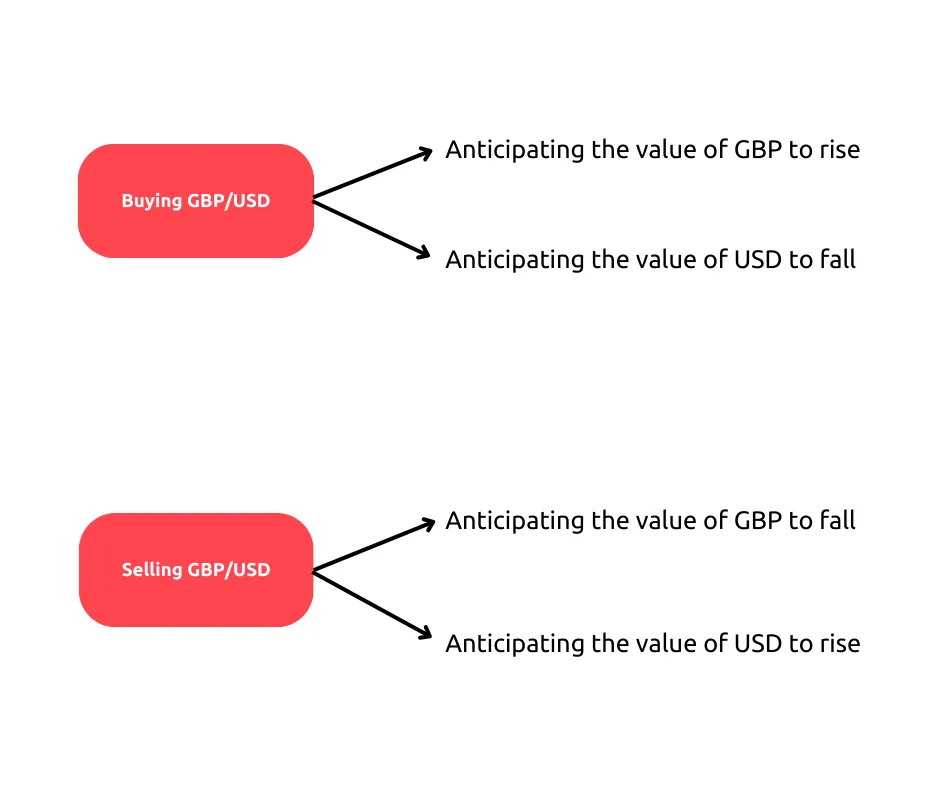
For instance, say GBP/USD was trading at 1.25 USD, and you decide to buy 1 GBP.
If the price of GBP/USD rises from 1.25 USD to 1.30 USD per 1 GBP, the USD would be said to have depreciated in value, and the GBP would have appreciated in value – as you would now need more USD to buy the same amount of GBP.
However, if the price of GBP/USD falls from 1.25 USD to 1.20 USD, the USD would have strengthened in value, and the GBP would have weakened in value as you would need fewer units of USD to buy the same amount of GBP.
There are multiple factors that affect forex rates, leading to the fluctuation of currency pair prices.
Now that you know how forex currency pairs work, trade forex pairs on CFDs, options, and multipliers on Deriv. Choose from a variety of major, minor, exotic, and micro forex pairs on our various platforms. Want to put your newfound knowledge to the test? Trade risk-free on our free demo account, which comes preloaded with 10,000 USD.

4 ways synthetic indices can boost your trading
Find out how synthetic indices transform the trading industry by giving traders global market access and the flexibility to trade whenever they want.
Whether you're new to trading or an experienced trader, you've likely come across the term 'synthetic indices'. The concept of synthetic indices has been a game changer for traders, offering them new opportunities to explore and disrupt traditional trading methods.
In Deriv, we offer synthetic indices under derived indices, which allow you to trade assets derived from simulated markets 24 hours a day, 7 days a week.
What are synthetic indices?
Synthetic indices encompass a wide range of indices which simulate certain real-world market characteristics which have been created by Deriv. Synthetic indices are not tied to any specific underlying market and instead are backed by a cryptographically secure random number generator.
Deriv offers synthetic indices that mimic volatility patterns, crashes, booms, and more. The values and movements of these indices are driven by advanced algorithms rather than external forces.
One of the most distinct advantages of Deriv's synthetic indices is that they are available for trading 24 hours a day, 7 days a week. Now, let’s take a closer look at how this gives traders more flexibility and opportunity.
Advantages of synthetic indices' 24/7 accessibility
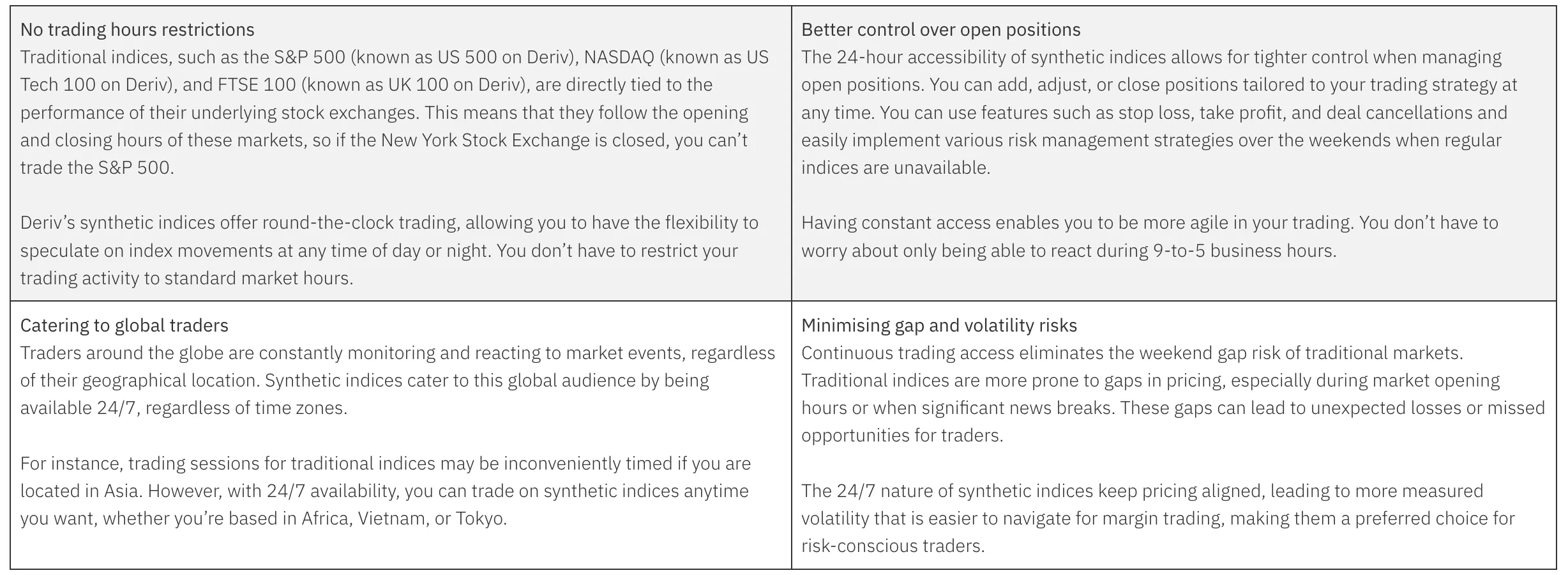
Here are 4 key benefits associated with the round-the-clock accessibility of synthetic indices:
How to trade synthetic indices
You can trade synthetic indices on Deriv with CFDs and options.

On Deriv, you can trade synthetic indices on Deriv Trader, Deriv MT5, and Deriv Bot.
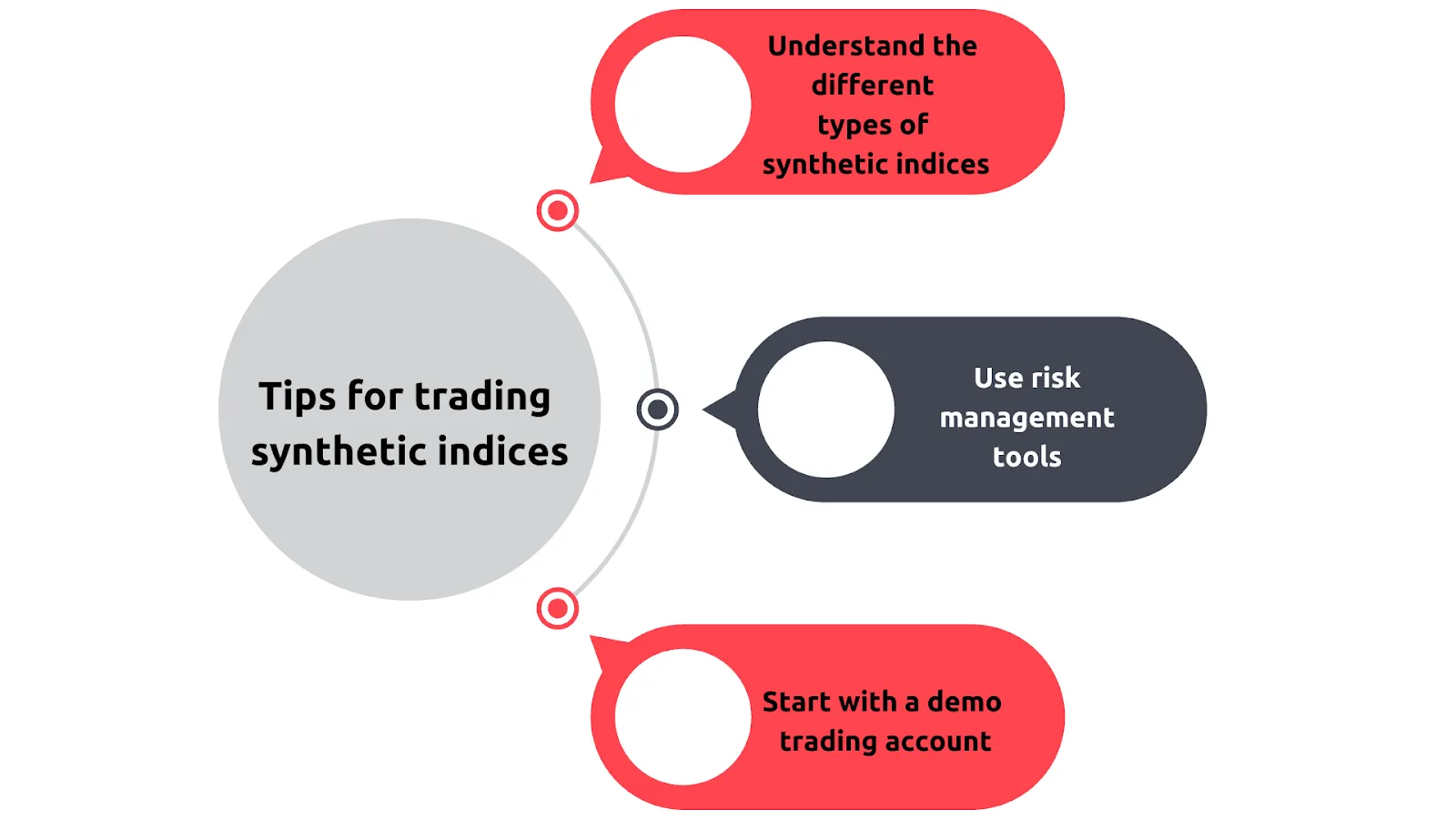
Tips for trading synthetic indices
It's important to have a few helpful tips in mind before trading synthetic indices.
- Understand the different types of synthetic indices
There are various synthetic indices, each with unique features and characteristics. Understanding the different types of synthetic indices is essential before you start trading them. Some of the instruments that you can trade on Deriv include crash/boom, range break, drift switch, and volatility indices.
- Use risk management tools
Synthetic indices can be volatile, so using risk management tools like stop loss, take profit, and deal cancellation to protect your capital is vital. Please note that deal cancellation is applicable only when stop loss and take profit are inactive.
- Start with a demo trading account
If you are new to trading synthetic indices, it is best to start with a demo account. This will help you to minimise your risk while you learn how to trade synthetic indices. Try out trading without risk using our free demo account, equipped with 10,000 USD in virtual currency on Deriv.
Synthetic indices are a versatile and flexible trading instrument that can be used by traders of all experience levels. The 24-hour trading availability of synthetic indices differentiates them from conventional indices and provides significant advantages to traders. By breaking free of restrictive trading hours, synthetic indices truly empower traders.
If you are looking for a way to trade the markets around the clock, with more flexibility and control, then synthetic indices may be the right choice for you.

Prime Time for Institutional Liquidity as Deriv Group Launches Deriv Prime
The announcement of Deriv Prime has shaken the trading world. Find out how this venture has reshaped the landscape of liquidity in our blog.
The venture reshapes the landscape of liquidity access and trading dynamics.
Deriv has introduced Deriv Prime, its institutional arm, designed to offer comprehensive liquidity solutions to address and tackle liquidity challenges.
The venture reshapes the landscape of liquidity access and trading dynamics.
Brokerage firms, corporations, startups, and others can now access a wellspring of global liquidity, regardless of their business scale. The Deriv Prime solution aims to change how financial entities harness liquidity.
As brokers expand to new markets, portfolio diversification is no longer an option to cater to the needs of different traders. Deriv Prime rises to meet this demand, offering diverse assets like Forex, Cryptocurrencies, Commodities, Stocks and Indices, and ETFs that can be customised to suit the distinct trading needs of brokers and their clients.
Deriv Prime's timely arrival
The liquidity solution arrives as a timely catalyst, empowering institutions to navigate the fluid financial landscape with unprecedented agility by leveraging a wide network of liquidity providers without compromising price integrity.
“Deriv Prime doesn't just provide liquidity. It's a strategic response to the challenges faced by institutions in today's ever-changing financial landscape,” said Alexandros A. Patsalides, Head of Deriv Prime.
“Deriv Prime accommodates top-of-book liquidity and unparalleled market depth. This adaptability ensures that a broad spectrum of traders can find suitable options within the Deriv Prime ecosystem,” continues Patsalides.
Cutting-Edge Infrastructure
Deriv Prime’s ecosystem is underpinned by cutting-edge technology, delivering seamless operations with minimal latency or disruptions.
This infrastructure boasts several key features: effortless integration with existing systems, ultra-low latency facilitated by intelligent order routing, reliable access to deep liquidity pools for competitive price feeds, and dedicated support.
Deriv Prime integration is highlighted for its simplicity, facilitated by FIX protocol that seamlessly links a user's bridge provider or MT5 gateway. With an average execution speed under 50ms, orders are intelligently routed, ensuring enhanced liquidity and efficiency.
Experience and Expertise
Deriv Group’s strategic network of prime-of-prime and Tier-1 counterparties affords the group exceptional market depth and ultra-fast execution. The Deriv Group processes over 20 billion USD in daily trades with almost instant uptime. There are no hidden fees, commissions, and integration costs, with 24/7 support.
Deriv Prime marks an advancement in institutional liquidity solutions, presenting a compelling proposition for institutions seeking to navigate the complex trading world. With its cutting-edge technology, extensive network, and institutional-centric approach, Deriv Prime addresses liquidity needs and ushers in a new era of trading possibilities. This disruption could spark a broader trend of reimagining liquidity solutions, ultimately fostering a more dynamic and competitive environment.
.webp)
Market recap: Week of 25-29 Sep 2023
Stay informed with our weekly market recap from 25th to 29th September, 2023. Get insights on the latest trends and developments in the financial world.
Bank of Japan
Reuters: The Bank of Japan maintained ultra-low interest rates at -0.1%. Their commitment to supporting the economy until inflation consistently reaches the 2% target suggests a deliberate approach to phasing out the extensive stimulus program.
Governor Kazuo Ueda highlighted the importance of a careful evaluation of data, with a specific focus on wages and service prices, before considering any adjustments to interest rates.
In a related context, just a week ago, US Treasury Secretary Janet Yellen acknowledged the rationale behind yen intervention in response to volatility. Furthermore, Japan's Finance Minister Shunichi Suzuki expressed a willingness to explore various options in the currency arena. This comes as the dollar surpassed 148 yen, with a warning against actions that could negatively impact trade-dependent Japan.
Oil demand
BNN Bloomberg: The Canadian crude exports from US Gulf terminals in October. Production cuts from Saudi Arabia and Russia are fueling increased demand overseas, and with US refinery maintenance in progress, more of this oil is becoming available for shipment.
Anticipated shipments are set to reach a remarkable 11 million barrels next month, marking the second-highest volume on record.
Government shutdown
Reuters: The potential for a government shutdown underscores the impact of political polarisation in Washington, hampering fiscal policymaking. This comes at a time when rising interest rates are exerting pressure on the affordability of U.S. government debt, as noted by Moody's analyst William Foster in a conversation with Reuters.
Congress has encountered challenges in passing spending bills to fund federal agency programs for the upcoming fiscal year starting on Oct. 1 amid an internal feud within the Republican Party.
In another development, Deutsche Bank's analysis, dating back to the 1700s, has identified four criteria signalling an impending recession, with the U.S. economy now triggering the final warning sign.
UK growth
The Guardian: According to a study by the Chartered Institute of Personnel & Development (CIPD), average sickness absence in the past year increased to 7.8 days, up from 5.8 days in 2019, among 918 organizations representing 6.5 million employees.
The Organization for Economic Cooperation and Development (OECD) data reveals that among its 38 member countries, the UK stands out with a lower employment rate, higher unemployment rate, and increased economic inactivity compared to early 2020. KPMG's economic forecast for the UK anticipates a slowdown, with growth projected at just 0.4% this year, down from 4.1% in 2022 and further deceleration to 0.3% in 2024.
Gold slides
CNBC: Gold prices slid for a second straight day, driven by rising Treasury yields and a stronger dollar amid expectations of prolonged higher interest rates by the Federal Reserve.
SPDR Gold Trust, the world's largest gold-backed exchange-traded fund, reported its lowest holdings since January 2020.
China's central bank lifted temporary gold import restrictions imposed on select lenders, previously aimed at stabilizing the renminbi.
During these restrictions, the Shanghai gold price vs. London reached an all-time high of $121 per troy ounce, but it has since receded.
Australia inflation
The Guardian: Australia's inflation shows acceleration in August, primarily driven by surging fuel prices and increasing rents. The consumer price index for the month rose to an annual rate of 5.2%, up from 4.9%.
Next week, the RBA board will convene for its first rates decision under the leadership of new governor Michelle Bullock.
European economic policy
Reuters: The European Central Bank (ECB) urges governments to reconsider energy price subsidies introduced during the Ukraine conflict, citing the potential to stabilize inflation over time. Monitoring over 500 fiscal measures, the ECB notes most countries are complying with the July agreement to end subsidies. ECB forecasts GDP growth at 0.7% for 2023 and 1.0% for 2024.
UK housing
The Guardian: In a recent survey by KPMG, over 1,000 UK mortgage holders were asked about coping with higher monthly payments.
- 18% dipped into savings to reduce debt, 25% considering it
- 12% extended mortgage terms, 25% were considering
- 8% downsized homes, 22% contemplating a move
Linda Ellett, KPMG's UK head of consumer markets, notes the impact on household budgets and spending.
Interest rate cuts and easing policy by Bank of Japan
Bloomberg: Goldman Sachs in the U.S. adjusts rate cut expectations from April-June 2024 to October-December amidst rising long-term interest rates. Investors brace for prolonged high rates.
Meanwhile, Bank of Japan maintains current easing policy, extending the expected timeline for policy revision. Japanese PM Kishida emphasizes vigilance on exchange rate trends and possible responses to excessive fluctuations.
Speculators hold a significant short yen position, raising the potential for government intervention and yen appreciation.
Sorry, we couldn’t find any results matching .
Search tips:
- Check your spelling and try again
- Try another keyword