
Results for
.webp)
Market recap: Week of 23-27 Oct 2023
Stay informed with our weekly market recap from 23rd to 27 October, 2023. Get insights on the latest trends and developments in the financial world.
Japan economy
Investors Chronicle & Bloomberg: Japan's 20-year bond auction outcome signals weak domestic demand from banks and insurers. The Bank of Japan, unlike other central banks, is concerned about undershooting its 2% inflation target, with inflation currently around 3%.
This may pose concerns about Japan's high public debt and impact insurance firms and pension funds. As a result, the BoJ might consider widening its tolerance band if yields approach the ceiling again. Analysts at Societe Generale suggest the ceiling could rise to 1.5% in January 2024.
European Central Bank
BNP Paribas: The rate hike cycle may be nearing its end. Weakening economic activity and lower expected inflation by year-end could lead the Fed, like the European Central Bank and Bank of England, to pause rate increases.
However, further tightening remains a possibility. Instead of immediate cuts, policy rates are expected to remain at elevated levels until mid-2024 to combat inflation. BNP Paribas forecasts no policy rate changes for the Fed, ECB, and BoE before mid-2024, possibly marking the onset of rate cuts. In contrast, the Bank of Japan is set to initiate monetary tightening in April 2024.
Hedge funds and commodities
Kitco: Hedge funds are witnessing a significant shift in the gold market, as per the CFTC's latest report for the week ending Oct. 17.
Money managers increased their speculative long positions in Comex gold futures by 10,774 contracts, reaching 104,708, while short positions decreased by 31,096 contracts, down to 89,605.
After two weeks of being net short, speculative positions have turned bullish, with a net long position of 15,103 contracts. Société Générale's analysts noted this as the second-largest short-covering move in the gold market since 2006.
Quantitative tightening
CNBC and Fortune: Bill Ackman, founder of Pershing Square, announced his decision to cover his bet against long-term Treasurys. He cited increasing geopolitical risks as a reason for this move.
He is concerned that the world's current risk levels make maintaining short positions in long-term bonds at prevailing rates unwise. Federal Reserve Chair Jerome Powell hinted that rising long-term Treasury yields might allow the central bank to pause its string of interest-rate hikes.
However, Wall Street experts caution that quantitative tightening (QT) is complex and hard to predict, with potential risks to the economy.
Interest rates
Sweden Postsen: ECB's interest rate announcement will be on this Thursday. According to a Bloomberg report, Europe Central Bank President Christine Lagarde had a telephone conference with the European Commission, EU Presidency, and the Eurogroup.
She anticipates stagnation in the coming quarters, with the potential for it to worsen. Lagarde notes resilient employment but also signs of a slowdown.
UK unemployment
The Guardian: Bank of England expected to keep interest rates at 5.25% for the second time as the UK job market shows signs of slowing.
Recent figures reveal a rise in the unemployment rate to 4.2%, up from 4% in the previous quarter. Manufacturers report declining sentiment, falling output, and increased caution in a CBI survey.
Analysts anticipate the Bank's Monetary Policy Committee to maintain rates, considering the job market's weakness. #BankOfEngland #InterestRates #UKEconomy
Electric vehicles
Forbes: Growing insurance costs and expiring subsidies pose challenges for the European electric car market. UK media reports soaring premiums; one Tesla Model Y owner faced a shocking £5,000 ($6,000) annual insurance bill, up from £1,000 ($1,200) the previous year.
In the US, EV sales have slowed, taking twice as long to sell in August 2023 compared to January. Despite Tesla's price reductions, EV prices are down 22% YoY. Insurance for new energy vehicles is often 20% higher than traditional cars due to higher loss ratios.
Canadian economy
Bank of Canada: Bank of Canada has decided to keep its policy rate steady at 5% and continues its strategy of quantitative tightening. The bank forecasts global GDP growth of 2.9% this year and 2.3% in 2024. Business investment is facing challenges due to weaker demand and increased borrowing costs. Meanwhile, Canada's growing population is impacting labour markets and housing demand.
Yen volatility
Reuters: Japan Finance Minister Shunichi Suzuki reaffirms Japan's commitment to address currency market fluctuations swiftly. With the yen weakening past 150 against the U.S. dollar, Suzuki emphasizes the need for stable currency movements based on fundamentals while discouraging excessive volatility.
Japanese law grants the government control over currency policy, with the Ministry of Finance making intervention decisions.
European rate hikes
The Guardian: The ECB has held its key policy rates steady, a departure from 10 previous rate hikes aimed at combating rising living costs.
Despite inflation exceeding the 2% target, concerns mount over the potential impact of rate hikes on European economies, particularly in Germany, where manufacturing struggles led to a fourth consecutive month of business activity contraction in October.
Christine Lagarde, ECB President, anticipates ongoing economic weakness. Eurozone inflation fell to 4.3% in September, down from 5.2% in August, compared to 9.9% a year ago.
.webp)
Exploring the Martingale Strategy in Deriv Bot
Let's dive into how the Martingale strategy works, its pros and cons, and how it can be effectively implemented in Deriv Bot.
This article was originally published on 24 Oct 2023 and updated on 27 May 2024.
The Martingale strategy involves increasing your stake after each loss to recoup prior losses with a single successful trade.
This article explores the Martingale strategy integrated into Deriv Bot, a versatile trading bot designed to trade assets such as forex, commodities, and derived indices. We will delve into the strategy’s core parameters and application, providing essential takeaways for traders looking to use the bot effectively.
Key Parameters
These are the trade parameters used in Deriv Bot with the Martingale strategy.
Initial stake: The amount you pay to enter a trade. This is the starting point for any changes in stake depending on the dynamic of the strategy being used.
Multiplier: The multiplier used to increase your stake if you’re losing a trade. The value must be greater than 1.
Profit threshold: The bot will stop trading if your total profit exceeds this amount.
Loss threshold: The bot will stop trading if your total loss exceeds this amount.
Maximum stake: The maximum amount you will pay to enter a single trade. The stake for your next trade will reset to the initial stake if it exceeds this value. This is an optional risk management parameter.
An Example of Martingale Strategy
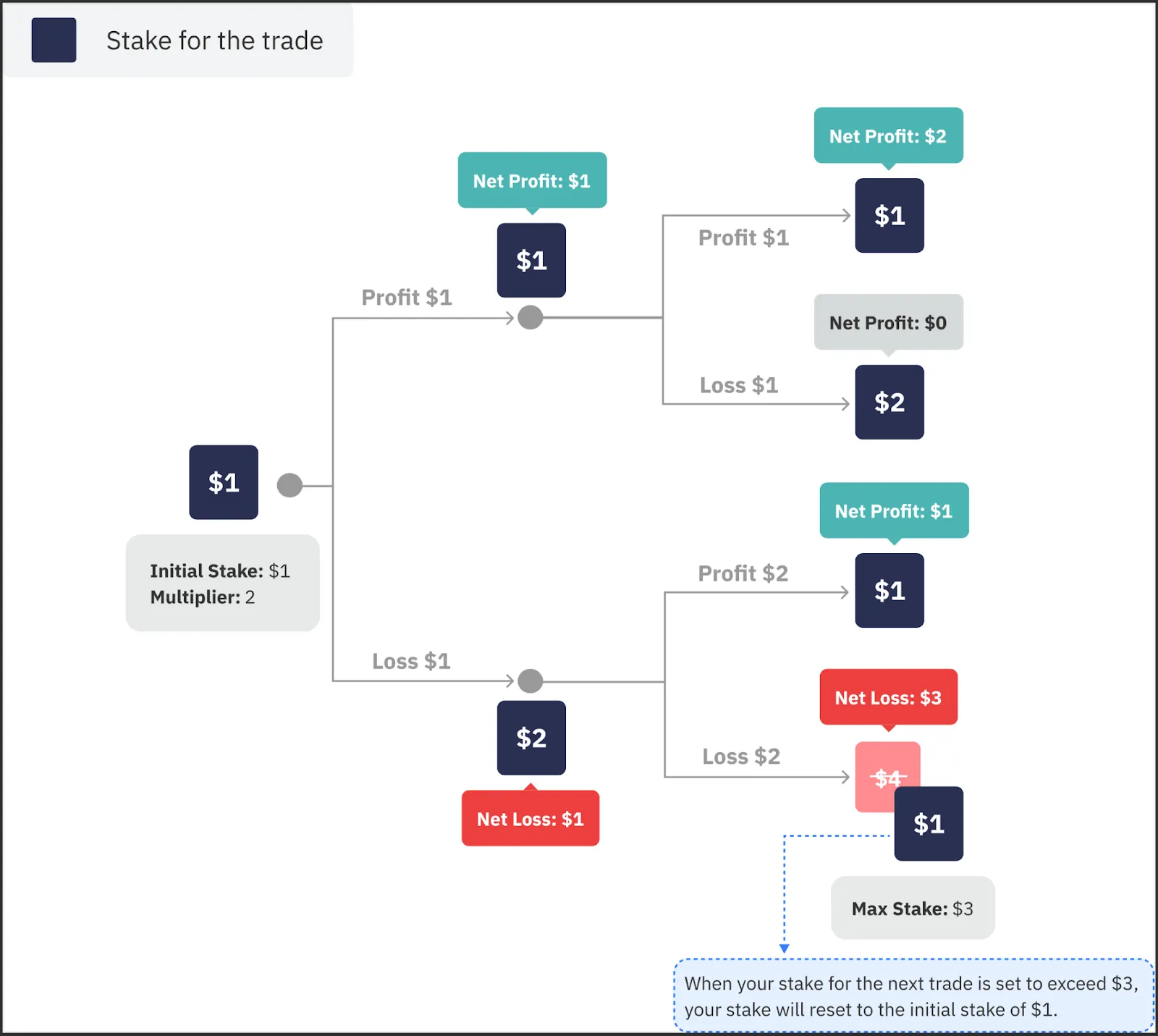
- Start with the initial stake. Let’s say 1 USD.
- Select your Martingale multiplier. In this example, it is 2.
- If the first trade ends in a loss, Deriv Bot will automatically double your stake for the next trade to 2 USD. Deriv Bot will continue to double the stake after every losing trade.
- If a trade ends in a profit, the stake for the following trade will be reset to the initial stake amount of 1 USD.
The idea is that successful trades may recoup previous losses. However, it is crucial to exercise caution as the risk can quickly increase with this strategy. With Deriv Bot, you can minimise your risk by setting a maximum stake. This is an optional risk management feature. Let’s say a maximum stake of 3 USD. If your stake for the next trade is set to exceed 3 USD, your stake will reset to the initial stake of 1 USD. If you didn’t set a maximum stake, it would have increased beyond 3 USD.
Profit and Loss Thresholds
With Deriv Bot, traders can set the profit and loss thresholds to secure potential profits and limit potential losses. This means that the trading bot will automatically stop when either the profit or loss thresholds are reached. It’s a form of risk management that can potentially enhance returns. For example, if a trader sets the profit threshold at 100 USD and the strategy exceeds 100 USD of profit from all trades, then the bot will stop running.
The Martingale Formula
If you’re about to start trading and haven’t established a Maximum Stake as part of your risk management strategy, you can determine how long your funds will last by employing the Martingale strategy. Simply use this formula.
R = log(B/s) / log(m)
Where:
R represents the number of rounds a trader can sustain given a specific loss threshold.
B is the loss threshold.
s is the initial stake.
m is the Martingale multiplier.
For instance, if a trader sets the loss threshold (B) is 1000 USD, initial stake (s) is 1 USD, and the Martingale multiplier (m) is 2, the calculation would be as follows:
R = log(1000/1) / log(2)
R ≈ 9.965
This means that after 10 rounds of consecutive losses, this trader will lose 1023 USD which exceeds the loss threshold of 1000 USD, stopping the bot.
This formula allows you to work backwards based on your available capital and risk tolerance. Determine the Loss Threshold and Initial Stake, which will automatically calculate the number of rounds you can trade. This will give you an insight on stake sizing and expectations.
Summary
The Martingale strategy in trading may offer substantial gains but also comes with significant risks. With your selected strategy, Deriv Bot provides automated trading with risk management measures like setting initial stake, stake size, maximum stake, profit threshold and loss threshold. It’s crucial for traders to assess their risk tolerance, practice in a demo account, and understand the strategy before trading with real money.
.webp)
Guide to MT5 signals: Benefits, risks, and how to select one
Navigating MT5 signals: Get the scoop on what they are, how they operate, their pros and cons, and how to select the right ones.
While walking on a busy street, you'll see people signalling for cabs when they need a ride. Traffic signals switch from red to green to allow vehicles to go ahead. In the trading world, there are signals that traders can make use of in their trading strategies. MT5 signals are a key feature of the MetaTrader 5 (MT5) platform and a popular choice among many traders.
In this blog post, we will explore:
- What are MT5 signals
- Benefits of using MT5 signals
- How MT5 signals work
- Risk and considerations
- How to choose an MT5 signal provider
What are MT5 signals?
MT5 signals is a service that allows you to copy trades from other traders, who are known as signal providers. These signals are generated by the signal providers (or expert traders) and can be used to automate trading or guide your trading decisions.
These signals are available for many financial markets, including forex, stocks, and commodities. If you’re new to trading, MT5 signals are a great way to start learning to trade and analyse the strategies of other more experienced traders. Or, if you’re experienced, you can use MT5 signals to save time and effort.
On Deriv, the MT5 signals allow you to copy the trades of more experienced traders to your MT5 account. When you subscribe to a signal (also known as a call), the provider's deals will be copied to your Deriv MT5 account.
Now, let’s look into the advantages of using MT5 signals in your trades.
Benefits of using MT5 signals
Here are 5 advantages of subscribing to MT5 signals on Deriv:
- Access to expert traders: Take advantage of strategies developed by seasoned traders by copying their trades. This can be helpful for those who are new to trading or who want to improve their trading strategies by following experts.
- Diversification: Diversify your trading portfolio by subscribing to multiple signal providers with various trading strategies. This can help spread risk and potentially improve your trading performance.
- Time-saving: You can save time and effort by subscribing to MT5 signals instead of doing your own market research and analysis. MT5 also allows for automated trading, which means you can set up your Deriv MT5 account to automatically execute the trades generated by the signal provider, saving you time and effort.|
- Transparency in signal provider performance: MT5 signal providers are required to disclose their past performance so you can choose a signal provider with a proven track record. This ensures that you can make informed decisions when choosing a signal provider. You can always switch to a different provider if the performance does not meet your expectations.
- Risk management: When you subscribe to MT5 signals, you copy an experienced trader’s trades, including their use of risk management tools. You can also set stop loss and take profit orders for each trade you copy, and MT5 will automatically execute the orders when the prices reach the specified levels.Other key MT5 risk management tools include risk evaluation metrics, such as profit factor and maximum drawdown. These metrics can help you select signal providers with a strong track record and minimise potential risks.
How MT5 signals work
It is essential to understand the mechanics of MT5 signals. Here’s what you need to know to find out how they work:
Signal providers: Experienced traders who create and offer trading strategies (which are the MT5 signals) on the MT5 platform for traders to subscribe to.
Subscribers: As subscribers, you can browse and select the signal providers whose strategies suit your trading style.
Platform integration: Set up MT5 signals on your MT5 trading platform, connecting it to your Deriv MT5 account.
Execution and automation: When you subscribe to the MT5 signals you like, your Deriv MT5 account will automatically execute the signs.
Subscribers can also execute the signals manually on their Deriv MT5 account.
Monitoring and management: Continuously monitor your signal subscriptions and make adjustments as necessary.

Risks and considerations
While MT5 signals offer significant benefits, it's important to be aware of the associated risks. Let's take a closer look at the possible risks related to MT5 signals and the considerations you should make before using them.

How to choose an MT5 signal provider
Overall, subscribing to MT5 signals can be a great way to improve your trading skills and potential profitability. However, choosing a signal provider carefully and doing your research before subscribing is a must.
Here are some tips for choosing an MT5 signal provider:
- Look for a signal provider with a proven track record.
- Make sure the signal provider uses a risk management strategy.
- Choose a signal provider that trades a style that you are comfortable with.
- Read reviews from other subscribers.
Once you have chosen a signal provider, monitor your trades carefully and be prepared to unsubscribe if you are unsatisfied with the performance.

With the right signal provider, MT5 signals can be a valuable tool for traders of all experience levels. Start your trading journey with MT5 signals on Deriv MT5 today.
Don’t have a Deriv account? Sign up for a free demo account with 10,000 USD virtual currency and explore MT5 signals.

5 common mistakes to avoid when trading ETFs
Are you thinking of diversifying your trading portfolio with ETFs? Avoid making these common mistakes when trading exchange-traded funds.
Exchange-traded funds (ETFs) are popular for traders of all levels because they are a diversified way to invest in a basket of stocks, bonds, or other assets. Although trading ETFs generally can tend to be lower risk than trading stocks, there are still some mistakes that traders commonly make. Steer clear of these top 5 mistakes:
1. Not doing your research on ETFs
ETFs can track various indexes, sectors, and assets. Before trading ETFs, it's important to examine the ETF’s prospectus, which provides detailed information about its holdings. Look for the list of companies or assets the ETF tracks, and pay attention to the weightings of individual companies within the ETF. If there are a few dominant companies that make up a large percentage of the portfolio, this concentration can increase risk if those companies face challenges. Make sure to research the individual companies within the ETF to see if they are well-established and financially sound, or if they are struggling or speculative. When choosing ETFs to buy, consider their fees, liquidity, weightings, and tracking errors, as well as your investment goals and risk tolerance.
Watch out!
Imagine you're interested in trading an ETF that tracks the technology sector with a medium-term trading strategy. Without researching its holdings, you might not realise that a big portion of the ETF is invested in tech growth stocks, which require a very long-term trading strategy to see profits. As your strategy was focused on a medium time period, this particular trade did not align with your strategy, and you likely will not make any profits.

2. Overtrading
New traders often make the mistake of overtrading, thinking that more frequent trades will lead to more profits. It often happens because of behavioural and psychological factors that can cloud judgment and lead to impulsive trading decisions. Excessive trading can lead to higher transaction costs and taxes, which can eat into your returns. Always be patient and stick to a trading strategy when trading ETFs.
Watch out!
Imagine you trade ETFs several times a day. You're constantly trying to time the market perfectly without a proper strategy. However, due to inexperience and increasing transaction costs with each ETF trade, you end up losing money instead.

3. Chasing an ETF's performance by relying on past results
It's key to remember that past ETF performance does not indicate future results. Just because an ETF has done well in the past doesn't mean that it will continue to do so in the future. Market performance is influenced by many factors, so it’s good to consider including fundamental and technical analysis in your strategy so you can be aware of these influences.
Watch out!
Imagine you decide to trade an ETF that has been performing really well over the past year. However, you overlook that a temporary market anomaly drove the ETF's spike, and it's likely to return to its historical average soon.

4. Ignoring diversification
Not diversifying when you trade ETFs can result in higher risks, as your portfolio becomes too dependent on the performance of a single sector, industry, or asset class. Putting your eggs in one basket can magnify losses during downturns, limit potential gains from other thriving market segments, and increase portfolio volatility. Your portfolio will be less resilient to market shocks, slowing your ability to navigate market fluctuations effectively.
Watch out!
Imagine you put all your money into a single commodity-focused ETF because it has been performing well recently. Unfortunately, the commodity market takes a hit, causing a big drop in the value of your investment portfolio.

5. Not using stop-loss orders
A stop-loss order is an order to sell an ETF at a specific price automatically, which can help you limit your losses if the ETF price moves against you — with a stop-loss order, you determine when you want the trade to end. For long trades (you predict the asset’s price will go up), the stop loss is set below the current market price. However, for short trades (you predict the asset’s price will go down), the stop loss is set above the current market price. This can help you to limit your losses if the ETF price moves against you. Stop-loss orders free up your time, as you don't have to monitor your ETF positions constantly.
Watch out!
Imagine you decide not to set a stop-loss order on an ETF you've traded. The market faces a sudden economic crisis, and prices experience a huge jump. This wipes out a large chunk of your trade because you weren't protected by a predetermined exit point.
More tips to trade ETFs
Trading ETFs offers many opportunities but also comes with risks. Whether you're a beginner or an expert, always do your research, don’t overtrade, have a strategy, diversify, and use stop-loss orders. Here are some more tips to consider when trading ETFs:
- Get a demo account
A demo account is a trading account that allows you to practise trading without real money. On Deriv, you can sign up for a free demo account to start exploring ETF CFDs on Deriv MT5 and Deriv X. Your Deriv demo account comes preloaded with 10,000 USD in virtual funds so you can practise trading ETFs online risk-free.
- Start small first
Once you've learned the basics of ETF trading, you can start trading with a small amount of real money. This can help minimise your losses if you make mistakes.
- Be patient and disciplined
ETF trading is a long-term strategy. Don't expect to get rich quickly. Instead, focus on developing a solid trading plan and sticking to it.
By educating yourself about ETFs and following the tips above, you'll be better equipped to confidently navigate the world of ETF trading and work toward your financial goals.
.webp)
Market recap: Week of 16-20 Oct 2023
Stay informed with our weekly market recap from 16th to 20th October, 2023. Get insights on the latest trends and developments in the financial world.
Yen currency drops
Reuters: A senior IMF official sees the yen currency's recent drops as fundamentally driven and not warranting currency market intervention.
While there are upside inflation risks due to strong demand, the BOJ remains cautious about raising rates amid global demand uncertainties.
Civil unrest
Mining.com: Gold prices surged this week amid escalating geopolitical tensions. Investors who had shorted gold were forced to cover their positions as prices climbed higher. The tragic events in Palestine propelled gold even further upwards, with the precious metal seen as a safe haven in times of uncertainty.
Periods of global turmoil often spur demand for gold as anxious investors seek to shield their capital. Thus, gold prices rallied in response to the recent turmoil, buoyed by its reputation as a store of value during volatile times.
Yen currency intervention
Reuters: Japan's Ministry of Finance and IMF differ on Yen decline response. MOF's Kanda suggests a readiness to act and intervene, considering various factors, including interest rates. IMF official underscores fundamental-driven yen declines, negating intervention need.
Oil market prices
Reuters & Yahoo Finance: Chief Economist Lane stated that the European Central Bank needs more time to confirm inflation's return to the 2% target. And keeping a high rate until at least Spring next year. President Lagarde monitors the Israel-Hamas conflict's potential impact on oil prices.
US retail sales
Reuters: U.S. retail sales surged 0.7% in September, beating expectations, indicating a boost in economic growth. Goldman Sachs raised Q3 GDP growth estimate to 4%.
Yet, American credit card balances hit a record high of $1.03 trillion, with growing payment delinquencies, revealing the strain on consumers amid rising costs and interest rates.
High mortgage rates
ABC.net: Reserve Bank Governor warns of prolonged inflation risks amid global shocks. Higher mortgage rates already impacting the economy, says Ms. Michele Bullock.
Further interest rate hikes may be necessary if inflation expectations persist at elevated levels.
US government shutdown
FX Street and BBC: Jim Jordan's second attempt to become US House Speaker failed. Without a Speaker, Congress cannot pass legislation or provide emergency aid, potentially affecting critical deadlines. One such deadline is the looming Nov. 17 requirement to pass a spending bill and avoid a government shutdown. There have been six partial or full government shutdowns since 1990.
History suggested a potential 1%-1.5% dip in the US dollar index following a shutdown, with subsequent recovery suggesting a limited long-term impact on the currency.
UK inflation
Express: Treasury minister Andrew Griffith asserts the Government's commitment to halving inflation by year-end, remaining on course.
Despite higher inflation data for September, Bank of England Governor Andrew Bailey is cautioned against hasty interest rate hikes. UK's September inflation remains at 6.7%
Energy security
Energy.GOV: The U.S. DOE's Office of Petroleum Reserve will regularly seek to buy oil for the Strategic Petroleum Reserve (SPR) through May 2024.
The initiative kicks off with a solicitation for up to 6 million barrels of oil, set for delivery between December 2023 and January 2024.
Their target is to secure oil at or below $79 per barrel, a cost significantly lower than the average of $95 per barrel in 2022's emergency SPR sales.
Federal reserve
NYTimes: Fed Chairman Powell addressed the challenges faced by the Fed. Balancing inflation control and economic well-being is the aim.
Interest rates have climbed to 5.25-5.5%, curbing economic activity, but growth remains robust.
While no rate hike is expected at the Nov. 1 meeting, Powell's remarks hint at future potential increases, keeping the December 13 meeting in focus
Market recap: Week of 11–15 Dec 2023
Stay informed with our weekly market recap from 11–15 Dec, 2023. Get insights on the latest trends and developments in the financial world.
UK elections
BBC News and Metro: Robert Jenrick resigns as immigration minister. Jenrick and Suella Braverman, backers of Mr Sunak's leadership, step down amid party setbacks.
With a disappointing conference and by-election defeats, patience wears thin among MPs. Some Tories fear continued losses to Keir Starmer's Labour unless Sunak considers stepping down.
Meanwhile, economists predict the Bank of England will maintain a 15-year high borrowing cost on Dec. 14, as UK markets lean towards a June 2024 rate cut.
Fed rate hikes
Forbes: Investors opt The Federal Open Market Committee (FOMC) will likely keep the rate unchanged in the upcoming December 12-13 meeting.
Questions arise about when the Fed might consider rate cuts and to what extent.
CME Group reports a 97.7% chance of the Fed maintaining the current Fed funds rate target range (5.25% to 5.5%).
Additionally, there's a 52.7% chance the FOMC will cut rates by at least 25 bps by March 2024.
UK economic forecast
The Guardian & Reuters: Latest polls suggest the Bank of England is set to maintain the Bank Rate at 5.25% on Dec 14 and throughout Q2 2024. The Resolution Foundation notes concerns over high pay awards may ease, with wage settlements responding to a decline in annual inflation.
Reuters polls predict the 15-year high interest rate to persist until Q3 2024, reaching 4.50% by year-end.
US economic outlook
Wall Street Journal & Federal Reserve Bank of New York: In November, the US added 199,000 jobs, a bit slower than earlier in the year but consistent with pre-pandemic gains. Excluding auto-worker strikes, the job gain was around 169,000, showing a slight dip from October's 180,000. Noteworthy growth in healthcare and government sectors, while overall employment pace slowed.
According to NY Fed's survey, median inflation expectations slightly declined to 3.4% at the one-year horizon.
The Fed is anticipated to keep rates steady this Thursday, with market expectations for rate cuts starting in May.
Gold market recap
Kitco News: Joseph Cavatoni, WGC North American markets strategist, notes gold's dependence on the Federal Reserve. In the first scenario, a soft U.S. landing aligns with the current consensus, supporting gold's trend. The second, a hard landing with recession, could drive bullish gold trends via aggressive rate cuts. The third, a no-landing scenario, is deemed unlikely, with only a 10% chance of sustained above-trend U.S. growth.
Inflation data
Wall Street Journal & FX Street: US Dollar holds steady as latest inflation data fails to cause significant movement. The consumer-price index rose 3.1% in November, a slight slowdown from October but above June's 3%.
Treasury Secretary Janet Yellen notes that inflation is 'meaningfully coming down' and expects it to align with the Fed's mandate.
The Fed is likely to maintain rates at its meeting despite the reading being slightly firmer than desired for a quick return to the 2% inflation goal.
Fed rate cuts
Wall Street Journal & The Guardian: The Fed maintains benchmark rates after the recent July increase, emphasizing caution to avoid economic harm amidst falling inflation. Powell highlights the shift in projections, with officials anticipating three rate cuts next year, diverging from prior expectations of one hike and two cuts. Markets respond positively, with all major indexes climbing, Dow industrials reaching a record close. 10-year Treasury note yields decline to 4.032%. Meanwhile, the House voted Wednesday to authorize the impeachment inquiry into Joe Biden formally.
UK GDP
Reuters & Ons.gov: October 2023 sees a 0.3% dip in UK Monthly GDP, contrasting September's 0.2% growth. Services output, down 0.2%, primarily drives the monthly contraction.
The Bank of England is poised to maintain rates today, with market sentiments leaning towards increased bets on cuts in 2024.
UK monetary policy
The Guardian: Bank of England asserts a need for prolonged restrictive monetary policy, countering money market expectations of five rate cuts in 2024. Despite maintaining current interest rates, three policymakers voted for a potential increase.
Andrew Bailey emphasizes it's premature to consider UK rate cuts, yet money markets project at least four in 2024, anticipating a drop to 4.1% from the current 5.25%. Earlier City forecasts indicated five quarter-point cuts before the BoE's noon announcement.
European monetary policy
Reuters: European Central Bank keeps rates unchanged and resists expectations for immediate interest rate cuts, with President Christine Lagarde emphasizing an anticipated rebound in inflation and robust price pressures.
Lagarde's stance contrasts sharply with the more dovish tone from U.S. Federal Reserve's Jerome Powell, hinting at a potential rate cut not likely before June or July.

Fed's dovish pivot: 2024 rate cuts anticipated
After a year of aggressive hikes to tame inflation, the Fed projects lower rates amid signs of slowing price increases and economic growth.
Market rally in response to Fed's forward guidance
The Federal Reserve's (Fed) recent policy shift has set the stage for a significant market response. This change in stance, widely expected by market participants, has led to a rally in stocks, bonds, and gold while simultaneously causing the US dollar to weaken and yields to decline.
Furthermore, Asia's tech sector has benefited from this shift in market sentiment.
Federal Reserve’s key statements
The Fed has opted to maintain the Federal Funds rates at 5.25%-5.5%. However, the central bank has made it clear that it is departing from its prior aggressive rate-hiking stance. The Fed now anticipates three quarter-point rate cuts in the coming year, aligning with market expectations. While the Federal Open Market Committee (FOMC) does not consider further rate hikes as their primary scenario, it remains open to adjustments as economic conditions evolve.

Dot plot projections: Three rate cuts in 2024: The dot plot, a visual representation of the Fed's rate projections, now shows a forecast of three rate cuts in 2024, exceeding the market's consensus of two. This forecast implies a total of 75 basis points of easing, surpassing the previous estimate of 50 basis points. By the end of 2024, the Fed funds rate is expected to reach 4.6%, according to the projections, down from the earlier projection of 5.1%.
US economy's resilience: This year has seen surprising strength in the US economy in terms of both growth and employment. The Federal Reserve aims for a "soft landing" to avoid a recession, balancing its dual mandate of price stability and maximum employment. Fed Chair Jerome Powell has been working to bring inflation back to its 2% target by aggressively increasing rates in the last two years, aiming to slow economic activities gradually without a crash while keeping the unemployment rate low. This is indeed a delicate balancing act that the Fed intends to continue pulling off moving into 2024.
Market response to the Federal Reserve's statement
The Fed's announcement triggered a significant market rally, impacting various asset classes. Currencies strengthened against the dollar, while global shares and corporate bonds posted robust gains.
- Impact on key market metrics: The S&P 500 extended its gains by 1%, the Dow Jones Industrial Average hit an all-time high above 37,000, and the two-year Treasury yields dropped by 25 basis points to around 4.5%. Swap contracts were repriced to reflect expectations of 130 basis points of easing over the next 12 months.
S&P 500

Dow Jones Industrial Average

- Depreciation of the US dollar: The US dollar, as measured by the DXY index, depreciated by nearly 0.9%, reaching its lowest point since August. This substantial drop resulted from a significant decline in US Treasury rates, driven by the Federal Reserve's unexpectedly dovish guidance. This shift did not catch market participants by surprise, as they had anticipated this change.

- Gold prices surge: Notably, precious metals experienced an extremely bullish reaction to the statement and comments by Chairman Powell. Both gold and silver had exceedingly strong moves to the upside. Gold prices surged by more than 1% to reach 2,004.79 USD per ounce as of 7:34 pm (GMT) on Wednesday, 13 December 2023. US gold futures settled 0.2% higher at 1,997.30 USD.

- Global equity rally: Global stocks extended their winning streak for a sixth consecutive session, with equity benchmarks in Australia, South Korea, and China registering gains exceeding 1%. Chinese tech companies, in particular, drew attention, leading to a more than 2% opening increase in the Hang Seng Tech index.

Sustainability of the stock market rally? Uncertainty looms
In closing, while the Fed's recent dovish pivot has fuelled optimism, caution is warranted. Market history reveals the peril of relying too heavily on rate-cut expectations. Overvaluation in stocks and unrealistic valuations pose risks to the current rally. The Santa Claus rally, often short-lived, underscores the futility of trying to time the market perfectly.
Traders should exercise vigilance, diversify portfolios, and focus on long-term fundamentals. Attempting to predict short-term market movements can lead to missed opportunities or significant losses. As we navigate these uncertain times, a disciplined and informed approach, rather than market timing, is key. The allure of a Santa Claus rally should not overshadow the importance of prudent decision-making and risk awareness. Caution is paramount as we acknowledge potential headwinds in the dynamic financial landscape ahead.
.webp)
Japan's approach to currency intervention
Discover the intricacies of Japan's stance on currency intervention and its implications for international trade and exchange rates.
In August, a former central bank official suggested that Japan would abstain from interfering in the currency market unless the yen’s value fell below 150 against the dollar, posing a considerable political challenge for Prime Minister Fumio Kishida. Decisions regarding intervention have always carried significant political weight in Japan, with the Prime Minister ultimately responsible for the call. According to Takeuchi, an analyst, authorities might issue verbal warnings and conduct rate assessments as a preliminary step, hoping that market forces would stabilise the yen.
Japanese law grants the government authority over currency policy, with the Ministry of Finance determining the timing of interventions, while the Bank of Japan acts as its agent.
As of the most recent update, the USDJPY exchange rate stands at 149.80.
In September, US Treasury Secretary Janet Yellen gave the green light for intervention; she expressed that Japan’s intervention to stabilise the yen would be acceptable if its purpose were to alleviate market volatility rather than to dictate the exchange rate’s level.
In early October, Finance Minister Shunichi Suzuki confirmed that the Japanese government was prepared to take action if the yen’s depreciation was overly abrupt, emphasising that the focus was on volatility, not specific exchange rate levels.
On 14 October 2023, Sanjaya Panth, Deputy Director of the IMF’s Asia and Pacific Department, noted that the yen’s recent decline stemmed from fundamental factors and did not meet the criteria necessitating government intervention.
However, on 16 October 2023, Masato Kanda, Vice Finance Minister for International Affairs at Japan’s Ministry of Finance (MOF), refrained from commenting when asked about the IMF’s stance that Japan still needed to meet the prerequisites for currency intervention. Kanda emphasised that various factors influenced currency rates, and long-term interest rates were just one component. He stated that the situation was fluid, and the potential impact of rising oil prices on Japan’s economy remained uncertain.
Assess the possible impact of the intervention
In July, a report from the Bank for International Settlements (BIS) highlighted that the yen had functioned as a key global credit currency since 2021 due to its low interest-rate status. It had accumulated a significant share of global credit growth even amid the Federal Reserve’s tightening monetary policies.

Notably, the latest data shows that large speculators have held the largest short position on the yen since 2021, increasing the risk of a short squeeze if the Bank of Japan (BOJ) intervenes in the currency market.

Examining the weekly chart, there’s a notable potential for yen devaluation should it surpass the 160 level. Consequently, the Bank of Japan intends to intervene when USDJPY is between 150 and 160. Presently, the Stochastic indicator is in an overbought zone, suggesting a possible correction for USDJPY.


5 benefits of ETF trading
Discover the advantages of ETF trading, including diversification, low costs, and flexibility. Start trading smarter today with Deriv.
For those new to trading, exchange-traded funds (ETFs) serve as an excellent starting point. But what are they? Let’s define them before we delve into their many benefits.
ETFs are investment funds that track an underlying asset, such as a commodity, index, or basket of stocks. They are traded on exchanges like stocks, so you can buy and sell them throughout the day. ETFs can offer unique benefits and are relatively easy to understand and use.
This blog will explore the benefits of ETFs, including transparency, access to index performance, liquidity and diversification. All of these are a part of what makes ETFs an interesting choice to diversify your portfolio with.
ETFs are transparent, so you know what you're trading
Traders can enjoy unparalleled transparency with ETFs, as they can easily track the underlying investments. ETFs are transparent because they are required by law to disclose their full portfolio holdings on a daily basis.
This means that traders can easily see what stocks, bonds, or other securities the ETF is invested in. This transparency helps traders make informed investment decisions and reduces the risk of fraud.
Trading ETFs diversifies your portfolio and reduces risk
ETFs, or exchange-traded funds, hold a basket of assets, such as stocks, bonds, or commodities. This allows traders to diversify their portfolios instantly without having to buy individual securities.
By diversifying their portfolios, traders can reduce their risk and improve their chances of achieving their financial goals.
ETFs have made trading in the market more accessible than ever before
The ETF market is huge. As a trader, you can easily buy ETF for nearly any type of investment, ranging from a particular country in Southeast Asia to a worldwide asset class such as bonds and even commodities like gold.
ETFs have made trading in previously challenging markets more accessible and straightforward for traders.
Trading ETFs is a simple process
ETFs are traded on the stock exchange, meaning they can be bought or sold by traders through their brokers at the current market price without any minimum purchase requirement.
Moreover, ETFs usually have lower annual management fees, which can help traders save money in the long run.
ETFs can match index performance
ETF investments can reduce the uncertainties of trading by tracking indexes. These funds aim to closely mirror the performance of the underlying index, providing no surprises.
Although investments are never guaranteed, trading in a suitable ETF can help take the guesswork out of trading.
ETFs offer a number of benefits that can make them a good choice for traders of all experience levels. If you are considering trading in ETFs, it is important to do your research and choose ETFs that are right for your individual needs and goals.
There are ETFs available to track a wide variety of asset classes, so you can find one that fits your trading strategy.
Sorry, we couldn’t find any results matching .
Search tips:
- Check your spelling and try again
- Try another keyword