
Results for

Inflation cools, markets heat up
U.S. inflation cools to 3.4% in April, sparking optimism in financial markets. Learn how this affects gold,USD, stocks, and your trading portfolio.
At 3.4%, year-on-year US inflation for April came in cooler than expected, triggering a wave of optimism in the financial markets. This 0.1% drop from the previous month’s 3.5% marks a pivotal shift and holds significant implications for key assets like gold, the USD, and stocks. Let’s break down what this means for these key assets and explore how you can make the most of this shifting economic landscape.
The US dollar, which often moves inversely to inflation data, is poised for more volatility. With the inflation cooling, the pressure on the Federal Reserve to maintain a hawkish stance diminishes, potentially leading to a softer policy outlook. This scenario usually spells a dip for the dollar against a basket of currencies, making it an opportune moment for forex traders to strategise around these movements. A weaker dollar could boost emerging market currencies and offer a competitive edge to exporters facing the U.S. market, thereby reshaping forex market dynamics extensively.
Gold shines bright
Despite the recent dip in inflation, gold isn’t losing its lustre. While traditionally seen as a haven during high inflation, gold’s appeal extends beyond that. With the potential for the Federal Reserve to ease up on interest rate hikes, gold becomes a more attractive investment due to a weaker dollar and lower yields. This makes it a haven for those seeking stability and potentially high returns in this evolving economic landscape.

USD retreats
The US dollar, which often moves inversely to inflation data, is poised for more volatility. With the inflation cooling, the pressure on the Federal Reserve to maintain a hawkish stance diminishes, potentially leading to a softer policy outlook. This scenario usually spells a dip for the dollar against a basket of currencies, making it an opportune moment for forex traders to strategise around these movements. A weaker dollar could boost emerging market currencies and offer a competitive edge to exporters facing the U.S. market, thereby reshaping forex market dynamics extensively.
Stock market sentiments soar
Equities benefit from the relaxed inflation numbers, particularly in technology and growth sectors. Lower inflation eases concerns about economic overheating and excessive tightening of monetary policy, which can stifle growth by increasing borrowing costs. Therefore, a moderated approach from the Fed could sustain the buoyancy in stock prices, especially as earnings outlooks become more favourable against a backdrop of reduced financial pressure on consumers and businesses. The prospect of enduring low rates in this scenario might redirect capital back towards equities, driving valuations upward.

Cooling US inflation has sparked a seismic shift in the financial markets, creating both opportunities and challenges for investors and traders. While the immediate future of gold, the US dollar, and stocks seems bright, the evolving macroeconomic landscape demands vigilance and adaptability. While the direct implications suggest enhanced attractiveness for gold and potential softening of the USD, equities are primed for a resurgence in investor interest, highlighting a period of strategic opportunities in the financial markets.
As always, the evolving macroeconomic environment will necessitate vigilant analysis and adaptive strategies to trade on these trends.
Whether you’re exploring gold’s potential, anticipating the dollar’s next move, or eyeing promising stocks, a demo account allows you to experiment, learn, and refine your approach before committing real capital.

Cisco earnings preview: Cisco bets future on software and AI growth
Cisco leverages its Splunk acquisition to enhance AI and software capabilities. We explore how this impacts upcoming earnings amid market challenges.
While Nvidia and Amazon grab headlines, Cisco isn’t standing still. Beneath the stock dip, a tech giant primarily for its networking solutions, is plotting a comeback fueled by software and artificial intelligence.
Cisco’s Splunk acquisition and market challenges
Cisco acquired Splunk in a game-changer move that was confirmed on 18th March 2024. Splunk’s expertise in AI and data analytics significantly boosts Cisco’s capabilities, adding $4.2 billion in annual recurring revenue in this fiscal year. Analyst Simon Leopold from Raymond James notes that while the deal may not be transformational, it’s a smart fit and aligns well with Cisco’s goals to enhance its software offerings.
Cisco’s history of strategic acquisitions which include companies like IMImobile, ThousandEyes, and AppDynamics — all point to sustained efforts at diversification beyond hardware into cloud communications, cybersecurity, and network intelligence.
Cisco faces heightened competition, not only from the Hewlett Packard Enterprise’s acquisition of Juniper Networks but also from the changing tech landscape. The rise of remote work reduces corporate investment in traditional data networks, putting pressure on Cisco’s core offerings. Cisco’s response? Investing in next-gen enterprise networks that blend on-premise and cloud solutions — a move designed to future-proof its position.
Cisco earnings report preview
Despite a slight downturn in financial health, Cisco is making strategic investments for future growth. Earnings are expected to dip this quarter, falling to $12.47 billion from $12.79 billion previously. Earnings per share are also down, from $0.87 to $0.83. While these numbers might raise concerns, they could reflect a strategic period of investment and transition that could position Cisco for significant gains in the future.
At the time of writing, the technicals indicate that strong selling pressure persists with prices below the 100-day EMA. There is also potential for strong volatility with the bands widening as well. Traders should be wary of the RSI pointing up slightly at the 37 mark and prices touching the lower Bollinger band because it indicates that some buy pressure may come alive amid oversold conditions.
The first resistance for buyers will likely be around the $50 mark, close to the upper Bollinger band. A breakthrough at this level, coupled with a continued rise in the RSI, could stimulate further bullish momentum. However, failure to surpass this resistance could set the stage for another small drop towards current prices — confirming a short-term consolidation pattern.
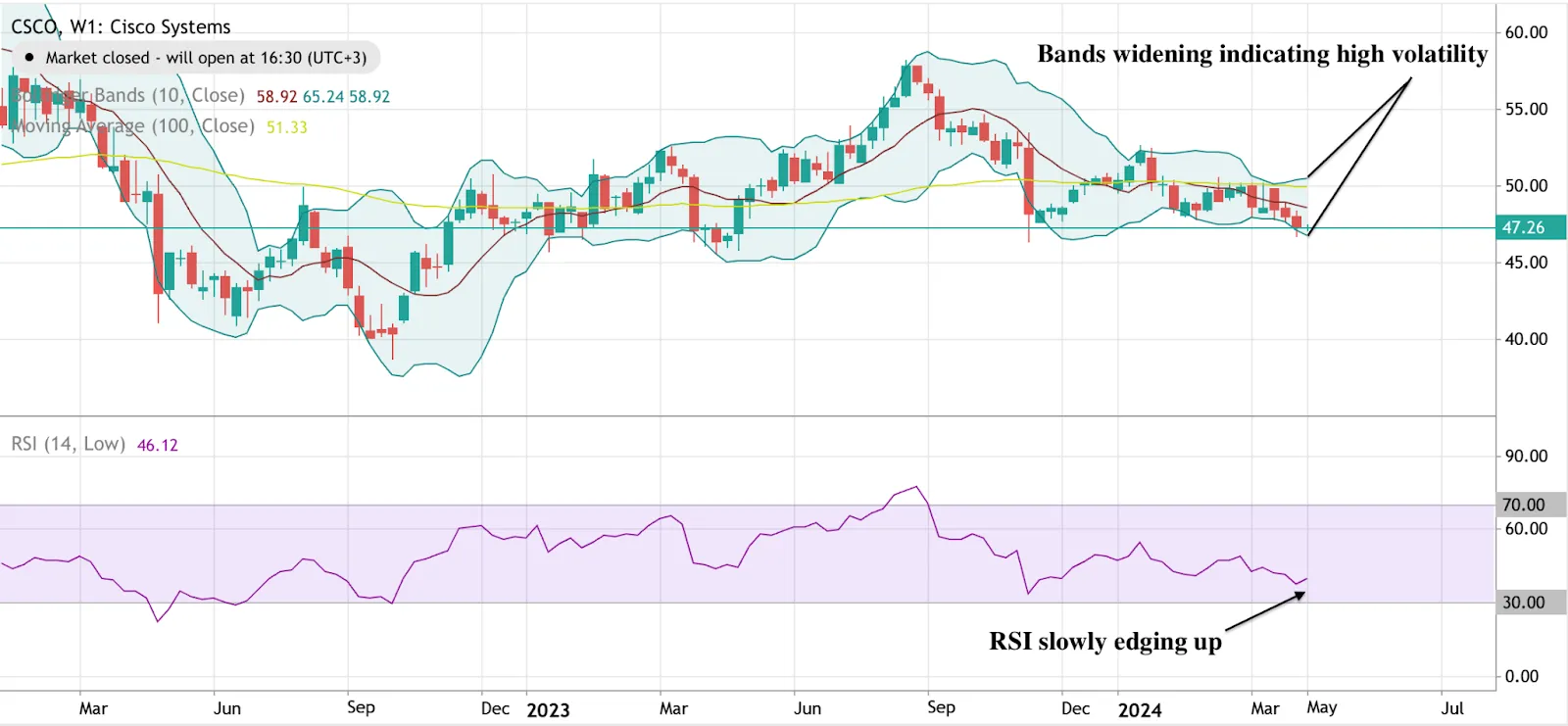
If Cisco fails to meet its earnings estimates or delivers weak forward guidance, the price may continue its downtrend.
Will sellers retain control after the earnings call?

Driving forward: Uber earnings report and potential implications for traders
Uber earnings loom. We break down the coming earnings report and how it could trigger buy or sell signals.
Uber Technologies has emerged stronger in the current financial year, demonstrating remarkable growth and innovative strategies that have sparked considerable interest among traders and investors. With its stock price witnessing a significant upsurge and new functionalities enhancing user engagement, Uber is standing at a pivotal point.
Here’s an in-depth analysis of its performance and what traders might expect.
Uber technologies stock performance
Since the beginning of the year, Uber’s stock has seen an 16% increase, signaling robust confidence from the market. This uptrend was particularly influenced by the company’s innovative approach to expanding its app functionalities, now offering up to 20 different ways for users to book rides. Analysts have reacted positively, with one setting a bullish price target of USD 100 for Uber’s stock.
Uber earnings call: What to watch
In early April, Uber rolled out multiple new features on its app, significantly diversifying the ways customers can engage with the service. These innovations are not just enhancements; they represent a strategic pivot towards a more flexible and user-oriented service model. Such advancements are crucial as they differentiate Uber from other players in the ride-sharing market and can be a key driver of customer loyalty and increased market share.
Looking forward to the company’s financial health, the Zacks Consensus Estimate projects a strong quarterly earnings report. The anticipated figures suggest earnings of USD 10.07 billion and earnings per share of 21 cents for the upcoming quarter. These numbers not only reflect Uber’s ability to generate revenue amidst a challenging economic environment, but also highlight its operational efficiency and effective cost management strategies.
Strategic implications for traders
For traders, Uber’s current trajectory and the outcomes from the upcoming earnings call could signal several moves:
Short-term trading opportunities: If the upcoming earnings report surpass market expectations, Uber’s stock price may experience a swift upswing. This scenario presents a prime short-term trading opportunity for those looking to capitalise on the immediate positive sentiment.
Long-Term investment prospects: Uber’s ongoing dedication to innovation and expanding its global footprint bolsters its appeal as a long-term investment. The company’s focus on improving operational efficiencies is essential for sustaining growth and profitability in a competitive landscape. Any optimistic forecasts or noteworthy developments that will be highlighted during their earnings call could also serve as catalysts for driving the stock price higher.
Technical analysis
The daily chart shows strong selling pressure as prices settle at the lower Bollinger Band below the 50 SMA. This is indicative of a short-term bearish trend and potentially oversold conditions. A better-than-expected earnings report could see a potential bounce back of Uber prices in the short-term as selling pressure eases. This is supported by the RSI indicator which is pointing up within oversold territory, suggesting a possible bounce back.
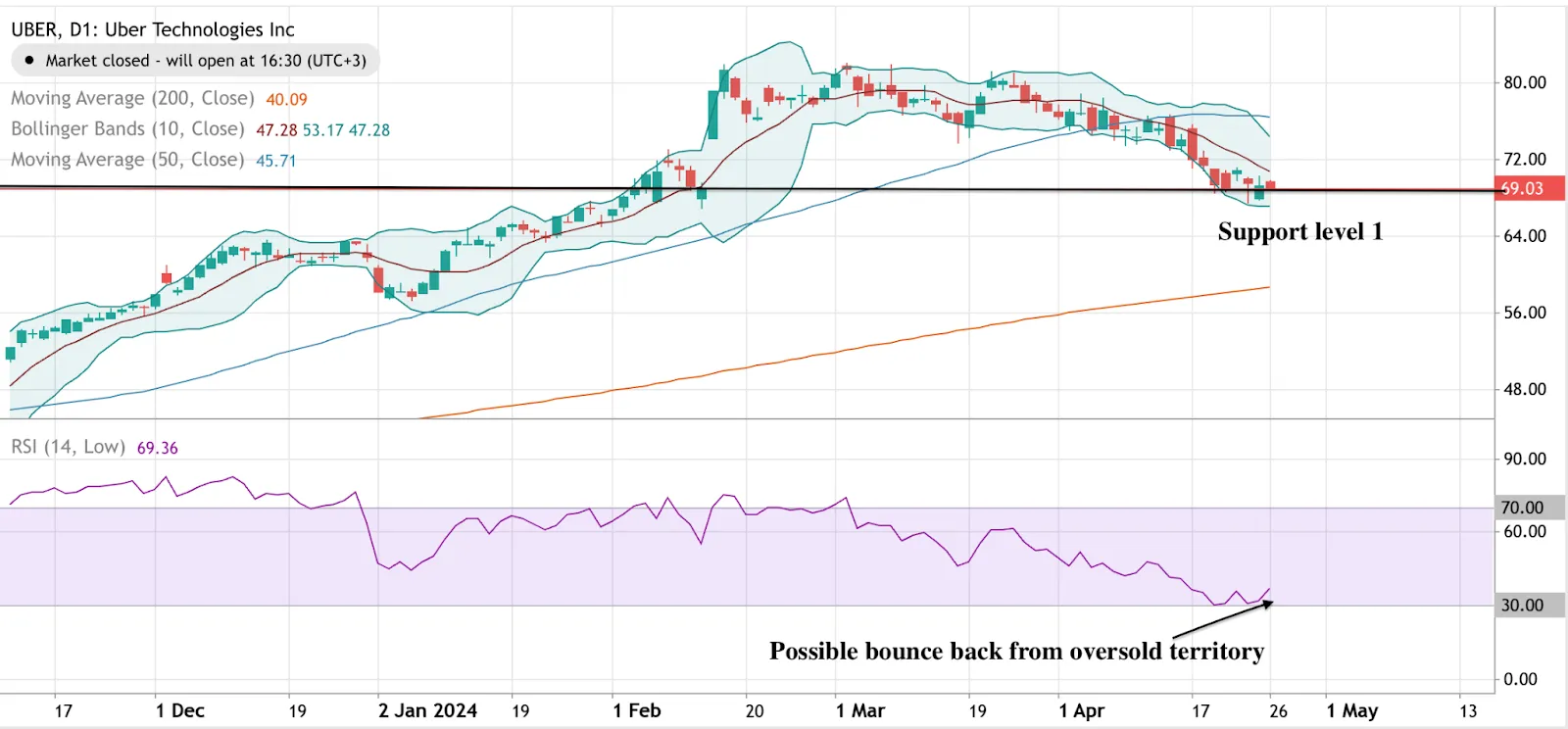
At the time of writing, Uber’s stock price is testing the USD 66 support level. Wednesday’s (8 May) earnings call could see some volatility that could provide a clearer picture on price trajectory. Will the sellers maintain control or will the longer-term uptrend resume?
Get involved and speculate on Uber’s price trajectory with a Deriv MT5 account. It offers a list of technical indicators that can be employed to analyse prices. Log in now to take advantage of the indicators, or sign up for a free demo account. The demo account comes with virtual funds so you can practise analysing trends risk-free.

Brace yourselves: What's next for oil prices?
In this latest InFocus, we explore the dynamics affecting oil prices and their potential impact on market trends.
In this latest InFocus, we explore the dynamics affecting oil prices and their potential impact on the market:
- OPEC+ production cuts
- Geopolitical factors
- Upcoming CPI data
Stay informed with our weekly market analysis on InFocus.
.webp)
New CFD trading assets on Deriv
We’ve added new trading assets to our platforms to make our CFD offering even better. Learn more about these assets and their potential.
Ever felt like you’re running out of new territories in the trading world? We’re happy to announce a significant update to our contracts for difference (CFD) offerings on Deriv MT5, Deriv cTrader, and Deriv X.
Get ready for a wider selection of indices to trade with lower costs!
Trade new stock indices CFDs on Deriv
Take your trading to the next level with these new, highly anticipated stock indices:
1. China 50
2. China H Shares
3. Hong Kong 50
4. Singapore 20
5. Swiss 20
6. Taiwan Index
7. US Mid Cap 400
8. US Small Cap 2000
These additions open up possibilities to diversify your portfolio, target new markets, and explore different trading strategies.
CFD trading with better spreads: Maximise your potential profits
The new stock indices bring with them improved spreads. This means you pay less in spreads with each trade.
We’re also updating the naming of some existing stock indices and energies CFDs to improve consistency and clarity across platforms. This will make it easier to locate instruments quickly and efficiently.
Important: Trading assets move to “close only” mode
Starting from 29 April 2024, 10 existing stock indices and 2 energy assets will be moved to close-only mode. This means you’ll only be able to close positions on these instruments. We recommend reviewing your open positions and making any necessary adjustments before this date to ensure a smooth transition.
Here’s a detailed list of the assets that will move to close-only mode and the asset’s new name that you can trade on with better spreads:
- AUS_200 -> Australia 200
- DAX_40 -> Germany 40
- EUR_50 -> Europe 50
- FRA_40 -> France 40
- JP_225 -> Japan 225
- NED_25 -> Netherlands 25
- UK_100 -> UK 100
- US_30 -> Wall Street 30
- US_100 -> US Tech 100
- US_500 -> US SP 500
- CL_BRENT -> UK Brent Oil
- WTI_OIL -> US Oil
We’re committed to providing you with the tools and opportunities to elevate your trading journey. Open a demo account on Deriv to practise trading these new instruments risk-free.
Happy trading!

Will the yen rise or fall against the dollar?
We explore the impact of the yen’s movements against the USD and the potential intervention by the Bank of Japan.
In the latest InFocus episode, we spotlight the recent movements of the Japanese yen against the US dollar and discuss their potential impact on your trades.
- Bank of Japan’s potential intervention
- Yen’s value against other currencies

USD/JPY recovers ground after dropping to 34-year lows
The Japanese yen has been on a rollercoaster ride in recent weeks, tumbling to 34-year lows against the US dollar. Will the Bank of Japan step in to prevent further depreciation?
The Japanese yen has been on a rollercoaster ride in recent weeks, tumbling to 34-year lows against the US dollar. Will the Bank of Japan step in to prevent further depreciation?
Fueled by speculation of intervention by the Bank of Japan (BOJ), Japan’s top currency diplomat, Masato Kanda, remained tight-lipped on Monday. He refused to confirm or deny whether the BOJ intervened in the foreign exchange market to prop up the yen.
At the time of writing, USD/JPY is seeing some sharp sell-offs that have seen it go from above 160 to around 156 at the time of writing. While some analysts are still attributing this intraday recovery to an undisclosed BOJ move, it remains to be seen whether the current selling pressure will be sustained.
Technical analysis
The 4-hour chart shows a sudden drop that saw USD/JPY tumble from highs of 160 to lows of 154.60 — with the bearish candle settling around the 155.4 support area.

This sharp decline triggered a pullback in both the stochastic and RSI indicators, which were previously in extremely overbought territory. This movement suggests a potential shift towards a more neutral reading in the near future..
Market attention remains intensely focused on the BOJ as USD/JPY volatility sparks ongoing speculation. If the BOJ confirms intervention, we could see further downward pressure on the USD/JPY pair, potentially testing the 151 support level. However, silence from the BOJ amid a strengthening US dollar, buoyed by a solid labour market and an expanding manufacturing sector, could lead to another historic surge for USD/JPY, potentially surpassing the 160 mark.
You can get involved and speculate on USD/JPY’s price trajectory with a Deriv MT5 account. It offers a list of technical indicators that can be employed to analyse prices. Log in now to take advantage of the indicators, or sign up for a free demo account. The demo account comes with virtual funds so you can practise analysing trends risk-free.

How will rising inflation impact your trades?
In this latest InFocus episode, we examine the effects of inflation on your trades.
In this latest InFocus episode, we examine the effects of inflation on your trades, focusing specifically on:
- 2 major currency pairs – USD/JPY & EUR/USD
- Strength of the US dollar
Stay informed with our weekly market analysis on InFocus, providing you with crucial insights to refine your trading strategies.

What is the ERC-20: Understanding smart contracts in blockchain
Discover how smart contracts work in blockchains and why the ERC 20 standard is a big step forward for the crypto industry and users alike.
Think of the ERC-20 as the universal language for tokens on the Ethereum blockchain. It’s a standard or set of rules that ensure all these tokens speak the same language, allowing them to interact seamlessly with each other and, more importantly, with smart contracts.
Two of the most popular tokens within the ERC-20 standard are the USDC and USDT tokens, but with a twist – they’re stablecoins. Unlike your usual tokens such as Bitcoin (BTC), Ether (ETH), and Litecoin (LTC) whose value fluctuates rapidly according to market trends, stablecoins are just that, “stable” – because they’re pegged to the US dollar.
ERC-20: How smart contracts work in blockchain
Seamless token integration: Fast and secure transactions
USDC and USDT are slowly becoming popular with business entities, with good reason.
Being pegged to the US dollar means that 1 token of the USDC or USDT is equivalent to 1 US dollar. The value only changes slightly depending on the strength of the dollar in the forex market. The stability of stablecoins and the power of the ERC-20 standard make USDT and USDC perfect for three use cases.
Imagine a business looking to pay some overseas contractors in cryptocurrency. Traditionally, the business might need to transfer funds from the bank account to a cryptocurrency exchange, then convert to the specific cryptocurrency needed for the payments. This process can be slow and may involve multiple fees.
With ERC-20 tokens integrating seamlessly with the Ethereum network, it allows for an instantaneous transfer of funds directly to contractor crypto wallets – no conversions and multiple fees needed.
Creating a safe haven in crypto
Parking your funds in tokens like Bitcoin and Ethereum can be risky because these are highly volatile assets. Agreements to be settled in Bitcoin can be worth 1 million dollars this week and 800,000 dollars next week – making it hard to do business.
The USDT and USDC tokens offer safety and stability, creating a safe haven in crypto for such business transactions. Instead of doing deals with Bitcoin and Ethereum and hoping prices don’t plummet the next day, deal makers can instead park their money in USDC and USDT during periods of volatility. This way, neither party’s purchasing power is eroded.
Other than securing the value of your holdings, smart contracts give investors the flexibility required to fully participate in the digital asset space. You can set your account such that some of your stablecoin holdings automatically convert to Bitcoin, when the price reaches a certain level. This conversion will happen without needing manual intervention, in an “if-then” execution system for smart contracts.
Fueling DeFi (decentralised finance)
Decentralised finance (DeFi) is a rapidly growing sector offering financial services like lending, borrowing, and earning interest, all without the need for traditional banks. For this sector to become an even more disruptive force in global finance, there is a need for faster and more reliable digital applications.
The USDT and USDC tokens act as the fuel for DeFi applications, where users can borrow against the tokens or use them as collateral when procuring loans. Smart contracts would then manage the interest payments and ensure that the tokens used as collateral are returned to the borrower upon servicing of the loan.
What the ERC-20 standard means for the global marketplace
ERC-20 smart contract tokens, like USDC and USDT, are a big deal because they are paving the way for a future of:
Increased trust
Where smart contracts remove the need for intermediaries, creating trust and transparency in transactions.
Enhanced efficiency
Manual processes that would take place in traditional finance are automated, saving time and money.
A more inclusive financial system
Banking won’t be a preserve for the savvy because anyone with an internet connection can participate in the global financial system, regardless of location or traditional banking access.
An important note on the ERC-20 standard
While the potential is massive, ERC-20, smart contracts, and stablecoins are still evolving. Security and regulation are ongoing considerations. It’s also important to note that while both the USDC and USDT are ERC-20 tokens, they also exist on other blockchains with different standards. For instance, USDT can also be found on the Tron blockchain using the TRC-20 standard. Therefore, it’s crucial to always double-check which network a specific USDC or USDT token resides on before sending or receiving them. Sending an ERC-20 token to a TRC-20 address could result in a loss of funds.
Gain a strategic edge in the dynamic crypto market by using stablecoins like USDC and USDT. Hold your funds in these reliable assets, immune to crypto volatility, and seize trading opportunities as they arise.
Sorry, we couldn’t find any results matching .
Search tips:
- Check your spelling and try again
- Try another keyword