
Results for

Bitcoin surpasses silver’s market cap as momentum builds for $100K
Bitcoin hit a historic milestone, with its market cap reaching $1.75 trillion, surpassing silver’s $1.732 trillion and marking its position as the world’s eighth-largest asset.
Bitcoin hit a historic milestone, with its market cap reaching $1.75 trillion, surpassing silver’s $1.732 trillion and marking its position as the world’s eighth-largest asset. The cryptocurrency surged past $90,000 before easing, buoyed by strong institutional interest and growing demand for spot Bitcoin ETFs. Despite this rally, analysts note potential resistance from overbought conditions, with support around the $75,000 and $71,200 levels.
Crypto regulations and political support
This achievement highlights Bitcoin’s increasing mainstream acceptance, with recent U.S. elections paving the way for pro-crypto regulatory optimism. Reduced election uncertainty, rising institutional inflows, and declining interest rates have all strengthened Bitcoin’s position. Experts like Chris Chung and Lukas Enzersdorfer-Konrad attribute this momentum to high investor confidence, as Bitcoin is now seen as a “safe asset” amidst market volatility.
Bitcoin’s market cap and impact on financial markets
Bitcoin’s surge has reverberated across related assets. The “Bitcoin Industrial Complex,” including stocks like Coinbase and MicroStrategy, saw record trading volumes, reflecting broader market enthusiasm. Bitcoin’s market cap now trails only seven major assets, with gold maintaining a substantial lead. However, analysts believe Bitcoin’s finite supply and increased acceptance could fuel further gains.
BTC technical analysis: Road to 100?
Bitcoin trades close to $90K, with momentum indicators showing overbought levels, hinting at possible near-term resistance. Key support zones stand at $75,000 and $71,200, while resistance at the upper Bollinger band could challenge further gains. Analysts remain optimistic about the path to $100K, with six-figure targets anticipated by 2025 as ETF demand rises.
Read the full article here: https://www.finextra.com/blogposting/27194/bitcoin-surpasses-silver-in-market-cap-will-it-hit-100k

Market Radar: EU retail sales and Germany inflation rate
Gain key market insights from this latest Market Radar where we feature EU retail sales data and Germany's inflation rate.
Join us in this latest Market Radar where we explore the key decisions and data releases that are influencing market trends:
- EU retail sales
- Germany’s inflation rate
Stay informed with our weekly market analysis on Market Radar.

Crypto’s uptober: Why is Bitcoin going up?
As "uptober" drew to a close, Bitcoin surged to new heights, capping off what has historically been a strong month for the cryptocurrency.
As "uptober" drew to a close, Bitcoin surged to new heights, capping off what has historically been a strong month for the cryptocurrency. Bitcoin pushed past $73,000 this week, coming within striking distance of its all-time high. The rally is attributed to election-related optimism and a favourable market environment for crypto, which have lifted not only Bitcoin but also the broader cryptocurrency market.
Bitcoin’s impressive uptober run
October, often called "uptober" by crypto enthusiasts, has traditionally been a lucrative month for Bitcoin, and 2024 is no exception. Last month alone, Bitcoin has risen over 12%, thanks to a combination of historical trends, ETF inflows, and growing excitement around the upcoming U.S. election. Over the past week, Bitcoin jumped 8%, momentarily surpassing the $73,000 mark on Tuesday before settling between $71,000 and $73,000. This rally positions Bitcoin close to its all-time high, which was previously reached in March.
Bitcoin Surge: Election optimism drives the rally
Much of the recent rally can be attributed to the anticipation surrounding the U.S. election, with many in the crypto community viewing Republican candidate Donald Trump as a pro-crypto advocate. Trump’s support for the industry has been evident in his pledge to make the United States “the crypto capital of the planet,” his speaking engagement at this year’s Bitcoin conference in Nashville, and his promise to fire SEC Chair Gary Gensler, a figure often criticised by crypto enthusiasts.
According to the crypto prediction platform Polymarket, Trump currently has a 67% chance of winning, though traditional polls show a much closer race with Vice President Kamala Harris slightly ahead. Trump's election platform and direct appeal to the crypto community have invigorated crypto bulls, who believe a Trump victory could accelerate Bitcoin’s growth trajectory.
Broader market follows Bitcoin’s lead
As Bitcoin surged this week, other cryptocurrencies joined the rally. Ethereum and Solana saw respective gains of 4% and 5%, while Dogecoin shot up 23% after Elon Musk mentioned the memecoin at multiple Trump rallies. Musk also hinted at a possible role in Trump’s proposed Department of Government Efficiency, or D.O.G.E., further energising Dogecoin fans and the wider crypto market.
The impact of BTC spot ETF inflows
Bitcoin’s climb this week was also fueled by substantial inflows into spot Bitcoin ETFs, which were approved in early 2024. Tuesday alone saw $870 million flow into these ETFs—the third-largest inflow since their approval in January. Since October 11, spot Bitcoin ETFs have drawn nearly $4 billion, reflecting strong demand from institutional investors seeking exposure to Bitcoin ahead of the election.

The growth of Bitcoin ETFs has been a major factor behind Bitcoin’s performance in 2024. These funds provide an accessible way for investors to buy Bitcoin without directly holding the asset, bringing greater liquidity and stability to the market. Analysts believe that the consistent ETF inflows suggest continued demand that could support Bitcoin’s price, even as it hovers near its all-time high.
OTC activity suggests support for continued price stability
In addition to ETF inflows, data from CryptoQuant highlights an increase in Bitcoin held by over-the-counter (OTC) desks, which cater primarily to large investors wanting to trade privately without impacting the public market price. OTC desks now hold around 416,000 BTC, worth $30 billion—a substantial increase from the average of less than 200,000 BTC held in the first quarter.

The lower amount of Bitcoin flowing into these OTC desks, which dropped to the year’s lowest in October, has reduced potential selling pressure. This limited supply has allowed Bitcoin to rally without heavy sell-offs, creating an environment that could enable U.S.-listed ETFs to make large purchases without significant price impact.
Post-Uptober prediction: Analysts upbeat regardless of election outcome
As Bitcoin’s rally continues, analysts are confident in its momentum. According to Michael Terpin, CEO of Transform Ventures and a longtime Bitcoin advocate, the market has reached a point in the cycle where Bitcoin historically gains strength, suggesting that the currency could see sustained growth. Terpin acknowledges that a Trump win could boost Bitcoin's price more quickly, yet he believes that even a Harris victory won’t disrupt the current momentum.
“There’s just too much momentum right now,” Terpin told Fortune. “We’re at the point of the cycle where it usually does go up quite a bit. I just think that Trump winning would make it quicker and faster and higher.”
Bitcoin technical analysis: Looking ahead
As "uptober" wraps up, Bitcoin is well-positioned for continued gains. Although the market experienced a slight dip on Wednesday, with Bitcoin pulling back after its $73,000 high, the combination of strong ETF inflows, increasing OTC holdings, and bullish sentiment around the election has laid a solid foundation for growth. According to analysts, if the historical trend holds and inflows continue, Bitcoin could reach a new all-time high just in time for the election.
With the broader crypto market following Bitcoin’s lead, October has proven to be a bullish month across the board. Investors now look to the next few weeks with cautious optimism, hoping that Bitcoin’s upward trajectory will carry the market to even greater heights as 2024 comes to a close.
At the time of writing, BTC is holding around the $72,400 mark, with bullish signals evident as the price stays above the 100-day moving average. However, the price touching the upper Bollinger band as RSI breaches the 70 mark hints at overbought conditions. This means that a slowdown could be in the offing.
Buyers looking to test all-time highs could struggle to go past the upper Bollinger band at $72,800. Sellers, on the other hand, could find support at the $68,700 and $66,500 price levels.

As for now, you can get involved and speculate on the price of these two incredible assets with a Deriv MT5 account. It offers a list of technical indicators that can be employed to analyse prices. Log in now to take advantage of the indicators, or sign up for a free demo account. The demo account comes with virtual funds so you can practise analysing trends risk-free.
.webp)
Yen rebounds as traders eye key data and central bank moves
The yen rebounds sharply, heightening uncertainty around USD/JPY. Learn how approaching economic data could affect market volatility.
After a sharp sell-off earlier in the week, the Japanese yen (JPY) rebounded on Thursday, buoyed by bargain hunting and anticipation of key economic data. The market is now focused on Tokyo inflation figures and global PMI data, both of which could influence the Bank of Japan's next policy steps and impact major currency pairs, particularly USD/JPY.
Geopolitical impact: The BoJ’s struggle to hit its inflation target adds uncertainty to the Yen’s trajectory. Meanwhile, the Bank of Canada’s surprise rate cut has sent ripples through the USD/CAD pair, intensifying market volatility.
USD/JPY technical outlook: The pair is trading around $152, facing resistance near $152.51 as the RSI signals overbought conditions. Support is seen at $148.80, with a possible retest of the 100-day moving average. Expect heightened volatility as traders digest upcoming PMI and US labour data.
Read the full article here: https://www.fxstreet.com/analysis/yen-rebounds-amid-key-global-data-and-central-bank-moves-202410241445
.webp)
Election 2024: Which stocks could thrive or dive post-polls?
How will the US Presidential 2024 election affect stock market behaviour? Find out what stock market predictions say about EV stocks and more.
With the US presidential election set to take place on 2 November, the contest between Vice President Kamala Harris and former President Donald Trump is tightening, pushing election fever to an all-time high. The result could have significant implications for various sectors of the economy, and investors are keeping a close eye on stocks that may be influenced by the outcome.
From financial services, to energy and electric vehicles (EVs), stocks like Bank of America, Microsoft, Rivian, and Airbnb are poised for potential movement. But before we dive into these individual stocks, it's crucial to understand how the stock market has historically behaved during election cycles.
Stock market behaviour during past elections
Historically, US elections have had a profound impact on the stock market, with patterns emerging over nearly a century. Since 1928, the S&P 500 has accurately predicted the outcome of 20 out of 24 US presidential elections. This predictive power comes from a trend where, if the market rises in the three months leading up to Election Day, the incumbent party tends to win.
Conversely, a declining market usually signals a shift in power. For example, when the stock market was up during this critical period, the incumbent party kept the White House 12 out of 15 times. On the flip side, the party in power lost 8 out of the last 9 elections when the market was down in the months leading up to the vote.
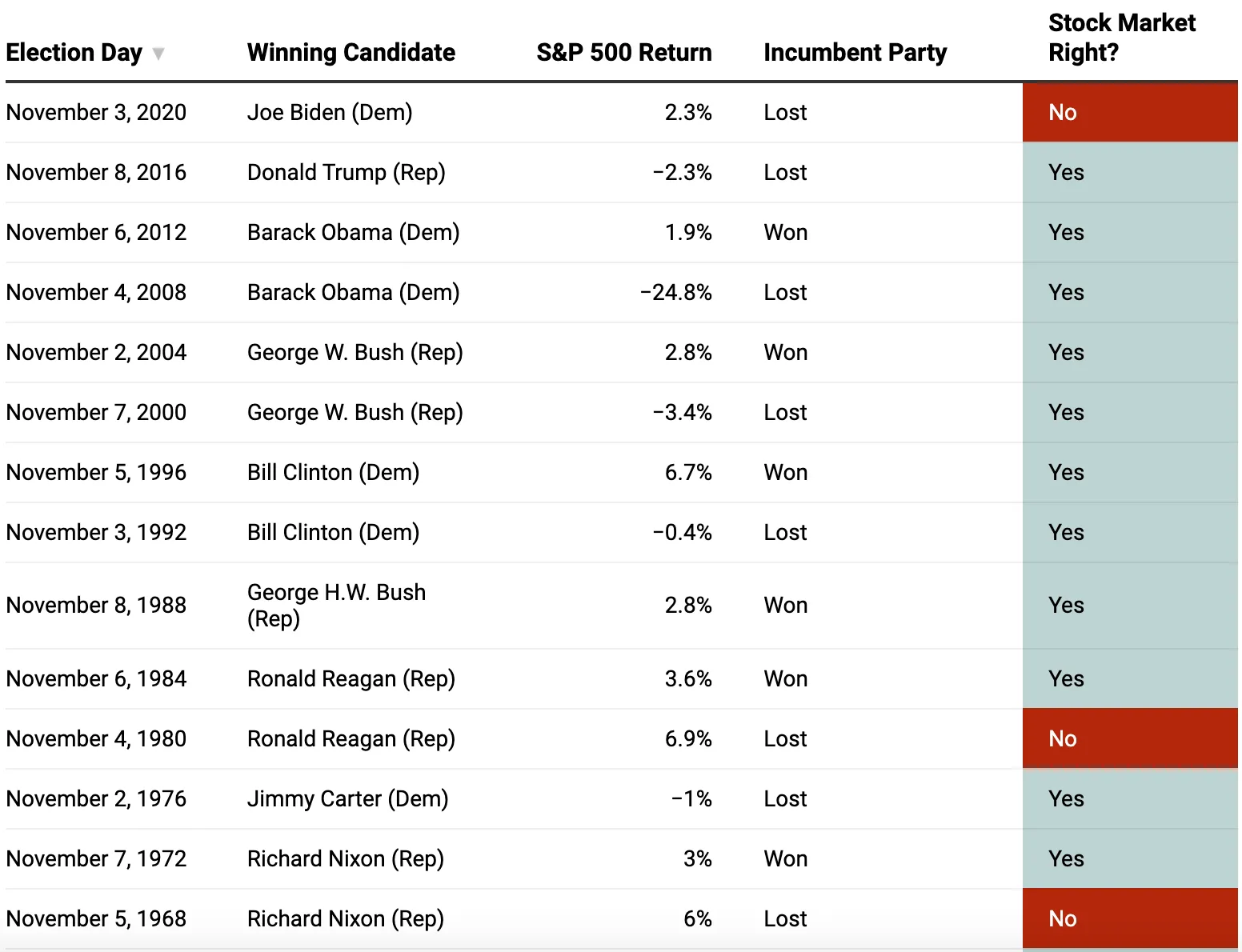
Source: LP Financial
Currently, the stock market has shown positive momentum since August, which, historically, could suggest a continuation of the current administration’s policies. However, with Joe Biden opting out of a second term and Kamala Harris leading the Democratic ticket, this election introduces unique uncertainties.
Renowned investor Stan Druckenmiller recently noted that the market seems to be pricing in a potential Trump victory, which could lead to significant sector-specific moves. Druckenmiller's observations reflect a larger sentiment that, while stock markets tend to react in the short term to political outcomes, long-term performance is more tied to broader economic trends like inflation, fiscal policies, and consumer confidence.
The immediate impact of elections is undeniable; however, it is crucial to note that historical data suggests market returns over the medium to long term are more significantly influenced by macroeconomic factors rather than election outcomes.
A divided government—where one party controls the presidency and the other controls Congress—has historically led to better stock market performance than single-party control. This is why investors need to focus not only on who wins the presidency but also on the makeup of Congress and how it might affect policy implementation.
Key sectors and stocks to watch
Finance services: Bank of America (BAC)
The finance sector is one of the key areas that could see significant impacts based on the election outcome. A Trump victory may signal a continuation of deregulation, potentially benefiting large financial institutions like Bank of America. Trump’s first term saw a rollback of several Dodd-Frank regulations, which allowed banks to expand operations and boost profits.
Another beneficiary of the looser business regulatory environment Trump is expected to foster is the financial sector, including banking and other financial institutions. Bankers are hoping that stiff rules being formulated by the Biden administration would be rolled back or even withdrawn, with one analyst expecting “less stringent capital standards.” This could create a more favourable environment for financial giants like Bank of America, enabling them to grow and take on more risk.
However, even under a Harris presidency, the finance sector is likely to remain strong, particularly with growing bipartisan concerns around inflation, interest rates, and consumer lending. Bank of America, as one of the largest banks in the US, is well-positioned to benefit from either administration, making it a stock that investors should closely monitor as the election approaches.
Technology and cybersecurity: Microsoft (MSFT)
Microsoft is another company that stands to perform well regardless of the election outcome. Both Harris and the GOP have emphasised the importance of cybersecurity, with Harris being a long-time advocate for strengthening IT infrastructure against cyber threats. The GOP’s platform also includes a focus on cybersecurity, aligning with the growing concern over cyber defence.
Microsoft, a leader in both AI and cybersecurity, is positioned to benefit from this bipartisan focus. As the second-largest cloud service provider, Microsoft has integrated AI into its suite of software products and also offers comprehensive cybersecurity solutions. Given the importance of AI in both business and government sectors, Microsoft’s growth prospects remain strong, regardless of which party takes the White House.
EV stocks: Rivian Automotive (RIVN) and Tesla (TSLA)
The electric vehicle (EV) sector is a major focus in this election, particularly under Harris, who has continued Biden’s support for pro-EV policies. Harris has championed federal incentives such as the $7,500 EV tax credit, along with billions of dollars in grants to build a national charging network. These policies directly benefit companies like Rivian Automotive, which produces the R1T pickup, R1S SUV, and delivery vans for Amazon, as well as Tesla, whose leadership in the EV space positions it to capitalise on these incentives.
Despite Elon Musk backing Trump, a Kamala Harris win could actually boost Tesla, thanks to her emphasis on renewable energy and EV expansion. In fact, the Harris campaign is scheduled to meet with Tesla owners on a Zoom call on 2 November, highlighting her alignment with pro-EV policies.
Rivian has also garnered positive reviews from analysts, with a consensus “Buy” rating and optimism about its future growth. Rivian's improvements in production and strategic partnerships, such as Volkswagen’s $5 billion investment, further solidify its position in the EV market. Whether Harris continues Biden’s policies or Trump shifts the market to a more traditional energy focus, both Rivian and Tesla remain strong stocks to watch.
Travel and Tourism: Airbnb (ABNB)
Airbnb is another stock to keep an eye on as the election approaches. Some analysts predict that a Trump victory could lead to increased consumer confidence and travel, which would benefit Airbnb. The company has already demonstrated profitability and resilience in the travel sector and could see further growth as travel demand picks up post-pandemic.
Regardless of who wins the election, Airbnb’s operational efficiency and positive financial performance make it a solid option for investors looking to capitalise on the recovery of the travel and tourism sector.
Expert opinions and the road ahead
As the US election draws near, market experts emphasise that while political outcomes can influence specific sectors, long-term stock performance is primarily driven by broader economic trends such as inflation, interest rates, and fiscal policies. Investors should keep a close eye on these macroeconomic factors while monitoring individual stocks that could be impacted by the election.
For those looking to navigate the post-election market, the stocks discussed— Bank of America, Microsoft, Rivian, and Airbnb—offer strong potential for growth. Whether Harris or Trump wins, these companies are poised to benefit from ongoing trends in defence, technology, energy, and consumer travel.
Trade election stocks on Deriv MT5
If you're looking to set up trading positions ahead of the US elections, Deriv MT5 offers a wide range of assets, including Bank of America, Microsoft, Rivian, Tesla, and Airbnb. With Deriv MT5, you can explore these key stocks and position your portfolio for success, no matter who wins the presidency.

The next wave of AI: Is Nvidia set for a strong rally?
Nvidia's stock has surged 25% in the last month, signaling continued strength in the AI rally.
Nvidia's stock has surged 25% in the last month, signaling continued strength in the AI rally. With anticipation building around its upcoming Blackwell chips, Nvidia is poised to lead the next wave of AI demand.
Unprecedented demand for Blackwell chips:
Tech giants like OpenAI, Microsoft, and Meta are eager to integrate Nvidia’s Blackwell chips into their AI-driven data centers. Priced between $30,000 and $40,000 per unit, these chips promise major advancements over the current Hopper models, with billions in revenue expected as production ramps up.
Nvidia’s AI hardware dominance:
Nvidia’s GPUs power nearly every AI application, driving its impressive financial performance, including a 122% year-over-year revenue increase in the latest quarter. The company's leadership in AI hardware has also helped it surpass Microsoft as the second-most valuable company globally.
Technical outlook:
Nvidia’s stock is currently around $134 with strong momentum, though flat RSI near 70 and nearing the Bollinger band suggest a potential slowdown. Analysts are eyeing the path to $200 as the AI demand continues to grow.
Read the full article here: https://www.finextra.com/blogposting/27027/the-next-wave-of-ai-is-nvidia-set-for-a-strong-rally.

Japanese yen forecast: Recovery in sight or is economic pressure here to stay?
The Japanese Yen (JPY) trimmed some of its recent losses during Friday's London trading session, offering temporary relief after a sharp decline earlier in the week.
The Japanese Yen (JPY) trimmed some of its recent losses during Friday's London trading session, offering temporary relief after a sharp decline earlier in the week. The yen had faced significant pressure following comments from Japan’s new Prime Minister, Shigeru Ishiba, and Bank of Japan (BoJ) Governor Kazuo Ueda, both of whom signaled a cautious approach to monetary policy. Despite this recovery, the broader outlook for the yen remains clouded, with economic headwinds and subdued expectations for interest rate hikes likely to continue influencing the currency's performance.
Yen outlook: Interest rate uncertainty and economic priorities
Prime Minister Ishiba’s stance on Japan’s interest rates has been pivotal in shaping the recent movements of the yen. Earlier this week, Ishiba stated, "I do not believe that we are in an environment that would require us to raise interest rates further," reinforcing the view that Japan is not yet ready for tighter monetary policy. This statement, combined with Governor Ueda’s cautious approach, has dampened market expectations of any imminent interest rate hikes by the BoJ, adding to the yen’s weakness against major currencies like the U.S. dollar.
Before assessing the potential impact of monetary tightening and the yen's future outlook, it's essential to examine how a weaker yen affects the broader economy. Over the past few years, the yen has depreciated due to the growing interest rate differential between the U.S. and Japan. Despite efforts by the Japanese government since 2020 to encourage companies in China to relocate back to Japan and Southeast Asia, industrial production has not experienced a significant rebound.
While Japan’s real GDP has increased in yen terms, its GDP in U.S. dollars has declined, suggesting that much of the growth is a result of the weaker yen rather than underlying economic strength. This highlights the reliance of Japan's economy on currency-driven growth, which may complicate any future decisions to tighten monetary policy.
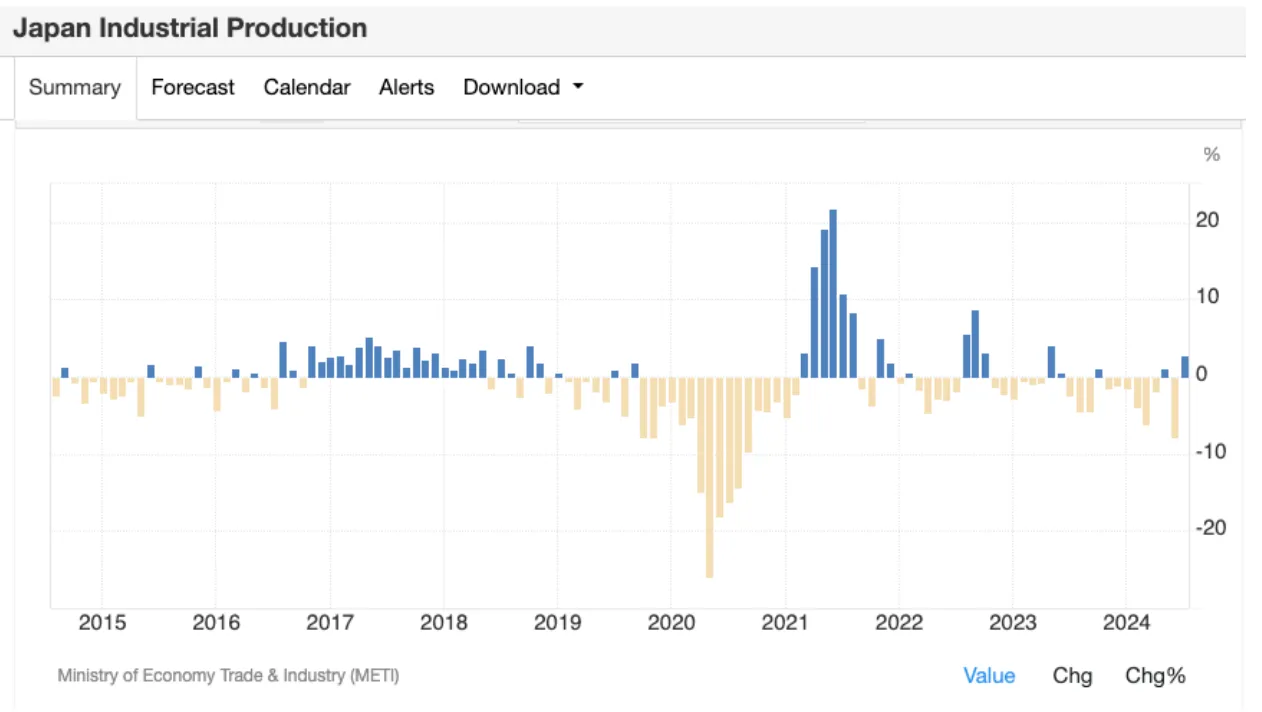
Japan’s ongoing struggle with deflation and the government's focus on economic growth continue to play a significant role in monetary policy decisions. Overcoming deflation remains Japan’s top priority, and both Prime Minister Ishiba and the BoJ are committed to maintaining an accommodative policy stance until this goal is achieved. The BoJ’s 2% inflation target, while still in place, has proven difficult to reach, and any move towards tightening monetary policy is likely to be delayed until more concrete signs of economic recovery emerge.
Will the yen get stronger?
While the yen's performance in the near term may be influenced by global factors like U.S. dollar strength and economic data releases, the longer-term outlook remains uncertain. With the BoJ maintaining its ultra-loose monetary policy and showing little inclination to raise interest rates, the yen could face sustained downward pressure in the months ahead.
Moreover, the broader economic landscape in Japan, including rising costs and the potential for increased government spending, suggests that the yen may continue to struggle in the absence of stronger inflationary pressures. Prime Minister Ishiba has pledged to introduce an economic package aimed at easing the impact of rising costs on households, but the effect of such measures on the yen’s value remains to be seen.
The upcoming supplementary budget and Japan’s fiscal strategy will be crucial in shaping both the yen's trajectory and market sentiment. While some analysts believe that the yen could recover if the BoJ signals a shift in policy or if inflation accelerates beyond expectations, the current environment suggests a more cautious outlook.
Technical outlook: USD to yen forecast
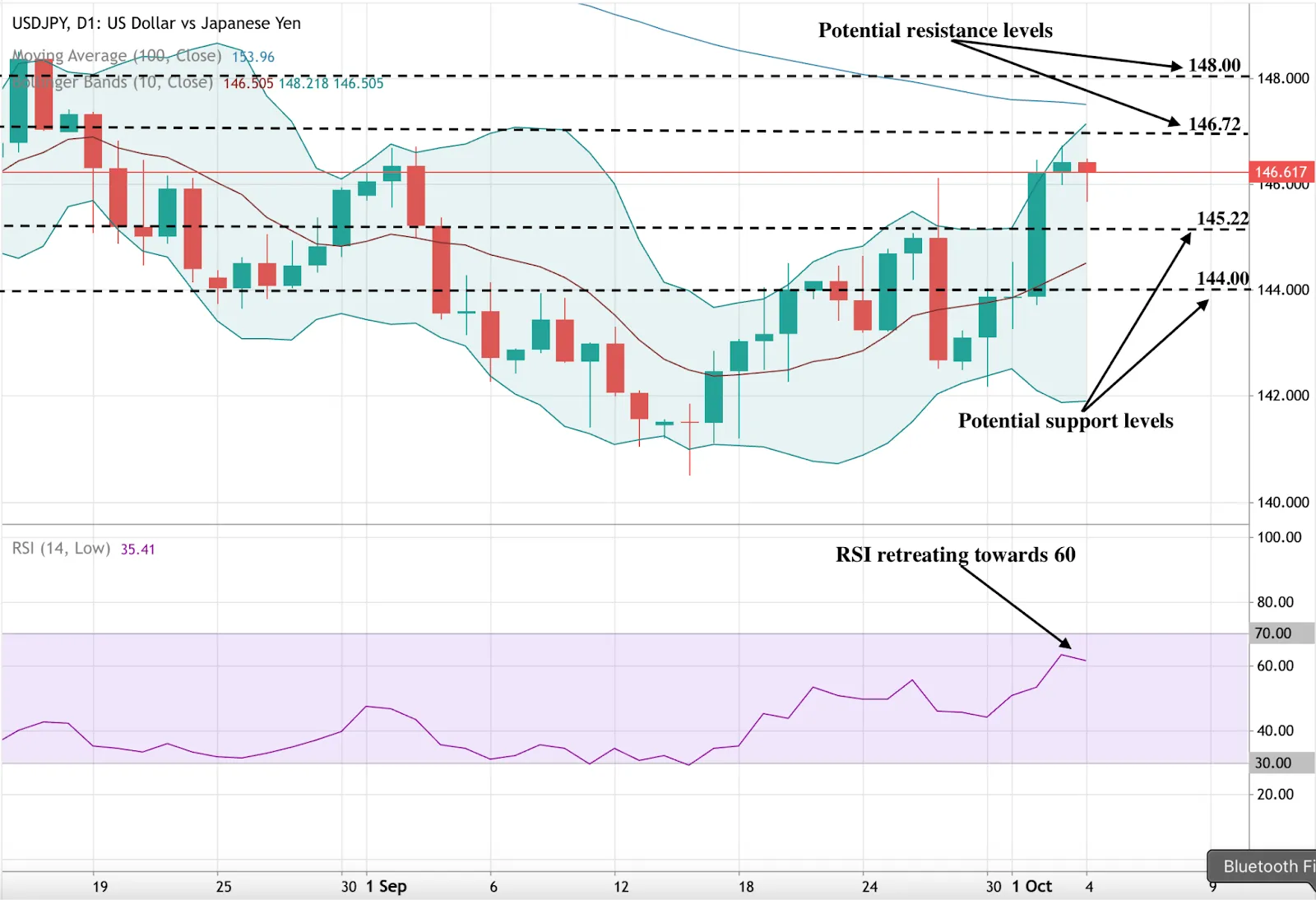
At the time of writing the pair trades at around 146.61, with bullish momentum evident on the daily chart. However, the RSI retreating towards 60, with price close to the upper boundary of the bollinger band, hints at overbought conditions.
Buyers could struggle to breach the upper boundary of the bollinger band, potentially being stopped at 146.72, with a further up potentially being stopped at the 100-day moving average. On the downside, sellers could be held at the 145.22 price level, with a further move down likely to hold 144 psychological levels.
As for now, you can get involved and speculate on the trajectory of this pair with a Deriv MT5 account. It offers a list of technical indicators that can be employed to analyse prices. Log in now to take advantage of the indicators, or sign up for a free demo account. The demo account comes with virtual funds so you can practise analysing trends risk-free.

Oil price forecast: Are we headed for unprecedented highs?
Oil surges above $71 as tensions in the Middle East escalate, following Iran’s missile strike on Israel.
Oil surges above $71 as tensions in the Middle East escalate, following Iran’s missile strike on Israel. US Oil prices have rebounded from last week’s lows of $67, reaching $71.35 in early trading on Wednesday. The attack has sparked fears of supply disruptions, pushing oil prices higher as markets brace for further escalations.
Geopolitical impact: With Iran being a major oil producer, the risk of production disruptions is high, potentially driving prices to new highs. This follows historical patterns where geopolitical tensions involving Iran have led to significant oil price surges.
Technical outlook: Analysts suggest US Oil is facing resistance near $72, with a potential challenge around the 100-day moving average at $73.52. A further rise could target $75, while on the downside, support lies at $70 and $68.
Read the full article here: https://www.finextra.com/blogposting/26941/oil-surges-as-iran-strikes-israel-are-we-headed-for-unprecedented-highs

TradingView charts integration now on Deriv X: Enhanced trading capabilities for CFDs traders
Deriv has successfully integrated TradingView into its Deriv X platform, marking a significant enhancement in its trading offerings.
Note: As of August 2025, we no longer offer the Deriv X platform.
Redefining the trading experience with TradingView charts
Deriv has successfully integrated TradingView charts into its Deriv X platform, marking a significant enhancement in its trading offerings. This integration brings advanced charting tools and real-time market data directly to traders, enabling more informed and strategic trading decisions.
The TradingView charts integration on Deriv X offers users access to a comprehensive suite of features, including:
- Advanced charting capabilities with over 100 pre-built indicators
- 17 customisable chart types for detailed technical analysis
- 110+ smart drawing tools for precise chart annotations
- Chart settings with their highly flexible styling.
This new feature set allows traders to conduct in-depth technical and financial analysis across a wide range of assets, including forex, stocks, indices, commodities, cryptocurrencies, derived indices, and ETFs. Now, you can track any assets from EURUSD, XAUUSD, and BTCUSD to less popular ones, giving you comprehensive market coverage.
The TradingView charts are available on desktop and accessible via tablets and other portable devices, ensuring seamless access across devices. Importantly, this integration comes at no additional cost to traders, maintaining Deriv's commitment to value-driven services.
How to start trading with TradingView charts on Deriv X
To access TradingView on Deriv X, follow these steps:
1. Sign up or log in to your Deriv account.
2. Navigate to Trader's Hub and select 'Get' under the Deriv X section.
3. Create a Deriv X account and password.
4. Access the TradingView chart under the 'My Trading Account' tab.
This integration is compatible with both demo and live trading accounts, allowing users to practice strategies on the demo account risk-free before engaging in live markets.
This move is another sign of Deriv’s commitment to bringing you advanced tools and technologies to support your trading journey.
Are you ready to make the most of it? Launch Trader's Hub now!
Sorry, we couldn’t find any results matching .
Search tips:
- Check your spelling and try again
- Try another keyword