
Results for

Comparative analysis: Deriv Bot trading strategies
We analyse and compare various algorithmic trading strategies for the Deriv Bot automated trading platform.
Trading strategies are diverse, each with unique approaches and risk levels. In this article, we will explore three main strategies on Deriv Bot: Martingale, D’Alembert, and Oscar’s Grind. We aim to simplify and shed light on their objectives, risks, and methodologies.
Martingale
Approach: The Martingale strategy is a negative progression system, where you double your stake after each loss and return to the initial trade after a gain.
Goal: To recover previous losses with a single gain.
Risk: High level of risk. You can accumulate large losses if you experience a series of losses.
How it works:
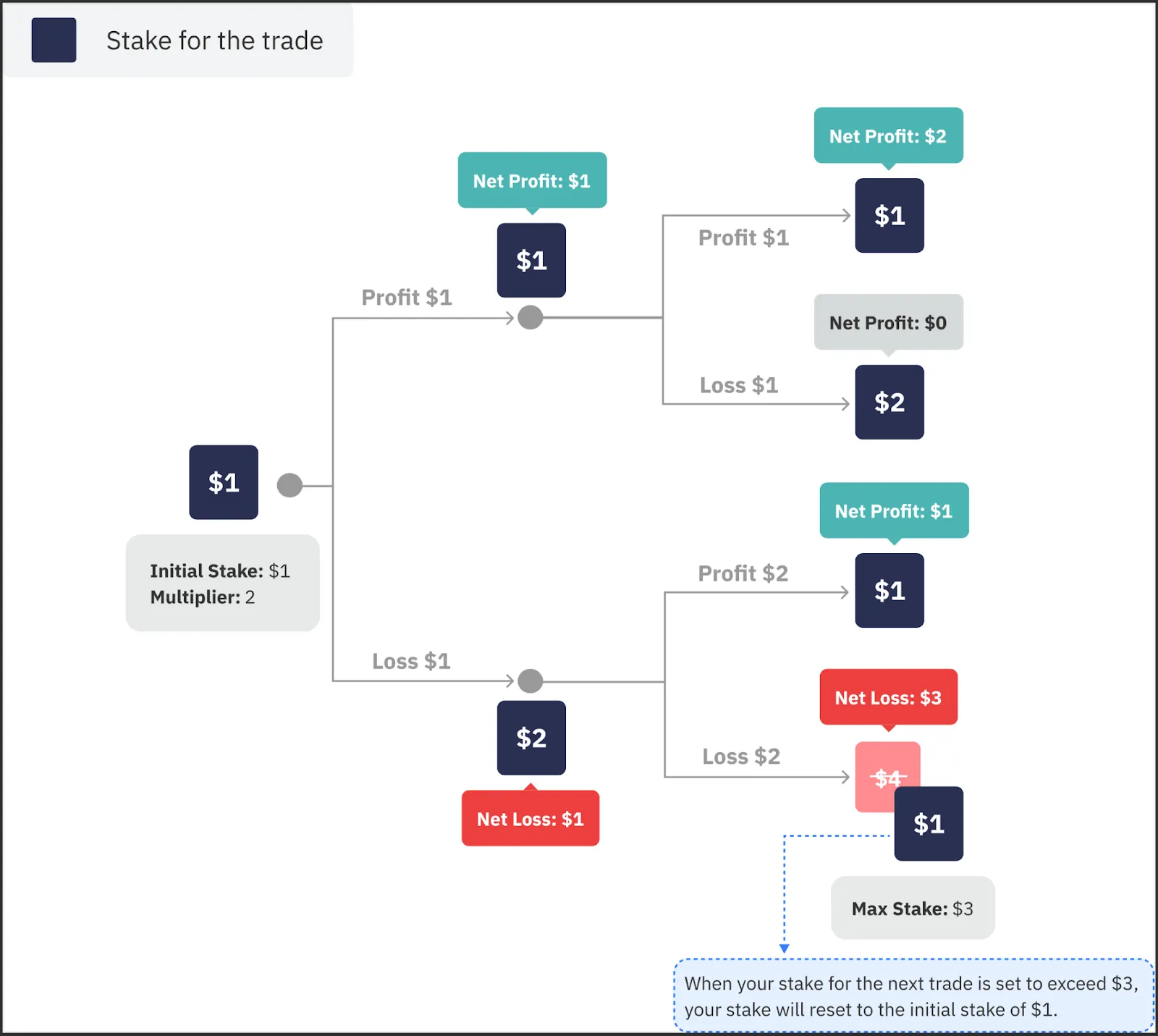
Summary: The Martingale system is about chasing losses by doubling your stakes. It assumes that you’ll eventually gain, and when you do, you’ll recover your losses. However, it’s risky because it doesn’t guarantee success and can lead to substantial losses if you face a prolonged losing streak.
D’Alembert
Approach: D’Alembert is a more conservative strategy where you increase your stake by a fixed unit after a loss and decrease it by the same unit after a gain.
Goal: To reach a balance between gains and losses while making a small profit.
Risk: Moderate risk compared to the Martingale, as it doesn’t increase stakes as rapidly.
How it works:
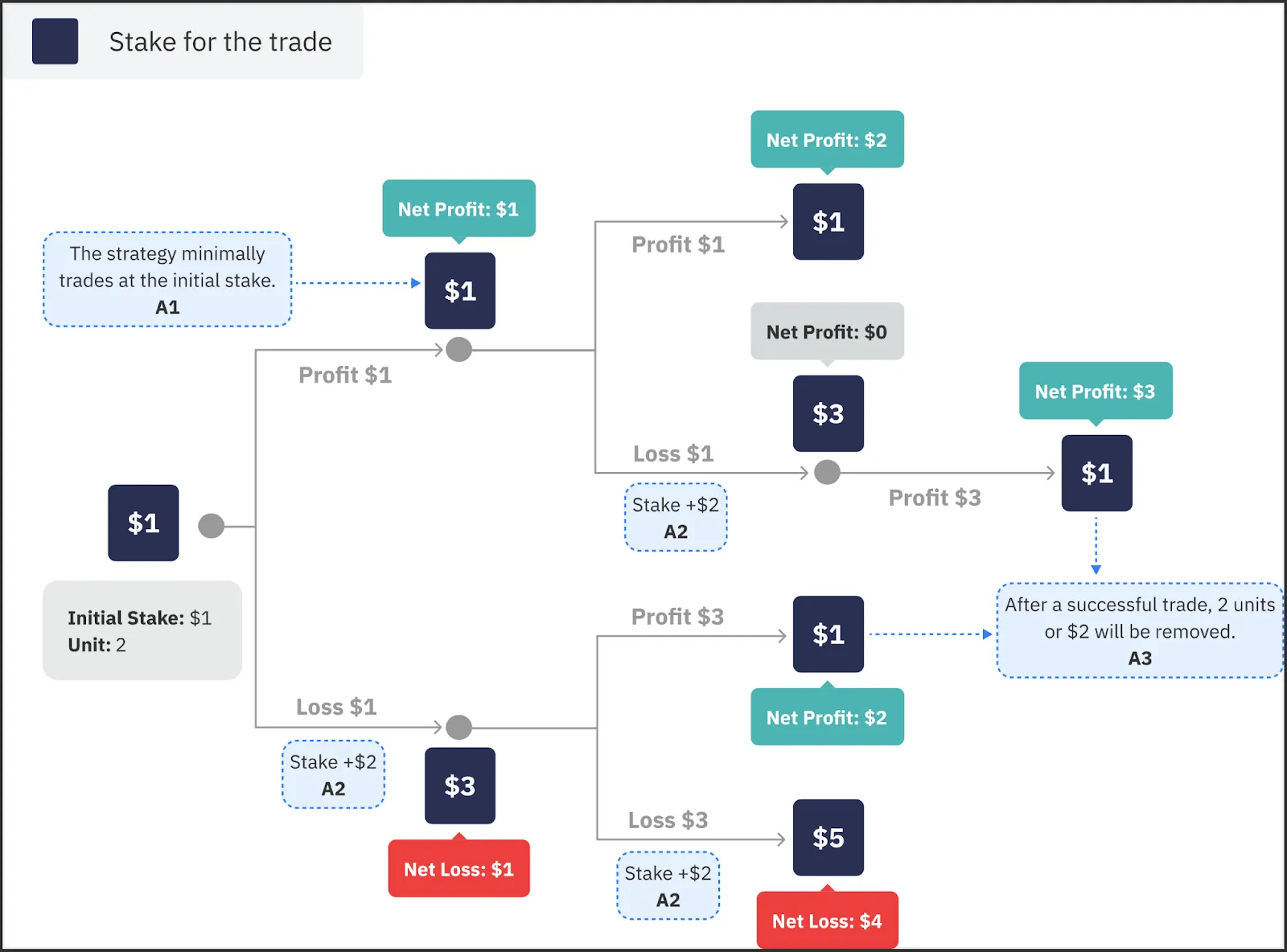
Summary: D’Alembert is about managing your traders more cautiously. It aims to balance losses and gains, making it a more moderate approach compared to the more aggressive Martingale strategy.
Oscar’s Grind
Approach: Oscar’s Grind is a positive progression system where you increase your stake by a fixed unit after a gain and maintain the same stake after a loss. This continues until you reach the aim of making one unit of profit per session.
Goal: To make small, consistent profits while minimising losses.
Risk: Low level of risk when compared to the Martingale, as it doesn’t chase losses aggressively.
How it works:
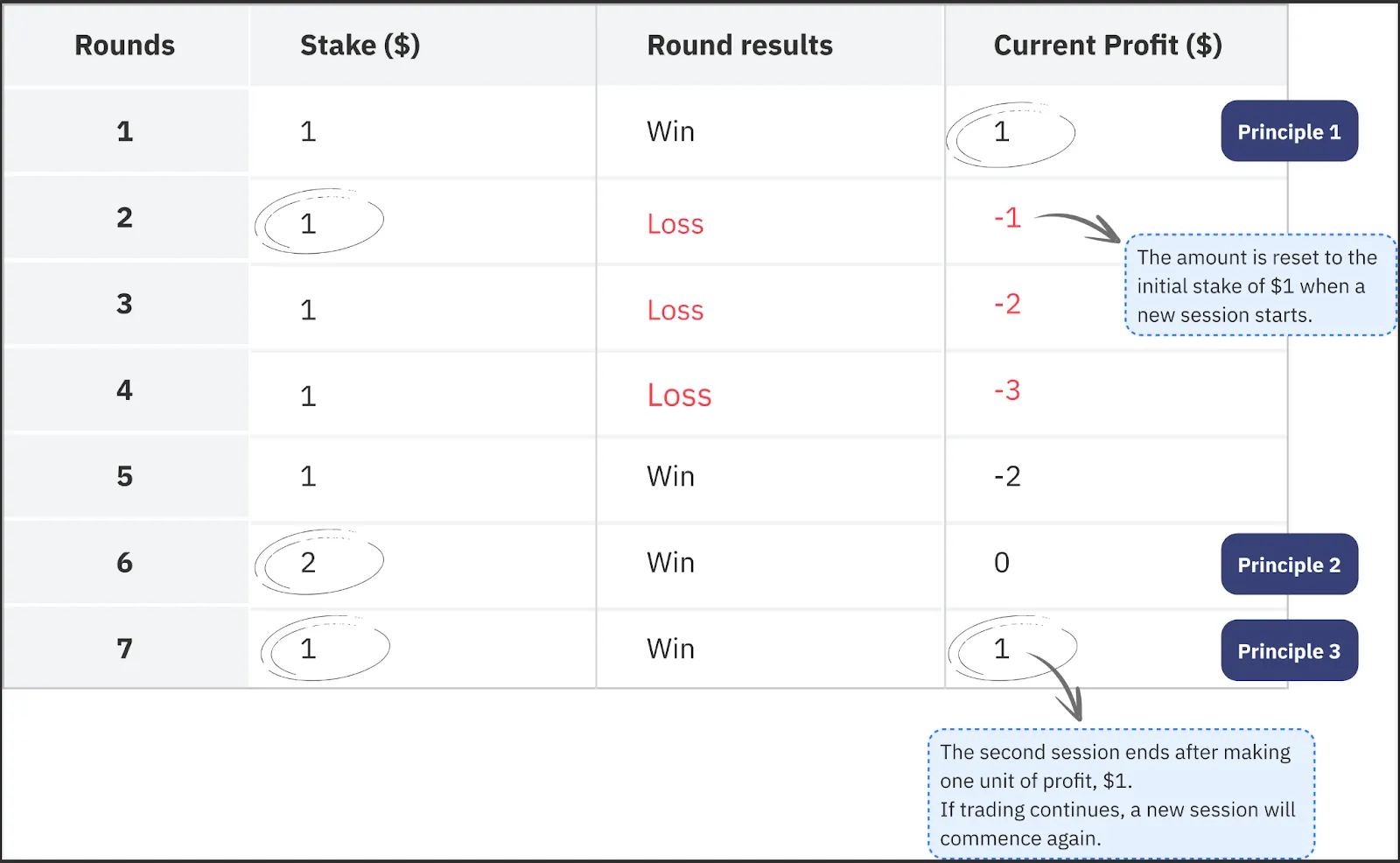
Summary: Oscar’s Grind focuses on setting profit targets and making incremental gains while managing losses. It’s designed for more controlled and conservative trades.
In conclusion, each trading strategy offers a distinct approach tailored to different risk appetites and objectives:
- Martingale pursues aggressive recovery
- D’Alembert seeks balance
- Oscar’s Grind focuses on consistent, incremental gains.
Understanding these strategies and their inherent risks is essential, as this will help you make informed decisions aligned with your trading preferences and goals.
Explore how these strategies work risk-free with a free Deriv demo account. It comes loaded with virtual funds to test out these strategies to see which one works best for your risk appetite and trading preferences.

Market recap: Week of 22–26 Jan 2024
Stay informed with our weekly market recap from 22-26 Jan, 2024. Get insights on the latest trends and developments in the financial world.
Central bank rate decisions
Bloomberg, Reuters:
Bank of Japan:
- Expected to maintain current policy
- Focus on Governor Kazuo Ueda's assessment of sustainable inflation progress
- No immediate end to the world's last negative interest rate
Bank of Canada:
- Predicted to keep interest rates unchanged
- Economy in "recessionary territory"
- Analysts anticipate a cautious approach to interest rate decisions
European Central Bank (ECB):
- Interest rates likely to remain steady on Thursday
- Market attention on insights into the timing of rate cuts
- Reuters poll: 45% expect rate reduction next quarter
- Median expectation: 100 basis points of cuts in 2024, bringing the deposit rate to 3.00%
Pensions & investments
Bank of America Fund Managers Survey Highlights
Interest rates outlook:
- Only 3% of surveyed managers in January anticipate higher rates.
- Majority predict rate cuts in the first half of 2024.
Manager insights:
- Surveyed 256 fund managers overseeing $669 billion in assets.
- Global growth expectations over the next 12 months at a net -40%. A notable improvement from December's net -50%.
Market sentiment:
- Managers express a cautious outlook on global growth.
- Despite remaining bearish, the shift indicates increased optimism.
Insights from Bill Gross, former CEO of PIMCO
Bloomberg and Market Watch:
Insights from Bill Gross, former CEO of PIMCO
- Bill Gross' Advice to Federal Reserve:
- Recommends halting the balance sheet wind-down.
- Urges interest rate cuts in the coming months to steer clear of a recession.
- Gross' Investment Preferences:
- Highlights stocks' expensiveness relative to real yields.
- Favors conservative investments: high-dividend stocks (banks, tobacco) and M&A arbitrage.
- Counterpoint from Wall Street:
- Longtime strategist optimistic about the S&P 500.
- Anticipates a potential 5% surge in the coming months.
Kitco updates
- Position overview:
- Net long positions in gold: 83,229 contracts. minimal change from the previous week.
- Price movement:
- Gold prices consolidating within $2,050-$2,000/ounce range.
- Speculators' response:
- Doubts arise amid hawkish comments from Fed officials lead to aggressive cuts in gold long positions.
- Analyst insights (TD Securities):
- Speculators cite high cost of carry and extended opportunities.
- Treasury market sell-off in the latter part of the CFTC reporting period.
- Fed's stance and gold outlook:
- Analysts suggest an unlikely trend towards $2,200 average price until Fed dovish signals emerge.
Bank of Canada rate predictions
Wall Street Journal:
- Economist consensus:
- Widely expected to maintain main interest rate.
- 10 out of 14 economists foresee rate cuts before end of June.
- Concerns raised:
- Weak consumer spending and business investment could impact price pressures.
- Caution urged to avoid premature cuts and potential inflation risks.
- Expert insights:
- Tu Nguyen from RSM Canada warns against early cuts, emphasising past central bank efforts.
- Carl Gomez of CoStar Group suggests the economy is possibly in or near a recession.
- Anticipated timeline:
- Analysts foresee the first rate cut potentially in H1 and the earliest in April.
Bank of Japan updates
Japan Times and Reuters:
- Current monetary settings:
- BOJ maintains ultra-easy monetary settings.
- Shift in conviction:
- Signals growing conviction towards phasing out stimulus.
- Suggests a nearing end to negative interest rates.
- Governor Ueda's remarks:
- BOJ Governor Kazuo Ueda expresses confidence in Japan's ability to sustainably achieve the 2% inflation target.
- Cites steady rises in service sector prices.
- Market impact:
- Hawkish tilt prompts Japanese yen rebound.
- Short-term government bond yields reach a one-month high.
- Investors foresee an increasing chance of ending negative rates in March or April.
- Upcoming focus:
- Markets closely monitoring annual wage negotiations, concluding in mid-March.
- Consensus among analysts:
- Six out of eight analysts predict the lower end of the greenback's range to be between ¥130 and ¥135 against the yen.
Federal Reserve and PYMNTS
Bank Term Funding Program update from Fed:
- Federal Reserve update:
- Bank Term Funding Program (BTFP) ceases new loans on March 11.
- Rate on new BTFP loans adjusted, aligning with interest rates on reserve balances.
- Immediate implementation; all other program terms remain unchanged.
- Initially costly BTFP borrowing due to anticipated higher rates.
- Shift in rate expectations makes borrowing attractive, leading to a surge in recent record-high borrowing.
- Banks can borrow from BTFP, deposit funds at the Fed, earning higher rates on reserve balances.
- Analysts note banks exploiting positive arbitrage, evident in Nov 2023's yield drop and BTFP asset increase.
- Fed's move may reverse recent bond yield downtrend, signaling a potential upward trend.
US stocks
Barrons and the Wall Street Journal:
- Barrons : US stock indexes finished mixed
- Treasury Auction update:
- Weak reception for the $61 billion 5-year Treasury notes auction.
- Awarded yield at 4.055%, 2 basis points above pre-bidding yield, signaling low investor demand.
- 10-year yield reaches 4.171%, up from Tuesday's (23 Jan) close at 4.138%.
- S&P edges higher on Wednesday (24 Jan).
- Earnings season reveals mixed company performances:
- Netflix surges on strong subscriber growth.
- AT&T slides.
The Guardian & Apple News:
- China impact: Apple's iphone shipments dipped 2.1% in Q4 2023.
- EU changes: Apple adapts to Brussels laws, allowing app downloads outside its store.
- iPhone adjustments: More browser choices, alternative payments, and App Store options.
- Developer benefits: Accepting new terms reduces Apple's cut from 15-30% to 10-20%.
- Stock update: Apple Inc. shares slipped 0.17% to $194.17.
Interest rates
Wall Street Journal:
- Key interest rate maintained at record high.
- Deposit rate held at 4% for third consecutive meeting.
- Door open to rate cuts in spring.
- Christine Lagarde: "Slight decline in wage growth is directionally good."
- Key data awaited in April-May; Lagarde downplays dates.
- Analyst View: Likelihood of pre-summer rate cut increases.
- Euro dips, Eurozone shares climb.

Earnings season: What’s to come for the Magnificent 7 stocks?
Explore the 'Magnificent 7' stocks in our latest earnings season analysis. Get expert insights on market trends and investment potentials.
It’s earnings season in the US, a period that begins one or two weeks after the last month of each quarter, where earnings reports of all the big corporations start to trickle in.
So far, we have seen some heavy hitters like Tesla falling short of expectations. On 24 Jan when it released its earnings, Tesla recorded Q4 top-line revenue of 25.17 billion USD against the market estimate of 25.87 billion USD.
Tech earnings dominated the headlines last week, with Chipmaker ASML being the star of the week, recording a 9% rise to €2 billion (2.17 billion USD) net profit. This surpassed analyst expectations of €1.87 billion (2 billion USD).
This week, the tech industry is set to dominate the news again with report cards of five of the Magnificent 7 set to be released — Microsoft, Alphabet, Meta, Apple, and Amazon.
What to expect?
Microsoft Q2 earnings (Tuesday, 30 January)
Microsoft is expected to post an improvement in its earnings report year on year, with the Zacks Consensus Estimate indicating a possible 2.75 USD earnings per share. Revenues are expected to grow by 15.7% compared to 2023’s Q2 earnings, to sit at 61 billion USD.

Q1 growth was largely driven by the continued strength of the cloud, which surpassed 31.8 billion USD in quarterly revenue, according to company Chairman and CEO Satya Nadella.
With AI being a big contributor to Q1 growth, the CEO spoke in his annual letter about his aims of making the age of AI “real for people”. “Every customer solution will be reimagined for the AI era. And that's exactly what we’ve already begun to do.“
The stock price sits at 402.56 USD a share, with the company being the newest member of the 3 trillion USD club in market valuation.
Alphabet Q4 earnings (Tuesday, 30 January)
After Q3 results that saw Alphabet beat Wall Street expectations of 1.45 USD earnings per share to record 1.55 USD earnings per share, the cloud business is expected to report 1.60 USD earnings per share in Q4. This is according to the Zacks Consensus Estimate, which also forecasts a revenue reading of 70.71 billion USD — meaning a 12% growth year on year.
The positive Q3 earnings report was largely driven by search and YouTube ad revenue. This surged to 59.65 billion USD, up from 54.48 billion USD a year earlier, to record an overall revenue growth of 11% in the quarter.

With the demand side looking solid for generative artificial intelligence, Alphabet is looking to further integrate its chatbot Bard into all of its apps and services. The company is also looking to challenge Microsoft’s AI foray into office applications. This is to maintain the market leadership of office apps like Google Sheets and Docs. The stock price stands at 150.35 USD a share as at the time of writing.
Meta Q4 earnings (Thursday, 1 February)
Meta experienced remarkable Q3 growth that saw the company record earnings of 4.39 USD a share, compared to projected earnings of 3.60 USD. The quarter saw the company clock revenues of up to 34.15 billion USD, a 23% growth year on year.
Meta’s Q4 results on Thursday could see the company report revenues of 38.82 billion USD and an estimated earnings per share of 4.80 USD. This would mean a 20.7% increase in revenue year on year, according to Zacks research.
The company’s 194% stock surge in 2023 hogged the headlines, buoyed by an increase in active users which translated to ad revenue growth that kept surging from Q1 through to Q3.

Despite the company’s big risk losses at Reality Labs, Zuckerberg’s “Year of Efficiency” strategies have borne dividends with leaner overheads and increased investment into AI, data analytics and features like Reels. The stock is trading at 390.68 USD per share as of the time of writing, up 11.21% for the year.
Apple Q1 earnings (Thursday, 1 February)
Also being released on Thursday is Apple’s Q1 earnings report. With the company braving strong competition from China to report revenues of 89.5 billion USD compared to projected earnings of 89.28 USD, Apple is projected to report revenues of 117.95 billion USD with earnings per share at 2.11 USD.
These Wall Street projections have incorporated investor fears of soft demand in China, with Huawei being a strong homegrown competitor. This is in part due to the 2023 yearly decline in sales that saw Apple fail to meet its 2022 record of 394.33 billion USD in sales.

In the build-up to its Q4 earnings report, Apple’s Vice President for Environment, Policy and Social Initiatives, Lisa Jackson, reiterated the company’s commitment to carbon neutrality, emphasising the development of a growing line of carbon-neutral products and anticipating rising demand in the future.
“We’ve achieved an important milestone in making the world’s most popular watch carbon neutral — and we will keep innovating to meet the urgency of the moment.”
The stock price stands at 194.50 USD a share, with a year-to-date gain of 3.93% as Apple embarks on an exciting AI project that will see the entry of iPhones with generative AI capabilities into the market.
Amazon Q4 earnings (Thursday, 1 February)
Amazon recorded an impressive 13% growth in Q3 that saw revenues stand at 143.1 billion USD, up from 127.1 billion USD in Q3 2022.
Factset analysts project a 2023 Q4 earnings report that will indicate revenues of 165.9 billion USD and earnings of 0.79 USD per share. Despite the company’s market leadership in cloud computing services as well as e-commerce, investors are concerned that the company may not be in pole position to reap big in the era of generative AI.
With a 4 billion USD AI deal with Anthropic now in place, Amazon is gearing up for the AI arms race as the company seeks to ramp up earnings and improve its AWS services. The stock currently sits at 156.87 USD as at the time of writing, with a year-to-date gain of 3.52%.

The Magnificent 7 stocks are likely to dominate financial news this week. Traders should keep an eye on each of these company’s earnings reports to see if they fall short of or surpass projected earnings per share numbers and revenues. Earnings surprises, which means going above or below projected numbers, could see volatility in that company’s stock.

Market Radar: GBP/USD volatility amid key central bank decisions
Find out the key insights on how the FOMC and BOE rate decisions are set to drive GBP/USD volatility in our latest Market Radar.
In this latest Market Radar, we uncover the impact of key central bank decisions on the GBP/USD currency pair. This week, we focus on the rate decisions of:
- Federal Open Market Committee (FOMC)
- Bank of England (BOE)
Stay informed with our weekly market analysis on Market Radar.

Unfolding UK inflation and Bank of England rate policy: A comprehensive overview
From labor market trends to monetary policy challenges, we analyse the complex dynamics shaping British inflation and interest rates.
The United Kingdom is grappling with a surge in inflation, hitting 4.0% over the 12 months up to December 2023. This is a climb from the 3.9% noted in November and the first increase since February 2023. Looking at monthly variations, the Consumer Prices Index (CPI) went up by 0.4% in December 2023, reflecting the same rate as December the previous year.
Contributing factors: Tobacco and alcohol
The main factor for the monthly shift in CPIH (Consumer Prices Index including owner occupiers’ housing costs) and CPI annual rates was the price hike in alcohol and tobacco. The increase in tobacco prices mainly stemmed from a rise in tobacco duty after the government announced higher taxes in the autumn statement. Tobacco prices jumped 4.1% from November to December, resulting in a significant yearly increase of 16.0%. On the other hand, alcohol prices dropped by 1.6% in the same timeframe, contributing marginally to the overall annual rate increase.

Inflation outlook and fiscal stimulus
Historical data from 2005 to 2023 shows a pattern of UK inflation typically slowing in January compared to the previous December. Despite the unexpected increase in December 2023, analysts are forecasting a likely slowdown for January, with the official figures expected to be released in February.
It’s expected that services inflation will continue in the short term, largely depending on the extent of any fiscal stimulus revealed in the March budget. Governor Andrew Bailey might choose to be cautious before deciding to lower rates, considering the ongoing increase in wages and services prices. Furthermore, the possibility of significant spending by the UK government complicates the decision-making scenario.

Minimum wage increase and inflation concerns
A major concern contributing to inflation is the upcoming 9.8% rise in Britain’s minimum wage, set to hit 11.44 GBP per hour in April 2024. This hike places the UK's minimum wage among the top in advanced economies and could contribute to inflationary pressures.
Two key elements likely to accelerate the decrease in inflation are energy prices and a rollback of the widespread price increase witnessed in spring 2023.
Bank of England’s rate policy: Awaiting data
The Bank of England is set to consider rate cuts after March, eyeing the May Monetary Policy Report as a significant turning point. By then, the central bank is anticipated to have collected enough data to make well-informed decisions, taking into account the changing economic scenario.

Source: ONS, Deriv
GBP/USD outlook and expert opinions
The GBP/USD exchange rate has been under close scrutiny. HSBC’s Dominic Bunning has criticised the sterling’s surge from 1.20 USD to 1.27 USD in late November, deeming it unwarranted given the interest rate differences. Bunning anticipates a possible decline of the sterling to around 1.20 USD in 2024, attributing this to underlying weaknesses in the British economy.
JP Morgan predicts the sterling/dollar pair to drop to 1.18 in the first quarter of 2024, with a recovery to 1.26 expected by December. The main influences on this forecast are the dynamics between inflation and subdued growth in 2024, which are set to steer the Bank of England’s policy choices.
Economic performance and resilience
Latest economic figures show a dip in output, indicating a 0.1% decrease in Quarter 3 (July to Sept) 2023, adjusted from an initial estimate of no growth. This comes after a stagnant Quarter 2 (Apr to June) 2023, which was initially projected to rise by 0.2%.
In summary, the current situation in the UK represents a multifaceted mix of inflationary pressures, sluggish economic growth, fiscal factors, upcoming general elections, and central bank policy decisions.
%252520(1).webp)
Market Radar: BOJ and ECB interest rate decision, US Manufacturing PMI, US Core PCE Price Index, Ethereum ETF | Deriv Blog
This week we explore about BOJ and ECB interest rate decisions, US Manufacturing PMI and Core PCE Price Index, and Ethereum ETF murmurs.
In this latest Market Radar, we explore the major economic developments that are set to impact your trading decisions this week:
- BOJ and ECB interest rate decisions
- US Manufacturing PMI and Core PCE Price Index
- Ethereum ETF approval murmurs
Stay informed with our weekly market analysis on Market Radar.

Market recap: Week of 8–12 Jan 2024
Stay informed with our weekly market recap from 8-12 Jan, 2024. Get insights on the latest trends and developments in the financial world.
Stock market
CNBC & Yahoo Finance:
• The Financial Times Stock Exchange 100 Index down 0.4% & US stocks up on 5 Jan after strong US non-farm payroll data.
• S&P 500 up 0.6%, Dow rose 0.3%, Nasdaq rose 0.7% post opening bell.
• US payroll gains 216,000, beating expectations of 171,000 increase in December.
• Unemployment flat at 3.7%, contrary to expected uptick to 3.8%.
• Government jobs (+52k), healthcare (+38k), leisure/hospitality (+40k) drive hiring boost.
• Construction (+17k), retail trade (+17k) also contribute to job growth.
• Fed funds futures react, lowering odds of March rate cut to 56%.
UK economic outlook
The Guardian, BNN Bloomberg and JP Morgan:
• Former Bank of England Deputy Governor Howard Davies warns of BoE’s potential slowness in cutting interest rates. BoE previously criticized for lagging response to rising inflation.
• UK company insolvencies surged in 2023 — 30,199 businesses involved in insolvency actions, a 52% increase from 2021, as per Creditsafe.
• J.P. Morgan Research takes a bearish stance on sterling for 2024, anticipating a drop to 1.18 in Q1 before a rise to 1.26 by December. Economic resilience noted amid policy tightening concerns.
Economic indicators
Business Insider:
• JPMorgan's Marko Kolanovic warns of stock market vulnerability in 2024.
• Investors should brace for a challenging risk-reward scenario.
• Equities and bonds rallied year-end, but markets now seem overbought. Complacent sentiment with high Relative strength indices, Bull-Bear, low VIX, tight credit spreads, and rich valuations.
• Partial reversal of year-end rally due to stronger data and geopolitical risks.
• Stock investors urged to reassess risk appetite; low bond yields signal potential low growth.
Japan economy
Business Times & Market Screener:
• Core inflation slows for the 2nd consecutive month.
• Pressure eases on Bank of Japan to exit ultra-loose monetary policy.
• Tokyo CPI rises 2.1% YoY in Dec, matching forecasts.
• BOJ to scrutinize data at Jan. 22-23 policy-setting meeting.
• Governor Ueda emphasizes ultra-loose policy until demand-driven price hikes fueled by wage gains.
• Household spending drops for the 9th straight month in November.
• BOJ's regional branch managers' meeting on Thursday may provide insights into wage gain prospects.
• Market analysts anticipate BOJ's cessation of negative interest rates in April, foreseeing a potential boost to the yen.
Fed insights
Wall Street Journal:
• Top Fed official signals Bank Term Funding Program's likely wind-down in mid-March.
• Michael Barr, the Federal Reserve's vice chairman for banking supervision, suggests no extension for the emergency lending program.
• Bank Term Funding Program allowed banks to take Fed advances for up to a year by pledging various bonds as collateral.
• $114 billion credited to banks under the temporary program designed to counter fallout from Silicon Valley Bank's failure.
• Barr emphasizes the program's emergency nature, established to prevent a repeat of events like Silicon Valley Bank's crisis.
• The move aimed to help banks meet withdrawals without selling bonds at a loss, as witnessed in Silicon Valley Bank's case last March.
• Insights shared at an event sponsored by Women in Housing & Finance.
Europe monetary policy
Nasdaq:
• European Central Bank policymaker Mario Centeno dismisses waiting until May to decide on monetary policy, citing no additional pressure on inflation.
• Nearly 150bp of ECB rate cuts priced in by year-end, according to market expectations.
• Francois Villeroy de Galhau advocates for 2024 rate cuts when inflation expectations solidly anchor at 2%, backed by effective and durable data.
• Mario Centeno sees annual inflation of 2.9% in the eurozone in December as "good news" but downplays concerns about second-round effects on wages.
• Dollar index rises ahead of Thursday's U.S. Consumer Price Index report and amid concerns over the euro zone's recessionary trend.
• EUR/USD falls 0.2% despite higher bund-Treasury yield spreads, highlighting challenges faced by the euro zone's manufacturers.
Bitcoin ETFs
Reuters:
• U.S. Securities and Exchange Commission greenlights 11 applications, including giants like BlackRock, Ark Investments/21Shares, Fidelity, Invesco, and VanEck, for U.S.-listed bitcoin Exchange Traded Funds.
• Game-changer for Bitcoin: Opens doors for institutional and retail investors, providing exposure without direct ownership.
• A significant boost for the crypto industry, overcoming recent challenges and scandals.
• Standard Chartered analysts predict ETFs could attract $50-100 billion in 2024, potentially propelling Bitcoin to $100,000.
UK inflation
Yahoo:
• Governor Andrew Bailey prioritizes tackling inflation, keeps interest rate future undisclosed.
• Stresses UK's crucial return to the 2% inflation target.
• No comments on monetary policy outlook at Treasury select committee meeting.
• Deutsche Bank projects UK inflation hitting BoE's 2% target this spring, revised to 2.5% YoY in 2024.
• Money markets foresee five quarter-point interest rate cuts, dropping from 5.25% to 4%, post-October's 0.3% economic shrink.
• Traders bet on four 2024 interest rate cuts, adapting to economic challenges.
Fed watch
CNBC & Pew Research Center:
• U.S. CPI increased by 0.3% in December, surpassing estimates.
• Year-on-year growth at 3.4%, beating expectations of 3.2%.
• Rising shelter costs driving the surge.
• Shelter costs up by 0.5% for the month, contributing over half to core CPI increase.
• Annual basis shows a 6.2% increase in shelter costs.
• Despite inflation spike, futures traders anticipate March rate cut. CME Group’s FedWatch indicates a 69% probability of Fed cutting rates in March.
• The major indexes ended the day mostly flat after the latest reading on inflation.
Precious metals
Kitco:
• Weak U.S. dollar drives record gold prices in Dec 2023, holding above $2,000/oz.
• HSBC warns: Gold may not maintain this level in the new year.
• Market seen as overstretched; HSBC anticipates a decline due to:
• Higher prices impacting physical demand.
• Headwinds on jewellery and bullion sales.
• Real interest rates to rise; potential headwind for gold.
• HSBC notes historical sensitivity of gold to US real rates.
• Bedrock factors sustaining gold prices:
• Geopolitical and trade risks.
• Central bank demand.
• 75 nations with elections in 2024.
• "Gold faces headwinds, but bedrock factors may sustain historically high levels," says HSBC.
Disclaimer:
The information contained in this blog is for educational purposes only and is not intended as financial or investment advice. It is considered accurate at the date of publication by the sources. Changes in circumstances after the time of publication may impact the accuracy of the information.
Past performance is not indicative of future results. Doing your own research before making any trading decisions is recommended.
Market recap: Week of 15–19 Jan 2024
Stay informed with our weekly market recap from 15-19 Jan, 2024. Get insights on the latest trends and developments in the financial world.
Citigroup Q4 highlights
Reuters:
- Revenue: $17.4B (↓3% YoY)
- Markets revenue: $3.4B (↓19%)
- Banking revenue: $949M (↑22%)
- U.S. personal banking: $4.9B (↑12%)
- Plan job cuts: 20,000 (8% of staff) by 2026
- Challenges persist, with rivals JP Morgan and Bank of America also reporting lower profits.
Global gold ETFs
World Gold Council:
Net outflows: -$1B in Dec (7th consecutive monthly loss)
Total holdings: 3,225t (↓10t in Dec)
Regional flows:
- North America: +$717M
- Asia: +$208M
- Europe: -$2B
Historical:
- Soft landings: Avg. flat returns in the past two instances.
- Recessionary strength: Gold historically performs well during economic downturns.
Japan economy
Reuters, Gold.Org and Japan Times:
- Bank of Japan monetary policy meeting on 22-23 January affects USDJPY
- Market anticipates insights on wages and potential end to negative rates in April.
- Real wages concern: Shrinking for 20th month (Nov), down 3.0% YoY—heightening worries for economic recovery.
- 2024 Shunto (wage negotiation): Rengo seeks a substantial 5% pay increase.
Oil markets
Reuters and Offshore Technology:
- Conflict impact: Limited effect on crude output
- Profit taking: Prices weakened after 2% gains last week
- Brent Crude: Settled at $78.15 (-0.2%)
- WTI (West Texas Intermediate) Crude: $72.50 (-0.3%) on Holiday
- Saudi cuts & OPEC (Organization of the Petroleum Exporting Countries) Rise: Countering Middle East concerns
- US EIA (Energy Information Administration) outlook: 2024–25 average oil prices stable
- Navigating geopolitical shifts in the energy landscape.
US and Eurozone inflation
Financial Review and The Wall Street Journal:
- Federal Reserve governor Christopher Waller: US “within striking distance” of 2% inflation goal
- Caution urged: No rush to cut benchmark interest rate; must ensure sustained lower inflation
- Economy strong, labour markets solid, gradual inflation decline to 2%
- Atlanta Fed President Raphael Bostic warns of inflation “see-saw” if rates cut too soon
- Euro hits 5-week low vs. USD on bets of early European Central Bank rate cuts, contrasting with potential prolonged high rates from the US Federal Reserve
European economy
CNBC:
- Portugal’s central bank governor, Mario Centeno: Eurozone inflation moving positively
- Medium-term focus, not fixated on short-term fluctuations like February
- German central bank chief, Joachim Nagel: Inflation too high for rate cut talks now
- Summer potential for discussions, domestic pressures cited for inflation shift
ECB Update
AFP News:
- President Lagarde hints at potential interest rate cuts this summer
- Emphasises reliance on the latest economic data for decision-making
- Eurozone inflation at 2.9% in Dec, down from 2022 peak but above 2% target
- Key risk factors: Energy prices & supply chain disruptions
- Wage negotiations & profit margins closely monitored for inflation battle
- Lagarde: More clarity in April/May post-wage agreements
2023 year-end bonus trends
Gusto and Morgan Stanley:
- American bonuses down 3.8-36.2% vs 2022, 12.3-36.7% vs 2021
- Tech sector resilient (-3.8% YoY), stable bonuses despite slow growth
- Transportation sector hit hard, down -36.2% since last year
- Bonus cuts expected to impact consumption and inflation
- Morgan Stanley warns of overvalued stocks post-2023 rally
- Bonus reduction adds pressure to the stock market
UK inflation
The Financial Review, DailyMail UK, and the Guardian:
- Inflation report: UK consumer prices rose 4% in Dec, exceeding estimates.
- Money markets price four quarter-point reductions.
- Largest upward contribution tobacco, due to tax
- 65% chance of a fifth cut in 2024, per swaps tied to central bank meetings.
- May rate cut chance drops to just over 50%, from 85% the previous day.
- June rate cut remains fully priced.
- UK Chancellor Jeremy Hunt teases big tax cuts in March budget.
- Note: Former Chancellor Kwasi Kwarteng’s mini-budget caused chaos in GBP with proposed rate cut.
Workforce reduction
Breakingthenews.net:
Macy’s cuts jobs
- Workforce reduction: About 2,350 employees (13% of corporate staff, 3.5% of overall workforce).
- Store closures: Five locations shuttered to embrace automation and offshore roles.
- Strategic Shift:
- Visual appeal: Focus on visual display managers for enhanced in-store appearance.
- Digital upgrade: Improving online shopping experience through digital function enhancements.
Disclaimer:
The information contained in this blog is for educational purposes only and is not intended as financial or investment advice. It is considered accurate at the date of publication by the sources. Changes in circumstances after the time of publication may impact the accuracy of the information.
Past performance is not indicative of future results. Doing your own research before making any trading decisions is recommended.

9 essential tips for finding undervalued stocks
Discover 9 tips on how to find undervalued stocks in the market and learn the essential trading skills to leverage their potential for growth.
Imagine scooping up stocks before they skyrocket — like uncovering diamonds amongst coal. Undervalued gems are out there, waiting to be discovered by traders like you.
Undervalued shares present an attractive trading opportunity for traders who are seeking to buy stocks at a ‘discount,’ anticipating that their prices will eventually rise to align with their inherent worth.
What are undervalued stocks?
Undervalued stocks are stocks that are trading at a price lower than their intrinsic value. This can happen due to a combination of factors:
- Negative market sentiments: Sometimes, the overall mood of the market can turn sour due to economic uncertainty, world events, or a general downturn in the market. This can lead traders to hastily sell their shares.
- Disappointing earnings: If a company's earnings or future outlook isn't as good as expected, traders might lose confidence.
- Industry challenges: Certain industries face unique challenges, like new technologies or changes in regulations. This can negatively affect all stocks in that sector.
- Overreaction to news: Both good and bad news can lead to extreme reactions. This can temporarily push a stock's price away from its true value.
- Misunderstood fundamentals: Sometimes, a company's financial health is misinterpreted, causing traders to value it incorrectly.
- Limited information: Without enough information or transparency, traders might not see the true picture, leading to misjudgment.
- Short-term concerns: Matters like legal disputes or changes in management can temporarily unsettle traders until these issues are resolved.
- Trader behaviour: Various biases, panic selling, or following trends without proper analysis can lead to irrational decisions among traders.
- Hidden gems: Some companies, especially lesser well-known ones with solid fundamentals, might not get the attention they deserve in the market.
How to find undervalued stocks
The nine key financial indicators outlined below can help you find undervalued stocks in the market, as they unveil a company's potential to grow and succeed.
1. The Price-to-Earnings Ratio (P/E) compares the company’s stock price to its earnings per share (EPS). Think of it as a way to see how the market values the company’s ability to make money. A lower P/E ratio, especially when compared to other companies in the same industry or to the company’s own past numbers, could be a hint that the stock is undervalued.

2. The earnings yield is the inverse of P/E. Instead of comparing the stock price to earnings, it shows the earnings you get for each dollar you invest in the stock. A higher earnings yield suggests a stock might be undervalued as traders could be getting a relatively higher return for their capital.

3. The Price-Earnings to Growth Ratio (PEG) considers a company’s P/E ratio in relation to its earnings growth rate. A PEG ratio below 1 might indicate that the stock is undervalued relative to its earnings growth potential, suggesting that the market hasn’t fully recognised its future prospects.

4. The Debt-Equity Ratio (D/E) assesses a company’s financial leverage by comparing its total debt to shareholders’ equity. A lower D/E ratio implies lower financial risk, indicating that the company relies less on borrowed funds. A favourable D/E ratio could signal stability and the potential for long-term growth.

5. The current ratio assesses a company’s short-term liquidity. To do so, it compares what a company owns (its current assets) to what it owes (its current liabilities). An undervalued stock with a high current ratio shows that the company is well-equipped to pay off its short-term debts, which adds to its overall stability.

6. The Price-to-Book Ratio (P/B) compares a company’s stock price to its book value per share. The book value represents the net value of a company’s assets after deducting its liabilities. A P/B ratio below 1 may mean the stock is priced under its book value.

7. Return on Equity (ROE) measures a company’s efficiency in generating profits from shareholders’ equity. A higher ROE often indicates effective management and the ability to generate strong returns. If a stock has a high ROE but is still undervalued, it might mean the market hasn’t fully recognised the company’s earnings potential.

8. The dividend yield calculates the annual dividend income relative to the stock’s price. If a company manages to pay a steady dividend even when its share price is low, it’s a good sign that the company’s financial foundations are strong. But here’s a catch: if the company is using a lot of its earnings just to pay these dividends, it might not have enough cash left to grow its business or pay off debts.

9. Financial statements like an income sheet, balance statements, and earnings reports can give you a better understanding of the company’s financial strength and the viability of the business model. It’s important to look at future predictions, too. For example, if a company is expected to earn more in the future (estimated revenue growth) but the market hasn’t caught on yet, the stock could be undervalued, making it an attractive opportunity.

How to trade undervalued stocks
Here are some tips for developing an effective approach to trading undervalued stocks.
- Evaluate the fundamentals: Distinguishing between undervalued stocks and those with weak fundamentals is vital to avoid falling into a "value trap," where stock prices remain low or even decrease. Traders can utilise the fundamental analysis techniques outlined above to accurately identify genuine undervalued stocks.
- Compare the competitors: Assessing a stock's fundamentals relative to its competitors can also provide valuable context. If a stock appears undervalued compared to its industry peers using the above metrics, it might indicate untapped potential.
- Make a trading plan: Use technical analysis to identify key support and resistance levels to help time your entries and exits. Look at moving averages, past trading ranges, and volume patterns to pinpoint ideal buying points when the stock is trading below its intrinsic value. You can use stop-losses to contain downside risk on any trades. Be sure to track your trades to assess what worked and what didn’t. Make adjustments to improve over time. One thing to bear in mind is that you may need to allow time for undervaluation to be corrected.
Blindly chasing cheap stocks can lead to losses. Before trading undervalued stocks, traders should have a comprehensive understanding of the underlying fundamentals complemented by proper research to make informed and strategic investment choices.
Put these tips into practice and identify undervalued stocks in Deriv’s portfolio of stock offerings. Open a demo trading account, which comes with virtual funds so you can practise navigating the stock market risk-free before trading with real money.
Sorry, we couldn’t find any results matching .
Search tips:
- Check your spelling and try again
- Try another keyword