
Results for

Market Radar: McDonald’s and PepsiCo reveal earnings reports
Gain financial insights from 2 F&B industry giants, McDonald’s and Pepsi, as they reveal their earnings reports in our latest Market Radar.
In this latest Market Radar, we break down key stock earnings from 2 F&B industry giants:
- McDonald’s
- Pepsi
Stay informed with our weekly market analysis on Market Radar.

Market Radar: S&P Global Services and ISM Non-Manufacturing PMI
In this market radar, gain insights on the US economic indicators in our latest Market Radar, focusing on S&P Global Services and ISM Non-Manufacturing PMI.
In this latest Market Radar, we talk about key economic indicators that may shed some light on the state of the US economy. We are focusing on:
- S&P Global Services PMI
- ISM Non-Manufacturing
Stay informed with our weekly market analysis on Market Radar.
.webp)
How to trade accumulator options on Deriv Trader
Explore accumulator options trading on Deriv Trader with this beginner-friendly video tutorial.
Explore accumulator options trading on Deriv Trader with this beginner-friendly video tutorial.
Focused on the Volatility 25 Index, this video guides you through setting up your trades, from selecting markets and defining trade parameters to managing your investments for potential exponential growth.
Learn how to navigate the Deriv Trader platform, adjust your growth rate, set a take profit level, and understand the impact of spot price changes on your trades.
We also cover risk management and how to use the platform's features to monitor your trades and review your trading history.

Market recap: Week of 29 Jan—02 Feb 2024
Stay informed with our weekly market recap from 29 Jan-02 Feb, 2024. Get insights on the latest trends and developments in the financial world.
Let's take a look at what went down in our market recap this week, as we navigate through the latest updates on inflation, consumer spending, labor market trends, earnings reports, and more, providing you with a comprehensive overview of the ever-evolving economic landscape.
Personal consumption expenditures
CNBC: Federal Reserve's favourite inflation gauge rose 0.2% in December
- Markets relatively unaffected by recent data, as indicated by minimal movement in stock futures and mostly lower Treasury yields.
- December’s core personal consumption expenditures (PCE) price index rose by 0.2% monthly and 2.9% annually, a key metric for the Federal Reserve.
- Consumer spending surpassed estimates, growing by 0.7%, while personal income growth slightly decreased to 0.3%, aligning with forecasts.
- The Federal Reserve favours the PCE for its ability to account for changes in consumer purchasing patterns.
- Anticipations suggest Fed policymakers will maintain current interest rates during this week’s session.
Bitcoin updates
KITCO: A ‘bad recession’ is risking Bitcoin price to fall, analyst said
- With just over two weeks since the approval of 11 spot Bitcoin Exchange-traded funds and millions of inflows, the price of Bitcoin is down around 14% off its recent highs.
- Grayscale Bitcoin Trust (GBTC) is selling bitcoin — a lot of smart money bought ahead of this news.
- Following the spot Bitcoin ETFs approval by the US Securities and Exchange Commission, assets under management (AUM) of those funds beat that of silver ETFs. Spot Bitcoin ETFs' AUM is currently around $25 billion, while silver ETFs are at about $11.5 billion in assets.
- BlackRock and Fidelity have dominated the Bitcoin-ETF flow race, with about $2.1 billion and $1.8 billion of inflow.
US inflation
The Wall Street Journal (WSJ): Plummeting inflation raises new risk
- The Fed won’t cut at its two-day meeting ending this Wednesday, 31 Jan, because the economy has been growing solidly.
- Inflation, excluding food and energy, on a monthly basis has been at or below 2% in six of the last seven months.
- The Fed wants to ensure sustainable conditions before cutting rates.
- If inflation has sustainably returned to the Fed’s 2% target, real rates might be restricting economic activity too much.
- Officials could wait until May or even later to cut rates, according to William English, a former senior Fed economist now at Yale School of Management.
EUR / USD
Bloomberg, PIMCO, and Pound Sterling
ECB’s Kazimir: June more likely than April for first European Central Bank (ECB) cut
- ECB won’t rush into cutting interest rates to avoid undoing progress on inflation, says Governing Council member Peter Kazimir. June is more likely than April for a first move.
- According to PIMCO, ECB proceeding with caution initially, wanting to ensure victory against inflation and possibly waiting for signs of wage disinflation. However, they see rates trending downward.
- HSBC forecasts Euro-Dollar at 1.06 by the end of Q1 2024, dropping from the current spot level of 1.0950. Predictions include 1.04 by mid-2024, 1.02 by the end of Q3, and 1.02 by year-end.
Labour market
The Wall Street Journal and Morning Star
WSJ: Job quitting fell, bad news for the economy
- Workers called it quits less frequently in 2023, indicating declining confidence in the labour market amid expectations of a slowing US economy and prolonged job searches.
- Americans quit 6.1 million fewer jobs last year compared to 2022, marking a 12% decline.
- “On the surface things look really good and robust but when you dig deeper it’s a labour market that is being driven by a narrower set of industries and is showing signs of substantial slowing,” said Brett Ryan, senior US economist at Deutsche Bank.
- Dow Jones Industrial Average (DJIA) gained 133 points to 38467, while the S&P 500 slipped 2 points to 4924, and the Nasdaq dropped 0.8% to 15509.
Earnings reports
Nasdaq
Reuters: Microsoft beats quarterly revenue estimates
- Microsoft shares experienced a 1% decline in volatile after-hours trading, followed by a slight rise, despite a remarkable 57% surge last year.
- Alongside a tech stock rally involving Alphabet (GOOGL.O) and Nvidia (NVDA.O), Microsoft played a pivotal role in driving a 24% increase in the S&P 500 (SPX) in 2023.
- Revenue for Microsoft grew by 18% to $62 billion in the quarter ending Dec. 31, surpassing the average analyst estimate of $61.12 billion, per LSEG data.
- Google-parent Alphabet (GOOGL.O) also surpassed expectations with fourth-quarter revenue reaching $86.31 billion, compared to estimates of $85.33 billion, according to LSEG data.
Economic outlook
Federal Reserve, CNBC TV, and the Wall Street Journal
Fed: Keep rate unchanged
- US Fed maintains rates at 5.25-5.5%, signalling stability.
- Recent indicators point to robust economic expansion and resilient job gains.
- Fed commits to further reduce holdings of Treasury securities and agency debt.
- Powell emphasizes close monitoring of economic indicators, ready to adjust policy for emerging risks.
- No rate cut expected in March, according to signals from Powell during the press conference.
- Stock indexes close lower; Nasdaq drops over 2%, S&P 500 falls 1.6%, Dow down 0.8%.
- Despite the decline, all three indexes show a third consecutive month of gains.
Silver market
Kitco
Silver Institute: Silver market to see record physical demand in 2024
- Global silver demand expected to reach 1.2 billion ounces in 2024, per The Silver Institute.
- Industrial silver demand projected to rise by 4% this year, reaching a record 690 million ounces.
- Jewelry consumption anticipated to increase by 6% in India, driving growth in the sector.
- Weaker investment in silver expected to be temporary; analysts foresee recovery once Fed begins rate cuts in mid-2024.
UK monetary policy
CNBC & UKFT
CNBC: BOE hints market could be right on rate cuts
- Bank of England keeps rate steady at 5.25%, Governor Bailey hints at potential rate cuts.
- Investors anticipate four rate cuts by year-end, with rates possibly dropping to 4.25%.
- UK Government announces record increase in National Living Wage to £11.44 per hour from April 2024.
- Monetary Policy Committee vote splits 6-3, reflecting differing opinions on inflation and monetary policy direction.
Economic optimism
CNBC
CNBC: Survey shows US business owners are more optimistic
- 75% of small business owners feel optimistic about 2024 financial outlook, up from 68% last year, per Goldman Sachs survey.
- “There’s growth opportunities... demand for authentic brands and services is there,” says Bommarito.
- Economic optimism linked to anticipated rate cuts by Federal Reserve, says Wall Street.
Thank you for joining us in this week's market recap.
Disclaimer:
The information contained in this blog is for educational purposes only and is not intended as financial or investment advice. It is considered accurate and correct at the date of publication by the sources. Changes in circumstances after the time of publication may impact the accuracy of the information.
The performance figures quoted refer to the past, and past performance is not a guarantee of future performance or a reliable guide to future performance.
We recommend you do your own research before making any trading decisions.

Market Radar: Amazon, Meta, and Apple reveal earnings reports
Gain financial insights from 3 Mega Cap tech giants — Amazon, Meta, and Apple — as they reveal their earnings reports in our latest Market Radar.
We break down 3 key stock earnings from the Magnificent 7 stocks:
- Amazon (AMZN)
- Meta (META)
- Apple (AAPL)
Stay informed with our weekly market analysis on Market Radar.

Market Radar: Microsoft and Alphabet announcing earnings reports
Gain financial insights with 2 mega-cap giants, Microsoft and Alphabet, announcing their earnings reports in our latest Market Radar.
In this latest Market Radar, we explore key stock earnings from 2 out of the Magnificent 7 stocks:
- Microsoft (MSFT)
- Alphabet (GOOGL/GOOG)
Stay informed with our weekly market analysis on Market Radar.

Exploring the Reverse D’Alembert strategy in Deriv Bot
Explore the Reverse D'Alembert strategy on Deriv Bot, suitable for traders who prefer a controlled, methodical approach to automated trading.
Interested in taking a more controlled, methodical approach to trading when using Deriv Bot? The Reverse D’Alembert strategy is the one for you.
It’s all about smart adjustments with the Reverse D’Alembert. This strategy increases your stake after each successful trade and reduces it after unsuccessful outcomes by a predetermined number of units.
We’ll go through how this trading strategy works on Deriv Bot, a trading bot that offers options trading on popular financial markets. You’ll discover the key parameters involved in applying the Reverse D’Alembert to your trading bot, how the strategy works, and how you can manage your risk with profit and loss thresholds.
Key parameters
The Reverse D'Alembert strategy in Deriv Bot uses these trade parameters.
Initial stake: The amount that you are willing to place as a stake to enter a trade. This is the starting point for any changes in stake depending on the dynamic of the strategy being used.
Unit: The number of units that are added in the event of successful trades or the number of units removed in the event of losing trades. For example, if the unit is set at 2 with an initial stake of 1 USD, the stake increases or decreases by two times the initial stake, meaning it changes by 2 USD.
Profit threshold: The bot will stop trading if your total profit exceeds this amount.
Loss threshold: The bot will stop trading if your total loss exceeds this amount.
How the Reverse D’Alembert strategy works

- Start with the initial stake. Let’s say 1 USD.
- Select your unit. In this example, it is 2 units or 2 USD.
- For trades that result in a profit, the stake for the next trade will be increased by 2 USD. Deriv Bot will continue to add 2 USD for every successful trade. See A1.
- For trades that result in a loss, there are two outcomes.
- If it was traded at the initial stake, the next trade will remain at the same amount as the strategy trades minimally at the initial stake, see A2.
- If it was traded with a higher amount, the stake for the next trade would be reduced by 2 USD, see A3.
Profit and loss thresholds
With Deriv Bot, you can set the profit and loss thresholds to secure potential profits and limit potential losses. This implies that the trading bot will automatically stop when it reaches either the profit or loss threshold.
This is a form of risk management that can potentially boost successful trades whilst limiting the impact of loss. For example, if you set the profit threshold at 100 USD and the strategy exceeds 100 USD of profit from all trades, the bot will stop running.
Summary
Effective trading with the D'Alembert system requires careful consideration of its stake progression and risk management. You can automate this approach using Deriv Bot, setting profit and loss thresholds to ensure balanced and controlled trading.
However, it is crucial for you to assess your risk appetite and test strategies on a demo account. This can help you determine whether the Reverse D’Alembert aligns with your trading strategy before transitioning to real money trading.
Sign up for a free demo trading account to test out this popular trading strategy on Deriv Bot. This demo account comes with virtual funds so you can test it risk-free before upgrading to a real money account.

How the 1-3-2-6 trading strategy works in Deriv Bot
Explore the 1-3-2-6 trading strategy with Deriv Bot, ideal for traders seeking a systematic, probability-based approach in automated trading.
The 1-3-2-6 trading strategy isn’t about overnight riches or immediate wins. It's about building your potential profits brick by brick, one successful trade at a time.
What is the 1-3-2-6 strategy?
This strategy aims to maximise potential profits with four consecutive successful trades. Here’s how it works:
One unit is equal to the amount of your initial stake. The stake will adjust from 1 unit to 3 units after the first successful trade, then to 2 units after your second successful trade, and to 6 units after the third successful trade.
If there is an unsuccessful trade or the trade cycle of four contracts is complete, the stake for the next trade will reset to your initial stake.
This article explores the strategy integrated into Deriv Bot, a versatile trading bot designed to trade popular markets such as forex, commodities, and derived indices. We will delve into the strategy's core parameters and its application and provide essential takeaways to help you navigate this strategy on Deriv Bot.
Key parameters
These are the trade parameters used in Deriv Bot with the 1-3-2-6 strategy.
Initial stake: The amount that you are willing to place as a stake to enter a trade. This is the starting point for any changes in stake depending on the dynamic of the strategy being used.
Profit threshold: The bot will stop trading if your total profit exceeds this amount.
Loss threshold: The bot will stop trading if your total loss exceeds this amount.
How the 1-3-2-6 strategy works
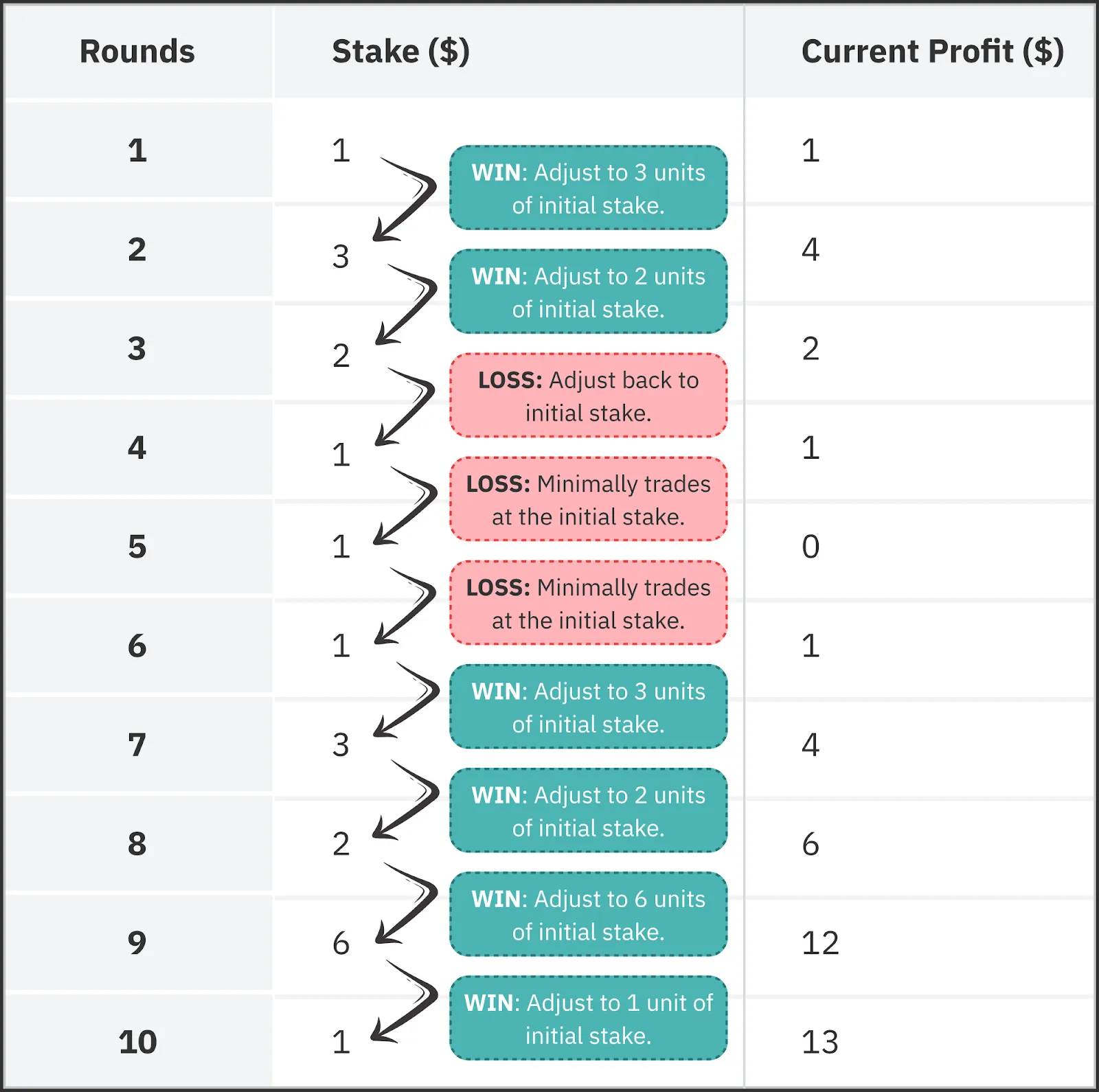
- Start with the initial stake. Let’s say 1 USD.
- If the trade is successful, this strategy will automatically adjust your stake to 3 units of your initial stake for the next trade. In this case, the stake adjustment is 3 units, and the initial stake is 1 USD Hence, the next trade will start at 3 USD.
- If the second trade is also successful, your stake will adjust to 2 USD or 2 units of the initial stake for the next trade.
- However, if any trade results in a loss, your stake will reset back to the initial stake of 1 USD for the next trade. In the example above, the third trade results in a loss, which is why the stake resets to the initial stake of 1 USD for the next trade.
- Upon reaching the initial stake, if the next trade still results in a loss, your stake will remain at the initial stake of 1 USD. This strategy will minimally trade at the initial stake. Refer to the fourth and fifth trades.
- If consecutive successful trades were to happen, the stake would follow a sequence of adjustments from 1 to 3, then 2, and 6 units of initial stake. After 4 consecutive successful trades, it completes one cycle and then the strategy will repeat itself for another cycle. If any trade results in a loss, your stake will reset back to the initial stake for the next trade.
Breakdown of the 1-3-2-6 strategy
The 1-3-2-6 strategy is designed to capitalise on consecutive successful trades while minimising losses during losing streaks. The rationale behind this strategy lies in statistical probabilities, with adjustments to stake sizes based on the perceived likelihood of success.
There is a higher likelihood of success in the second trade after one successful trade. Hence, the stake adjusts to 3 units in the second trade. In the third trade, the stake adjusts to 2 units due to a lower probability of a successful trade. If the third trade is also successful, the strategy then allocates all the previous gains (a total of 6 units of initial stake) into the fourth trade with the aim of doubling the potential profits.
If the fourth trade results in a positive outcome, the strategy helps achieve a total gain of 12 units. However, it is crucial to exercise caution, as the risk can escalate quickly with this strategy, and any loss in the fourth trade forfeits all previous gains.
Profit and loss thresholds
Deriv Bot offers risk management tools with profit and loss thresholds. You’ll be able to set these limits to secure potential profits and limit potential losses. This means that the trading bot will automatically stop when either the profit or loss threshold is reached. For example, if you set the profit threshold at 100 USD and the strategy exceeds 100 USD of profit from all trades, then the bot will stop running.
Summary
The 1-3-2-6 trading strategy may offer substantial gains but also comes with significant risks. Each stake is independent, and the strategy does not increase your chances of successful trades in the long run. If you encounter a series of losses, the strategy can lead to significant losses.
This is why it’s important to assess your risk tolerance and practise with a demo account before trading with real money.
Sign up for a demo trading account. You’ll be able to practise risk-free with virtual funds, explore how the profit and loss thresholds work, and understand how the 1-3-2-6 trading strategy works before upgrading to real-money trading.

How the Reverse Martingale strategy works in Deriv Bot
Learn when to apply the Reverse Martingale strategy, its key rules and logic for trade sizing, when to reset orders, and more.
Imagine being able to maximise the potential to multiply profits with successful trades. Enter the Reverse Martingale strategy.
With the aim of helping to secure potential profits from consecutive successful trades, this trading strategy increases your stake after each successful trade and resets to the initial stake for every losing trade.
In this article, we explore the Reverse Martingale strategy available on Deriv Bot, a versatile trading bot designed to trade assets such as forex, commodities, and derived indices. We will delve into the strategy’s core parameters and its application and provide essential takeaways for traders looking to use the bot effectively.
Key parameters
These are the trade parameters used in Deriv Bot with the Reverse Martingale strategy.
Initial stake: The amount that you are willing to place as a stake to enter a trade. This is the starting point for any changes in stake depending on the dynamic of the strategy being used.
Multiplier: The multiplier used to increase your stake if your trade is successful. The value must be greater than 1.
Profit threshold: The bot will stop trading if your total profit exceeds this amount.
Loss threshold: The bot will stop trading if your total loss exceeds this amount.
Maximum stake: The maximum amount you are willing to pay to enter a single trade. The stake for your next trade will reset to the initial stake if it exceeds this value. This is an optional risk management parameter.
How the Reverse Martingale strategy works

- Start with the initial stake. Let’s say 1 USD.
- Select your multiplier. In this example, it is 2.
- If the first trade is a successful trade, Deriv Bot will automatically double your stake for the next trade to 2 USD. Deriv Bot will continue to double the stake after every successful trade.
- If a trade ends in a loss, the stake for the following trade will be reset to the initial stake amount of 1 USD.
The objective of the Reverse Martingale strategy is to take advantage of consecutive successful trades and maximise potential profits from them. This strategy is beneficial only if there are consecutive successful trades.
Therefore, it is important to set a maximum stake to secure all the potential profits gained from a number of consecutive successful trades. If there is no maximum stake set, you could lose all the profits you have accumulated, including your initial stake. For example, if your goal is to maximise profits within 2 consecutive successful trades, you set a maximum stake of 2 USD, given your initial stake is 1 USD. Similarly, if your goal is to maximise profits within 3 consecutive successful trades, you set a maximum stake of 4 USD, given your initial stake is 1 USD.
Profit and loss thresholds
Deriv Bot allows setting profit and loss thresholds to manage risk. A profit threshold will automatically stop trading after reaching a preset amount to lock your profits. A loss threshold will stop trading after accumulating a preset loss amount. These thresholds secure profits and limit losses as part of your risk management. For example, with a 100 USD profit threshold, the bot will stop after exceeding 100 USD in total profit.
Summary
The Reverse Martingale strategy in trading may offer substantial gains but also comes with significant risks. With your selected strategy, Deriv Bot provides automated trading with risk management measures like setting initial stake, stake size, maximum stake, profit threshold and loss threshold. It's crucial for traders to assess their risk tolerance, practise in a demo account, and understand the strategy before trading with real money.
Sign up for a free Deriv demo account and try out this strategy on Deriv Bot. You’ll be able to practise risk-free with virtual funds. Once you’re ready to trade with real money, upgrade your demo account to a real Deriv account.
Sorry, we couldn’t find any results matching .
Search tips:
- Check your spelling and try again
- Try another keyword