
Results for

Boost your earning potential as a strategy provider on Deriv cTrader’s copy trading platform
Transform your trading skills into higher earnings by becoming a strategy provider on Deriv cTrader—our detailed guide will help you get started!
For a visual walkthrough, check out the video that complements this blog.
Have you ever wondered how top traders extend their market reach and earnings without committing extra hours to trading?
In the world of online trading, sharing your expertise can be just as profitable as applying it. Deriv cTrader offers a platform where experienced traders can do exactly that.
This guide will explore the significant benefits of becoming a strategy provider on Deriv cTrader and provide a clear, step-by-step path to help you achieve this status. By the end, you’ll know exactly how to leverage your trading skills to influence others and earn more.
How to earn from trading
Becoming a strategy provider on Deriv cTrader is not just about additional earnings; it’s about establishing your mark in the trading world. Here are some compelling reasons why you should consider this opportunity:
- Enhanced earning potential: Generate income not only from your trades but also from the success of those who follow your strategies.
- Increased market presence: As more traders follow your strategies, your influence and reputation in the market grow.
- Flexible income options: With a combination of performance, management, and volume fees, you control how you earn.
- Community contribution: Help less experienced traders by providing them with proven strategies, thus contributing to the overall health of the trading ecosystem.
- Low latency benefit: Trades can be copied almost instantaneously between brokers, ensuring that there is no delay in executing these trades.
Step-by-step guide on becoming a Deriv cTrader strategy provider
1. Enable strategy provision
First, log in to your Deriv cTrader account and select your main account under the Copy tab. Then, select the “Become a Strategy Provider” option to initiate the process.

2. Set your strategy details

Configuring your strategy details is crucial for attracting and retaining copy traders. Here’s what you need to specify:
- Strategy name: Choose a unique name for your strategy that reflects your trading style or philosophy. Once created, the name cannot be changed. This is the name that will appear in the list of available strategies to potential copy traders.
- Min investment: Determine the minimum investment required for copy traders. They cannot withdraw funds if it causes equity to fall below this minimum while copying your strategy, unless they stop copying.
- Performance fee: Determine the fee you will charge based on the net profits your followers generate. You can charge up to 30% of the investor’s net profit, based on the High-Water Mark (HWM) model.
- Management fee: Set a fee for the ongoing management of your followers’ funds, which can be up to 10% of the investor’s equity annually, charged daily. This fee compensates you for the time and effort involved in managing the strategy.
- Volume fee: Establish a fee per one million USD volume traded by your followers, with a cap of up to USD 10. This fee is tied to the trading activity under your strategy.
- Account for Fees: Choose a separate live trading account specifically for receiving any fees paid by your copy traders; this account must be different from your strategy account used for actual trading. You can use the same “Account for Fees” for multiple trading strategies.
- Allow copying for: Decide the accessibility of your strategy. You can opt for live accounts only, or extend it to both live and demo accounts. Note that this setting cannot be changed once your strategy is active, so choose wisely based on your target audience.
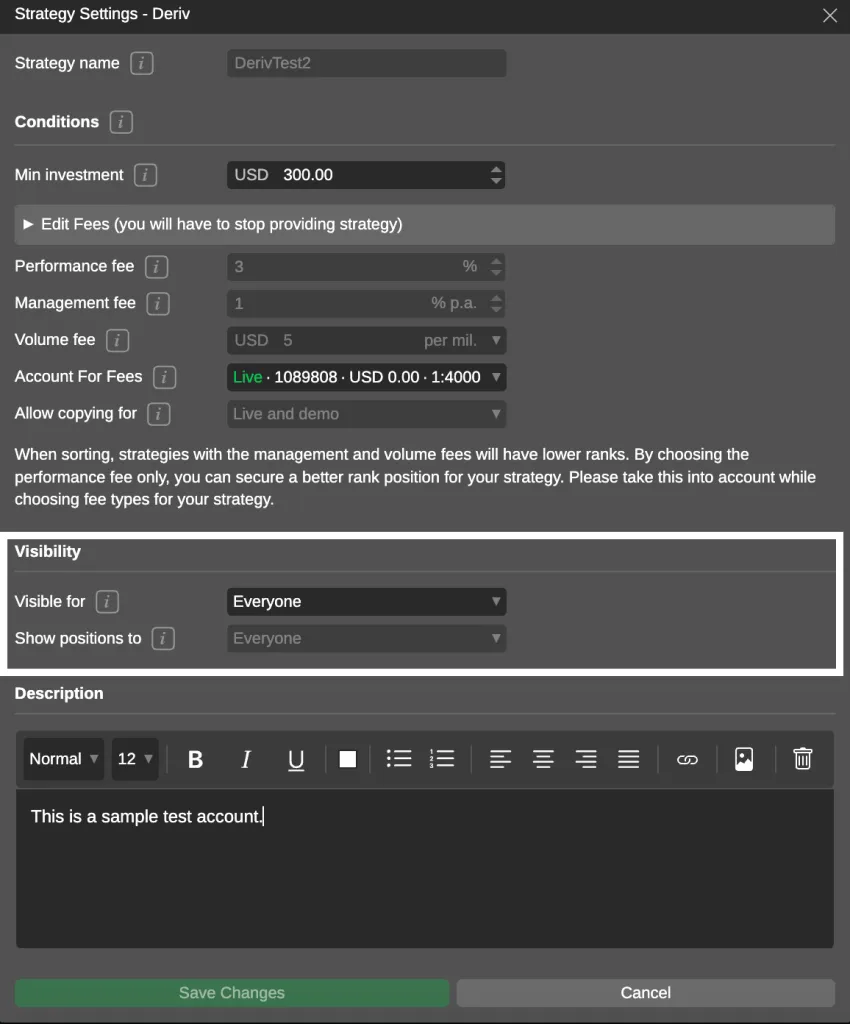
- Visibility:
- Visible for: Select who can see and subscribe to your strategy. You have the option to make it visible to everyone or only to traders who have a specific invitation link.
- Show positions to: Choose who can view your open positions. The options are everyone, only your investors, or no one. This helps in maintaining the desired level of transparency and privacy.
- Description: Craft a compelling description of your strategy. Utilize the formatting panel to enhance the text, add images, and include links that provide more insights or evidence of your strategy’s effectiveness. This description will play a key role in convincing potential investors of the value and reliability of your strategy.
Once all details are set and you’re ready to share your strategy with the world, click on ‘Become a Strategy Provider‘ to confirm your action and officially start your journey as a strategy provider on Deriv cTrader.
3. Publish your strategy
Once everything is set, publish your strategy on the platform. This will make it visible to potential followers and mark the beginning of your journey as a strategy provider.

Promoting your strategy on cTrader
Once your strategy is live, promotion becomes key to attracting copy traders. Deriv cTrader offers several tools to effectively market your strategy:
- Set visibility preferences: Configure who can copy your strategy (live/demo or live accounts only) and who can view your open positions (everyone, only investors/copy traders, or no one) in “Strategy Settings” before starting.
- Invite copy-traders: Use the “Invite link” in the ‘Promotion’ section to distribute a direct link to your strategy. This link attributes any new copy traders to you.
- Embed your strategies: Use the HTML iframe code from the “Embedded Strategy Application” tab to embed your strategy on your website, avoiding redirects and helping convert leads into copy traders.
- Share your personal profile: Customize and promote your strategies through your personal profile page, sharing achievements and contact details. Use the “Profile Link” in your social media strategy.
- Share the access link: Provide live trading statistics to potential copy traders with the “Investor Access link”, enhancing credibility and trust.

Leverage your trading expertise with one of the top brokers that offer copy trading
Becoming a strategy provider on Deriv cTrader is a strategic move that can expand your trading activities into a profitable venture. By setting up a comprehensive strategy and allowing others to follow your trades, you amplify your impact in the trading world while enhancing your earnings.
Are you ready to elevate your trading career? Create a trading account and set up your strategy provider profile on Deriv cTrader to unlock a new world of opportunities!
.webp)
Gold price forecast 2024: how high could Gold go?
Gold experienced a surge, testing USD 2475 at the start of the London session on Wednesday last week. This surge reinforced its reputation as a preferred safe-haven asset during times of economic uncertainty. The Federal Reserve’s hints at potential rate cuts and recent political developments have significantly influenced market sentiment, pushing gold prices to new heights.
Gold prices have been on the rise
This year, gold has risen by over 20%, driven by expectations of Federal Reserve rate cuts, geopolitical tensions, and substantial central bank purchases. On Monday, Federal Reserve Chair Jerome Powell stated that the Fed would not wait for inflation to reach the 2% target before implementing rate cuts, acknowledging the delayed effects of policy changes.
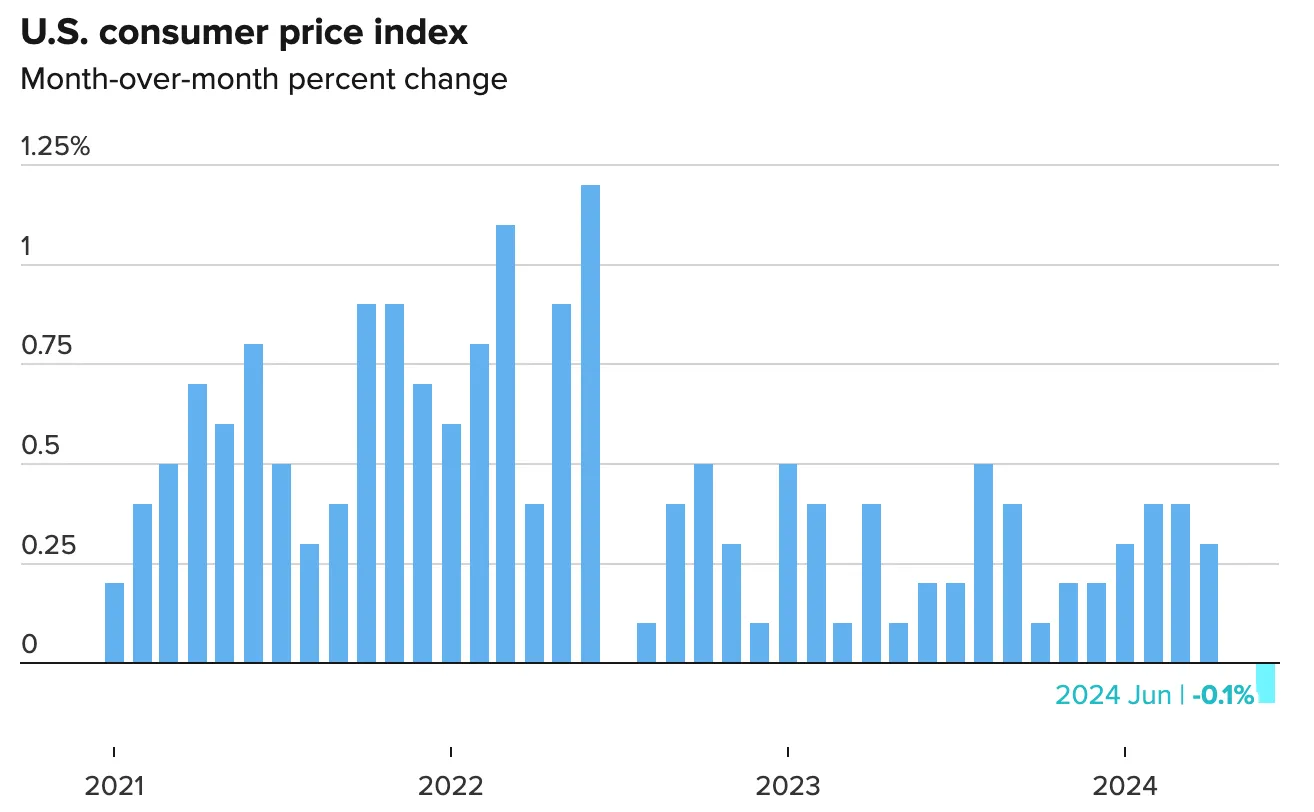
Powell’s statement, along with a 0.1% month-to-month decline in the June consumer price index, has strengthened market confidence in upcoming rate cuts.
According to the CME FedWatch tool, traders are now almost certain of a rate cut in September. Analysts at JPMorgan have noted that the anticipation of lower interest rates enhances gold’s appeal. As a non-interest-bearing asset, gold tends to perform well when interest rates fall. JPMorgan forecasts that gold prices could reach USD 2,500 per ounce by the fourth quarter of 2024, driven by increased investor demand through futures and ETF holdings.
Why is gold price rising?
Daniel Hynes, a senior commodity strategist at ANZ, pointed out that signs of slowing inflation and weak economic data have triggered the recent move in gold prices. Vivek Dhar from the Commonwealth Bank of Australia also emphasised gold’s resilience, predicting that prices could surpass USD 2,500 per ounce by the end of the year.
The upcoming US election has also impacted gold’s price movements. A potential second term for Donald Trump, with his tariff and tax policies, is seen as a factor that could increase inflation and widen the budget deficit. UBS analysts have suggested that political uncertainty could lead to market volatility, further boosting gold’s attractiveness as a safe-haven asset.
Divergent moves for copper and oil prices
While gold prices have reached record highs, this trend is not mirrored across all commodities, presenting a challenge for traders. Pro-cyclical commodities like copper and oil, which typically thrive in a healthy economy, have seen price declines. This divergence indicates underlying global economic troubles, with investors turning to gold amid fears of instability.
Copper, often considered a barometer of economic health due to its extensive use in construction and manufacturing, is not trending up like gold. Similarly, oil prices have been lacklustre, signalling that while investors hedge with gold, confidence in overall economic growth remains unsteady. For traders, this presents a nuanced landscape: gold’s strong performance suggests caution, while the underperformance of pro-cyclical commodities points to deeper economic issues that could affect broader market strategies.
Gold’s rise suggests increasing investor concern about the global economic outlook. The metal’s appeal as a safe-haven asset is particularly strong during uncertain times, providing a hedge against economic turbulence and inflationary pressures.
Despite worrying economic indicators, US equity investors remain optimistic. They believe the economic situation is “bad enough” to justify supportive monetary policy from the Federal Reserve, such as lower interest rates, but not so dire as to trigger a major economic crisis. This delicate balance has been termed a “Goldilocks economy”—neither too hot nor too cold. However, this equilibrium is fragile and may not last.
Several significant economic data releases are expected on Wednesday, including inflation figures from New Zealand, the UK, and the Eurozone, as well as US housing and industrial production data. These reports will provide further insights into the global economic situation and could influence gold prices and investor sentiment.
As we move through 2024, many traders will closely monitor Gold’s price trajectory. With geopolitical tensions, economic instability, and potential rate cuts on the horizon, gold could reach new record levels. Analysts’ predictions vary, with some forecasting prices well above USD 2,500 per ounce. However, the volatile nature of global markets and unforeseen economic developments will ultimately dictate just how high gold can climb in the coming months.
XAU/USD analysis: Gold’s technical outlook
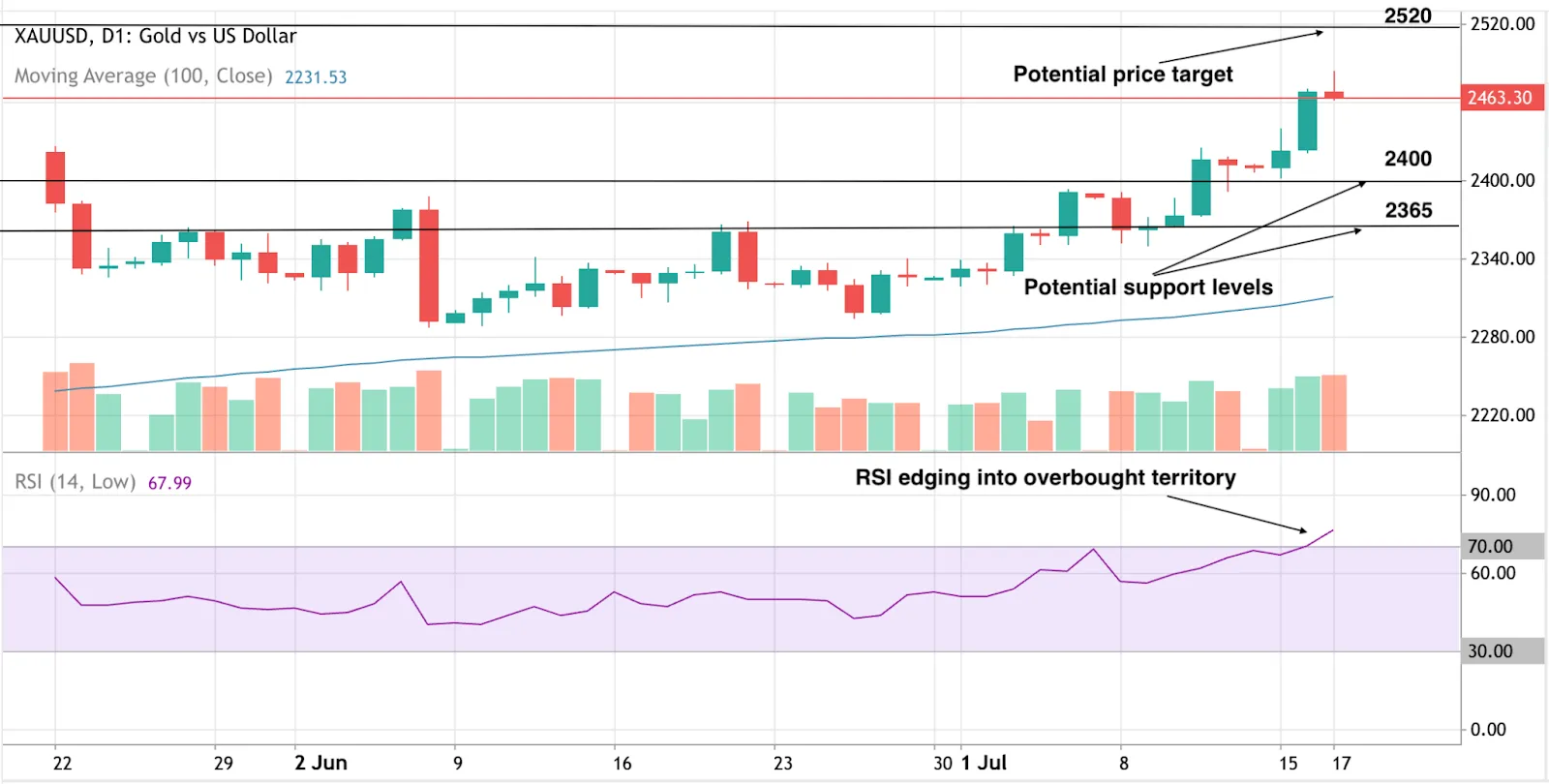
At the time of writing, Gold’s path towards USD 2500 appears to be clear, with bullish signs evident on the daily chart. Prices are well above the moving average, and the RSI is rising sharply, indicating strong upward momentum. However, the RSI is now past 70 into overbought territory, hinting at the possibility of a slowdown.
Buyers aiming to breach USD 2,500 and move into uncharted territory could find it difficult to surpass the USD 2,520 psychological high. On the downside, sellers could find support at the USD 2,400 support and resistance level, with a further move down likely to be held at the USD 2,365 psychological support level.
As for now, you can get involved and speculate on CFDs with a Deriv MT5 account. It offers a list of technical indicators that can be employed to analyse prices. Log in now to take advantage of the indicators, or sign up for a free demo account. The demo account comes with virtual funds so you can practise analysing trends risk-free.

Bitcoin’s balancing act: Weighing sell-offs against a potential crypto bull run
Bitcoin’s price experienced a recovery on Wednesday 10 July, bouncing back from recent lows as bargain hunters stepped in to take advantage of lower prices. The temporary weakening of the dollar also provided some support to the cryptocurrency. Despite BTCs upward movement, concerns remain due to potential selling pressure from the upcoming release of Bitcoin by Mt. Gox, a defunct crypto exchange, and ongoing sales by the German government. The uncertainty surrounding U.S. interest rate policy also contributes to the overall apprehension in the market.
Current cryptocurrency market trends
Following a sharp decline below the $58,000 mark in early July, a two-month low, Bitcoin has recently recovered. This sharp decline was triggered by Mt. Gox initiating reimbursements to clients, flooding the market with a substantial amount of Bitcoin. The German government’s liquidation of Bitcoin holdings further exacerbated the downward pressure.
Despite these challenges, there are glimmers of hope for a potential rebound. Tron founder Justin Sun’s offer to purchase a large sum of Bitcoin from the German government could alleviate some of the selling pressure. Additionally, social media sentiment indicates that many investors view the current dip as a buying opportunity, suggesting continued demand for the cryptocurrency.
Historical BTC trends also provide some optimism. July has traditionally been a strong month for Bitcoin, with the possibility of a price rebound later in the month. Moreover, analysts point to sufficient market liquidity and past precedents, such as the Silk Road case, to suggest that the market can absorb the current selling pressure.
Looking further ahead, some analysts believe that Bitcoin’s current price cycle has not yet peaked. They predict that Bitcoin could surpass its all-time high of $73,700 later this year. This optimism is based on historical patterns observed in Bitcoin’s price cycles, the upcoming launch of Ethereum ETFs and similar products in the U.S., and the potential for increased retail activity once the all-time high is breached.
While the recent price fluctuations have undoubtedly created uncertainty, the overall sentiment remains cautiously optimistic. Analysts like Kraken’s Thomas Perfumo and Gemini’s Vijay Ayyar highlight that key indicators of a market peak have not yet materialised, suggesting potential for further growth. However, the market remains vigilant, keeping a close eye on ongoing liquidations and their potential impact on Bitcoin’s price trajectory.
BTC technical analysis: Is a significant bounce coming?
At the time of writing, BTC appears to be recovering after an early July drop, currently hovering around the $58,500 mark. A look at technical indicators on the daily chart shows that sellers still hold control with prices below the 100-day EMA. The sharp rise in RSI towards 50 suggests a potential shift into neutral territory, possibly providing momentum for buyers. Buyers could face a hurdle at the $60,000 psychological resistance level. Conversely, a further move down will likely find support at the $55,800 mark, with a further move down likely to be held around the $53,400.

As for now, you can get involved and speculate on CFDs with a Deriv MT5 account. It offers a list of technical indicators that can be employed to analyse prices. Log in now to take advantage of the indicators, or sign up for a free demo account. The demo account comes with virtual funds so you can practise analysing trends risk-free.

Solana’s price prediction: Is SOLUSD’s dip a major buy opportunity?
In the ever-evolving world of cryptocurrency, Solana (SOL) has captured significant attention. Known as one of “crypto’s big three,” Solana’s potential approval for spot exchange-traded funds (ETFs) in the United States could be a game-changer. A recent report from GSR Markets indicates that this move could catapult the price of SOL to nine times its current value. With the crypto market showing mixed price action recently, could Solana be on the brink of a major surge?
Current market trends and Solana’s performance
Solana has experienced a bearish trend recently, with its price dropping since the beginning of the month. It hit a 30-day low below $123 against the dollar, a significant decline from its monthly high of $175. However, some analysts remain optimistic about Solana’s long-term prospects. According to Bitcoin expert Crypto Patel, a ‘cup and handle’ formation on the Solana/TetherUS 1-week chart suggests Solana has the potential to hit $1,000 in the future.
A 27 June report by GSR Markets highlighted the potential of spot Solana ETFs to significantly boost SOL’s price. GSR’s analysis suggests that if these ETFs capture 14% of the flows seen by spot Bitcoin ETFs, Solana’s price could increase by 8.9 times, exceeding $1,320. This estimate is based on the assumption that the relative market cap size of Solana would attract similar investment flows.
The GSR Markets report also outlined different scenarios for Solana’s price trajectory:
Blue Sky Scenario: Solana’s price could rise from $149 to over $1,320, with its market cap soaring to $614 billion.
Baseline Scenario: If Solana ETFs capture 5% of Bitcoin ETF flows, SOL’s price could rise by 3.4 times.
Bear Scenario: With only 2% of Bitcoin ETF flows, SOL’s price might still see a 1.4 times increase.

Analysts note that these projections could be even more optimistic if staking rewards are included in the spot Solana ETFs, though current regulations do not allow staking in approved spot Ether ETFs.
Solana’s regulatory hurdles and market sentiment
Despite GSR’s positive outlook, regulatory challenges remain. The U.S. Securities and Exchange Commission (SEC) and its chair, Gary Gensler, have reportedly labelled SOL as a security in lawsuits against major exchanges like Binance and Coinbase. This classification complicates the pathway to approval for spot Solana ETFs, unlike the now-approved spot Bitcoin and Ether ETFs.
Bloomberg ETF analyst Eric Balchunas suggests that a change in the U.S. president and the SEC chair might be necessary for a spot Solana ETF to be seriously considered. However, there is momentum in North America, as seen with VanEck’s recent filing for a spot Solana ETF and cryptocurrency asset manager 3iQ’s application in Canada, marking a North American first.
As Solana navigates its current bearish trend, the potential approval of spot Solana ETFs could mark a significant turning point, making the current downturn a major buy opportunity. At the time of writing, SOL appears to be edging down towards the $140 price point, with prices below the 100-day moving average and RSI pointing down at the 50 midline – hinting that bears are in control at the moment.

Sellers could encounter a hurdle at the $137.73 price point. A further move down could find support at the $121.43 support. Conversely, a price bounce could encounter resistance at the $159.60 price level.
As for now, you can get involved and speculate on CFDs with a Deriv MT5 account. It offers a list of technical indicators that can be employed to analyse prices. Log in now to take advantage of the indicators, or sign up for a free demo account. The demo account comes with virtual funds so you can practise analysing trends risk-free.

Commodities trading basics: How to trade on the raw materials that power our world
The world of commodities trading offers a dynamic alternative to traditional stock and bond investments. Here you get to discover how fortunes are built on the raw materials that fuel our planet.
From the oil that powers industries, the gold that safeguards wealth, to the coffee beans that start your day, commodities provide a unique path to potential profits and portfolio diversification.
So, what exactly are these commodities that hold such power? And how can you, the aspiring trader, tap into this dynamic market? Let’s delve deeper and unpack the world of commodities trading, breaking down the essential building blocks — the commodities themselves — and the strategies used to navigate their ever-shifting prices.
What are commodities and what is commodities trading?
Commodities are raw materials or agricultural products traded on global exchanges. These standardised goods, such as oil, gold, or wheat, are interchangeable within their specific category. Unlike stocks representing company ownership, commodities are tangible assets whose value fluctuates based on supply and demand dynamics.
Commodities trading involves buying and selling these assets to capitalise on price movements driven by various factors, including weather events, geopolitical shifts, and economic trends.
Commodity trading strategies
Speculation: Riding the price waves
Speculation is a key strategy in commodities trading, where traders capitalise on short-term price fluctuations. They essentially make educated guesses, aiming to buy commodities they predict will rise in value and then sell them for a profit. Conversely, they might sell commodities they expect to decline in price, benefiting by buying them back at a reduced cost.
Tools of the speculative trade
There are two main techniques that speculative traders can utilise:

An example of speculative trading in action is a trader noticing a rise in global oil production and speculating that oil prices will decline. They could sell oil CFDs, hoping to repurchase them later at a lower price.
Hedging in commodity trading: Locking in profits
Unlike speculation, which capitalises on price volatility, hedging is a risk management strategy used primarily by businesses directly involved in commodities.
It aims to safeguard profit margins from unforeseen price swings, acting as a buffer against market unpredictability.
In practice, hedging involves entering into options or futures contracts that counteract the undesirable outcome a business wants to avoid. Let’s explore two scenarios illustrating how hedging works.

Hedging therefore helps traders get a degree of certainty about costs and revenue, which makes decision-making easier. It also insulates against unexpected price swings that may cause losses while also helping to avert cash flow disruptions.
Diversification: Expanding into the commodities market
Think of your investment portfolio as a three-legged stool. If one leg weakens (stocks decline), the other two legs (bonds and commodities) can offer support and help maintain balance.
The main idea here is that commodities often have a low correlation to stocks and bonds. This means that when stocks or bonds experience a downturn, commodities might perform differently, potentially offsetting losses in other parts of your portfolio.
There are multiple ways to incorporate commodities into your portfolio

Strategies are great on paper, but how do you practically buy or sell commodities? Trading platforms are the answer. Let’s explore the different platforms available and grasp the various contract types they offer.
Where to trade commodities
Trading platforms are essential tools for accessing the market. Deriv is a renowned platform that gives traders access to real-time data, charting capabilities, and order types needed to execute your CFD or Option commodities trades.
Major commodity classes

Risks of Commodities CFD Trading

How to start trading commodities
If you’re considering commodities trading, here’s what to do:

Important note: Commodities trading carries inherent risks. Before investing, thoroughly research the markets and consult with a financial advisor if needed.
You can access commodities like Gold, Oil, Gas, Silver, and others with a Deriv MT5 account. It offers a list of technical indicators that can be employed to analyse prices. Log in now to take advantage of the indicators, or sign up for a free demo account. The demo account comes with virtual funds so you can practise analysing trends risk-free.

Apple stock forecast: Will it touch highs of $250 in 2024?
As Apple prepares for new product releases, can it compete with Google and Microsoft in AI and push its stock above $250? Read more.
While Microsoft remains on the up, touching highs of $450 at the time of writing, Apple stock is finding its footing after a pullback that saw it tumble from highs of $220, to lows of $207. As the AI arms race heats up, market analysts are scrutinising whether Apple can keep pace with the rapid advancements of tech giants Google and Microsoft and if its stock price can surpass its June all-time high to reach the $250 mark.
An AI partnerships perspective
Apple recently announced a deal with OpenAI that will enable millions of Apple users to access OpenAI’s service offerings. According to some analysts, this move, which will see Apple’s operating systems iOS, iPadOS, and macOS integrate ChatGPT’s language model later this year, marks a departure from Apple’s long-held closed ecosystem that has recently come under government scrutiny.
Under the deal, Apple’s Siri will gain the capability to surface answers from ChatGPT, while providing personalised recommendations and writing assistance across several apps. This enhancement is one of the deal’s highlights that could help boost revenue and engagement for the tech giant.
There’s also talk of the iPhone maker opening its doors to partnerships with more AI companies including some Chinese companies — in a market where Microsoft’s OpenAI chatbot is banned. This could further bolster the Apple Intelligence agenda, unveiled in early June, which seeks to differentiate the company from competitors by placing privacy at the core of its features.
A new product wave perspective
Beyond Apple Intelligence, which puts powerful generative models at the core of the iPhone, iPad, and Mac experience, the company is also looking to release new product offerings this September, according to MacRumors.
On the list of expected product releases are:
- iPhone 16: New Action and Capture buttons, vertically arranged cameras for spatial video, and a faster A18 chip.
- iPhone 16 Pro: Larger displays, Capture button, upgraded 48-megapixel Ultra Wide camera, and a 5x Telephoto camera on the smaller model.
- Apple Watch X: Redesigned, thinner body with magnetic band attachments, potential new health features like blood pressure and sleep apnea monitoring.
- New Apple Watch Ultra: Minor updates, likely focused on new health features.
- AirPods 4: Two models — one lower cost, one with Active Noise Cancellation. New design with shorter stems, upgraded USB-C charging case with built-in speaker for Find My.
These product offerings will likely generate significant interest from consumers later this year. Despite Apple’s successful diversification into the Apple Watch, AirPods, and services, the iPhone remains its most valuable product and the cornerstone of its revenue, contributing 52%. Direct iPhone earnings increased steadily from 2008 all the way to 2015, followed by up and down results in the subsequent five years. Revenues saw an uptick in 2021 and 2022 before experiencing a downturn in 2023.
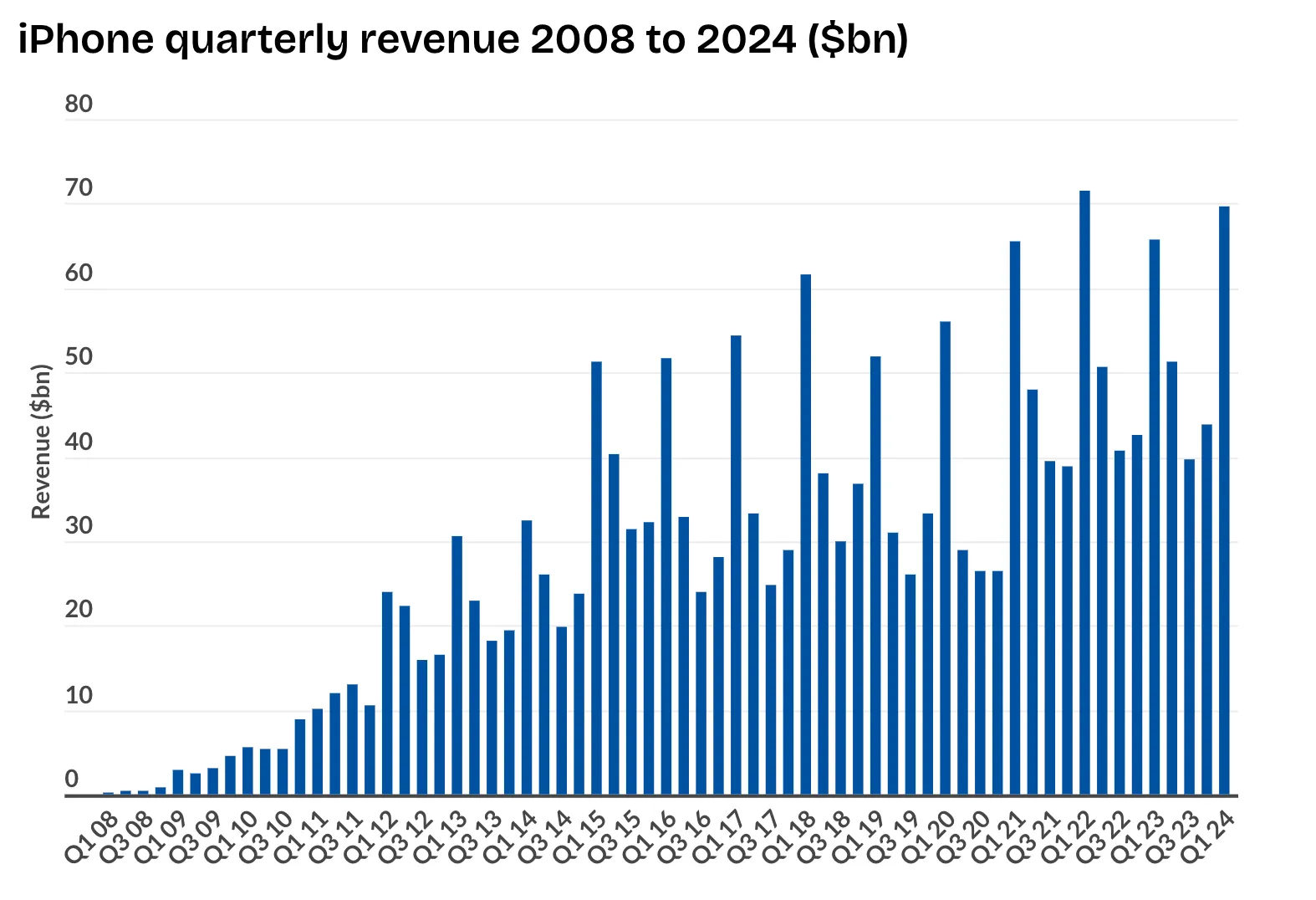
Some analysts believe that Apple’s new AI-integrated iPhones could help reinvigorate sales and help the company overcome quarterly revenue downturns caused by choppy consumer spending and resurging tech rivals. This could in turn help the company’s share price.
Apple stock performance: Could shares reach $250 by end of 2024?
Investment firm Evercore’s analysts have revised their Apple stock target from $220 to $250, citing optimism about the public’s reaction to Apple’s new AI iPhone product offerings. At the time of writing, the stock has seen a slight recovery from its recent downturn and is hovering around the $211 price point.
Analysts note that sentiment remains bullish, with prices elevated above the 100-day moving average. The RSI, edging up past the 70 mark into overbought territory, suggests that a slowdown could be on the way within the bullish cycle. Buyers could face a hurdle at the 217 mark, with a further move north likely to face a hurdle at the $220 psychological barrier.
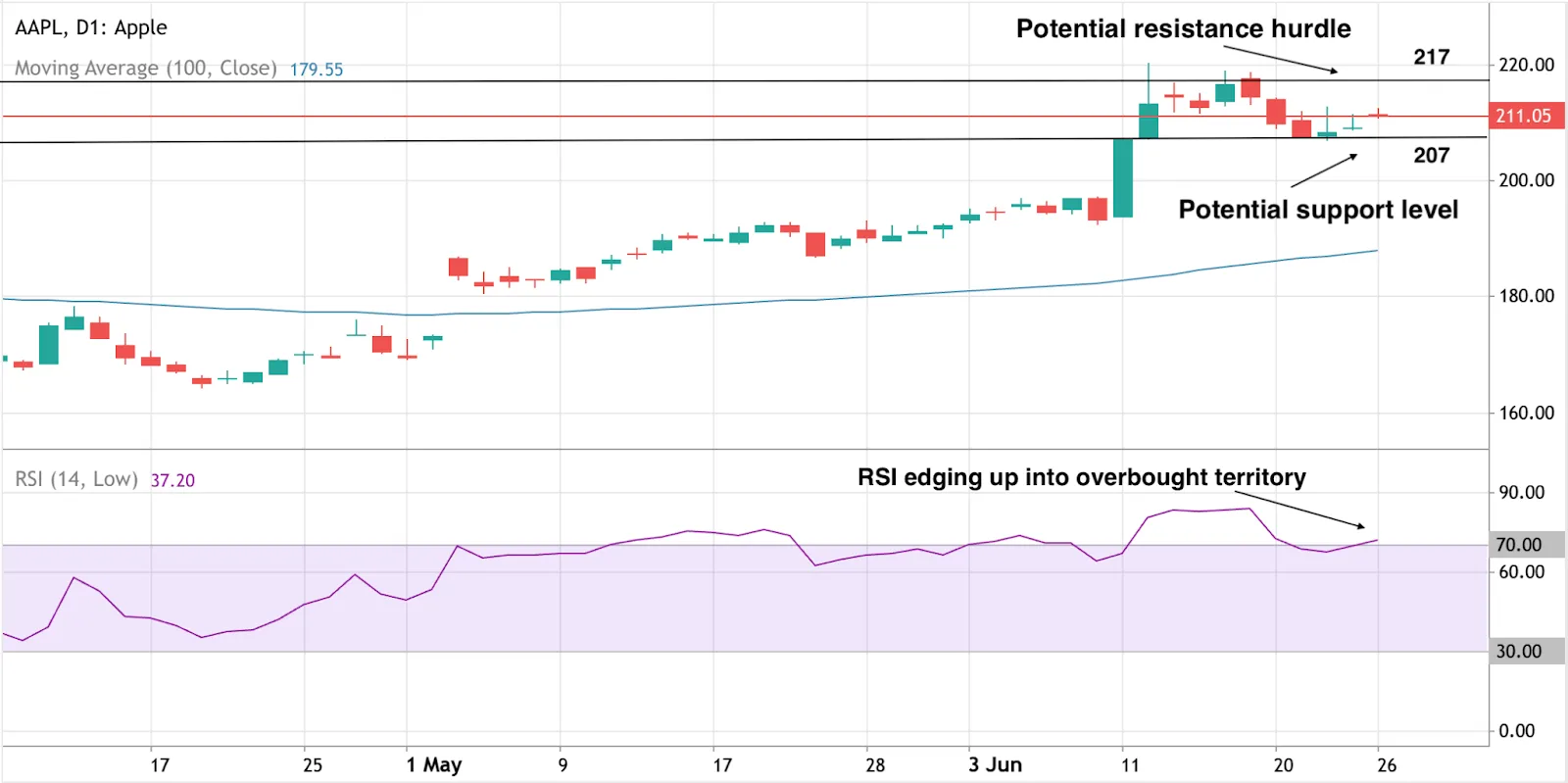
On the downside, prices could be held at the $207 psychological resistance level, with a significant drop likely to find support at the $193 psychological level, according to analyst projections.
You can get involved and speculate on the price of these two incredible assets with a Deriv MT5 account. It offers a list of technical indicators that can be employed to analyse prices. Log in now to take advantage of the indicators, or sign up for a free demo account. The demo account comes with virtual funds so you can practise analysing trends risk-free.
.png)
New: Multi Step Indices, a dynamic twist on Deriv’s Synthetic Indices
Gear up for strategic flexibility and lower volatility with the launch of Multi Step Indices! Find out more about this asset and what makes it unique.
The world of Synthetic Indices trading just got more interesting — we’re launching new Multi Step Indices on Deriv MT5 and Deriv cTrader!
Designed as an evolution of our Step Indices, the new Multi Step Indices expand your strategic options in the synthetic markets. These innovative offerings provide varying step sizes, simulate market movements with greater complexity and give traders more choice over volatility.
Let’s delve into the details of these dynamic new instruments.
What are Multi Step Indices?
Multi Step Indices build upon the concept of Step Indices, which move in fixed increments. Multi Step Indices, however, simulate market movements with varying step sizes.
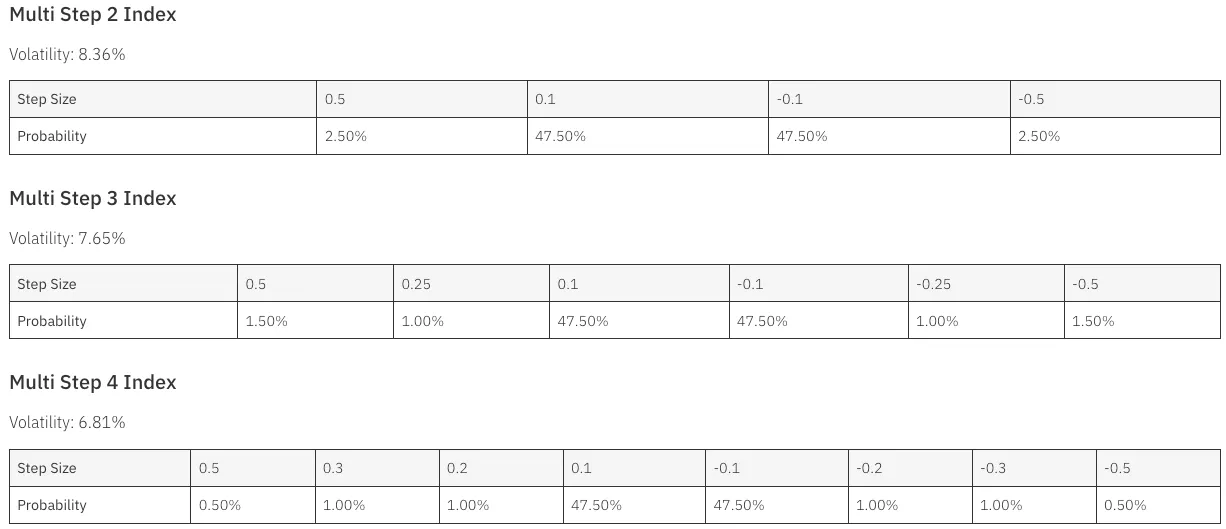
While predominantly moving in 0.1 increments, they also include less frequent movements of other sizes, introducing a more dynamic element to trading.
Like all Synthetic Indices, they operate independently of real-world financial markets.
Three new indices, three new opportunities
Three new Multi Step Indices are available, each offering symmetrical probabilities for various step sizes up and down:
Lower volatility for strategic trading
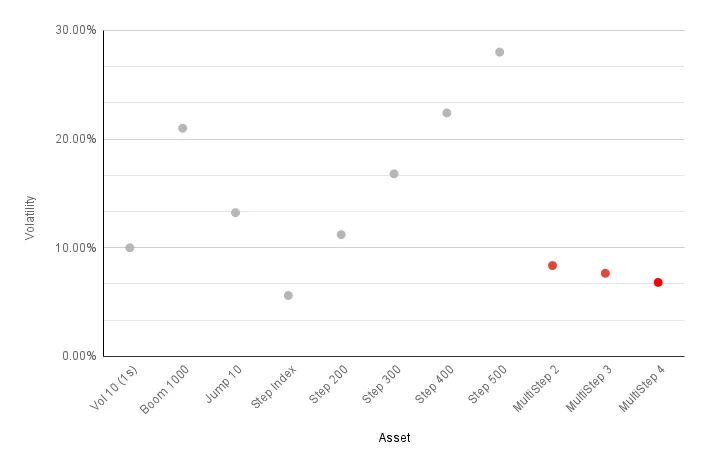
It’s important to highlight that Multi Step Indices generally exhibit lower volatility compared to other Synthetic Indices on Deriv, some of which can reach levels as high as 250%. This is illustrated in the volatility comparison plot below.
Trade Multi Step Indices today
Whether you’re aiming to diversify your portfolio or explore new trading strategies, these indices offer the flexibility to achieve your goals. Get your free practise trading account today and explore Multi Step Indices CFDs on Deriv MT5 and cTrader.

Migrate to Deriv Bot before Binary Bot retires
This bot import guide details how to migrate from Binary bot to Deriv Bot and also highlights this trading platform’s features and benefits.
Are you ready to take your automated trading to the next level? With Binary Bot’s retirement on the horizon, now is the perfect time to upgrade your trading experience by migrating to Deriv Bot. This article provides a step-by-step guide to migrating from Binary Bot to Deriv Bot, highlighting the benefits and features of Deriv Bot that can enhance your automated trading strategies.
Why migrate from Binary Bot to Deriv Bot?
As the digital trading landscape evolves, staying ahead of the curve is crucial for success. The upcoming retirement of Binary Bot on July 31, 2024, presents an opportunity to embrace a more advanced platform. Deriv Bot offers a range of benefits that can significantly enhance your trading experience:
- Seamless migration of existing strategies
- User-friendly interface for traders of all levels
- Access to pre-built strategies and custom XML uploads
- Expanded asset range for diverse trading opportunities
- Integrated educational tools to improve your skills
Let’s dive into the step-by-step process of transitioning from Binary Bot to Deriv Bot, ensuring you don’t miss a beat in your trading journey.
Step-by-step trading bot migration process
1. Importing your Binary Bot strategies
The first step in your migration journey is to import your existing Binary Bot strategies into Deriv Bot. Here’s how:
- Log in to Deriv Bot using your existing credentials
- Navigate to the “Bot Builder” tab
- Click “Import” to upload your Binary Bot strategy in XML format
This process allows you to maintain continuity in your trading approach while transitioning to the more advanced Deriv Bot platform.


2. Verifying and saving your automated trading strategies
After importing your strategies, it’s crucial to ensure they perform as expected in the new environment:
- Run your imported strategy to check its performance
- Click “Save” to download the strategy to a local or cloud drive
Saving your strategies locally or in the cloud eliminates delays when accessing them in the future, especially for complex algorithms that may take time to upload.


Exploring Deriv Bot’s advanced features
Deriv Bot isn’t just a replacement for Binary Bot; it’s an upgrade that offers a host of advanced features to elevate your trading game:
User-friendly interface
Deriv Bot boasts an intuitive design catering to novice and experienced traders. The streamlined interface makes it easy to:
- Create and modify trading strategies
- Monitor real-time performance
- Adjust parameters on the fly
Pre-built strategies
Jump-start your trading with six pre-built strategies available on the Deriv Bot platform. These ready-to-use algorithms provide a solid foundation for beginners or a starting point for more experienced traders to customise.
Extensive asset range
Expand your trading horizons with access to over 70 instruments, including:
- Global indices
- Forex pairs
- Precious metals
This diverse range of assets allows you to diversify your portfolio and explore new trading opportunities.
Integrated trading tools
Deriv Bot is committed to your success as a trader. Take advantage of the platform’s integrated resources:
- In-depth tutorials
- Instructional videos
- Comprehensive FAQs
- Strategy guides
These tools are designed to help you enhance your trading skills and make the most of the Deriv Bot platform.
Preparing for the Binary Bot’s retirement
With the Binary Bot platform set to retire, it’s essential to plan your migration well in advance. Here are some key steps to ensure a smooth transition:
- Start exploring Deriv Bot today to familiarise yourself with its features
- Begin migrating your strategies one by one, testing each thoroughly
- Take advantage of Deriv Bot’s educational resources to optimise your trading approach
- Reach out to customer support if you encounter any issues during the migration process
Embrace the future of automated trading with Deriv Bot
The transition from Binary Bot to Deriv Bot represents an exciting opportunity to elevate your automated trading strategies. By migrating to Deriv Bot, you’ll gain access to a more advanced, feature-rich platform to help you achieve your trading goals.
Don’t wait until the last minute – start your migration process today and experience the power of Deriv Bot for yourself. With its user-friendly interface, extensive asset range, and integrated tools, Deriv Bot is poised to become your go-to platform for automated trading success.
Ready to take the next step? Log in to your Deriv account and start exploring Deriv Bot now. The future of automated trading is here – don’t miss out!

Zero spread trading on Deriv MT5: A new era of transparent pricing
Trade with precision on Deriv MT5 with zero spread trading. Execute trades closer to market price with no spread and fixed commissions.
Deriv is excited to introduce the zero spread account, now available on the powerful Deriv MT5 platform. Trade your favourite financial assets and Synthetic Indices and experience a new level of transparency and cost-effectiveness.
What does zero spread mean for you?
Zero spread trading means there’s no difference between the buying (ask) and selling (bid) prices of an asset. With no spread to factor in, your trades are executed closer to the market price, giving you greater control over your entry and exit points. That means you can:
- Get the price you want: With zero spread, you buy or sell at prices as close as possible to the market price, not a slightly worse price due to the spread.
- Enter and exit trades faster: Because there’s no spread to wait for, your trades can be executed instantly at the market price, allowing for quicker reactions to price movements.
This particularly benefits high-frequency traders, scalpers, and those using automated trading strategies.
Deriv MT5: Your zero spread trading hub
Step into zero spread trading with Deriv MT5. Our advanced platform offers a seamless, intuitive experience loaded with the tools you need to analyse markets, execute trades, and manage risk effectively.
Deriv MT5 offers a wide range of synthetic and financial instruments for zero spread trading. With access to major and minor forex pairs, commodities, stock indices, and more, you can maximise your trading potential with leverage of up to 1:1000. Here’s a list of all the assets available to trade with your zero spread account.
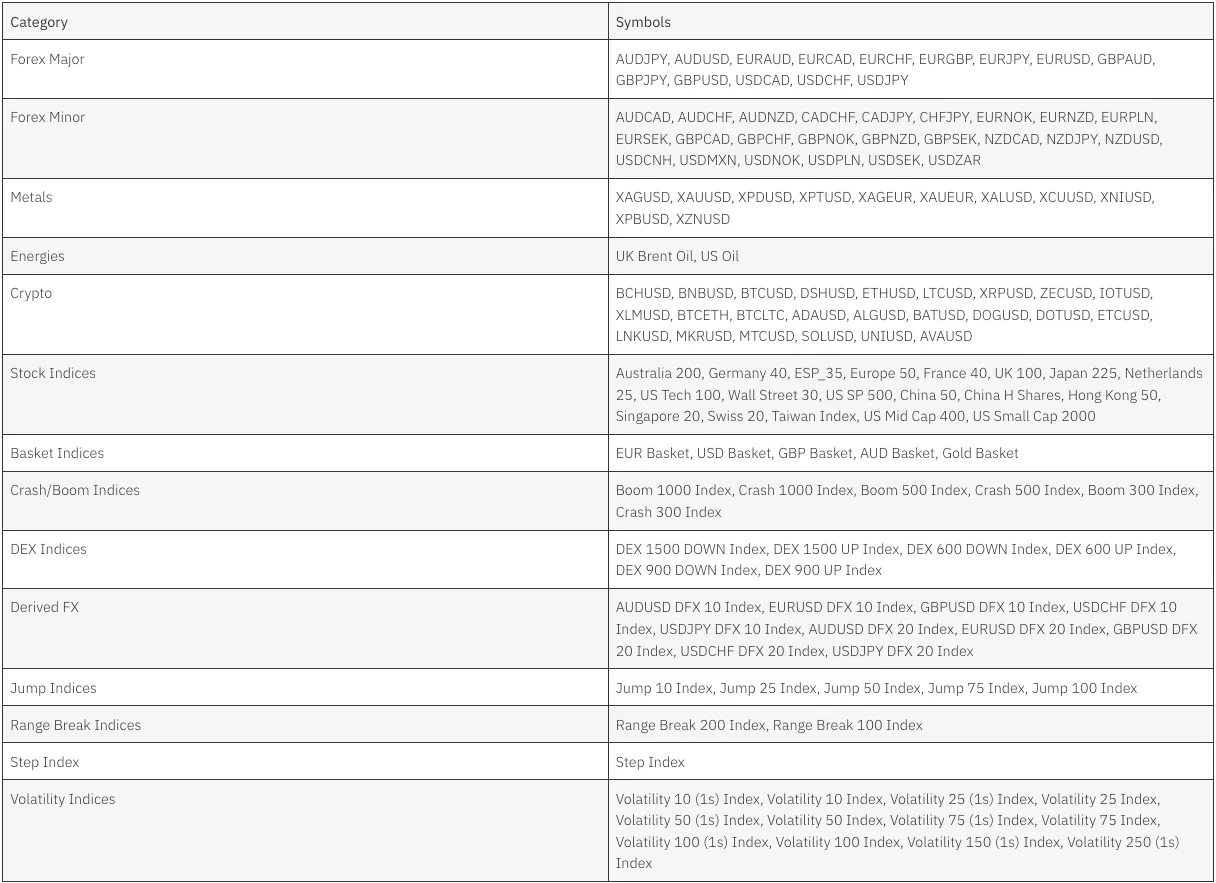
Whatever your trading preferences, you’ll find ample opportunities on Deriv MT5.
Why choose Deriv for zero spread trading?
- Reduced trading costs: Eliminate spread costs and potentially increase your profitability.
- Transparent pricing: Gain direct access to market prices for precise trade execution.
- Fixed commissions, not spreads: Enjoy predictable trading costs with fixed commissions, regardless of market volatility.
- No spread widening during volatility: Trade confidently, knowing your costs won’t increase unexpectedly during volatile market conditions.
Embrace the future of trading with Deriv’s zero spread account. Experience transparent pricing, predictable costs, and an intuitive trading experience on Deriv MT5. Open your zero spread account today and explore all the opportunities that await you.
Important note: Trading involves risk, and the zero spread account is not suitable for all traders. Developing a sound trading strategy is crucial before engaging in zero spread trading.
Sorry, we couldn’t find any results matching .
Search tips:
- Check your spelling and try again
- Try another keyword