
Results for
Tariffs impact on markets 2025: Crypto and Gold outlook
As global trade policies shift, markets are bracing for impact.
As global trade policies shift, markets are bracing for impact. The latest wave of tariffs, spearheaded by the U.S., is stirring uncertainty across sectors. While some view this as a necessary step toward economic protectionism, others warn of long-term repercussions.
Beyond immediate stock market reactions, these policies could reshape global finance-including the crypto landscape.
A market in flux: Volatility and investor sentiment
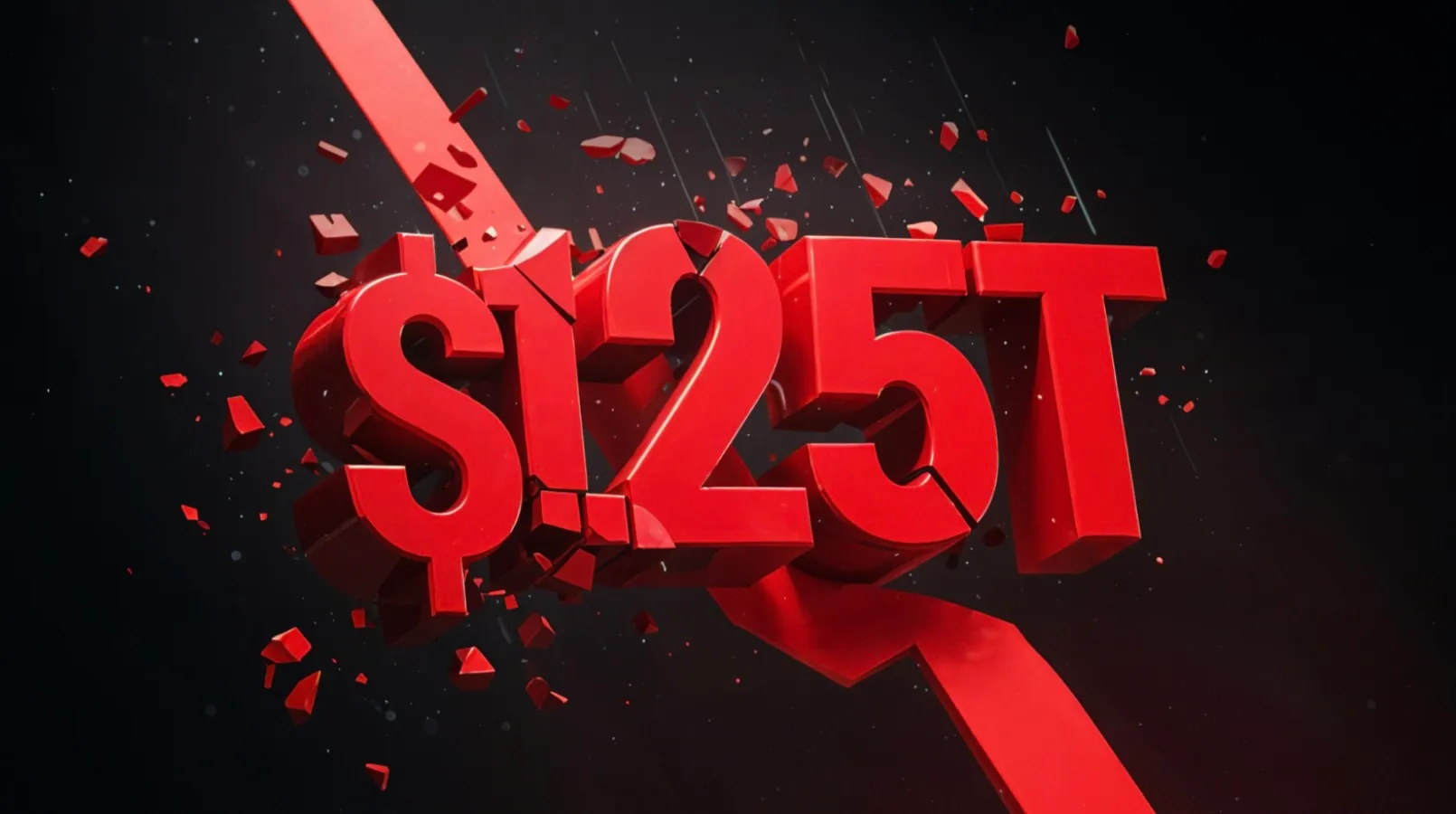
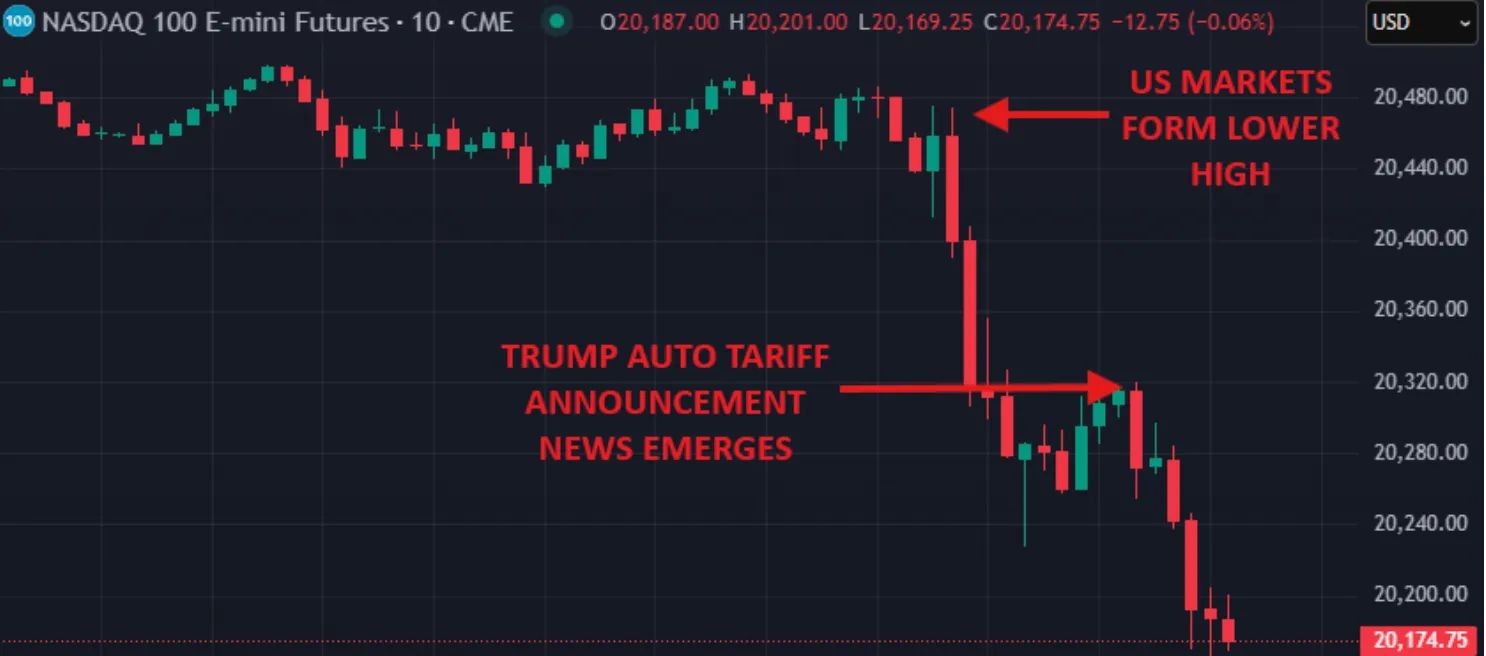
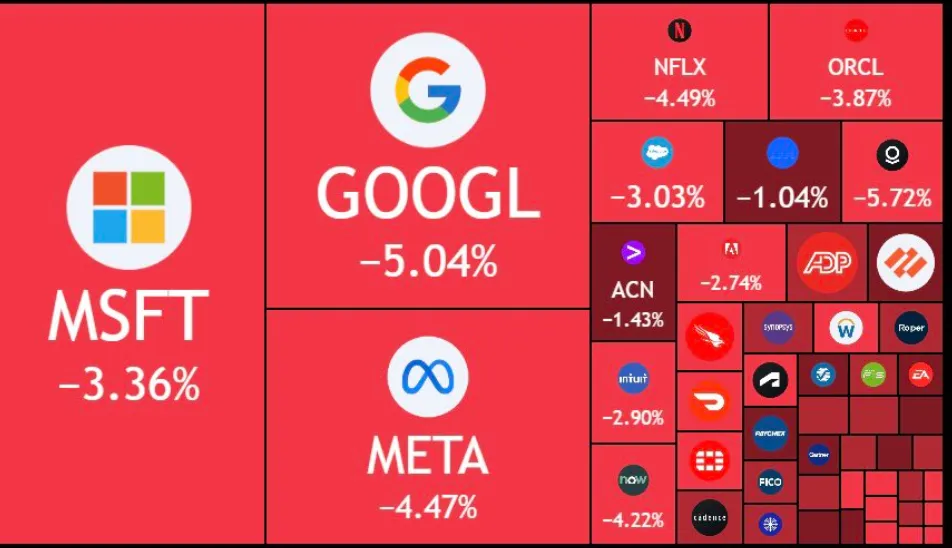
Recent policy announcements have sparked significant market swings. Initial optimism over potential tariff exemptions quickly gave way to concerns over broad-based levies. As a result, major tech stocks have faced sharp declines, with over $400 billion in market value erased in a matter of days.
Institutional investors are reacting swiftly-foreign withdrawals from U.S. equity funds have surged, marking one of the largest recorded exits. Meanwhile, retail traders continue to “buy the dip,” a classic divergence in sentiment that raises questions about who has the better read on the market.
The intersection of trade policy and crypto
Tariffs may seem unrelated to cryptocurrency at first glance, but the connection is growing. Bitcoin’s correlation with tech stocks means broader market uncertainty could spill over into digital assets. Historically, when risk-off sentiment dominates, Bitcoin and other cryptocurrencies tend to experience heightened volatility.
Additionally, semiconductor tariffs present a unique challenge for the crypto mining industry according to experts. Higher costs for mining equipment could lead to reduced network participation, lower hash rates, and potential selling pressure from miners looking to cover expenses.
While this may cause short-term turbulence, it also highlights the evolving dynamics between government policies and decentralized finance.
Emerging trends: Bitcoin as a national reserve asset?
Despite these challenges, there are signs of a shifting perspective on Bitcoin at the sovereign level. Reports suggest that Brazil is exploring the possibility of adding Bitcoin to its national reserves, a move that could set a precedent for other economies. Pedro Giocondo Guerra, speaking on behalf of Brazil’s administration, recently emphasized Bitcoin’s role as “the gold of the internet.”
Brazilian lawmakers are considering a proposal that would allocate up to 5% of the country’s foreign reserves to Bitcoin. Given Brazil’s $2.2 trillion economy, this could be a significant step toward mainstream government adoption of digital assets.
Beyond crypto, the macroeconomic implications of ongoing tariff policies remain a key concern. Higher import costs could translate into persistent inflationary pressures, complicating central bank strategies. The Federal Reserve, which had signaled potential rate cuts in 2025, may need to reconsider its stance if inflation proves more resilient than expected.
Technical insight : Shorter-term price outlook
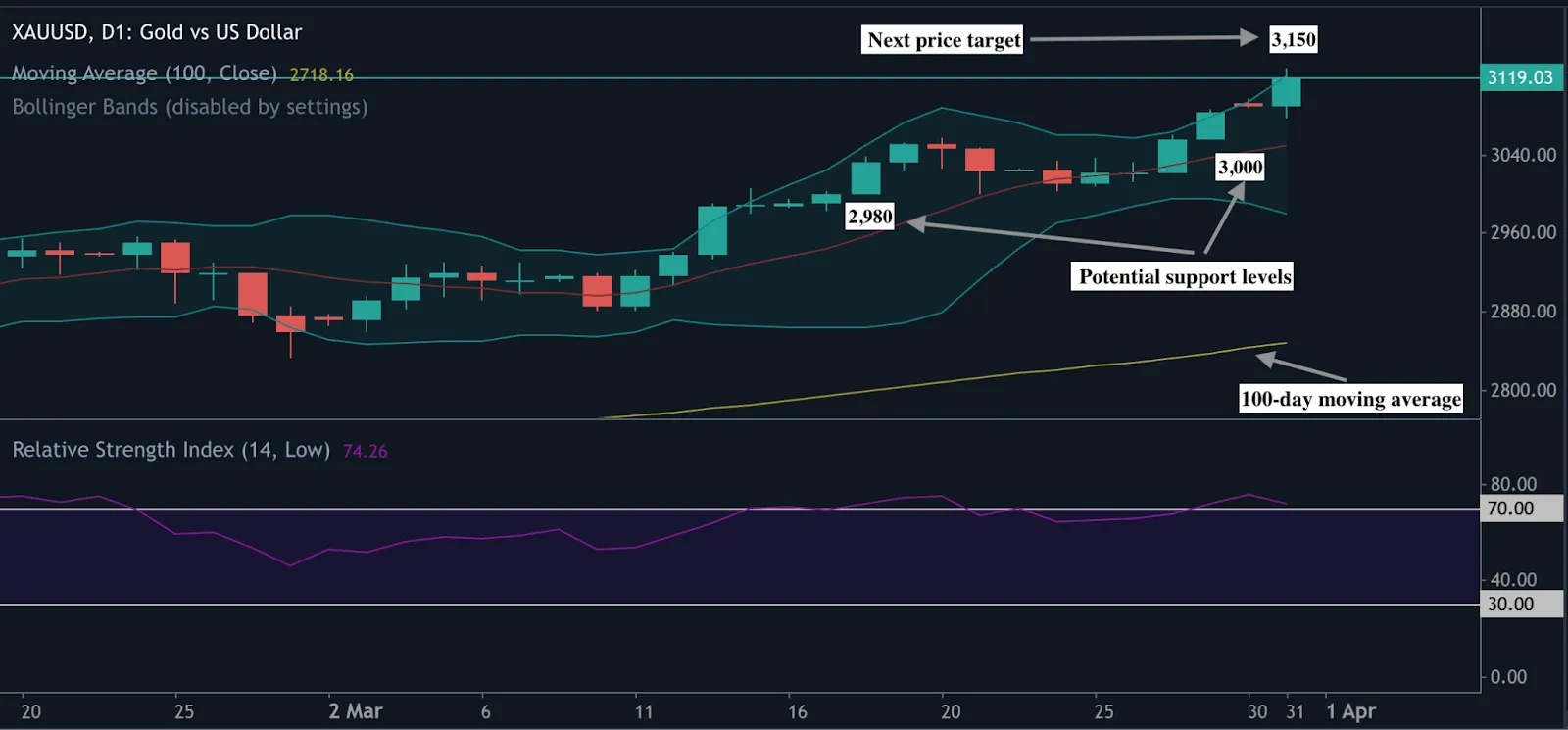
At the time of writing Gold remains on a tear even after smashing the $3,100 target mark. Upward bias persists as $3,150 looks like the next likely target for bulls. The upward narrative is supported by prices remaining above the 100-day moving average. However, prices touching the upper bollinger band hints at overbought conditions. Should we see a reversal due to overbought conditions, the key support levels to watch are $3,000 and $2,980.
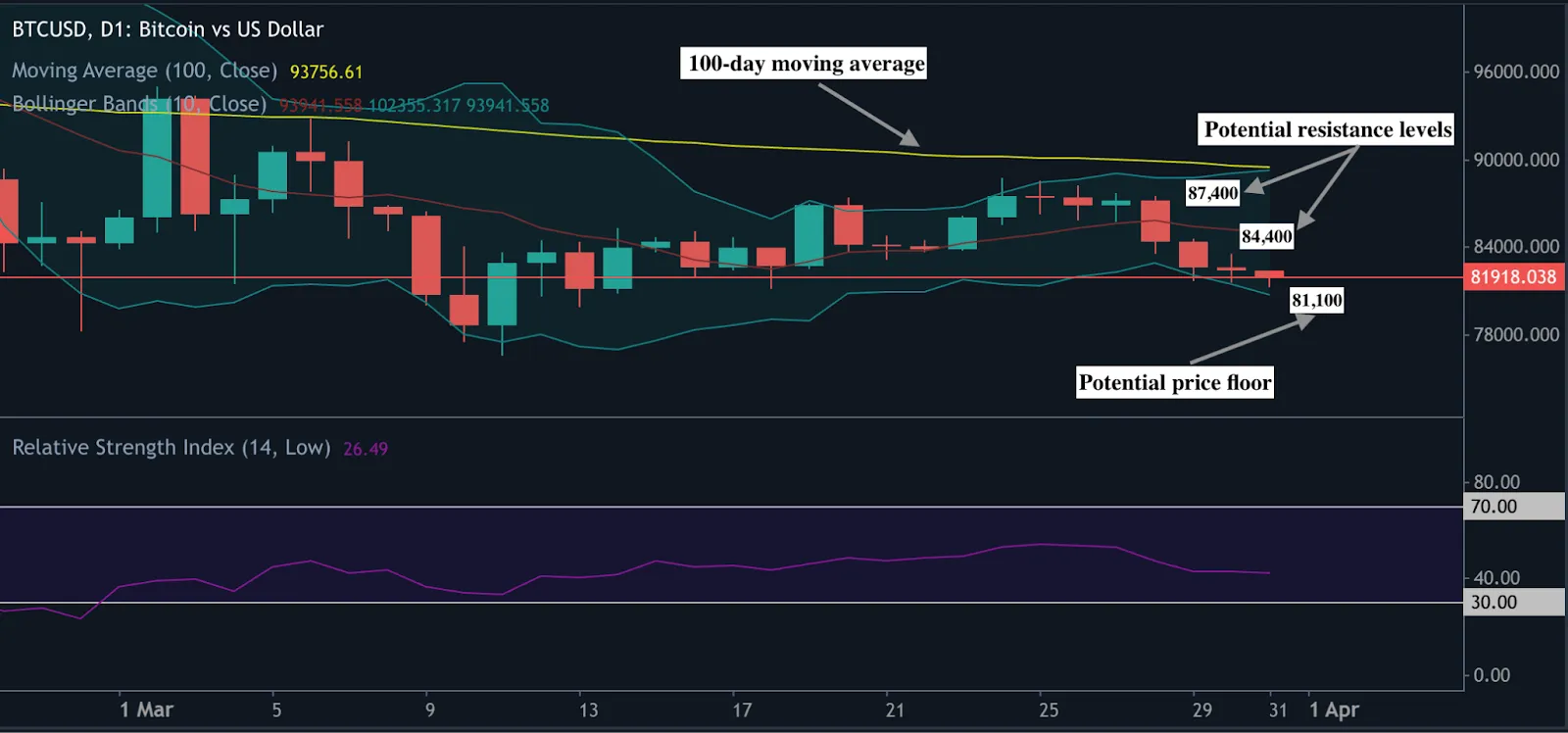
Bitcoin in contrast is sliding as risk-off sentiment dominates markets. Bearish pressure is evident on the daily chart with the downside narrative supported by prices remaining below the moving average. However, prices are now touching the lower bollinger band, hinting at oversold conditions. Should we see a rebound, the key levels to watch are $84,400 and $87,400. Should prices continue to plummet, a potential price floor level to watch is $81,100.
You can get involved and speculate on the price of these two incredible assets with a Deriv MT5 account or a Deriv X account.

Gold all-time-high price: How high can the yellow metal go?
Gold hits $3,076 as Trump's tariffs spark a trade war. See why central banks are stockpiling the safe haven asset and if $3,100 is next.
Gold just shattered expectations, surging past $3,059 and setting a new all-time high. The yellow metal has been on an unstoppable run, climbing over 1% as markets reel from President Trump’s latest tariff bombshell. His decision to slap a 25% tariff on imported cars and auto parts has sent shockwaves through the global economy, fueling uncertainty and sending investors flocking to gold.
Trade war sparks a flight to safety
The impact of these tariffs goes far beyond the auto industry. With Canada and the EU already threatening retaliation, a full-blown trade war is brewing. Markets hate uncertainty, and when fear sets in, gold thrives. The Dow is bleeding red while gold continues to shine, proving once again that in times of turmoil, investors turn to the ultimate safe-haven asset.
At the same time, the US Dollar, which had been riding high, is showing signs of weakness, slipping 0.33%.

That’s another boost for gold, which historically performs well when the dollar falters. The perfect storm of economic tension, currency fluctuations, and investor anxiety is playing out in real time.
How high can Gold’s price go?
Market experts are already making bold predictions. Bob Haberkorn, senior market strategist at RJO Futures, believes gold could hit $3,100 soon. And he’s not alone. Goldman Sachs just raised their year-end target to $3,300 per ounce, signaling confidence that the rally still has room to run.
The reason? Central banks across the globe are stockpiling gold at a record pace, and demand from ETFs is surging. When the big players are buying, you know they see something coming.
Another key element to watch is the Federal Reserve. With inflation concerns still looming, today’s PCE data could be a game-changer. Markets have already priced in 64.5 basis points of rate cuts for 2025. Historically, lower interest rates make gold even more attractive since it doesn’t yield interest. If the Fed follows through, gold could have even more room to climb.
Tesla’s unexpected role in the Tariff fallout
While most automakers are bracing for impact, Tesla stock is climbing. With its heavy reliance on US manufacturing, many see Tesla as a winner in this trade war. But here’s the twist-Elon Musk himself isn’t convinced. Despite Tesla’s “Made in America” reputation, many of its components come from abroad, meaning the company won’t escape unscathed.
“The tariff impact on Tesla is still significant,” Musk admitted. “The cost impact is not trivial.” Even with a domestic footprint, the ripple effects of a trade war are impossible to avoid.
Wall Street analysts see Tesla gaining an edge, while legacy automakers scramble to adjust. With nearly half of the midsize crossover segment now facing steep tariffs, companies like GM and Ford could see margins take a serious hit. Bernstein’s Daniel Roeska put it bluntly: “Tesla is the clear structural winner.”
And Trump isn’t stopping at tariffs. He’s also floating a plan to make interest payments on American-made cars tax-deductible - another potential win for Tesla.
The bottom line
Gold’s breakout is more than just a number on a chart-it’s a signal. Trade wars, currency fluctuations, central bank movements, and Fed policy all point to a volatile global financial landscape. Meanwhile, Tesla’s unexpected rise amid the turmoil reminds us that even the biggest disruptions create winners and losers.
Technical outlook: March to $3,100?
At the time of writing, XAUUSD is showing strong upside bias rising to around $3,076. The bullish narrative is also backed by prices remaining above the 100-day moving average. However, RSI towering past 70 and price touching the upper bollinger band hints at overbought conditions.
If upside pressure persists, the immediate target will be $3,100. In case of a price retreat, a support level to watch would be $3,008. A price collapse could see the yellow metal find support at the $2,884 price level.

As Gold makes history, you can get involved and speculate on the price of the yellow metal with a Deriv MT5 account or a Deriv X account.

GameStop’s Bitcoin investment: A bold move or a risky gamble?
Remember when GameStop sent shockwaves through Wall Street in 2021, turning a struggling retailer into a meme stock legend?
Remember when GameStop sent shockwaves through Wall Street in 2021, turning a struggling retailer into a meme stock legend? Well, they’re back at it-but this time, it’s not Reddit traders fueling the hype. It’s Bitcoin.
GameStop’s board just unanimously approved adding Bitcoin to its treasury reserves. No small dip, no half-measures-just straight-up converting corporate cash into BTC with no ceiling on how much they might buy. The result? The stock popped 15% instantly. But that’s just the beginning.
Why now?
GameStop isn’t exactly drowning in cash, but they did report a more than 100% jump in net income, reaching $131.3 million in Q4. While other retailers might use that to stabilize operations, GameStop is going all in on digital gold. Meanwhile, they’re still closing physical stores, signaling a broader pivot away from old-school retail.
And get this-they’re not just using their cash reserves. They openly stated they may use cash, equity issuances, and even future debt to acquire more Bitcoin. Translation? They’re willing to raise money just to buy more BTC. That’s a level of commitment rarely seen from traditional retailers.
Jim Cramer saw this coming?!
Yes, that Jim Cramer. Back in 2021, he tweeted (probably jokingly), “Bitcoin! Genius!!! GameStop needs to be a 5000-store bitcoin palace!!!” Turns out, he might’ve been onto something.
GameStop is now following the playbook of MicroStrategy, the company that transformed itself into a Bitcoin-holding giant. Michael Saylor, MicroStrategy’s CEO, turned his business into a de facto Bitcoin ETF-and GameStop may be looking to do something similar.
The bigger picture: Why this matters for crypto
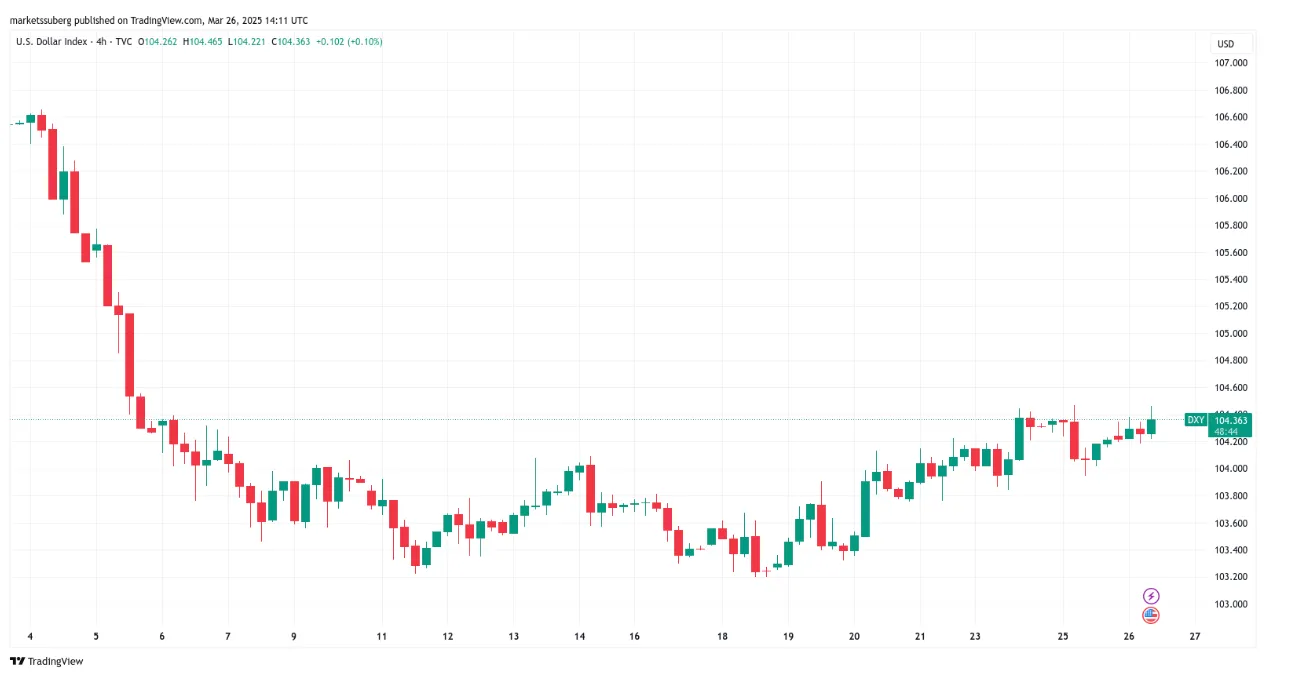
Bitcoin briefly dipped below $87K after GameStop’s move, but there’s a bigger play at hand. The stock market has been shaky, the U.S. dollar just hit a 3-week high, and Trump’s looming trade tariffs are adding uncertainty to the mix.
Meanwhile, we’re seeing a regulatory shift in favor of crypto. Kentucky and Arizona just passed pro-crypto legislation, moving toward integrating digital assets into their financial systems. While Washington, D.C. is still figuring things out, individual states are racing to become blockchain hubs.
So why isn’t Bitcoin experiencing a major breakout? The answer could lie in traditional finance (TradFi) roadblocks. Institutional investors still face hurdles-cash-settled ETFs are inefficient for taxes, major banks limit direct BTC access, and derivatives markets lack regulatory clarity. Until these issues get resolved, the full-scale institutional shift into Bitcoin remains an open question.
Technical outlook: What’s next?
GameStop’s move highlights the evolving relationship between corporate strategy and digital assets. Whether this signals a broader shift in retail or remains an isolated experiment is yet to be seen. While regulatory developments and market sentiment will play a role in shaping the outcome, one thing is clear-companies are increasingly exploring new ways to allocate their resources in a rapidly changing financial landscape.
As the market digests GameStop’s latest move, the focus now shifts to how other corporations and institutions respond. Will more traditional retailers embrace digital assets, or will they take a more cautious approach?
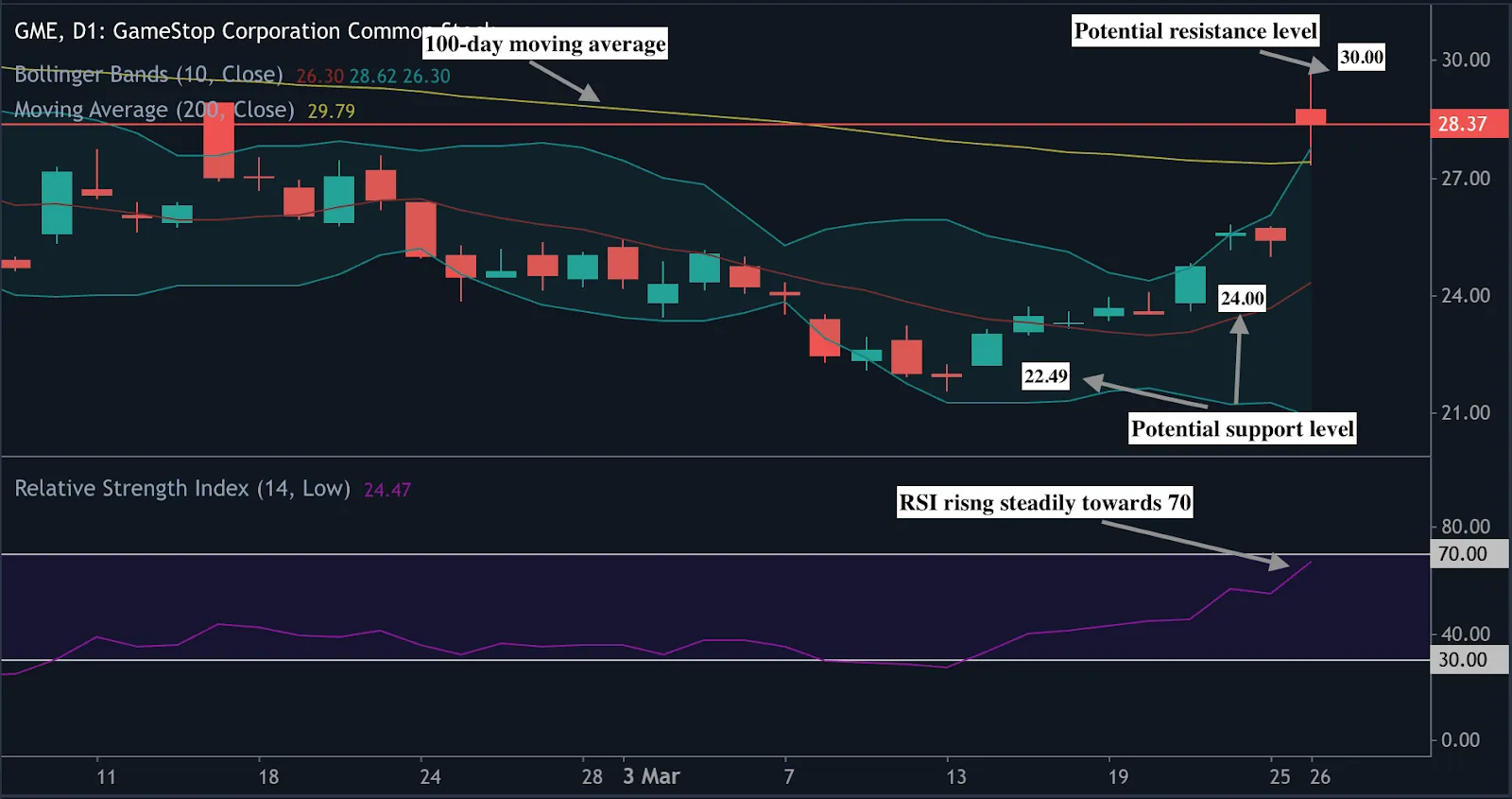
At the time of writing, Gamestop is showing signs of retracement after towering towards the $30 mark. Price is just above the 100-day moving average indicating that upside bias still persists. However, price breaching the upper bollinger band as RSI steadily rises towards 70, shows signs of overbought conditions.
Key levels to watch should the stock slide are $24.00 and $22.49. Should upside pressure take control, the price target will be around $30.00.
As BTC-Gamestop hype ramps up, you can get involved and speculate on the price of gamestop stock with a Deriv MT5 account or a Deriv X account.

XRP vs. Solana comparison: Altcoin season 2025
Few things in crypto spark debate quite like the elusive "altcoin season."
Few things in crypto spark debate quite like the elusive "altcoin season." Traditionally, this refers to a brief period following a Bitcoin (BTC) rally when altcoins outperform BTC in cumulative returns. While past cycles saw clear alt seasons, 2025 has yet to deliver one in full force. But with major regulatory shifts and market movements shaking things up, could the tide be turning? Enter two of the most significant players in the space: XRP and Solana.
In one corner, XRP, backed by Ripple, is pushing to transform global payments with its blockchain-powered alternative to traditional finance. In the other, Solana is fueling Web3 with its ultra-fast, developer-friendly ecosystem.
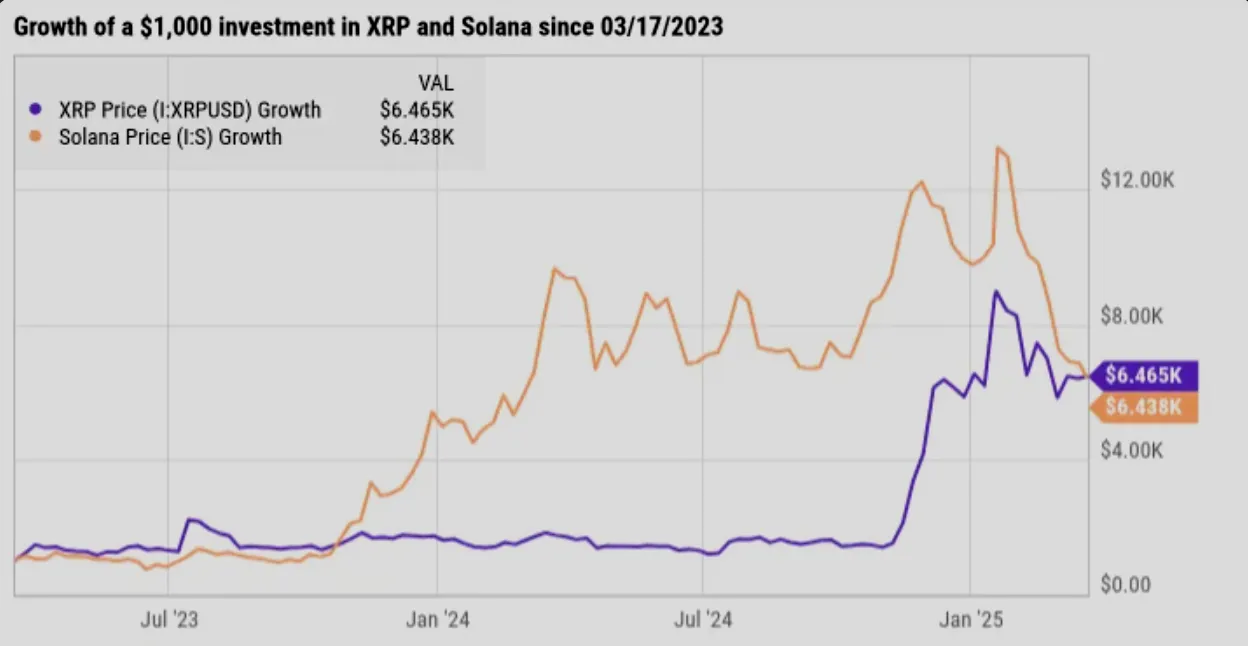
Both have seen wild price swings-XRP up 14% year-to-date, while Solana has faced a 33% pullback. Yet, zoom out two years, and a $1,000 investment in either would be worth around $6,500 today.
Clearly, these two cryptos have staying power-but which one is better positioned for the future?
XRP: The payment powerhouse gets regulatory clarity
XRP just scored a landmark win against the U.S. Securities and Exchange Commission (SEC), securing a $75M refund after a grueling four-year legal battle. With regulatory clarity finally in place, XRP can now focus on its core mission: revolutionizing cross-border payments.
RippleNet, already used by over 300 financial institutions, leverages XRP as a bridge currency to facilitate near-instant, low-cost global transactions. Traditional wire transfers take days and cost upwards of $50-XRP settles in seconds for just $0.0002. The $150 trillion global payments industry has long relied on SWIFT, a decades-old system with inefficiencies that XRP aims to disrupt. While competitors like Stellar and Hedera exist, Ripple's strong banking partnerships may give it a key advantage.
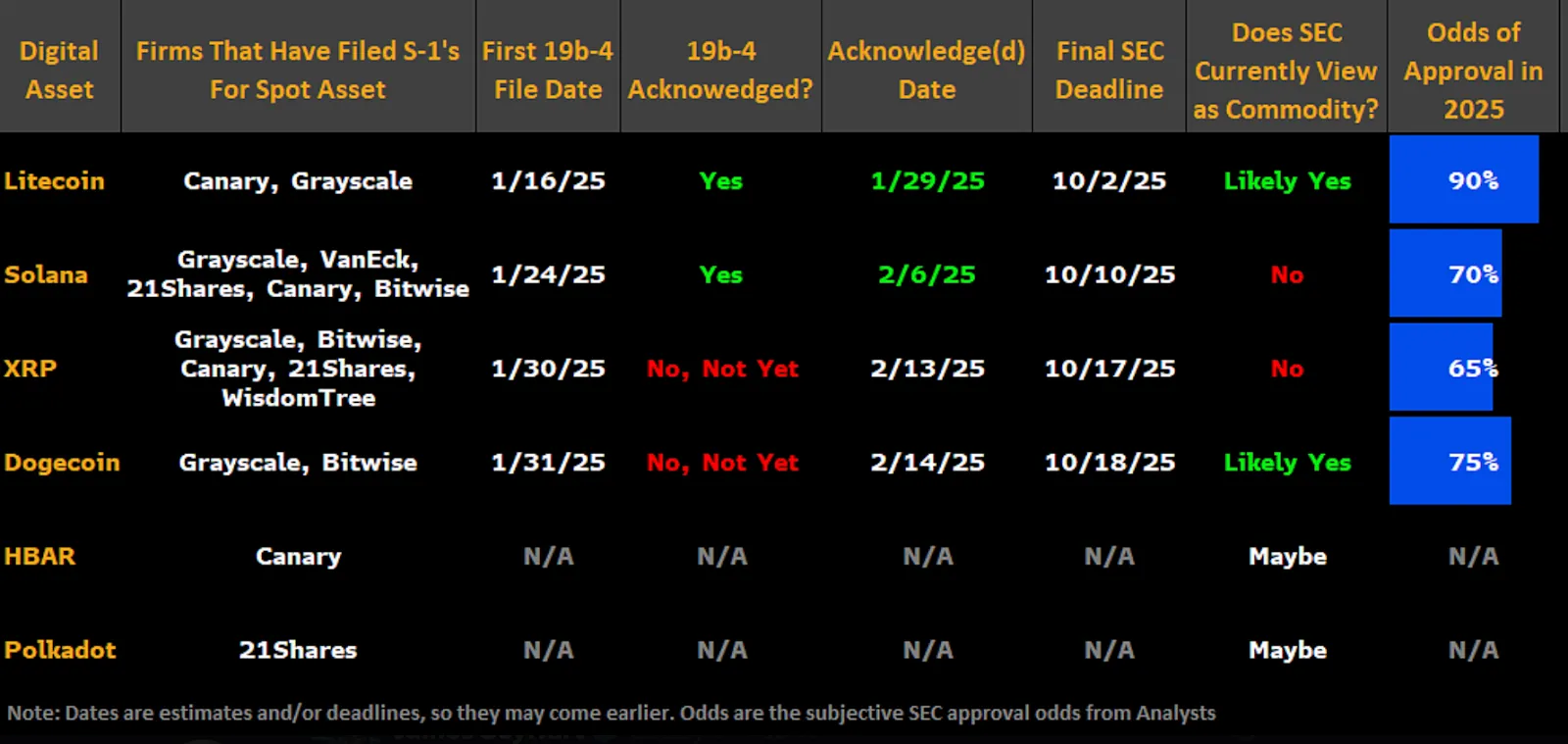
The broader crypto market is also benefiting from a pro-crypto shift in U.S. policy. With the new Trump administration embracing digital assets, the SEC has pulled back on enforcement, setting the stage for potential XRP adoption growth. Some analysts even give XRP a 65% chance of seeing a spot ETF approval-a move that could bring institutional money flooding in.
Solana: Web3’s rising star with explosive growth
While XRP has carved out a niche in finance, Solana is making waves as one of the fastest-growing blockchain ecosystems. Known for its lightning-fast transactions and low fees, Solana has become a hub for decentralized apps (dApps), smart contracts, and yes-meme coins.
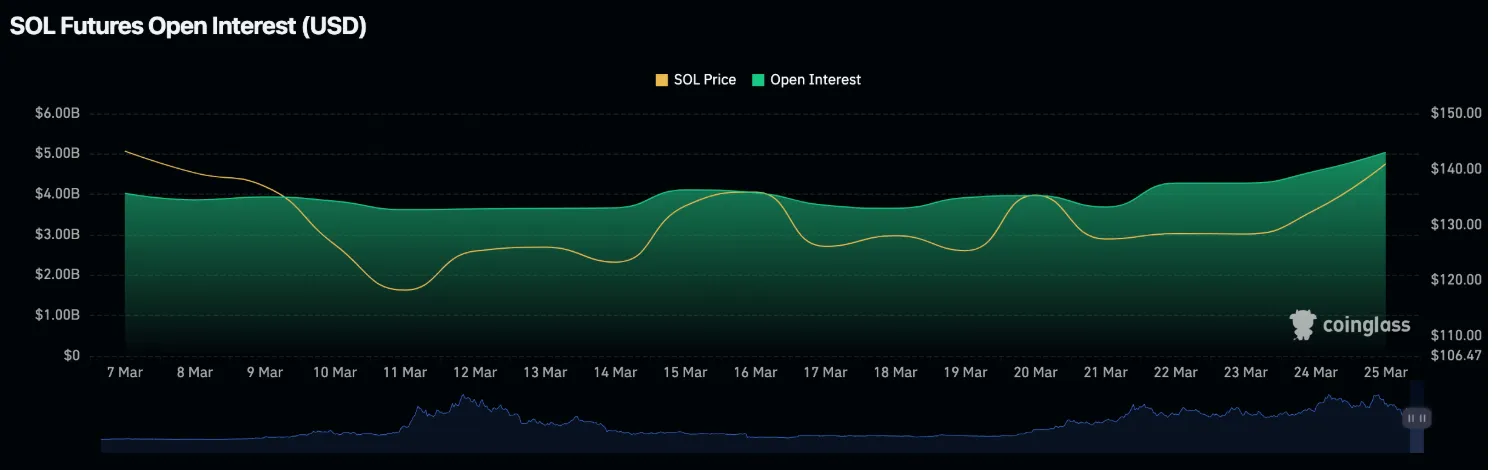
Trump’s recent endorsement of the $TRUMP token, built on Solana, sent shockwaves through the market, with SOL prices holding strong above $140. At the same time, open interest in Solana derivatives exploded by $700M in a single day, signaling a surge in institutional positioning. Despite concerns over past sell-offs-like FTX’s massive SOL liquidation-Solana has remained resilient, bolstered by strong developer activity and rising transaction volumes.
Beyond speculation, Solana is emerging as a serious Ethereum competitor. Recent data shows it outpacing Ethereum in key areas like new developers, active addresses, and daily transactions. Meme coins-often dismissed as a fad-have helped drive engagement, with digital collectibles gaining regulatory acceptance from the SEC. Whether for gaming, DeFi, or tokenized assets, Solana’s ecosystem is proving its staying power.
The verdict? It’s not so simple
The battle between XRP and Solana isn’t just about price action-it’s about the future of crypto itself. XRP represents the promise of blockchain disrupting traditional finance, while Solana embodies the rapid evolution of Web3. With regulatory clarity improving and institutional interest rising, both cryptos could see significant growth in the months ahead.
So, is altcoin season finally here? The jury’s still out, but one thing’s clear: XRP and Solana are leading the charge in 2025’s altcoin showdown. Whether you lean toward banking innovation or decentralized ecosystems, the battle for dominance is far from over.
Technical outlook: XRP vs Solana
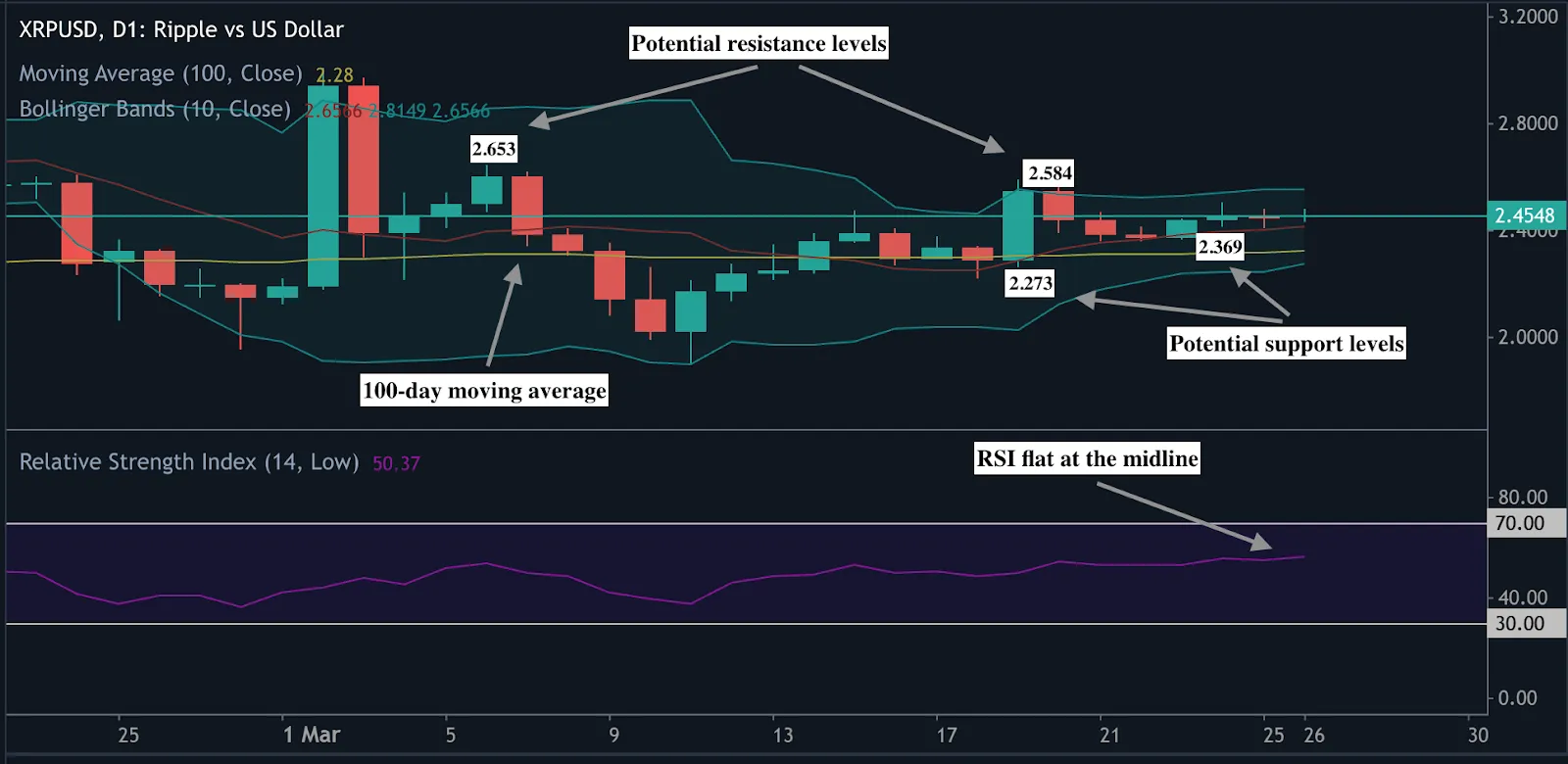
Despite positive news, XRP has not seen a breakout yet. Prices towering slightly above the moving average suggest that we could be entering into an upward longer-term trend. However, RSI staying flat at the midline hints at slowing momentum-meaning upward movement may be subdued. Key levels to watch on the upside are $2.584 and $2.653. On the downside, key support levels to watch are $2.369 and $2.273.
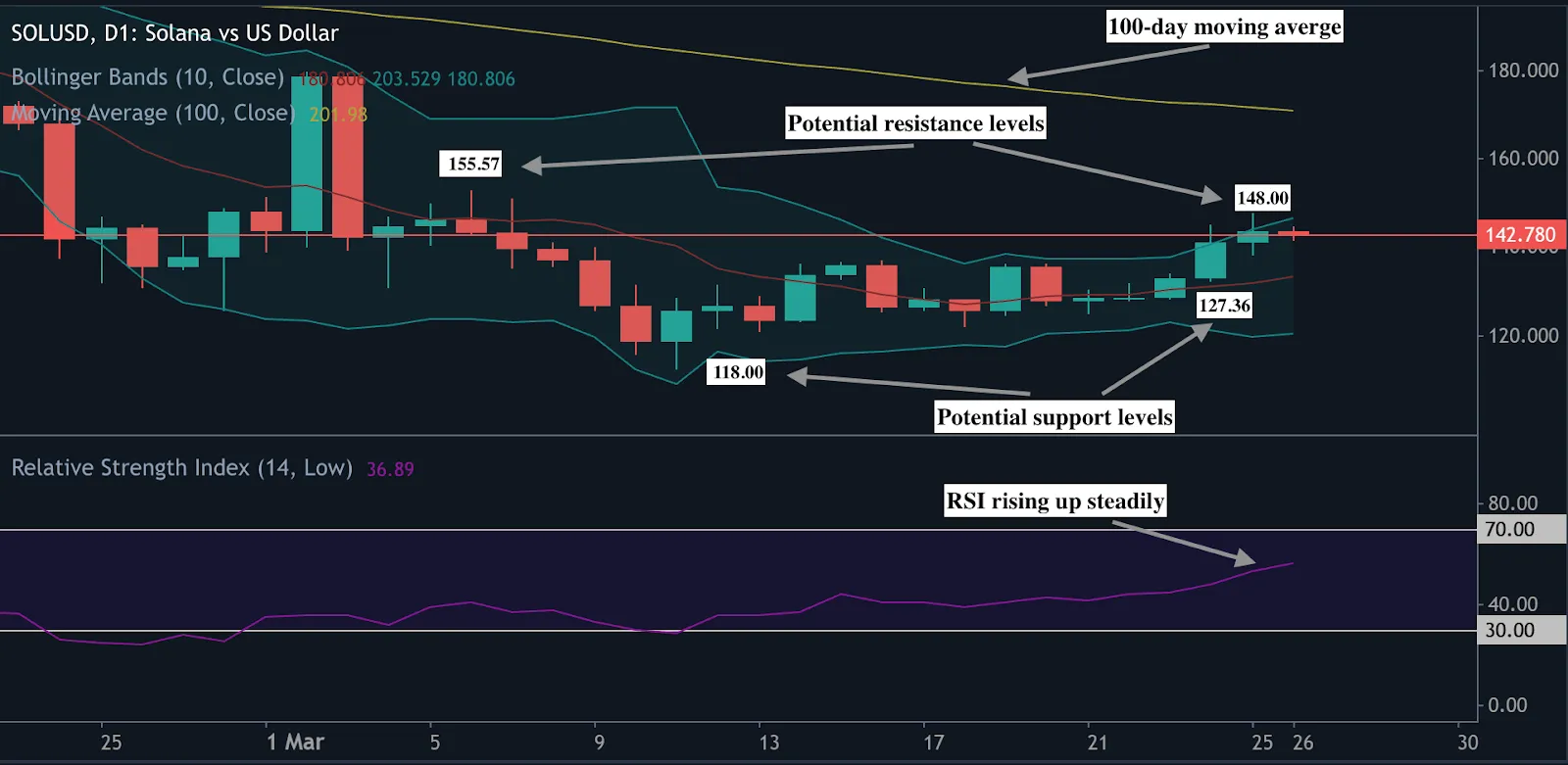
Solana is showing some bullish pressure on the daily chart as RSI rises steadily past the midline. However, prices remaining below the moving average suggest that the longer-term trend could still be bearish- a hint that there could be a further slide before upward momentum. Key levels to watch include $127.36 and $118.00 on the downside. On the upside, traders should monitor the $148.00 and $155.57 price levels.
You can get involved and speculate on the price of these two incredible assets with a Deriv MT5 account or a Deriv X account.
.webp)
2025 market outlook: What’s next for Gold & Bitcoin as risk appetite rises?
Gold extended its losing streak for a third straight day as shifting market sentiment fueled a move away from safe-haven assets.
Gold extended its losing streak for a third straight day as shifting market sentiment fueled a move away from safe-haven assets. Despite a 13% gain this year, the yellow metal is under pressure as investors pile into riskier assets, driven by optimism surrounding Trump's tariff strategy and a resilient U.S. economy.
Trump's tariffs: A more targeted approach
Markets initially feared a broad, economy-wide tariff war, but the latest news suggests a more strategic plan. The White House is narrowing its focus to the "Dirty 15"-countries with the largest trade deficits with the U.S., including China, the EU, and Mexico. This has eased inflation fears and boosted risk appetite, weighing on gold prices while sending Wall Street into a frenzy. On Monday alone, U.S. stocks added a staggering $1.35 trillion in value.
The fed’s hawkish stance weighs on metals
Adding to gold’s woes, Atlanta Fed President Raphael Bostic surprised markets with his latest remarks, predicting just one rate cut this year. He doesn’t expect inflation to return to the Fed’s 2% target until 2027, signaling that high rates may persist longer than expected. Markets, however, are still pricing in about 62.5 basis points of easing this year, setting the stage for potential volatility in precious metals.
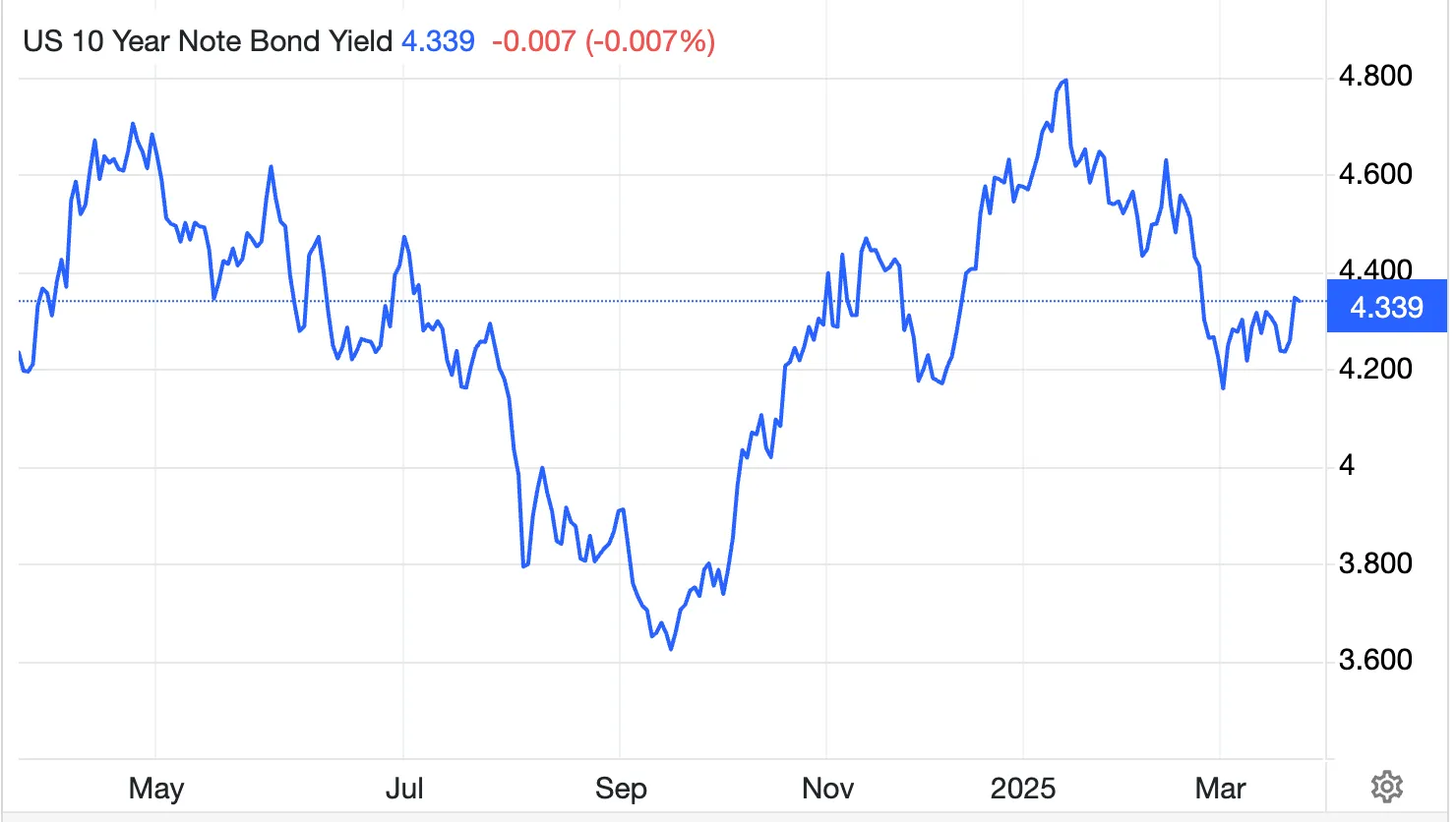
Rising Treasury yields are another headwind for gold. The 10-year yield surged to 4.33%, with real yields climbing toward 2%, making non-yielding assets like gold less attractive.
Bitcoin surges past $86K, but volatility looms
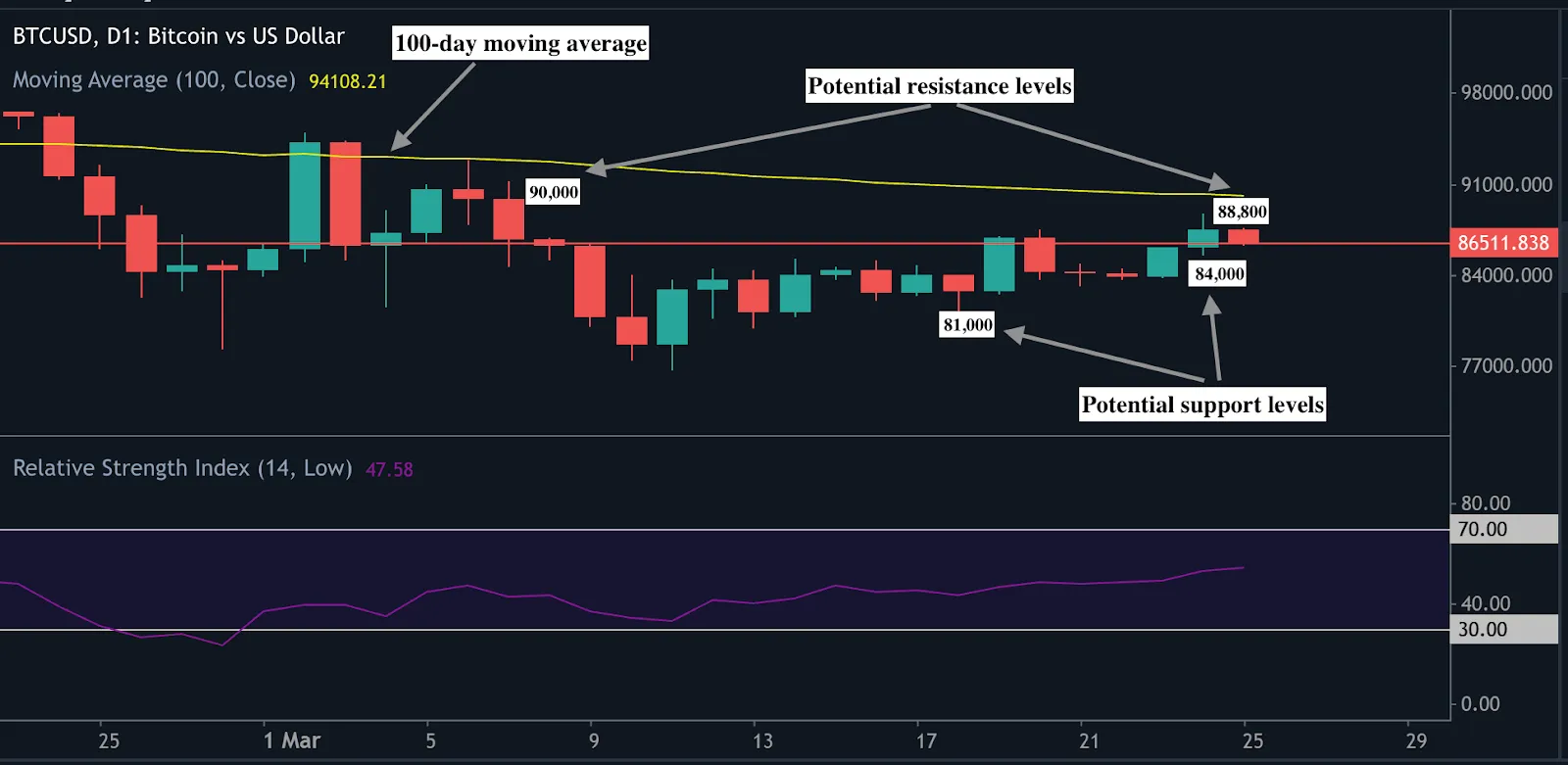
While gold struggles, Bitcoin is flexing its muscles, surging past $86,000 with a 4.25% gain last week. Institutional demand continues to pour in, with U.S. spot Bitcoin ETFs recording $744.3 million in inflows last week alone.
BitMEX co-founder Arthur Hayes predicts Bitcoin could reach $110,000 before pulling back to $76,500. His bullish case hinges on the Fed’s dovish long-term stance and Trump’s tariff flexibility. However, an unexpected development threatens to disrupt the rally-Mt. Gox just moved 11,501 BTC, worth over $1 billion, to various wallets.
Large Bitcoin transfers from Mt. Gox have historically preceded market volatility, as holders who have waited nearly a decade to reclaim their funds may look to cash out. This has traders on edge, watching whether the next 72 hours will confirm Hayes’ bullish forecast or bring a sharp reversal.
According to analysts, gold’s path hinges on Fed policy and risk sentiment. Persistent high rates could pressure prices, while easing could spark a rebound. Bitcoin’s trajectory, on the other hand, could depend on institutional demand and macro trends.
Technical outlook: Pullback-buy or protracted dump?
Gold remains vulnerable to further downside if risk appetite continues to grow, with key levels at $3,000 being closely watched. Meanwhile, Bitcoin faces a crucial test: Will it continue its rally toward $110K, or will the Mt. Gox overhang trigger a correction?
Gold has shown upside pressure for the past few weeks before its latest slide. Despite the slide, prices remain above the moving average, a hint that the bigger trend is still upward. Key levels to watch on the upside are $3,034 and $3,057. The support level to watch is $3,000.

Bitcoin has shown some consolidation for the past few weeks. Though some upward pressure is evident, prices remain below the moving average-hinting that the bigger trend is still downward. The key levels to watch on the downside are $84,000 and $81,000. On the upside, key levels to watch are $88,800 and $90,000.
You can get involved and speculate on the price of these two incredible assets with a Deriv MT5 account or a Deriv X account.
Nvidia death cross warning: Should we brace for a market downturn?
A storm may be brewing in the markets as the infamous "death cross" has just appeared in Nvidia's stock, the Russell 2000 index, and most recently, Microsoft.
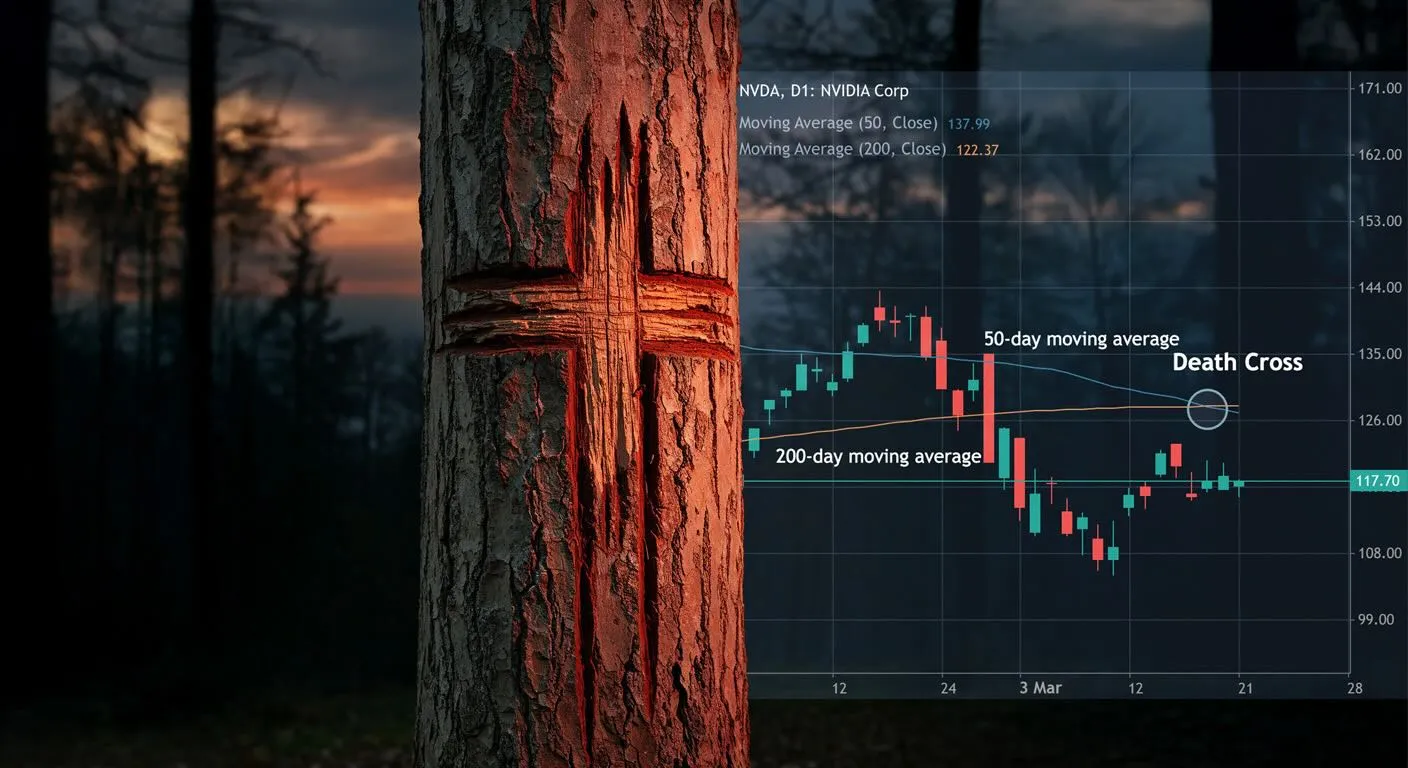
A storm may be brewing in the markets as the infamous "death cross" has just appeared in Nvidia's stock, the Russell 2000 index, and most recently, Microsoft. This technical pattern, where a stock's 50-day moving average crosses below its 200-day moving average, has historically preceded some of the biggest market downturns.
The big question: Is this time different, or should investors prepare for more pain ahead?
Nvidia and Russell 2000: Early warning signs?
Nvidia's last death cross in April 2022 resulted in a near-48% decline over the following six months. Given the stock’s meteoric 948% rise since October 2022, its recent sideways movement could signal the AI-fueled rally is running out of steam.
Meanwhile, the Russell 2000, often seen as a barometer for broader market conditions, has flashed the same warning sign for the first time in 17 months. The last time this happened in October 2023, the index fell another 5.6% before finding a bottom. Small caps often act as a leading indicator of broader economic weakness, making this development particularly concerning.
Microsoft joins the list
Now, another tech giant is flashing a death cross: Microsoft. The stock has already dropped from $468 to around $389, a sharp 17% decline. This drop coincides with broader fears, including trade tensions, high valuations, and market uncertainty.
Yet, Microsoft remains at the forefront of AI adoption, with a staggering 67% of cloud environments utilizing OpenAI or its Azure OpenAI SDKs. Despite its dominance, Wall Street remains unimpressed. January’s earnings report showed strong numbers, but Azure’s growth fell short of sky-high investor expectations. The market had priced in perfection-Microsoft delivered merely “excellent.”
The bigger picture: A market in flux
While the S&P 500 has yet to confirm a death cross, its 50-day moving average is declining by about five points daily, placing it within striking distance. This comes at a time when election uncertainty, inflation worries, and geopolitical risks are already weighing on investor sentiment.
Notably, technical analyst Ari Wald of Oppenheimer offers a word of caution: “While every major decline starts with a ‘death cross,’ not every ‘death cross’ leads to a major decline.” In other words, while the signal is concerning, it’s not a guaranteed doom scenario.
Buy the dip or run for cover?
With AI playing a critical role in today’s market narrative, the upcoming earnings reports for Nvidia, Microsoft, and other tech leaders will be crucial in determining whether the bull run continues or if a deeper correction is underway. Microsoft’s April earnings, in particular, could be a pivotal moment for the AI trade.
So, is this the buying opportunity of the decade-or the beginning of an AI bubble burst? As investors weigh technical signals against fundamental strength, the market’s next move remains uncertain. One thing is clear: the coming months will be anything but dull.
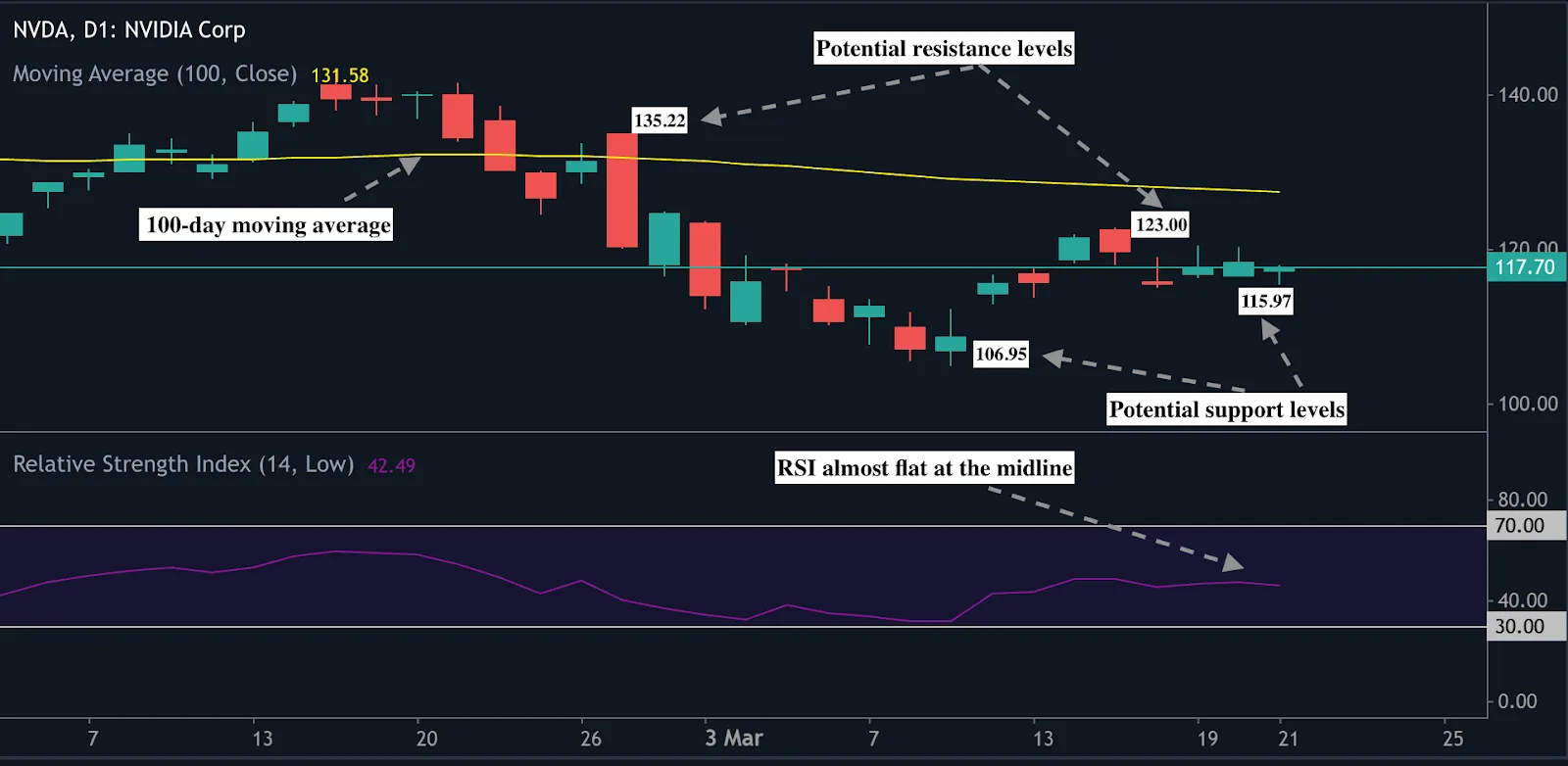
At the time of writing, some buy pressure is evident on the daily chart. However, RSI remaining near-flat at the midline suggests waning momentum. Prices remaining below the moving average also suggests that the longer-term trend is down.
You can get involved and speculate on the price of NVDA with a Deriv MT5 account or a Deriv X account.

Gold & Silver: Short-term dip or long-term opportunity?
Is the current metals pullback a buying opportunity? Analyse Gold price forecasts and Silver market outlook amid Fed decisions and Trump's tariff plans.
Gold and silver prices are taking a hit, with gold slipping below $3,030 after touching record highs and silver crashing under $34. Even with all the global chaos, these metals are pulling back-leaving investors scratching their heads.
Is this just a little breather, or are we looking at a bigger shake-up?
The fed factor: A market puzzle
The Federal Reserve just hit the pause button on interest rates again, keeping them at 4.25%-4.50%.

Not only that, but they’re also slowing down their quantitative tightening-normally a recipe for higher gold prices. And yet, gold isn’t budging. Instead, the U.S. dollar is flexing its muscles, pushing metals lower.
Adding to the mystery, Fed Chair Jerome Powell admitted that economic uncertainty is on the rise. Meanwhile, the Fed’s new projections are all over the place-fewer rate cuts in 2025, but higher inflation and unemployment. It’s a classic case of mixed signals, leaving investors unsure whether to double down on gold or wait for more clarity.
Geopolitical tensions vs. market reaction
Gold is supposed to be the go-to safe haven in times of crisis, right? But despite rising tensions in the Middle East, like Israel resuming airstrikes in Gaza, gold is actually dipping. That’s a head-scratcher. It seems traders are cashing in profits rather than rushing to safety.
Alex Ebkarian from Allegiance Gold puts it simply: “Gold isn’t acting as a safe haven yet because we’re not officially in a recession.” The key word? Yet. If the economy takes a turn for the worse, we could see a real gold rush down the line.
Silver’s rollercoaster ride & Trump’s tariff factor
Silver is getting hit even harder, plunging below $34 as the U.S. dollar climbs toward 104. This isn’t just random market noise-it’s directly tied to the Fed’s stance and Trump’s economic policies.
Powell threw another curveball, saying Trump’s proposed tariffs could slow growth while driving inflation higher. Tariffs usually create uncertainty, which tends to be good for metals like silver. But with interest rates still elevated, the immediate reaction has been a sell-off.
Even with today’s drop, silver is still up 28% year-to-date, outperforming most major assets. Citi analysts are staying bullish, calling for gold to hit $3,500 by year-end due to stagflation fears. If they’re right, today’s dip could be a golden (or silver) buying opportunity.
Why the long-term outlook for Gold & Silver is still bright
Short-term fluctuations aside, the bigger picture for gold and silver remains strong. Western investors are still underexposed to gold, with ETF holdings at 86 million ounces-far below the 110 million ounces held during the COVID era. This suggests plenty of room for upside if investor sentiment shifts.

Silver, meanwhile, has a booming future in industrial applications. Consider this: by 2050, solar energy alone could consume 85–98% of the world’s current silver reserves. The automotive industry is another major growth driver, with electric vehicle (EV) production ramping up and demand increasing for silver-heavy components like charging infrastructure and advanced powertrains.

Technical insights: Buy-the-dip moment or a red flag?
At the time of writing, gold is showing some bearish signals as RSI towers into overbought territory. However, prices are still elevated above the moving average, an indicator that the larger trend is still upward.
Key levels to watch are $3,050 on the upside, and on the downside $2,984, and $2,921.

Silver is also showing clear bearish bias with a significant dip down from highs of $34.00. However, prices almost touching the lower bollinger band hints at oversold conditions- a potential reversal. The reversal narrative is also helped by prices remaining above the moving average- a sign that the overall trend is still upward.
Key levels to watch on the upside are $33.86 and $34.25. On the downside, the key levels to watch are $32.59 and $32.00.

You can get involved and speculate on the price of these two incredible assets with a Deriv MT5 account or a Deriv X account.
XRP’s SEC resolution, Solana’s ETF boom: What's next for institutional adoption?
The cryptocurrency market is buzzing with excitement as two major developments shake up investor sentiment.
The cryptocurrency market is buzzing with excitement as two major developments shake up investor sentiment. First, the U.S. Securities and Exchange Commission (SEC) has officially dropped its long-running lawsuit against Ripple, sending XRP soaring.
Second, Volatility Shares is rolling out the first-ever Solana futures ETFs, potentially unlocking a new wave of institutional investment. These moves could be a game-changer, setting the stage for a friendlier regulatory environment and broader market participation.
XRP soars as SEC waves the white flag
Ripple’s cryptocurrency, XRP, jumped 15% after the SEC announced it was no longer pursuing its appeal against the company. The legal battle, which kicked off in 2020, centered around whether XRP was an unregistered security. A partial victory in 2023 confirmed that XRP isn’t a security when traded on retail exchanges, but some regulatory question marks remained.
Ripple CEO Brad Garlinghouse didn’t hold back in his reaction, calling the SEC’s approach a “broken system” and emphasizing that this fight was about more than just Ripple. His message? Crypto deserves fair treatment. And it looks like regulators might finally be listening.
Beyond XRP, the SEC has been hitting the brakes on crypto crackdowns. It recently closed investigations into Coinbase, Robinhood, Uniswap, Gemini, and Consensys without taking further action. The agency also dialed down its crypto enforcement unit and even stated that meme coins aren’t securities. Taken together, these moves suggest regulators might be shifting gears-potentially clearing the path for a more favorable crypto landscape.
Solana futures ETFs: A big step toward institutional adoption
In another milestone moment, Volatility Shares is launching two futures-based Solana ETFs-the first of their kind in the U.S. The Volatility Shares Solana ETF (SOLZ) will track Solana futures, while the Volatility Shares 2X Solana ETF (SOLT) will offer leveraged exposure. With Nasdaq listings and expense ratios of 0.95% and 1.85%, these funds could be a major gateway for institutional investors looking to tap into Solana’s ecosystem- and data shows demand is growing.
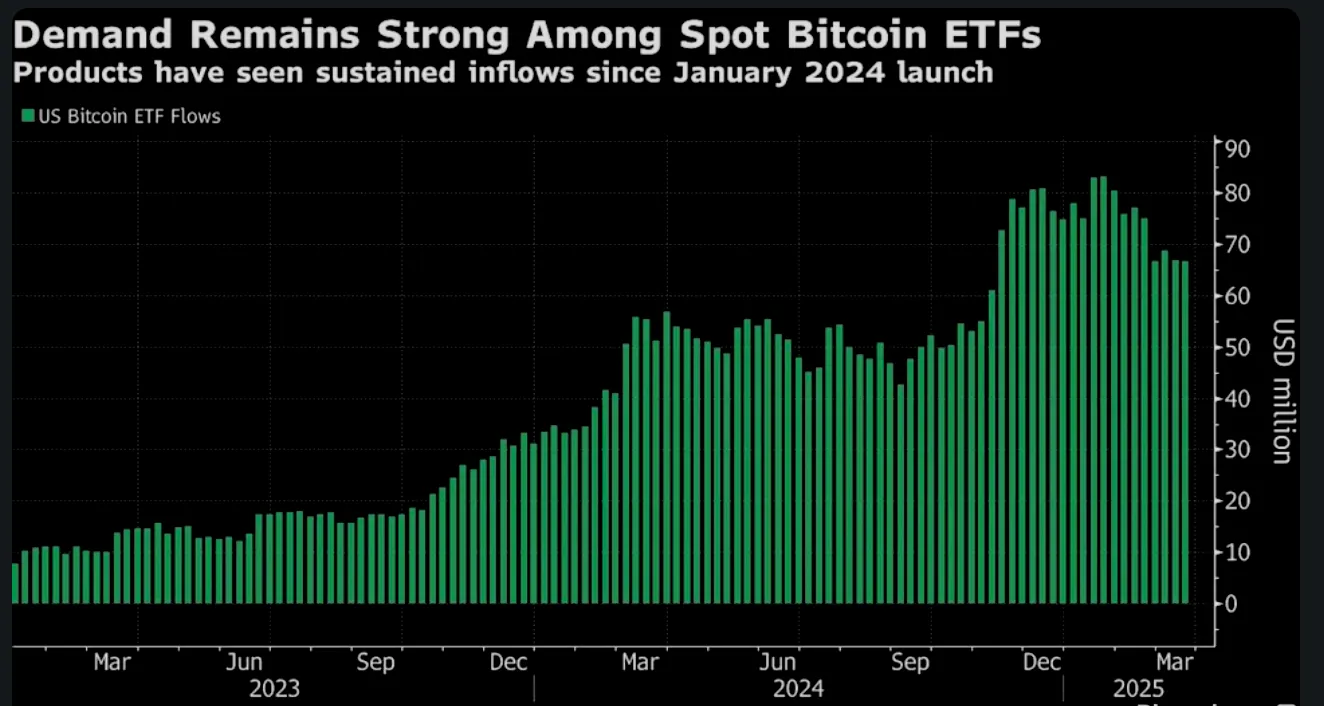
This follows the same playbook used for Bitcoin and Ethereum ETFs-first, futures-based products, then (hopefully) spot ETFs. Analysts at Bloomberg Intelligence estimate there’s a 75% chance we’ll see a spot Solana ETF approved this year. Heavy hitters like Franklin Templeton, Grayscale, and VanEck are already in the race, filing applications in anticipation of a green light.
Solana (SOL) isn’t just watching from the sidelines-it’s riding this wave of momentum. The token has climbed nearly 8% in 24 hours, hitting $135 before a slight retreat.
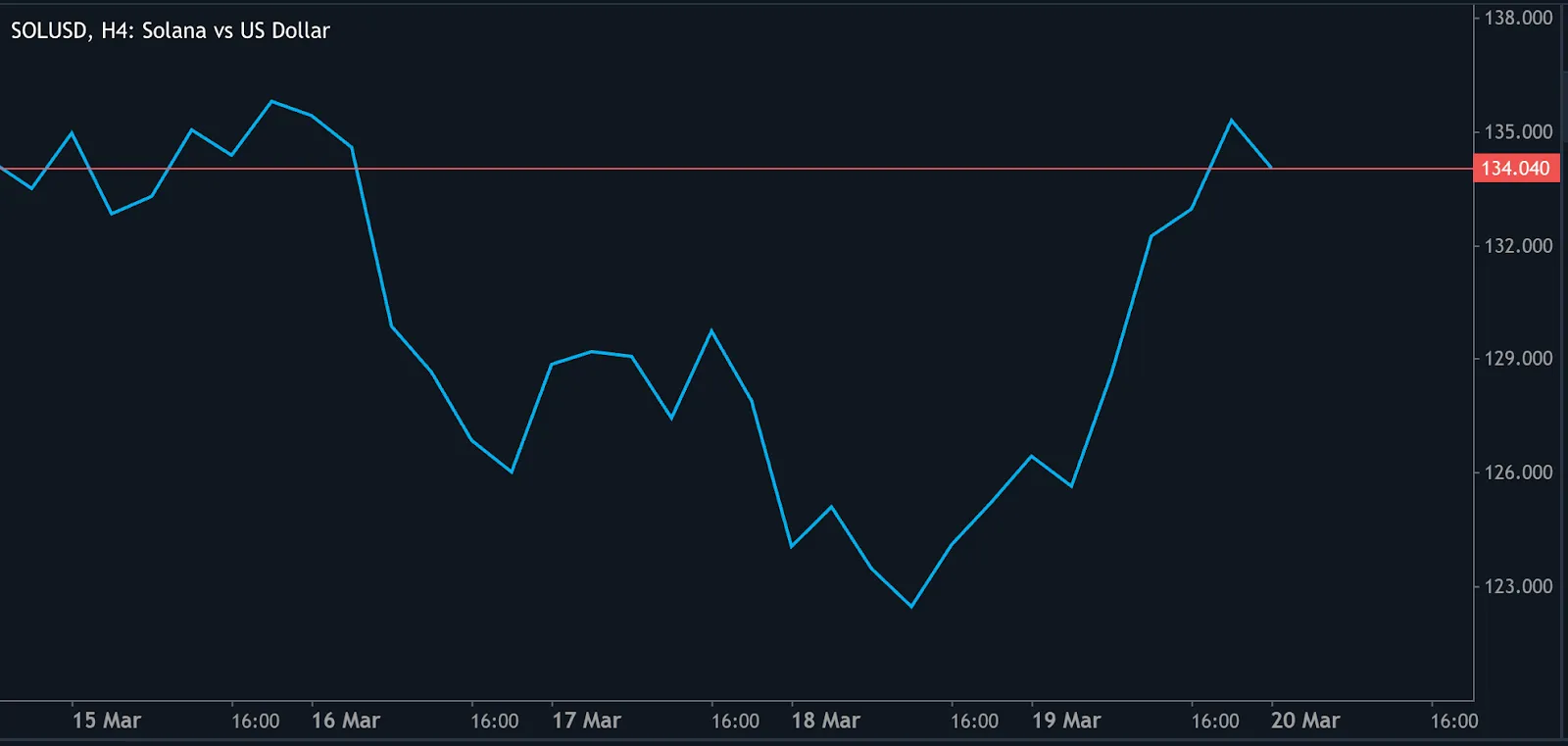
Solana has been gaining traction thanks to its low transaction fees and thriving ecosystem, bouncing back from the turbulence following the FTX collapse in 2022.
The big question now: Will Solana’s rally hold strong post-ETF launch, or will we see some short-term profit-taking? Either way, traders believe the introduction of these ETFs adds another layer of legitimacy, increasing liquidity and paving the way for long-term stability.
What’s next for crypto regulation and institutional adoption?
The SEC’s recent moves suggest a potential shift toward a more open stance on digital assets. According to analysts, if this trend continues, we could see:
- More spot ETFs for assets like Solana, Cardano, and even XRP
- Greater institutional participation, bringing fresh capital into crypto markets
- A boost in bullish sentiment as regulatory clarity improves
With XRP gaining some long-awaited regulatory clarity and Solana stepping into the ETF arena, crypto could be on the verge of a new era. While there are still hurdles ahead, legal wins and institutional-grade financial products are bringing digital assets closer to mainstream finance.
Technical insight: Key levels to watch
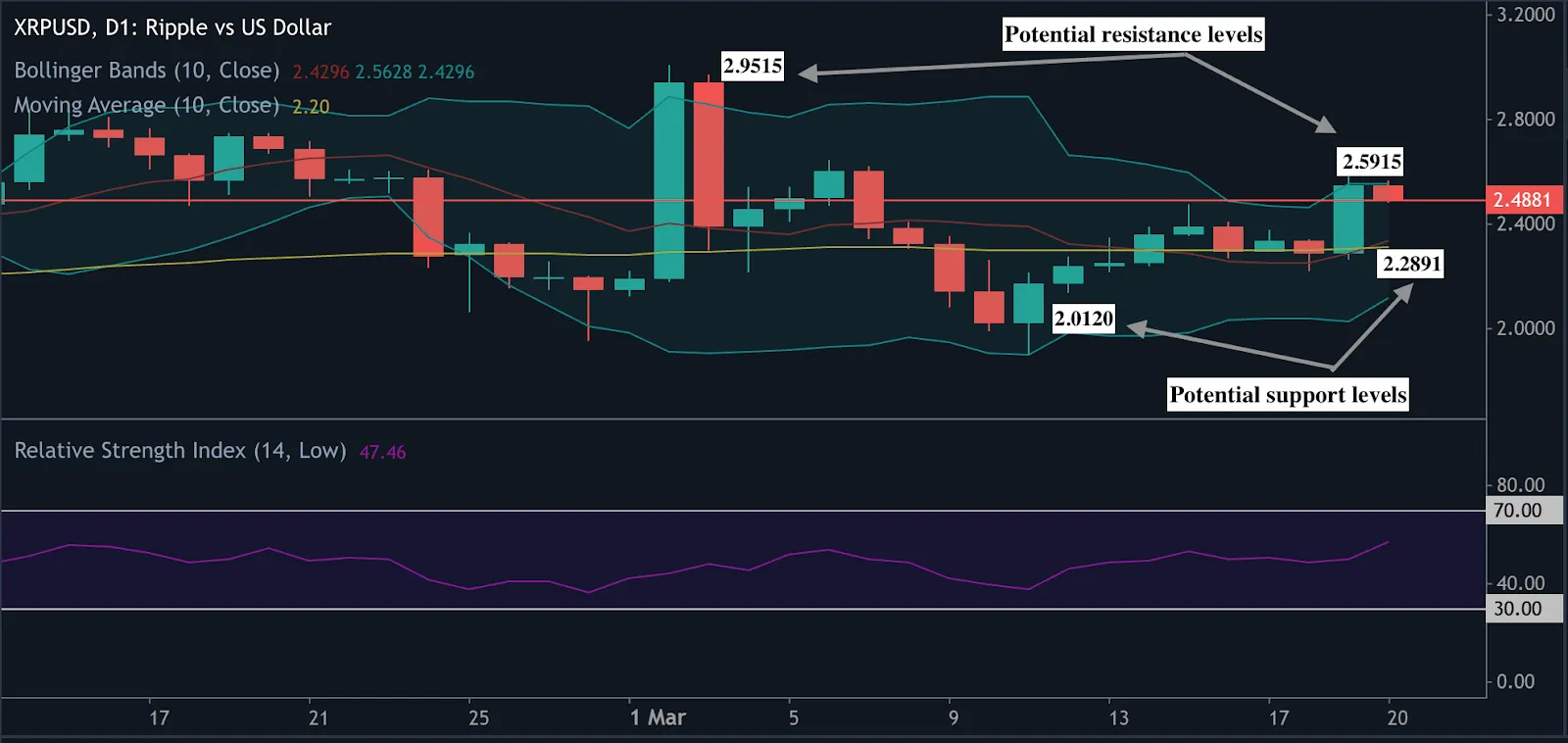
At the time of writing, XRP is showing some bullish bias after a period of consolidation. Prices touching the upper bollinger band hint at overbought conditions though. Key levels to watch on the upside will be $2.5915 and $2.9515. On the downside, $2.2891 and $2.0120.
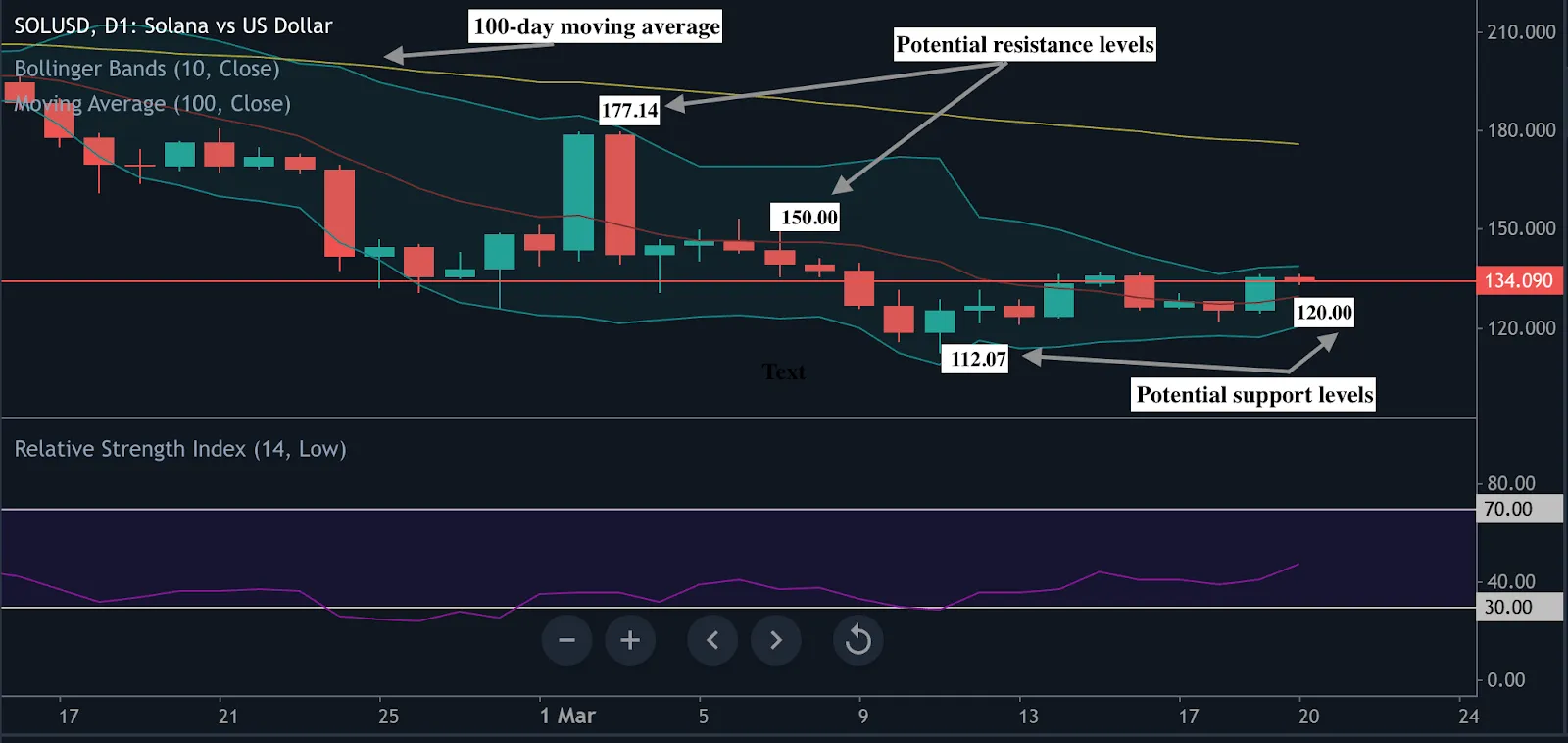
Solana is also showing some bullish bias after the ETF news. However, prices remain below the moving average, hinting at the larger trend still being bearish. Adding to the bearish narrative is prices touching the upper bollinger band- signalling overbought conditions. Key levels to watch on the upside will be $150.00 and $177.14 and on the downside, $120.00 and $112.07.
You can get involved and speculate on the price of these two incredible assets with a Deriv MT5 account or a Deriv X account.

Bitcoin price prediction 2025: Will the Fed fuel the next crypto big rally?
The crypto market is in full-on “hurry up and wait” mode.
The crypto market is in full-on “hurry up and wait” mode. Bitcoin is lingering just under $83,000, and investors are holding their breath ahead of the Federal Reserve’s latest move. The sentiment? Cautious, with a side of “let’s see what Powell says.”
While no one expects an actual rate cut in the immediate, the market is bracing for clues about what’s coming next-and whether the much-hoped-for dovish pivot is in the cards.
The slowdown in Bitcoin’s trading volume speaks volumes (pun intended). In the last 24 hours, only $22 billion worth of BTC has changed hands-a sharp drop from last week’s $49 billion. Clearly, traders are sitting on the sidelines, waiting for the Fed’s next move before making their own.

Bitcoin’s 2025 playbook: All about the Fed’s tone
For Bitcoin, the next few months may be less about actual policy changes and more about Powell’s choice of words. Ryan Lee from Bitget Research predicts BTC will trade between $80,000 and $86,000 post-Fed announcement with "80% confidence." Not the most thrilling range, but it underscores that we’re in a consolidation phase rather than a chaotic bull run (yet).
Futures markets are also flashing caution signs. Bitcoin futures open interest has dropped 30% from its January peak of $69 billion to $48 billion today. For traders, this means a less speculative froth - a good thing if you’re hoping for a more sustainable rally later in the year.
Ethereum’s identity crisis: Can it still compete?
While Bitcoin is in a holding pattern, Ethereum is dealing with an existential dilemma. Standard Chartered recently slashed its 2025 ETH price target from a sky-high $10,000 to a much humbler $4,000. Why? A wave of competition from Layer 2 networks like Base (which has apparently siphoned off $50 billion in value from Ethereum) and the upcoming Converge blockchain.
There’s even talk of the Ethereum Foundation considering a “tax” on Layer 2 solutions to protect ETH’s dominance-an idea that would undoubtedly stir controversy. Meanwhile, big investors are taking notice. Whale wallets holding between 10,000 and 100,000 ETH dumped a massive 630,000 ETH last week alone. When the big players start reducing their exposure, smaller investors tend to follow.

The fed’s impossible balancing act
So what’s the wildcard in all of this? The Federal Reserve. Inflation is cooling, but it’s still above target, leaving Powell in a tricky spot. He needs to acknowledge economic progress without accidentally sparking expectations for aggressive rate cuts.
According to CME FedWatch, traders see zero chance of a rate cut tomorrow, a 20% chance in May, and a much more promising 66% chance by June. Translation?

Markets think the Fed will have enough justification by mid-year to finally start easing. Even Donald Trump is pushing for cuts, citing recent moves by the Bank of England and European Central Bank. But the Fed remains locked into its “data-dependent” strategy.
What’s next for Bitcoin and Ethereum in 2025?
For Bitcoin, the path ahead looks relatively steady compared to altcoins. If Powell even hints at a dovish stance, BTC could find renewed momentum toward fresh highs. Analysts at QCP Capital put it best: "Any dovish signal from Powell could be the catalyst that sparks upside momentum."
Ethereum’s situation is a bit more complicated. Other analysts see a 17% chance of ETH reaching $3,000 by September-and a 31% chance it could drop below $1,500. Ouch. But there’s a silver lining: staking continues to grow, with 180,000 ETH added to staking contracts last week. That suggests a core group of believers is playing the long game.
Technical insight: The longer term game
Bearish signs are evident on BTC’s weekly chart, however prices remaining above the 100-day moving average-suggests that the longer-term bullish trend is still alive. RSI rising up steadily is also a sign of upward pressure slowly building up. Key levels to watch out for on the upside are $92,965 and $100,000. While on the downside, the key level to watch is $76,937.

As for ETH, bearish signals are dominant as prices inch lower with RSI flat around the midline. However, prices touching the lower bollinger band hints at oversold conditions. Key levels to watch out for on the upside are $2,215 and $2,800. While on the downside, the key level to watch would be around $1,775.

You can get involved and speculate on the price of these two incredible assets with a Deriv MT5 account or a Deriv X account.
Sorry, we couldn’t find any results matching .
Search tips:
- Check your spelling and try again
- Try another keyword