
Results for

Will the industrial metals rally persist with US-China tariff negotiations potentially on the horizon?
Silver holds at $31 while copper rebounds as tariff compromises spark an industrial metals rally.Will this industrial metals rally continue?
It’s been an eventful week for metal trading enthusiasts as silver and copper prices ride a wave of optimism fueled by shifting trade policies and steady industrial demand. On the one hand, investors are comfortable with the Federal Reserve’s decision to keep rates unchanged.
Conversely, a temporary pause on some US tariffs, along with hints that China may be open to talks, injected fresh hope into markets worried about a global slowdown.
Silver price outlook: Inflation worries and steady demand
Silver is holding around $31.00, buoyed by its appeal as a safe-haven asset and as a crucial component in industries ranging from electric vehicles to solar panels. Even with the Fed highlighting ongoing inflation concerns, policymakers decided to hold rates steady for now, giving silver some breathing room to consolidate recent gains.
Analysts also point out that consumer electronics are rapidly evolving thanks to advances in artificial intelligence, offering another boost to silver’s industrial demand outlook.
Recent chatter about a possible recession has eased a bit after Goldman Sachs withdrew its prediction, citing President Trump’s 90-day tariff pause on nations that chose not to retaliate. Nevertheless, others remain cautious, warning that a US economic downturn could still be on the horizon. If those fears materialise, investor demand for silver could climb even higher, given its traditional reputation as a haven in turbulent times.
Copper market analysis: US-China tariff risk remains
Copper, meanwhile, has been on a wild ride. Prices took a sharp tumble on 4 April, plummeting 7.7% before bouncing back to about $8,735 a ton on the London Metal Exchange.

Market watchers at Citi and BNP Paribas continue to warn that the global trade shake-up could spark a historic correction, but that hasn’t stopped copper from showing signs of resilience.
China’s plan to impose a 34% tariff on US imports rattled markets, contributing to a dip in copper stocks. Multiple countries, including China, hint at a willingness to negotiate with the US. While that’s a promising development, it doesn’t wipe away concerns about slower global growth. UBS has noted that a 1% drop in US GDP might slash output in key Asian economies by as much as 2%, underscoring how interconnected the world’s supply chains are.
Still, the 90-day pause on new tariffs suggests there’s room for more constructive talks. According to analysts, revived manufacturing activity and infrastructure spending could give copper demand another jolt if negotiators strike meaningful deals. Conversely, any breakdown in talks or sudden policy reversals could send the market on another rollercoaster ride.
For now, both silver and copper stand at a crossroads. Investors seem cautiously upbeat about the potential for trade peace and a steady hand from the Fed. Only time will tell whether cooler heads will prevail, but it’s safe to say the spotlight will remain on these two metals for a while yet.
Technical trading outlook: Will Silver and Copper continue upward?
Both industrial metals have seen an uptick in prices at the time of writing. Silver is seeing some upward pressure as it inches towards 31.240, with prices also looking to exceed the moving average. Should prices decisively tower above the moving average, the overall is likely beginning to turn bullish. Key levels to watch on the upside are $32.00 and $33.00. If prices slide, the potential support floor is $29.65.

Copper is also inching up, with the price currently touching an important support and resistance level. Though the current uptick is quite significant, prices remaining below the moving average suggest that the overall trend is still bearish. The key levels to watch on the upside are $8,986 and $9,250. Should prices slide, a potential price floor would be the $8,750 price level.

You can speculate on the price trajectory of these industrials with a Deriv MT5 or Deriv X account.
.webp)
Can markets find respite amid Bitcoin’s dead cat bounce?
Bitcoin has dropped below $76,000 as the market continues to reel from President Trump’s surprise announcement of an additional 50% tariff on Chinese imports.
Bitcoin has dropped below $76,000 as the market continues to reel from President Trump’s surprise announcement of an additional 50% tariff on Chinese imports. The move has deepened fears of a prolonged global trade war, sending shockwaves across equities, commodities, and crypto.
After initially bouncing from a year-to-date low of $74,508 to nearly $79,000 earlier in the week, BTC’s renewed decline is raising doubts about the strength of the rebound. Is this a temporary pause or a classic dead-cat bounce before another steep drop?
Recession incoming?
The macro pressure is undeniable. Goldman Sachs and JPMorgan Chase have warned that further escalation in the U.S.-China trade war could tip the U.S. and global economy into recession this year, a scenario already chilling investor sentiment. Stocks took a beating early in the week, with the S&P 500 erasing $2.5 trillion in value before staging a modest recovery to end Tuesday with a 1.57% loss.
Traditional safe-haven assets like gold and silver were initially caught in the crossfire, tumbling 2.6% and 8%, respectively. And Bitcoin? It fell to a year-to-date low of $74,508 before bouncing back-temporarily fueled by false reports that tariffs might be paused.
That bounce was short-lived. Trump swiftly dismissed the rumors on Truth Social and doubled down: more tariffs are coming if China doesn’t yield. China responded with equally strong language, vowing to “fight to the end.” Amid the confusion, some in the Trump administration were already claiming victory. “It’s finding the bottom now,” Trump’s top trade adviser Peter Navarro said on Fox News Monday night. “It’s going to shift over, and it’s going to be companies in the S&P 500 who are the first to produce here.
Those are the ones going to lead to recovery. And it’s going to happen. Dow 50,000. I guarantee that, and I guarantee no recession.” That optimism wasn’t echoed by JPMorgan CEO Jamie Dimon, who, in his annual letter to shareholders, warned that the tariffs could raise consumer prices, drag on global growth, and damage the U.S.'s credibility with allies.
Market volatility opens the door for alternative safe havens
This period of macro stress could ironically lay the groundwork for Bitcoin's next rally. Binance CEO Richard Teng argued that while the recent downturn reflects short-term uncertainty, the long-term thesis for BTC remains intact. He pointed out that many long-term holders continue to see Bitcoin as a resilient, non-sovereign store of value.
Bitwise CIO Matt Hougan took the idea a step further, citing a recent speech by Steve Miran, Chair of the White House Council of Economic Advisers, who highlighted the distortive effects of the U.S. Dollar’s role as the global reserve currency. Hougan interpreted Miran’s comments as a subtle call for a weaker dollar, noting that any prolonged decline in the USD could buoy Bitcoin due to their historically inverse relationship. “We’ll move from a single reserve currency to a more fractured system,” Hougan wrote, “with hard money like Bitcoin and gold playing a much bigger role than it does today.”
VanEck’s Mathew Sigel echoed the same narrative. He suggests that if tariffs slow GDP growth without triggering a fresh inflation wave, the Federal Reserve might have room to cut interest rates. That would reintroduce the liquidity environment in which Bitcoin has historically thrived. The bond market is already leaning in that direction.
At one point on Monday, traders were pricing in as many as five Fed rate cuts for 2025-an abrupt shift from the one-or-none stance seen just last week.

It’s a clear signal that monetary policy expectations are changing rapidly, and Bitcoin could be a major beneficiary if the dollar continues to weaken and risk appetite returns.
Gold reclaims its haven crown-for now
Meanwhile, gold is quietly reclaiming its role as a traditional haven. The precious metal rebounded after a sharp drop at the start of the week and is trading just above $3,000 per ounce. The move is driven by technical positioning and geopolitical concerns, wildly as the China-U.S. tariff conflict spirals further out of control.
Gold’s bounce also reflects another reality: when fear spikes and uncertainty reigns, some investors still prefer assets with centuries of trust behind them.
Technical analysis: BTC’s dead-cat bounce
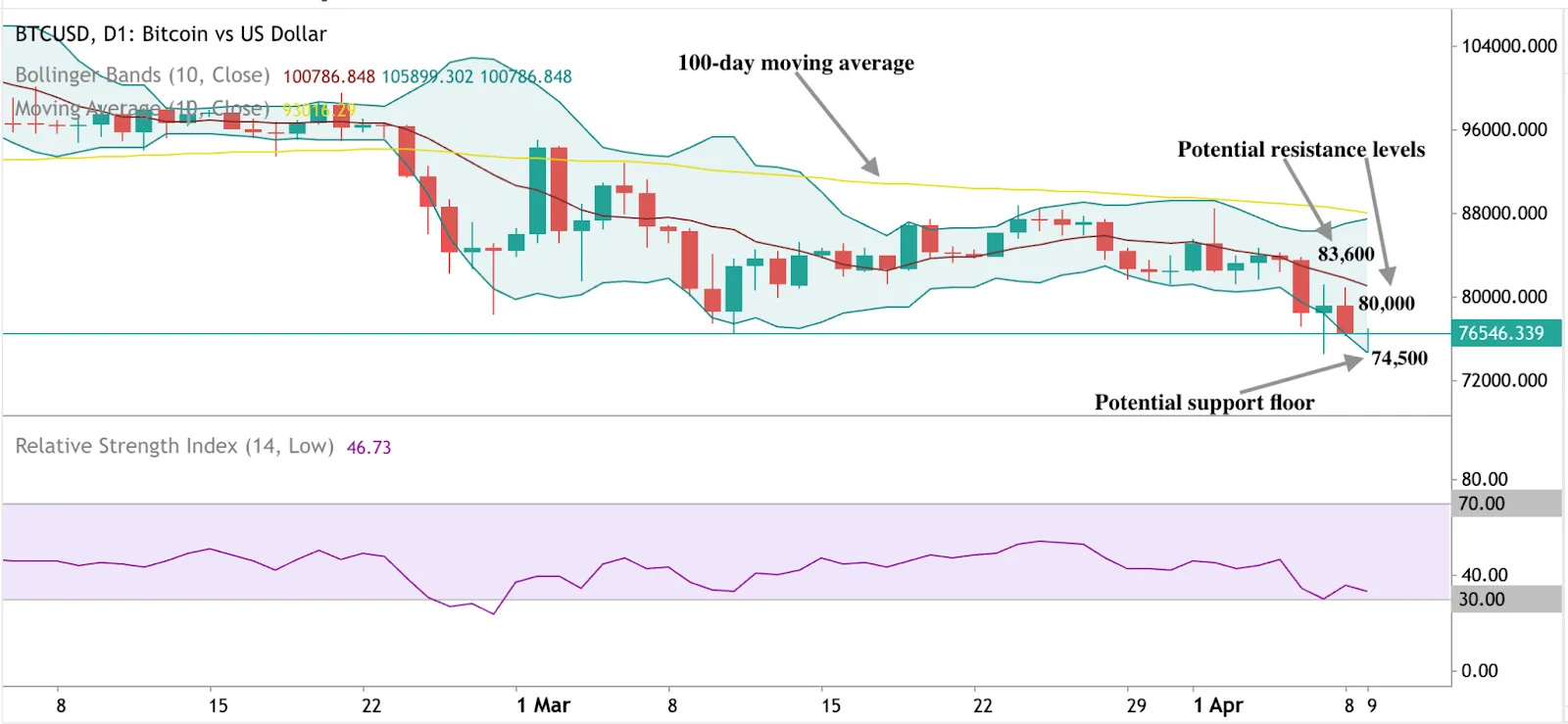
In the days ahead, the market’s focus will likely zero in on key Bitcoin levels: $76,600 as immediate support and $85,000 as resistance. Whether BTC breaks out or breaks down will shape the next chapter of its evolving role in the global financial system. For now, this could be a classic dead-cat bounce or the early tremors of a bigger narrative shift.
At the time of writing, bitcoin is finding support around the $76,000 mark. Bearish sentiment is still dominant, as the moving average staying above prices indicates that we are still in a bearish market. However, prices touching the lower Bollinger band indicate oversold conditions. Key levels to watch if prices see a bounce are $80,000 and $83,600. Should the downturn continue, a potential price floor is at $74,500
You can speculate on the price trajectory of the BTCUSD pair with a Deriv MT5 or Deriv X account.

Is the U.S. already in a recession? What you need to know
The question on everyone’s mind lately is: Are we officially in a recession?
The question on everyone’s mind lately is: Are we officially in a recession? As economic uncertainty continues to swirl, fueled by President Trump’s actions and growing fears about a global economic slowdown, many experts believe the U.S. economy is already in the midst of a downturn. But how accurate is the threat of a recession, and how should we think about the next few months in the market? Let’s dive in.
The tariff effect: The spark for market fears
It all started with tariffs. When President Trump unveiled his sweeping tariff plans, many hoped it would strengthen the U.S. economy by reducing the trade deficit. Instead, the tariffs have ignited market instability, triggering fears of an economic slowdown not just in the U.S. but globally.
Larry Fink, the CEO of BlackRock, made waves recently by suggesting the U.S. could already be in a recession. He’s far from alone in his assessment. According to a survey by CNBC, 69% of CEOs believe a recession is either already here or imminent. This growing consensus has sparked a wave of concern among investors and economists alike, leading to calls for caution in the market.
Is the U.S. already in a recession?
While we might not have the official numbers yet, there’s a strong argument that we could already be in a recession. Larry Fink and other industry leaders point to mounting signs of economic stress, with Goldman Sachs raising the likelihood of a U.S. recession to 45%-up from 35% the week before.

For context, a recession is often characterised by two consecutive quarters of negative GDP growth, rising unemployment, and other economic indicators.
While the official declaration may take time, the signals are already loud and clear: the U.S. economy is weakening. Many experts believe that we might be in the early stages of what could become a deeper recession.
Recession fears aren't just U.S.-Centric
The current downturn isn't just a U.S. phenomenon. Global markets are also feeling the pressure. President Trump’s tariff policies have rippled worldwide, with China and the European Union announcing countermeasures. This growing trade war has made traders nervous, and global growth projections have been downgraded.
JPMorgan’s CEO, Jamie Dimon, also warns that the U.S. economy could face even more struggles. While some believe the tariffs could eventually be beneficial in the long run, Dimon and other experts argue that they’re more likely to harm the economy in the short term by raising prices and stalling economic growth.
A look ahead: How could this play out?
With all this uncertainty, it’s natural to wonder what the future holds. Will we see a continued downturn? Or is this just a short-term blip in an otherwise resilient economy?
The case for a short-term drop
As mentioned earlier, Larry Fink has cautioned that we could see another 20% market drop before things settle. Given the current market volatility and the potential for tariffs to hurt U.S. economic growth, a short-term pullback is within the realm of possibility.
The idea of a 20% drop has spooked many, but it's worth noting that recessions-while painful-are part of the economic cycle. Even if a downturn is in progress, it might not necessarily lead to a severe long-term crash. Many market veterans view the current pullbacks as a natural correction rather than a precursor to something much worse.
A recession could push the Fed into action
If the U.S. economy does enter a full-fledged recession, the Federal Reserve will likely take steps to ease the pain. Markets are already pricing in interest rate cuts as early as this year, with some expecting three more cuts in 2025.
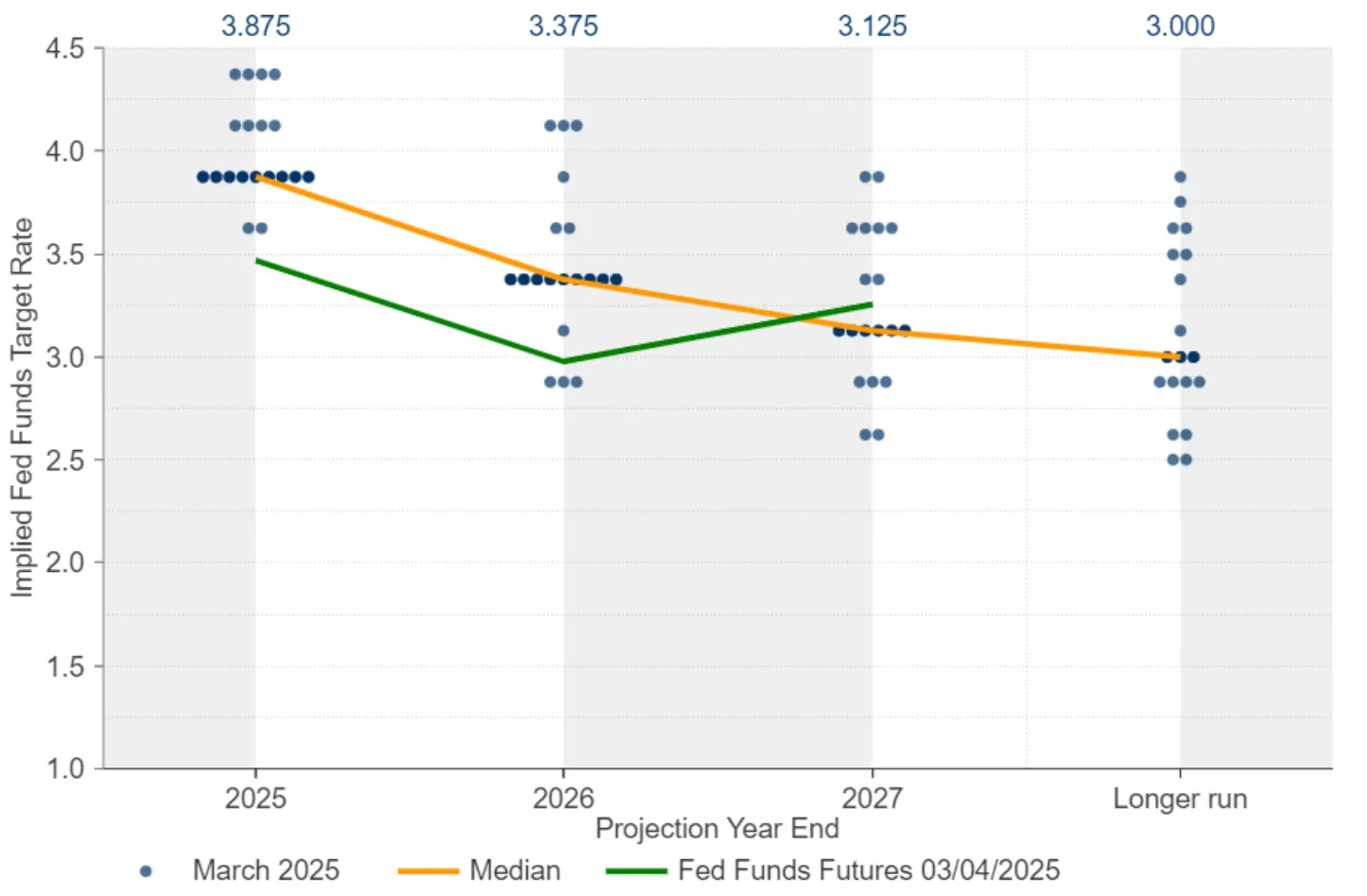
A rate cut could provide much-needed relief to consumers and businesses, but it could also signal an economy in a more fragile state than previously thought. The dollar could lose its edge as interest rates drop, especially as other global currencies look more attractive. This is something to watch closely, especially if you’re involved in international trade or investment.
The long-term outlook: Recovery after the storm
While the short-term outlook for the U.S. economy is bleak, history tells us that recessions tend to follow a cycle. Once the pain of the downturn is over, economies usually recover- albeit slowly.
The key question for many investors and economic strategists will be: how deep will this recession go? And how long will it take for recovery to take hold? While it’s hard to say with certainty, there are a few things to consider:
- Trade Policies Will Continue to Shape the Future: As long as trade tensions remain high, the U.S. economy will face headwinds. The longer-term question will be whether trade deals or diplomatic resolutions can stabilize the global economy.
- Global Economic Integration: The world is more interconnected than ever, so a downturn in the U.S. economy will affect markets globally. However, as other economies adapt and evolve, the recovery could come from overseas, with regions like Asia and Europe potentially leading the charge.
- Technological Advancements and Innovation: During past recessions, innovation has often driven recovery. Whether in tech, energy, or new industries, fresh breakthroughs could pull the economy out of a slump—if businesses and governments take the proper steps.
Technical outlook: Is the U.S. in a recession or just headed toward one?
According to experts, the signs are there. Traders must stay informed and flexible as the market reacts to economic signals. The volatility of the next few weeks could be challenging, but it also presents opportunities as currencies and assets fluctuate. If the dollar continues to lose its strength, it could significantly shift the global currency landscape if other economies recover before the U.S. does.
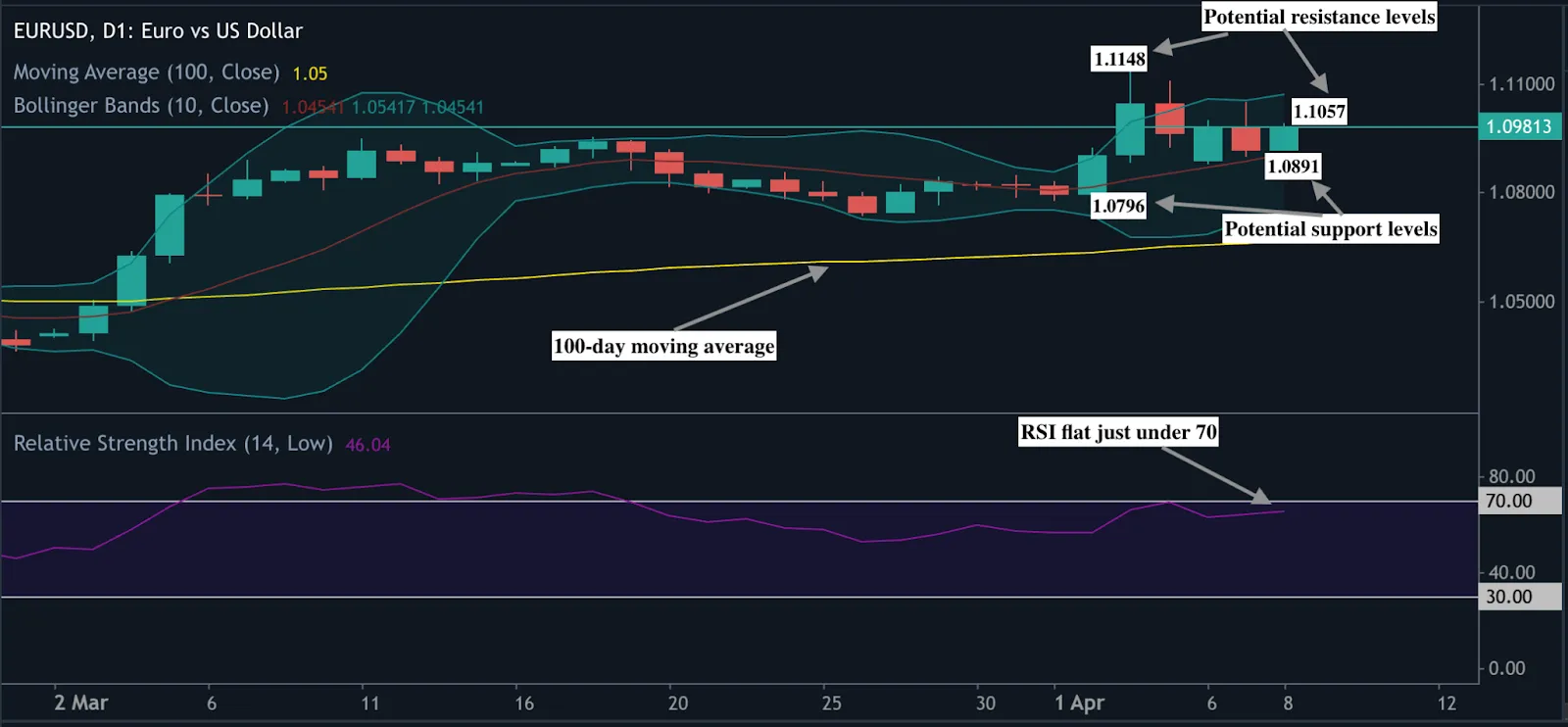
At the time of writing, EURUSD is inching up as the Euro gains on the dollar. The daily chart has some upward pressure bias as prices remain above the moving average. However, prices inching toward the upper Bollinger band hints at overbought conditions. Key levels to watch on the upside are $1.1057 and $1.1148, while on the downside, the levels to watch are $1.0891 and $1.0796.
You can speculate on the price trajectory of the EURUSD pair with a Deriv MT5 or Deriv X account.

Bitcoin price drop raises crypto safe-haven doubts
Bitcoin price drop to $77,700 triggered by Trump tariffs. Analysis of crypto market volatility, support levels, and whether BTC can still be a safe haven asset.
After weeks of remarkable resilience, Bitcoin is showing signs of strain. The largest cryptocurrency by market cap dropped to a three-week low of $77,700 over the weekend, falling more than 6% in 24 hours as global investors grappled with escalating trade tensions and a broad sell-off in risk assets.
Ethereum followed suit, plunging nearly 12% to $1,575. Solana and Cardano also saw sharp declines, echoing widespread volatility across the digital asset landscape. As macro pressures build, the crypto market is entering a crucial phase that could help define how digital assets behave in a high-stakes, policy-driven environment.
Crypto and the new macro equation
This time, the trigger was a sweeping new round of tariffs from the U.S., spearheaded by President Donald Trump. The administration’s universal 10% import tariff- alongside steeper, country-specific rates like 34% on Chinese goods and 20% on European Union imports-has rattled global markets and renewed fears of a prolonged trade war.
Equity futures were quick to react. The S&P 500, Nasdaq, and Dow futures all fell between 4–4.6% during early Asia trading hours.

Once CME futures opened, Bitcoin also began to slide, highlighting its increasing alignment with macro sentiment - at least in the short term.
“There was chatter that Wall Street desks were called in early ahead of CME’s open - the tension was in the air,” said Peter Chung of algorithmic trading firm Presto.
Support cracks, volatility returns
Just days earlier, Bitcoin had impressed market watchers by holding steady near $83,000 despite sharp losses in stocks and commodities. But as of Monday, BTC had dipped to $78,931 - a 5.6% drop in under 12 hours - breaking below the closely watched $80K support level.
That support wasn’t just psychological. According to Coinglass, nearly $793 million in leveraged long positions were stacked around the $81K level. Once that zone gave way, cascading liquidations may have amplified the move lower.

“Volatility is back, and with it comes opportunity,” said Pratik Kala, head of research at Apollo Crypto. “This feels like a setup for re-entry - cautiously, in small size. Traders wait for dust to settle, but those moments don’t last forever.”
From decoupling to recoupling?
Bitcoin’s earlier strength had fueled hopes of a long-awaited “decoupling” from traditional markets. When gold, silver, and equities sank, Bitcoin dipped only slightly before bouncing - suggesting it might be more defensive.
But this week’s sell-off complicates that narrative. With crypto suddenly moving in lockstep with broader markets, some wonder whether Bitcoin can truly act as a hedge - or if it’s still a high-beta asset caught in the same risk cycles as everything else.
Still, historical precedent offers some perspective. In March 2020, Bitcoin crashed alongside stocks during the initial COVID panic. However, weeks later, it began one of the strongest bull runs in its history - as institutional capital flooded into the space seeking alternatives to traditional assets.
Waiting on the next move
Much now depends on how policymakers respond. President Trump has called on the Federal Reserve to cut rates, pressuring Fed Chair Jerome Powell to act. Powell has maintained a cautious stance so far, but any sign of a dovish pivot could swiftly change the tone of global markets - and potentially crypto. The market’s response was swift: U.S. indices extended their losses, with the Nasdaq also falling 6% and into what increasingly looks like a bear market.

“There are hints of disagreement inside the White House on the pace of tariffs,” said Chung. “If Trump walks it back or signals flexibility, that could trigger a sharp rebound in risk assets - including crypto.”
At the same time, ongoing geopolitical uncertainty is likely to keep volatility high. Investors will be watching for the European Union’s response and further guidance from U.S. monetary authorities. In this environment, Bitcoin’s behavior may offer early signals about where investor confidence is heading.
Solana under pressure
Solana continues to face challenges of its own. The $150 resistance level has proved stubborn, with the token now hovering closer to $120. A recent $200 million token unlock added more supply-side pressure, further weakening sentiment.
Despite the downturn, institutional adoption continues in the background. PayPal’s recent integration of Solana reminds us that infrastructure is still being built, even if prices aren't reflecting it yet. But with momentum stalling, traders seek stronger catalysts to revive interest.

Technical outlook: Looking ahead
Whether this marks a temporary correction or the early stages of a more profound market shift remains to be seen. Crypto’s current price action underscores its growing entanglement with global macro forces - a sign of maturity and vulnerability.
If Bitcoin stabilizes and reclaims higher levels in the coming days, it may reinforce its emerging reputation as a resilient asset during uncertainty. If not, the coming weeks could test investor conviction in new ways.
At the time of writing, BTC has fallen sharply below $80,000, and downward pressure is now dominant on the daily chart as prices remain below the moving average. However, prices are also inching below the lower Bollinger band, signaling oversold conditions, which could lead to a bounce. Should a bounce occur, key levels to watch would be $85,000 and $88,500 and on the downside, the key level to watch is $76,400.

Solana is also dipping after holding over the weekend, with a clear downward bias on the daily chart as prices remain in a sell zone. However, prices are also inching below the lower Bollinger band, signaling oversold conditions, which could lead to a bounce. Should a bounce occur, key levels are $120.00 and $136.00. On the downside, the key support level to watch will be around $99.00.

You can participate in and speculate on the price of these two cryptos with a Deriv MT5 or Deriv X account.

Boost your Gold and Silver trading potential, not your risk, with Multipliers
Maximise Gold and Silver trading potential with Deriv's Multipliers. Amplify returns, cap risks, and trade swap-free with no overnight fees.
What if you could double your Gold returns from a 1% price movement while never risking more than your stake?
You can now trade Gold and Silver using Multipliers on Deriv, allowing you to hold positions overnight without swap fees, amplify market movements in either direction, and trade with certainty about your maximum risk.
Why trade Gold and Silver with Multipliers?
Multipliers let you increase your market exposure without increasing your capital outlay. You set your stake and a Multiplier level, and your potential return is scaled based on both. If the market moves in your favour, your gains are multiplied. If it moves against you, your maximum loss is limited to your stake — no margin calls, no negative balance.
When trading Gold and Silver with Multipliers, you’ll benefit from:
- 100% swap-free trading: Hold positions indefinitely without overnight fees eating into your potential profits.
- Limited risk by design: Your maximum potential loss is strictly capped at your initial stake amount.
- No negative balances: Trade with confidence knowing you can never lose more than you invest.
- Customisable leverage: Choose from various multiplier levels to match your risk appetite, account size, or market conditions.
- Amplified returns: Multiply your profits when the market moves in your direction.
What this could look like in Gold trading
Let’s say you trade Gold with a multiplier of 100 and a $20 stake.
If Gold moves 1.5% in your favour, here’s what happens:
- $20 x 100 x 1.5% = $30 profit
That’s a 150% return on your stake from a relatively small market move!
If the market moves against you by the same amount (1.5%), the calculated loss would be $30. But because Multipliers cap your risk at your stake, you’d only lose your $20. Your exposure is amplified, but your risk stays fixed.
Gold and Silver automated trading
For those interested in automated trading, Multipliers are fully integrated with Deriv Bot. This means you can:
- Create trading bots without any coding knowledge
- Automate your precious metals trading strategies
- Deploy bots with zero build costs
Start trading Multipliers on Gold and Silver today
With no swap charges, tailored multiplier levels, and automated trading, you have more ways to stay active in the market without taking on additional complexity or cost.
Multipliers on Gold and Silver are available to trade on Deriv Trader, Deriv Bot, and Deriv GO.
Log in to your Deriv account and start trading today. If you’re new to Deriv, sign up now to trade precious metals with more flexibility, more control, and no swap fees.

Bitcoin’s price drop and the ripple effect: What’s next for crypto?
The crypto market has been on a rollercoaster lately, with Bitcoin (BTC) taking center stage in the latest turbulence.
The crypto market has been on a rollercoaster lately, with Bitcoin (BTC) taking center stage in the latest turbulence. Following President Trump’s announcement of reciprocal trade tariffs, Bitcoin dipped below $83,000 before a slight bounce-back, dragging the entire market, including XRP-down.
Traders are now trying to gauge the long-term impact of these developments, with speculation swirling about how major players like the Federal Reserve and institutional investors might react. But is this just a temporary setback, or are we seeing a more significant shift in the crypto landscape?
Bitcoin’s wild ride: Trump tariffs, rate cuts, and market jitters
Bitcoin was climbing in the lead-up to Trump’s tariff announcement, but once the news hit, the price tumbled. The uncertainty surrounding global trade policies has left traders scrambling to reposition themselves, with short-term interest-rate futures now pricing in a 64.8% chance of a Fed rate cut in June from 60% before the tariffs were announced.
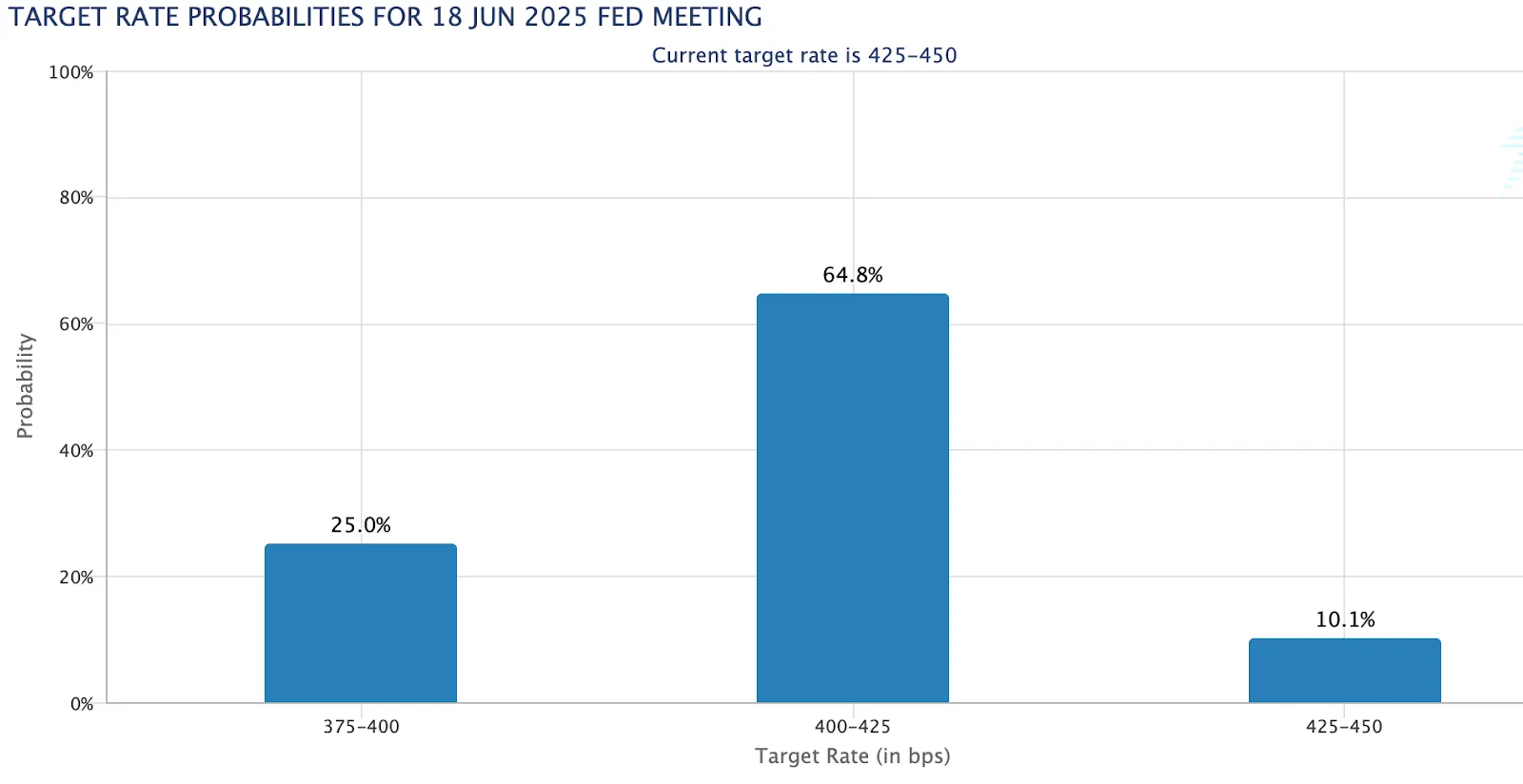
Why does this matter? If the Fed starts cutting rates to stave off a recession, it could flood the market with dollars, which could fuel renewed demand for BTC. Some analysts believe that if Bitcoin holds above $76,500 by mid-April, it could signal the end of this downturn, potentially setting up another rally toward the $100K mark and beyond.
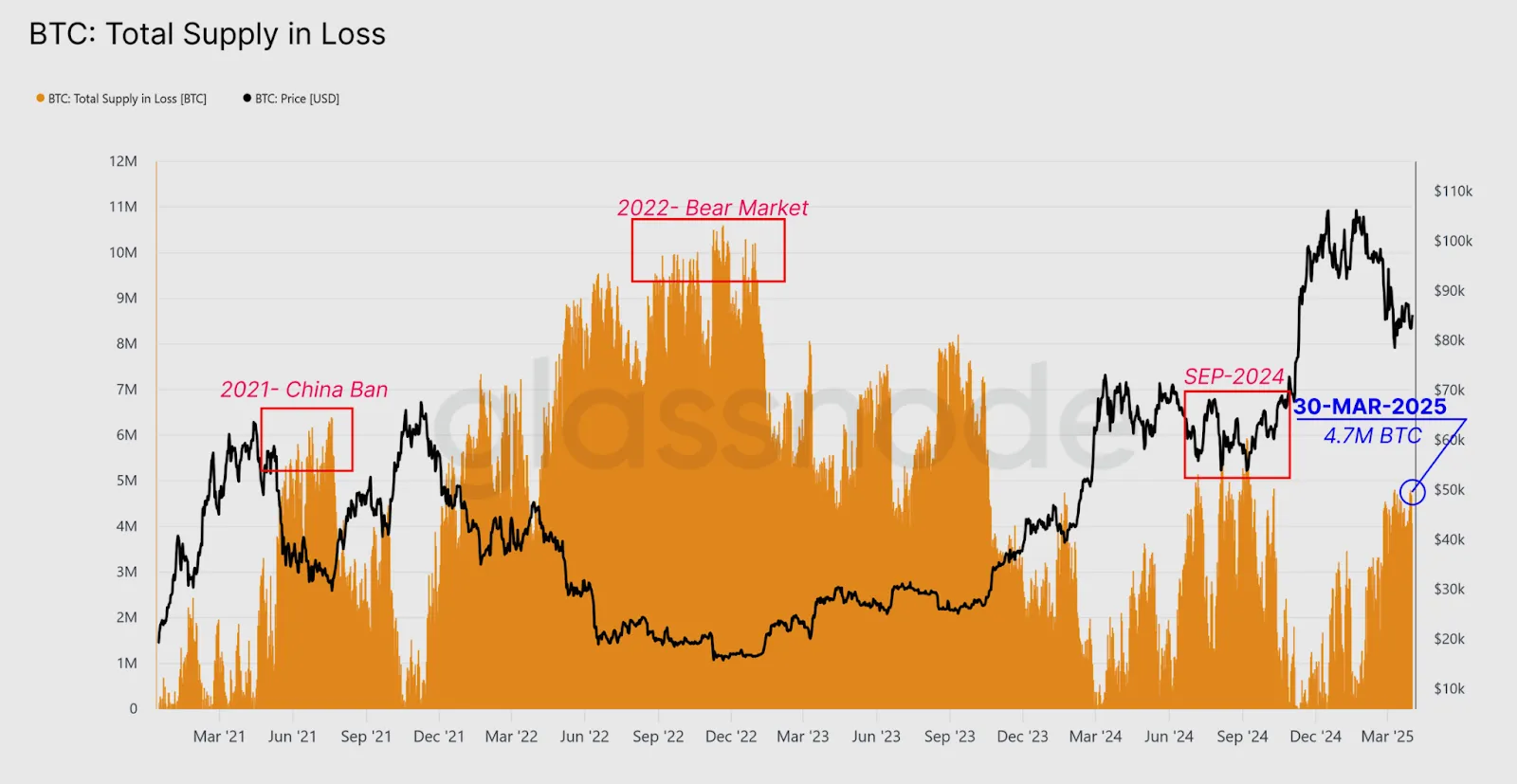
Meanwhile, Glassnode’s latest report suggests Bitcoin is showing early signs of a bear market, with many holders now sitting on unrealised losses. The current market shows typical bear market signs: weakening momentum, shrinking profitability, tighter liquidity, and negative sentiment. Investors are taking losses, driven by fear.
Historically, bear markets end with capitulation, setting the stage for recovery. As of 30 March, 4.7M BTC were held at a loss, indicating the market may be nearing exhaustion but still has the potential for more pain before bottoming out.
XRP price prediction: Market speculation and the American Express rumors
The ripple effect (pun intended) of Bitcoin’s decline has been particularly harsh on XRP, which dropped 5% following Trump’s tariff news. This wiped-out gains fuelled by Ripple’s confirmation that RLUSD, its new stablecoin, is now integrated into Ripple Payments.
Adding to the XRP buzz, rumours have been swirling about a potential partnership between Ripple and American Express to introduce a crypto-backed debit card. The speculation, fuelled by social media figures like XRP Chancellor and “Alts King,” suggested that such a partnership could be a game-changer for XRP adoption.
But let’s separate hype from reality. While Ripple and American Express collaborated in 2017 to improve cross-border payments, there has been no official confirmation of a crypto debit card partnership. Investors should remain cautious and rely on company statements rather than social media speculation.
Technical outlook: A look at crypto market volatility?
The broader crypto market is still reacting to macroeconomic events, and Bitcoin remains the key indicator of where things go next. If BTC stabilises and climbs back toward $100K, it could lift the entire market, including XRP. However, if the bearish momentum continues, we may see further corrections before the next leg up.
One thing’s for sure: Crypto is no stranger to volatility, and while rumors can create short-term excitement, real value lies in confirmed developments and macroeconomic trends.
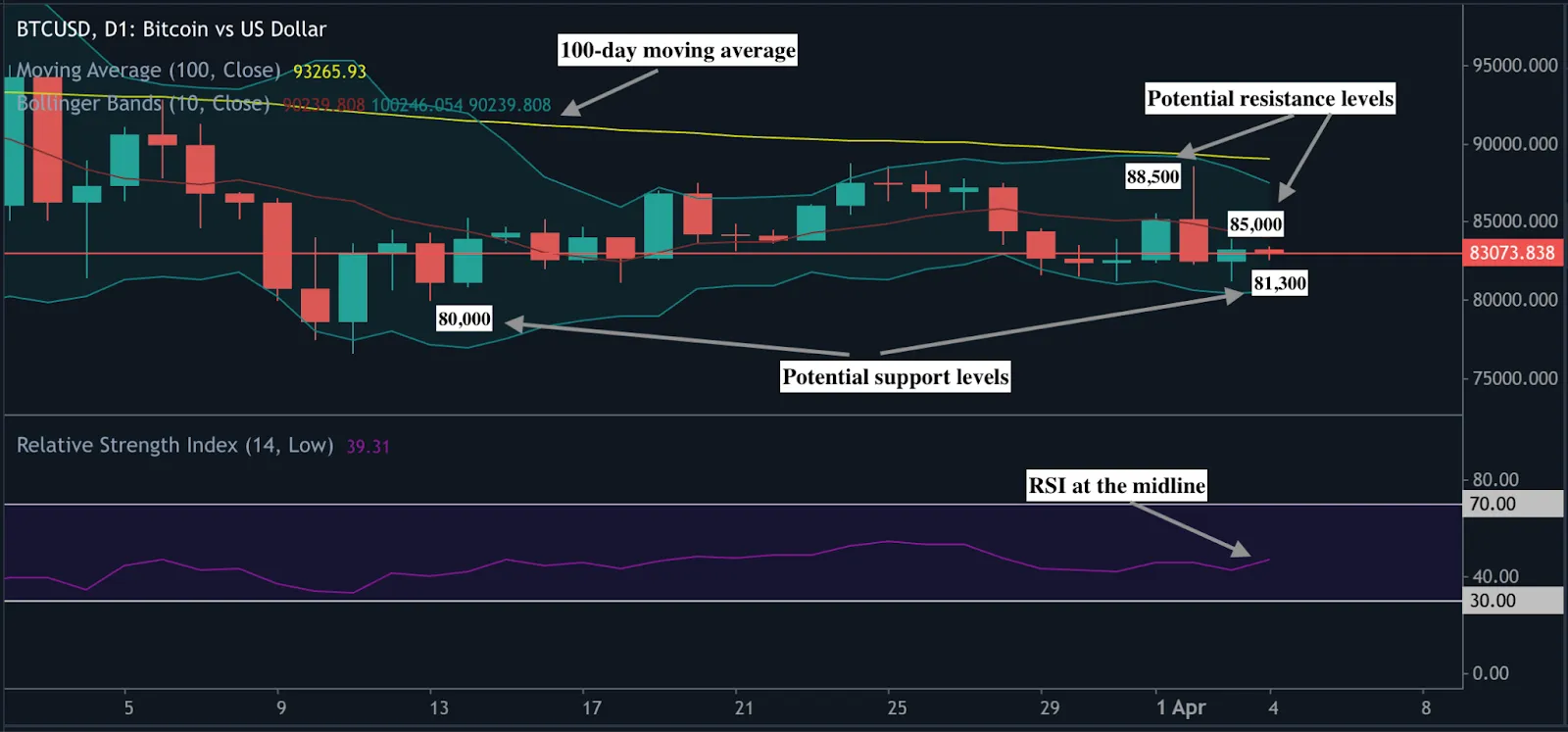
At the time of writing, BTC has bounced back above the $83,000 mark. Bearish sentiment appears dominant as prices remain below the moving average. However, prices touching the lower Bollinger band hints at oversold conditions- signaling a potential reversal. RSI rising steadily also supports the reversal argument. Key levels to watch on the upside are $85,000 and $88,500. On the downside, the key levels to watch are $81,300 and $80,000.
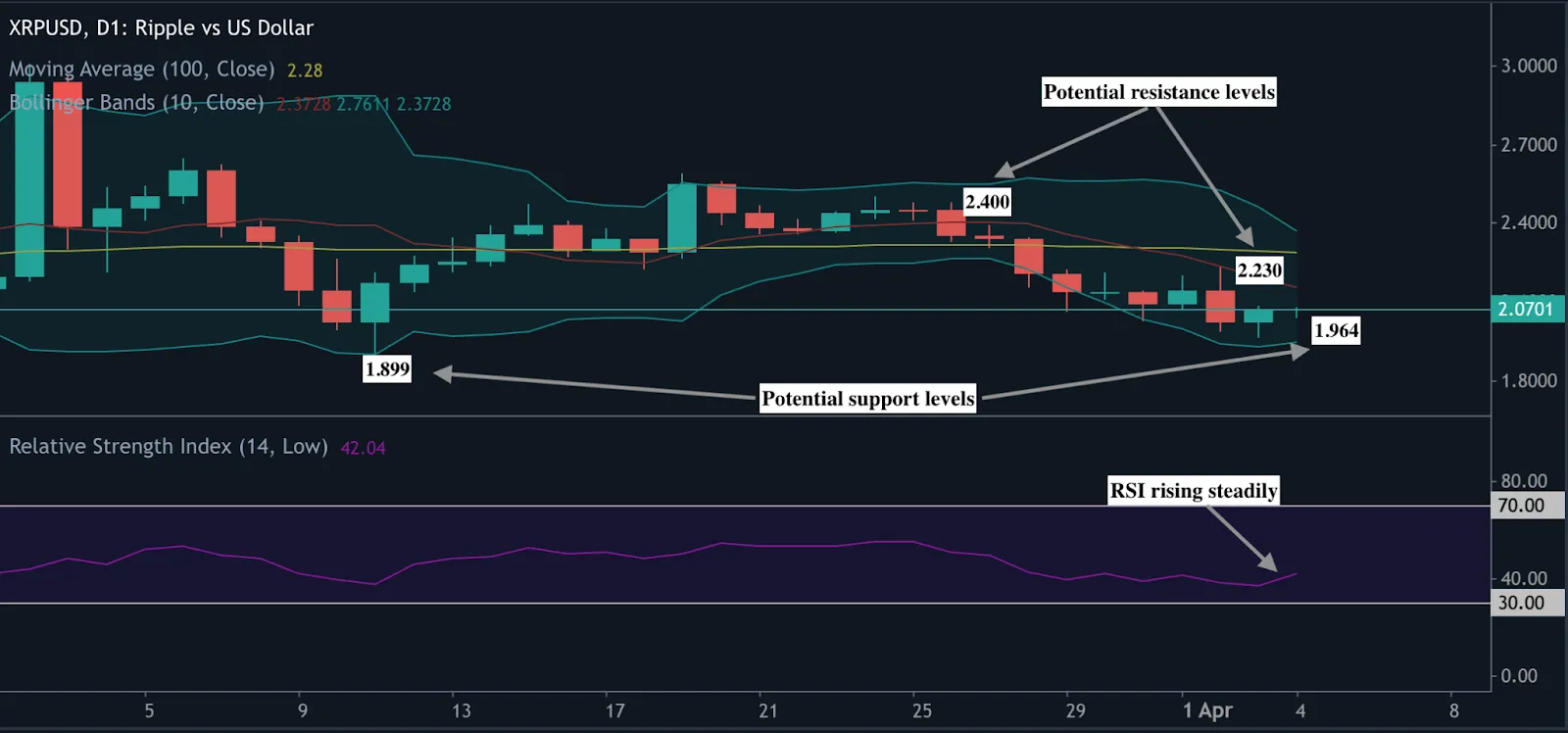
Bearish sentiment also dominates the XRP daily chart. However, prices almost touching the lower Bollinger band hints at oversold conditions- signalling a potential reversal. RSI rising smoothly also hints at building upward pressure. Key price levels to watch on the upside are $2,230 and $2,400. On the downside, key support levels are $1.964 and $1,899.
You can participate in and speculate on the price trajectory of BTCUSD and XRPUSD with a Deriv MT5 or Deriv X account.

Gold and Silver Investment: Will the safe-haven demand hold?
Gold is on fire, and silver isn’t far behind.
Gold is on fire, and silver isn’t far behind. With global trade tensions rising, precious metals are cashing in on market uncertainty, proving why they remain the ultimate haven investments.
The tariff earthquake and its ripple effects
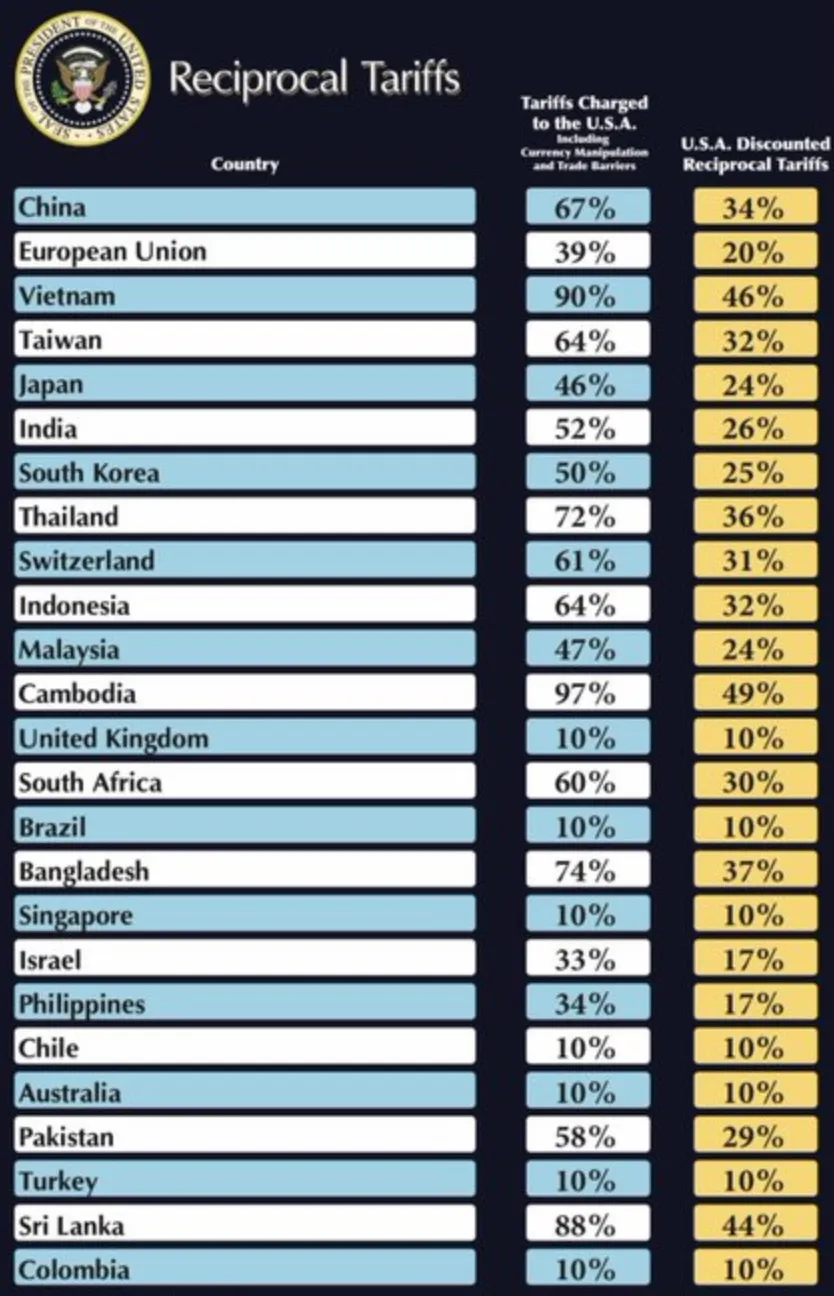
Recent trade policy shifts have sent shockwaves through the global economy. On what’s now being called "US Liberation Day," President Trump announced sweeping new tariffs: a 10% baseline on all imports, 25% on automobiles, and steeper reciprocal tariffs hitting China (34%), the EU (20%), Vietnam (46%), Japan (24%), and the UK (10%).
Markets reacted swiftly. The U.S. dollar slipped, stocks wobbled, and gold surged past $3,100, with $3,200 now the next target. Since Trump’s election win, gold has gained over 23%, climbing from a low of $2,560 in mid-November to its current high.
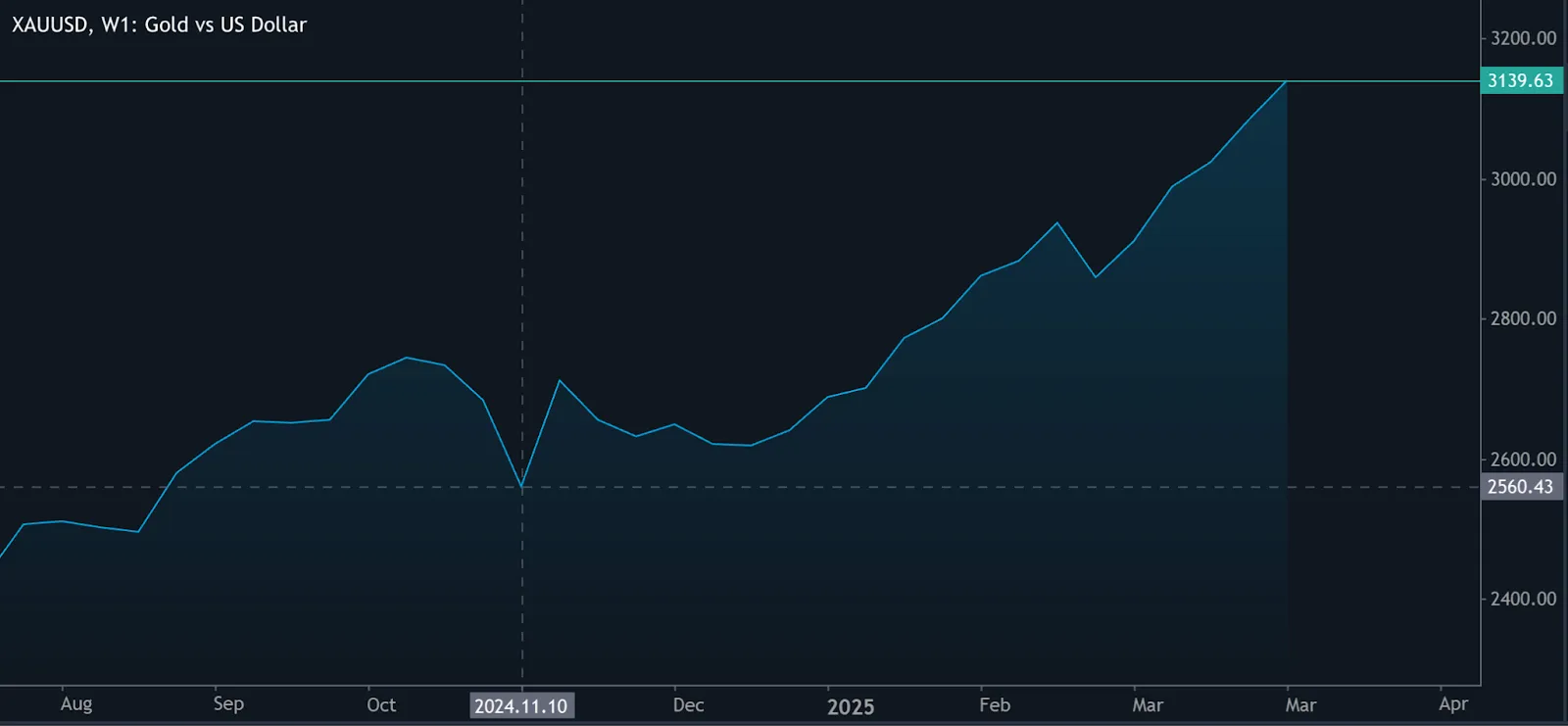
Analyst Tai Wong notes that these tariffs are "much more aggressive than expected," fueling volatility and increasing demand for safe-haven assets.
Safe havens in demand
Whenever economic uncertainty spikes, investors instinctively flock to gold and silver. Gold’s resilience is particularly striking. Typically, rising U.S. Treasury yields would weigh on non-yielding assets like gold. But this time, fear and inflation concerns are overriding traditional market dynamics, according to analysts.
Often overshadowed by gold, silver is making its case for a breakout. It recently touched $34 before a significant pullback. Time will tell whether the current pullback will attract enough dip buyers to push the white metal to new highs.
The Fed’s dilemma
Adding to the intrigue, the Federal Reserve is now facing a challenging crossroads. The latest economic data shows strength. ADP reported that private-sector hiring jumped to 155K in March, well above February’s 84K.
Factory orders rose 0.6% month-over-month, slightly above expectations. These numbers suggest the economy remains resilient despite looming trade tensions.
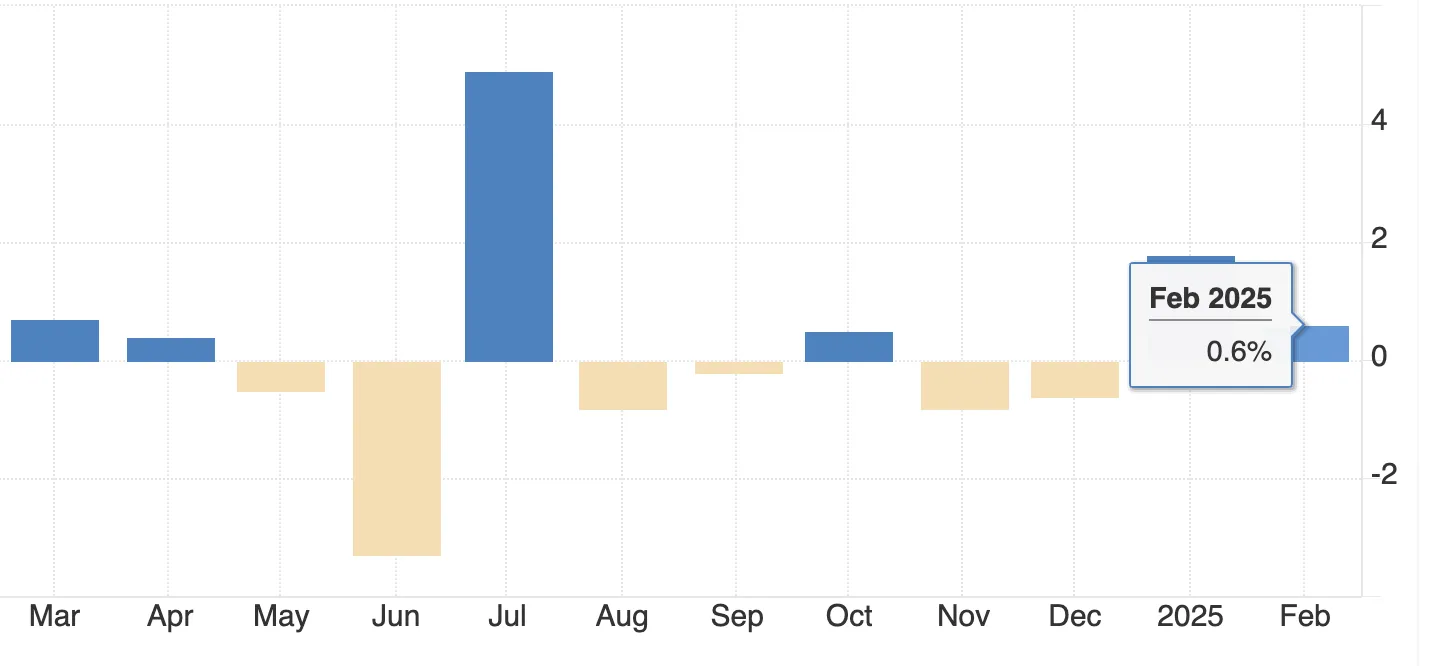
However, inflation pressures are rising. Trump’s tariffs are expected to push prices higher, making it difficult for the Fed to justify rate cuts. On the other hand, hiking rates won't be a viable option if economic growth slows due to a prolonged trade war. This policy limbo creates an ideal environment for metals, which tend to thrive when traditional financial tools lose effectiveness.
A long-term metals outlook
Gold and silver aren’t just reacting to recent trade tensions-they reflect deeper concerns about global economic stability. With tariffs threatening to reshape international trade and monetary policy at a crossroads, investors increasingly turn to precious metals as a hedge against uncertainty. Whether this turns into a full-fledged metals bull market remains to be seen, but one thing is clear: silver is back in the spotlight.
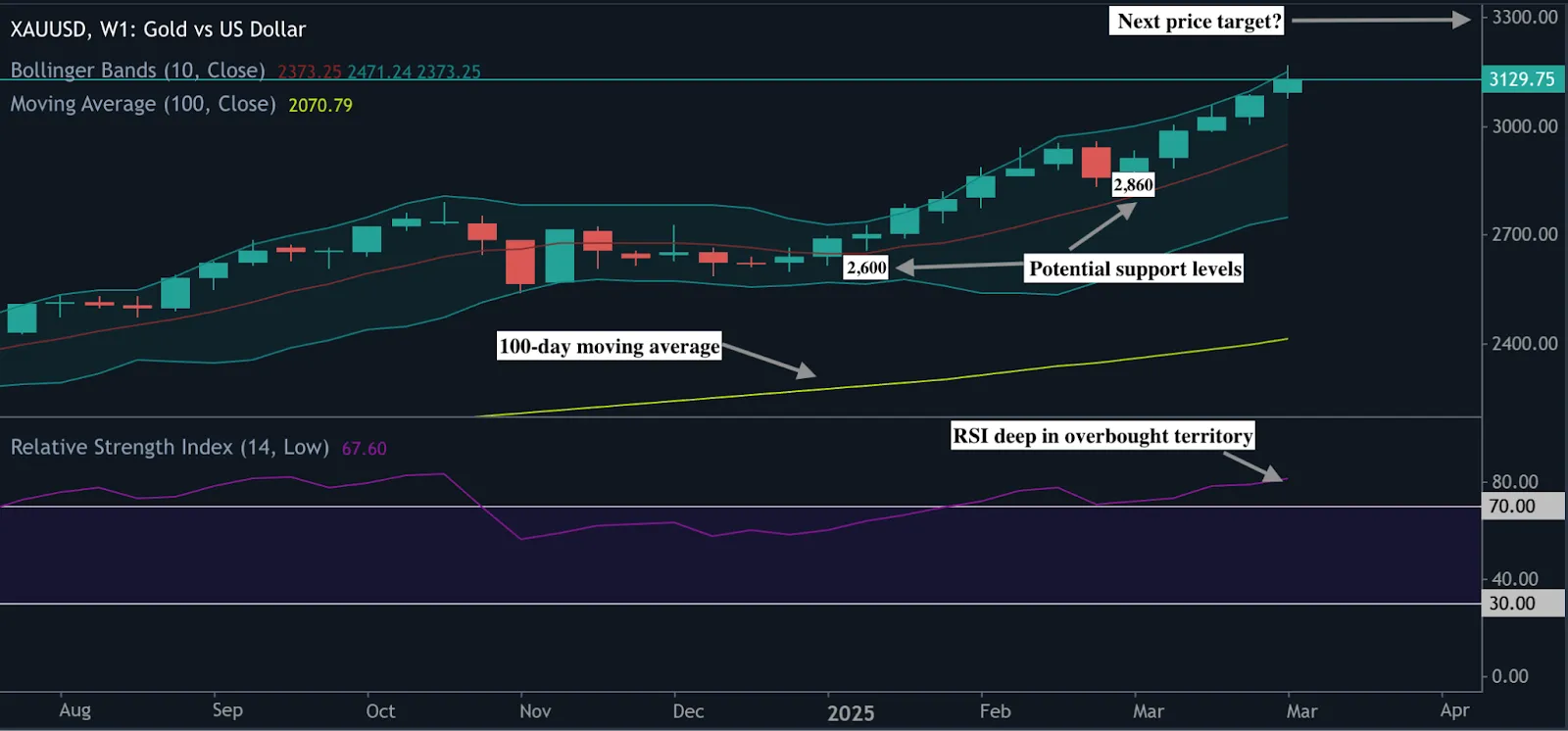
Gold sees a slight retreat at the time of writing, though upside pressure remains dominant. Prices remaining elevated above the 100-day moving average add to upside sentiment. However, RSI deep in overbought levels, while prices touch the upper Bollinger band, paints a picture of overbought conditions.
Key levels to watch should prices retreat are $2,860 and $2,600, should prices remain on a tear, the next target could be $3,300.
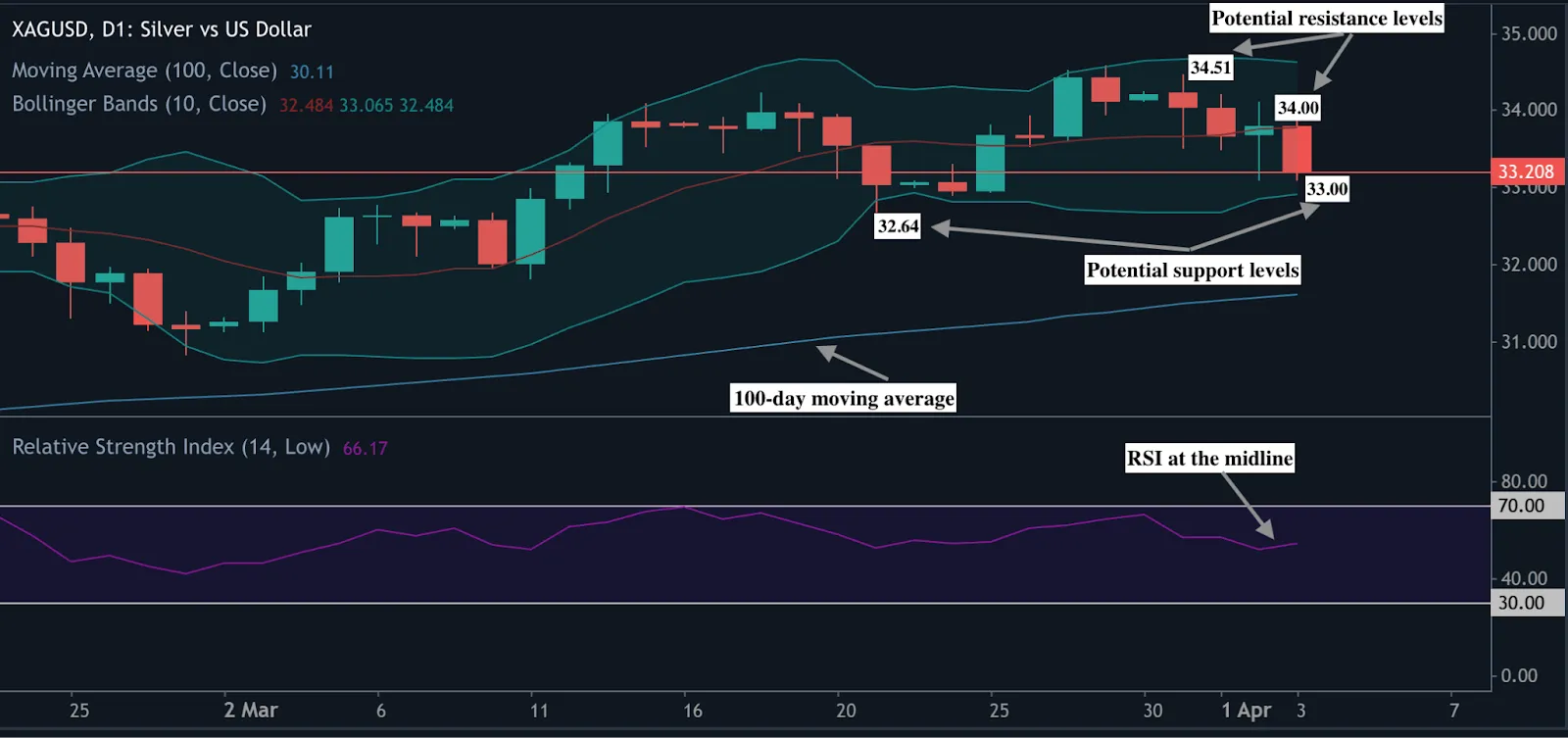
Conversely, Silver is seeing a significant retreat as the RSI holds almost flat around the midline, an indicator that upside momentum is waning. However, prices nearly touching the lower Bollinger band hint at oversold conditions. Prices above the 100-day moving average also suggest that the main trend is still upward.
Should prices continue retreating, key levels to watch are $33.00 and $32.64. They could touch the $34.00 and $34.51 resistance levels if prices rebound.
You can participate in and speculate on the price of these two precious metals with a Deriv MT5 or Deriv X account.

Yen volatility ahead? The potential effects of trade Policy on USD/JPY
The Japanese yen is caught in a fierce tug-of-war, and global markets are watching closely.
The Japanese yen is caught in a fierce tug-of-war, and global markets are watching closely. Why? Because shifting trade policies, particularly those involving tariffs, continue to shake up the forex landscape. With major economies recalibrating their strategies, the stakes couldn’t be higher-these moves could send shockwaves through global markets, ignite massive forex volatility, and create some of the best trading opportunities we’ve seen in months.
Let’s break it down.
Bank of Japan monetary policy is a huge factor
Despite occasional gains against the USD, the yen often struggles to build sustained momentum. Market anxiety leaves traders hesitant, waiting for policy shifts to set the tone. This kind of indecision is a breeding ground for opportunity-when traders hesitate, sharp market moves often follow.
Here’s where things get interesting: Japan is in a tough spot. According to analysts, if new tariffs or trade restrictions hit Japanese exports hard, the Bank of Japan (BoJ) may have to reconsider its monetary policy approach to protect the economy. But at the same time, Tokyo’s inflation data suggests the BoJ needs to keep tightening. It’s a classic rock-and-a-hard-place scenario.
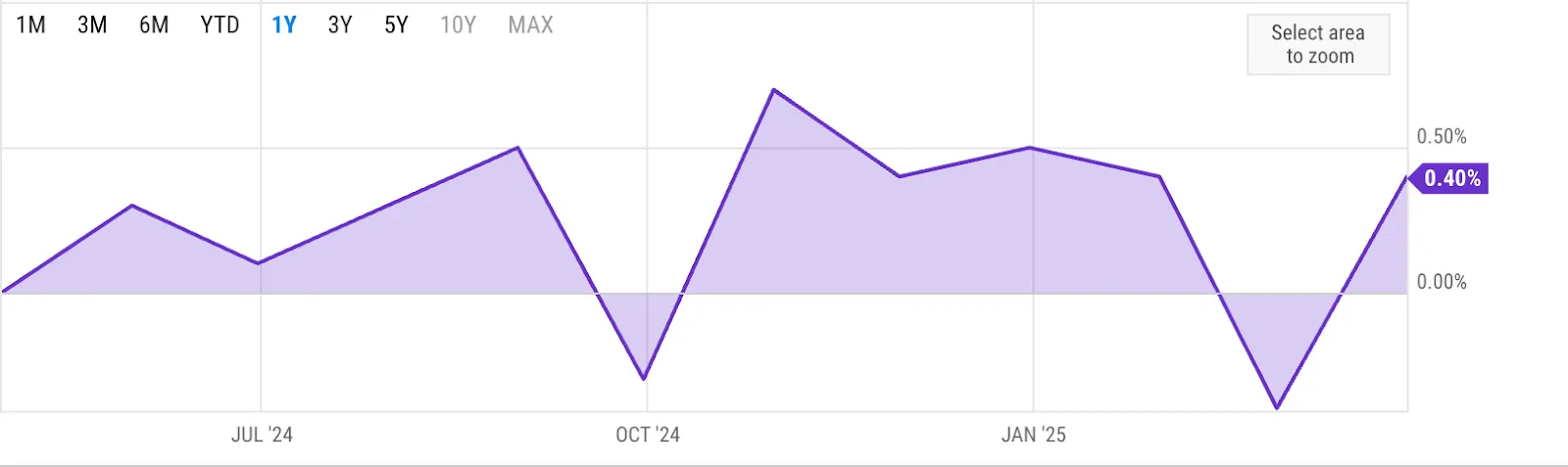
Meanwhile, recent policy signals suggest that trade restrictions could become broader, targeting multiple economies instead of just a select few with major trade imbalances. That’s especially bad news for Japan’s export-heavy economy, which is highly sensitive to global trade disruptions.
EUR/USD in limbo as Trump’s tariffs spark market jitters
EUR/USD remains pinned near the 1.0800 level, reflecting the market’s nervous anticipation of upcoming trade policies. Traders are bracing for the long-threatened "reciprocal" tariffs announcement. The uncertainty is palpable-Trump has already delayed this decision four times in just 71 days in office, leaving investors unsure of what’s actually coming.
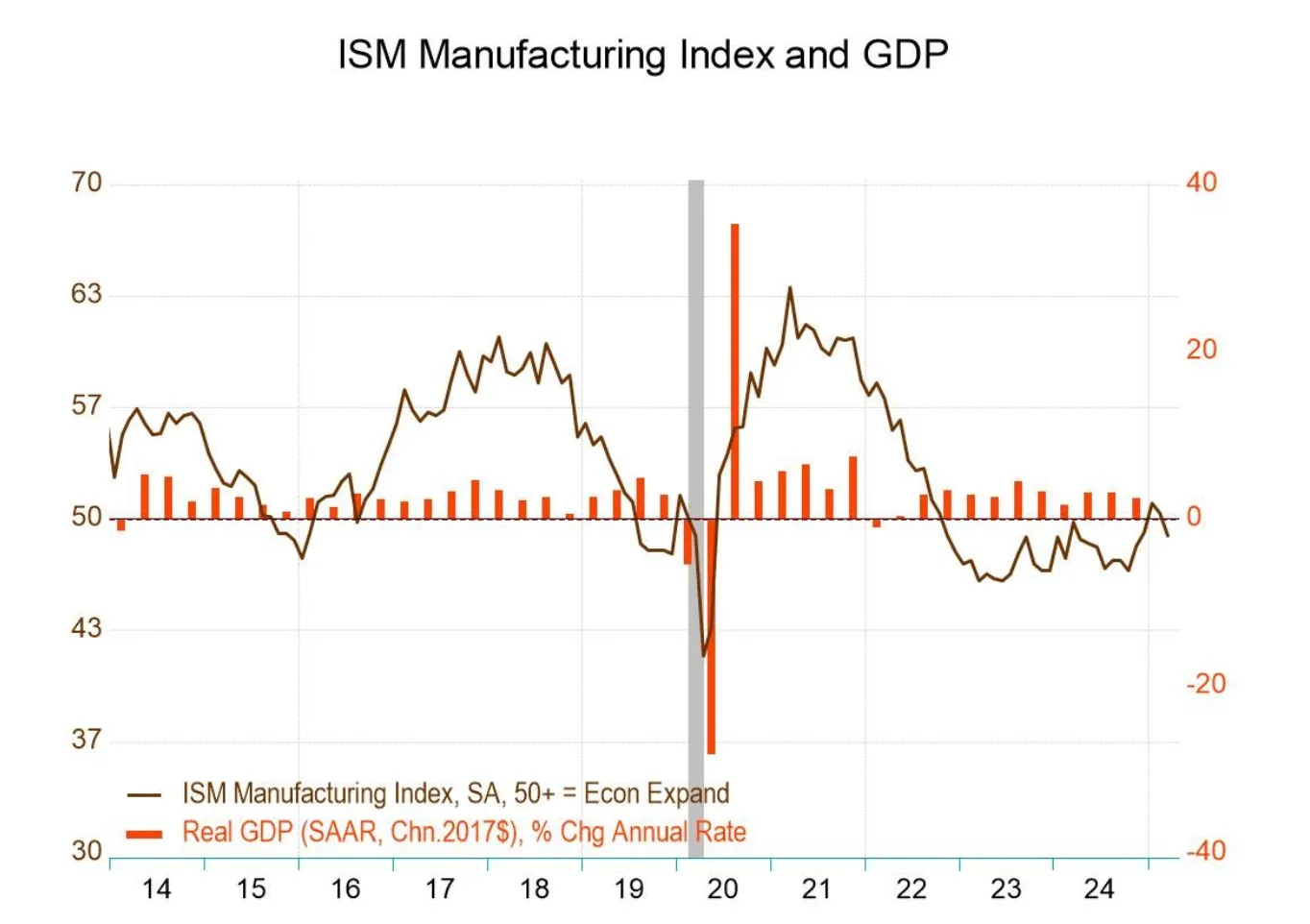
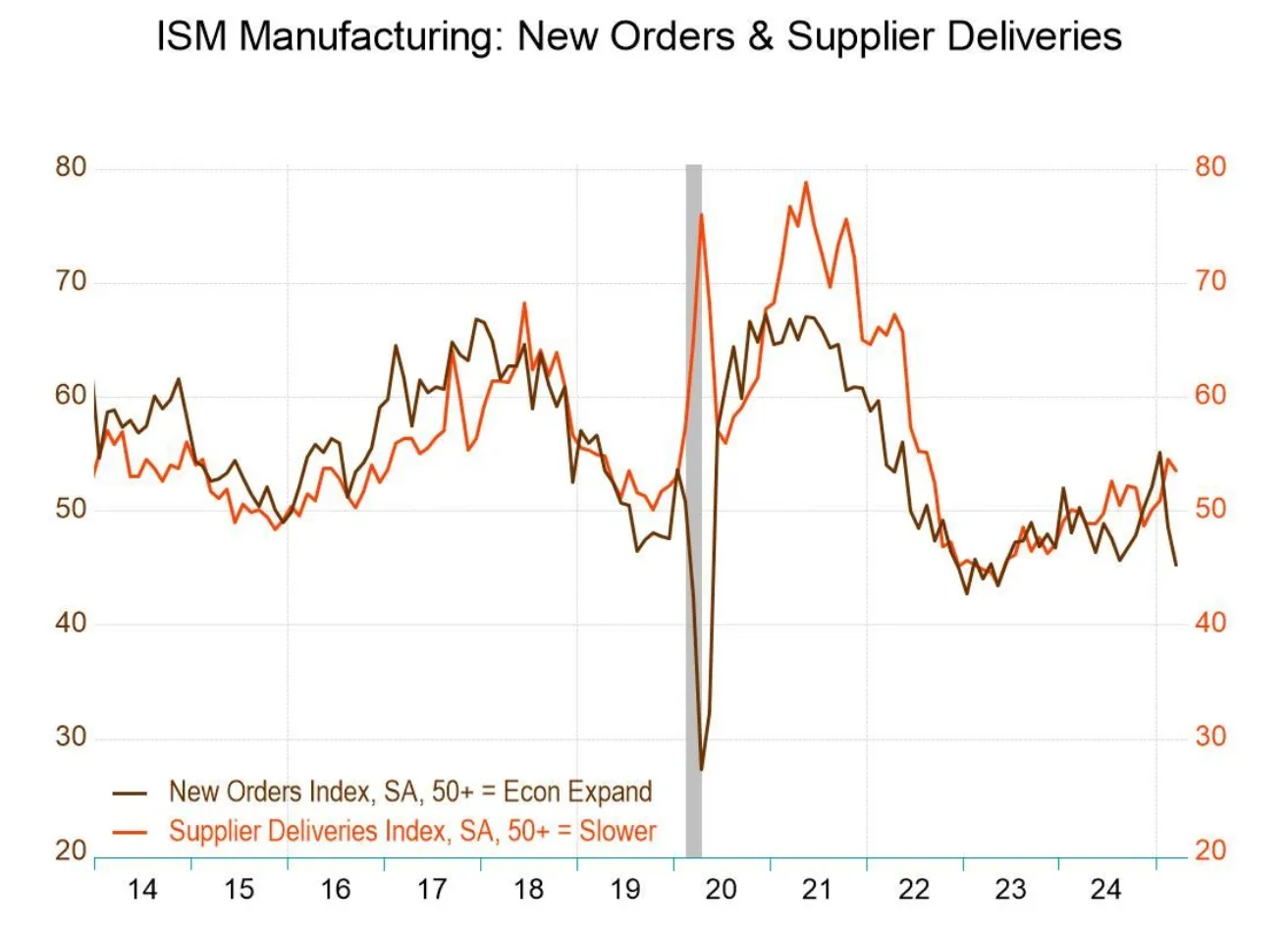
Adding to the tension, the US ISM Manufacturing PMI for March sank to 49.0 from 50.3, indicating contraction as businesses hunker down ahead of the expected tariff shake-up. The Manufacturing New Orders Index also fell sharply to a two-year low of 45.2, signalling growing economic concerns.
Forex market volatility: The great rate divergence
Central banks are moving in opposite directions. While the BoJ is expected to continue tightening, the Federal Reserve and other major central banks are increasingly signaling potential rate cuts. Normally, this kind of divergence would push JPY higher against USD. But right now, trade uncertainty is overriding everything, keeping traders on edge.
Across the world, economic signals are flashing warning signs. Manufacturing contractions, rising inflation, and labor market shifts are fueling concerns about slower global growth. The specter of stagflation-a toxic mix of slowing growth and persistent inflation-remains a key risk for major economies. And if trade policies tighten further, those fears could turn into full-blown market volatility according to analysts.
Meanwhile, the upcoming US Nonfarm Payrolls (NFP) report this Friday is expected to serve as a bellwether for how these new trade policies might impact the economy. If labor figures disappoint, markets could see an even greater shake-up in the coming days.
Trump’s "Liberation Day" and tariffs impact
Trump has been calling April 2 "Liberation Day" for weeks, reports suggest that a blanket 20% tariff on nearly every country is on the table. While such a move could theoretically boost the US dollar, analysts warn that the real concern is whether tariffs accelerate stagflation risks in the US economy.
"Markets are going to be jittery ahead of the announcement," says Carol Kong, a currency strategist at Commonwealth Bank of Australia. And the uncertainty isn’t going anywhere-traders will be digesting tariff impacts well beyond this week.
So, where does that leave the JPY trade? It all comes down to timing. If you’re watching for market reactions to evolving trade policies, there could be some incredible entry points.
USDJPY analysis: Outlook as tariff wars rage on
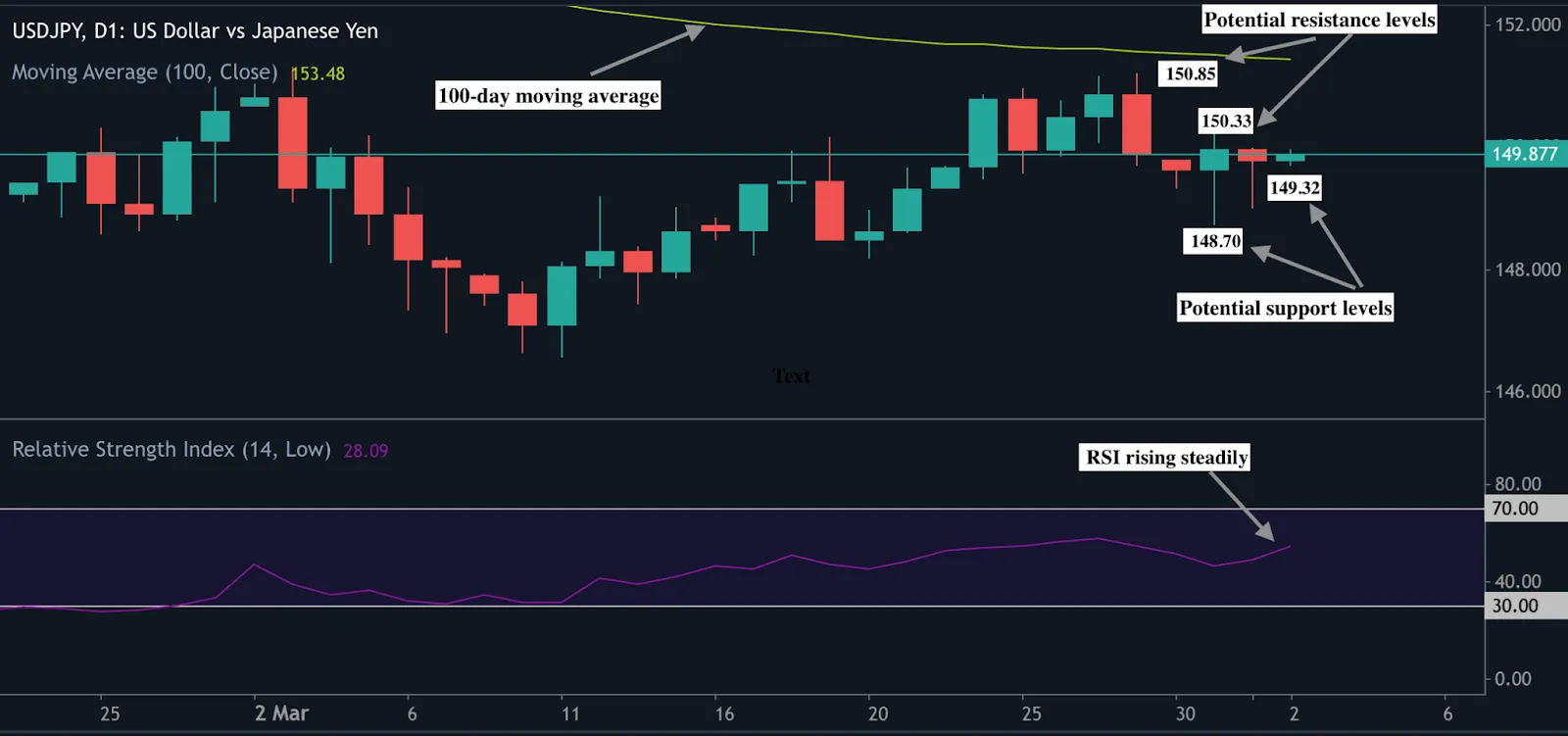
At the time of writing, the USDJPY pair is in consolidation mode. Upward pressure is limited as downward pressure also finds support. Prices remaining below the moving average, suggests that the major trend is still bearish for the pair, however RSI rising steadily just above the midline suggests that some upward pressure could be building.
Key levels to watch on the upside are $150.33 and $150.85. On the downside, the key support levels to watch are $149.32 and $148.70.
With “Liberation day” upon us, you can get involved and speculate on the price action of the pair, with a Deriv MT5 account or a Deriv X account.

Gold and Silver price forecast: What’s next after breaking key levels?
Gold is back in the spotlight after smashing through $3,120!
Gold is back in the spotlight after smashing through $3,120! But this isn’t just another price movement-it’s a major signal about what’s coming next. Between Trump’s tariff threats, growing recession fears, and geopolitical chaos, we’ve got the perfect storm for gold.
But this isn’t just a short-term story-here’s what the road ahead could look like.
The tariff tsunami is pushing Gold higher
Trump is back with his favorite economic weapon-tariffs. His latest proposal? A massive 25% tariff on all foreign cars. That news alone sent markets into a frenzy. But now, the Wall Street Journal is reporting that he’s considering even broader tariffs against multiple countries. Investors don’t like uncertainty, and when things start looking shaky, they run to gold. And that’s exactly what’s happening.
Longer-term, if trade tensions continue to escalate, we could see persistent demand for gold as a hedge. Historically, prolonged trade wars weaken global economic confidence, and gold tends to shine brightest when investors lose faith in traditional markets.
Fear is driving this Gold rally
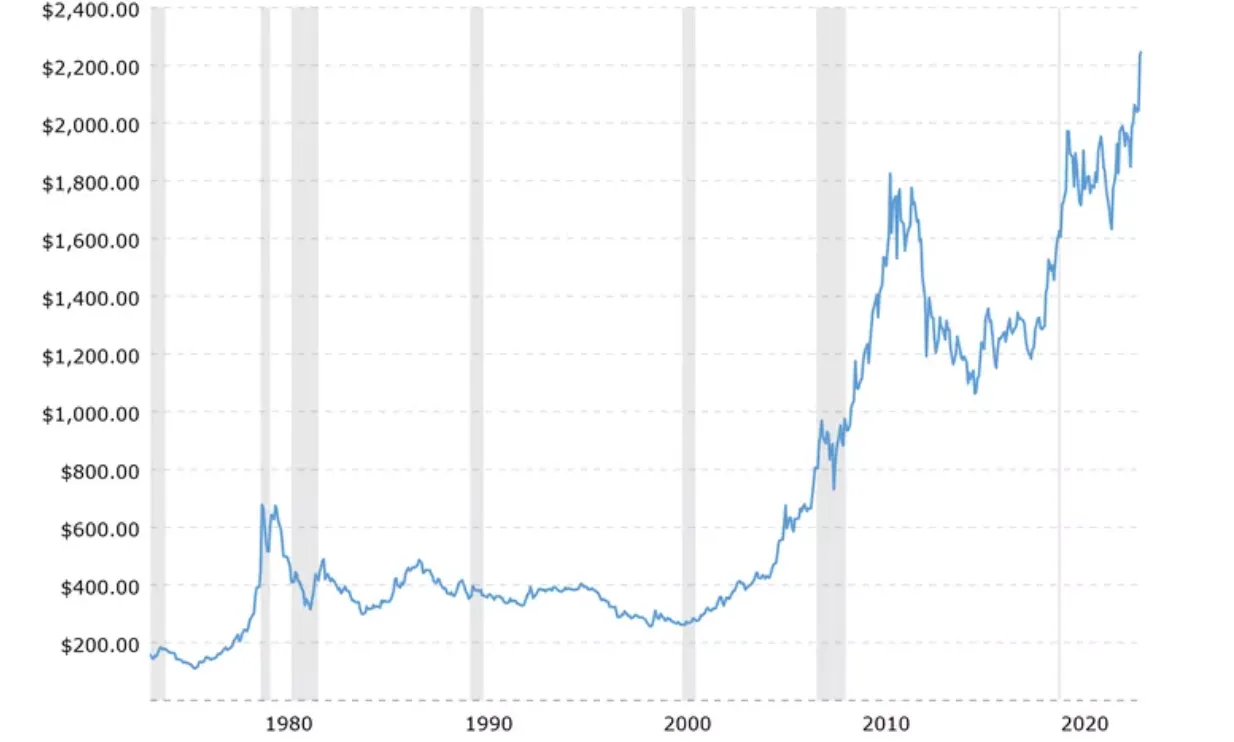
Gold doesn’t just move randomly. It feeds on fear. And right now, fear is in the driver’s seat. Inflation worries, economic slowdown concerns, and rising global tensions are all making investors nervous. When uncertainty spikes, gold thrives.
The chart below shows the price of one ounce of gold since 1974. As you can see, the price has had several large swings over the last few decades, where gold spiked in times of uncertainty.
Trump’s latest comments over the weekend didn’t help calm things down, either. He lashed out at Putin, hinted at massive tariffs on Russian oil, warned about potential strikes in Iran, and even put Ukraine’s president on notice. The markets hate unpredictability, and investors are hedging their bets with-you guessed it-gold.
As long as geopolitical risks remain elevated, gold is likely to maintain strong demand. Analysts have pointed out that if global tensions worsen, we could see gold comfortably pushing past $3,500 over the third quarter of this year.
The Fed is stuck, and that’s great for Gold
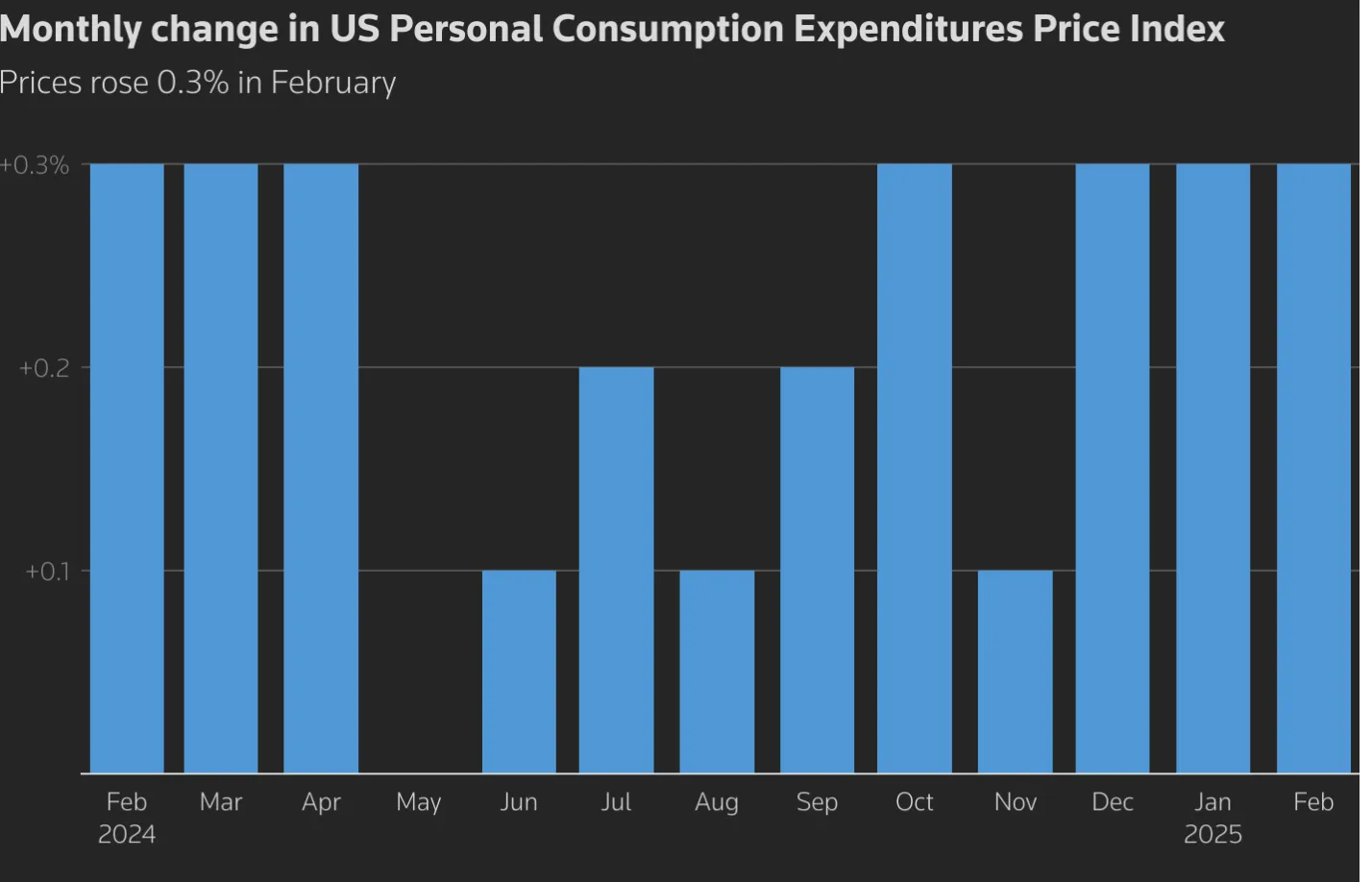
As if the global drama wasn’t enough, the Federal Reserve is now stuck in a tough spot. The latest inflation data showed that the PCE Price Index rose 0.3% in February, with core inflation jumping 0.4%-its biggest gain in months. That’s a recipe for stagflation fears to take off.
The U.S. dollar, meanwhile, is on its third straight day of declines. Why? Because markets now expect the Fed to cut interest rates sooner than later, despite inflation being stubbornly high. A weaker dollar makes gold even more attractive, and traders are taking full advantage.
According to analysts, the Fed’s next moves will be crucial. If rate cuts happen while inflation remains sticky, gold could enter a long-term uptrend. Many traders are already eyeing $4,000 gold as a real possibility within the next 12-18 months.
Silver is the real sleeper hit
Gold might be stealing the headlines, but silver is quietly staging an even more exciting move. The metal just hit $34.46 before settling at $34.18-and what’s happening behind the scenes is unlike any silver rally in recent memory.
This time around, retail traders aren’t the ones fueling the rally. Instead, institutional buyers-including central banks-are quietly accumulating silver while everyday investors sit on the sidelines. And history tells us that when silver breaks key resistance levels with almost no selling pressure above, things can escalate fast.
The geopolitical backdrop is adding fuel to silver’s fire. April 2nd, dubbed “U.S. Liberation Day,” is expected to bring major tariff announcements from Trump. That means more economic uncertainty-and more demand for precious metals.
But silver isn’t just riding the same wave as gold. It’s uniquely positioned because of its dual role as both a monetary and industrial metal. While gold is mostly seen as a safe haven, silver also has strong demand from industries like tech and renewable energy. And supply? It’s been in deficit for years. That’s a bullish setup if there ever was one.
The perfect storm for precious metals
Between tariffs, inflation, a weakening dollar, and growing market anxiety, gold and silver have everything they need for a sustained rally. And if history is any guide, retail investors will only start piling in after the biggest gains are already made.
With the jobs report coming this Friday, another weak economic number could be the final push for gold to break $3,200-or even higher. And silver? The last time it hit a rare technical condition like this, it tripled in value.
While short-term moves will be dictated by upcoming economic data and political developments, the broader trend for gold and silver remains firmly bullish. Persistent geopolitical tensions, potential Fed rate cuts, and a growing preference for safe-haven assets all point to continued upside.
If trade wars intensify and inflation remains sticky, gold could push toward $4,000 in the coming years, while silver-given its supply constraints and industrial demand-might finally break past $50, or even test all-time highs.
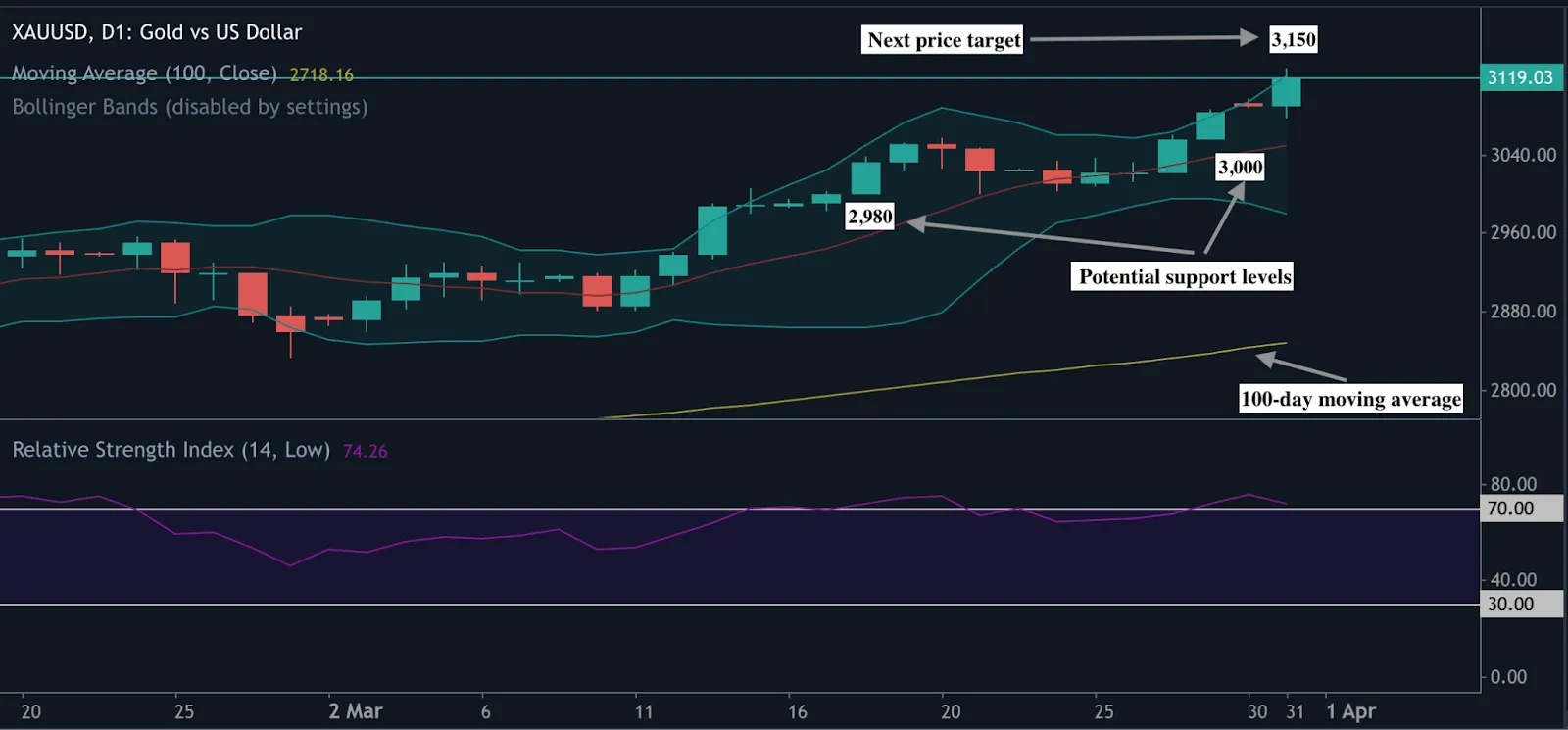
At the time of writing Gold remains on a tear even after smashing the $3,100 target mark. Upward bias persists as $3,150 looks like the next likely target for bulls. The upward narrative is supported by prices remaining above the 100-day moving average. However, prices touching the upper bollinger band hints at overbought conditions. Should we see a reversal due to overbought conditions, the key support levels to watch are $3,000 and $2,980.
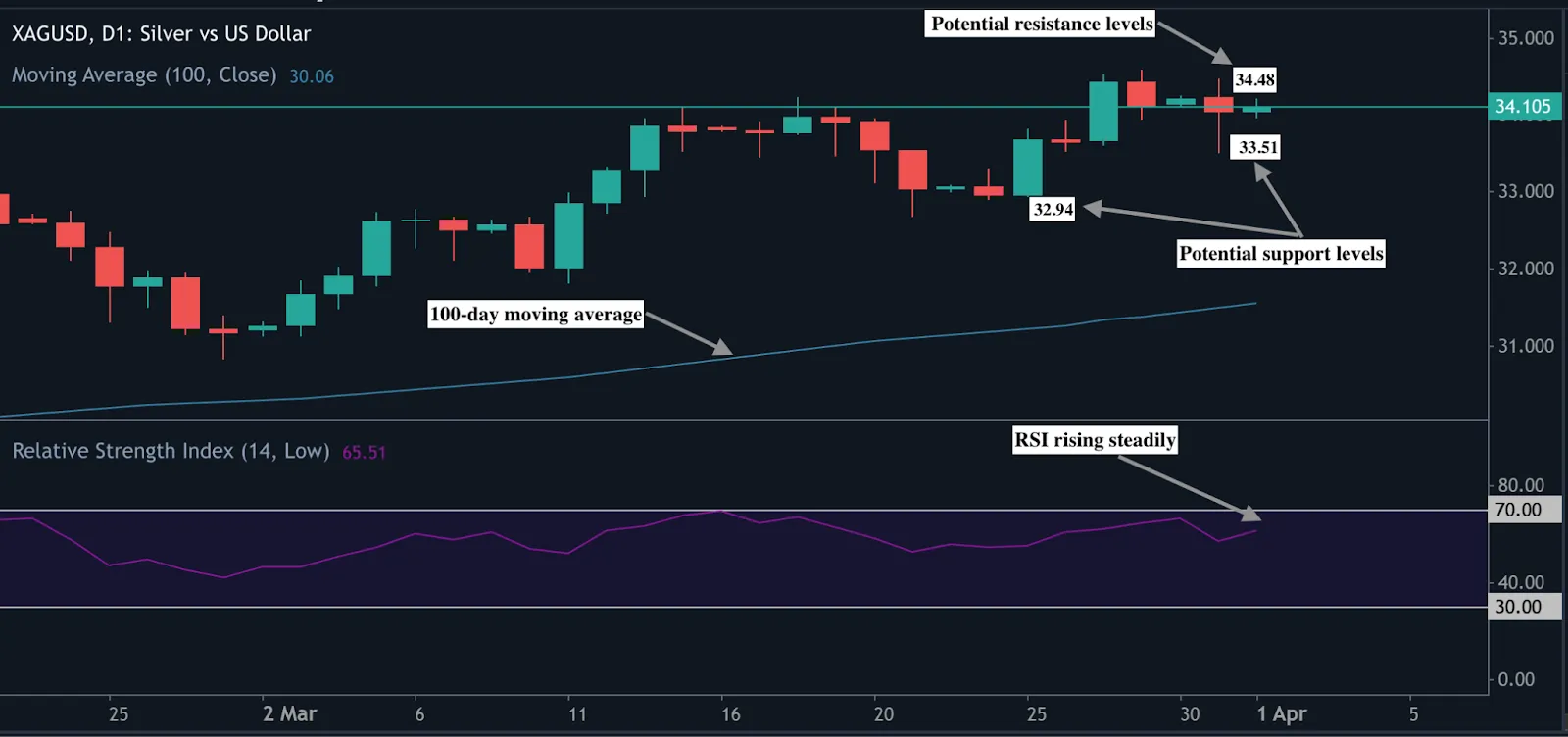
At the time of writing, Silver is seeing some upward pressure which is supported by prices staying above the 100-day moving average. RSI steadily rising towards 70 also adds to the bullish narrative. Key levels to watch should prices continue rising are $34.48, enroute to $35.00. Should the industrial metal see a slide, prices could find support at the $33.51 and $32.94 support levels.
You can get involved and speculate on the price of these two precious metals with a Deriv MT5 account or a Deriv X account.
Sorry, we couldn’t find any results matching .
Search tips:
- Check your spelling and try again
- Try another keyword