
Does gold still have upside after Trump’s Davos pivot?

Yes, gold can still have upside even after President Donald Trump cooled his rhetoric on Greenland at the Davos forum, analysts say. While prices have slipped from record highs near $4,900 per ounce, the pullback reflects easing headline risk rather than a collapse in demand. Spot gold peaked at $4,887.82 before retreating, yet the metal remains up more than 11% in 2026, following a 64% surge last year.
Trump’s shift reduced immediate safe-haven flows, but it did little to unwind the deeper forces driving gold higher. Central bank buying, private-sector diversification, and persistent macro uncertainty remain firmly in place. As markets move beyond the Davos headlines, attention is turning to whether these structural supports can keep pushing gold higher despite calmer geopolitics.
What’s driving gold?
Gold’s latest pullback followed a brief surge driven by geopolitical escalation. Earlier tariff threats tied to tensions between the US and Europe over Greenland prompted investors to seek shelter in bullion. The dispute carried strategic weight, given Greenland’s importance for security and access to critical minerals, amplifying fears of broader trade and diplomatic fallout.
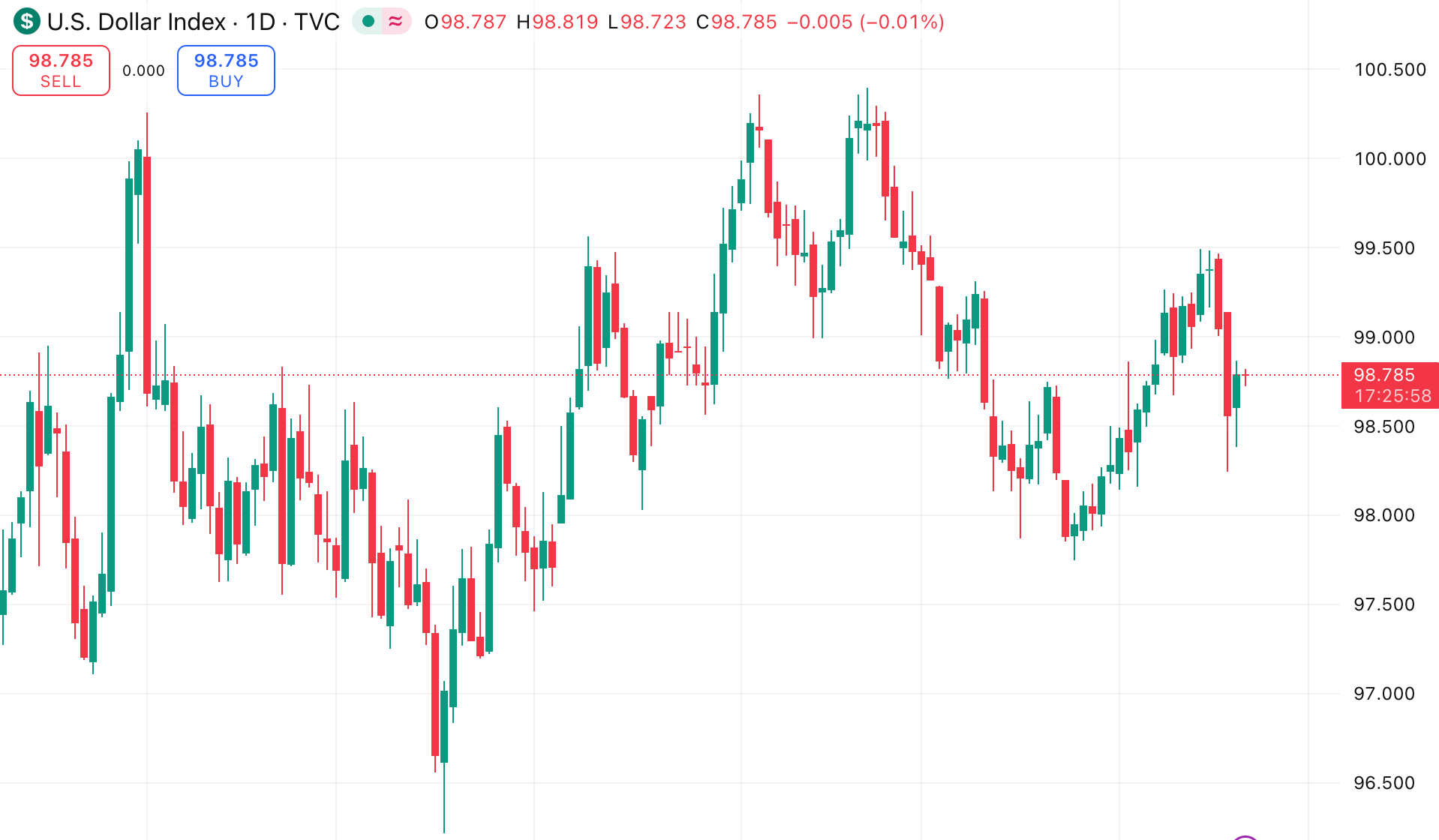
That risk premium eased after Trump struck a more conciliatory tone in Davos. He ruled out the use of force, stepped back from tariff threats, and signalled progress towards a long-term framework agreement with NATO allies. As geopolitical anxiety receded, gold prices softened, a move reinforced by a modest rebound in the US dollar, with the Dollar Index edging higher after a 0.1% rise in the prior session.
Why it matters
Gold’s behaviour underlines how markets are increasingly reacting to political signalling rather than policy outcomes. The mere threat of tariffs was enough to push prices close to $5,000, while reassurance prompted short-term profit-taking. This sensitivity reflects gold’s role as a hedge against policy uncertainty rather than a simple inflation trade.
Crucially, analysts see little sign that the buyers who drove gold higher are stepping away. Goldman Sachs has upgraded its gold outlook, now expecting prices to reach $5,400 per ounce by the end of the year, up from a previous forecast of $4,900. The bank argues that private-sector diversification into gold is now materially reinforcing central bank demand.
Impact on markets and investors
For investors, the pullback looks more like consolidation than reversal. Gold was trading around $4,800 per ounce after easing from its record high, yet prices have more than doubled since early 2023, when gold traded near $1,865.
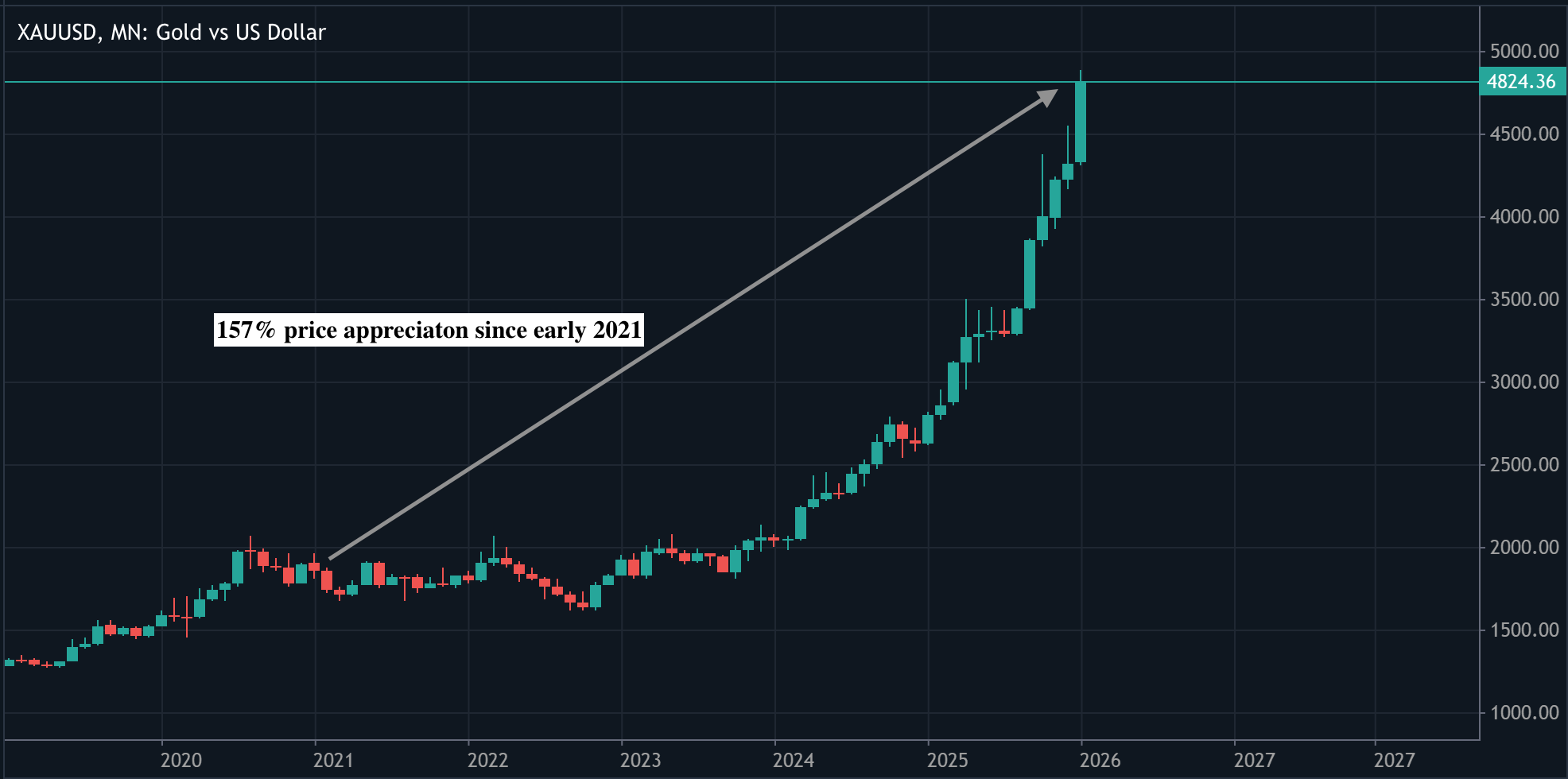
That rise has been underpinned first by official-sector buying in 2023 and 2024, and more recently by a surge in private demand.
The effects are visible across the precious metals space. Silver retreated from a daily high of $95.56 after Trump’s Davos comments, tracking gold lower as risk sentiment improved. The move suggests that shifts in geopolitical risk premiums, rather than changes in physical supply or industrial demand, are currently dictating price action.
Gold’s resilience is also feeding into broader interest in hard assets. Platinum, often overlooked during gold-led rallies, is attracting attention as investors seek diversification in the precious metals space. While platinum remains more sensitive to industrial demand cycles, its constrained supply and strategic role in autocatalysts and emerging clean-energy technologies are reinforcing its appeal as a secondary hedge against macro and policy uncertainty. The shift suggests investors are not just chasing gold’s momentum, but positioning more broadly for a renewed focus on tangible assets.
Expert outlook
Goldman Sachs argues that gold’s rally has accelerated since 2025 because central banks are no longer the sole major buyers. Analysts Daan Struyven and Lina Thomas noted that official institutions are now competing with private investors for limited bullion, intensifying upward price pressure. This follows years of strong central bank accumulation, which laid the groundwork for the current rally.
Private-sector demand has broadened well beyond traditional ETF inflows. Goldman points to rising purchases of physical gold by high-net-worth families, growing use of call options, and the expansion of investment products designed to hedge global macro policy risks.
The bank also expects support from potential Federal Reserve rate cuts, alongside average central bank purchases of 60 tonnes per month in 2026, as emerging markets continue to diversify their reserves.
Underlying this outlook is a structural constraint unique to gold. Unlike other commodities, higher prices do not quickly bring new supply to the market.
Most gold already exists and simply changes hands, while new mining adds roughly 1% to global supply each year. As Goldman notes, gold prices typically peak only when demand weakens meaningfully - through sustained geopolitical calm, reduced reserve diversification, or a shift by the Federal Reserve back towards rate hikes.
Key takeaway
Gold’s pullback after Trump’s Davos pivot reflects easing headline risk rather than a breakdown in its structural bull case. Central bank buying, expanding private-sector demand, and constrained supply continue to support elevated prices. While near-term volatility is likely as geopolitical narratives shift, analysts see little evidence that the forces driving gold higher are fading. Investors should watch policy signals, dollar strength, and central bank behaviour for the next decisive move.
Technical outlook
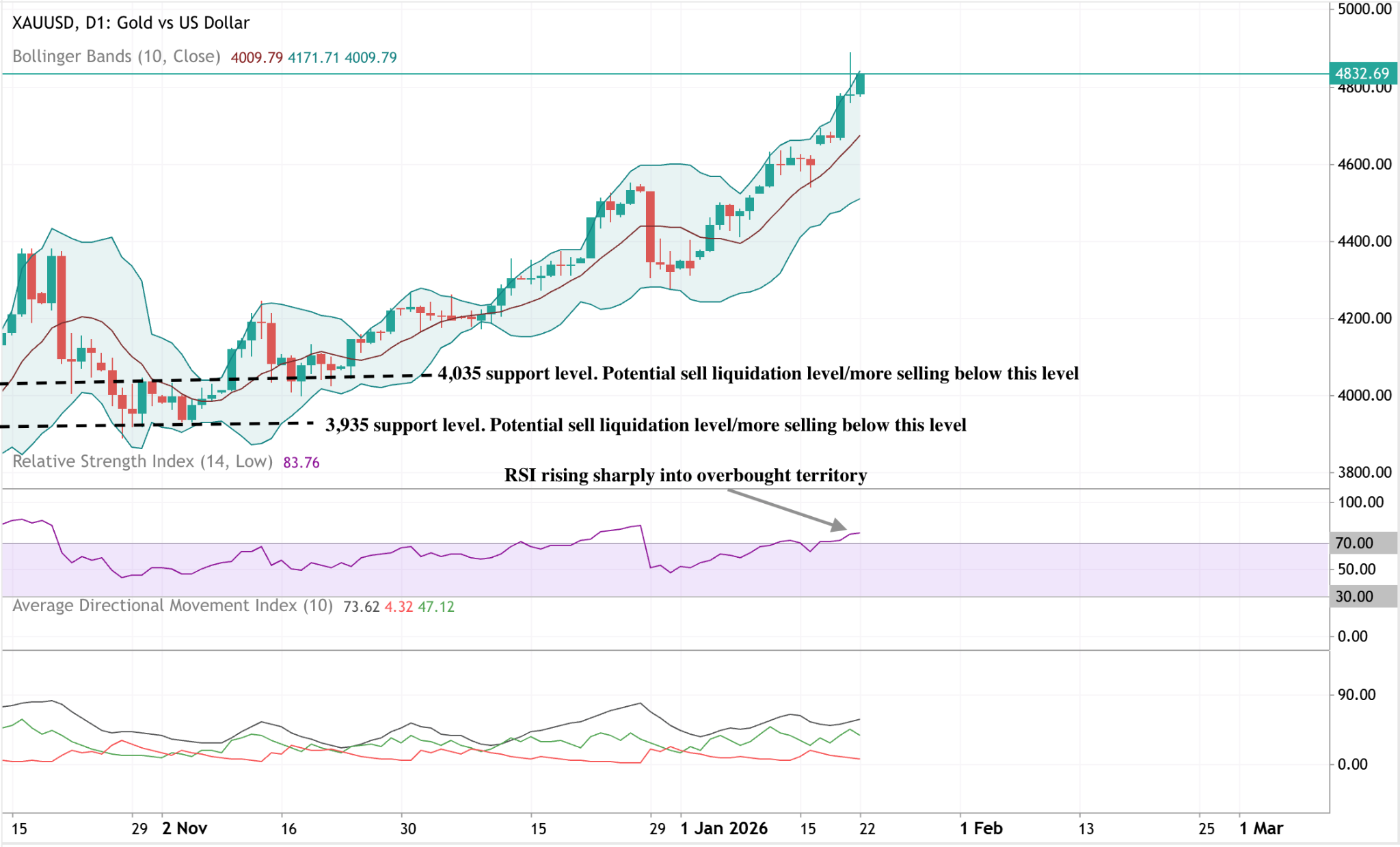
Gold has pushed into fresh all-time highs past $4,800, trading beyond the upper Bollinger Band and signalling an extreme momentum phase. Volatility remains elevated, with the bands widely expanded, reflecting sustained directional pressure rather than consolidation.
Momentum indicators are deeply stretched, with the RSI overbought across multiple timeframes and the monthly reading near extreme levels, while the ADX above 30 confirms a strong, mature trend environment. Overall, price action reflects active price discovery, where trend strength and exhaustion risk are coexisting features of the current market structure.
The information contained on the Deriv Blog is for educational purposes only and is not intended as financial or investment advice. The information may become outdated, and some products or platforms mentioned may no longer be offered. We recommend you do your own research before making any trading decisions. The performance figures quoted are not a guarantee of future performance.


