
Price-weighted and market cap-weighted stock indices stock indices dey behave differently because dem dey give different types of stocks different levels of influence. For price-weighted index, shares wey get higher prices usually dey affect movements more, while for market cap-weighted index, companies wey get larger total value usually dey carry more weight.
Dis difference dey explain why two stock indices wey dey track di same economy fit move for opposite directions on di same day. One fit react sharply to news from one company, while di oda one fit move only wen several large companies move together. Wen beginners understand dis difference, e dey help dem make sense of market behaviour instead of seeing index movements as random.
Quick summary
- Price-weighted indices usually dey give more influence to shares wey get higher prices, even if di company itself dey smaller.
- Market cap-weighted indices usually dey give more influence to larger companies based on dia total market value.
- Stock splits dey change influence for price-weighted indices, but dem no dey change am for market cap-weighted indices.
- Different weighting dey lead to different behaviour, especially around news and earnings.
- For beginners: wen you understand weighting, e dey help you better anticipate how indices fit react and approach risk management wit more awareness.
Wetin be index weighting methods?
Stock index na basket of stocks wey dem combine into one number, and di number dey move up and down during di trading day. Weighting na simply di rule wey dey decide how much each stock inside dat basket fit move di final number.
One useful way to think about am na dis: di weight of a stock na di level of influence wey e get on di daily movement of di index. Some stocks get loud voice and fit move di index in a noticeable way on dia own. Oda stocks get quieter voice and dia effect dey matter only wen many of dem move together.
Different indices dey use different weighting rules:
- Price-weighted index dey give more importance to stocks wey get higher share prices.
- Market cap-weighted index dey give more importance to companies wey get larger overall value.
For beginners, dis difference dey important because e dey explain why indices wey look similar on di surface fit behave very differently for practice. Weighting no dey change di stocks wey dey included for di index, but e dey change di ones wey dominate di day-to-day movements. Once you understand dis, e go dey much easier to follow how an index dey behave.
Wetin be price-weighted index?
For price-weighted index, stocks wey get higher share prices usually dey get more influence than stocks wey get lower prices. Di actual size of di company no matter as much as di price wey dey show for screen.
Dat means say company wey dey trade at 300 USD per share fit move di index far more than company wey dey trade at 30 USD per share, even if di 30-USD company dey much larger in terms of sales, employees or overall business size. Dis fit seem unexpected at first.
Price-weighted indices dey among di oldest types of indices. Di idea behind dem dey relatively straightforward to understand, but you need to pay extra attention because small number of high-priced stocks fit dominate index movement technical analysis fundamentals.
Why dis difference dey important
Two stock indices fit track di same market but behave very differently. One fit jump because one expensive stock moves sharply afta earnings. Anoda fit barely move unless several large companies rise or fall together.
For beginners, dis often dey explain why headlines dey say “di market was flat” while one index wey you dey watch seems volatile. Di weighting method dey determine whether di index dey reflect narrow leadership (wey one or two stocks dey drive) or broad participation (wey many stocks dey drive at once). Dis dey directly affect how calm or jumpy di price action seems.
Anoda way to think about dis na to imagine two classrooms wey dey take di same exam. For one classroom, di performance of di top student dey heavily influence di final score. For di oda one, di score dey reflect di average performance of di whole class. Both dey describe di same group, but dem dey tell very different stories.
Index weighting dey work di same way. Some indices dey highlight outstanding performers, while odas dey reflect di broader market mood. Wen beginners know which story an index dey tell, e dey help dem interpret market movements wit clearer expectations.
How index weighting dey work?
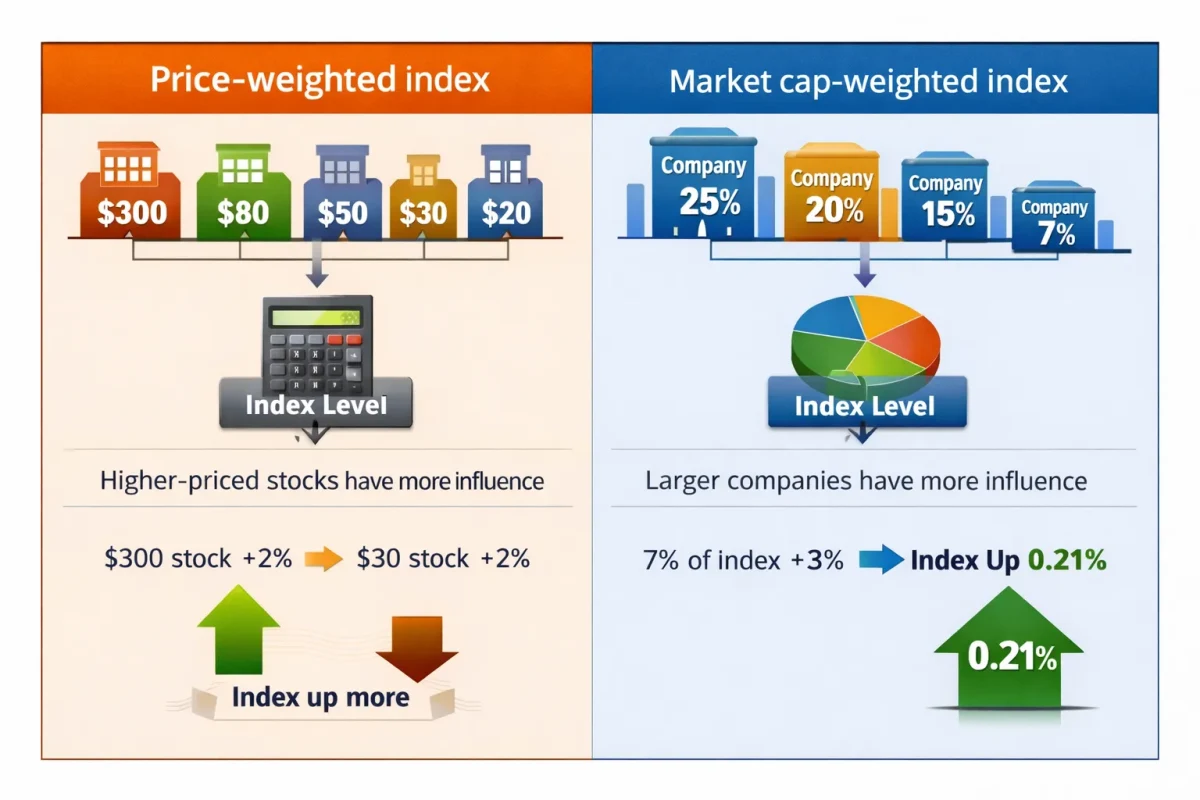
Price-weighted index (step-by-step explanation)
- Add di share prices of all di stocks wey dey di index together.
- Divide di total by one number wey dem dey call divisor.
- Di result na di index level wey you dey see for charts.
You no need to calculate dis yourself. Wetin matter na di effect of di calculation: If two stocks move by di same percentage, di stock wey get higher price dey move di index more.
Example:
If stock wey cost 300 USD and stock wey cost 30 USD both rise by 2%, di 300-USD stock dey get about ten times more impact on di index. Na why price-weighted indices fit react strongly to news from just one or two companies.
Deriv market analyst: “Wen traders understand index weighting, dem dey stop to ask why an index move and start to ask which stocks get di power to move am dat day.”
Market cap-weighted index (explanation wit example)
- Calculate di market value of each company (price × shares outstanding).
- Compare di value of each company wit di total value of all di companies wey dey di index.
- Companies wey get larger market value dey move di index more.
Dem design dis method to reflect economic size rather than share price. Larger companies usually dey represent more investor capital and greater economic activity, so dia decisions naturally dey carry more weight for di index.
Worked example:
If company make up 7% of an index and im share price rise by 3%, e dey add roughly 0.21% to di index return.
For beginners, dis approach often dey feel more intuitive. Large companies usually get more customers, generate more revenue, and attract more investors wey dey pay attention to dem. Wen dese companies move together, di index movement often dey feel steadier and easier to follow.
Dis no mean say market cap-weighted indices dey always calm, but dia movements fit reflect broader economic forces instead of di behaviour of one stock. Dis dey make dem useful for learning how overall market sentiment dey shift over time.
How stock splits dey affect index weighting?
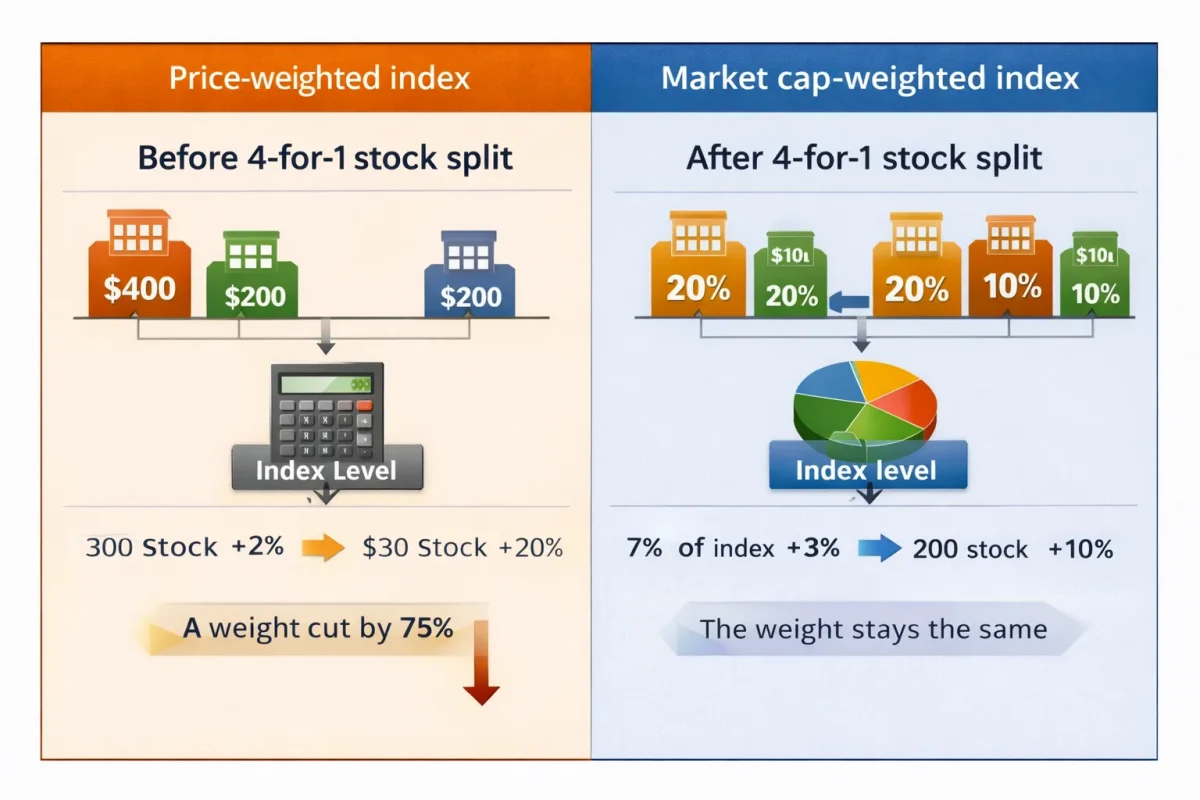
Stock split dey increase di number of shares while e dey reduce di price per share. Di important thing be say di company total value usually dey remain relatively stable.
- For price-weighted stock index, di lower share price dey immediately reduce di stock influence.
- For market cap-weighted index, di additional shares dey balance di lower price, so di influence dey remain di same.
Equity index methodology specialist: “Stock splits no dey change company value, but dem fit rearrange influence for price-weighted index overnight.”
Example
Two stocks get prices of 400 and 200.
- Before a split, di stock wey im price na 400 dey dominate di index.
- Afta a 4-for-1 split, di price dey fall to 100, and di influence dey drop sharply.
Dis dey explain why leadership fit suddenly change for price-weighted indices even wen nothing fundamental don change about di business itself.
How news and macro data dey move indices?
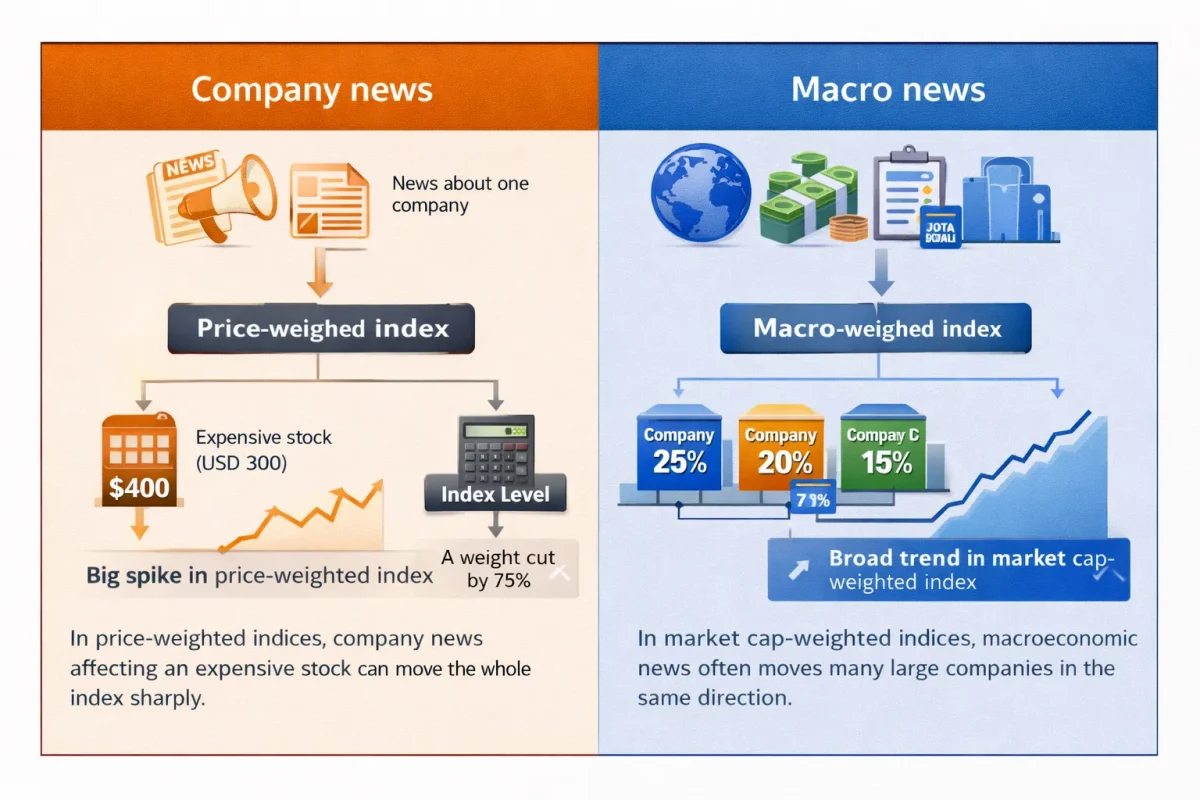
News dey affect stock indices through di stocks wey get di most influence at dat moment.
Company news
- For price-weighted indices, news wey affect an expensive stock fit move di whole index on im own.
- For market cap-weighted indices, news wey affect a very large company fit dominate di index movement.
Na why earnings reports from one well-known company fit sometimes feel more important than broader market conditions.
Global macro strategist: “Macro news rarely dey affect all companies equally. Di biggest companies usually dey react first.”
Macro news
Interest rates, inflation, and jobs data often dey affect di largest companies pass. Wen several large companies react for di same direction, market cap-weighted indices tend to move more smoothly and form clearer trends.
For beginners, di main thing to note be say no be all news get di same reach. Headlines about a particular company tend to create sudden, sharp reactions, while macro news often dey set di direction for days or weeks.
Wen you understand whether di market dey react to one company or to wider economic forces, index movements fit feel less random, and dis fit help new traders avoid overreacting to short-term noise.
Price-weighted vs cap-weighted: Wetin be di difference?
- Price-weighted example: Di Dow Jones Industrial Average, wia high-priced stocks fit get more influence than oda stocks.
- Market cap-weighted example: Di S&P 500, wia di largest companies matter pass.
Dese differences dey explain why two well-known indices fit show different movements on di same day, even though dem describe both as indices wey dey track di same market.
How you fit trade price-weighted stock indices?
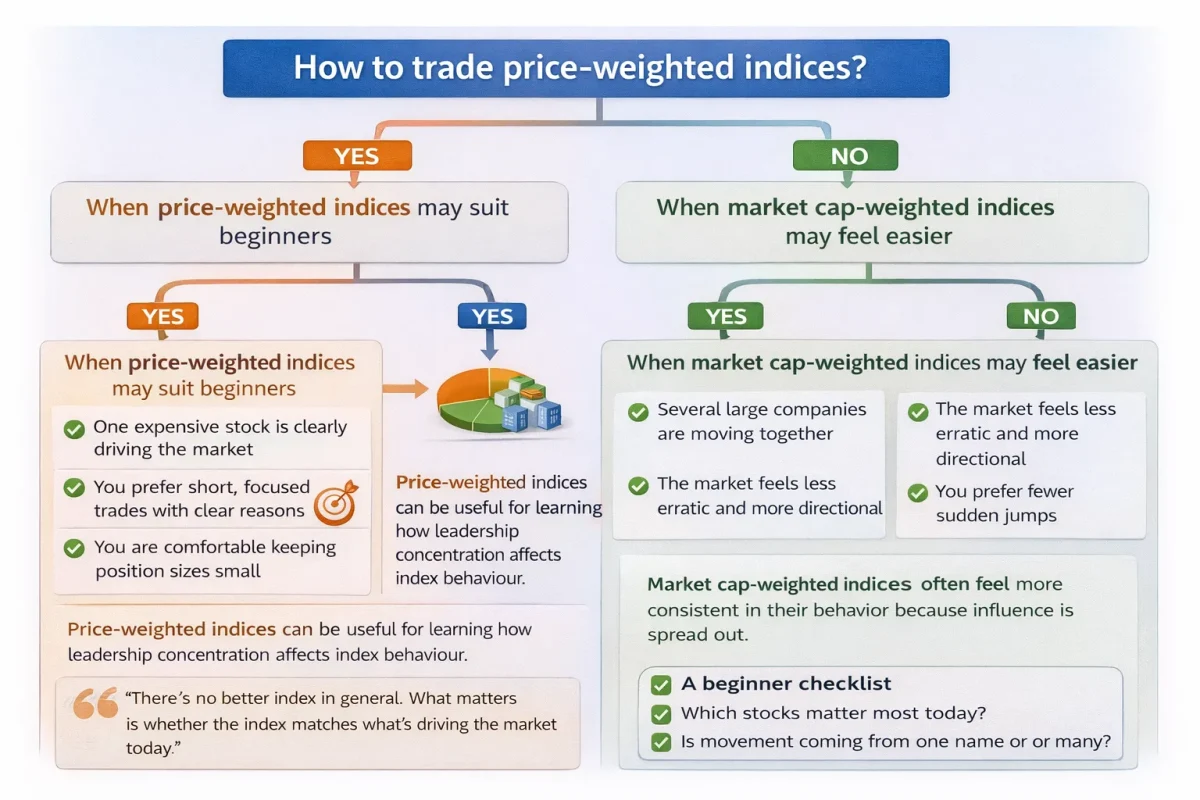
Wen price-weighted indices fit suit beginners
- One expensive stock dey clearly drive di market.
- You prefer short, focused trades wey get clear reasons.
- You dey comfortable to keep position sizes small.
Price-weighted indices fit help you learn how concentration of leadership dey affect index behaviour, as long as you remain aware of di associated risks. Wen one stock dey get di most attention, you fit see im impact more easily.
Wen market cap-weighted indices fit feel easier to observe
- Several large companies dey move together.
- Di market appear less erratic and dey move more clearly for one direction.
- You prefer fewer sudden jumps.
Because influence dey spread across many companies, market cap-weighted indices often fit feel more consistent for dia behaviour at some times for beginners.
Deriv trading educator: “No index generally better pass anoda. Wetin matter na whether di index match wetin dey drive di market today.”
Checklist for beginners
- Which stocks matter pass today?
- Di movement dey come from one company or many?
- I fit keep my position size small enough make I stay calm?
How dem dey explain market cap-weighted indices?
Market cap-weighted stock indices usually dey feel smoother because di influence dey spread across several large companies.
Many beginners dey use dese indices as starting point because dia movements often dey align more closely wit overall market confidence. Wen sentiment improve, prices tend to rise steadily; wen confidence fade, declines usually dey broader and easier to recognise.
Dis no mean say dem no get risk, but dia behaviour fit easier to observe and learn from compared wit indices wey one high-priced stock dey drive.
Common mistakes wey beginners dey make
- To treat all indices as if dem dey behave di same way.
- To ignore which stocks actually dey move di index.
- To use position sizes wey make you feel uncomfortable.
- To trade during major news without clear plan.
Quiz
Which type of index dey give companies wey get higher market value more influence, instead of companies wey just get higher stock prices?
FAQs