
Cross currency pairs dey connect macro themes wit relative performance, and dem dey help traders focus on how one economy dey perform against anoda, instead of against di US dollar. Cross currency pairs list wey dem arrange well dey help traders make decisions: e dey help dem prioritise which regional stories, policy differences, or risk cycles dem fit trade best at any time, instead of reacting to evri move for USD-led markets.
Quick summary
- Cross-currency pairs no include USD, and dem dey reflect regional themes instead of US data.
- Dem fit improve diversification, hedge USD exposure, and help traders express macro views directly.
- Spreads often dey wider, and liquidity dey depend more on di trading session than e dey for USD major pairs.
- Structured workflow—pair selection, session timing, risk sizing, and journalling—dey essential.
Trading forex involve significant risk and e fit no dey suitable for all traders. Losses fit pass wetin you expect at first, especially wen leverage dey involved.
Wetin be cross-currency pair list for forex trading forex trading basics, and why e dey important?
Cross currency pairs list na watchlist wey trader carefully select of non-USD forex pairs wey di trader dey actively follow for analysis and trade ideas. Instead of scanning di whole Market, di list dey help di trader focus on pairs wey best reflect specific regional relationships—like Europe versus di UK or Asia-Pacific risk dynamics—so analysis fit dey more focused and easier to repeat.
E dey important because US economic data and Federal Reserve policy dey strongly influence most major pairs. Crosses dey allow you target regional fundamentals directly, like European inflation, UK growth, Japanese monetary policy, or commodity cycles for Australia and Canada—without passing your exposure through USD.
Which key terms traders need to know forex glossary wen dem dey trade currency crosses?
- Major pairs: Pairs wey include USD, wit high liquidity and tight spreads.
- Minor pairs (crosses): Pairs wey no include USD, wit moderate liquidity and wider spreads.
- Exotic pairs: One major currency wey dem pair wit an emerging-market currency; risk and cost dey higher.
- Spread: Di difference between bid and ask prices.
- ATR (Average True Range): Na measure of volatility wey traders dey use to determine position size and wia to place stop.
Which forex cross pairs dey commonly appear for cross-currency pairs list?
Di list below na example, and dem group am by theme. Wetin dey available dey vary by platform.
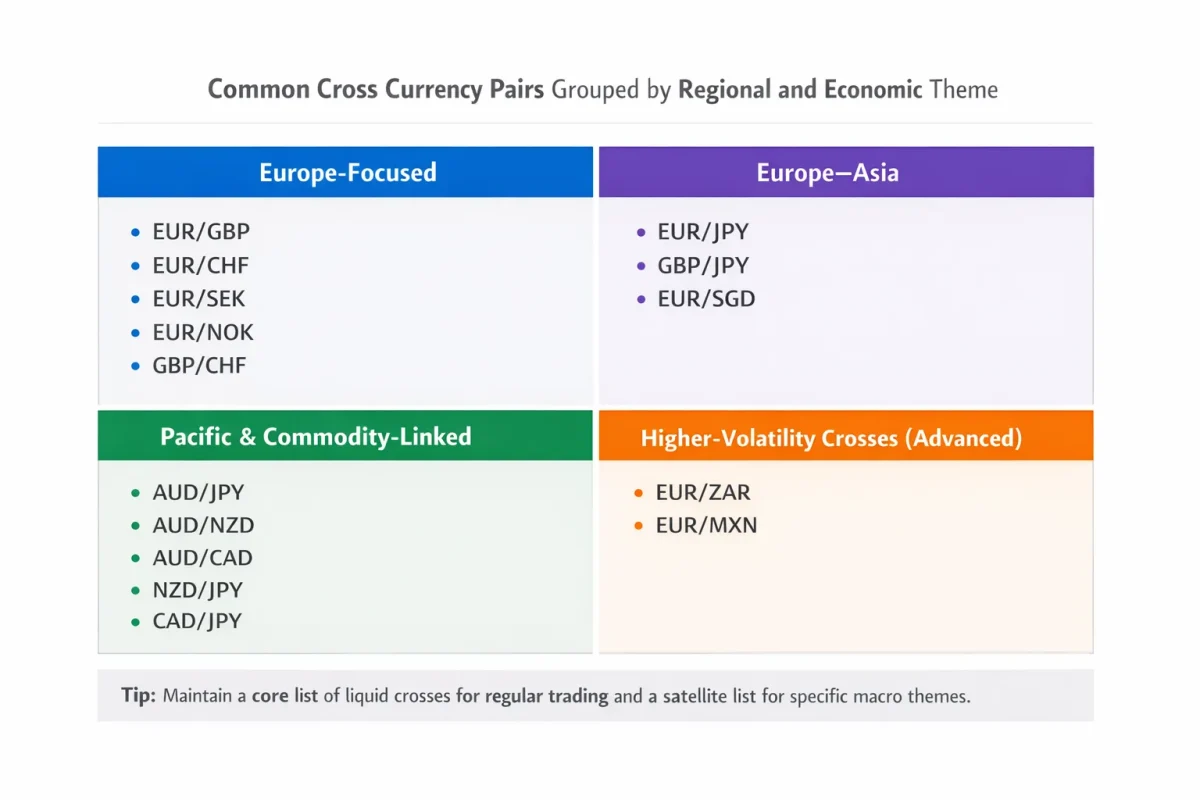
Wey focus on Europe
EUR/GBP, EUR/CHF, EUR/SEK, EUR/NOK, GBP/CHF
Europe–Asia
EUR/JPY, GBP/JPY, EUR/SGD
Pacific and pairs wey connect to commodities
AUD/JPY, AUD/NZD, AUD/CAD, NZD/JPY, CAD/JPY
Crosses wit higher volatility (advanced)
EUR/ZAR, EUR/MXN
Tip: Keep core list of crosses wit good liquidity for regular trading and satellite list for specific macro themes.
“Wen traders move beyond USD majors, wetin matter no be di number of pairs but how relevant dem be. Cross-currency pairs list wey dey focused and aligned wit regional themes tends to produce clearer signals and better risk control.” — Deriv market analyst
How cross-currency trading dey support forex diversification and hedging?
Beyond basic diversification, cross-currency pairs list wey traders maintain well dey help dem separate regional narratives wey USD majors often dey obscure. Wen US data releases, interest-rate expectations, or changes for Federal Reserve guidance dominate global markets, non-USD pairs fit continue to reflect local economic realities. Dis separation dey particularly valuable during periods of high US volatility, wen USD-driven moves fit distort signals for major pairs.
Crosses also dey allow traders express relative-value views between economies wey dey similar stages of di business cycle. For example, comparing two developed markets wit different inflation pressures or fiscal outlooks fit produce more stable trends than pairing one developed economy wit USD. Ova time, dis approach fit help traders manage behavioural tendencies, like overtrading around US news or abandoning valid setups.
For practice, diversification through crosses dey most effective wen traders dey aware of USD concentration risk. During periods of high US volatility, like Federal Reserve rate decisions or major inflation releases, USD majors often dey move together. Dis dey reduce di benefit of holding multiple positions wey appear diversified on di surface. Cross-currency pairs list wey dem carefully select dey help traders avoid dis trap by shifting dia focus to relative performance between two non-USD economies.
“Currency crosses often dey provide clearer way to express relative economic strength because dem remove di dominant influence of di US dollar.” — Senior FX strategist, global investment bank
Anoda advantage na di ability to manage correlation drift. Relationships between currencies no dey fixed; pairs wey bin once move independently fit become highly correlated during global risk events or policy convergence. Wen traders regularly review how crosses dey behave compared wit USD majors, dem fit add or remove pairs from dia core list as market regimes dey change. Dis kind adaptability dey difficult to achieve wen dem dey trade only small set of USD-based pairs.
For practice, traders often dey use crosses as part of wider approach to managing exposure to volatility. Wen US data dominate headlines and price action become erratic, regional crosses fit continue to follow technical structure wey local fundamentals dey drive. Ova time, dis fit reduce behavioural errors like overtrading around US news or abandoning valid setups because of short-term USD noise.
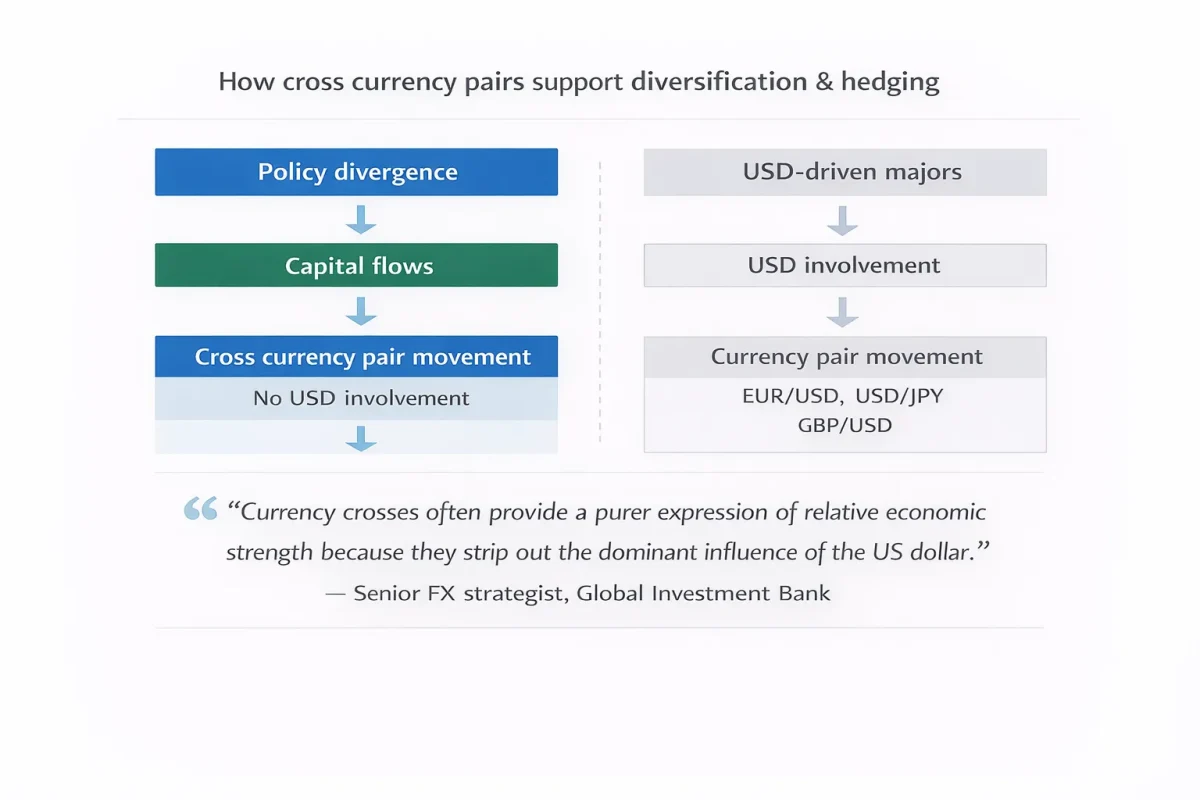
Diversification
Different macro forces, like regional growth, inflation paths, and commodity demand, dey drive crosses. For example, EUR/SEK fit react to ECB guidance compared wit Riksbank guidance, while AUD/JPY often dey follow risk sentiment and commodity prices.
One simple check na to review di rolling correlations between your positions. Crosses wey get low correlation wit USD majors fit help reduce portfolio volatility wen US data dominate Markets.
Hedging
If your book concentrate on USD pairs, crosses fit reduce how US events affect am. For example:
- Long EUR/GBP dey express euro strength against sterling without USD exposure.
- Small position for a cross fit partially offset USD risk before major US data releases.
Hedges no dey perfect, but dem fit reduce drawdowns during periods of USD volatility.
Trading currency crosses dey more efficient than trading synthetic USD?
Expert insight (Deriv): “From trading perspective, direct crosses fit reduce operational complexity for execution. One position dey easier to manage than two synthetic legs, especially wen Markets dey move fast.” — Deriv trading specialist
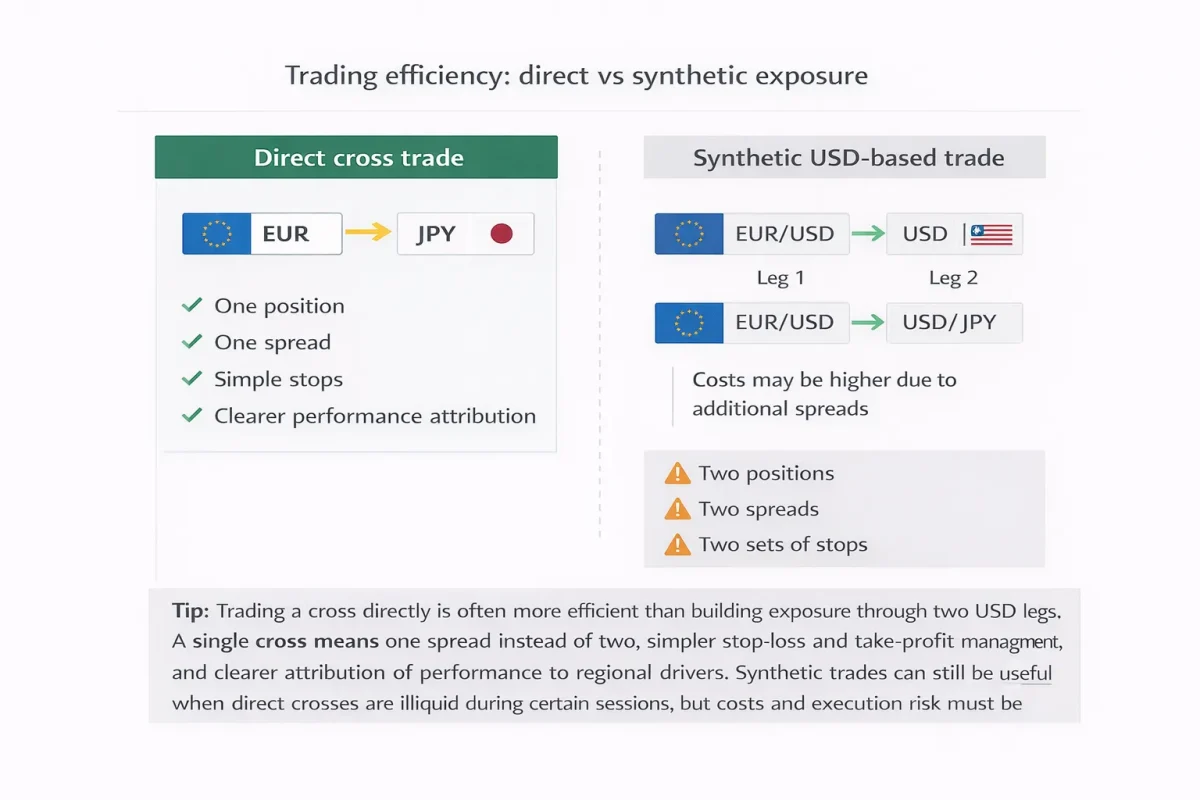
- One spread instead of two.
- Stop Loss and Take Profit management wey dey simpler.
- E dey clearer how regional factors contribute to performance.
Synthetic trades fit still dey useful wen direct crosses no get enough liquidity during certain sessions, but you must monitor costs and execution risk carefully.
How carry, Spreads and sessions dey affect trading sessions cross-currency trading?
Funding costs and carry dynamics dey play more visible role for cross-currency trading than wetin many traders expect at first. Because each cross dey reflect di interest-rate policies of two central banks wey no dey use USD, overnight financing fit support performance or slowly reduce am over time. Even trades wey get correct directional bias fit underperform if you ignore negative carry.
For traders wey dey hold positions for several days, e dey useful to align di expected duration of di trade wit di carry profile of di pair. Short-term technical setups fit make am worthwhile to tolerate negative carry, while swing or position trades generally dey benefit from carry-neutral or carry-positive crosses. If you monitor swap schedules and know di rollover days wey cost more, e go help you avoid surprises.
Carry considerations also dey closely connected wit volatility and trade duration. For intraday traders, overnight financing fit no matter, and dis dey give dem more flexibility to choose pairs. But for swing traders, negative carry wey continue over time fit significantly affect performance, especially wen dem hold positions through periods of low volatility, wen price movement dey slow. For such cases, even trade wey dey technically sound fit underperform once you consider financing costs.
Session timing dey increase dis effect even more. Positions wey you open during hours wey liquidity dey low fit face wider Spreads and rollover pricing wey no dey as favourable, and dis dey increase di actual cost of holding di trade. If you align entry timing wit di most active session for di pair, e no only dey improve execution quality, e also dey help ensure say di expected price movement dey enough to justify funding costs. Na why many experienced traders dey consider cross selection, session timing and holding period together as part of one decision-making process, instead of treating dem separately.
Liquidity conditions also dey vary significantly across sessions. Outside core trading hours, market depth fit reduce, Spreads fit widen, and stop execution fit become less effective. So, to consider sessions wen you dey plan trades dey as important as technical analysis itself.
Crosses dey inherit interest-rate differentials from both currencies. Before you hold positions overnight:
- Check whether carry dey positive or negative.
- Know di triple-swap days.
- Align di holding period wit your carry expectations.
Liquidity also dey depend on di session. EUR/GBP dey trade best during London hours, while AUD/JPY dey most active during Tokyo and Sydney sessions. Outside core hours, Spreads fit widen significantly.
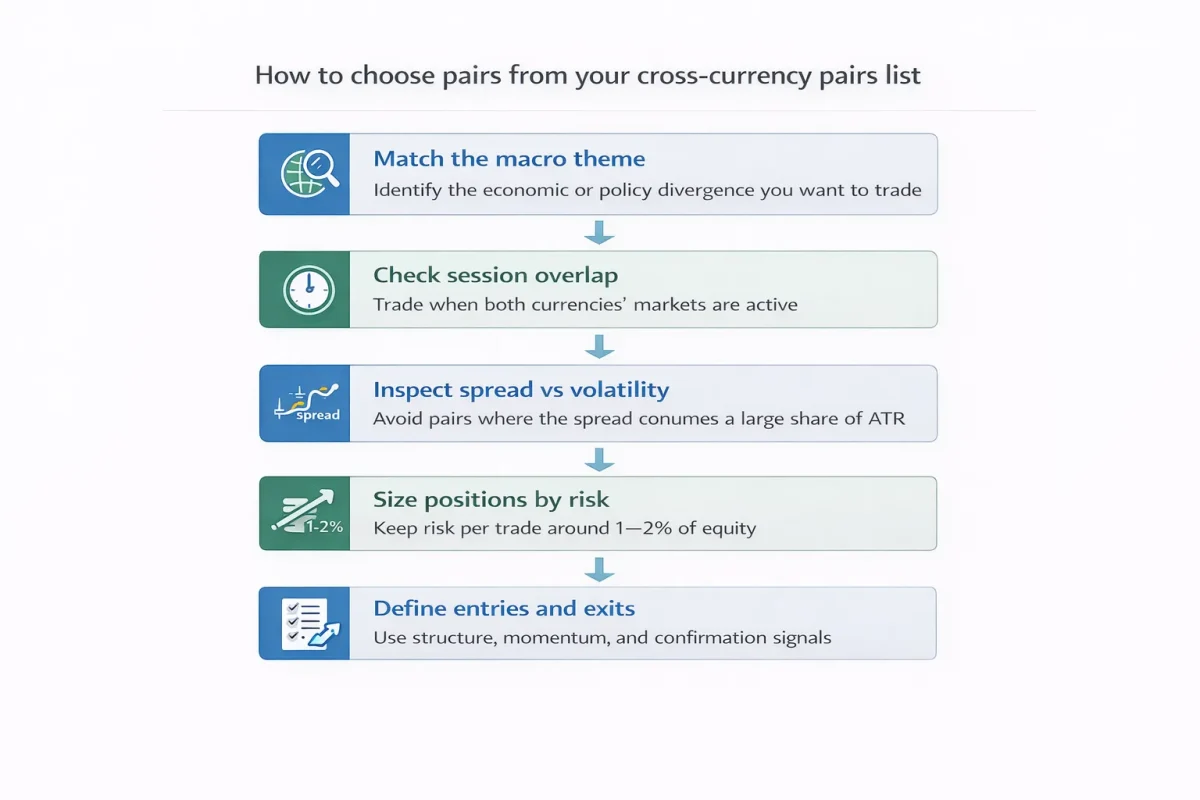
How traders suppose choose pairs from a cross-currency pairs list?
Use dis five-step framework:
- Match di macro theme: Identify di economic or policy divergence wey you want trade.
- Check session overlap: Trade wen di Markets for both currencies dey active.
- Inspect spread against volatility: Avoid pairs wia di spread dey consume large part of ATR.
- Size positions according to risk: Consider risk per trade of around 1–2% of equity as guideline. Define entries and exits: Use structure, momentum and confirmation signals.
Which risks dey affect minor currency pairs, and how traders suppose manage dem risk management strategies?
Effective risk management na wetin fit turn a cross-currency pairs list from collection of instruments into a trading framework wey you fit repeat. Because volatility and liquidity dey vary widely across crosses, using di same position sizes or stop distances fit lead to inconsistent outcomes. If you normalise risk across trades, e go help ensure say no single position dominates portfolio performance.
Anoda common risk na theme clustering, wia di same underlying factor dey drive multiple positions. For example, holding EUR/JPY and GBP/JPY at di same time fit look diversified, but e often dey result in heavy exposure to Japanese yen risk sentiment. If you treat related crosses as one risk bucket and limit total exposure accordingly, e go help prevent drawdowns wey one macro shock fit cause wen e affects several positions at once.
For practice, dis mean say you adjust exposure based on both average volatility and execution conditions. A cross wey dey relatively calm and wey you trade during im most liquid session fit justify tighter stops and standard sizing, while pair wey get less liquidity and wey you trade outside im main session fit require smaller size and wider invalidation levels. Dis adjustments no be signs of uncertainty; dem na deliberate controls wey dey intended to limit downside exposure.
“Wider Spreads no make cross-currency pairs inherently riskier; poor sizing na wetin dey do dat. Position sizing wey you adjust for volatility na wetin dey keep risk consistent.” — Independent risk management consultant
- Use ATR to size positions, no be conviction.
- Place stop-losses beyond clear invalidation levels, no be at round numbers.
- Limit your exposure to any single macro theme.
- Reduce risk before major data releases wey affect either of di two currencies.
Wen you dey keep journal consistently—dey track spread, session, reason for di trade, and outcome—e go help you identify which crosses dey perform best during your trading hours.
Wetin be di common trading setups wey use forex cross pairs?
EUR/GBP range trade
- Context: Range wey dey clearly defined wen policy expectations dey stable.
- Plan: Buy near support, sell near resistance, wit tight invalidation.
EUR/JPY momentum trade
- Context: Policy divergence and risk sentiment wey dey improve.
- Plan: Enter based on break-and-retest, and manage di trade wit trailing stop.
Dese examples dey show structure and risk control, dem no be trade signals.
How currency crosses compare wit USD major pairs?
Wen traders understand how crosses differ from USD majors, e dey help dem decide wen each category dey most appropriate. USD majors often dey provide deeper liquidity and lower transaction costs, wey make dem suitable for high-frequency or news-driven strategies. Crosses, on di oda hand, dey more suitable for traders wey prioritise thematic clarity and medium-term positioning.
Instead of choosing only one category, many traders dey use USD majors as liquidity anchor while dem dey select crosses to express more nuanced macro views. Dis combined approach dey balance cost efficiency wit strategic flexibility and dey reduce reliance on one dominant driver.
- Drivers: Crosses dey reflect two non-USD economies; majors dey centred on USD.
- Costs: Crosses usually get wider spreads.
- Use case: Crosses dey suitable for diversification and targeted macro views; majors dey serve as liquidity anchor.
Most traders dey benefit from using both.
How beginners fit start wit a list of cross currency pairs?
- Build watchlist wey align wit your trading session.
- Practise on demo account before you commit capital.
- Select account settings wey align wit your holding period.
- Start wit small position sizes and refine your approach through review and risk monitoring.
Quiz
Wetin be cross-currency pair?
FAQs