
Gold slips as US jobless claims spike: Signal or noise?

Gold prices softened after US jobless claims jumped to 231,000, their highest level in nearly two months, overshooting forecasts by almost 20,000 claims. On the surface, weaker labour data was expected to bolster gold’s safe-haven appeal. Instead, spot prices slid more than 2% on the session, highlighting a growing disconnect between economic stress signals and market positioning.
This divergence matters because labour data remains the Federal Reserve’s most sensitive policy input. With job openings falling to a five-year low and hiring still subdued, traders are now questioning whether gold is simply consolidating or misreading the next macro turn.
What’s driving Gold and US jobless claims?
The rise in initial jobless claims was sharp, but not clean. Claims jumped by 22,000 in a single week, the largest increase since early December, pushing the headline figure well above economists' expectations of 212,000, according to reports.
Severe winter storms distorted regional employment data, leading to outsized increases in Pennsylvania, New York, New Jersey, and the Midwest. Seasonal adjustment issues around year-end hiring cycles added further noise.
Yet the broader labour picture shows genuine softening beneath the volatility. Job openings fell to 6.54 million in December, the lowest level since September 2020, while November data were revised sharply downward.
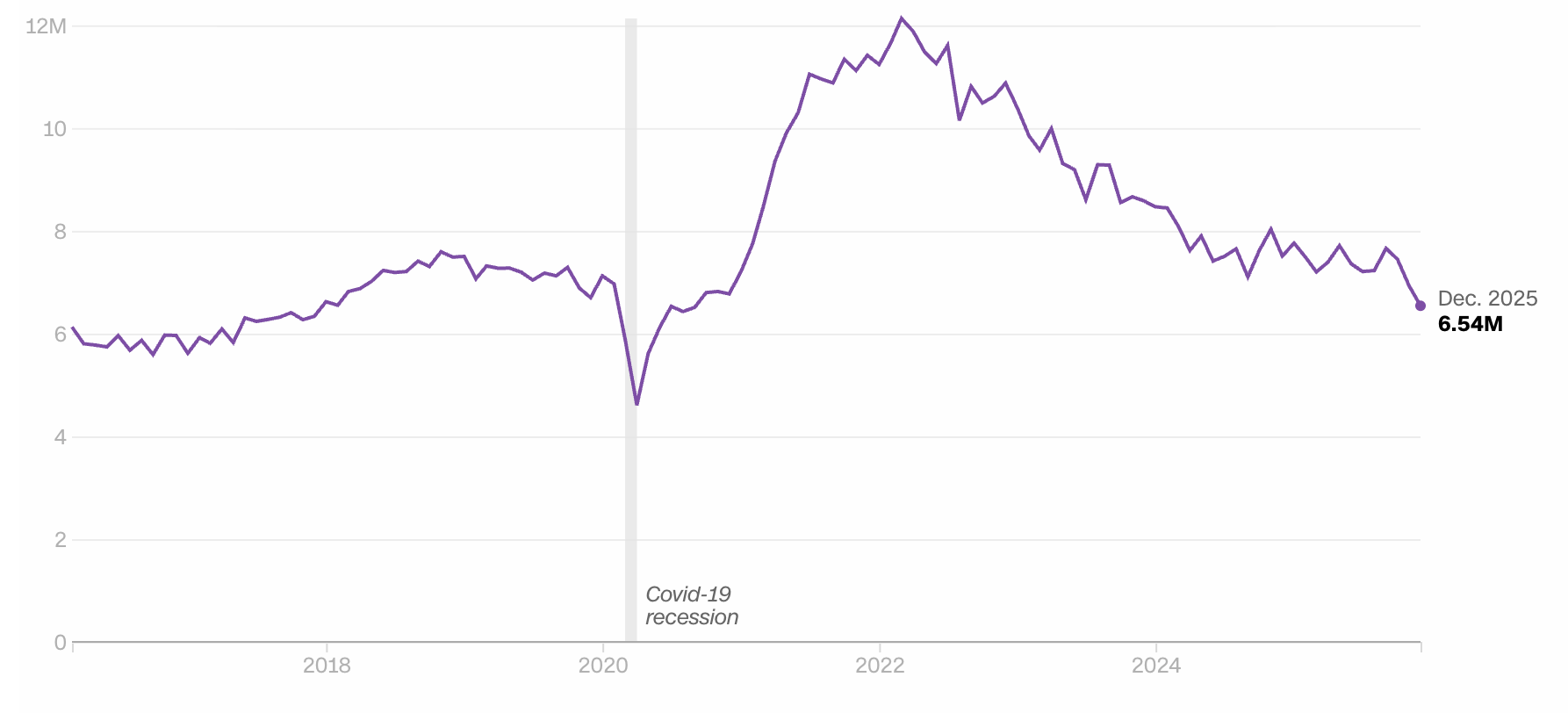
Hiring improved marginally but remained historically weak, reinforcing what economists describe as a “low-hire, low-fire” labour market. That mix suggests cooling momentum rather than outright recession - a nuance gold traders are still digesting.
Why it matters
Labour market trends directly influence rate expectations, and that connection explains gold’s muted reaction. While jobless claims surprised to the upside, continuing claims remain historically low, and the four-week average still points to stability rather than stress.
As Carl Weinberg of High Frequency Economics put it, “There is no sign of the kind of layoffs we expect to see in a weakening labour market during the early days of a recession”.
For the Federal Reserve, this data does little to force an immediate policy shift. Oxford Economics’ Bernard Yaros noted that weather distortions and data discontinuities limit the signal value of a single claims report, adding that nothing has yet altered the Fed’s near-term calculus. Without a clear pivot in rate expectations, gold lacks the macro catalyst it typically feeds on.
Impact on Gold markets
Market watchers highlighted that gold’s decline following the claims data reflects positioning rather than fundamentals. Spot prices traded near session lows at $4,860 per ounce after the release, despite weaker-than-expected labour numbers. That reaction suggests traders prioritised dollar resilience and rate stability over headline economic weakness.
At the same time, falling job openings and delayed payroll data introduce uncertainty that gold markets rarely ignore for long. If upcoming employment reports confirm a broader slowdown - rather than weather-related noise - gold’s current pullback may prove temporary. The metal has historically responded more forcefully to trend confirmation than to isolated shocks, especially when monetary policy credibility is at stake.
Expert outlook
Most economists expect labour conditions to improve gradually through 2026 as interest-rate relief filters into demand, supported by recent tax cuts. That outlook caps immediate upside for gold, as it argues against aggressive Fed easing in the near term.
Still, risks are asymmetric. Job openings are falling faster than unemployment is rising, a pattern that often precedes broader labour weakness. With January’s non-farm payrolls report delayed due to the government shutdown, gold traders face a data vacuum that could amplify volatility once clarity returns. The next clean read on employment momentum may prove decisive.
Key takeaway
US jobless claims have risen sharply, but the signal remains clouded by weather effects and seasonal distortions. Gold’s pullback reflects market caution rather than a rejection of its safe-haven role. With job openings falling and payroll data delayed, the next labour release carries outsized importance. Traders should watch for confirmation, not headlines, before judging gold’s next move.
Gold technical outlook
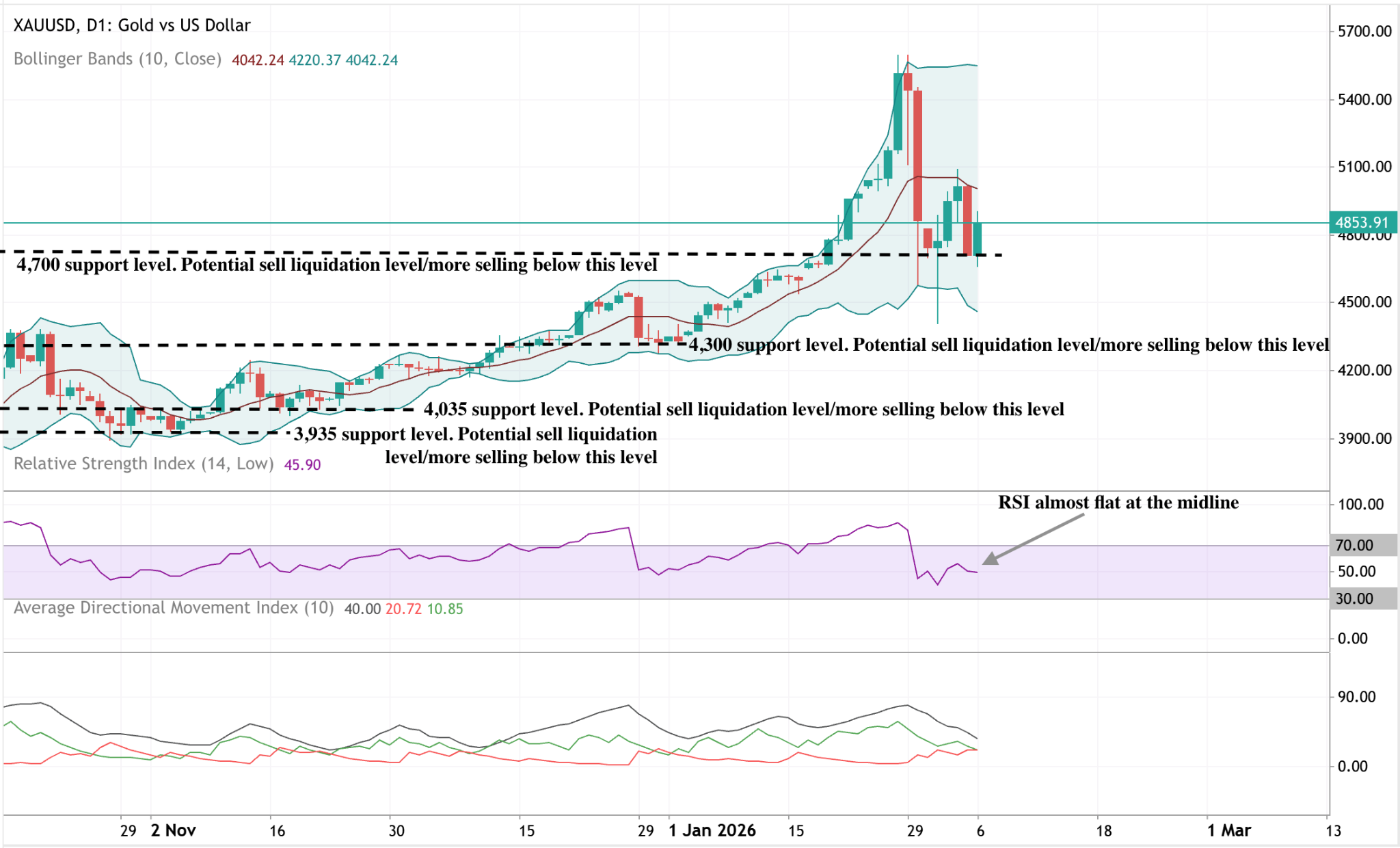
Gold has consolidated after a sharp advance into new highs, with price now oscillating around the $4,850 area following a volatile pullback. Bollinger Bands remain widely expanded, indicating that volatility remains elevated despite the recent moderation in price movements.
Momentum indicators show a neutralising profile: the RSI has flattened near the midline after previously reaching overbought conditions, reflecting a balance between upside and downside momentum. Trend strength has eased from extreme levels, with ADX readings lower than during the acceleration phase, suggesting a transition from strong directional movement into consolidation.
Structurally, price remains well above earlier consolidation zones around $4,300, $4,035, and $3,935, underscoring the magnitude of the prior rally.
The performance figures quoted are not a guarantee of future performance.


