
A practical guide to commodities trading on Deriv

Commodities trading on Deriv gives retail traders cash-settled exposure to energy, metals, and softs without owning the underlying asset. In 2025, most clients choose between CFDs on Deriv MT5 or Deriv cTrader for actively managed positions, or digital options on Deriv Trader or SmartTrader for time-boxed, defined-risk views. This guide explains how each instrument works, when to use them, typical costs and risks, and practical setups for oil, gold, gas, and selected softs, helping you match your idea, time window, and risk limits to the right contract.
Quick summary
- Commodities like oil and gold move with supply and demand, geopolitics, rates, and inventories.
- Deriv offers CFDs for managed trades and digital options for defined-risk ideas.
- Options are often associated with time-based or level-based setups, while CFDs are typically linked to more flexible trade management.
- Risk control, position sizing, and awareness of market events are key to long-term consistency.
What is commodities trading on Deriv?
On Deriv, traders speculate on commodity prices through contracts for difference (CFDs) and digital options without owning physical assets. Any position is purely financial and settled according to the price movement of the underlying instrument. This makes it possible to engage with global markets even without direct access to commodity exchanges.
Commodities behave differently from equities or forex because their prices often respond quickly to real-world events: production changes, political decisions, adverse weather, or shifts in consumer demand. For beginners, Deriv’s platforms simplify access by focusing on price exposure rather than physical delivery, allowing traders to express their ideas while controlling the risk level.
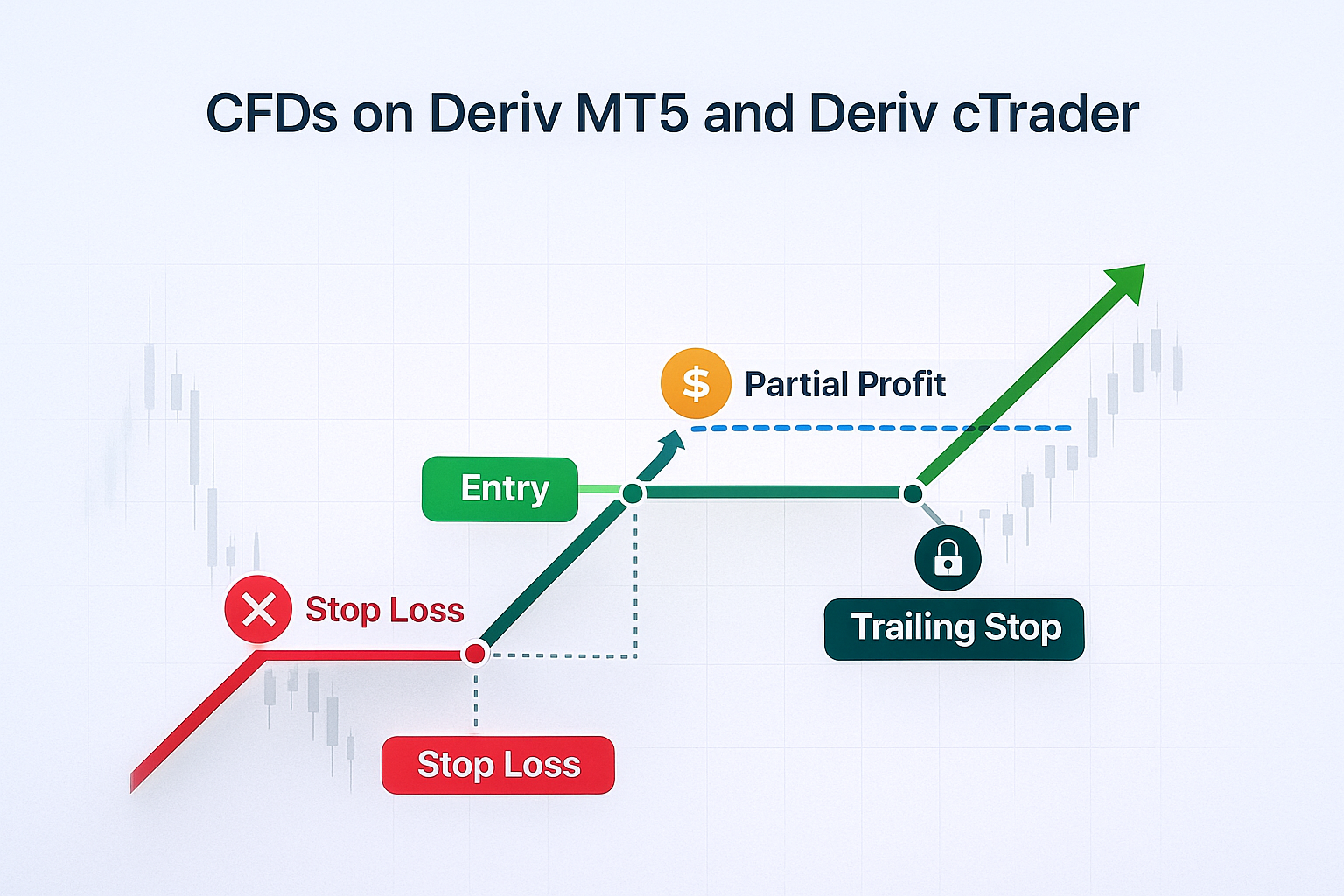
CFDs on Deriv MT5 and Deriv cTrader
CFDs allow traders to open Buy or Sell positions and manage them dynamically. This appeals to traders who want to fine-tune their execution, position size, and exit strategy. With CFDs, you can control exactly where your stop sits, take partial profits, and trail the remainder if the market continues in your favour.
CFDs mimic the ebb and flow of market structure, so they make sense when you want to capture multi-hour trends, trade pullbacks, or respond to emerging volatility. They also allow a high degree of precision — from scaling-in on confirmation to protecting profits with a carefully placed stop adjustment. However, this flexibility also carries responsibility, especially around leverage and overnight swap charges.
Digital options on Deriv Trader and SmartTrader
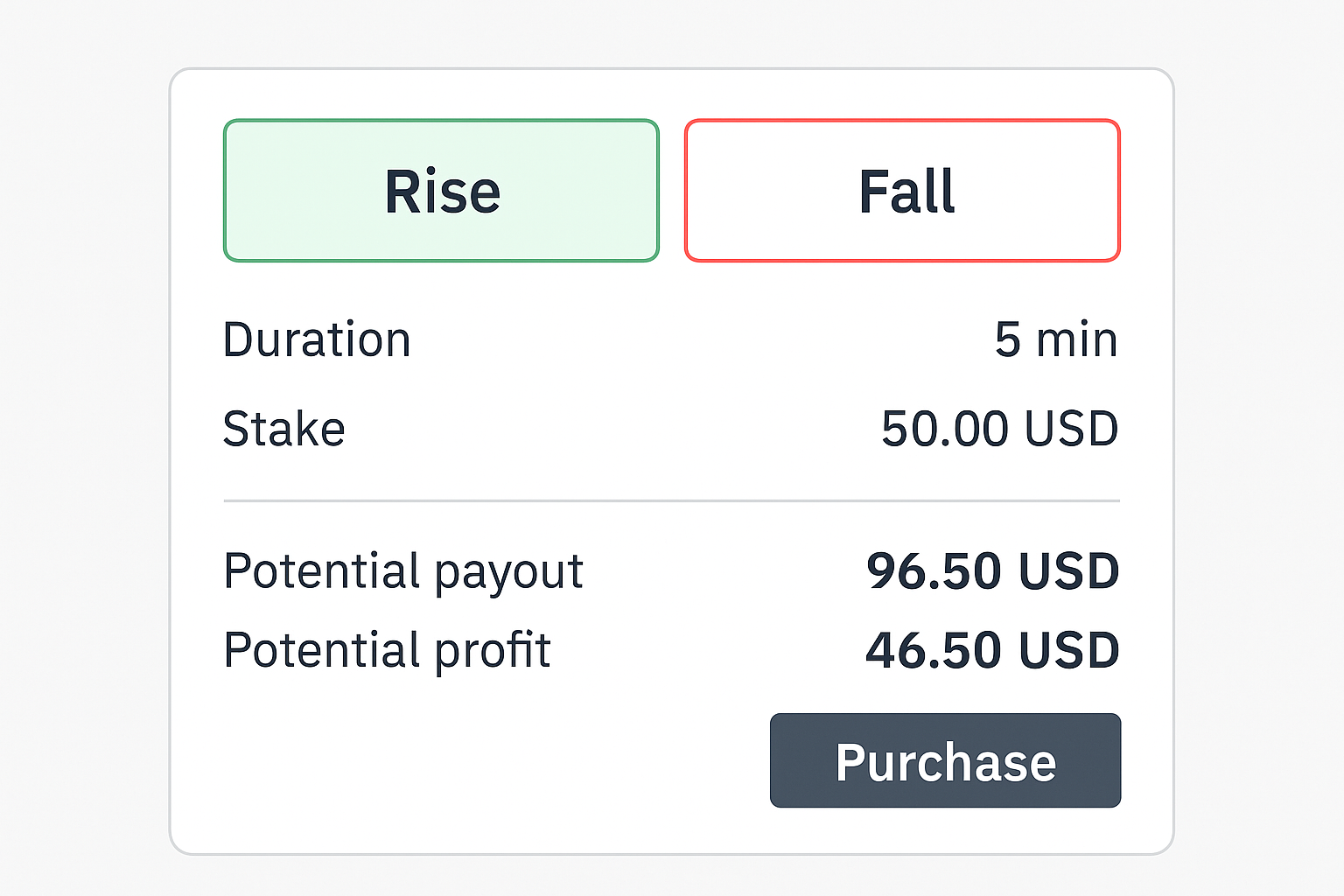
Digital options offer a very different experience. Each contract expresses a clear question: Will the market rise or fall? Will it finish above or below a level? Will it touch a specific price before time runs out? Because you decide your stake upfront, your maximum loss is fixed.
For many beginners, this structure reduces second-guessing. If you expect a short-term momentum burst or believe price will respect a level, you choose the relevant contract and let it play out. There is no need to manage stops or adjust positions during a trade. Options are especially useful around scheduled events where volatility might cause price spikes but you still want controlled risk.
How to choose between CFDs and options?
Instrument choice often comes down to whether your idea is mainly about direction over a short window, finishing relative to a level, whether a level is reached, or active trade management.
- Short-term direction (up or down) is commonly expressed with Rise/Fall.
- A view on finishing above or below a level is often expressed with Higher/Lower.
- A view on whether a specific level will be reached (or not) is often expressed with Touch/No Touch.
- Ideas that involve ongoing position management (for example, adjusting stops or taking partial profits) are typically handled with CFDs.
Thinking in this way helps you avoid forcing trades into unsuitable instruments. The clearer your question, the more naturally the instrument choice follows.
What are practical use cases for commodities trading?
Gold micro-trend (Options)
Gold often forms short-lived bursts of momentum when macro sentiment shifts. In these scenarios, price behaves cleanly for a few candles before settling back into a range. Rise options for 10–15 minutes lets you focus on capturing that precise window without worrying about stop placement. It’s a simple way to practise timing and to build a feel for momentum decay.
WTI pullback setup (CFDs)
Oil frequently retraces to minor support levels before continuing its trend. A CFD pullback strategy is common among pros because it allows placing a limit order where price is likely to pause, set a stop below the structure, and manage the position as the trend resumes. This structured approach trains discipline: you could take partial profits, protect the rest, and allow the market to decide how far the move extends.
Commodities Strategist from Independent Research elaborates:
“Energy markets react first to supply signals and only later to macro tone. Traders who monitor inventories and shipping flows tend to stay ahead of large moves.”
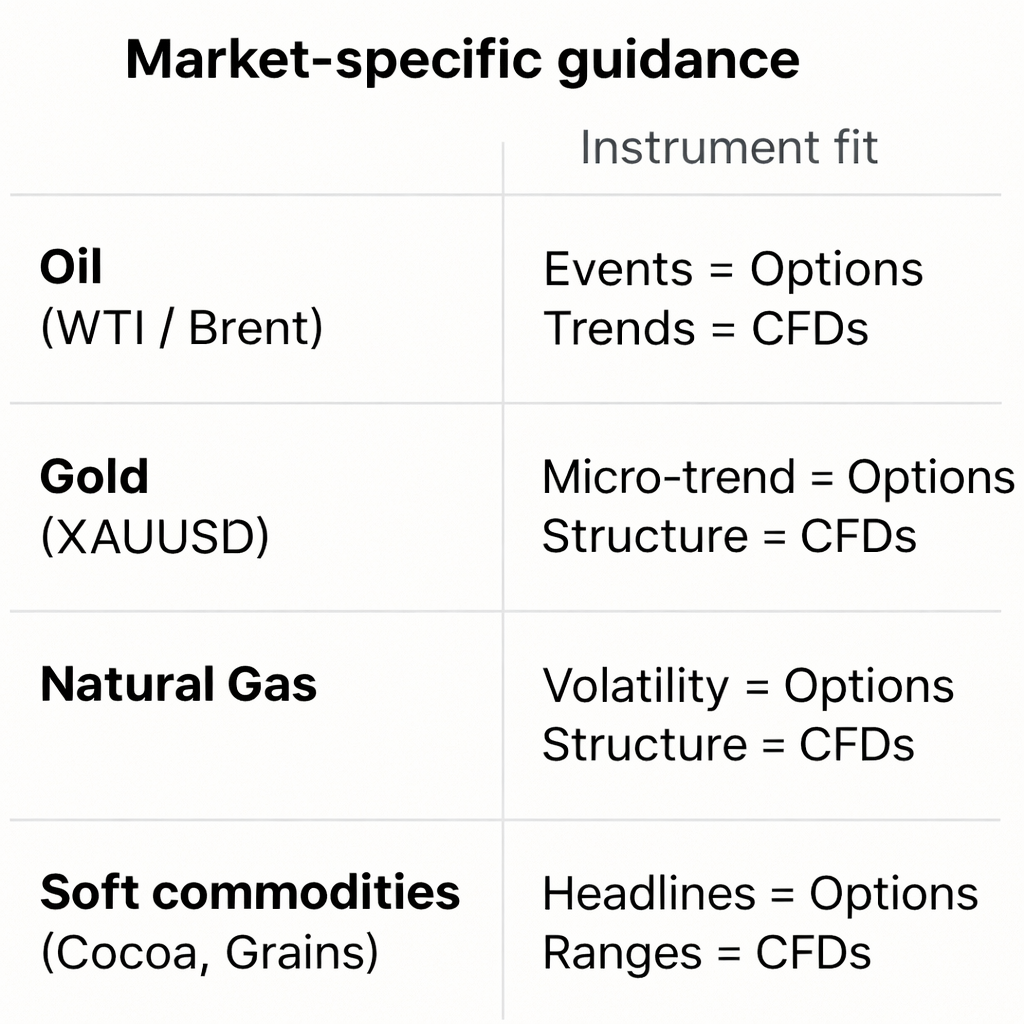
What market-specific guidance applies to commodities trading?
US Oil and UK Brent Oil
Oil reacts quickly to weekly inventory releases and OPEC+ announcements. During these events, options help you limit risk while expressing a directional or level-based idea. After the dust settles, CFDs become useful for capturing extended trends, especially during the London–US session overlap where liquidity improves.
Gold (XAUUSD)
Gold is sensitive to interest-rate expectations and USD movement. Short bursts of momentum fit Rise/Fall options well, while structured pullbacks in established trends are often better expressed through CFDs.
Natural gas
Natural gas can shift abruptly due to weather forecasts or storage data. When conditions become noisy or unpredictable, small-stake No Touch options keeps risk contained. CFDs is an alternative when structure is clear and volatility is manageable.
Soft commodities (cocoa, grains)
Softs respond heavily to weather patterns and regional supply issues. Options help keep risk controlled when headlines dominate, while CFDs is leveraged by traders on quieter intraday conditions with defined ranges.
Why does Deriv offer multiple commodities platforms?
Expert insight (Deriv): “Platforms aren’t interchangeable. MT5 and cTrader support structured risk management, while Trader and SmartTrader are built for precise, time-defined questions.” — Product Lead, Deriv Trading Platforms
Each platform has a purpose. MT5 and cTrader give you flexibility for CFD management: charting, indicators, pending orders, partials, and alerts. Trader and SmartTrader simplify options execution by focusing on direction, barrier, duration, and stake. Deriv Bot allows simple automation for rule-based setups, while Deriv GO keeps you aligned with your plan even when away from the desk.
What market drivers and expert context matter in commodities trading?
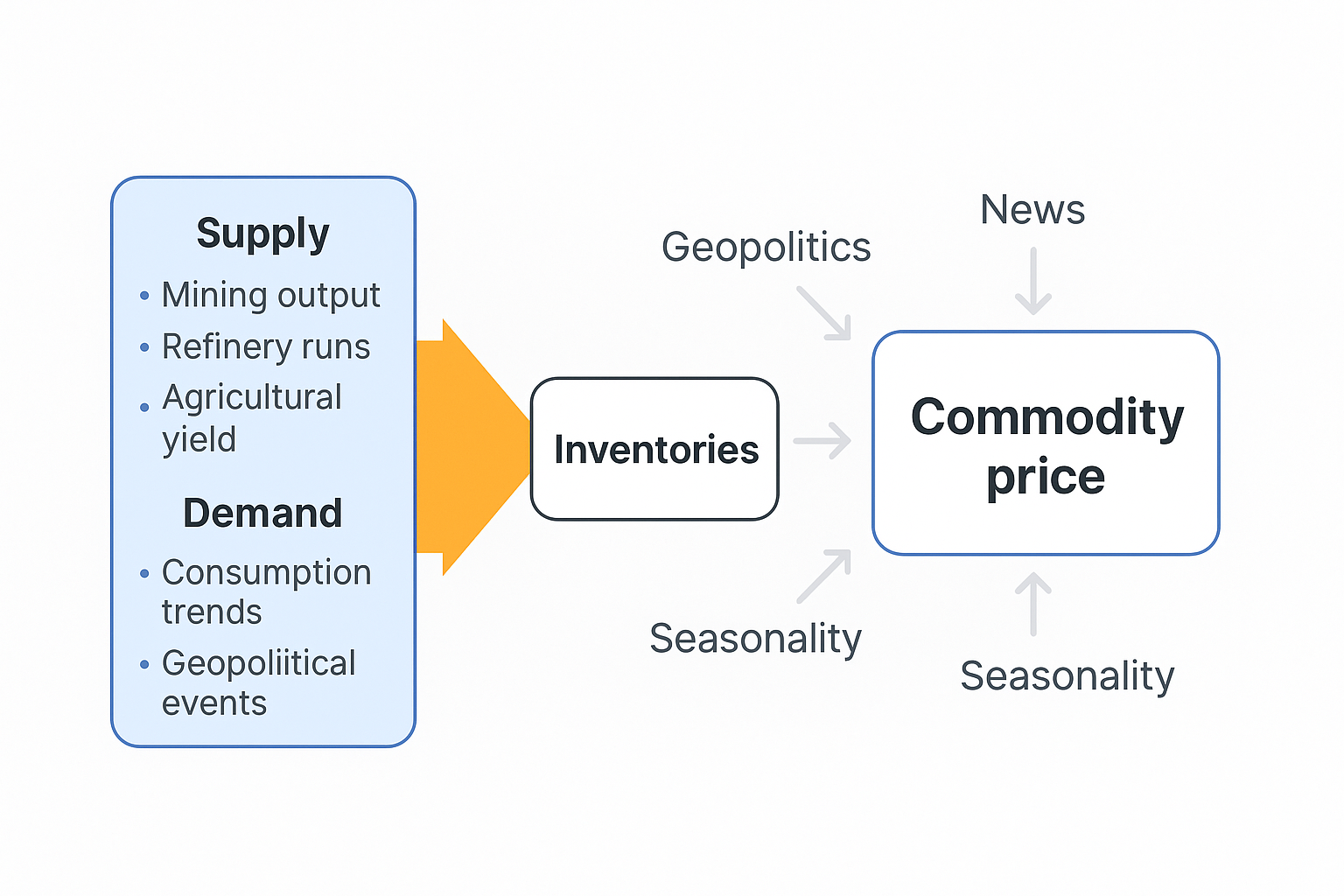
Commodities respond to a blend of fundamental and macro forces.
- Supply and demand: Inventory data, refinery runs, mining output, and consumption trends.
- Geopolitics: Conflict, sanctions, route blockages, and diplomatic shifts.
- Macro drivers: Interest-rate expectations, global growth, and currency strength.
- Seasonality: Winter energy demand, planting and harvest cycles, and weather anomalies.
- Agricultural supply: Drought, disease, and logistics disruptions can cause significant price swings.
Understanding how these factors interact helps you filter noise and size trades appropriately.
Senior Economist from Global Markets institute explains:
“Geopolitical shocks rarely move all commodities the same way. Understanding cross-market effects is essential for active traders.”
How do you improve steadily as a Deriv trader?
Improvement comes from combining fundamentals and technicals, trading one regime at a time, keeping risk rules constant, and recording each decision. Reviewing screenshots and notes builds pattern recognition, while cooldowns and loss caps prevent emotional spirals. Over time, your focus shifts from predicting markets to executing with discipline.
Deriv trading education team mentions:
“Consistency is the true edge. Smaller size, fixed rules, and weekly reviews outperform rapid strategy hopping every time.”
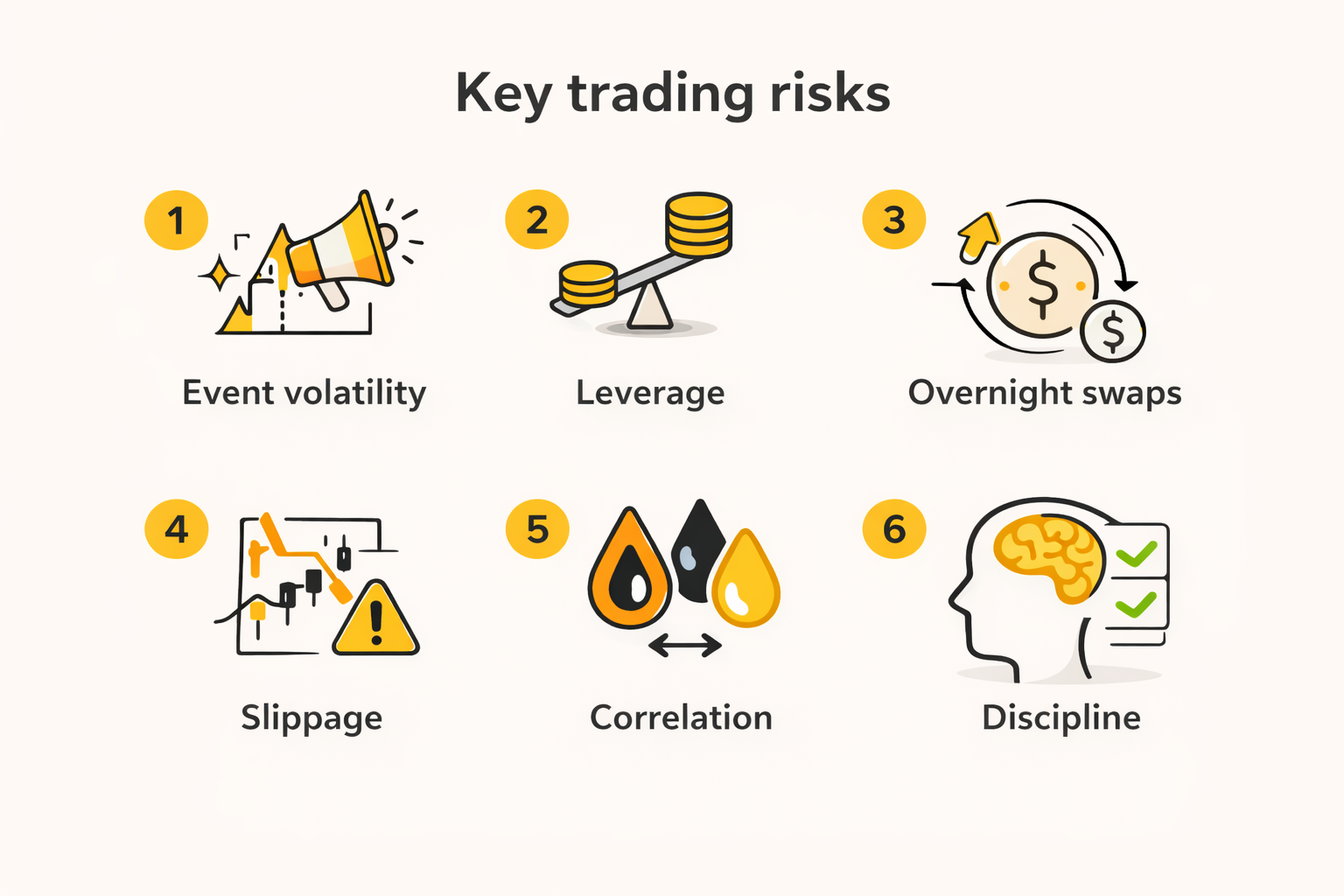
What are the key risks in commodities trading, and how do you manage them?
- Event volatility and gaps: Headlines and data releases can trigger sharp moves; some traders favour predefined-risk structures during these windows.
- Leverage and position size: Leverage amplifies outcomes; exposure is often measured against a stop distance and a maximum acceptable loss.
- Overnight swaps: Holding CFDs past rollover can add financing costs (or credits), which may affect outcomes over time.
- Slippage and execution: In fast or illiquid conditions, fills can differ from expected prices; order type and liquidity conditions matter.
- Correlation risk: Related commodities can move together, increasing concentration in a single theme (e.g., energy).
- Psychological discipline: Large swings can drive impulsive decisions; structured limits and routines can support consistency.
What are the takeaways and next steps?
Commodities on Deriv offer flexible ways to express market views. CFDs are known for structured trade management and digital options when you prefer defined risk and simpler questions. Start small on a demo account, build consistency, review your decisions, and scale gradually only when your process becomes repeatable.
Disclaimer:
Options trading, Deriv X, Deriv Bot, and SmartTrader platforms are not available for clients residing in the EU. This information is intended for educational purposes only and it is not intended as financial or investment advice.


.png)
