Will rising AI, EV and energy demand turn copper into the next oil?

November 12, 2025
A 3D digital illustration of a copper bar disintegrating into small glowing fragments.

Yes - and the data increasingly supports that view. Copper’s role in the global economy is shifting from an industrial input to a strategic resource underpinning the energy and technology transitions. Prices are trading near $11,000 per tonne on the London Metal Exchange (LME), up about 27% since January 2025, as demand from AI data centres, electric vehicles (EVs), and renewable energy infrastructure surges.

With global supply struggling to keep pace, analysts believe copper could soon become as central to modern growth as oil was to the 20th century - powering everything from high-voltage grids to the AI servers of the digital age.

Key takeaways

  • Copper prices remain near record highs, supported by demand from AI data centres, EVs, and renewable energy projects.
  • Supply disruptions in Chile and Peru, combined with declining ore grades and project delays, are tightening global output.
  • Institutional inflows from pension and sovereign wealth funds have transformed copper into a strategic investment asset.
  • JPMorgan expects copper to reach $12,000 per tonne by early 2026, while Morgan Stanley projects a deepening supply deficit through 2029.
  • Trade policy uncertainty and a cautious Fed may create short-term volatility, but structural fundamentals remain overwhelmingly bullish.

Copper’s supply shortage meets surging demand

Unlike previous commodity booms, copper’s rally isn’t a product of speculation - it’s a response to deep, structural imbalances. Global production continues to struggle, with around 6% of supply currently offline due to labour strikes, weather disruptions, and infrastructure bottlenecks across South America.

Chile and Peru, which together account for approximately 40% of the world's copper output, are facing severe operational pressures. Damaged logistics networks, delayed maintenance schedules, and limited transport capacity have curtailed ore movement, while ageing smelters are operating below capacity.

Compounding this is geology. New copper deposits are yielding lower ore grades - typically 0.3–0.8% copper content, compared with 2–5% in earlier decades. This means miners must process more rock to achieve the same metal output, thereby increasing both costs and environmental footprints.

Meanwhile, mine development timelines have stretched to between seven and eighteen years, limiting the speed at which new supply can respond to rising demand. Morgan Stanley forecasts a 590,000-tonne global deficit in 2026, which is expected to widen to 1.1 million tonnes by 2029 - the largest in over two decades.

Source: Morgan Stanley, Bloomberg

Copper demand revolution: AI, EVs, and clean energy

The next decade’s copper demand will not come from construction or traditional manufacturing, but from technologies powering the global energy and data transitions. 

AI data centres have become a major new source of demand. According to the U.S. Department of Energy and research by the Lawrence Berkeley National Laboratory, data centres could consume 6.7% to 12% of total U.S. electricity by 2028, up from 4.4% in 2023. Every new facility requires vast quantities of copper for cabling, transformers, and power distribution.

Electric vehicles (EVs) are another key driver of growth. Each EV contains around 40–50 kilograms of copper, roughly four times more than a petrol-powered car. With EV production scaling globally, copper’s role in automotive manufacturing is expanding rapidly.

Meanwhile, the renewables sector - particularly wind and solar power - continues to absorb unprecedented quantities of copper. A single 2–3 megawatt offshore wind turbine uses 5–7 tonnes of copper across its generator coils, wiring, and control systems. Grid modernisation and battery storage investments only add to this copper intensity.

Together, these forces are fuelling what many analysts describe as a once-in-a-generation demand transformation - one that positions copper as the critical link between electrification, digitalisation, and decarbonisation.

Copper’s momentum: Industrial metal to strategic asset

Copper is no longer just an industrial metal - it’s now a financial and strategic asset. The London Metal Exchange remains the primary benchmark for global pricing, but trading volumes in copper futures and ETFs have surged throughout 2025.

Institutional investors, including pension funds and sovereign wealth funds, have increased their exposure to copper as a hedge against the global energy transition. This institutional demand compounds existing supply pressures, creating a feedback loop in which rising prices attract additional capital inflows.

Commodity strategists note that this cycle is becoming self-reinforcing: “as long as deficits persist, investors will keep buying the shortage,” one analyst observed.

On Deriv MT5, traders can monitor copper’s price movements (XCU/USD) directly through advanced charting and technical indicators - giving them access to institutional-grade analysis tools used in professional trading environments.

Copper tariffs, policy, and Fed caution

Despite strong fundamentals, copper’s short-term performance is still influenced by trade and monetary policy.

The Trump administration’s shifting tariff policy on refined copper earlier this year created volatility between the CME and LME benchmarks. When tariffs were initially proposed, U.S. copper prices surged as importers rushed to secure supply. Once refined copper was exempted, prices corrected - but the gap underscored how political risk now moves metal markets.

The 2026 tariff review remains a key risk event, and traders expect further dislocations if the exemption is lifted. Analysts like Roukaya Ibrahim of BCA Research believe “the lingering possibility of tariffs on refined copper will continue to impact the market,” keeping U.S. prices at a premium.

Meanwhile, the Federal Reserve’s cautious tone on rate cuts has temporarily slowed speculative inflows into commodities. Yet for long-term investors, the structural tightness in copper supply is overshadowing short-term policy noise.

Copper investment outlook: Path towards $12,000 and beyond

JPMorgan Chase forecasts that copper prices could reach $12,000 per tonne by early 2026, representing an 11% increase from current levels. Its bullish outlook is supported by:

  • Expanding investment in renewable energy, EVs, and AI infrastructure.
  • Limited near-term supply response from major producers.
  • Lengthy mine development cycles delay new output.
  • Sustained institutional demand for commodities exposure.

Similarly, Morgan Stanley expects the market to enter its most severe deficit in 22 years, while Goldman Sachs has described copper as “the most compelling long-term opportunity in the industrial metals complex”.

Should these forecasts materialise, copper could maintain a new price floor above $10,000 per tonne, even in the face of temporary macroeconomic slowdowns.

Copper technical analysis

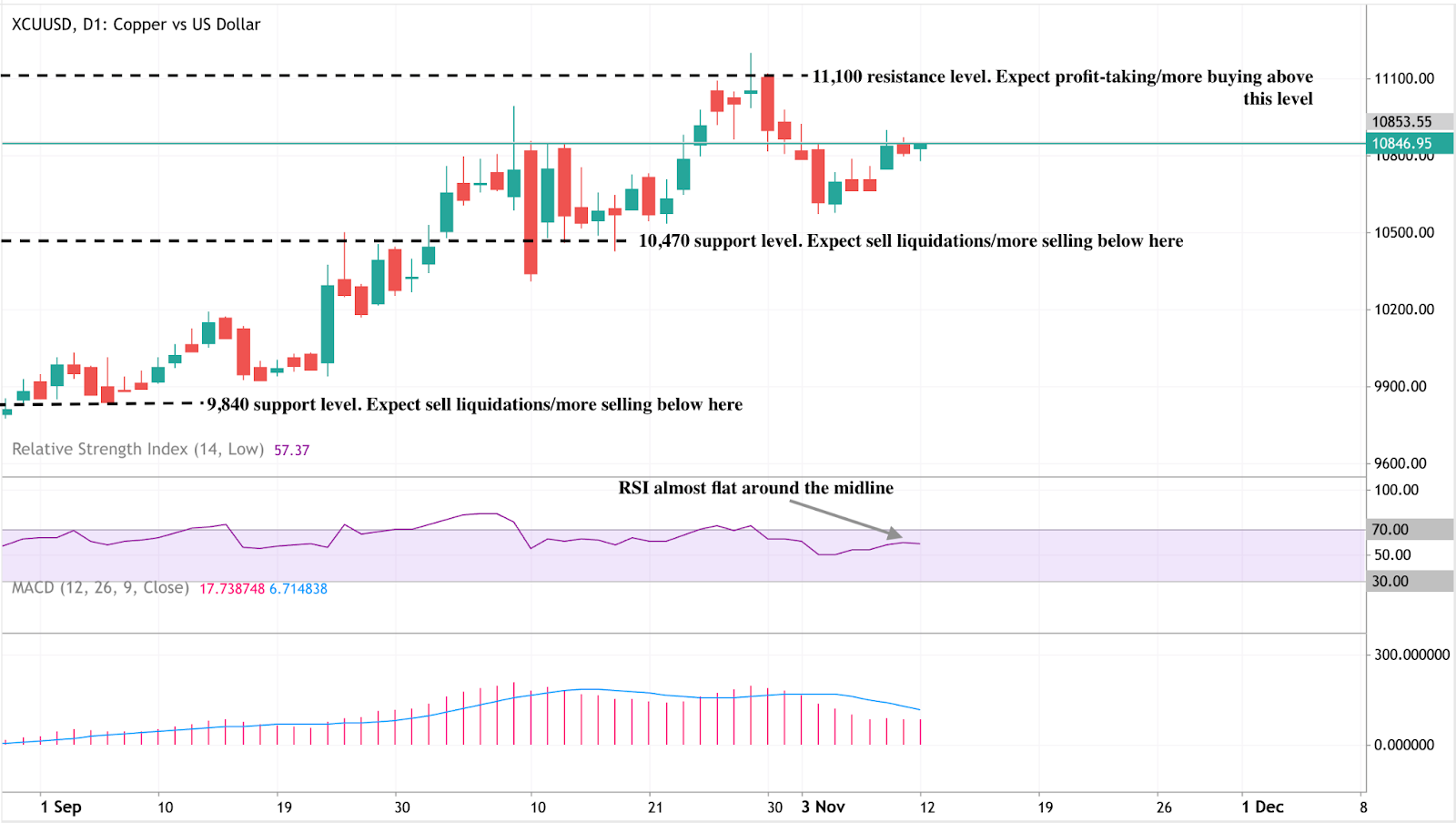
At the time of writing, Copper (XCU/USD) is trading near 10,850, consolidating between a key support zone at 10,470 and a resistance level at 11,100. A breakout above 11,100 could trigger renewed bullish momentum, while a drop below 10,470 might invite fresh selling pressure. The next lower support sits around 9,840, where further liquidation could occur if sentiment turns risk-off.

The RSI is hovering around 57, almost flat near the midline, suggesting a neutral bias - neither strongly overbought nor oversold. This indicates a market in wait-and-see mode, with momentum lacking clear direction.

Meanwhile, the MACD line remains slightly above the signal line but shows fading momentum, reflecting a weakening bullish impulse. If the MACD crosses below the signal line, it could confirm short-term bearish sentiment.

Source: Deriv MT5

Traders can use the Deriv trading calculator to estimate margin requirements and profit potential when trading copper and other metals. To deepen your understanding of commodities trading strategies, explore Deriv’s detailed commodity trading guides - ideal for both new and advanced traders.

Copper’s short-term volatility vs long-term conviction

Despite the bullish longer-term trend, short-term headwinds persist. China’s property sector slowdown continues to weigh on sentiment for industrial metals, while tighter financial conditions may delay speculative inflows.

However, analysts widely believe that any price correction will be short-lived, as long-term fundamentals remain supportive. Pullbacks towards the $9,000–$9,500 range are seen as buying opportunities by funds positioning for the next uptrend in 2026.

The performance figures quoted are not a guarantee of future performance.

자주 묻는 질문

인공지능이 어떻게 구리에 대한 수요를 증가시킬까요?

구리 수요 구조에 근본적인 변화가 일어났기 때문입니다. 인공지능 인프라, 전기차 도입, 재생 에너지 시스템으로의 글로벌 전환이 현재 채굴 능력을 훨씬 능가하는 지속적인 수요를 창출하고 있습니다. 투기가 아니라 공급 제약이 가격을 상승시키고 있습니다.

구리가 정말로 ‘다음의 석유’인가요?

여러 면에서, 그렇습니다. 석유는 20세기의 산업 및 교통 혁명을 가능하게 했습니다. 구리는 이제 21세기의 디지털 및 전기화된 혁명을 주도하고 있습니다. 데이터 센터에서 풍력 터빈에 이르기까지, 구리는 현대 성장의 중추입니다.

구리 가격 상승세를 늦출 수 있는 요인은 무엇일까요?

미국의 금리 인상과 같은 단기적 역풍이, 갱신된 관세 긴장이나 중국 산업 활동의 일시적인 둔화와 함께 모멘텀을 잠시 멈출 수 있습니다. 그러나 이러한 요인들은 경기 순환적인 것입니다. 기본적인 수급 불균형은 구조적이며 지속적입니다.

예상되는 공급 부족은 얼마나 심각한가요?

모건 스탠리는 2026년까지 59만 톤의 공급 부족을 예상하며, 이는 2029년까지 110만 톤으로 확대될 것으로 전망합니다. 대규모 광산 개발이 적고 원석 품질이 감소함에 따라, 생산 증가가 수년간 전 세계 수요를 충족시키기 어려울 것으로 보입니다.

현재 거래자와 투자자들이 바라보는 구리 투자 전망은 어떠한가요?

구리의 장기적인 전망은 여전히 긍정적입니다. 단기 거래자들은 되돌림 구간 근처에서 Tactical 매수 기회를 찾을 수 있으며, 장기 투자자들은 전기화 추세에 노출된 저비용 채굴업체와 소재 ETF에 집중할 수 있습니다. 인공지능(AI)과 전기차(EV) 도입이 현재 속도로 계속된다면, 구리는 향후 10년간 최고의 성과를 내는 상품 중 하나로 남을 수 있습니다.

콘텐츠