
Nvidia’s 2026 test: Can AI inference drive the next leg higher?
%20(1)%20(1)%20(1)%20(1).png)
According to analysts, Nvidia’s next leg higher in 2026 will hinge on its ability to turn AI inference into a durable profit engine. While the company remains the backbone of AI training infrastructure, Wall Street increasingly views inference - the stage where trained models generate real-time outputs - as the defining battleground for the next phase of growth.
That view comes as semiconductor stocks opened 2026 with force, with the Philadelphia Semiconductor Index jumping 4% in the first session of the year, significantly outperforming the S&P 500’s 0.19% rise.
The shift matters because inference is where efficiency, pricing power, and competition collide. Analysts warn that Nvidia now faces a more execution-driven market, where elevated valuations leave little margin for disappointment. With CES keynotes, a critical U.S. jobs report, and key product launches approaching, the coming weeks may shape how investors price Nvidia’s 2026 prospects.
What’s driving Nvidia in 2026?
The macro backdrop remains a powerful force. Semiconductor stocks are highly sensitive to interest-rate expectations because a significant portion of their value is tied to future earnings. As a result, even modest changes in Treasury yields can trigger sharp sector moves.
Investors enter 2026 still debating whether the Federal Reserve can ease policy later in the year without reigniting inflation, a balance that directly influences appetite for long-duration growth stocks like Nvidia.
At the company level, Nvidia’s growth narrative is evolving. The AI boom is no longer just about training massive models but about deploying them at scale. Inference workloads are rising rapidly as enterprises integrate AI into everyday operations, from search to customer support. Nvidia’s strategy reflects that shift, focusing on performance-per-watt, total cost of ownership, and ecosystem lock-in rather than raw computing power alone.
Why it matters
For investors, Nvidia’s transition comes with heightened expectations, according to analysts. The stock ended the latest session near $189, following a broader semiconductor rally that left valuations stretched. Market participants describe the prevailing mood as tactical rather than long-term, with Charles Schwab strategist Joe Mazzola noting that “buy the dip, sell the rip” remains the dominant mindset.
Analysts broadly agree that Nvidia’s leadership remains intact, but they are paying closer attention to competitive dynamics. Bank of America analyst Vivek Arya reiterated a buy rating and a $275 price target even while calling Nvidia’s late-2025 deal with Groq “surprising” and raising questions about exclusivity and pricing pressure. The message is clear: confidence remains, but scrutiny is rising.
Impact on the semiconductor market
Nvidia’s strategic decisions ripple far beyond its own balance sheet. Chipmakers operate within tightly linked supply chains, meaning changes in Nvidia’s product mix or pricing can affect foundries, memory suppliers, and rival designers. That interdependence is why appearances by Nvidia Chief Executive Jensen Huang and AMD Chief Executive Lisa Su at CES are viewed as sector-wide signals rather than company-specific events.
The broader market impact also runs through interest rates. Semiconductor stocks are among the most yield-sensitive equities, benefiting when bond yields fall and struggling when they rise. A stronger-than-expected U.S. jobs report could reignite concerns about sticky inflation, pushing yields higher and pressuring chip valuations. In that sense, Nvidia often trades as a proxy for both AI optimism and macro confidence.
Expert outlook
Looking ahead, analysts say Nvidia’s 2026 story is less about expansion and more about execution. The company’s non-exclusive licensing and talent agreement with Groq underscored that shift. Early reports framed the deal as a $20 billion acquisition, but the reality was a strategic partnership that gives Nvidia access to inference-focused expertise without full ownership.
Attention now turns to Nvidia’s Vera Rubin chip launch, expected to be a cornerstone of its inference strategy. Analysts will closely monitor signals for performance gains, energy efficiency, and customer adoption. At the same time, traders are monitoring whether Nvidia can hold the psychologically important $190 level. A sustained break lower would suggest recent gains were driven by positioning rather than new fundamentals, particularly if macro data turns unfavourable.
Key takeaway
According to analysts, Nvidia’s ability to drive its next leg higher in 2026 depends on execution in AI inference rather than headline-grabbing growth alone. The company still dominates AI infrastructure, but competition and macro sensitivity are rising. Elevated valuations leave little room for disappointment. Investors will be watching macro data, product timelines, and pricing power closely as Nvidia’s 2026 story unfolds.
Nvidia technical outlook
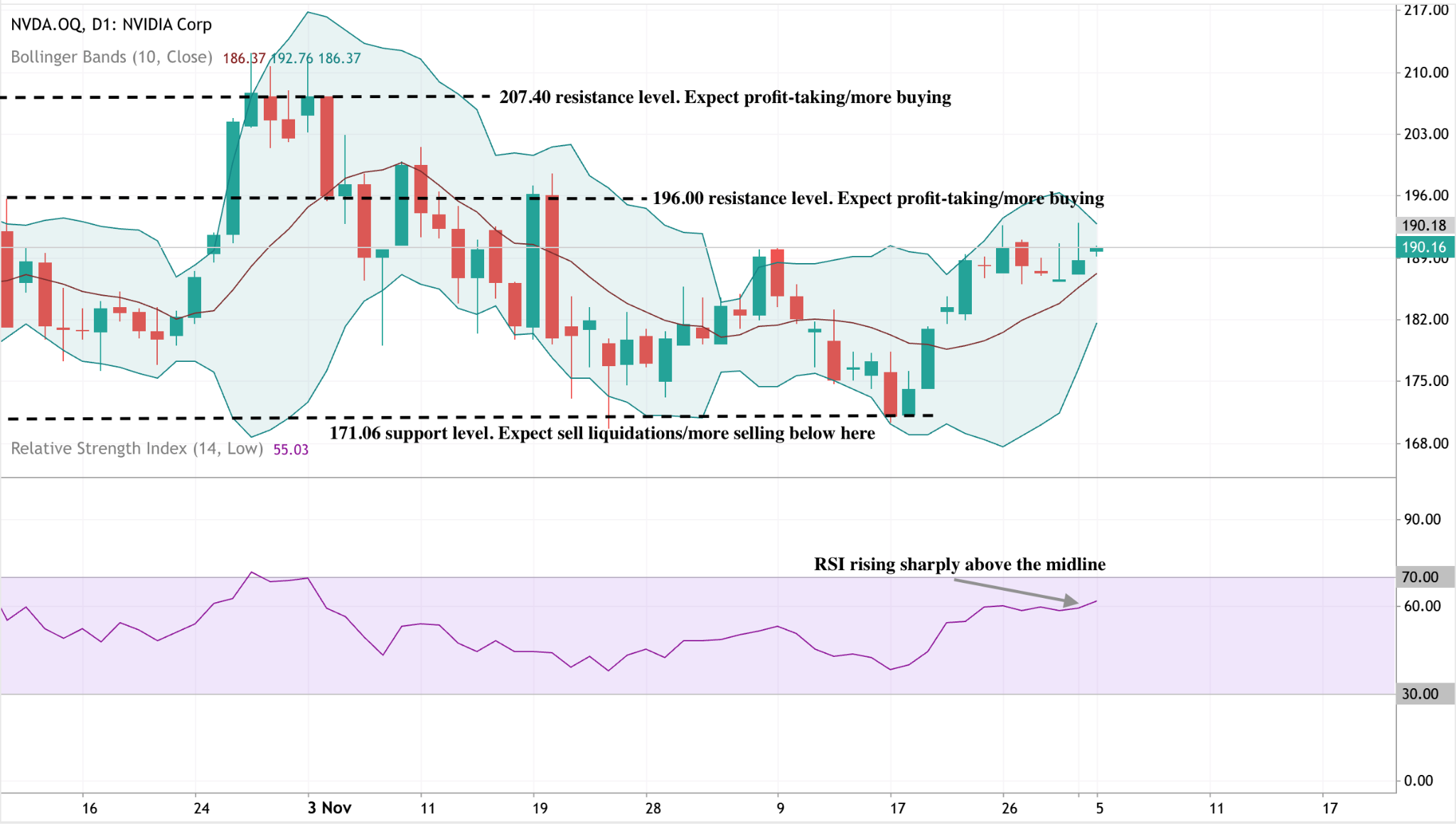
NVIDIA is rebounding from the $171 support zone, with price pushing back above the US$190 area and regaining the middle of its recent range. The recovery is being accompanied by improving momentum signals: the RSI is rising sharply above the midline, indicating strengthening bullish participation rather than a purely technical bounce.
Bollinger Bands are beginning to widen again after a period of compression, suggesting volatility is returning as buyers step back in. That said, upside progress remains capped by resistance at $196 and the key $207 level, where previous rallies have attracted profit-taking.
As long as NVDA holds above $171, the broader structure remains constructive, but a decisive break above $196 would be needed to confirm a more sustained bullish continuation.
The performance figures quoted are not a guarantee of future performance.


