Silver price outlook: Why XAG/USD is holding near $80

February 9, 2026
Modern trading room with a large digital display showing a rising bar chart and upward-trending line graph ending in an arrow.

Silver prices are extending their gains, with XAG/USD trading close to $80.80 per ounce, as markets digest a rare combination of reflationary optimism and lingering geopolitical risk. The move comes as the US dollar slips to its weakest level since early February, easing pressure on dollar-priced metals and drawing renewed inflows into precious assets.

What makes this rally stand out is its timing. Investors are navigating Japan’s renewed push for fiscal expansion, fresh signals from US Federal Reserve officials, and cautious optimism around Middle East diplomacy. Together, these forces are reshaping how traders price silver’s dual role as both an inflation hedge and a macro risk asset.

What’s driving Silver?

Silver’s recent strength has been triggered by shifting global inflation expectations, led by political developments in Japan. The landslide election victory of Prime Minister Sanae Takaichi’s ruling coalition has reinforced expectations of expansionary fiscal policy.

Markets interpret this as a signal for sustained government spending, a weaker yen, and structurally higher inflation pressures. Historically, reflationary policy environments have supported demand for precious metals, particularly silver, which straddles both monetary and industrial use.

At the same time, traders are positioning ahead of key US labour market data. The January non-farm payrolls report is expected to show job growth slowing to around 70,000, with unemployment steady near 4.4%. 

Federal Reserve officials have struck a cautious tone. San Francisco Fed President Mary Daly described the economy as drifting into a “low-hiring, low-firing” phase, while Fed Governor Philip Jefferson reiterated that policy will remain data-dependent. That uncertainty has kept real yields contained, a supportive backdrop for silver.

Why it matters

Silver’s resilience highlights a broader shift in how markets are pricing risk. Unlike gold, silver tends to benefit when inflation hedging and growth expectations overlap. Reflation signals from Japan are reinforcing that dynamic, while expectations for US rate cuts later this year are limiting upside in the dollar. Markets currently price the first Fed rate cut for June, with another possible by September.

Analysts note that silver is increasingly sensitive to policy divergence. “Silver is responding less to isolated data points and more to structural policy trends,” said one metals strategist quoted by Reuters, pointing to fiscal expansion in Asia and slower disinflation in the US as a powerful mix for hard assets. That shift helps explain why silver has held gains even as geopolitical tensions show tentative signs of easing.

Impact on Markets and Traders

Silver’s move is also being amplified by algorithmic and machine-learning-driven funds. Recent price swings in gold and silver have triggered systematic buying, particularly as volatility remains elevated and correlations with real yields tighten. 

With the US dollar trading at its lowest level since 4 February, overseas demand for dollar-denominated metals has strengthened, reinforcing upside momentum.

Daily chart of the U.S. Dollar Index showing a sharp sell-off, with the dollar breaking below its 4 February low and trading near 97.37.
Source: TradingView

Bond market signals add another layer. US Treasury Secretary Scott Bessent indicated that the Federal Reserve is unlikely to rush balance-sheet reduction, even under potential new leadership. That stance suggests liquidity conditions may remain looser than previously expected, indirectly supporting metals. Meanwhile, investors are already pricing at least two 25-basis-point rate cuts in 2026, extending silver’s medium-term appeal as a store of value.

Expert outlook

Looking ahead, silver’s trajectory hinges on confirmation rather than speculation. A weaker-than-expected US jobs report would likely reinforce rate-cut expectations and keep real yields suppressed, a scenario that favours further upside. Conversely, a re-acceleration in wage growth could cap gains by reviving inflation-control concerns at the Fed.

Geopolitics remains a wildcard. While US–Iran talks in Oman have reduced immediate escalation risks, Tehran’s refusal to suspend uranium enrichment keeps uncertainty elevated. US President Donald Trump has warned of “very steep” consequences if talks fail, underscoring why safe-haven demand for silver has not faded. For now, traders appear inclined to buy dips rather than fade rallies.

Key takeaway

Silver’s hold near $80 reflects more than short-term speculation. Reflationary policy signals from Japan, softer US rate expectations, and a weaker dollar have created a supportive macro backdrop. While geopolitical risks have eased slightly, they continue to underpin demand. The next decisive move will depend on US labour data and confirmation of the Fed’s easing path.

Silver price outlook

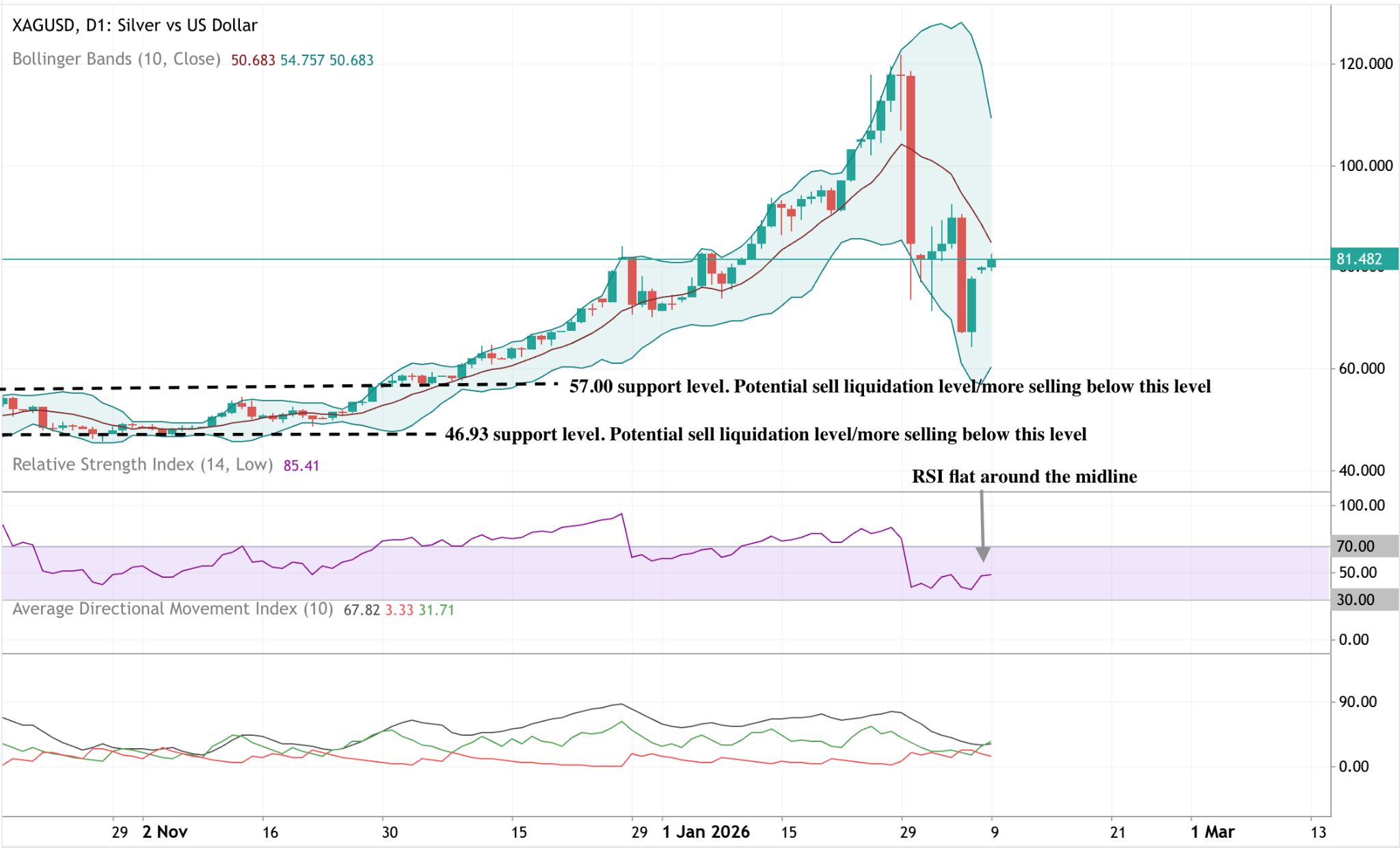
Silver has moved lower after a sharp upside extension, with price retreating from recent highs and settling back toward the middle of its broader price structure. Bollinger Bands remain widely expanded, indicating that volatility is still elevated following the earlier acceleration, even as price has moved back inside the bands. 

Momentum indicators show a clear moderation from extreme conditions: the RSI has stabilised around the midline after previously reaching overbought levels, reflecting a cooling in momentum. Trend strength remains elevated, as evidenced by high ADX readings, suggesting the broader trend environment remains strong despite the recent retracement. Structurally, price continues to trade well above earlier consolidation zones around $57 and $46.93, underscoring the scale of the prior advance

Daily chart of silver versus the US dollar showing a sharp pullback from recent highs, with price stabilising near 81.5 and RSI flattening around the midline.
Source: Deriv MT5

常見問題

Why is silver rising while geopolitical tensions ease?

Silver is benefiting more from reflation expectations and dollar weakness than from pure safe-haven flows. Fiscal expansion in Japan and softer US rate expectations are offsetting reduced geopolitical fear.

How does Japan’s election affect silver prices?

Japan’s pro-spending stance boosts global inflation expectations. That environment typically supports precious metals, including silver, as investors hedge against currency debasement.

What role does the US dollar play in silver’s rally?

A weaker dollar makes silver cheaper for non-US buyers. The dollar’s drop to early-February lows has directly supported metal prices.

Is silver outperforming gold right now?

Silver has shown stronger percentage gains recently due to its sensitivity to growth and reflation themes. Gold remains more defensive by comparison.

What data should silver traders watch next?

US non-farm payrolls, inflation data, and Fed commentary will be key. Any shift in rate-cut expectations could move silver sharply.

內容