Trade step-based movements with Step Indices

Choose indices that offer fixed structure, variable steps, or directional bias and trade a market that follows clear movement rules, 24/7.
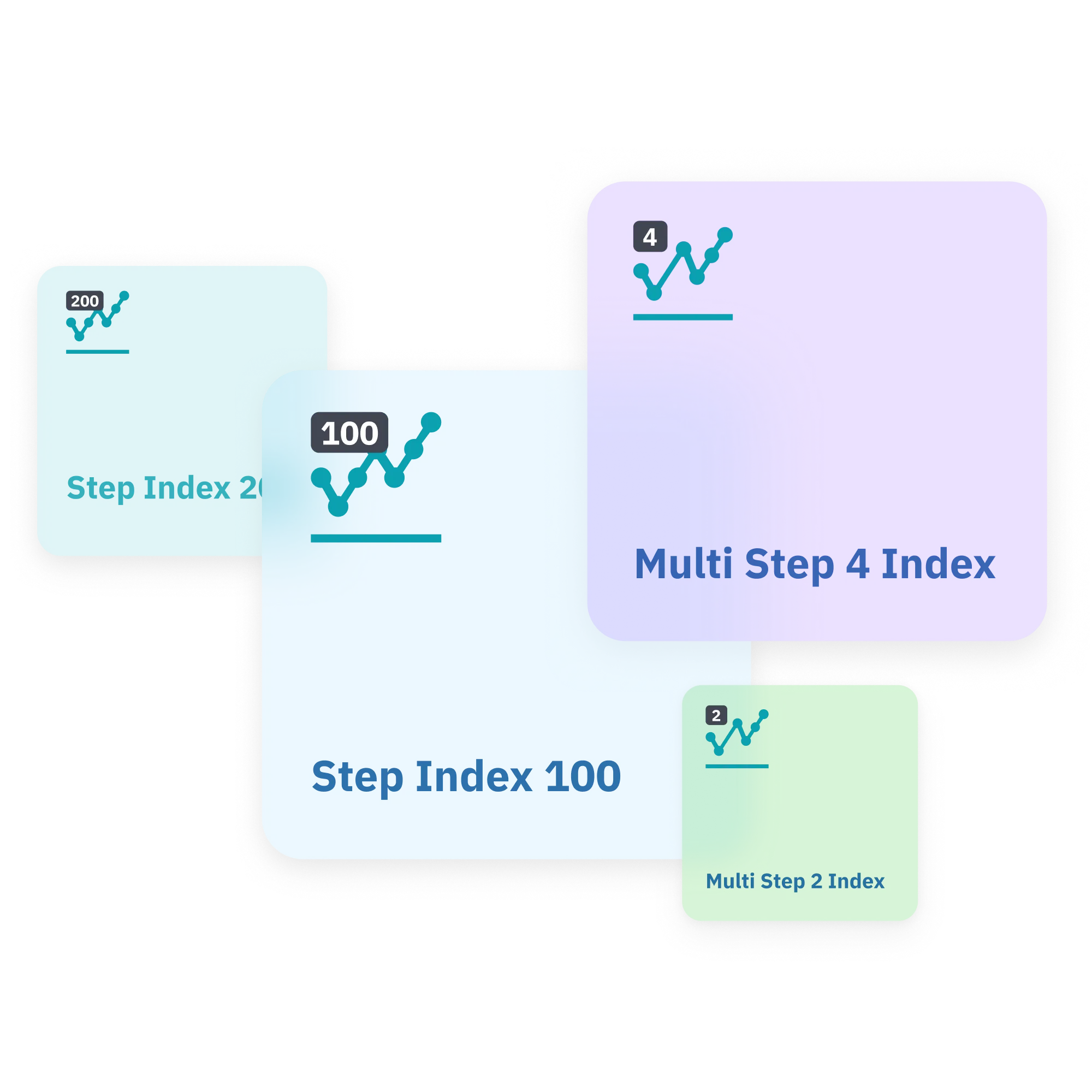
Illustration of trading assets like step index 100, step index 200, multi step 4 index, multi step 2 index

How Step Indices work

Step Indices are Derived Indices that generate price movement using predefined step increments per tick. Instead of irregular price changes, each tick follows a clear step structure, giving traders more control over how price behaves.

The Step Indices family includes:
Step Indices use a fixed step size with balanced up and down movement.
Multi Step Indices use multiple step sizes, where small steps occur frequently and larger steps appear occasionally.
Skew Step Indices introduce directional bias and asymmetry, creating longer runs in one direction with sharper corrective moves.

How Step Indices work

Step Indices are Derived Indices that generate price movement using predefined step increments per tick. Instead of irregular price changes, each tick follows a clear step structure, giving traders more control over how the price behaves. The Step Indices family includes:

Step Indices

Use a fixed step size with balanced up and down movement.

Multi Step Indices

Use multiple step sizes, where small steps occur frequently and larger steps appear occasionally.

Skew Step Indices

Introduce directional bias and asymmetry, creating longer runs in one direction with sharper corrective moves.

Why trade Step Indices

Defined price structure

Each tick follows clear movement rules, supporting precise trade planning and execution.

24/7 trading availability

Trade continuously, including weekends and holidays, with no market closures.

No external market noise

Price action is independent of economic news, earnings, or sentiment shifts.
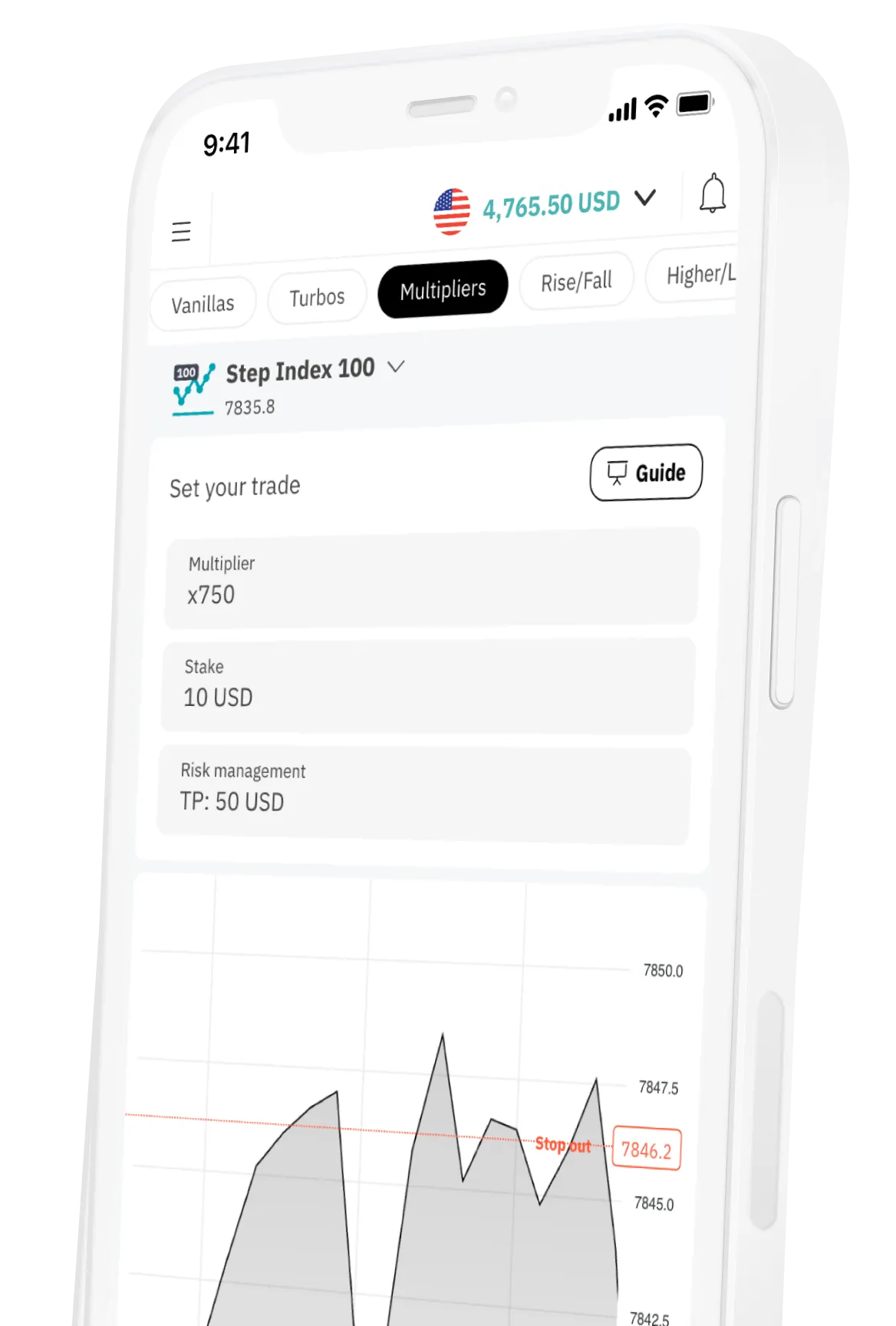
Deriv mobile app showing Step Index 100 multiplier trade setup with x750 multiplier and risk management barriers

Multiple step behaviour options

Select a step structure that matches your strategy rather than forcing strategy adaptation.

Flexible volatility

Choose your risk level, from the low volatility of standard steps to the dynamic swings of Skew and Multi Step Indices.

Step vs Multi Step vs Skew Step

Trader in sunglasses using smartphone to trade Step Indices on Deriv while sitting on park bench

How to trade Step Indices on Deriv

1

Log in to your Deriv account

Create a free Deriv account, or log in if you already have one.

2

Choose your trading platform

Select Deriv MT5 or Deriv cTrader for CFDs, or Deriv Trader, Deriv Bot, or SmartTrader for Options and Multipliers.

3

Select a step index type

Choose between Step, Multi Step, or Skew Step Indices based on your strategy and risk preference.

4

Set your trade and confirm

Define your position size, risk parameters, and order type, then execute your Step Index trade.

Step Indices FAQs

How are Step Indices different from Volatility Indices?

Step Indices use fixed step sizes with balanced probabilities, while Volatility Indices use continuous random movement. Step Indices offer recurring mechanics perfect for systematic trading, whereas Volatility Indices simulate constant volatility levels.

Are Step Indices affected by real-world events?

No, Step Indices are completely synthetic and unaffected by economic news, earnings reports, or geopolitical events. They follow purely mathematical rules, making them perfect for focusing on technical analysis and strategy development.

What's the difference between Multi Step and Skew Step Indices?

Multi Step Indices use variable step sizes but maintain balanced up/down probability (50/50). Skew Step Indices combine variable step sizes with directional bias (80-90% small moves in one direction, 10-20% large counter-moves).

How do Skew Step Indices differ from normal markets?

Skew Step Indices introduce a directional bias. For example, a "Skew Step Up" index has a higher probability of making small upward movements, while larger movements occur occasionally in the opposite direction.

Why would I trade Multi Step Indices?

Multi Step Indices mimic the "texture" of real markets by mixing small steps with occasional larger leaps. This provides diverse price movement opportunities within a single index while maintaining structured volatility.

Can I practise trading Step Indices risk-free?

Yes, all Step Indices are available on Deriv's demo account with virtual funds. Practise your strategies, test automated systems, and learn the mechanics before trading with real money.

Who should trade Step Indices?

Step Indices are suitable for different types of traders depending on the price behaviour selected.

  • Step Indices are best suited for beginners and systematic traders who prefer consistent, fixed step movement and structured price behaviour. 
  • Multi Step Indices are more appropriate for intermediate traders who want step-based structure with occasional larger moves and are comfortable adapting risk to changing step sizes. 
  • Skew Step Indices are designed for experienced traders who understand directional bias and asymmetrical price behaviour, and who can manage higher risk from extended runs and sharp corrective moves.