Trade spikes with Crash/Boom Indices

Access synthetic markets that offer volatility bursts, recurring cycles, and 24/7 access to instruments that never pause or depend on news.
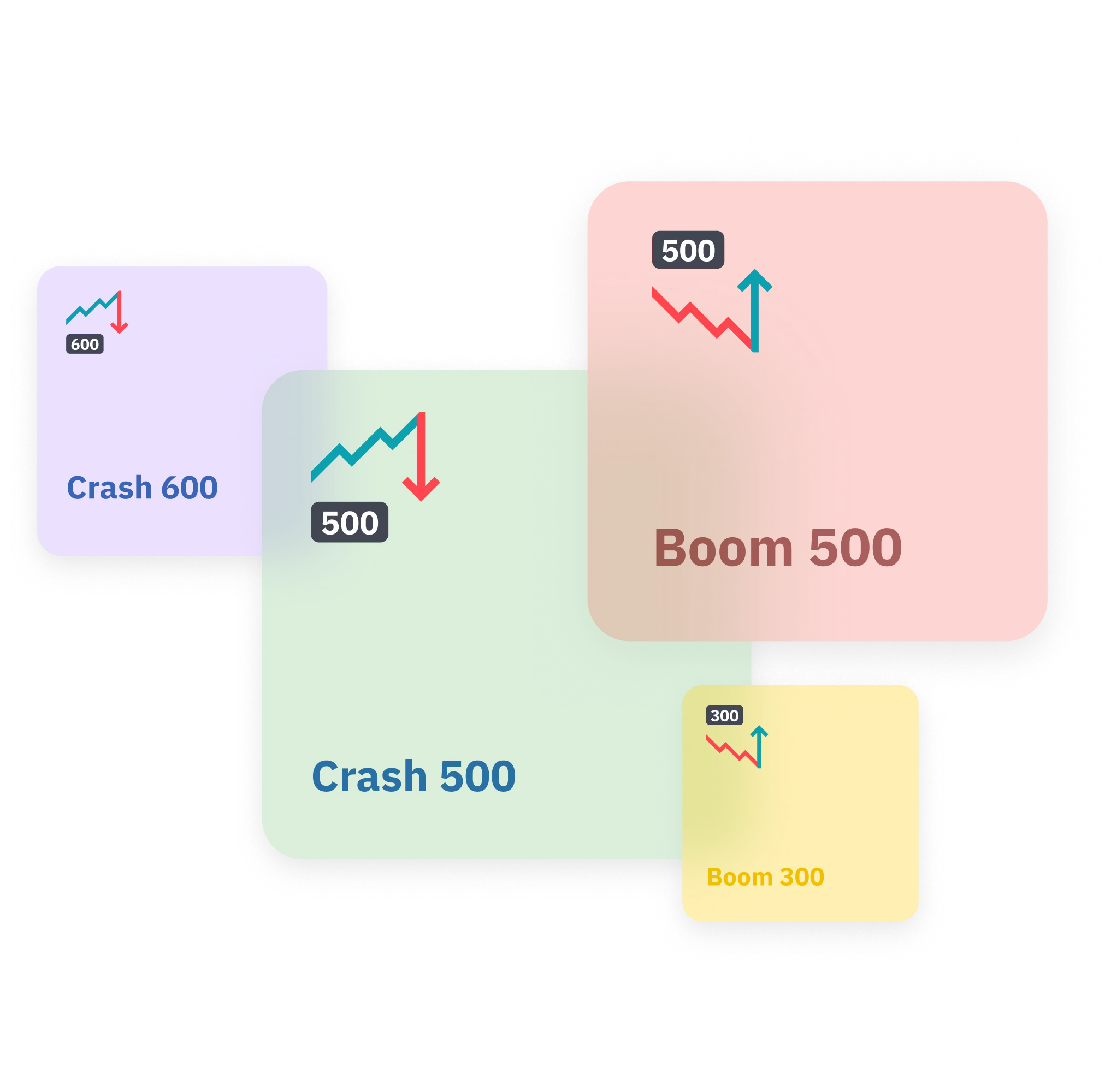
Illustration of trading assets like Crash 500, Boom 500, Crash 600, Boom 300

How Crash/Boom Indices work

Crash/Boom indices are proprietary synthetic markets designed to produce sudden directional spikes at statistically defined intervals. They operate on a tick-based probability model, and each index has a defined average number of ticks between spikes—for example, 150, 300, 600, or 1000 ticks.

Crash Indices produce fast downward spikes, with upward drifts between them.
Boom Indices produce fast upward spikes, with downward drifts between them.

How Crash/Boom Indices work

Crash/Boom indices are proprietary synthetic markets designed to produce sudden directional spikes at statistically defined intervals. They operate on a tick-based probability model, and each index has a defined average number of ticks between spikes—for example, 150, 300, 600, or 1000 ticks.

Crash Indices

Produce fast downward spikes, with upward drifts between them.

Boom Indices

Produce fast upward spikes, with downward drifts between them.

Why trade Crash/Boom Indices

24/7 trading access

Markets run nonstop with no closures, gaps, or news-driven shocks.

Choose your volatility level

Trade C/B 150–1000 to match your preferred balance of spike frequency, risk, and trade duration.

Customisable trading risk exposure

Choose your exact volatility frequency from the fastest cycles to higher volatility to match your risk tolerance.
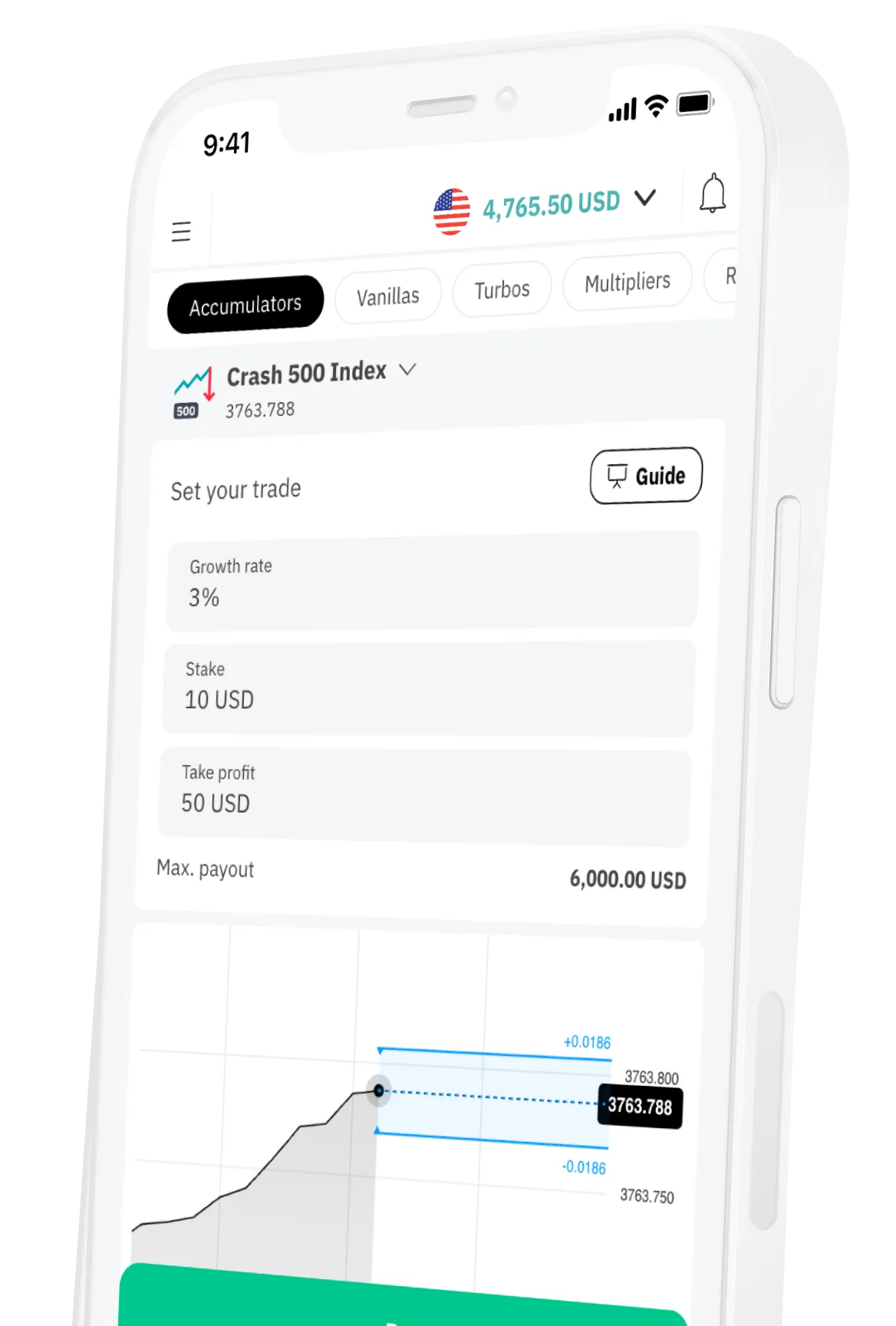
Deriv mobile app showing Crash 500 Index accumulator trade setup with growth rate, stake, and profit parameters

Clear spike and retracement patterns

Directional spikes followed by gradual drift support both breakout and mean-reversion setups.

Zero external market interference

Potentially profit from pure price movements unaffected by economic news or real-world market events.

A trader using his mobile to trade crash boom indices on Deriv

How to trade Crash/Boom Indices on Deriv

1

Log in to your Deriv account

Create a free Deriv account, or log in if you already have one.

2

Choose how you want to trade Crash/Boom indices

Select Deriv MT5 or Deriv cTrader for CFDs, or Deriv Trader or Deriv Bot for Multipliers and Accumulators Options.

3

Select your Crash or Boom index

Choose between Crash (downward spikes) or Boom (upward spikes), then select a spike frequency such as 150, 300, or 1000 ticks based on how often you want price spikes to occur.

4

Set your trade and confirm

Set your position size, leverage, and risk limits, then place your trade and manage it around spike and retracement movements.

Crash/Boom Indices FAQs

What is the difference between Crash and Boom indices?

The difference lies in spike direction. Crash indices are designed to generate downward spikes with gradual upward drift between spikes. Boom indices generate upward spikes with gradual downward drift between spikes.

What do the numbers (150, 300, 600, 1000) in Crash/Boom Indices mean?

The numbers represent the average number of ticks between spikes. Lower numbers mean more frequent spikes, while higher numbers mean less frequent but typically larger spikes. This allows traders to choose an index that matches their risk tolerance and strategy style.

Can I trade Crash & Boom on weekends?

Yes. Because they are not tied to a physical exchange like the NYSE or London Stock Exchange, Crash & Boom Indices are available to trade 24/7, including weekends and public holidays with no market closures or session gaps.

Which Crash/Boom index is best for beginners?

Lower-frequency indices like Crash/Boom 150 or 300 are generally more suitable for beginners because they offer more frequent opportunities with comparatively smaller spike movements. Beginners should still use small position sizes and proper risk management.

What's the best trading strategy for Crash/Boom Indices?

Popular strategies include spike anticipation (entering before expected spikes), retracement trading (capturing the gradual movements between spikes), and breakout trading (entering on spike confirmations). The key is matching your strategy to the specific index frequency you're trading.

Which platforms can I use to trade Crash/Boom Indices?

You can trade Crash & Boom Indices on several Deriv platforms:

  • Deriv MT5: CFD trading with advanced charting and automated trading (EAs).
  • Deriv cTrader: CFD trading with fast execution and copy trading.
  • Deriv Trader: Options trading on a simple, web-based trading interface.
  • Deriv Bot: Options trading with For building automated trading bots without coding.

Who should trade Crash/Boom Indices?

Crash/Boom Indices are suited to traders who actively trade sudden price spikes and understand the risks of fast market moves. They commonly appeal to day traders, scalpers, and experienced traders who prefer short-term opportunities and can manage positions around sharp directional spikes. These indices may also be suitable for algorithmic traders who build strategies around spike frequency and retracement behaviour.